 by Tom Gurney
Tom Gurney BSc (Hons) is an art history expert with over 20 years experience
Published on June 19, 2020 / Updated on July 26, 2026
Email: tomgurney1@gmail.com / Phone: +44 7429 011000
The Concert by Johannes Vermeer: Introduction
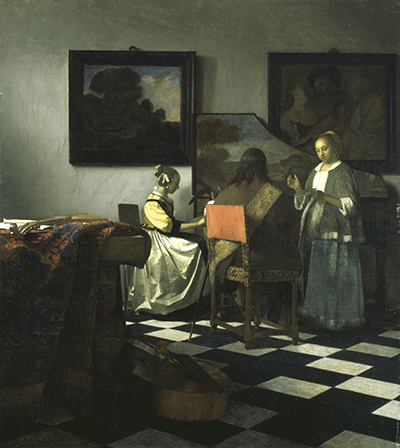
Johannes Vermeer’s The Concert is one of the most famous stolen paintings in the world. It is also one of the most important missing works in the Vermeer story. The painting is not currently viewable in a museum gallery. It was stolen from the Isabella Stewart Gardner Museum in Boston in 1990 and remains missing.
That status must shape every public discussion of the work. The Concert should not be presented as if it were simply another accessible Vermeer interior. It is a music painting, a Gardner Museum painting and a stolen object whose absence has become part of its modern meaning.
At a Glance
- ArtistJohannes Vermeer
- TitleThe Concert
- CollectionIsabella Stewart Gardner Museum, Boston
- StatusStolen in 1990 and still missing
- Key themesMusic, absence, theft, Gardner Museum, Vermeer’s music interiors
- Public cautionThe painting is stolen and should be discussed with current, factual stolen-work framing
Contents
- Introduction
- At a Glance
- What the Painting Shows
- The Gardner Theft
- Music and Social Space
- Absence as Modern Meaning
- Relation to The Music Lesson
- Relation to the Virginal Paintings
- Why the Painting Needs Careful Framing
- Place in Vermeer’s Work
- Frequently Asked Questions
- Discussion
What the Painting Shows
The Concert is known as a music-making scene. It belongs with Vermeer’s other music interiors, including The Music Lesson, A Young Woman Standing at a Virginal and A Young Woman Seated at a Virginal. The subject places people, instruments and domestic space into a world of performance, harmony and social relation.
The painting’s exact physical presence is now mediated by photographs, records and memory rather than direct viewing. That makes the page different from most Vermeer artwork pages. The reader is not only learning about a seventeenth-century composition; they are learning about an absent object.
This absence should be handled soberly. The painting matters as art, not as crime trivia. Its theft is central, but it should not overwhelm the painting’s place in Vermeer’s work.
The Gardner Theft
The Isabella Stewart Gardner Museum identifies The Concert as one of the works stolen in the theft of 18 March 1990. The museum continues to present the theft as active and unresolved, with an ongoing reward framework. [1]
That current status is the safest anchor for the page. The painting should be described as stolen and missing, not merely “formerly in Boston” or “lost.” Its absence is not historical closure. It remains an active museum and law-enforcement matter.
Speculation about suspects, locations or recovery rumours belongs outside a careful account unless it comes from authoritative museum or law-enforcement material. The value of the subject is not in retelling theories. It is in explaining why the missing painting matters within Vermeer’s oeuvre.
Music and Social Space
Vermeer’s music paintings often explore relations between people through instruments, listening and implied sound. Music is visible, but silent. The viewer is invited to imagine what cannot be heard.
In this context, The Concert is especially important because it belongs to Vermeer’s group music scenes rather than his solitary figures. It should be discussed alongside The Music Lesson and the virginal paintings, where music suggests education, courtship, harmony, performance and social exchange.
The title itself points to collective music-making. That distinguishes the work from images of a single woman at an instrument. It implies coordinated sound and shared attention.
Absence as Modern Meaning
The modern story of The Concert is inseparable from absence. The painting is no longer available to the public in the way Vermeer’s other works are. Its place in the Gardner Museum is defined by loss.
This creates a different kind of public memory. Many people know The Concert because it is missing. That fame is real, but it is also secondary. The painting’s original importance comes from Vermeer’s treatment of music, interior space and social relation.
The strongest account holds two truths together. The Concert is a stolen masterpiece, and it is also a Vermeer music painting. Neither identity should erase the other.
Relation to The Music Lesson
The Music Lesson provides one of the most useful comparisons. Both paintings involve music-making within a carefully staged interior. Both connect sound to social behaviour. Both suggest more than they narrate.
The difference is that The Music Lesson remains visible through the Royal Collection, while The Concert is absent. That contrast gives Vermeer’s music paintings a stark preservation story. His works survive through fragile chains of ownership, collection, conservation and protection. When one link breaks, an artwork can become present only through record and reproduction.
This does not make The Concert less important. It makes its importance harder to access.
Relation to the Virginal Paintings
The National Gallery’s two virginal paintings help frame The Concert within Vermeer’s late music world. A Young Woman Standing at a Virginal links music to Cupid, love and possible fidelity. A Young Woman Seated at a Virginal introduces darker courtship imagery through the Baburen Procuress and the foreground viol.
The Concert belongs to that same broad language of music and sociability. The musical subject gives Vermeer a way to explore relations between figures without spelling out a story.
Within Vermeer’s music interiors, The Concert belongs beside those works rather than being treated only as a stolen object.
Why the Painting Needs Careful Framing
This painting needs more caution than most Vermeer works because it is not currently available for direct public viewing. Images and reproductions carry the weight of absence, and the theft story can easily become sensational if it is separated from the work’s artistic meaning.
The public account should stay calm and factual. It should explain the painting’s stolen status, its relation to Vermeer’s music interiors and its importance as an absent work.
It should not be surrounded by speculative recovery claims, unsupported market-value claims or dramatic crime narrative. The strongest public treatment is factual, restrained and centred on the missing artwork.
Place in Vermeer’s Work
The Concert remains part of Vermeer’s artistic story even though it is missing. It belongs with the music interiors, the late domestic rooms and the paintings where sound, sociability and looking intersect.
Its absence also belongs to Vermeer’s modern reception. The painting reminds readers that the survival of old master paintings is not guaranteed. Museums preserve, but they can also lose. Collections make works public, but theft can remove them from public view.
For that reason, The Concert should be included carefully. It is not a page for speculation. It is a page about art, loss and the fragile public life of a painting.
Frequently Asked Questions
The Concert was stolen from the Isabella Stewart Gardner Museum in Boston in 1990 and remains missing. [1]
No. The painting is not currently on display because it remains stolen.
It is one of Vermeer’s music paintings and a major missing work from the Gardner Museum theft.
No. The theft is central to the painting’s modern history, but its place in Vermeer’s music interiors matters just as much.
Because the painting is stolen and known mainly through records and reproductions, any public image should be clearly sourced, accurately captioned and consistent with the Gardner Museum’s current framing.
Discussion
What feels most revealing about The Concert: Vermeer's handling of light, the silence of the scene, the object details, the attribution history, or the way the painting fits within Dutch Golden Age art?
Reader Insights
Vermeer rewards slow attention. Begin with the main action, then move outward to light, edges, objects and the quiet spaces that hold the composition together.
Many of these paintings are small, but their meanings open through Delft, collecting history, technical study and comparison with related Dutch interiors.
Pair this article with the biography and one neighbouring Vermeer work to see how subject, light and attention shift across the artist's compact oeuvre.
Join the Conversation
Have a thought or observation about The Concert? Share it below. Thoughtful responses may be added to this section as the Vermeer pages develop.
References
- Isabella Stewart Gardner Museum, theft information page.
- Isabella Stewart Gardner Museum, rights and reproductions information.
- Vermeer research notes on music interiors and Gardner source limitations.