 by Tom Gurney
Tom Gurney BSc (Hons) is an art history expert with over 20 years experience
Published on June 19, 2020 / Updated on July 26, 2026
Email: tomgurney1@gmail.com / Phone: +44 7429 011000
The Geographer by Johannes Vermeer: Introduction
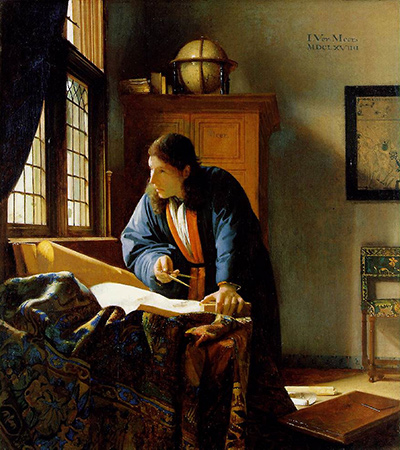
Johannes Vermeer’s The Geographer is one of his clearest images of thought in motion. A man leans over a table, compass in hand, surrounded by maps, books, papers and a terrestrial globe. Light enters from the left. The figure’s body is not relaxed; he seems to have paused in the middle of measuring, comparing or imagining a space beyond the room.
The Städel Museum in Frankfurt records The Geographer as a 1669 painting by Johannes Vermeer, oil on canvas, with a painted surface of 51.6 by 45.4 cm, inventory number 1149. [1] The museum also identifies the Louvre’s Astronomer as its counterpart. [1] Together, the two works form Vermeer’s most sustained engagement with knowledge, measurement and the intellectual culture of the Dutch Republic.
At a Glance
- ArtistJohannes Vermeer
- TitleThe Geographer
- Date1669
- MediumOil on canvas
- Dimensions51.6 x 45.4 cm
- CollectionStädel Museum, Frankfurt
- Inventory number1149
- Key themesGeography, maps, measurement, knowledge, light, Dutch global trade
Contents
- Introduction
- At a Glance
- What the Painting Shows
- The Astronomer and The Geographer
- Maps, Globes and the Dutch Republic
- Measuring the World Indoors
- The Body of Thought
- Counterpart to The Astronomer
- Light, Window and Discovery
- Signature, Date and Museum Status
- Carpet, Table and Working Disorder
- Light and Thought
What the Painting Shows
The geographer stands in a room filled with instruments and documents. His right hand holds dividers or a compass. His left hand rests on the table. A globe sits on top of a cabinet, while maps and papers suggest a working environment rather than a staged still life. The man’s robe gives him an intellectual or scholarly presence, but Vermeer avoids formal portraiture. The painting is less about who he is than what it feels like to think.
His pose is crucial. He has risen or leaned forward, turning slightly toward the window. His mouth is parted, and his gaze is directed outward. He may be measuring, calculating or pausing at the moment an idea forms. Vermeer gives intellectual labour a physical shape.
The room’s objects are not random signs of learning. Geography in the seventeenth-century Dutch Republic was tied to navigation, trade, collecting, empire, mapmaking and the expansion of knowledge. Maps and globes were practical tools, luxury objects and symbols of a world newly measured and contested. Vermeer compresses that world into a Delft interior.
The Astronomer and The Geographer
The Geographer is closely related to The Astronomer in the Louvre. The Städel identifies the Louvre painting as its counterpart, and the two works share format, scale, date proximity and intellectual subject matter. [1] The Louvre records The Astronomer as 1668, oil on canvas, 0.51 by 0.45 m, with signature and date. [2]
The pair is often read as earth and sky: geography and astronomy, terrestrial and celestial knowledge. That contrast is useful, but it should not be made too simple. Both paintings are about more than subject labels. They show acts of inquiry. One figure turns toward maps and terrestrial measurement; the other studies a celestial globe and astronomical text. In both, knowledge is embodied in posture, light and objects.
The possible identification of the model as Antoni van Leeuwenhoek should be treated cautiously. Van Leeuwenhoek and Vermeer both lived in Delft, and later connections between them are tempting, but the sitter should not be presented as a secure portrait. The safer reading is that Vermeer created an image of learned concentration rather than a documented likeness.
Maps, Globes and the Dutch Republic
The Dutch Republic was a major centre of mapmaking, navigation and global trade. In Vermeer’s interiors, maps are never simple decoration. They organise walls, suggest distance and place private rooms within wider networks of travel, commerce and knowledge. In The Geographer, that map culture becomes the main subject.
The globe, papers and measuring tools point beyond the visible room. The geographer is physically enclosed, but mentally engaged with the world. Vermeer uses the room to make distance imaginable. The light on the wall, table and objects gives the scene a sense of clarity, while the figure’s turning pose keeps it from becoming static.
This is not a heroic image of conquest or discovery. It is quieter and more ambiguous. The painting celebrates intellectual attention, but it also shows knowledge as something mediated through instruments, surfaces and representations. The world is approached through maps.
Measuring the World Indoors
The central paradox of The Geographer is that it is a painting about the wider world set inside a room. The figure does not travel, sail or stand before a landscape. He works indoors, surrounded by objects that translate distance into paper, measurement and thought.
This is typical of Vermeer’s intelligence. In many of his interiors, a room becomes larger than itself because of a map, letter, instrument or picture on the wall. Here that expansion becomes the subject. The geographer’s work depends on the idea that the world can be represented, measured and mentally possessed from a table.
The dividers or compass in his hand are therefore crucial. They make thought physical. Measurement is not only an abstract operation; it is an action performed by hand, eye and instrument. Vermeer catches the figure at a moment when calculation seems to become insight.
The Body of Thought
The geographer’s pose gives intellectual activity a bodily form. He leans forward, one hand near the table and the other holding his instrument. His mouth is slightly open, and his head turns toward the light. The painting is not a portrait of calm possession. It shows thought in transition.
This distinguishes the work from a simple scholarly portrait. A formal portrait might present the sitter with tools of learning as signs of status. Vermeer instead makes the body active. The geographer appears to have moved, paused and begun to turn. His thinking is not detached from the room; it happens through posture, light and objects.
The robe adds dignity, but it does not freeze the figure. It gives the body mass and colour while allowing the forward lean to remain visible. The result is an image of mental work that is unusually physical.
Counterpart to The Astronomer
The Städel identifies The Astronomer in the Louvre as the counterpart to The Geographer. [1] That relationship is important, but it should be handled with care. The two paintings share format, scale, subject and intellectual atmosphere, yet the relationship should not be reduced to a neat formula.
The common contrast is earth and sky: geography for the terrestrial world, astronomy for the heavens. That is a useful entry point, but the paintings are also linked by method. Both show a man in a room using instruments and images to think beyond the room. Both are about represented knowledge.
The Louvre’s caution around the pendant relationship and simple oppositions is valuable for the public reading. [2] Vermeer’s pair does not need to be forced into a rigid scheme. The power of the two paintings lies in their shared attention to inquiry: one with terrestrial maps and a globe, the other with celestial instruments and books.
Light, Window and Discovery
The window light in The Geographer is more than illumination. It gives the scene its direction. The figure turns toward it, and the light opens the left side of the room as if knowledge itself were arriving from outside.
This can be read without making the painting into a simple allegory of enlightenment. Vermeer’s light remains physical: it falls on fabric, paper, wall and face. But because the subject is intellectual work, the light inevitably becomes metaphorically charged. It helps the viewer feel the moment of thought.
The painting’s strongest effect is the pause before completion. The geographer is not shown writing a finished result. He is at the edge of formulation. The viewer sees the labour of knowledge before it settles into certainty.
Signature, Date and Museum Status
The Städel’s record gives the painting a secure public identity: Vermeer, 1669, oil on canvas, painted surface 51.6 by 45.4 cm, inventory number 1149, acquired in 1885. [1] The date is important because the work belongs to Vermeer’s later 1660s, when his interiors became increasingly refined and intellectually charged.
The painting’s museum history also matters because the Städel record gives a clear modern institutional setting, including acquisition in 1885 and display in Frankfurt. [1] The work’s current public identity is therefore strongly tied to the Städel, even while its subject remains a Delft interior.
The important point is that The Geographer gives Vermeer’s small surviving oeuvre a rare male intellectual subject. It helps prevent Vermeer from being understood only through women in domestic interiors.
Carpet, Table and Working Disorder
The table in The Geographer is not a neat scholarly desk. It is covered with textile, papers and instruments. The carpet or heavy cloth falling over the table gives the scene material richness, while the papers suggest work in progress rather than display.
This controlled disorder is important. Vermeer does not present knowledge as sterile. The geographer’s thinking happens among objects: folded surfaces, measuring tools, books, maps and light. The room feels inhabited by a mind at work.
The table also creates a barrier between viewer and figure, as in many Vermeer interiors. We are close enough to witness the moment of thought, but not close enough to enter it. The geographer’s world remains specialised and partly withheld.
Light and Thought
Vermeer’s light in The Geographer does more than illuminate objects. It structures thought. The window light falls across the table, the figure’s face, the robe and the wall. It draws attention to the space in which the man works and to the act of turning toward illumination.
The composition is more dynamic than many of Vermeer’s interiors. The figure leans forward, the carpet falls over the table, papers angle across the surface and the globe rises behind him. The room feels active, but not chaotic. Vermeer gives thought a moment of tension: the instant before a decision, measurement or insight is complete.
The painting’s power lies in this suspended state. The geographer is neither fully at rest nor fully in action. He is caught at the edge of understanding.
Place in Vermeer’s Work
The Geographer stands apart from Vermeer’s letter, music and domestic labour paintings, but it belongs to the same world of controlled interiors. It shares their left-side light, table barriers, wall objects and intense stillness. What changes is the kind of concentration being shown. Here, Vermeer turns from private emotion to intellectual activity.
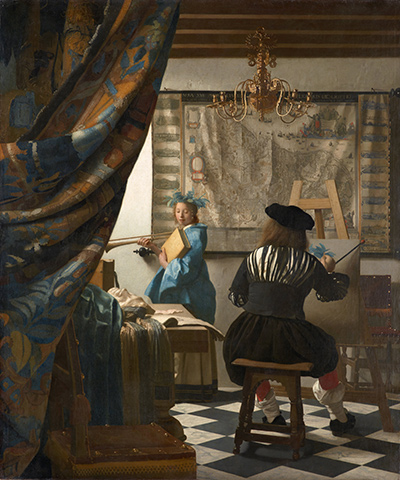
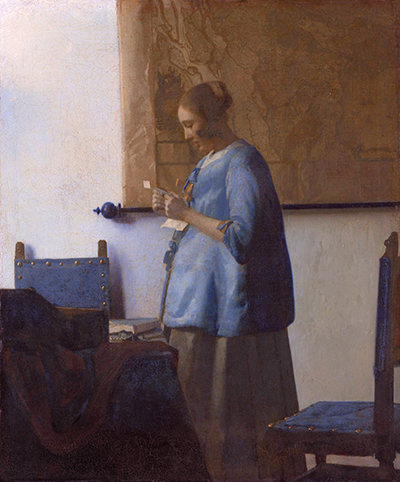
The painting connects naturally with The Astronomer, The Art of Painting and Woman in Blue Reading a Letter. All involve maps, knowledge, representation or the tension between a small room and a larger world. In The Geographer, that larger world is made visible through instruments of measurement.
It also expands the idea of Vermeer’s modern appeal. The painting is quiet, but not passive. It shows curiosity as a form of action. The figure’s movement, the instruments and the maps all suggest that knowledge begins in an interior but reaches outward.
Frequently Asked Questions
The Geographer is in the Städel Museum in Frankfurt. [1]
The Städel dates The Geographer to 1669. [1]
Yes. The Städel identifies the Louvre’s The Astronomer as the counterpart to The Geographer. [1]
That identification is speculative. The painting should not be treated as a secure portrait of Van Leeuwenhoek without stronger evidence.
Discussion
What feels most revealing about The Geographer: Vermeer's handling of light, the silence of the scene, the object details, the attribution history, or the way the painting fits within Dutch Golden Age art?
Reader Insights
Vermeer rewards slow attention. Begin with the main action, then move outward to light, edges, objects and the quiet spaces that hold the composition together.
Many of these paintings are small, but their meanings open through Delft, collecting history, technical study and comparison with related Dutch interiors.
Pair this article with the biography and one neighbouring Vermeer work to see how subject, light and attention shift across the artist's compact oeuvre.
Join the Conversation
Have a thought or observation about The Geographer? Share it below. Thoughtful responses may be added to this section as the Vermeer pages develop.
References
- Städel Museum, The Geographer, inventory 1149.
- Louvre Collections, L’Astronome, RF 1983 28.