


 by Tom Gurney
Tom Gurney BSc (Hons) is an art history expert with over 20 years experience
Published on June 19, 2020 / Updated on November 5, 2026
Email: tomgurney1@gmail.com / Phone: +44 7429 011000
Trellis
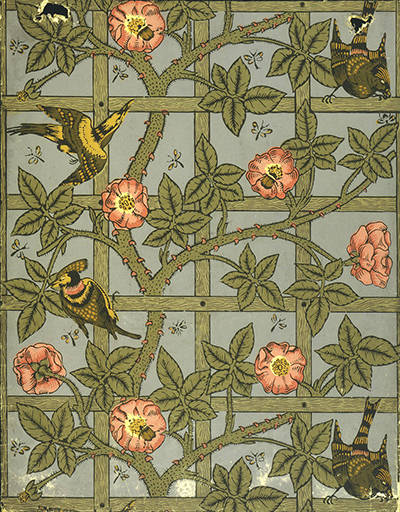
Roses climb through a wooden framework, birds turn and flutter among the stems, and tiny insects occupy the remaining spaces. William Morris’s Trellis brings a garden close enough to examine leaf by leaf. Its square lattice gives the eye something steady to follow, while the living forms continually interrupt it. Designed in November 1862 and first issued in 1864, it was Morris’s first wallpaper design. His friend Philip Webb supplied the birds. [1]
The appeal lies in that meeting of structure and movement. The trellis belongs to a garden shaped by human hands; the rose seems determined to find its own way through. Across a wall, this small encounter can happen again and again, without needing a central scene or a single privileged viewpoint.
Watch: William Morris Designs
A short visual selection of Morris patterns. Trellis appears at 1:37.
TheHistoryOfArt. A selection of wallpaper and textile patterns, including Trellis. Watch on YouTube.
At a Glance
From wallpaper to a ceramic panel
Contents
Plants held by a grid
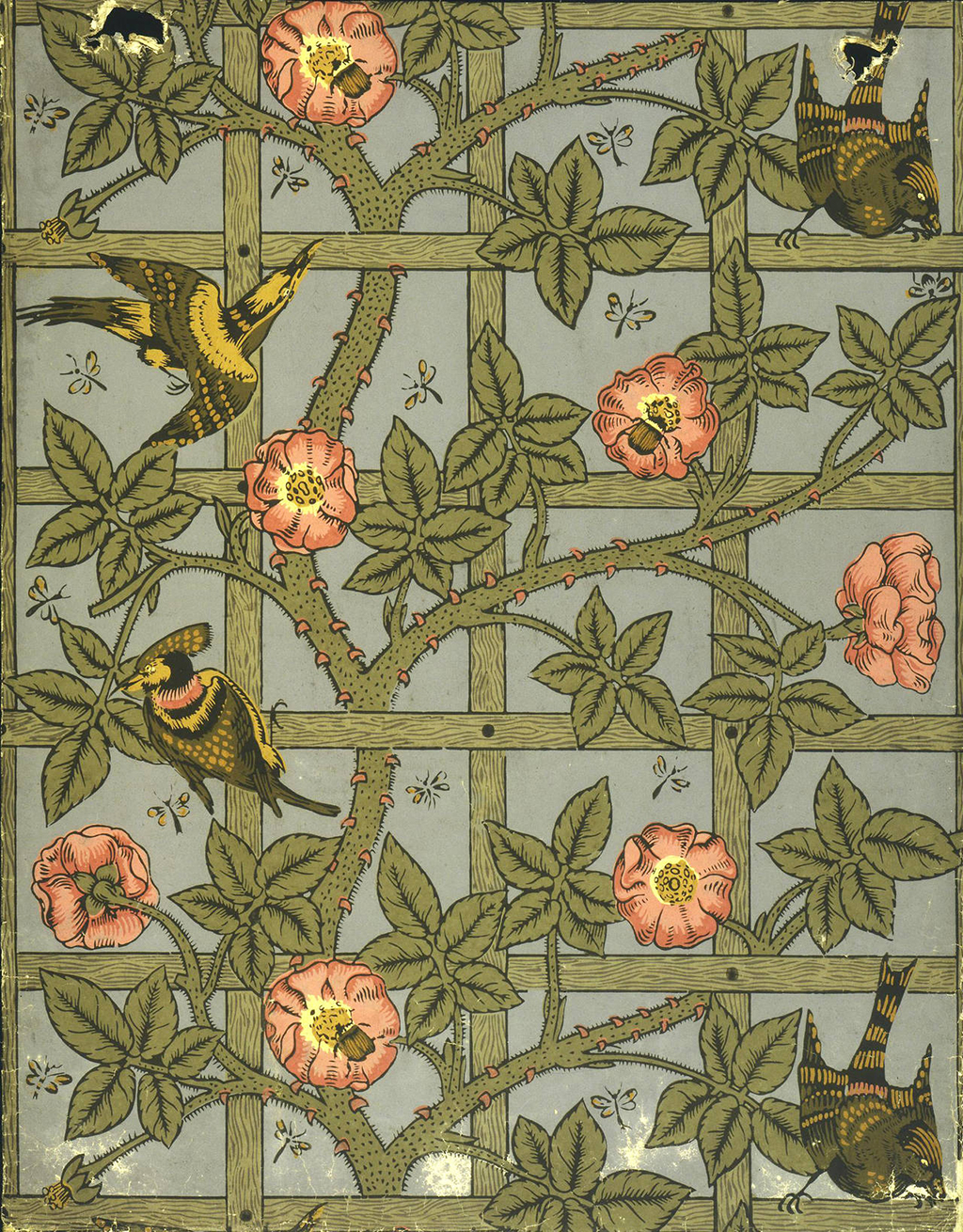
Start with the wooden bars. Their horizontal and vertical lines divide the surface into small compartments, but the wood itself is far from blank. Grain runs along the rails and dark nail heads mark their construction. These touches make the framework recognisable as something built, while keeping it light enough to support the flowers visually. A trellis that became too solid would close the pattern down.
The rose moves differently. Its main stems rise through the framework, then branch into long, bending shoots. Sharp little thorns punctuate their edges. Leaves gather in pointed clusters, with dark veins and serrated margins, while the pink blossoms open into rounded shapes. Look at how differently the blooms face: some show their centres broadly, others tilt sideways or turn away. The pattern contains repetition, but it also contains changes of direction that reward a slower look.
The leaves do much of the connecting work. Their clusters bridge the open squares, cross the wooden bars and fill spaces between flowers. Follow one branch and the eye soon travels away from the neat geometry of the background. Then a horizontal rail catches it again. This gentle alternation gives Trellis its rhythm: the straight lines make the wandering stems easier to see, and the stems prevent the grid from becoming monotonous.
Morris drew the idea from the garden of Red House at Bexleyheath, where roses grew over trellises. The V&A places this garden interest within his wider practice of adapting observed plants into repeat patterns. [2] Here the adaptation is especially easy to follow. The leaves remain legible as leaves, yet their sharp contours and organised groupings make them effective shapes on a flat surface. The design offers the pleasures of a growing rose without requiring the changing light or continuous space of a painted garden.
The birds and Philip Webb
The birds give the rose another kind of company. One spreads its wings, another holds a compact perched pose, and another leans down towards the rail. Their tails, beaks and feet provide brisk directional accents among the broader leaves. A wing can cut across the lattice at an angle; a perched bird can seem to pause on the very structure that organises the whole wallpaper.
Small insects add a further scale of activity. They occupy intervals too slight for another blossom or leaf cluster, making the open ground feel inhabited. Their delicate marks contrast with the thick stems and substantial birds. Even the gaps take part in the design.
Webb’s contribution grew from a friendship already expressed in a much larger project: he was the architect of Red House. The William Morris Gallery describes him as an attentive sketcher of animals and plants, and highlights his collaboration on Trellis. [3] The wallpaper therefore brought together the designer of the house and the man who lived there, drawing on the garden that belonged to their shared architectural setting.
Knowing who supplied the birds changes the experience of looking. Their lively postures have an identifiable contributor, while the plant and framework remain part of Morris’s organising conception. The joins between these contributions are visually convincing. The birds fit the available spaces, pick up the angles of the stems and give the rails an apparent practical use. Collaboration is present in the finished pattern, even when it is easy to overlook beneath Morris’s name.
Why the dates are 1862 and 1864
A design date and a printing date describe different stages in a wallpaper’s life. The V&A’s detailed record for Trellis, E.452-1919, dates the pattern to November 1862, its registration to 1 February 1864, and manufacture to 1864. That object is a printed specimen in a pattern book, made in distemper colours on paper. Jeffrey & Co. printed it for the firm. [1]
The Metropolitan Museum of Art also dates its printed example to 1864 and explains that production delays made Trellis the third wallpaper the company offered for sale. [4] Calling it Morris’s first wallpaper is therefore accurate when discussing the design, but the phrase needs that distinction: first conceived did not mean first brought to market.
The original design is held by the William Morris Gallery. Curator Helen Elletson separates this drawing from the printed samples owned by the William Morris Society. [5] A design sheet records the development of the pattern; a manufactured sample shows the result of translating that pattern into a repeatable product. Neither should be assumed to have the same date, size or surface as every other surviving example.
This distinction also helps when comparing museum photographs. A patterned sheet may look like a self-contained artwork because the camera gives it four clear edges. Its original purpose was to continue beyond those edges. The specimen preserves part of a much larger possible surface.
From an experiment to block printing
The route from drawing to wallpaper involved practical disappointments. Elletson records unsuccessful early attempts to print with oil colours and etched zinc plates. Production then passed to Jeffrey & Co., who used hand block printing and distemper colours. [5] The familiar pattern emerged through a working relationship with specialist printers, as well as through the partnership between Morris and Webb.
Block printing builds a coloured design in successive impressions. In its account of a separate wallpaper reconstruction, Sir John Soane’s Museum explains how each colour’s elements are prepared on a block, then carefully aligned with the impressions already on the paper. Positioning marks help keep the colours together as the pattern grows along the roll. [6] That account describes a different wallpaper, but it makes the underlying demands of the technique clear.
In Trellis, those demands can be understood by looking at a single flower. Its coloured petals, dark contours and small central details must sit together convincingly. Across the surrounding pattern, a leaf needs to meet its stem and a bird’s markings need to belong to its body. The finished surface feels fluent because many separate decisions work together.
Repetition adds a second challenge. The printing must sustain the pattern beyond one impression, so that a branch continues and the framework retains its alignment. What appears to be an effortless garden rhythm depends on a controlled sequence of making. Morris’s design gives that sequence an unusually visible structure: the rails provide a clear measure against which the plants can move.
Colour and the experience of a room
There is no single colour scheme that represents every historic printing of Trellis. The William Morris Gallery records a cream-ground example and identifies blue and green alternatives. [7] The Met’s specimen has pink roses and blue birds against cream, while its commentary dates the introduction of blue or grey grounds to 1868. [4] A change of ground alters how strongly the grid, foliage and flowers stand forward, even when the underlying design remains familiar.
On a wall, the lattice has an architectural effect. Its regular divisions can be read from across the room, while the flowers and birds draw attention at closer range. Furniture, doorways and pictures interrupt the paper, but the repeating framework allows the eye to imagine its continuation. There is no single scene whose loss at a corner would destroy the composition.
The relation between inside and outside is similarly flexible. The pattern can suggest a garden boundary, yet its firm outlines keep the wall visibly patterned. There is enough implied depth for a bird to perch and a stem to cross a rail, without a distant landscape opening behind them. The room gains an animated surface that remains coherent as decoration.
Morris himself lived with a blue-ground version in his bedroom at Kelmscott House. Elletson notes that an original fragment survives there in situ. [5] This gives Trellis a particularly direct domestic history: a design prompted by one garden became part of the interior of a later home.
Surviving papers and continuing life
At Standen House and Garden, the National Trust records Trellis wallpaper that has been repaired and renewed while retaining a considerable amount of original material. It also notes the pattern in the conservatory corridor. [8] Such survival is different from the preservation of an unused sample. Wallpaper in a house belongs to a history of occupation, damage, maintenance and replacement, and the surface may contain several periods of work.
A loose sample-book page at the William Morris Gallery offers another kind of evidence. Its record separates the November 1862 design from printing before 1917, and notes a stock annotation on the reverse. [9] The sample carries the early pattern into the later commercial life of the firm. An old design could continue to circulate through new sheets, new colour choices and the practical business of furnishing rooms.
Compared with Morris’s later wallpapers of densely scrolling foliage, Trellis makes its organising framework unusually explicit. The V&A describes the more closely interwoven foregrounds and backgrounds of his designs of the 1870s. [2] Here the spaces remain generous enough to follow a bird’s silhouette or the path of a thorned branch. That openness lets the reader of the pattern see how its parts cooperate: wood supports plant, plant crosses wood, and birds briefly settle or take flight among both.
Artworks directory
Designs, printed papers and collaborative ceramic objects documented in the linked collections. Designer, decorator and manufacturer are distinguished where known. Design and manufacturing dates are different kinds of evidence; a dash means that no object date is supplied here. Additional entries labelled “Tate” come from the museum’s October 2014 catalogue. They retain its historical titles, dates and attributions; newer collection records are used where available. The list brings together selected records from these sources. [11]
| Name | Date | Medium |
|---|---|---|
| Daisy tile (Morris design) | about 1870 | Ceramic |
| Alceste tile (Burne-Jones design; Lucy Faulkner painting) | about 1862 | Ceramic |
| The Labours of the Month (several designers; Lucy Faulkner painting) | 1862 | Ceramic |
| Membland Hall tile panel (Morris design; De Morgan production) | 1876 | Ceramic |
| Design for Membland Hall tile panel | 1876 | Drawing |
| Membland Hall tile panel (William Morris Gallery) | 1876 | Ceramic |
| Trellis (V&A pattern-book specimen) | manufactured 1864; design 1862 | Wallpaper |
| Trellis (Met specimen) | 1864 | Wallpaper |
| Design for Trellis Wallpaper (William Morris Gallery) | 1862 | Drawing |
| Trellis (William Morris Gallery specimen) | design 1862 | Wallpaper |
| Trellis (Standen specimen) | — | Wallpaper |
| Trellis (loose sample-book page) | printed before 1917; design 1862 | Wallpaper |
| An Angel with a Harp (Tate A00815) | date not known | Drawing |
| An Angel with a Pipe (Tate A00816) | date not known | Drawing |
| A Girl with a Flute (Tate A00817) | date not known | Drawing |
| Design for Tapestry (Tate A00818) | date not known | Drawing |
| Attributed to William Morris: The Archangel Raphael (Tate A00819) | date not known | Drawing |
| Attributed to William Morris: The Archangel Gabriel (Tate A00820) | date not known | Drawing |
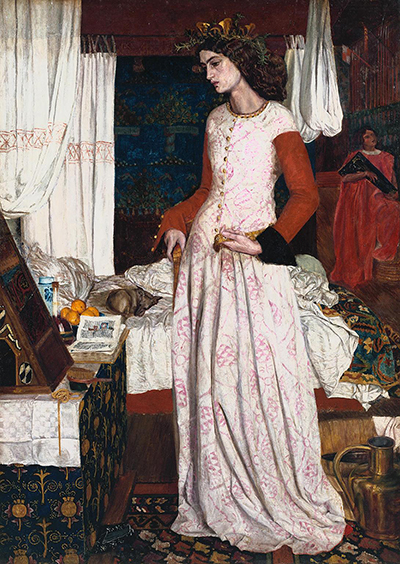
| La Belle Iseult (Tate N04999) | 1858 | Painting |
| The Archangel Gabriel (Tate N05219) | date not known | Drawing |
| Figure of Guinevere (Tate N05221) | c.1858 | Drawing |
| Guinevere and Iseult: Cartoon for Stained Glass (Tate N05222) | 1862 | Drawing |
| Angel of the Resurrection: Cartoon for Stained Glass (Tate N05223) | 1862 | Drawing |
Frequently Asked Questions
He designed the pattern in November 1862. The V&A records registration on 1 February 1864 and manufacture in 1864. [1]
Webb designed the birds. He was also the architect of Red House, whose rose trellises inspired the wallpaper. [3]
No. The design was printed in different periods and colourways. The William Morris Gallery, for example, dates its B133 sample to before 1917 while retaining November 1862 as the design date. [9]
Discussion
Follow the tension between the garden’s regular trellis and the plants, birds and insects moving across it.
Which do you notice first: the square framework, the climbing rose or the birds? Try following one stem across the trellis, then look again from farther away to see how the balance changes.
Reader Insights
Where does the lattice seem most firmly present?
How do the birds interrupt the repeating pattern?
What changes when a small specimen is imagined across a room?
Join the Conversation
Share a detail, comparison or question about Trellis below.
References
- Victoria and Albert Museum. “Trellis.” Wallpaper, museum no. E.452-1919, system no. O78220. Detailed collection record: pattern designed November 1862; registered 1 February 1864; manufactured 1864. Collection entry; complete museum catalogue data. Accessed 28 October 2026. View source 1. View source 2.
- Victoria and Albert Museum. “William Morris and wallpaper design.” Updated 4 August 2026. Museum essay. Accessed 28 October 2026. View source.
- William Morris Gallery, London Borough of Waltham Forest. “Explore the collection,” collection highlight “Design for Trellis Wallpaper, 1862.” Collection commentary. Accessed 28 October 2026. View source.
- The Metropolitan Museum of Art. “Trellis.” William Morris; birds designed by Philip Webb; printer Jeffrey & Co. 1864. Block-printed in distemper colours; sheet 68.6 × 54.6 cm. Purchase, Edward C. Moore Jr. Gift, 1923, accession no. 23.163.4h. Collection entry and curatorial commentary. Accessed 28 October 2026. View source.
- Elletson, Helen. “Trellis.” “From the collection,” The William Morris Society Magazine, Spring 2018, p. 28. Magazine PDF. Accessed 28 October 2026. View source.
- Sir John Soane’s Museum. “Block printing wallpaper.” Account of the recreation of wallpaper for the museum’s private apartments. Printing process. Accessed 28 October 2026. View source.
- William Morris Gallery, London Borough of Waltham Forest. “Trellis wallpaper (designed November 1862).” Catalogue no. B132a. Collection entry. Accessed 28 October 2026. View source.
- National Trust Collections. “Trellis.” William Morris and Philip Speakman Webb; paper; date unknown. Standen House and Garden, West Sussex, inventory no. 1213907. Collection entry. Accessed 28 October 2026. View source.
- William Morris Gallery, London Borough of Waltham Forest. “Trellis loose page from wallpaper sample book (designed November 1862, printed before 1917).” Catalogue no. B133. Collection entry. Accessed 28 October 2026. View source.
- Victoria and Albert Museum, Tile panel, C.36-1972, 1876, Morris design and De Morgan production. Collection account prepared for Museum With No Frontiers, Sharing History. Accessed 28 October 2026. View source.
- Tate, Tate Collection metadata, artwork_data.csv, October 2014 snapshot, released under CC0. Repository readme states that this dataset is no longer maintained. Downloaded and artist rows inspected 28 October 2026. View source.
 William Morris.jpg)