 by
Tom Gurney
Tom Gurney BSc (Hons) is an art history expert with over 20 years experience
Email:
tomgurney1@gmail.com
/ Phone:
+44 7429 011000
Queen Henrietta Maria with Sir Jeffrey Hudson: Introduction
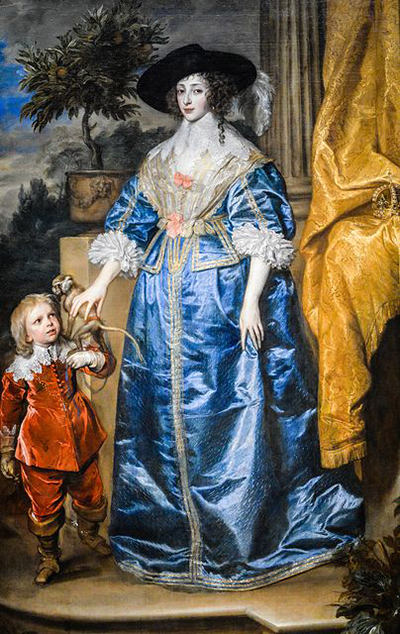
Anthony van Dyck gives this royal portrait two different directions of attention. Henrietta Maria looks towards us, while Sir Jeffrey Hudson looks up towards her. Between them, her extended hand reaches towards the monkey he supports. Follow those glances and gestures before looking at the crown: much of the painting's account of court life happens in this small, carefully arranged encounter.
At a Glance
- Artist Anthony van Dyck
- Date 1633
- Medium Oil on canvas
- Dimensions 219.1 × 134.8 cm
- Collection National Gallery of Art, Washington; Samuel H. Kress Collection
- Accession number 1952.5.39 [1]
This work across Anthony van Dyck’s career
Entry of Christ into Jerusalem
about 1617Frans Snyders
about 1620Rinaldo and Armida
1629–1632; Louvre commentary proposes late1631–spring1632Charles I in Three Positions
1635–before June 1636Lord John Stuart and his Brother
about 1638Cupid and Psyche
1639–40Self Portrait
c. 1640Contents
- Two people at court
- A riding costume made for looking
- Height, stone and cloth of gold
- The orange tree
- How might Van Dyck have made the portrait?
- An earlier portrait in Genoa
- The painting's destination and later history
Two people at court
Henrietta Maria, Charles I's queen, was twenty-four. Sir Jeffrey Hudson, fourteen, was a court attendant with dwarfism; the museum describes him as a trusted adviser. [1]
Van Dyck positions the queen almost in the centre of the canvas, with enough space above her hat for its broad silhouette to register clearly. Her body turns slightly to our left, but her face comes back towards the viewer. This small difference between the directions of body and head keeps the pose from feeling rigid. One shoulder advances; the other recedes beside the column. The hat's wide brim gives her pale face a dark surrounding shape, and the white feathers continue the light of the collar upwards.
Her hands make two different movements. The hand beside her skirt hangs down with the fingers lightly separated, following the long vertical fall of the dress. The other reaches sideways and downwards. Its position is easy to misread at first glance: she touches the monkey, Pug, beside Hudson's head. [1] The hand does not rest on Hudson himself. Her long fingers form an open, gentle shape, without the emphatic pointing gesture that might turn the encounter into an instruction.
Hudson occupies the lower left of the canvas, standing on the same broad stone surface as the queen. His body faces more directly outwards, while his head turns and tilts towards her. We can see his face clearly, although he does not meet our gaze. His parted lips and lifted head give his pose an immediacy different from the queen's more sustained outward address. These painted features invite attention; they cannot tell us what he was thinking during a sitting.
His raised left forearm supports the monkey, while his other arm falls beside his body. The animal's lean brings it into the space between his shoulder and the queen's hand. Hudson has a definite action within the composition. His conspicuous orange-red suit, lace collar, gloves and boots give his figure its own pattern of surfaces and its own strong colour.
Their difference in rank governs the arrangement. The queen has the central position, the largest uninterrupted expanse of fabric and the architectural height behind her. Hudson's lifted gaze returns attention to her. Yet looking at him separately changes the experience of the picture: the red suit becomes more than a patch beside blue, and the upward gaze becomes one person's action within an unequal social relationship. The portrait makes that relationship visible without supplying a complete account of Hudson's life at court.
A riding costume made for looking
The museum identifies Henrietta Maria's clothing as a blue satin hunting costume. [1] Its painted appearance rewards a slower look than that description alone suggests. At a distance the dress reads as a single brilliant blue shape. Close to the bodice, however, it breaks into sharp changes of light and dark. Bright strokes travel across the puffed sleeves; darker folds sink towards the waist. On the skirt the changes lengthen, turning the fabric into a succession of broad, uneven bands.
The gold trimming gives these shifting surfaces a firmer framework. It outlines parts of the bodice, divides the front of the skirt and travels around the hem. Because the blue folds change direction within those borders, the dress seems both richly structured and responsive to the body beneath it. The long central line of gold helps draw the eye down from the waist to the stone step. At the bottom, the skirt spreads sideways, and its train gathers beneath the heavy curtain.
White lace mediates between the blue dress and the queen's skin. The collar opens out across her shoulders, making a bright surrounding field for the neck and face. The cuffs repeat that light further down the composition. Small pink bows introduce a softer colour at the chest and waist, while the hat supplies the strongest dark accent above them. The clothes are elaborate, but their colours remain easy to distinguish.
Hudson's costume offers another way of seeing the painter's treatment of fabric. Its red-orange highlights have a warmer, sharper brilliance. His doublet closes closely around his torso, and the shorter lengths of cloth produce compact changes of direction at the waist, elbows and knees. His boots carry the figure down into earthier brown tones. Both sitters wear lace and lustrous fabric, but Van Dyck has given each a distinct silhouette. Their clothes connect them to the same luxurious court while preserving the difference between their roles.
Nothing in the visible setting requires us to imagine that the two people have just stopped during an actual hunt. The dress belongs to the portrait's presentation of the queen; the column, curtain and crown organise a much more formal encounter with the viewer.
Watch: Van Dyck’s art and working methods
Choose a museum introduction, a specialist lecture or a conservation film to continue exploring Van Dyck’s work.
Adam Eaker: Sitting for Van Dyck
Adam Eaker considers portrait sittings, courtly identity and Van Dyck’s English reception.
Watch on YouTubeHeight, stone and cloth of gold
The column rises behind Henrietta Maria's left side, continuing the vertical movement of her body. Its grooves are straight and regular beside the restless flashes of the satin. The crown sits further to the right, nestled within the gold curtain. It takes a moment to find, but once noticed it fixes the public identity of the woman in the fashionable hat.
The curtain has its own substantial presence. It hangs in large folds, advances into the foreground and occupies almost the entire right edge. Its colour joins the gold edging of the queen's costume, so that royal furnishing and personal dress become parts of the same visual arrangement. The crown is not isolated on a table as a separate emblem. It belongs to this concentrated area of gold.
At the left, the picture opens out. A distant landscape, cloudy sky and dark trees extend behind the terrace. The small potted tree stands close enough to the queen to bridge that outdoor view and the architecture. Van Dyck gives us several different distances within a narrow canvas: the curved edge of the step, the bodies, the pot on its ledge and the much softer vegetation beyond.
Look especially at the lower edge. The stone projects towards us, its pale front making a distinct boundary between our space and the sitters' platform. Hudson's boots and the queen's spreading skirt share that platform. Above it, the two figures reach very different heights. The queen's vertical prominence is thus built from several cooperating elements: the position of her head, the long dress, the column and the generous space around her upper body. Scale here is an active part of portrait design.
The orange tree
The National Gallery reads the orange tree through Henrietta Maria's Medici ancestry and through Marian associations of purity, chastity and generosity. These are interpretative connections. [1]
The plant also does visible compositional work. Its irregular crown of leaves answers the queen's broad hat, while the exposed trunk leaves a patch of air between the foliage and the pot. The pot's rounded body interrupts the succession of straight architectural edges. Its earthy colouring provides a quiet transition between the grey-brown stone and the distant landscape.
The fruit is small within the whole painting. A viewer need not identify every possible symbolic association to recognise the tree as a deliberately placed living thing among monumental furnishings. Its contained growth offers a different kind of richness from the piled curtain or the spreading satin: leaves, fruit and patterned pottery gathered into a modest area beside the queen's shoulder.
How might Van Dyck have made the portrait?
The museum proposes a separate head study and brief pose sketch, with the costume probably painted using a model or mannequin. This is a reconstruction. [1]
That possibility helps frame a useful question about the painting: how does an artist bring separately studied elements into a convincing whole? The queen's face is a relatively small area within an exceptionally extensive display of clothing. The body must remain legible beneath the satin, and the hands must connect its broad mass to the surrounding space. Her reaching arm is especially important because it links the main figure with the concentrated action at Hudson's shoulder.
The folds do not all have equal force. Some make clear structural turns; others dissolve into short flashes or broad shadows. That difference allows the dress to feel abundant without making every crease compete for attention. It would be a mistake to turn the proposed working method into a witnessed scene in the studio. The finished painting gives us the coordinated result, not a record of how long either sitter remained before the canvas.
An earlier portrait in Genoa
The National Gallery connects the queen's architectural setting with Van Dyck's Marchesa Elena Grimaldi Cattaneo of 1623. [1] [2] The earlier painting provides a revealing comparison, ten years before the royal portrait. In both, a full-length woman stands beside imposing columns, an outdoor view opens to one side, and another person occupies a lower position beside her.
The paintings develop those ingredients differently. Elena's dark dress forms a broad, almost continuous shape, while red cuffs and the large red parasol punctuate the upper half. The African attendant holding that parasol looks towards her; the shaft makes a long diagonal connection between the figures. In the queen's portrait, blue satin repeatedly catches the light, and Hudson's red suit gathers the warmest colour lower down. The short connection between the queen's hand and the monkey replaces the parasol's expansive diagonal.
Each composition uses another person's attention to help establish the principal sitter's prominence. The circumstances and identities remain distinct: Hudson is named, while the African attendant's name and legal status are unknown. [2] Their separate faces and actions deserve attention within the arrangements that place them beside powerful women.
The comparison also clarifies what Van Dyck could vary within an established portrait form. Black dress becomes blue; the parasol gives way to the great curtain as the dominant surrounding fabric; the queen's crown adds an explicit royal attribute. The earlier painting is worth exploring in its own right in Marchesa Elena Grimaldi Cattaneo .
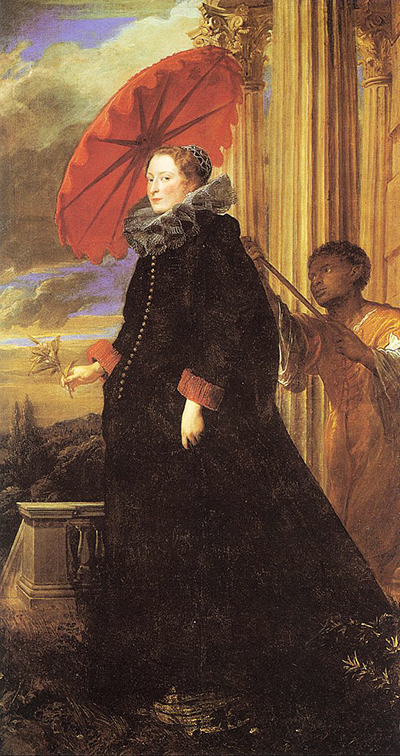
Anthony van Dyck, Marchesa Elena Grimaldi Cattaneo, 1623, oil on canvas. National Gallery of Art, Washington, Widener Collection.
The painting's destination and later history
The museum links this portrait type with political gifts; its recipient is unknown. Provenance begins with Thomas Newport before 1716; the Kress Foundation donated it in 1952. [1]
The gap between the painting's date and that early ownership record matters. The picture's royal subject and imposing form tell us about the public image it creates. They do not identify the first room in which it hung or the person for whom it was intended. Broader accounts of Van Dyck in England and Charles I's patronage place such images within the court's larger use of portraiture.
Artworks directory
A selected directory of paintings, drawings and prints, including works discussed in the articles and the Frick’s 2016 portraiture exhibition. It is not a complete catalogue of Van Dyck’s work. Print titles identify collaborators or later printmakers; disputed and workshop attributions are retained. The exhibition checklist supplies additional object records; current collection information governs the updated article entries. [3]
Frequently Asked Questions
He is fourteen. [1] His stature should not obscure his age or his identity as an individual. Looking at his clothing, raised arm and directed gaze helps distinguish his role within the scene.
Her extended hand touches Pug, the monkey supported by Hudson's raised arm. [1] The meeting of hand and animal falls close to Hudson's head, which can make the gesture confusing in a small reproduction.
Her long skirt, central position and the vertical column all extend the figure upwards. The low platform and the space surrounding her head reinforce that effect. The image presents stature through composition as well as through the figure itself.
The costume supplies a kind of court dress. The visible scene combines it with a crown, architectural setting and ceremonial curtain; it does not establish a specific hunting event.
Discussion
Look again at the images and ideas explored in Queen Henrietta Maria with Sir Jeffrey Hudson. These editorial prompts invite your observations.
Reader Insights
Follow each sitter's gaze and each hand. How do these directions connect the figures while giving them different relationships with the viewer?
Compare the blue satin, Hudson's red suit and the gold curtain. Where does Van Dyck make fabric feel most solid, and where does it seem to flicker into light?
Compare this painting with Marchesa Elena Grimaldi Cattaneo . Which changes most affect your sense of the principal sitter's authority?
Join the Conversation
Share a detail, comparison or question about Queen Henrietta Maria with Sir Jeffrey Hudson below.
References
- National Gallery of Art , Queen Henrietta Maria with Sir Jeffrey Hudson. View source .
- National Gallery of Art , Marchesa Elena Grimaldi Cattaneo. View source .
- The Frick Collection, Van Dyck: The Anatomy of Portraiture, online exhibition checklist (2016). View source.