 by
Tom Gurney
Tom Gurney BSc (Hons) is an art history expert with over 20 years experience
Email:
tomgurney1@gmail.com
/ Phone:
+44 7429 011000
Rest of the Holy Family during the Flight into Egypt: Introduction
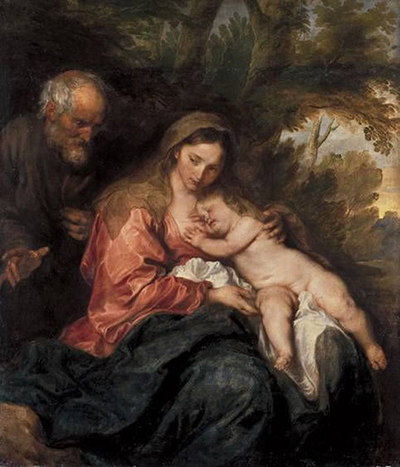
A sleeping child lies across his mother's lap while an older man bends towards them. Anthony van Dyck brings the three figures close to the front of the picture, beneath the shelter of a great tree. Mary's gaze reaches out towards us; the infant remains absorbed in sleep. Their different kinds of stillness give this Holy Family its particular intimacy.
At a Glance
- Artist Anthony van Dyck
- Current collection title The Holy Family in a Landscape
- Traditional title Rest on the Flight into Egypt
- Date About 1630
- Support Canvas
- Dimensions 134.7 × 114.8 cm
- Collection Alte Pinakothek, Munich
- Inventory number 555
- Recorded provenance From the Electoral Gallery, Munich. [1]
This work across Anthony van Dyck’s career
Entry of Christ into Jerusalem
about 1617Frans Snyders
about 1620Rinaldo and Armida
1629–1632; Louvre commentary proposes late1631–spring1632Charles I in Three Positions
1635–before June 1636Lord John Stuart and his Brother
about 1638Cupid and Psyche
1639–40Self Portrait
c. 1640Contents
- Two titles for the same painting
- Mary looks out while Joseph looks down
- The weight of the sleeping Child
- Warm reds and a dark, spreading base
- The landscape opens beyond the shelter
Two titles for the same painting
The Alte Pinakothek's current title is The Holy Family in a Landscape . It also records the older name Rest on the Flight into Egypt , relating it to the peaceful scene. Van Dyck omits the subsidiary episodes found in apocryphal accounts. [1]
The two titles encourage slightly different ways of looking. A Rest on the Flight invites us to imagine a journey temporarily suspended: the sleeping infant, the seated mother and Joseph's bent body become signs of a pause. The Holy Family in a Landscape keeps attention on what is present before us. We can spend time with their gestures without needing to reconstruct what happened immediately before or after this moment.
The tree supplies shelter within the image. Its branches spread above the family, and the heavy trunk gives their resting place a sense of enclosure. Nothing in that visual role requires us to identify it as a particular miraculous tree. Nor does the distant opening establish a precise stopping place on a map. The landscape works most immediately through the contrast between the protected foreground and the space beyond.
Mary looks out while Joseph looks down
Begin with the three heads. Joseph enters from the upper left, his grey hair catching the light against the dark background. Mary's face sits lower and nearer the centre. The Child's head drops further still, nestling against her. This descending sequence draws the eye into the family, from the older man's bowed head to the infant's closed eyes.
Mary interrupts that inward movement. Her head tilts towards her son, but her eyes turn towards the viewer. The position holds together two relationships: the physical closeness of mother and child, and the encounter between the image and the person looking at it. She does not lift the infant for display. We see him at rest, held securely in the position his sleeping body has taken.
Joseph's placement gives him a different part in the group. He bends into the space occupied by Mary and the Child, his dark clothing merging with the shadow at the left. One open palm emerges from his sleeve. Against the compact arrangement of heads and bodies, that hand introduces a small outward movement. It can look like a gesture of attention or presentation; the painting supplies no spoken exchange that would fix its meaning.
His face remains distinct even within the shadow. The light touches the crown of his head and picks out the beard, while Mary's face is more evenly exposed. These differences help us follow the group without giving each figure the same visual weight. Mary occupies the centre, the Child extends across her, and Joseph approaches their shared space from the side.
Watch: Van Dyck’s art and working methods
Choose a museum introduction, a specialist lecture or a conservation film to continue exploring Van Dyck’s work.
Van Dyck, The Anatomy of Portraiture
The Frick curators introduce Van Dyck’s portraits, drawings and prints.
Watch on YouTubeThe weight of the sleeping Child
The infant's body makes a broad diagonal across Mary's lap. His bent arms gather close to his face, while his legs fall apart and downward. One foot hangs near the right edge. These uneven positions make sleep visible: the limbs do not maintain a formal pose, and the body depends on the support beneath it.
Van Dyck makes that support easy to follow. Mary's hand rests beneath the Child's thigh, its fingers emerging between flesh and drapery. Her other hand reaches around his upper body. The gestures are separated across the picture, so that we register both the weight carried in her lap and the care taken around his shoulders. The broad sweep of his body is held within this smaller structure of fingers and folded cloth.
The pale fabric beneath him matters too. It falls in gathered ridges beside his leg, then hangs down over the darker material below. Its brightness lets us distinguish the infant's outline from the deep folds of Mary's clothing. Flesh, white cloth and dark skirt remain close in space but different in texture and tone.
That sense of bodily dependence gives the image a devotional focus. A viewer can recognise the infant as Christ while attending to something immediately familiar: a child's head resting against his mother, his limbs slack in sleep, her hands adjusting to his weight. The sacred subject becomes accessible through the practical act of holding him.
Warm reds and a dark, spreading base
Mary's rose-red sleeve is the largest area of warm colour. Light travels across its ridges, turning the folds from pale pink into deeper red. The bends of the fabric lead towards the hand supporting the Child. Below, the much darker blue-green drapery spreads across the foreground, creating a broad base for the figures. It gives Mary's seated body substance even where her knees and legs are concealed.
The contrast also concentrates the light. The red leads upwards to Mary's neck and face, while the Child's pale body stretches towards the right. Joseph's illuminated head answers those lighter areas from the opposite side. Across the dark setting, these passages form a loose chain of human presence.
The owning museum connects the painting with Van Dyck's study of Titian's Madonnas in Italy, pointing to the varied reds, freely sketched background and gentle type of Mary's face. [1]
The landscape opens beyond the shelter
At the right, a patch of lighter sky appears through the trees. It is a comparatively small opening, but it changes the sense of space. After looking at the closely joined figures, the eye can move past them towards softer, more distant forms. The landscape allows the group to feel sheltered without closing the picture completely.
The tree's scale strengthens that effect. Its trunk rises behind the family and branches across the upper part of the canvas. The small leaves and broken edges of foliage surround the more continuous contours of faces, arms and clothing. Human bodies remain the clearest forms within this uneven natural setting.
The painting rewards movement between these scales: the large tree, Mary's spreading drapery, the infant's body, then the individual fingers holding him. Its quietness is built from those relationships. For a wider view of how Van Dyck used bodies and gestures in sacred subjects, see his religious and mythological paintings .
Artworks directory
A selected directory of paintings, drawings and prints, including works discussed in the articles and the Frick’s 2016 portraiture exhibition. It is not a complete catalogue of Van Dyck’s work. Print titles identify collaborators or later printmakers; disputed and workshop attributions are retained. The exhibition checklist supplies additional object records; current collection information governs the updated article entries. [2]
Frequently Asked Questions
It belongs to the Alte Pinakothek in Munich, inventory number 555. [1]
The current title names the family and setting; the traditional title suggests a pause during their journey. Both identify this Munich painting. [1]
He is Joseph. His bowed head, dark clothing and open hand bring him into the group from the side, while Mary and the sleeping Jesus occupy the foreground.
The tree frames and shelters the figures. Its size helps create a protected foreground, but attention returns to the linked heads and Mary's supporting hands. No particular miracle needs to be assigned to it to understand its role in the composition.
Discussion
Look again at the images and ideas explored in Rest of the Holy Family during the Flight into Egypt. These editorial prompts invite your observations.
Reader Insights
How does Mary's outward gaze change your relationship with the family?
Follow the hands through the picture. Which gesture first makes you notice the Child's weight?
What changes when you look at the scene under the title The Holy Family in a Landscape instead of Rest on the Flight into Egypt ?
Join the Conversation
Share a detail, comparison or question about Rest of the Holy Family during the Flight into Egypt below.
References
- Bayerische Staatsgemäldesammlungen , Die Heilige Familie in einer Landschaft , inventory 555. German. View source .
- The Frick Collection, Van Dyck: The Anatomy of Portraiture, online exhibition checklist (2016). View source.