


 by
Tom Gurney
Tom Gurney BSc (Hons) is an art history expert with over 20 years experience
Email:
tomgurney1@gmail.com
/ Phone:
+44 7429 011000
Benjamin West Paintings: History, Portraits and Religious Art: Introduction
Benjamin West’s paintings range from portraits made in colonial Pennsylvania to classical histories, recent political events and enormous religious scenes painted in Britain. His subjects also include episodes from literature. The variety matters: the painter of The Death of General Wolfe was equally capable of arranging a quiet family group or building an apocalyptic scene around charging horses and falling bodies. [1]
This guide introduces several ways into his work. Subject is one starting point; scale, patronage and the relationship between versions offer others. A painting’s title may recur on a study, another painted version and a print made by a different artist. Looking closely at the particular object makes those relationships easier to follow.
Explore individual artworks
At a Glance
- Classical history Agrippina; Pylades and Orestes
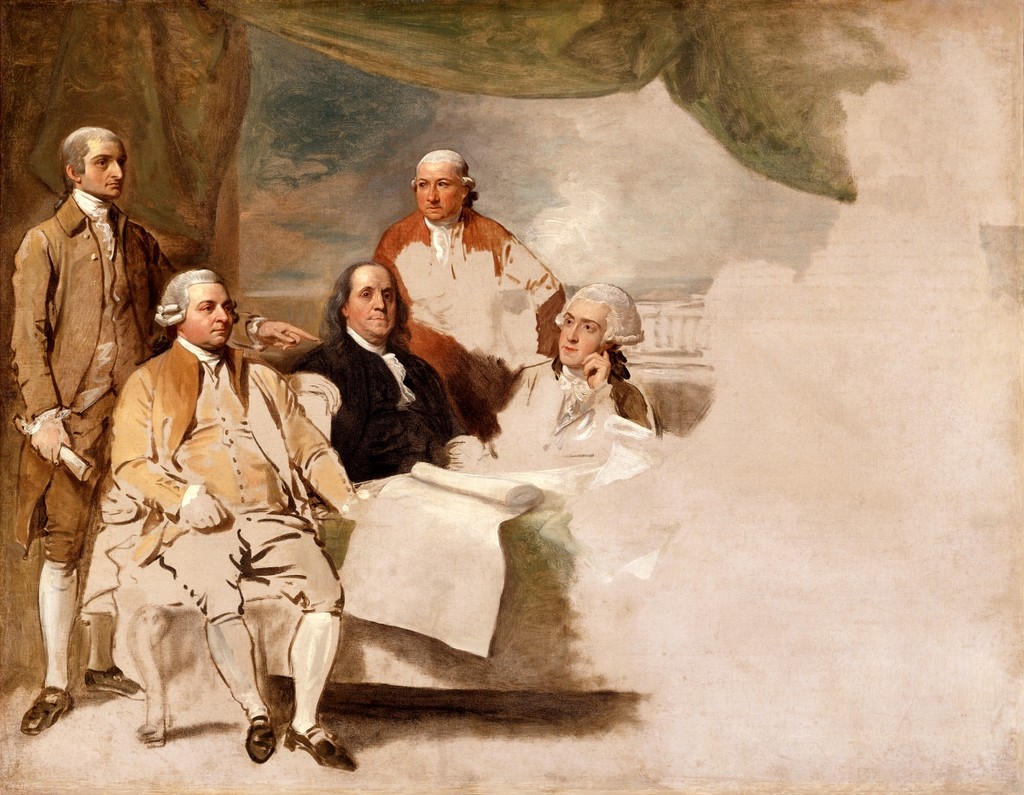
- Recent history and political memory The Death of General Wolfe; Penn’s Treaty; American Commissioners
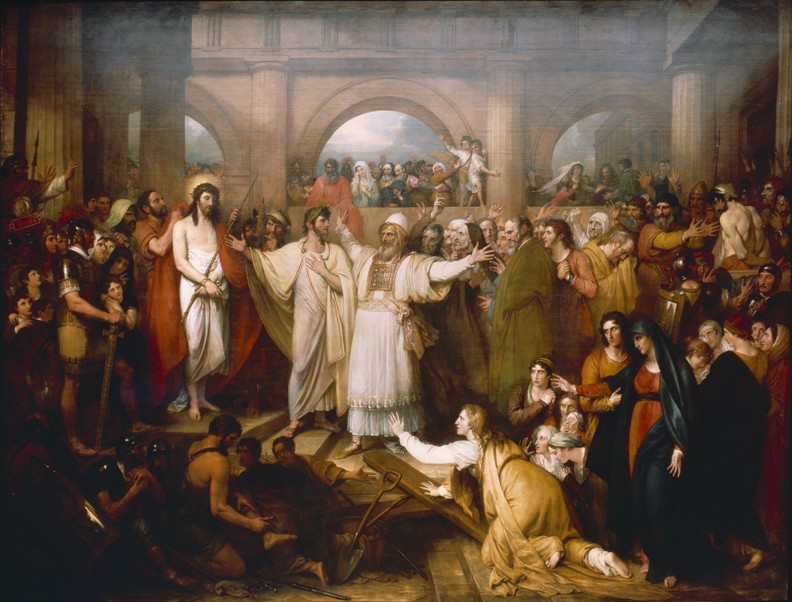
- Large religious compositions Death on the Pale Horse; Christ Rejected
- Portraits and family identity The Artist and His Family; Self-Portraits
- Studies and revisions The Expulsion of Adam and Eve from Paradise
- Painting translated into print The Facius brothers’ Mr. West and Family
Contents
- What history painting meant in West’s work
- Classical subjects: Agrippina and Pylades
- Recent history and the construction of public memory
- Religious paintings and the importance of scale
- Portraits, families and artistic identity
- Studies, later revisions and painted replicas
- A print after a painting
- Reading catalogues and choosing a painting
What history painting meant in West’s work
In this context, history painting involves the presentation of a significant action through figures. The action might come from antiquity, scripture, literature or a comparatively recent event. West’s pictures give people relationships within a scene: they mourn, accuse, plead, negotiate or witness something happening. Faces and gestures help turn a written or remembered story into an encounter that a viewer can follow.
The subject alone does not explain the result. A central figure can be isolated by pale clothing, supported by surrounding bodies or set beneath a flag. Architecture and landscape establish spaces in which these relationships become visible. Comparing paintings from different subject groups reveals how often West returned to the problem of giving an event a clear emotional centre.
Classical subjects: Agrippina and Pylades
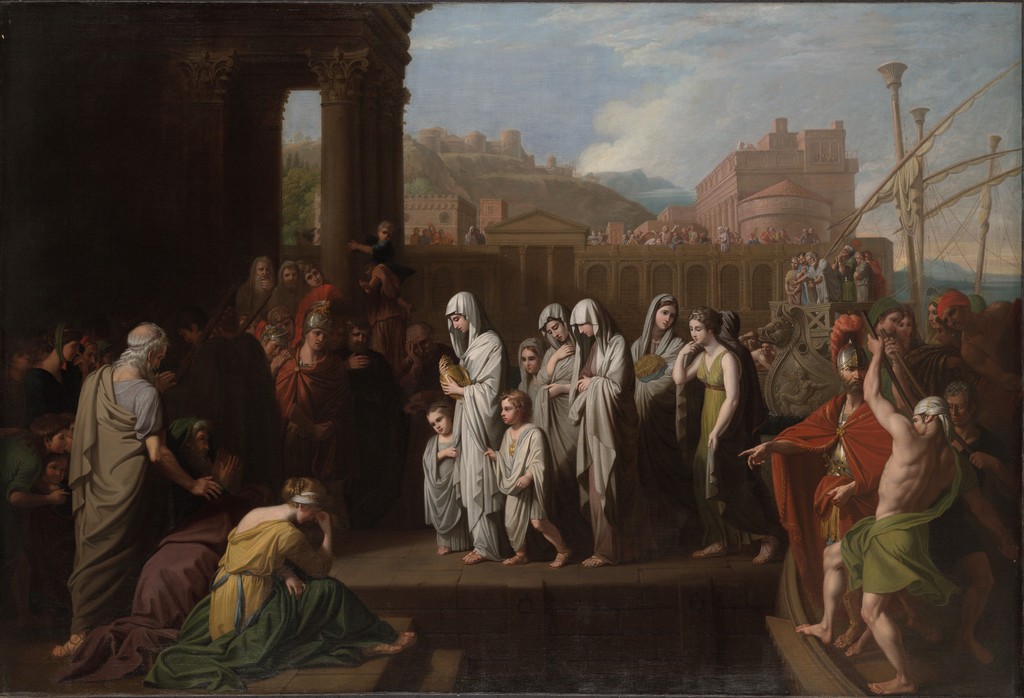
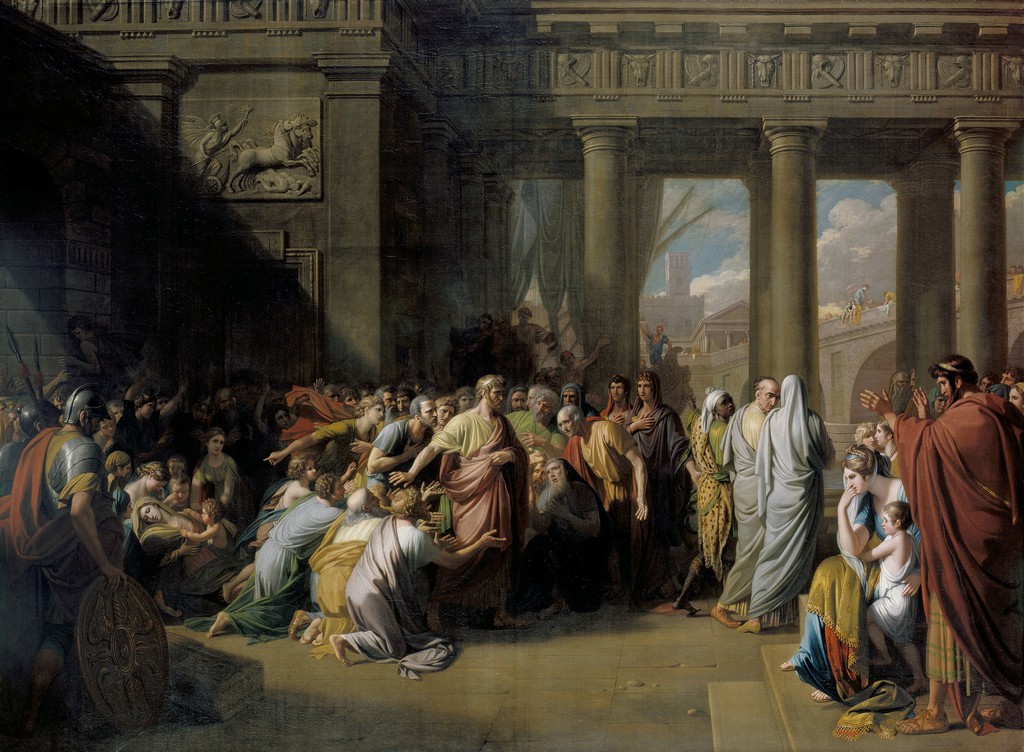
In Agrippina Landing at Brundisium with the Ashes of Germanicus , dated 1768, private bereavement becomes a public occasion. The veiled widow carries an urn, accompanied by children and surrounded by mourners. Yale University Art Gallery relates the composition to eighteenth-century interest in the moral values of antiquity. The picture’s classical subject offered a setting for reflection on conduct, loss and public feeling. [2]
The arrangement gives that theme a visible form. Pale garments distinguish the central group; the darker architecture and clustered figures provide a surrounding frame. A kneeling woman and an extended arm pull attention across the foreground. The event is organised into a sequence of responses rather than left as an undifferentiated crowd. Following those responses is often more revealing than trying to identify every distant spectator.
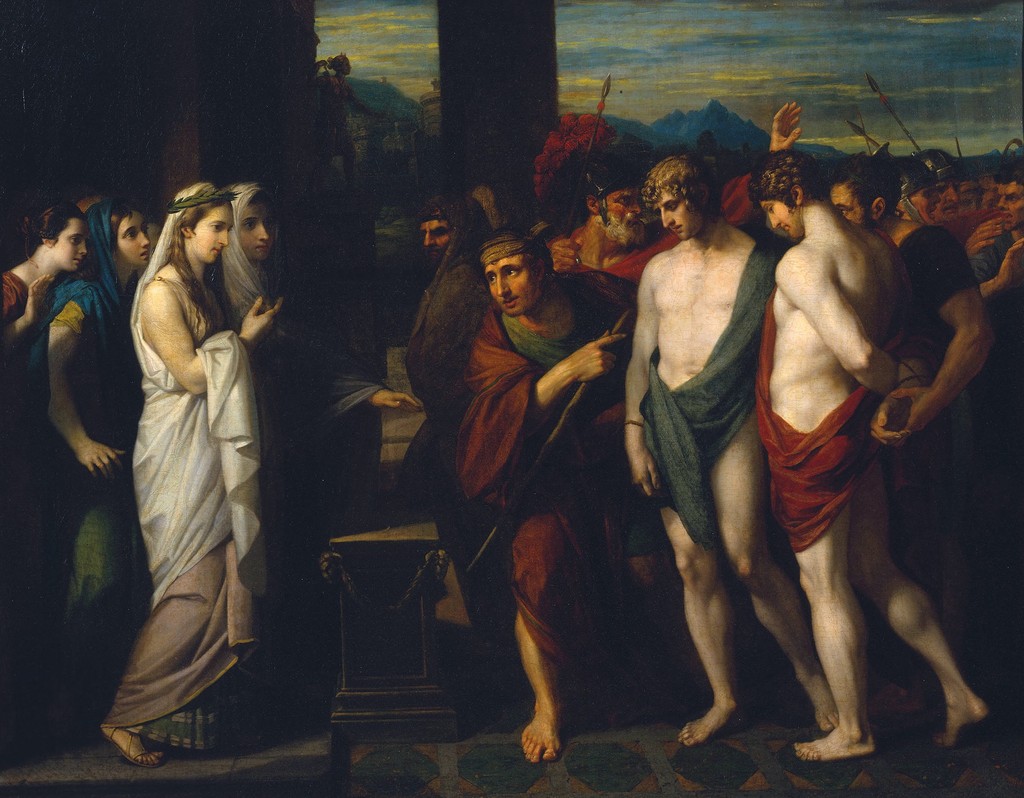
Pylades and Orestes , painted in 1766 and now in Tate’s collection, offers another encounter with classical narrative. Its concentrated group and emphatic gestures place relationships between the protagonists at the centre of the scene. The owning museum’s interpretation connects the work with classical friezes and Raphael. It is a useful companion to Agrippina when exploring the resources behind West’s classical figure painting. [3]
Recent history and the construction of public memory
The Death of General Wolfe , painted in 1770, brings contemporary military uniforms into an elevated scene of sacrifice. The National Gallery of Canada’s original presents the dying commander within a carefully arranged group. The museum distinguishes this construction of a moral example from a literal gathering of all the people who witnessed his death. Recognisable clothing does not make the composition a documentary snapshot. [4]
Look at the way the reclining body, supporting officers and rising flag work together. A broad battlefield is given a concentrated point of attention. The surrounding faces seem to register a shared event, while the flag extends the group upwards. The painting can be compared with Agrippina through its organisation of mourning, even though its setting, costumes and political associations differ.
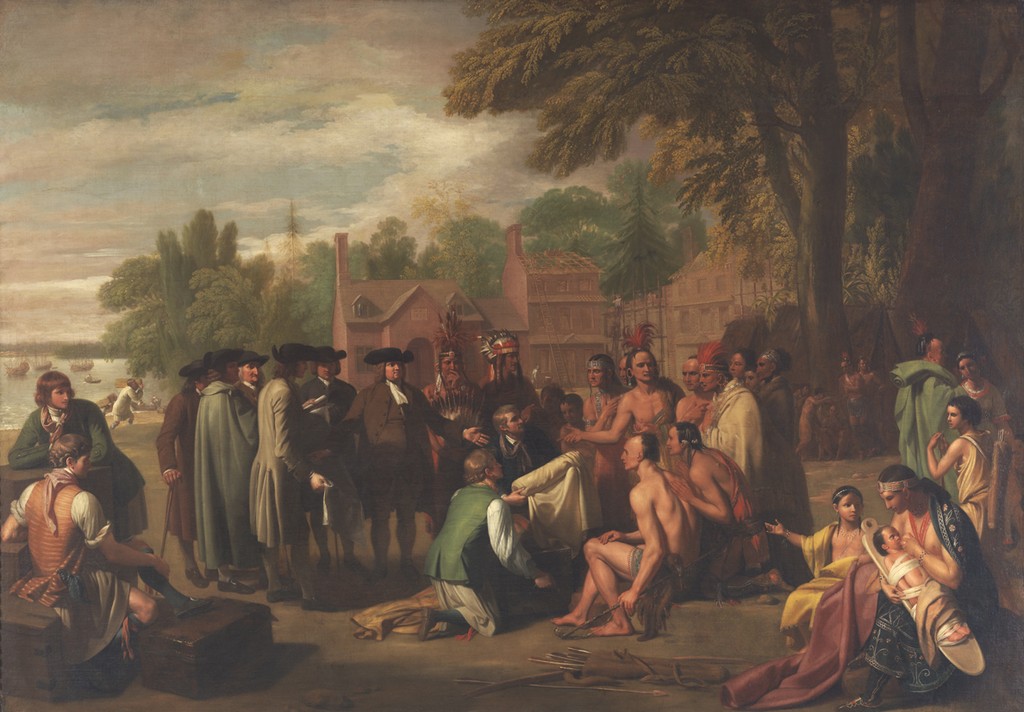
In Penn’s Treaty with the Indians , dated 1771–1772, the relevant question is how a foundation story was represented for a patron. Thomas Penn commissioned the picture. PAFA describes the meeting of William Penn, Lenape people and merchants as allegorical rather than an exact historical record. Its harmonious exchange is an image to interpret, not independent proof of the event or its terms. [5]
The unfinished American Commissioners changes the visual problem again. Five American negotiators occupy part of the composition, while a large uncompleted area remains at the right. Winterthur identifies that space as likely intended for British commissioners. The contrast between developed figures and exposed ground makes the painting’s unfinished state central to viewing it; the blank area alone cannot establish why work stopped. [6]
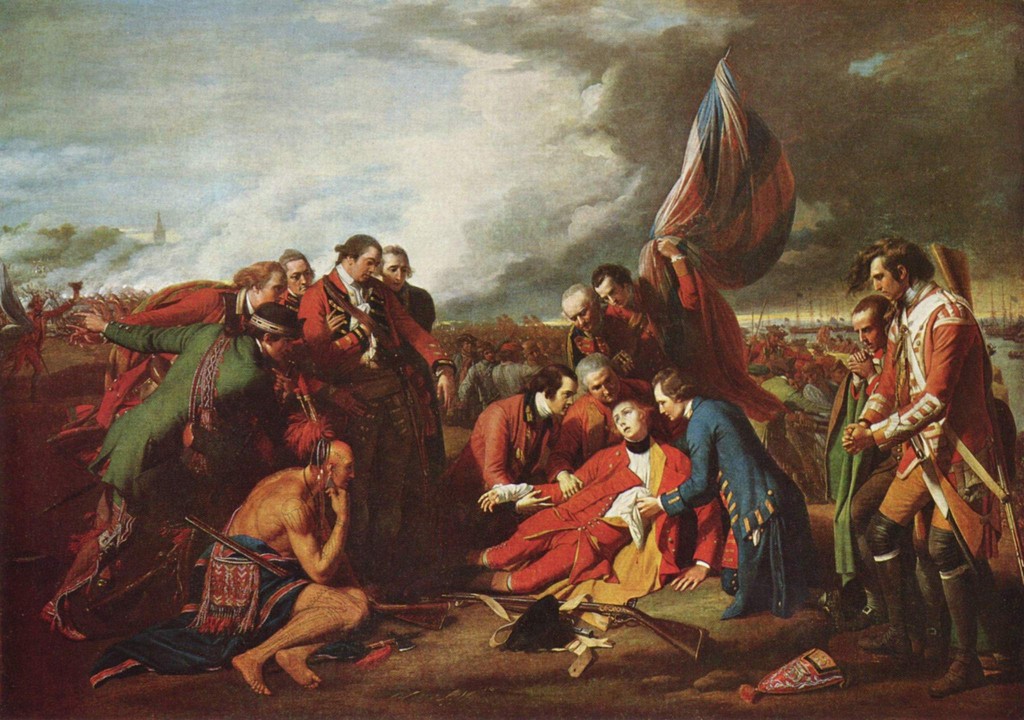
Benjamin West, The Death of General Wolfe, 1770. National Gallery of Canada, 8007. Gift of the 2nd Duke of Westminster to the Canadian War Memorials, 1918; Transfer from the Canadian War Memorials, 1921. Public-domain reproduction: original 2005 Yorck Project upload via Wikimedia Commons, resized only.
Image source
.
Public domain
. Whole supplied image, proportionally resized; no appearance adjustment.
Religious paintings and the importance of scale
The 1817 Death on the Pale Horse at PAFA measures 447 by 764.5 centimetres. Its riders and falling figures fill a canvas much larger than an ordinary domestic picture. The pale central horse, raised arms and bodies across the foreground carry attention through a scene of upheaval. Date and dimensions help distinguish this large canvas from other treatments of the same subject. [7]
Scale changes the encounter. On a screen, a vast painting and a small study can occupy similar rectangles. In front of the canvas, the viewer would need to take in a broad field of action. Its overall pattern and individual incidents operate at different distances. Keeping the physical dimensions in mind helps explain the relationship between the crowded narrative and its monumental presentation.
Christ Rejected , completed in 1814, is another enormous composition: PAFA records a width of more than six metres. The painting makes a public confrontation its subject, with figures and gestures distributed across a wide scene. It offers a different kind of religious drama from the rushing action of Death on the Pale Horse , while retaining the challenge of making many participants intelligible within one work. [8]
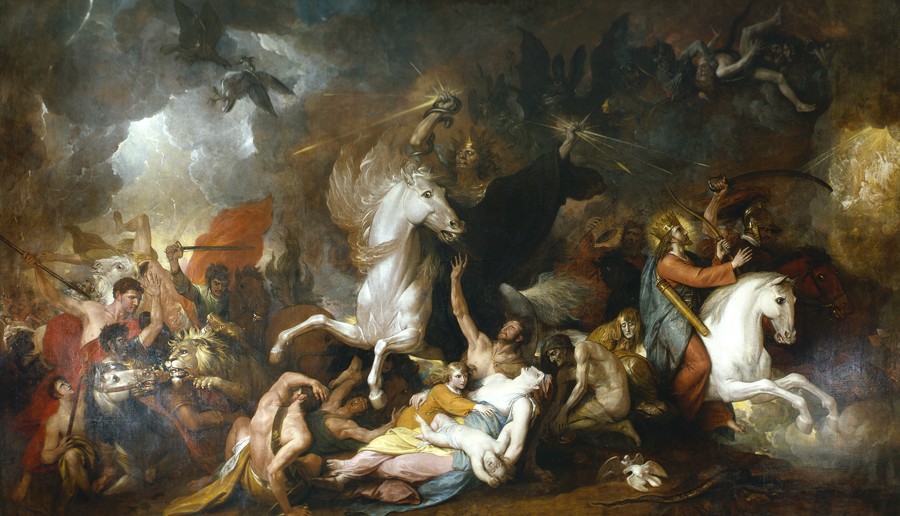
Benjamin West, Death on the Pale Horse, 1817. Oil on canvas, 447.0 × 764.5 cm. Pennsylvania Academy of the Fine Arts, Pennsylvania Academy purchase, 1836.1. Museum reproduction: no known copyright restrictions; complete supplied image retained.
Image source
.
Public-domain artwork; PAFA No known copyright restrictions
. Whole supplied image, proportionally resized; no appearance adjustment.
Portraits, families and artistic identity
West’s portraiture provides a change of pace. The Artist and His Family , painted around 1772, brings together his wife, two sons, father, half-brother and the painter himself. The Yale Center for British Art interprets the group through his transatlantic identity. The pale clothing around mother and infant contrasts with the darker seated relatives, while West stands behind them with the equipment of his profession. [9]
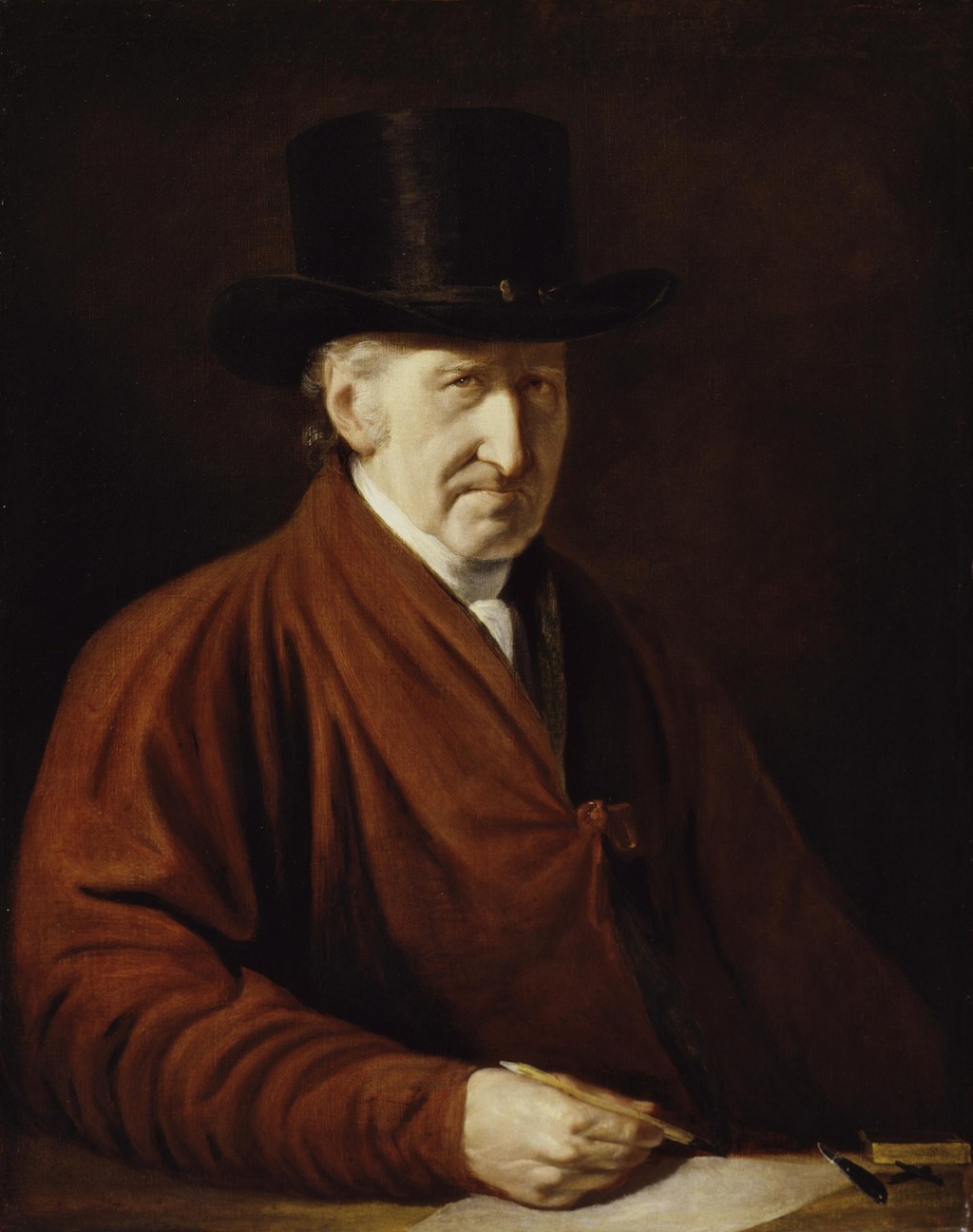
The self-portraits show different ways of presenting that profession. In the Smithsonian American Art Museum’s portrait of 1819, a tall hat and russet robe surround the lit face, while a pencil rests above a sheet of paper. The image is painted on paperboard. It invites attention to the working hand as well as the face, without requiring a diagnosis of the elderly painter’s feelings or health. [10]
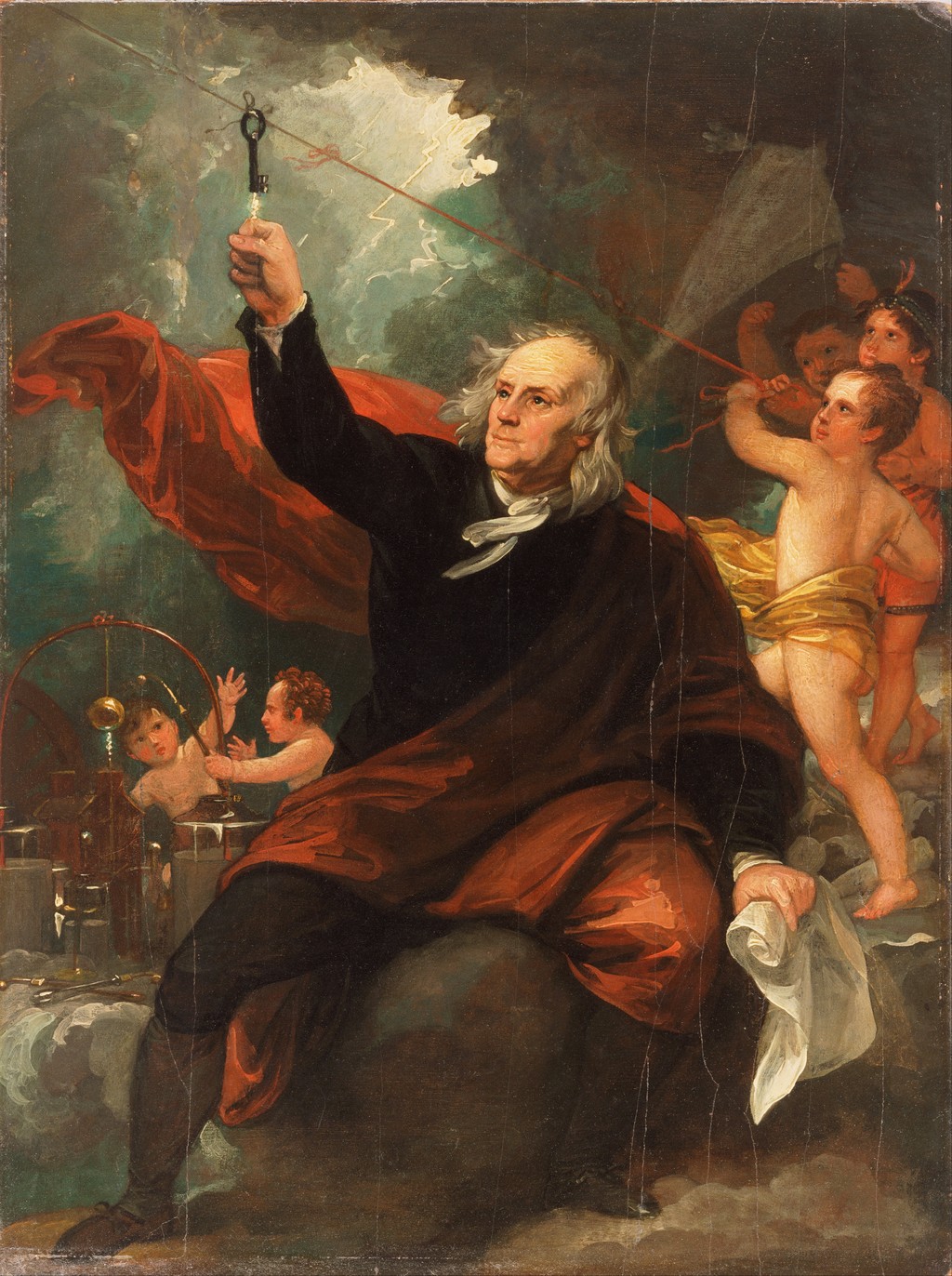
Benjamin Franklin Drawing Electricity from the Sky , painted around 1816, combines a recognisable public figure with an invented scene of achievement. The Philadelphia Museum of Art’s teacher resource identifies the support as slate and the dimensions as only 34 by 25.6 centimetres. Cherubs assist an elderly Franklin beneath storm clouds. The work is a commemorative invention, rather than a record of West observing the experiment. It also shows how heroic presentation could operate on a small painted surface. [11]
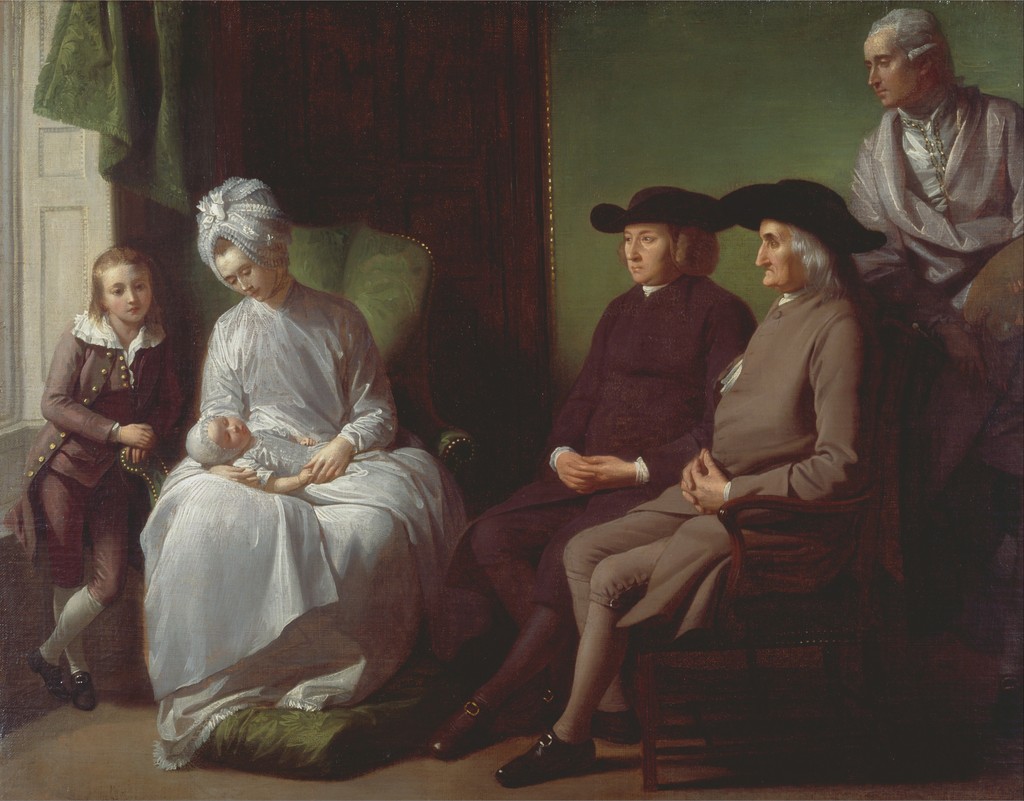
Benjamin West, The Artist and His Family, around 1772, oil on canvas, 52.1 × 66.7 cm. Yale Center for British Art, Paul Mellon Collection, B1981.25.674. Public-domain reproduction via Google Art Project/Wikimedia Commons; whole supplied image, resized only.
Image source
.
Public domain
. Whole supplied image, proportionally resized; no appearance adjustment.
Watch: Benjamin West
Choose a film to explore the artist’s work, its interpretation and its wider setting.
The making of an American myth: Benjamin West, Penn's Treaty with the Indians
Smarthistory examines the construction of an American historical myth in Penn’s Treaty with the Indians.
Watch on YouTubeStudies, later revisions and painted replicas
The large Expulsion of Adam and Eve from Paradise , dated 1791, now at the National Gallery of Art, belongs to West’s work for the intended Windsor chapel programme. Its angel and departing couple dominate the composition, with light and threatening animals extending the story beyond them. The finished canvas provides one object against which a related smaller painting can be compared. [12]
The Art Institute of Chicago’s smaller version is dated 1791 and explicitly recorded as retouched in 1803. That later intervention matters. Although the museum describes it as a preparatory sketch, its present appearance cannot simply be treated as an untouched record of West’s first thoughts in 1791. Differences between the two paintings are visible, but not every difference can be assigned a place in the original sequence of production. [13]
For example, Eve’s clothing and the treatment of the surrounding light differ. Comparing these elements raises useful questions about revision and emphasis. The smaller work measures 48.6 by 72.9 centimetres; displaying its reproduction beside the large canvas does not make the physical paintings equivalent in size. A comparison should preserve the identity and history of each object.
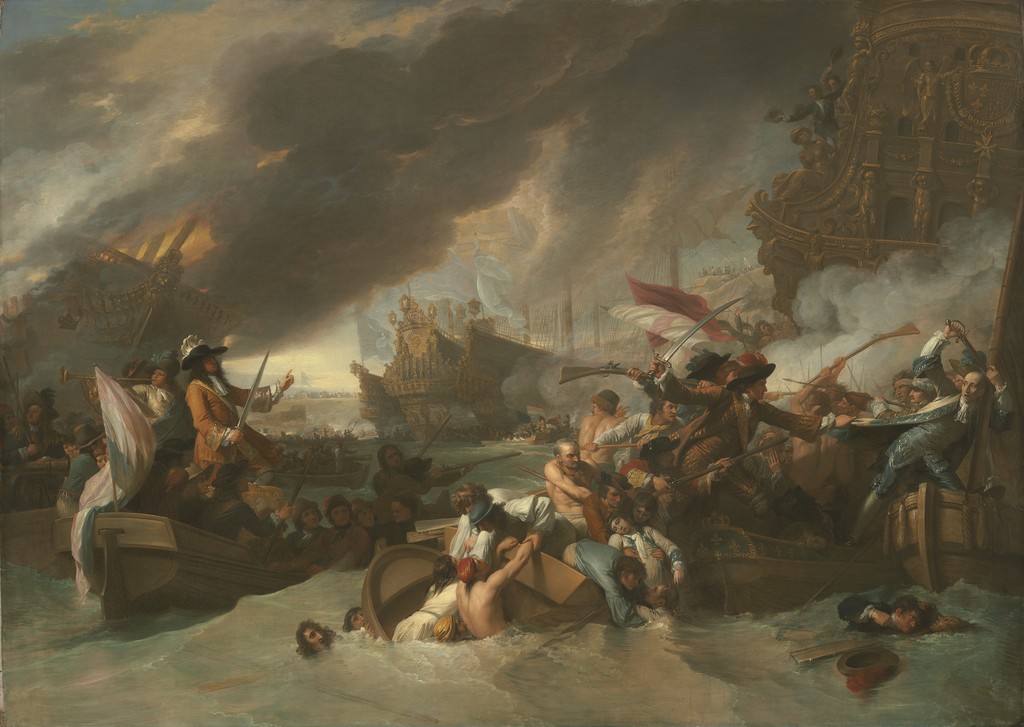
Replicas raise another issue. A historical Christie’s catalogue describes a studio version of The Battle of La Hogue associated with both West and John Trumbull. It had previously belonged to the Metropolitan Museum and was sold in 2006. This is a separate object from the National Gallery of Art’s large painting. The auction record helps distinguish versions and collaboration; it is not evidence that the studio version remains at the Met today. [14]
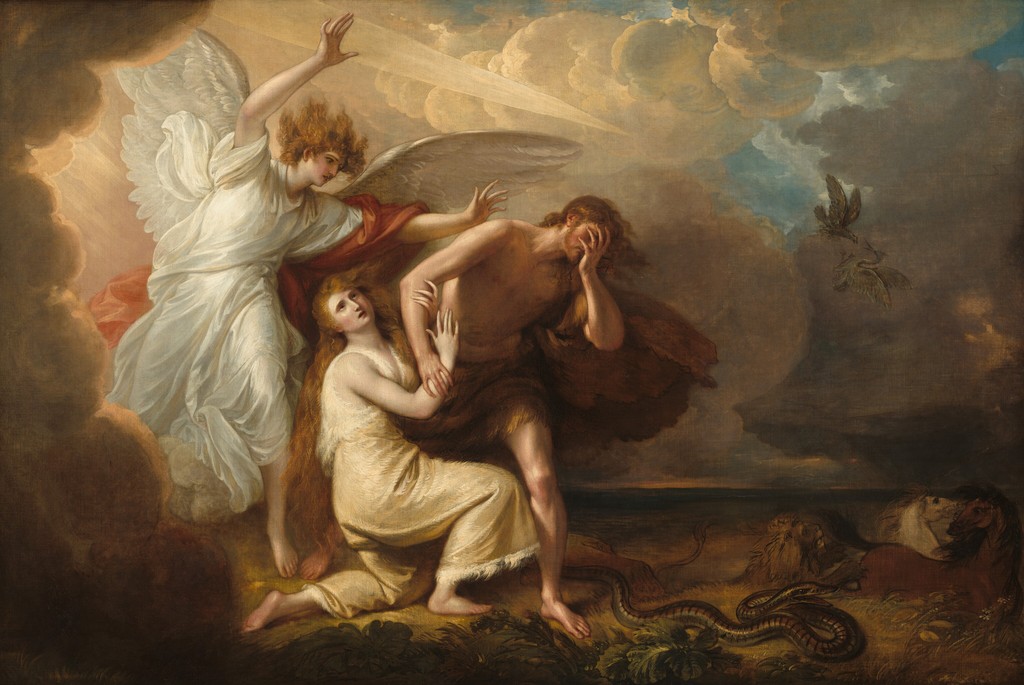
Benjamin West, The Expulsion of Adam and Eve from Paradise, 1791. Courtesy National Gallery of Art, Washington, Avalon Fund and Patrons’ Permanent Fund, 1989.12.1. CC0; complete supplied image, resized only.
Image source
.
CC0 / Public domain
. Whole supplied image, proportionally resized; no appearance adjustment.
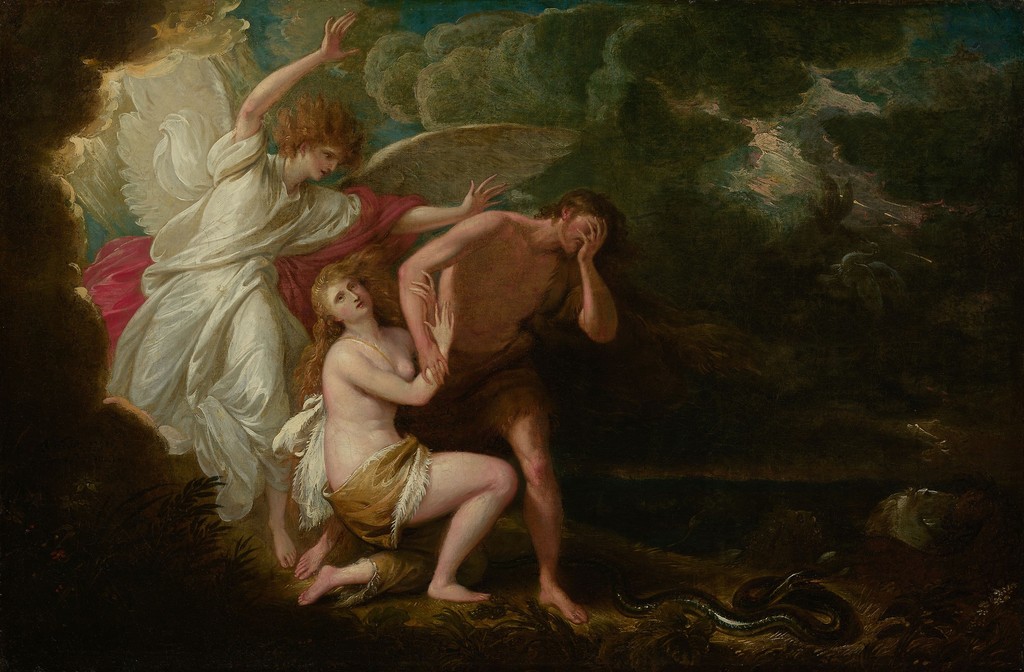
Benjamin West, The Expulsion of Adam and Eve from Paradise, 1791, retouched 1803. Oil on canvas, 48.6 × 72.9 cm. Art Institute of Chicago, George F. Harding Collection, 1984.175. AIC-origin reproduction via Wikimedia Commons, CC0; complete supplied image, resized only.
Image source
.
CC0 / Public domain
. Whole supplied image, proportionally resized; no appearance adjustment.
A print after a painting
The Facius brothers’ Mr. West and Family , dated 1779, translates the family group into a print. PAFA identifies its medium as stipple and engraving on cream laid paper. Its makers, Georg Sigmund Facius and Johann Gottlieb Facius, worked after West’s composition. Their print and the painting of around 1772 have different dates, supports and authorship descriptions. [15]
The comparison is immediately visible in the monochrome treatment and the publication lettering beneath the image. Similar figures and arrangements can therefore belong to different kinds of object. When a familiar West composition appears in another collection, the medium and maker fields help establish whether the record describes his painting, a related study, a painted copy or a print after his work.
A useful comparison begins with those object details, then returns to the images. Note who is credited, which date is given and whether a later revision is recorded. Look next at the relationship between the figures, the edges of the composition and any lettering around it. These observations answer different questions: a shared design establishes a relationship, while the record helps explain what kind of relationship it is. Similarity alone cannot make two objects interchangeable.
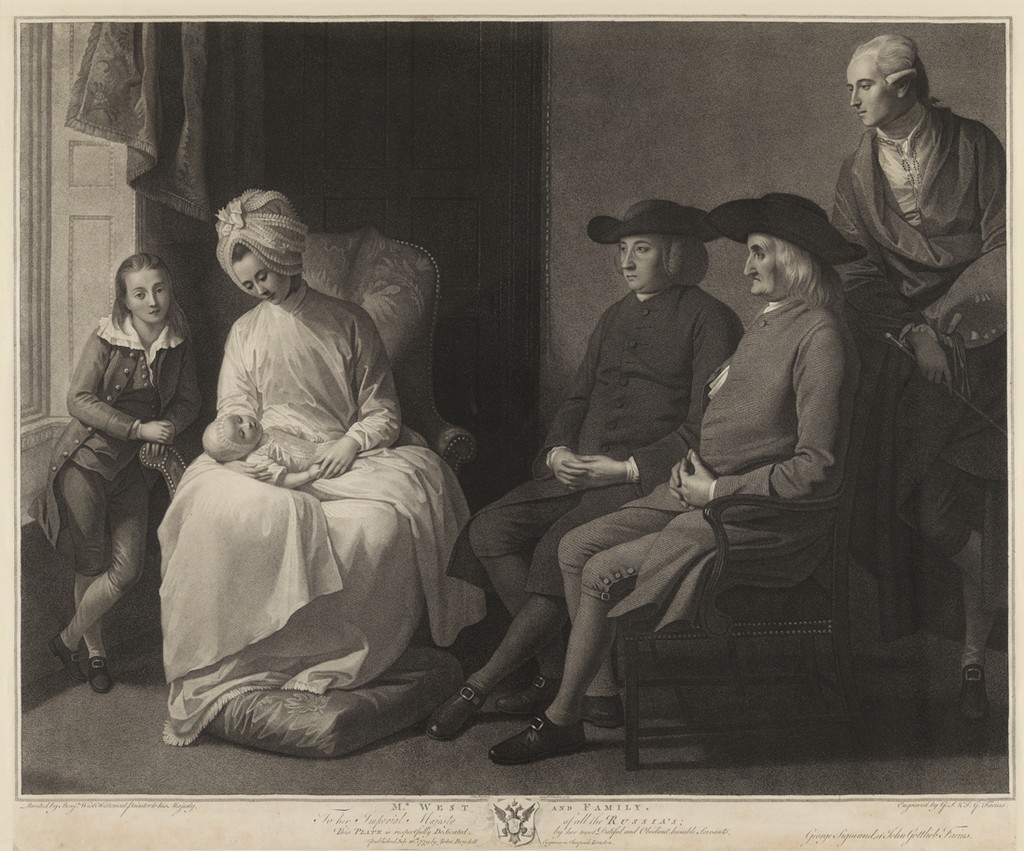
Georg Sigmund Facius and Johann Gottlieb Facius after Benjamin West, Mr. West and Family, 1779. Stipple and engraving on cream laid paper. Pennsylvania Academy of the Fine Arts, John S. Phillips Collection, 1985.x.312. No known copyright restrictions.
Image source
.
No known copyright restrictions; original1779print public domain
. Whole supplied image, proportionally resized; no appearance adjustment.
Reading catalogues and choosing a painting
John Galt’s early catalogue illustrates the difficulty of turning a list into a count of paintings. Its entries include drawings, cartoons, watercolours, copies and repeated versions. Some combine more than one work; others use abbreviated references to preceding entries. The list belongs to its historical moment. Period statements about possession cannot automatically be used as present-day locations, and grouped descriptions cannot be counted as single surviving canvases without further investigation. [16]
The individual artwork articles provide a more focused starting point. Choose Wolfe for recent history, Agrippina for a classical mourning scene, the family picture for portraiture, or Death on the Pale Horse for monumental religious action. The complete article browse selection also includes early portraits, literary subjects and quieter biblical scenes. It represents the subjects explored in this cluster, rather than a claim that these are all the works West made.
For the development of his career, continue to the biography . For closer comparisons of composition, materials and documented revisions, use Style and Technique . These different routes allow a single painting to be considered as a story, an object with a history and part of a much longer artistic practice.
Books and further reading
Books, museum publications and library records offer further routes into West’s life and work.
The Paintings of Benjamin West. Helmut von Erffa and Allen Staley. Yale University Press, 1986.
A specialist catalogue for readers pursuing individual works. The linked library record identifies the book. View library catalogue record.
American Paintings of the Eighteenth Century. Ellen G. Miles, with contributions by Patricia Burda, Cynthia J. Mills and Leslie Kaye Reinhardt. National Gallery of Art, 1995.
The West entries bring together subject, provenance and published technical research. The museum publication page provides a PDF. View museum publication and PDF.
Staley/von Erffa Benjamin West Archive. Historical Society of Pennsylvania, collection 3000.
The finding aid describes the research archive and post-publication revisions; it is distinct from the published catalogue. View archive finding aid.
Benjamin West artworks and catalogue records
This directory combines identified works with the complete list in John Galt’s 1820 catalogue. Historical entries may group several works or record studies, copies and repeated versions. The entry numbers are modern finding aids; old spellings may be retained. Their titles and locations describe the 1820 account; they do not establish present ownership or a count of unique paintings. Dates and media are left unspecified where the evidence does not settle them. Later catalogue reports are labelled, and recto/verso records may describe two sides of one sheet. Linked articles provide references for the individual works they discuss. The historical list is Galt’s Appendix II, pages 216–234. [17] The labelled 1995 records follow the National Gallery of Art catalogue. [18] Additional object details come from the Gallery’s collection index. [19] The Pyrrhus study and related exhibited painting are documented in Christie’s catalogue. [20]
| Name | Date | Medium |
|---|---|---|
| The Death of General Wolfe (Ottawa original) | 1770 | Oil painting |
| The Death of Wolfe (Royal Collection repetition) | 1771 | Oil painting |
| Penn’s Treaty with the Indians | 1771–1772 | Oil painting |
| Penn’s Treaty with the Indians (compositional study) | c. 1771 | Ink, wash and Chinese white |
| The Expulsion of Adam and Eve from Paradise (Washington painting) | 1791 | Oil painting |
| Installation plan for the exhibition of Christ Rejected | 21 December 1813 | Pen and brown ink |
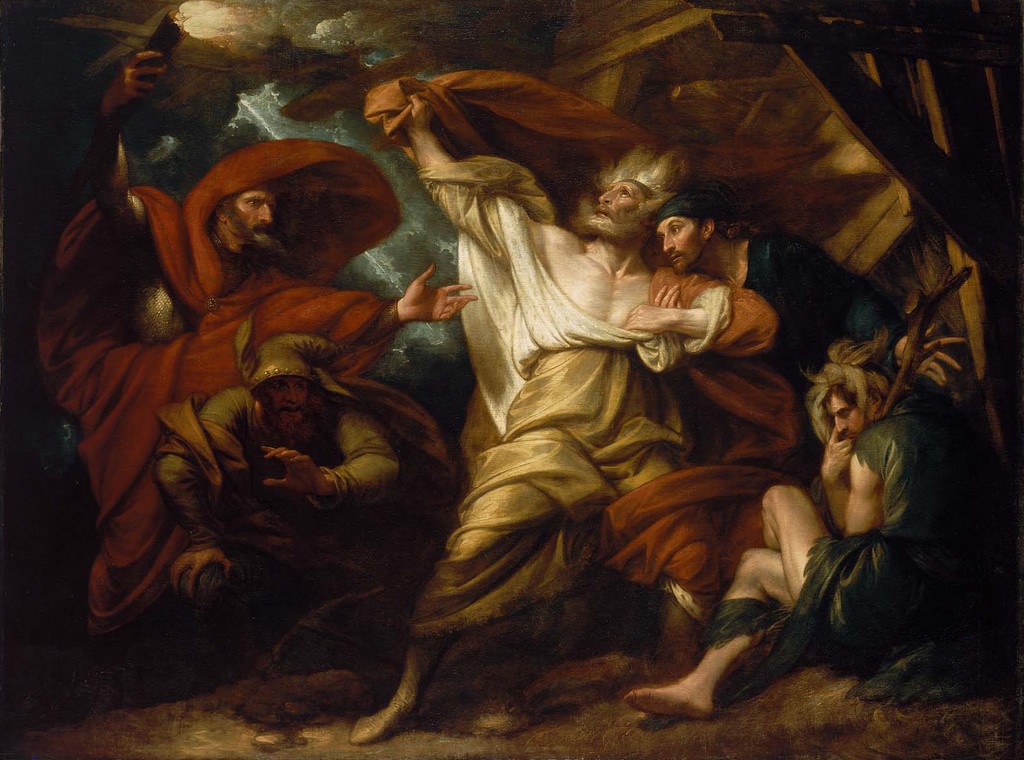
| King Lear (Detroit sketch) | c. 1788 | Oil painting |
| Death on the Pale Horse (Detroit painting) | 1796 | Oil painting |
| Benjamin Franklin Drawing Electricity from the Sky | c. 1816 | Oil on slate |
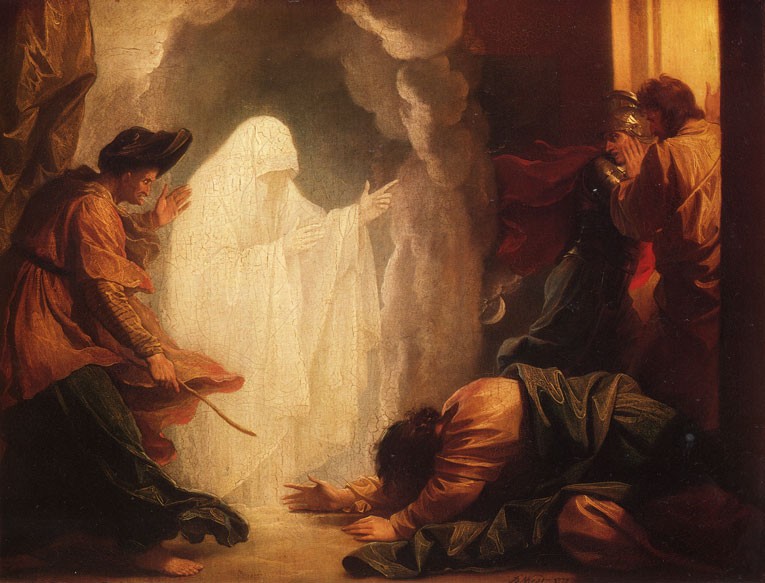
| Saul and the Witch of Endor (Hartford painting) | 1777 | Oil painting |
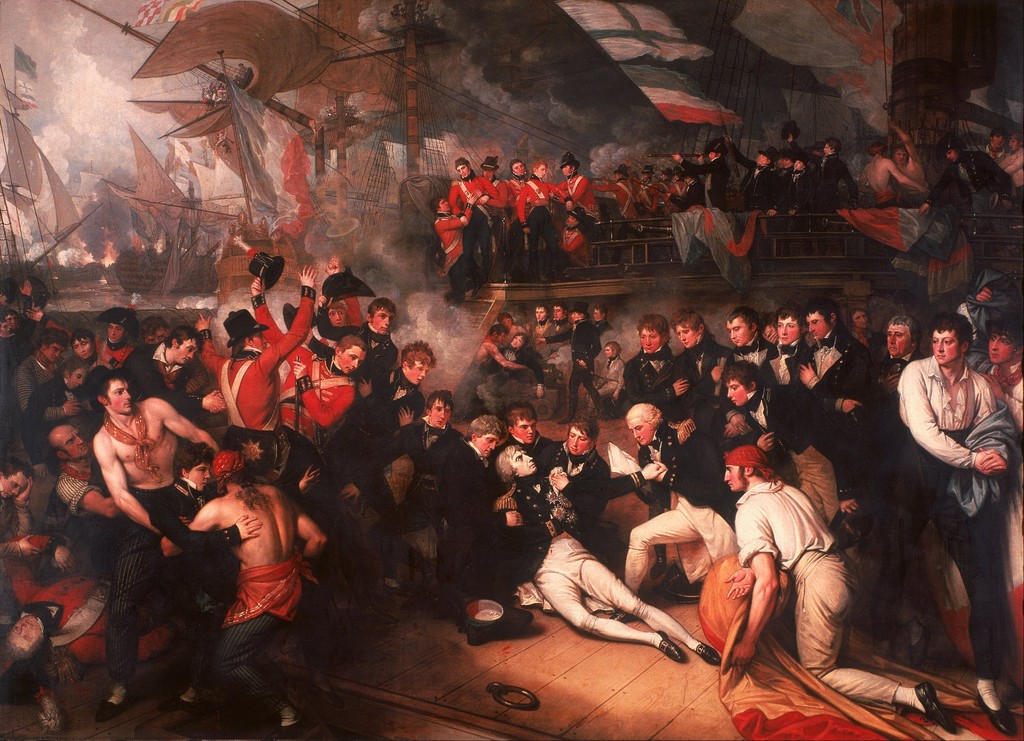
| The Death of Nelson (Walker painting) | 1806 | Oil on canvas and panel |
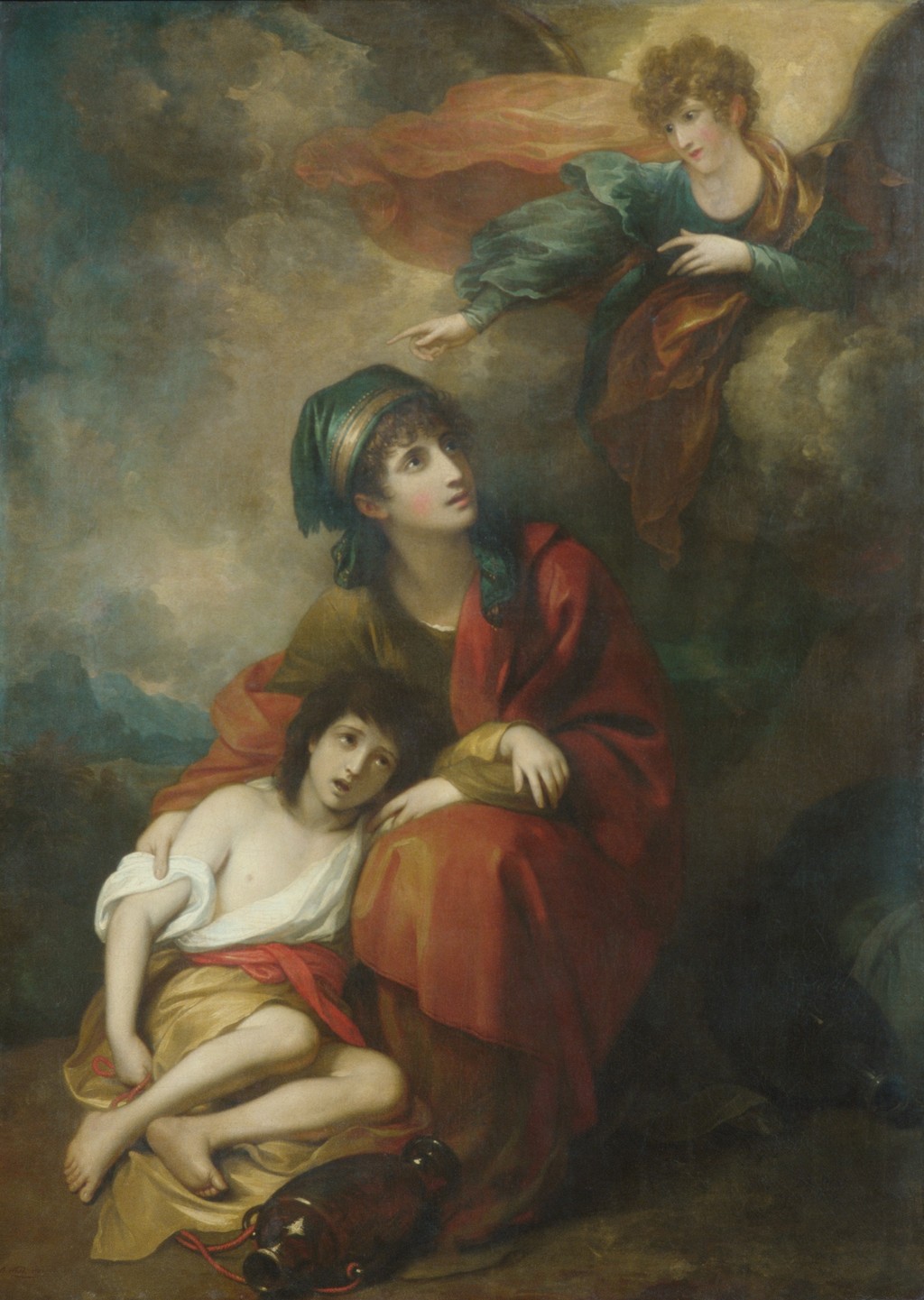
| Hagar and Ishmael | 1776; reworked 1803 | Oil painting |
| Pyrrhus Brought before Glaucias (oil study) | Undated | Oil on paper laid on canvas |
| The Artist and His Family | c. 1772 | Oil painting |
| Pylades and Orestes Brought as Victims before Iphigenia | 1766 | Oil painting |
| Self-Portrait (Smithsonian) | 1819 | Oil on paperboard |
| The Cave of Despair (graphite tracing) | Undated | Graphite tracing |
| The Battle of La Hogue (Washington painting) | 1778 | Oil painting |
| Agrippina Landing at Brundisium with the Ashes of Germanicus | 1768 | Oil painting |
| The Battle of La Hogue (West and Trumbull studio version) | Dating debated | Oil painting |
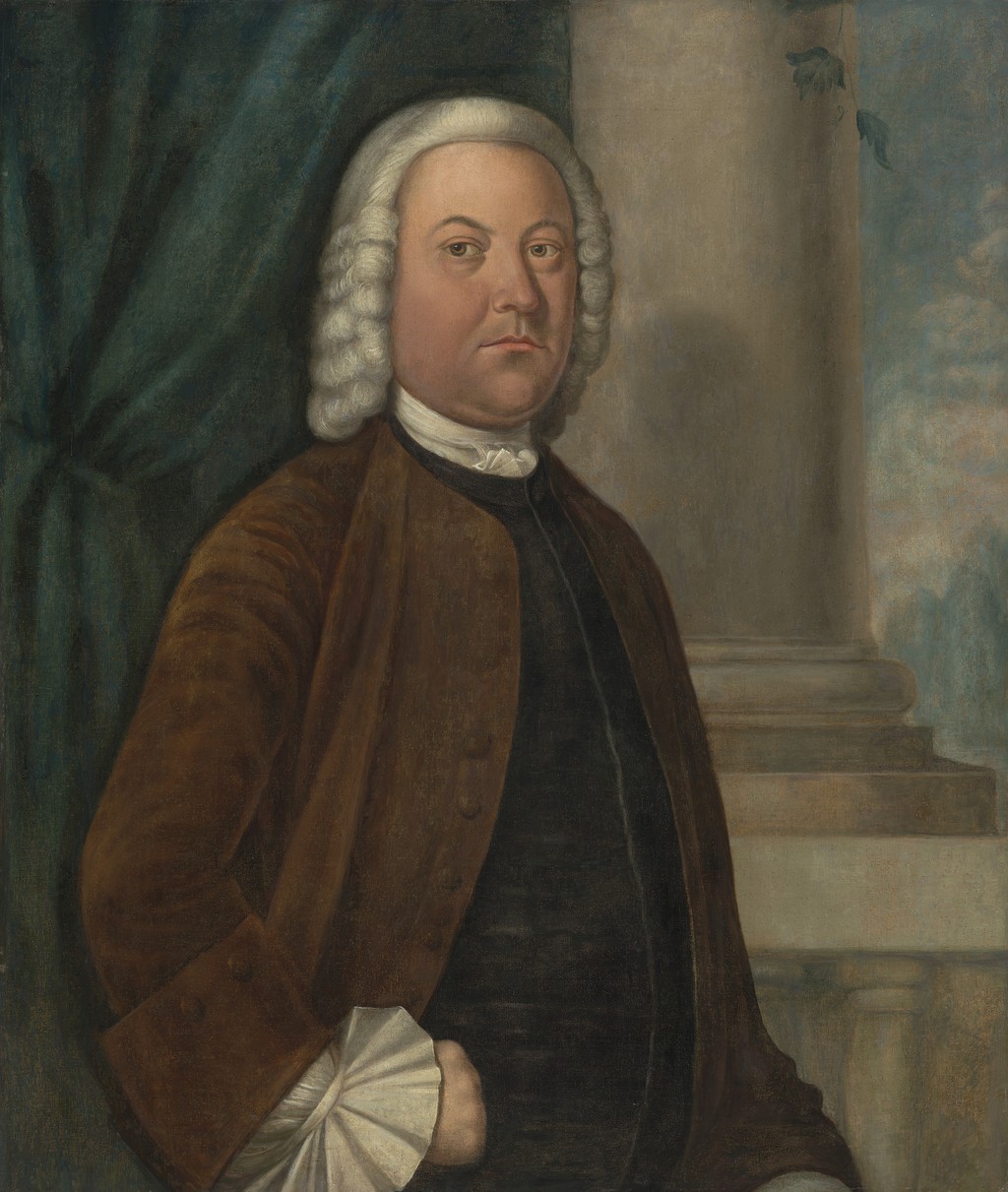
| Dr. Samuel Boude | 1755–1756 | Oil painting |
| Mary Bethel Boude (Mrs. Samuel Boude) | 1755–1756 | Oil painting |
| Sarah Ursula Rose | 1756 | Oil painting |
| Study for The Battle of La Hogue [recto] | 1778 | Pen and brown ink |
| Study for Pylades and Orestes (pencil drawing) | Undated | Pencil |
| The Immortality of Nelson | 1807 | Oil painting |
| The Expulsion of Adam and Eve from Paradise (Chicago study) | 1791; retouched 1803 | Oil painting |
| Death on the Pale Horse (Philadelphia painting) | 1817 | Oil painting |
| Death on the Pale Horse (Royal Academy drawing) | 1783–1803 | Pen, brown ink, wash and gouache |
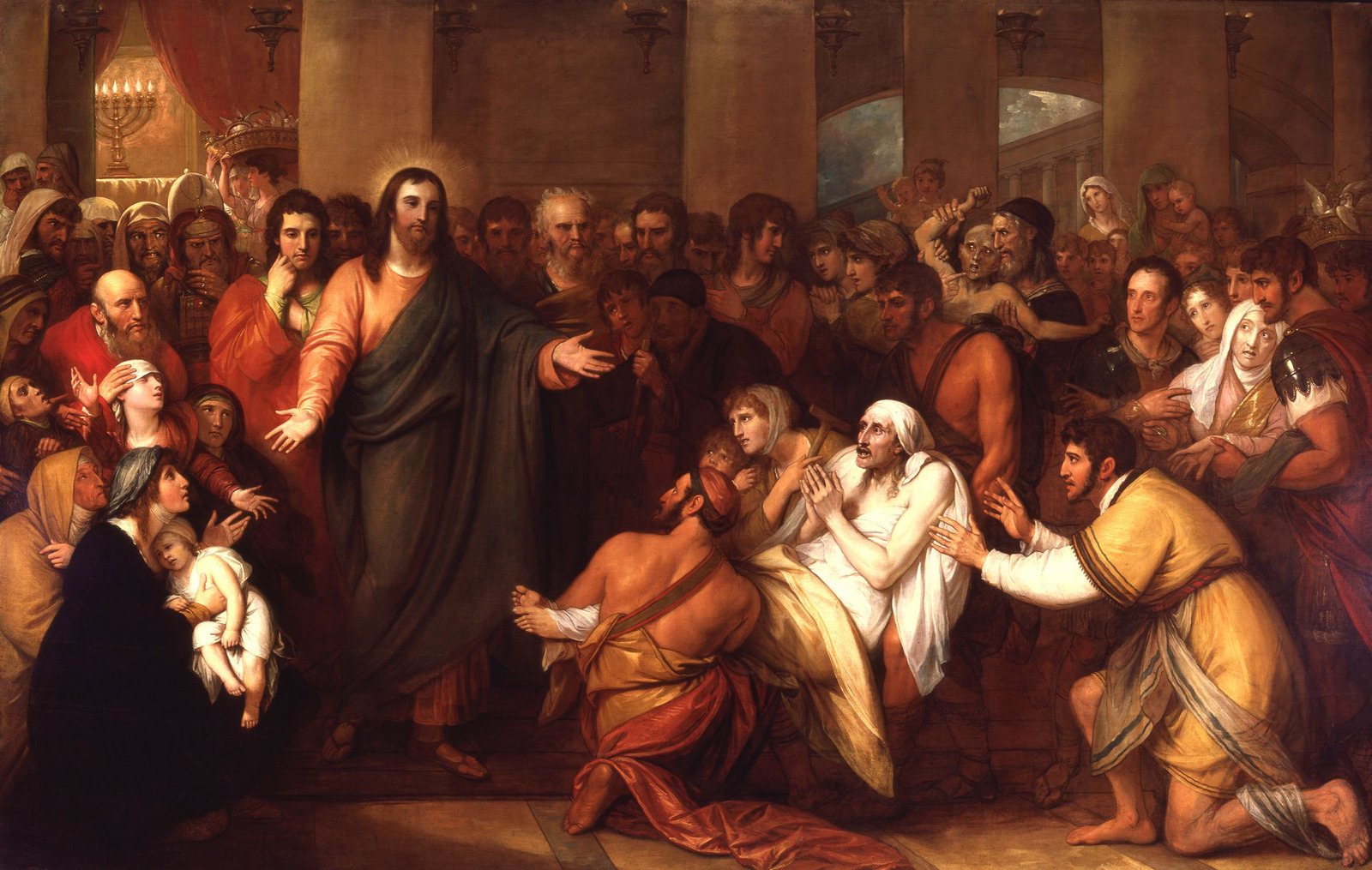
| Christ Healing the Sick in the Temple (Philadelphia painting) | 1815; sent 1817 | Oil painting |
| Sketch for the Demoniac in Christ Healing the Sick in the Temple | 1815 | Ink, graphite and wash |
| Christ Rejected (Philadelphia painting) | 1814 | Oil painting |
| King Lear (Boston painting) | 1788 | Oil painting |
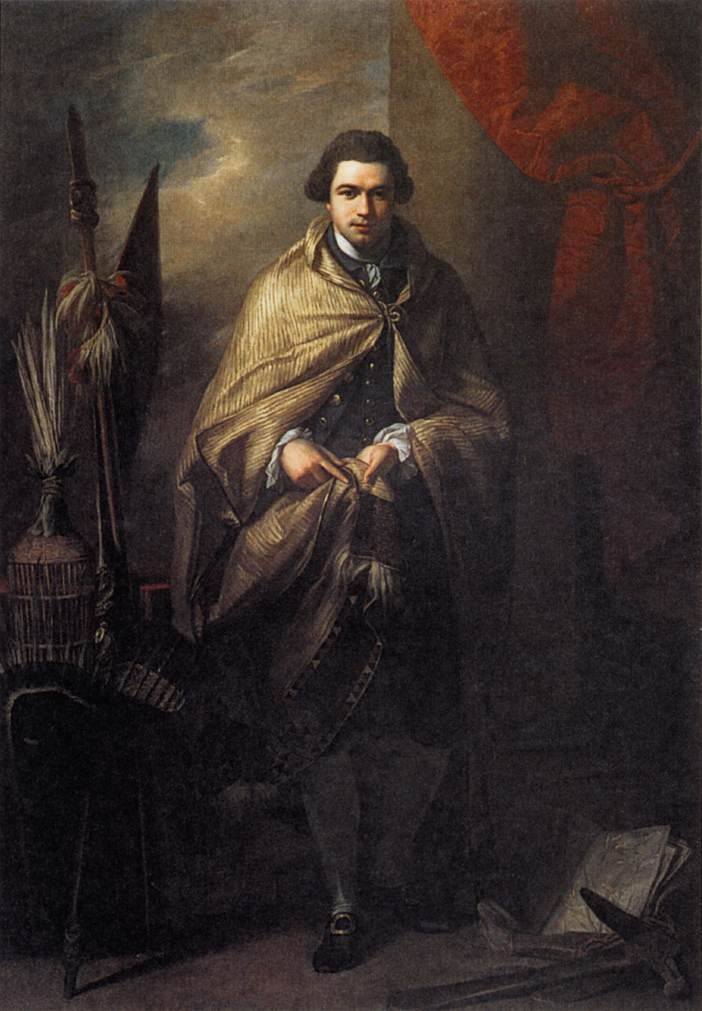
| Joseph Banks (Usher Gallery portrait) | 1771–1772 | Oil painting |
| The Departure of Regulus | 1769 | Oil painting |
| The Oath of Hannibal | 1770 | Oil painting |
| The Cave of Despair (Yale painting) | 1772 | Oil painting |
| Study for Saul and the Witch of Endor (Morgan drawing) | Undated; reported 1812 watermark | Ink, chalk and wash |
| American Commissioners of the Preliminary Peace Negotiations with Great Britain | c. 1783 | Oil painting |
| Self-portrait of Benjamin West, P.R.A. (Royal Academy) | 1793 | Oil on panel |
| Maternity | 1784 | Red chalk |
| Preservation of St Paul after a Shipwreck at Malta (Greenwich altarpiece) | Commissioned 1786 | Painting |
| Nelson in the Victory’s Cockpit (West’s painting) | 1808 | Painting |
| Self-Portrait (Baltimore original; catalogued 1995) | c. 1776 | Oil painting |
| Sailing Vessels and Longboats (catalogued 1995) | c. 1778 | Black chalk |
| A Naval Battle (catalogued 1995) | c. 1778 | Black chalk |
| The Expulsion of Adam and Eve (Morgan drawing) (catalogued 1995) | c. 1791 | Black chalk |
| Sketch for a Seated Woman with a Musical Instrument [recto] (catalogued 1995) | c. 1799 | Black chalk |
| Sketch for a Seated Woman with a Musical Instrument [verso] (catalogued 1995) | c. 1799 | Black chalk |
| Pyrrhus Brought before Glaucias (painting exhibited in 1767) | Exhibited 1767 | Oil painting |
| Telemachus and Calypso | c. 1809 | Oil on canvas |
| Colonel Guy Johnson and Karonghyontye (Captain David Hill) | 1776 | Oil on canvas |
| The Adoration of the Shepherds | 1805 | Pen and brown ink with brown wash and blue gouache heightened with white on wove paper mounted to board |
| This is my Beloved Son | 1802 | Lithograph |
| Angel of the Resurrection | 1801 | Pen-and-tusche lithograph |
| The Flight into Egypt | c. 1800 | Pen and brown ink and wash, heightened with white gouache, on laid paper |
| Maria Hamilton Beckford (Mrs. William Beckford) | 1799 | Oil on canvas |
| Elizabeth, Countess of Effingham | c. 1797 | Oil on canvas |
| The Crucifixion | 1796/1797 | Pen and brown and black ink with blue, black, and red chalk on laid paper |
| The Disobedient Prophet | 1793 | Pen and black ink with wash heightened with blue and cream oil paint over chalk |
| George III Resuming Royal Power in 1789 | c. 1789 | Pen and brown ink with brown wash on laid paper mounted to board |
| Vagabond Family [recto] | 1788 | Pen and brown ink with brown and blue wash on wove paper |
| Christ Healing the Sick in the Temple (London painting) | 1811 | Painting |
| Regulus (1820 catalogue, entry 1) | Not stated in 1820 list | Medium not stated |
| Hanibal (1820 catalogue, entry 2) | Not stated in 1820 list | Medium not stated |
| Epaminondas (1820 catalogue, entry 3) | Not stated in 1820 list | Medium not stated |
| Bayard (1820 catalogue, entry 4) | Not stated in 1820 list | Medium not stated |
| Wolfe, the first and second (1820 catalogue, entry 5) | Not stated in 1820 list | Medium not stated |
| Cyrus and the King of Armenia with his Family, captives (1820 catalogue, entry 6) | Not stated in 1820 list | Medium not stated |
| Germanicus and Segestus with his Daughter, captives (1820 catalogue, entry 7) | Not stated in 1820 list | Medium not stated |
| The Apotheosis of Prince Alfred and Prince Octavius (1820 catalogue, entry 8) | Not stated in 1820 list | Medium not stated |
| The picture of the Damsel accusing Peter (1820 catalogue, entry 9) | Not stated in 1820 list | Medium not stated |
| The Queen, with the Princess Royal, in one picture (1820 catalogue, entry 10) | Not stated in 1820 list | Medium not stated |
| Prince Ernest and Prince Augustus; Princesses Augusta, Elizabeth, and Mary, in one picture (1820 catalogue, entry 11) | Not stated in 1820 list | Medium not stated |
| Prince William and Prince Edward, in one picture (1820 catalogue, entry 12) | Not stated in 1820 list | Medium not stated |
| Prince Octavius (1820 catalogue, entry 13) | Not stated in 1820 list | Medium not stated |
| The whole-length portrait of His Majesty in Regimentals, with Lord Amherst and the Marquis of Lothian on Horseback, in the back-ground (1820 catalogue, entry 14) | Not stated in 1820 list | Medium not stated |
| The whole-length portrait of Her Majesty, with the fourteen Royal Children (1820 catalogue, entry 15) | Not stated in 1820 list | Medium not stated |
| The Queen with fourteen royal children (repetition) (1820 catalogue, entry 16) | Not stated in 1820 list | Medium not stated |
| The Battle of Cressy, when Edward III. embraced his son (1820 catalogue, entry 17) | Not stated in 1820 list | Medium not stated |
| The Battle of Poitiers, when John King of France is brought prisoner to the Prince (1820 catalogue, entry 18) | Not stated in 1820 list | Medium not stated |
| The Institution of the Order of the Garter (1820 catalogue, entry 19) | Not stated in 1820 list | Medium not stated |
| The Battle of Nevil's Cross (1820 catalogue, entry 20) | Not stated in 1820 list | Medium not stated |
| The Burgesses of Calais before Edward III (1820 catalogue, entry 21) | Not stated in 1820 list | Medium not stated |
| Edward III. crossing the Somme (1820 catalogue, entry 22) | Not stated in 1820 list | Medium not stated |
| Edward III. crowning Ribemont, at Calais (1820 catalogue, entry 23) | Not stated in 1820 list | Medium not stated |
| St. George destroying the Dragon (1820 catalogue, entry 24) | Not stated in 1820 list | Medium not stated |
| The design of our Saviour's Resurrection, painted in colours, with the Women going to the Sepulchre; also Peter and John (1820 catalogue, entry 25) | Not stated in 1820 list | Painted design; technique unstated |
| Resurrection of our Saviour (cartoon for the east window at Windsor) (1820 catalogue, entry 26) | Not stated in 1820 list | Cartoon; technique unstated |
| The design of our Saviour's Crucifixion, painted in colours (1820 catalogue, entry 27) | Not stated in 1820 list | Painted design; technique unstated |
| Crucifixion of our Saviour (cartoon for the west window at Windsor) (1820 catalogue, entry 28) | Not stated in 1820 list | Cartoon; technique unstated |
| The cartoon of the Angels appearing to the Shepherds (1820 catalogue, entry 29) | Not stated in 1820 list | Cartoon; technique unstated |
| The cartoon of the Nativity of our Saviour (1820 catalogue, entry 30) | Not stated in 1820 list | Cartoon; technique unstated |
| The cartoon of the Magi presenting Gifts to our Saviour (1820 catalogue, entry 31) | Not stated in 1820 list | Cartoon; technique unstated |
| Hymen leading and dancing with the Hours before Peace and Plenty (watercolour) (1820 catalogue, entry 32) | Not stated in 1820 list | Watercolour |
| The picture, in water-colours, of Boys with the Insignia of Riches (1820 catalogue, entry 33) | Not stated in 1820 list | Watercolour |
| Boys with the Insignia of the Fine Arts (companion watercolour) (1820 catalogue, entry 34) | Not stated in 1820 list | Watercolour |
| Genius calling forth the Fine Arts to adorn Manufactures and Commerce, and recording the names of eminent men in those pursuits (1820 catalogue, entry 35) | Not stated in 1820 list | Medium not stated |
| Husbandry aided by Arts and Commerce (1820 catalogue, entry 36) | Not stated in 1820 list | Medium not stated |
| Peace and Riches cherishing the Fine Arts (1820 catalogue, entry 37) | Not stated in 1820 list | Medium not stated |
| Manufactory giving support to Industry, in Boys and Girls (1820 catalogue, entry 38) | Not stated in 1820 list | Medium not stated |
| Marine and inland Navigation enriching Britannia (1820 catalogue, entry 39) | Not stated in 1820 list | Medium not stated |
| Printing aided by the Fine Arts (1820 catalogue, entry 40) | Not stated in 1820 list | Medium not stated |
| Astronomy making new discoveries in the Heavens (1820 catalogue, entry 41) | Not stated in 1820 list | Medium not stated |
| The Four Quarters of the World bringing Treasures to the Lap of Britannia (1820 catalogue, entry 42) | Not stated in 1820 list | Medium not stated |
| Civil and Military Architecture defending and adorning Empire (1820 catalogue, entry 43) | Not stated in 1820 list | Medium not stated |
| The Expulsion of Adam and Eve from Paradise (1820 catalogue, entry 44) | Not stated in 1820 list | Medium not stated |
| The Deluge (1820 catalogue, entry 45) | Not stated in 1820 list | Medium not stated |
| Noah sacrificing (1820 catalogue, entry 46) | Not stated in 1820 list | Medium not stated |
| Abraham and his son Isaac going to sacrifice (1820 catalogue, entry 47) | Not stated in 1820 list | Medium not stated |
| The Birth of Jacob and Esau (1820 catalogue, entry 48) | Not stated in 1820 list | Medium not stated |
| The Death of Jacob in Egypt, surrounded by his Twelve Sons (1820 catalogue, entry 49) | Not stated in 1820 list | Medium not stated |
| Moses and Aaron before Pharaoh; their Rods turned into Serpents (1820 catalogue, entry 50) | Not stated in 1820 list | Medium not stated |
| Pharaoh and his Host lost in the Red Sea, while Moses stretches his Rod over them (1820 catalogue, entry 51) | Not stated in 1820 list | Medium not stated |
| Moses receiving the Law on Mount Sinai (1820 catalogue, entry 52) | Not stated in 1820 list | Medium not stated |
| Moses consecrateth Aaron and his Sons to the Priesthood (1820 catalogue, entry 53) | Not stated in 1820 list | Medium not stated |
| Moses showeth the Brazen Serpent to the People to be healed (1820 catalogue, entry 54) | Not stated in 1820 list | Medium not stated |
| Moses shown the Promised Land from the top of Mount Pisgah (1820 catalogue, entry 55) | Not stated in 1820 list | Medium not stated |
| Joshua crossing the River Jordan with the Ark (1820 catalogue, entry 56) | Not stated in 1820 list | Medium not stated |
| The Twelve Tribes drawing Lots for the Lands of their Inheritance, 6 feet by 10 (1820 catalogue, entry 57) | Not stated in 1820 list | Medium not stated |
| The Call of Isaiah and Jeremiah, each 5 by 14 (1820 catalogue, entry 58) | Not stated in 1820 list | Medium not stated |
| David anointed King, 6 by 10 (1820 catalogue, entry 59) | Not stated in 1820 list | Medium not stated |
| Christ's Birth, 6 by 10 (1820 catalogue, entry 60) | Not stated in 1820 list | Medium not stated |
| The naming of John; or, the Prophecies of Zacharias (1820 catalogue, entry 61) | Not stated in 1820 list | Medium not stated |
| The Kings bringing Presents to Christ, 6 by 12 (1820 catalogue, entry 62) | Not stated in 1820 list | Medium not stated |
| Christ among the Doctors, 6 by 10 (1820 catalogue, entry 63) | Not stated in 1820 list | Medium not stated |
| The Descent of the Holy Ghost on our Saviour at the River Jordan, 10 by 14 (1820 catalogue, entry 64) | Not stated in 1820 list | Medium not stated |
| Christ healing the Sick in the Temple (1820 catalogue, entry 65) | Not stated in 1820 list | Medium not stated |
| Christ's Last Supper, 6 by 10 (1820 catalogue, entry 66) | Not stated in 1820 list | Medium not stated |
| Christ's Crucifixion, 16 by 28 (1820 catalogue, entry 67) | Not stated in 1820 list | Medium not stated |
| Christ's Ascension, 12 by 18 (1820 catalogue, entry 68) | Not stated in 1820 list | Medium not stated |
| The Inspiration of St. Peter, 10 by 14 (1820 catalogue, entry 69) | Not stated in 1820 list | Medium not stated |
| Paul and Barnabas rejecting the Jews, and receiving the Gentiles (1820 catalogue, entry 70) | Not stated in 1820 list | Medium not stated |
| John called to write the Revelation, 6 by 10 (1820 catalogue, entry 71) | Not stated in 1820 list | Medium not stated |
| Saints prostrating themselves before the Throne of God (1820 catalogue, entry 72) | Not stated in 1820 list | Medium not stated |
| The opening of the Seven Seals; or, Death on the Pale Horse (1820 catalogue, entry 73) | Not stated in 1820 list | Medium not stated |
| The overthrowing the Old Beast and False Prophet (1820 catalogue, entry 74) | Not stated in 1820 list | Medium not stated |
| The Last Judgment (1820 catalogue, entry 75) | Not stated in 1820 list | Medium not stated |
| The New Jerusalem (1820 catalogue, entry 76) | Not stated in 1820 list | Medium not stated |
| The picture of St. Michael and his Angels fighting and casting out the Red Dragon and his Angels (1820 catalogue, entry 77) | Not stated in 1820 list | Medium not stated |
| The Women clothed in the Sun (1820 catalogue, entry 78) | Not stated in 1820 list | Medium not stated |
| John called to write the Revelation (1820 catalogue, entry 79) | Not stated in 1820 list | Medium not stated |
| The Beast rising out of the Sea (1820 catalogue, entry 80) | Not stated in 1820 list | Medium not stated |
| The Mighty Angel, one Foot upon Sea and the other on Earth (1820 catalogue, entry 81) | Not stated in 1820 list | Medium not stated |
| St. Anthony of Padua (1820 catalogue, entry 82) | Not stated in 1820 list | Medium not stated |
| The Madra Dolo Roso (1820 catalogue, entry 83) | Not stated in 1820 list | Medium not stated |
| Simeon, with the Child in his arms (1820 catalogue, entry 84) | Not stated in 1820 list | Medium not stated |
| A picture of a small Landscape, with a Hunt passing In the back-ground (1820 catalogue, entry 85) | Not stated in 1820 list | Medium not stated |
| Abraham and Isaac going to sacrifice (1820 catalogue, entry 86) | Not stated in 1820 list | Medium not stated |
| A whole-length figure of Thomas à Becket, larger than life (1820 catalogue, entry 87) | Not stated in 1820 list | Medium not stated |
| The Angel in the Sun assembling the Birds of the Air, before the destruction of the Old Beast (1820 catalogue, entry 88) | Not stated in 1820 list | Medium not stated |
| Four half-lengths (subjects not named) (1820 catalogue, entry 89) | Not stated in 1820 list | Medium not stated |
| The small picture of the Order of the Garter, differing in composition from the great picture at Windsor (1820 catalogue, entry 90) | Not stated in 1820 list | Medium not stated |
| The picture of the Shunamite's Son raised to Life by the Prophet Elisha (1820 catalogue, entry 91) | Not stated in 1820 list | Medium not stated |
| Jacob blessing Joseph's Sons (1820 catalogue, entry 92) | Not stated in 1820 list | Medium not stated |
| The Death of Wolfe, the third picture (1820 catalogue, entry 93) | Not stated in 1820 list | Medium not stated |
| The Battle of La Hogue (1820 catalogue, entry 94) | Not stated in 1820 list | Medium not stated |
| The Boyne (1820 catalogue, entry 95) | Not stated in 1820 list | Medium not stated |
| The Restoration of Charles II (1820 catalogue, entry 96) | Not stated in 1820 list | Medium not stated |
| Cromwell dissolving the Long Parliament (1820 catalogue, entry 97) | Not stated in 1820 list | Medium not stated |
| A small portrait of General Wolfe, when a Boy (1820 catalogue, entry 98) | Not stated in 1820 list | Medium not stated |
| The Picture of the Golden Age (1820 catalogue, entry 99) | Not stated in 1820 list | Medium not stated |
| The picture of St. Michael chaining the Dragon, in Trinity College, Cambridge, 15 by 8 (1820 catalogue, entry 100) | Not stated in 1820 list | Medium not stated |
| The Angels announcing the Birth of our Saviour, in the Cathedral Church at Rochester, 10 by 6 (1820 catalogue, entry 101) | Not stated in 1820 list | Medium not stated |
| The Death of St. Stephen, in the church of St. Stephen, Walbrook, 10 by 18 (1820 catalogue, entry 102) | Not stated in 1820 list | Medium not stated |
| The Raising of Lazarus, in the Cathedral of Winchester, 10 by 14 (1820 catalogue, entry 103) | Not stated in 1820 list | Medium not stated |
| St. Paul shaking the Viper off his Finger, in the chapel at Greenwich, 27 by 15 (1820 catalogue, entry 104) | Not stated in 1820 list | Medium not stated |
| The Supper, over the communion-table in the Collegiate Church at Windsor, 8 by 13 (1820 catalogue, entry 105) | Not stated in 1820 list | Medium not stated |
| The Resurrection of our Saviour, in the east window of the Collegiate Church at Windsor, 28 by 32 (1820 catalogue, entry 106) | Not stated in 1820 list | Stained-glass design |
| Crucifixion (Collegiate Church at Windsor window) (1820 catalogue, entry 107) | Not stated in 1820 list | Stained-glass design |
| Angel announcing our Saviour’s Birth (Collegiate Church at Windsor window) (1820 catalogue, entry 108) | Not stated in 1820 list | Stained-glass design |
| Birth of our Saviour (Collegiate Church at Windsor window) (1820 catalogue, entry 109) | Not stated in 1820 list | Stained-glass design |
| Kings presenting Gifts to our Saviour (Collegiate Church at Windsor window) (1820 catalogue, entry 110) | Not stated in 1820 list | Stained-glass design |
| The picture of Peter denying our Saviour, in the chapel of Lord Newark (1820 catalogue, entry 111) | Not stated in 1820 list | Medium not stated |
| The Resurrection of our Saviour, in the church of Barbadoes, 10 by 6 (1820 catalogue, entry 112) | Not stated in 1820 list | Medium not stated |
| Moses with the Law and John the Baptist (Barbados church entry) (1820 catalogue, entry 113) | Not stated in 1820 list | Medium not stated |
| The picture of Telemachus and Calypso (1820 catalogue, entry 114) | Not stated in 1820 list | Medium not stated |
| Angelica and Madora (1820 catalogue, entry 115) | Not stated in 1820 list | Medium not stated |
| The Damsel and Orlando (1820 catalogue, entry 116) | Not stated in 1820 list | Medium not stated |
| Cicero at the Tomb of Archimedes (1820 catalogue, entry 117) | Not stated in 1820 list | Medium not stated |
| St. Paul's Conversion; his Persecution of the Christians; and the Restoration of his Sight, under the hands of Ananias, in one frame, divided in three parts (1820 catalogue, entry 118) | Not stated in 1820 list | Medium not stated |
| Mr. Hope's Family, containing nine figures as large as life (1820 catalogue, entry 119) | Not stated in 1820 list | Medium not stated |
| Large figures of Faith, Hope, Charity, Innocence, St. Matthew, St. Mark, St. Luke, St. John, St. Matthias, St. Thomas, St. Jude, St. Simon, St James the Major, St. Philip, St. Peter, St. Andrew, St. Bartholomew, St. James the Minor, Malachi, Micah, Zachariah, and Daniel (1820 catalogue, entry 120) | Not stated in 1820 list | Medium not stated |
| Paul shaking the Viper from his Finger (1820 catalogue, entry 121) | Not stated in 1820 list | Medium not stated |
| Paul preaching at Athens (1820 catalogue, entry 122) | Not stated in 1820 list | Medium not stated |
| Elimas the Sorcerer struck blind (1820 catalogue, entry 123) | Not stated in 1820 list | Medium not stated |
| Cornelius and the Angel (1820 catalogue, entry 124) | Not stated in 1820 list | Medium not stated |
| Peter delivered from Prison (1820 catalogue, entry 125) | Not stated in 1820 list | Medium not stated |
| The Conversion of St. Paul (1820 catalogue, entry 126) | Not stated in 1820 list | Medium not stated |
| Paul before Felix (1820 catalogue, entry 127) | Not stated in 1820 list | Medium not stated |
| Two whole-lengths of the late Archbishop of York's two eldest Sons (1820 catalogue, entry 128) | Not stated in 1820 list | Medium not stated |
| A whole-length portrait of the late Lord Grosvenor (1820 catalogue, entry 129) | Not stated in 1820 list | Medium not stated |
| The picture of Jacob drawing Water at the Well for Rachael and her Flock (1820 catalogue, entry 130) | Not stated in 1820 list | Medium not stated |
| The picture of the Citizens of London offering the Crown to William the Conqueror (1820 catalogue, entry 131) | Not stated in 1820 list | Medium not stated |
| The Queen soliciting the King to pardon her son John (1820 catalogue, entry 132) | Not stated in 1820 list | Medium not stated |
| Moses showing the brazen Serpent (1820 catalogue, entry 133) | Not stated in 1820 list | Medium not stated |
| John showing the Lamb of God (1820 catalogue, entry 134) | Not stated in 1820 list | Medium not stated |
| Three of the Children of the late Archbishop of York, with the portrait of the Archbishop, half-lengths (1820 catalogue, entry 135) | Not stated in 1820 list | Medium not stated |
| The Family-picture, half-lengths, of Mrs. Cartwright's Children (1820 catalogue, entry 136) | Not stated in 1820 list | Medium not stated |
| Sir Edmund Baker, Nephew and Niece, half-length (1820 catalogue, entry 137) | Not stated in 1820 list | Medium not stated |
| Children of — Lunis (half-lengths; family name incomplete) (1820 catalogue, entry 138) | Not stated in 1820 list | Medium not stated |
| A Lady leading three Children along the Path of Virtue to the Temple (1820 catalogue, entry 139) | Not stated in 1820 list | Medium not stated |
| A picture of Madora (1820 catalogue, entry 140) | Not stated in 1820 list | Medium not stated |
| The picture of the late Lord Clive receiving the Duannic from the Great Mogul (1820 catalogue, entry 141) | Not stated in 1820 list | Medium not stated |
| Christ receiving the Sick and Lame in the Temple (Philadelphia Hospital entry) (1820 catalogue, entry 142) | Not stated in 1820 list | Medium not stated |
| The picture of Pylades and Orestes (1820 catalogue, entry 143) | Not stated in 1820 list | Medium not stated |
| Original sketch of Cicero at the Tomb of Archimedes (1820 catalogue, entry 144) | Not stated in 1820 list | Sketch; medium unstated |
| The picture of Leonidas ordering Cleombrotas into Banishment, with his Wife and Children (1820 catalogue, entry 145) | Not stated in 1820 list | Medium not stated |
| The Marys at the Sepulchre (1820 catalogue, entry 146) | Not stated in 1820 list | Medium not stated |
| Alexander and his Physician (1820 catalogue, entry 147) | Not stated in 1820 list | Medium not stated |
| Julius Caesar reading the Life of Alexander (1820 catalogue, entry 148) | Not stated in 1820 list | Medium not stated |
| The Return of the Prodigal Son (1820 catalogue, entry 149) | Not stated in 1820 list | Medium not stated |
| The Death of Adonis (1820 catalogue, entry 150) | Not stated in 1820 list | Medium not stated |
| The Continence of Scipio (1820 catalogue, entry 151) | Not stated in 1820 list | Medium not stated |
| Venus and Cupid, oval (1820 catalogue, entry 152) | Not stated in 1820 list | Medium not stated |
| Alfred dividing his Loaf (1820 catalogue, entry 153) | Not stated in 1820 list | Medium not stated |
| Helen brought to Paris (1820 catalogue, entry 154) | Not stated in 1820 list | Medium not stated |
| A small sketch of the Shunamite's Son restored, &c (1820 catalogue, entry 155) | Not stated in 1820 list | Sketch; medium unstated |
| Cupid stung by a Bee, oval (1820 catalogue, entry 156) | Not stated in 1820 list | Medium not stated |
| Agrippina surrounded by her Children, and reclining her Head on the Urn containing the Ashes of Germanicus (1820 catalogue, entry 157) | Not stated in 1820 list | Medium not stated |
| Death of Wolfe (fourth picture; Lord Bristol entry) (1820 catalogue, entry 158) | Not stated in 1820 list | Medium not stated |
| Death of Wolfe (another fourth picture; Prince of Waldeck entry) (1820 catalogue, entry 159) | Not stated in 1820 list | Medium not stated |
| Death of Wolfe (small fifth picture; Moncton family entry) (1820 catalogue, entry 160) | Not stated in 1820 list | Medium not stated |
| A small picture of Romeo and Juliet (1820 catalogue, entry 161) | Not stated in 1820 list | Medium not stated |
| Small picture of King Lear and his Daughters (1820 catalogue, entry 162) | Not stated in 1820 list | Medium not stated |
| Belisarius and the Boy (1820 catalogue, entry 163) | Not stated in 1820 list | Medium not stated |
| Sir Francis Baring and part of his Family, containing six figures as large as life (1820 catalogue, entry 164) | Not stated in 1820 list | Medium not stated |
| Simeon and the Child, as large as life (1820 catalogue, entry 165) | Not stated in 1820 list | Medium not stated |
| The late Lord Clive receiving the Duannic from the Great Mogul, a second picture (1820 catalogue, entry 166) | Not stated in 1820 list | Medium not stated |
| The second picture of Philippa soliciting of Edward III. the pardon of the Burgesses of Calais (1820 catalogue, entry 167) | Not stated in 1820 list | Medium not stated |
| Europa on the back of the Bull, at Calcutta (1820 catalogue, entry 168) | Not stated in 1820 list | Medium not stated |
| The Death of Hyacinthus (1820 catalogue, entry 169) | Not stated in 1820 list | Medium not stated |
| The picture of Venus presenting the Girdle to Juno (1820 catalogue, entry 170) | Not stated in 1820 list | Medium not stated |
| Rinaldo and Armida (1820 catalogue, entry 171) | Not stated in 1820 list | Medium not stated |
| Pharaoh's Daughter with the Child Moses (1820 catalogue, entry 172) | Not stated in 1820 list | Medium not stated |
| The Stolen Kiss (picture) (1820 catalogue, entry 173) | Not stated in 1820 list | Medium not stated |
| Angelica and Madora (picture) (1820 catalogue, entry 174) | Not stated in 1820 list | Medium not stated |
| Woman of Samaria at the Well with Christ (picture) (1820 catalogue, entry 175) | Not stated in 1820 list | Medium not stated |
| Paetus and Arria (1820 catalogue, entry 176) | Not stated in 1820 list | Medium not stated |
| Rebecca coming to David (1820 catalogue, entry 177) | Not stated in 1820 list | Medium not stated |
| The Drawing respecting Christ's Nativity (1820 catalogue, entry 178) | Not stated in 1820 list | Drawing |
| Rebecca receiving the Bracelets at the Well (1820 catalogue, entry 179) | Not stated in 1820 list | Drawing |
| Drawing of the Stolen Kiss (1820 catalogue, entry 180) | Not stated in 1820 list | Drawing |
| Drawing of Rinaldo and Armida (1820 catalogue, entry 181) | Not stated in 1820 list | Drawing |
| Drawing of a Mother and Child (1820 catalogue, entry 182) | Not stated in 1820 list | Drawing |
| The whole-length portrait of Sir Thomas Strange, in the Town-hall of Halifax (1820 catalogue, entry 183) | Not stated in 1820 list | Medium not stated |
| Whole-length portrait of Sir John Sinclair (1820 catalogue, entry 184) | Not stated in 1820 list | Medium not stated |
| Agrippina landing at Brundusium (first picture) (1820 catalogue, entry 185) | Not stated in 1820 list | Medium not stated |
| Agrippina landing at Brundusium (second picture; Exeter entry) (1820 catalogue, entry 186) | Not stated in 1820 list | Medium not stated |
| Agrippina landing at Brundusium (third picture; Hatch entry) (1820 catalogue, entry 187) | Not stated in 1820 list | Medium not stated |
| Jupiter and Semele (small picture; large version reported lost at sea) (1820 catalogue, entry 188) | Not stated in 1820 list | Medium not stated |
| Hector parting with his Wife and Child at the Sun Gate (1820 catalogue, entry 189) | Not stated in 1820 list | Medium not stated |
| The prophet Elisha raising the Shunamite's son (1820 catalogue, entry 190) | Not stated in 1820 list | Medium not stated |
| The raising of Lazarus (1820 catalogue, entry 191) | Not stated in 1820 list | Medium not stated |
| Edward III. crossing the River Somme (1820 catalogue, entry 192) | Not stated in 1820 list | Medium not stated |
| Queen Philippa at the Battle of Nevil's Cross (1820 catalogue, entry 193) | Not stated in 1820 list | Medium not stated |
| The Angels announcing to the Shepherds the Birth of our Saviour (1820 catalogue, entry 194) | Not stated in 1820 list | Medium not stated |
| The Magi bringing Presents to our Saviour (1820 catalogue, entry 195) | Not stated in 1820 list | Medium not stated |
| A view on the River Thames at Hammersmith (1820 catalogue, entry 196) | Not stated in 1820 list | Medium not stated |
| View on the banks of the River Susquehanna in America (1820 catalogue, entry 197) | Not stated in 1820 list | Medium not stated |
| The picture of Tangire Mill, at Eton (1820 catalogue, entry 198) | Not stated in 1820 list | Medium not stated |
| Chrysëis returned to her father Chyses (1820 catalogue, entry 199) | Not stated in 1820 list | Medium not stated |
| Venus and Adonis, large as life (1820 catalogue, entry 200) | Not stated in 1820 list | Medium not stated |
| The sixth picture of the Death of Wolfe (1820 catalogue, entry 201) | Not stated in 1820 list | Medium not stated |
| The first and second picture of the Battle of La Hogue (1820 catalogue, entry 202) | Not stated in 1820 list | Medium not stated |
| The sketch, of Macbeth and the Witches (1820 catalogue, entry 203) | Not stated in 1820 list | Sketch; medium unstated |
| The small picture of the Return of Tobias (1820 catalogue, entry 204) | Not stated in 1820 list | Medium not stated |
| The small picture of the Return of the Prodigal Son (1820 catalogue, entry 205) | Not stated in 1820 list | Medium not stated |
| Ariadne on the Sea-shore (1820 catalogue, entry 206) | Not stated in 1820 list | Medium not stated |
| The Death of Adonis (1820 catalogue, entry 207) | Not stated in 1820 list | Medium not stated |
| John King of France brought to the Black Prince (1820 catalogue, entry 208) | Not stated in 1820 list | Medium not stated |
| Antiochus and Stratonice (1820 catalogue, entry 209) | Not stated in 1820 list | Medium not stated |
| King Lear and his Daughter (1820 catalogue, entry 210) | Not stated in 1820 list | Medium not stated |
| The picture of Chryses on the Sea-shore (1820 catalogue, entry 211) | Not stated in 1820 list | Medium not stated |
| Nathan and David:--"Thou art the Man!" as large as life (1820 catalogue, entry 212) | Not stated in 1820 list | Medium not stated |
| Elijah raising the Widow's Son to Life (1820 catalogue, entry 213) | Not stated in 1820 list | Medium not stated |
| The Choice of Hercules (1820 catalogue, entry 214) | Not stated in 1820 list | Medium not stated |
| Venus and Europa (1820 catalogue, entry 215) | Not stated in 1820 list | Medium not stated |
| Daniel interpreting the Hand-writing on the Wall (1820 catalogue, entry 216) | Not stated in 1820 list | Medium not stated |
| The Ambassador from Tunis, with his Attendant, as he appeared in England in 1781 (1820 catalogue, entry 217) | Not stated in 1820 list | Medium not stated |
| The drawing of Marius on the Ruins of Carthage (1820 catalogue, entry 218) | Not stated in 1820 list | Drawing |
| Cato giving his Daughter in Marriage on his Death (1820 catalogue, entry 219) | Not stated in 1820 list | Drawing |
| Belisarius brought to his Family (1820 catalogue, entry 220) | Not stated in 1820 list | Drawing |
| The large picture of the Stag, or the rescuing of Alexander the Third (1820 catalogue, entry 221) | Not stated in 1820 list | Medium not stated |
| Cymon and Iphigenia; Endymion and Diana (Wentworth Castle grouped entry) (1820 catalogue, entry 222) | Not stated in 1820 list | Medium not stated |
| Cymon and Iphigenia; Angelica and Madora (Mitton grouped entry) (1820 catalogue, entry 223) | Not stated in 1820 list | Medium not stated |
| Small picture of the Battle of Cressy (1820 catalogue, entry 224) | Not stated in 1820 list | Medium not stated |
| Small sketch of the Order of the Garter (1820 catalogue, entry 225) | Not stated in 1820 list | Sketch; medium unstated |
| Mr. West's small picture of his Family (1820 catalogue, entry 226) | Not stated in 1820 list | Medium not stated |
| The sketch of Edward the Third with his Queen, and the Citizens of Calais (1820 catalogue, entry 227) | Not stated in 1820 list | Sketch; medium unstated |
| West’s small copy after Van Dyck’s Cardinal Bentivoglio (1820 catalogue, entry 228) | Not stated in 1820 list | Medium not stated |
| West’s copy after Correggio’s St. Girolemo (1820 catalogue, entry 229) | Not stated in 1820 list | Medium not stated |
| The large Landscape from Windsor Forest (1820 catalogue, entry 230) | Not stated in 1820 list | Medium not stated |
| The picture of Mark Antony showing the Robe and Will of Julius Caesar to the People (1820 catalogue, entry 231) | Not stated in 1820 list | Medium not stated |
| Ægistus viewing the Body of Clytemnestra (1820 catalogue, entry 232) | Not stated in 1820 list | Medium not stated |
| The large sketch of the window at Windsor, of the Magi presenting Gifts to the Infant Christ (1820 catalogue, entry 233) | Not stated in 1820 list | Sketch; medium unstated |
| The small sketch of the Battle of Nevil's Cross (1820 catalogue, entry 234) | Not stated in 1820 list | Sketch; medium unstated |
| The second small sketch of the Order of the Garter (1820 catalogue, entry 235) | Not stated in 1820 list | Sketch; medium unstated |
| The small picture of Ophelia before the King and Queen, with her brother Laertes (1820 catalogue, entry 236) | Not stated in 1820 list | Medium not stated |
| The Recovery of His Majesty in the year 1789 (1820 catalogue, entry 237) | Not stated in 1820 list | Medium not stated |
| Miranda and her Two Companions (from Thomson’s Seasons) (1820 catalogue, entry 238) | Not stated in 1820 list | Medium not stated |
| Edward the Third crowning Ribemont at Calais, a sketch (1820 catalogue, entry 239) | Not stated in 1820 list | Sketch; medium unstated |
| The picture of Leonidas taking leave of his Family on his going to Thermopylæ (1820 catalogue, entry 240) | Not stated in 1820 list | Medium not stated |
| A Bacchanté, as large as life, half-length (1820 catalogue, entry 241) | Not stated in 1820 list | Medium not stated |
| First sketch of the Battle of Cressy (1820 catalogue, entry 242) | Not stated in 1820 list | Sketch; medium unstated |
| The picture of Phaëton soliciting Apollo for the Chariot of the Sun (1820 catalogue, entry 243) | Not stated in 1820 list | Medium not stated |
| The second picture of Cicero at the Tomb of Archimedes (1820 catalogue, entry 244) | Not stated in 1820 list | Medium not stated |
| The small picture of Belisarius and the Boy, different from that in the possession of Sir Francis Baring (1820 catalogue, entry 245) | Not stated in 1820 list | Medium not stated |
| The small picture of the Eagle giving the Vase of Water to Psyche (1820 catalogue, entry 246) | Not stated in 1820 list | Medium not stated |
| The Death of Adonis, from Anacreon (1820 catalogue, entry 247) | Not stated in 1820 list | Medium not stated |
| Moonlight and the "Beckoning Ghost," from Pope's Elegy (1820 catalogue, entry 248) | Not stated in 1820 list | Medium not stated |
| The Angel sitting on the Stone at the Sepulchre (1820 catalogue, entry 249) | Not stated in 1820 list | Medium not stated |
| Angel sitting on the Stone at the Sepulchre (second picture; different composition) (1820 catalogue, entry 250) | Not stated in 1820 list | Medium not stated |
| Angel sitting on the Stone at the Sepulchre (small sketch) (1820 catalogue, entry 251) | Not stated in 1820 list | Sketch; medium unstated |
| A sketch of King Lear and his Daughter (1820 catalogue, entry 252) | Not stated in 1820 list | Sketch; medium unstated |
| The second picture of Angelica and Madora (1820 catalogue, entry 253) | Not stated in 1820 list | Medium not stated |
| A Damsel and Orlando (1820 catalogue, entry 254) | Not stated in 1820 list | Medium not stated |
| Mr. West's portrait, half-length (1820 catalogue, entry 255) | Not stated in 1820 list | Medium not stated |
| Sketch of his two Sons, when Children (1820 catalogue, entry 256) | Not stated in 1820 list | Sketch; medium unstated |
| Sketch of West’s two sons when boys (1820 catalogue, entry 257) | Not stated in 1820 list | Sketch; medium unstated |
| Sketch of West’s two sons when young men (1820 catalogue, entry 258) | Not stated in 1820 list | Sketch; medium unstated |
| Portrait of the Rev.---- Preston (1820 catalogue, entry 259) | Not stated in 1820 list | Medium not stated |
| Picture of the Bacchanté Boys (1820 catalogue, entry 260) | Not stated in 1820 list | Medium not stated |
| The Good Samaritan (1820 catalogue, entry 261) | Not stated in 1820 list | Medium not stated |
| Picture of the Destruction of the Old Beast and False Prophet:--Revelation (1820 catalogue, entry 262) | Not stated in 1820 list | Medium not stated |
| Christ healing the Sick, Lame, and Blind, in the Temple (1820 catalogue, entry 263) | Not stated in 1820 list | Medium not stated |
| Tintern Abbey (1820 catalogue, entry 264) | Not stated in 1820 list | Medium not stated |
| Death on the Pale Horse; or, the Opening of the Seals (1820 catalogue, entry 265) | Not stated in 1820 list | Medium not stated |
| Jason and the Dragon, in imitation of Salvator Rosa (1820 catalogue, entry 266) | Not stated in 1820 list | Medium not stated |
| Venus and Adonis looking at Cupids bathing (1820 catalogue, entry 267) | Not stated in 1820 list | Medium not stated |
| Moses and Aaron before Pharaoh (1820 catalogue, entry 268) | Not stated in 1820 list | Medium not stated |
| The Uxbridge Passage-boat on the Canal (1820 catalogue, entry 269) | Not stated in 1820 list | Medium not stated |
| St. Paul and Barnabas rejecting the Jews, and turning to the Gentiles (1820 catalogue, entry 270) | Not stated in 1820 list | Medium not stated |
| Picture of the Falling of Trees in the Great Park at Windsor (1820 catalogue, entry 271) | Not stated in 1820 list | Medium not stated |
| Diomed and his Chariot-horses struck by the Lightning of Jupiter (1820 catalogue, entry 272) | Not stated in 1820 list | Medium not stated |
| The Milk-woman in St. James's Park (1820 catalogue, entry 273) | Not stated in 1820 list | Medium not stated |
| King Lear in the Storm at the Hovel (1820 catalogue, entry 274) | Not stated in 1820 list | Medium not stated |
| The Expulsion of Adam and Eve from Paradise (1820 catalogue, entry 275) | Not stated in 1820 list | Medium not stated |
| The Order of the Garter (1820 catalogue, entry 276) | Not stated in 1820 list | Medium not stated |
| Orion on the Dolphin's back (1820 catalogue, entry 277) | Not stated in 1820 list | Medium not stated |
| Cupid complaining to Venus of a Bee having stung his finger (1820 catalogue, entry 278) | Not stated in 1820 list | Medium not stated |
| The Deluge (1820 catalogue, entry 279) | Not stated in 1820 list | Medium not stated |
| Queen Elizabeth's Procession to St. Paul's (1820 catalogue, entry 280) | Not stated in 1820 list | Medium not stated |
| Christ showing a Little Child as the Emblem of Heaven (1820 catalogue, entry 281) | Not stated in 1820 list | Medium not stated |
| Harvest-home (1820 catalogue, entry 282) | Not stated in 1820 list | Medium not stated |
| A View from the east end of Windsor Castle, looking over Datchet (1820 catalogue, entry 283) | Not stated in 1820 list | Medium not stated |
| Washing of Sheep (1820 catalogue, entry 284) | Not stated in 1820 list | Medium not stated |
| St. Paul shaking the Viper from his Finger (1820 catalogue, entry 285) | Not stated in 1820 list | Medium not stated |
| The Sun setting behind a group of Trees on the banks of the Thames at Twickenham (1820 catalogue, entry 286) | Not stated in 1820 list | Medium not stated |
| The driving of Sheep and Cows to water (1820 catalogue, entry 287) | Not stated in 1820 list | Medium not stated |
| Cattle drinking at a Watering-place in the Great Park, Windsor, with Mr. West drawing (1820 catalogue, entry 288) | Not stated in 1820 list | Medium not stated |
| Pharaoh and his Host drowned in the Red Sea (1820 catalogue, entry 289) | Not stated in 1820 list | Medium not stated |
| Calypso and Telemachus on the Sea-shore; second picture (1820 catalogue, entry 290) | Not stated in 1820 list | Medium not stated |
| Gentlemen fishing in the Water at Dagenham Breach (1820 catalogue, entry 291) | Not stated in 1820 list | Medium not stated |
| Moses consecrating Aaron and his Sons to the priesthood (1820 catalogue, entry 292) | Not stated in 1820 list | Medium not stated |
| Picture of the View of Windsor-Castle from Snow-Hill, in the Great Park (1820 catalogue, entry 293) | Not stated in 1820 list | Medium not stated |
| A Mother inviting her little Boy to come to her through a small Stream of Water (1820 catalogue, entry 294) | Not stated in 1820 list | Medium not stated |
| The naming of Samuel, and the prophesying of Zacharias (1820 catalogue, entry 295) | Not stated in 1820 list | Medium not stated |
| The Ascension of our Saviour (1820 catalogue, entry 296) | Not stated in 1820 list | Medium not stated |
| The Birth of Jacob and Esau (1820 catalogue, entry 297) | Not stated in 1820 list | Medium not stated |
| The Brewer's Porter and Hod Carrier (1820 catalogue, entry 298) | Not stated in 1820 list | Medium not stated |
| Venus attended by the Graces (1820 catalogue, entry 299) | Not stated in 1820 list | Medium not stated |
| Samuel when a Boy presented to Eli (1820 catalogue, entry 300) | Not stated in 1820 list | Medium not stated |
| Christ's Last Supper. (In brown colour.) (1820 catalogue, entry 301) | Not stated in 1820 list | Medium not stated |
| The Reaping of Harvest, with Windsor in the back-ground (1820 catalogue, entry 302) | Not stated in 1820 list | Medium not stated |
| Adonis and his Dog going to the Chace (1820 catalogue, entry 303) | Not stated in 1820 list | Medium not stated |
| Christ among the Doctors in the Temple (1820 catalogue, entry 304) | Not stated in 1820 list | Medium not stated |
| Moses shown the Promised Land (1820 catalogue, entry 305) | Not stated in 1820 list | Medium not stated |
| Joshua crossing the River Jordan with the Ark (1820 catalogue, entry 306) | Not stated in 1820 list | Medium not stated |
| Christ's Nativity (1820 catalogue, entry 307) | Not stated in 1820 list | Medium not stated |
| Mothers with their Children, in water (1820 catalogue, entry 308) | Not stated in 1820 list | Medium not stated |
| Cranford Bridge (1820 catalogue, entry 309) | Not stated in 1820 list | Medium not stated |
| The sketch of Pyrrhus when a Child, before King Glaucus (1820 catalogue, entry 310) | Not stated in 1820 list | Sketch; medium unstated |
| The Traveller laying his Piece of Bread on the Bridle of the dead Ass. From Sterne (1820 catalogue, entry 311) | Not stated in 1820 list | Medium not stated |
| The Captivity (from Sterne) (1820 catalogue, entry 312) | Not stated in 1820 list | Medium not stated |
| Cupid letting loose Two Pigeons (1820 catalogue, entry 313) | Not stated in 1820 list | Medium not stated |
| Cupid asleep (1820 catalogue, entry 314) | Not stated in 1820 list | Medium not stated |
| Children eating Cherries (1820 catalogue, entry 315) | Not stated in 1820 list | Medium not stated |
| Sketch of a Mother and her Child on her Lap (1820 catalogue, entry 316) | Not stated in 1820 list | Sketch; medium unstated |
| The small picture of the Eagle bringing the Cup to Psyche (1820 catalogue, entry 317) | Not stated in 1820 list | Medium not stated |
| The picture of St. Anthony of Padua and the Child (1820 catalogue, entry 318) | Not stated in 1820 list | Medium not stated |
| Jacob, and Laban with his Two Daughters (1820 catalogue, entry 319) | Not stated in 1820 list | Medium not stated |
| The Women looking into the Sepulchre, and beholding Two Angels where the Lord lay (1820 catalogue, entry 320) | Not stated in 1820 list | Medium not stated |
| The Angel loosening the Chains of St. Peter in Prison (1820 catalogue, entry 321) | Not stated in 1820 list | Medium not stated |
| The Death of Sir Philip Sydney (1820 catalogue, entry 322) | Not stated in 1820 list | Medium not stated |
| The Death of Epaminondas (1820 catalogue, entry 323) | Not stated in 1820 list | Medium not stated |
| The Death of Bayard (1820 catalogue, entry 324) | Not stated in 1820 list | Medium not stated |
| The small sketch of Christ's Ascension (1820 catalogue, entry 325) | Not stated in 1820 list | Sketch; medium unstated |
| The sketch of a Group of Legendary Saints. In imitation of Reubens (1820 catalogue, entry 326) | Not stated in 1820 list | Sketch; medium unstated |
| The picture of Kosciusco on a Couch, as he appeared in London, 1797 (1820 catalogue, entry 327) | Not stated in 1820 list | Medium not stated |
| The Death of Cephalus (1820 catalogue, entry 328) | Not stated in 1820 list | Medium not stated |
| Abraham and Isaac:--"Here is the Wood and Fire, but where is the Lamb for Sacrifice?" (1820 catalogue, entry 329) | Not stated in 1820 list | Medium not stated |
| The sketch of the Bard. From Gray (1820 catalogue, entry 330) | Not stated in 1820 list | Sketch; medium unstated |
| The Pardoning of John by his brother King Henry, at the Solicitation of his Mother (1820 catalogue, entry 331) | Not stated in 1820 list | Sketch; medium unstated |
| St. George and the Dragon (1820 catalogue, entry 332) | Not stated in 1820 list | Sketch; medium unstated |
| The picture of Eponina with her Children, giving Bread to her Husband when in Concealment (1820 catalogue, entry 333) | Not stated in 1820 list | Medium not stated |
| The sketch on paper of Christ's Last Supper (1820 catalogue, entry 334) | Not stated in 1820 list | Sketch; medium unstated |
| The picture of the Pardoning of John, at his Mother's Solicitation (1820 catalogue, entry 335) | Not stated in 1820 list | Medium not stated |
| The Death of Lord Chatham (1820 catalogue, entry 336) | Not stated in 1820 list | Medium not stated |
| The Presentation of the Crown to William the Conqueror (1820 catalogue, entry 337) | Not stated in 1820 list | Medium not stated |
| Europa crowning the Bull with Flowers (1820 catalogue, entry 338) | Not stated in 1820 list | Medium not stated |
| Mr. West's Garden, Gallery, and Painting-Room (1820 catalogue, entry 339) | Not stated in 1820 list | Medium not stated |
| The Cave of Despair. From Spenser (1820 catalogue, entry 340) | Not stated in 1820 list | Medium not stated |
| The picture of Christ's Resurrection (1820 catalogue, entry 341) | Not stated in 1820 list | Medium not stated |
| The sketch of the Destruction of the Spanish Armada (1820 catalogue, entry 342) | Not stated in 1820 list | Sketch; medium unstated |
| The picture of Arethusa bathing (1820 catalogue, entry 343) | Not stated in 1820 list | Medium not stated |
| The sketch of Priam soliciting of Achilles the Body of Hector (1820 catalogue, entry 344) | Not stated in 1820 list | Sketch; medium unstated |
| The picture of Moonlight. (Small.) (1820 catalogue, entry 345) | Not stated in 1820 list | Medium not stated |
| The small sketch of Cupid showing Venus his Finger stung by a Bee (1820 catalogue, entry 346) | Not stated in 1820 list | Sketch; medium unstated |
| The drawings of the Two Sides of the intended Chapel at Windsor, with the Arrangement of the Pictures, &c (1820 catalogue, entry 347) | Not stated in 1820 list | Drawing |
| The drawing of St. Matthew, with the Angel (1820 catalogue, entry 348) | Not stated in 1820 list | Drawing |
| Alcibiades and Timon of Athens (1820 catalogue, entry 349) | Not stated in 1820 list | Drawing |
| Penn's Treaty (1820 catalogue, entry 350) | Not stated in 1820 list | Drawing |
| Regulus (1820 catalogue, entry 351) | Not stated in 1820 list | Drawing |
| Mark Antony, showing the Robe and Will of Cæsar (1820 catalogue, entry 352) | Not stated in 1820 list | Drawing |
| The Birth of Jacob and Esau (1820 catalogue, entry 353) | Not stated in 1820 list | Drawing |
| The Death of Dido (1820 catalogue, entry 354) | Not stated in 1820 list | Drawing |
| The large sketch, in oil, (on paper,) of Moses receiving the Laws on Mount Sinai (1820 catalogue, entry 355) | Not stated in 1820 list | Oil sketch |
| The large drawing of the Death of Hippolytus (1820 catalogue, entry 356) | Not stated in 1820 list | Drawing |
| The large sketch, in oil, of the Death of St. Stephen. On paper (1820 catalogue, entry 357) | Not stated in 1820 list | Oil sketch |
| The drawing of the Death of Cæsar (1820 catalogue, entry 358) | Not stated in 1820 list | Drawing |
| The Swearing of Hannibal (1820 catalogue, entry 359) | Not stated in 1820 list | Drawing |
| The Expulsion of Adam and Eve (1820 catalogue, entry 360) | Not stated in 1820 list | Drawing |
| The Deluge (1820 catalogue, entry 361) | Not stated in 1820 list | Drawing |
| The sketch, in oil, of the Landing of Agrippina. On paper (1820 catalogue, entry 362) | Not stated in 1820 list | Oil sketch |
| Leonidas ordering Cleombrotus into Banishment (oil sketch on paper) (1820 catalogue, entry 363) | Not stated in 1820 list | Oil sketch |
| The drawing of the Death of Epaminondas (1820 catalogue, entry 364) | Not stated in 1820 list | Drawing |
| The sketch, in oil, of the Death of Aaron. On paper (1820 catalogue, entry 365) | Not stated in 1820 list | Oil sketch |
| The drawing of the Death of Sir Philip Sydney (1820 catalogue, entry 366) | Not stated in 1820 list | Drawing |
| The sketch, in oil, (on paper,) of David prostrate, whilst the destroying Angel sheathes the Sword (1820 catalogue, entry 367) | Not stated in 1820 list | Oil sketch |
| The drawing of the Women looking into the Sepulchre (1820 catalogue, entry 368) | Not stated in 1820 list | Drawing |
| St. John Preaching (1820 catalogue, entry 369) | Not stated in 1820 list | Drawing |
| The Golden Age (1820 catalogue, entry 370) | Not stated in 1820 list | Drawing |
| Antinous and Stratonice (1820 catalogue, entry 371) | Not stated in 1820 list | Drawing |
| The Death of Demosthenes (1820 catalogue, entry 372) | Not stated in 1820 list | Drawing |
| The large sketch, in oil, (on paper,) of Death on the Pale Horse (1820 catalogue, entry 373) | Not stated in 1820 list | Oil sketch |
| The drawing of King John and the Barons with Magna Charta (1820 catalogue, entry 374) | Not stated in 1820 list | Drawing |
| La Hogue (1820 catalogue, entry 375) | Not stated in 1820 list | Drawing |
| Jacob and Laban (1820 catalogue, entry 376) | Not stated in 1820 list | Drawing |
| Destruction of the Assyrian Camp by the destroying Angel (large drawing) (1820 catalogue, entry 377) | Not stated in 1820 list | Drawing |
| The large sketch, in oil, (on paper,) of Christ raising the Widow's Son (1820 catalogue, entry 378) | Not stated in 1820 list | Oil sketch |
| Water gushing from the Rock when struck by Moses (oil sketch on paper) (1820 catalogue, entry 379) | Not stated in 1820 list | Oil sketch |
| The drawing of the Death of Socrates (1820 catalogue, entry 380) | Not stated in 1820 list | Drawing |
| The Boyne (1820 catalogue, entry 381) | Not stated in 1820 list | Drawing |
| The Death of Eustace St. Celaine (1820 catalogue, entry 382) | Not stated in 1820 list | Drawing |
| The sketch, in oil, (on paper,) of the Procession of Agrippina with her Children and the Roman Ladies through the Roman Camp, when in Mutiny (1820 catalogue, entry 383) | Not stated in 1820 list | Oil sketch |
| The drawing of the Rescue of Alexander III. of Scotland from the Fury of the Stag (1820 catalogue, entry 384) | Not stated in 1820 list | Drawing |
| The Death of Wolfe (1820 catalogue, entry 385) | Not stated in 1820 list | Drawing |
| The sketch, in oil, of King Alfred dividing his Loaf with a Pilgrim (1820 catalogue, entry 386) | Not stated in 1820 list | Oil sketch |
| The sketch, in oil, of the Raising of Lazarus (1820 catalogue, entry 387) | Not stated in 1820 list | Oil sketch |
| The small whole-length of Thomas à Becket, in oil, on canvass (1820 catalogue, entry 388) | Not stated in 1820 list | Oil painting |
| The small picture of the Death of the Stag (1820 catalogue, entry 389) | Not stated in 1820 list | Medium not stated |
| Death of the Stag (drawing) (1820 catalogue, entry 390) | Not stated in 1820 list | Drawing |
| Nathan and David (1820 catalogue, entry 391) | Not stated in 1820 list | Drawing |
| Joseph making himself known to his Brethren (1820 catalogue, entry 392) | Not stated in 1820 list | Drawing |
| The drawing of Narcissus in the Fountain (1820 catalogue, entry 393) | Not stated in 1820 list | Drawing |
| The Duannic received by Lord Clive (small drawing sketch) (1820 catalogue, entry 394) | Not stated in 1820 list | Drawing |
| The Continence of Scipio (1820 catalogue, entry 395) | Not stated in 1820 list | Drawing |
| The Last Judgment, and the Sea giving up its Dead (1820 catalogue, entry 396) | Not stated in 1820 list | Drawing |
| The Bard. From Gray (1820 catalogue, entry 397) | Not stated in 1820 list | Drawing |
| Belisarius and his Family (1820 catalogue, entry 398) | Not stated in 1820 list | Drawing |
| The sketch, in oil, of Aaron standing between the Dead and Living to stop the Plague (1820 catalogue, entry 399) | Not stated in 1820 list | Oil sketch |
| Messenger announcing to Samuel the Loss of the Battle (oil sketch on paper) (1820 catalogue, entry 400) | Not stated in 1820 list | Oil sketch |
| The drawing of Sir Philip Sydney ordering the Water to be given to the wounded Soldier (1820 catalogue, entry 401) | Not stated in 1820 list | Drawing |
| The sketch of Christ Rejected (1820 catalogue, entry 402) | Not stated in 1820 list | Sketch; medium unstated |
| The great picture of Christ Rejected (1820 catalogue, entry 403) | Not stated in 1820 list | Medium not stated |
| Death on the Pale Horse (great picture entry) (1820 catalogue, entry 404) | Not stated in 1820 list | Medium not stated |
| The second picture of Christ healing the Sick (1820 catalogue, entry 405) | Not stated in 1820 list | Medium not stated |
| The third great picture of Lord Clive receiving the Duannic (1820 catalogue, entry 406) | Not stated in 1820 list | Medium not stated |
| Portrait of the Duke of Portland (1820 catalogue, entry 407) | Not stated in 1820 list | Medium not stated |
| Self-portrait left unfinished (1820 catalogue, entry 408) | Not stated in 1820 list | Medium not stated |
Frequently Asked Questions
The Death of General Wolfe , Agrippina , Penn’s Treaty , The Artist and His Family and Death on the Pale Horse introduce different parts of his practice. The individual articles identify the versions discussed.
His subjects also include religion, literature and portraiture. History painting itself could draw on several kinds of narrative, rather than only on recent events.
A title can recur on studies, revised paintings, replicas and prints. Dates, dimensions, medium, attribution and collection identifiers help distinguish the objects.
The Art Institute dates it 1791, retouched 1803. Its later revision must be considered when comparing it with the large painting.
The print is by Georg Sigmund and Johann Gottlieb Facius after West. It translates his family composition into stipple and engraving.
Historical lists can mix media, versions, grouped works and abbreviated entries. They need to be read alongside object records; their entry totals do not automatically equal a count of unique surviving paintings.
Discussion
Look again at the images and ideas explored in Benjamin West Paintings: History, Portraits and Religious Art. These editorial prompts invite your observations.
Reader Insights
Which comparison best explains West’s range: Agrippina and Wolfe , or the family portrait and Death on the Pale Horse ? What changes, and what remains recognisable?
How does knowing that the Chicago Expulsion was retouched affect the questions you would ask about its relationship to the large canvas?
Compare the family painting with the Facius print. Which differences can you see, and which require information from the object records?
Join the Conversation
Share a detail, comparison or question about Benjamin West Paintings: History, Portraits and Religious Art below.
References
- Ellen G. Miles and contributors , American Paintings of the Eighteenth Century , National Gallery of Art, 1995, West biography, pp. 316–317. View source
- Yale University Art Gallery , Agrippina Landing at Brundisium with the Ashes of Germanicus , 1768, 1947.16. View source
- Tate , Pylades and Orestes , 1766, N00126, via Google Arts & Culture. View source
- National Gallery of Canada , The Death of General Wolfe , 1770, accession 8007. View source
- Pennsylvania Academy of the Fine Arts , Penn’s Treaty with the Indians , 1771–1772, 1878.1.10. View source
- Winterthur Museum , Garden & Library, American Commissioners of the Preliminary Peace Negotiations with Great Britain , circa 1783, 1957.0856, via Google Arts & Culture. View source
- Pennsylvania Academy of the Fine Arts , Death on the Pale Horse , 1817, 1836.1. View source
- Pennsylvania Academy of the Fine Arts , Christ Rejected , 1814, 1878.1.9. View source
- Yale Center for British Art , The Artist and His Family , circa 1772, B1981.25.674, installation label, 2022, via Google Arts & Culture. View source
- Smithsonian American Art Museum , Self-Portrait , 1819, 1917.2.3. View source
- Rebecca Mitchell and Suzannah Niepold , American Art from 1650 to 1850 , Philadelphia Museum of Art teacher resource, printed p. 29, Franklin entry. View source
- National Gallery of Art , The Expulsion of Adam and Eve from Paradise , 1791, 1989.12.1. View source
- Art Institute of Chicago , The Expulsion of Adam and Eve from Paradise , 1791, retouched 1803, 1984.175, public object record. View source
- Christie’s , Benjamin West and John Trumbull, The Battle of La Hogue , lot 34, 2009, description, provenance and catalogue essay. View source
- Pennsylvania Academy of the Fine Arts , Georg Sigmund and Johann Gottlieb Facius after West, Mr. West and Family , 1779, 1985.x.312. View source
- John Galt , The Life, Studies, and Works of Benjamin West , Part II, 1820, Appendix II, catalogue, pp. 216–234; Project Gutenberg transcription and selected facsimile comparison. View source
- John Galt, The Life, Studies, and Works of Benjamin West (1820), Part II, Appendix II, A Catalogue of the Works of Mr. West, pp. 216–234. Historical catalogue entries can group works or repeat titles; their number is not a unique-painting total. View source
- Ellen G. Miles and contributors, American Paintings of the Eighteenth Century (National Gallery of Art, 1995), selected West, Stuart and Trumbull passages and West object entries. Selected passages only: West biography and object entries; Stuart and Trumbull biographies for studio relationships. Directory records reported from this publication retain their 1995 scope; underlying archives were not independently inspected. View source
- National Gallery of Art, Benjamin West artist and collection index, selected object tombstones. Selected artist-page objects and the first collection-results page; this is not a complete census of the 35 indexed collection entries. View source
- Christie’s, Study for Pyrrhus when a child brought before Glaucias, object description and discussion of the related exhibited painting. The oil study and the painting exhibited in 1767 are separate records; the latter was untraced when catalogued. View source
- Splash image source.
Benjamin West, Agrippina Landing at Brundisium with the Ashes of Germanicus, 1768. Yale University Art Gallery, Gift of Louis M. Rabinowitz, 1947.16. Public-domain image supplied through Yale Open Access. Public domain . Whole supplied image, proportionally resized; no appearance adjustment.
View source