 by Tom Gurney
Tom Gurney BSc (Hons) is an art history expert with over 20 years experience
Page Created on / Page Updated on
Email: tomgurney1@gmail.com / Phone: +44 7429 011000
Boy with a Basket of Fruit by Caravaggio
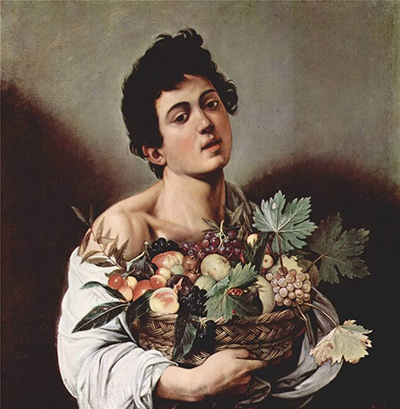
In Boy with a Basket of Fruit, a young man holds a basket so close to the front of the picture that its leaves, grapes and rounded fruit compete with his face for attention. Caravaggio makes the figure and the still life equally present. The painting belongs to the Galleria Borghese in Rome, whose catalogue dates it to about 1595. It is an early work, made before the large public chapel paintings that would establish his Roman reputation.[1][2]
The canvas has a distinct collection history. It was among paintings in the possession of Giuseppe Cesari, the Cavalier d'Arpino, confiscated in 1607 and passed to Cardinal Scipione Borghese. Another early Caravaggio from that group, Young Sick Bacchus, is also in the Borghese collection. These records provide firmer ground than a story invented from the boy's expression alone.[1][3]
Caravaggio in context
The Cardsharps
c.1595Calling of Saint Matthew
1599–1600Supper at Emmaus
1601At a Glance
- ArtistMichelangelo Merisi da Caravaggio, accepted by the present owner after earlier attribution debate[1]
- TitleBoy with a Basket of Fruit (Giovane con canestra di frutta)[1]
- Dateabout 1595 in the Galleria Borghese catalogue[1]
- Mediumoil on canvas[1]
- Dimensions70 × 67 cm, height × width[1]
- CollectionGalleria Borghese, Rome, inventory 136[1]
- Recorded early ownerGiuseppe Cesari; transferred through the 1607 confiscation to Scipione Borghese[1]
Contents
- What the Painting Shows
- What a Horticulturist Sees in the Basket
- The Basket as a Subject
- The Youth and the Fruit Together
- A Lombard Fruit-Seller Comparison
- An Early Roman Work
- The Route into the Borghese Collection
- Another Fruit Painter in Cesari's Collection
- Attribution and Dating
- Comparing Other Fruit Paintings
- Frequently Asked Questions
Look closer: Boy with a Basket of Fruit
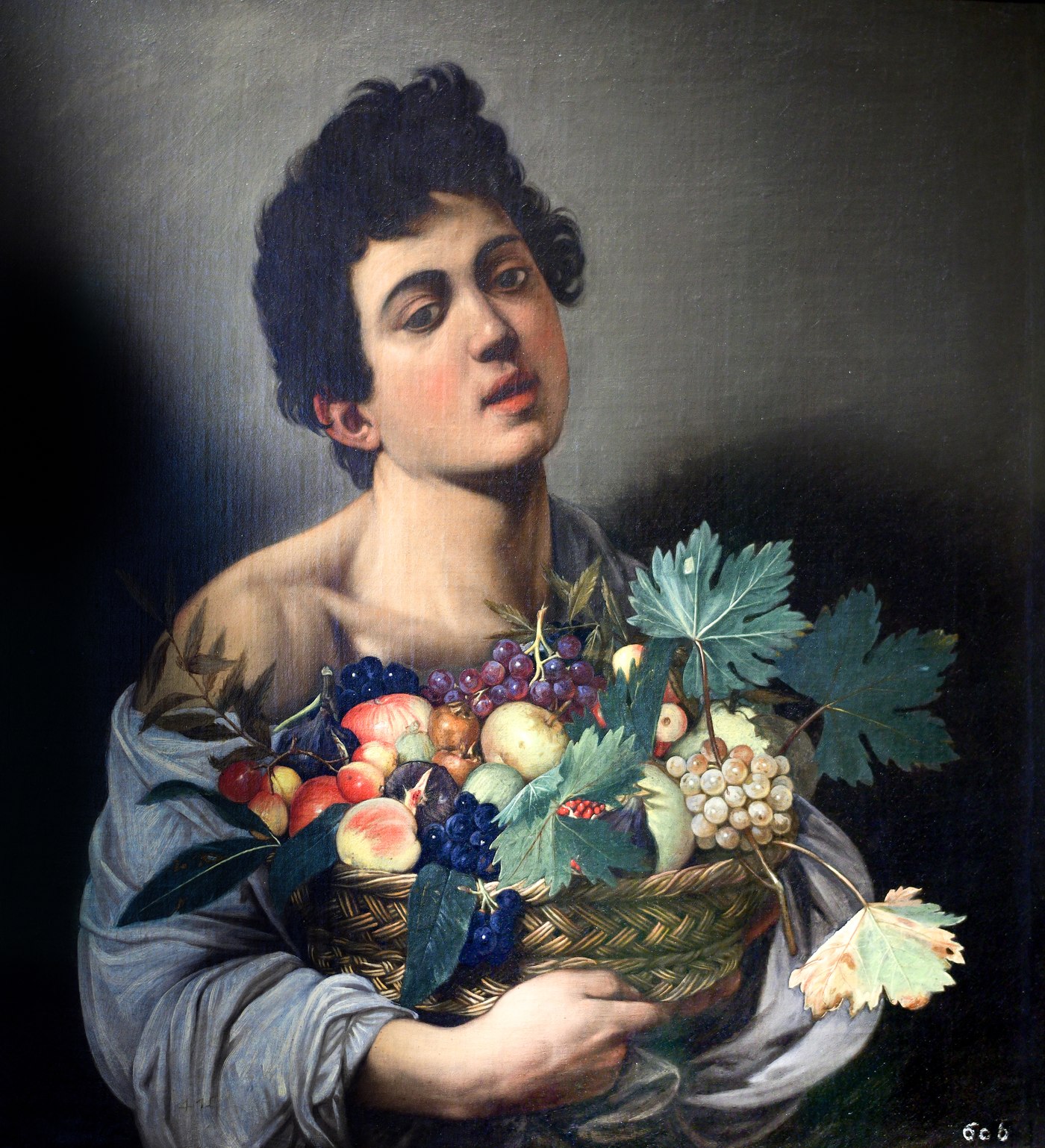
The figure and the basket press into the same shallow foreground. Details show the contrast between soft flesh, varied fruit and woven fibres.
 123
Details from Boy with a Basket of Fruit
Select a detail image to open the full-size gallery, then use the arrows to compare views.
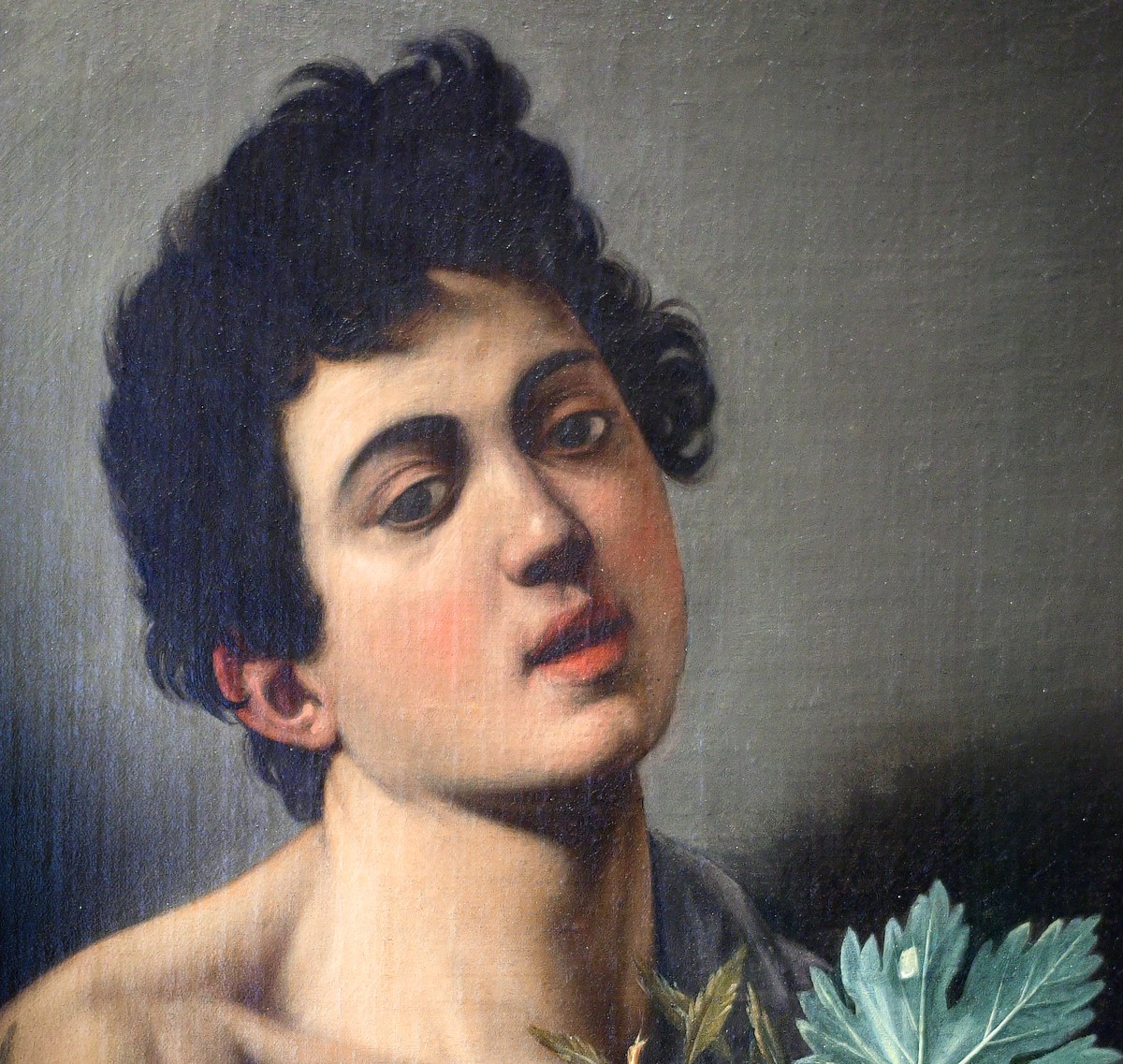
The boy’s face
The boy turns his head toward the viewer while light defines the cheek, lips and loose curls.
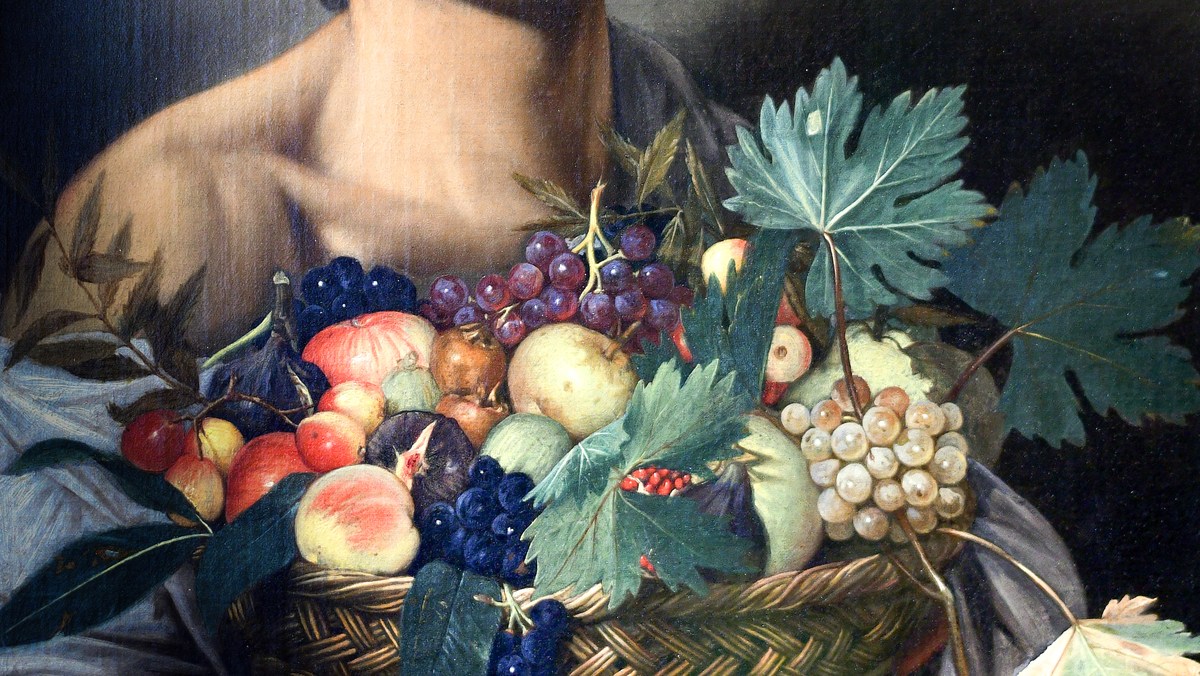
The fruit and leaves
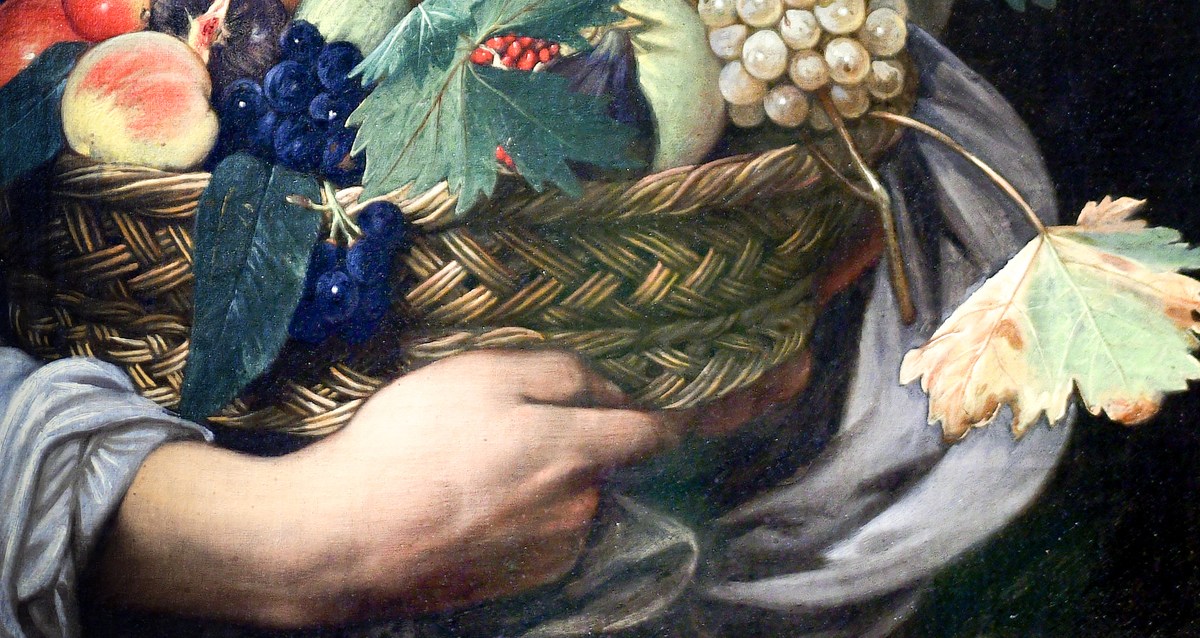
Clusters of grapes, rounded fruit and broad leaves fill the basket, creating a dense arrangement in front of the boy.
The supporting hands
The boy’s hands carry the heavy basket at its lower edge, connecting the still life to the pose.
What the Painting Shows
The young man is seen from roughly the waist upward. He wears a loose white shirt that slips from one shoulder and turns his head toward the viewer. Both arms hold a woven basket across his body. The arrangement is simple, yet the eye keeps moving between the youth's exposed skin, folds of cloth, leaves and fruit. The basket is not a small accessory tucked into a corner; it fills much of the picture's lower half.[1]
Grapes and apples appear among autumn leaves. The Galleria Borghese emphasises the fruit's natural imperfections rather than an idealised harvest. This is a useful way to look at the painting: the surfaces differ in weight, texture and ripeness. Thin leaves curl around larger rounded forms, while the boy's hands have to support the mass in front of him. The detail invites slow attention without requiring a single hidden allegory for each grape.[1]
The young man's gaze can seem direct or distracted depending on which part of the picture one looks at first. It is tempting to give him a name or personal story, but no secure identification of the model follows from the cited owner record. The object is a composed painting of a youth and fruit, not an archival portrait of a named sitter.
What a Horticulturist Sees in the Basket
Horticulturist Jules Janick examined Caravaggio's fruit paintings as evidence of how particular plants were represented. In this canvas he identifies a blushed peach, clusters of grapes in different colours, a split pomegranate, ripe figs, medlars, apples and branches of small pears. This is a more varied basket than the quick label “grapes and apples” suggests. Janick also points to blemishes and discoloration on leaves and fruit, including a spotted grape leaf.[13] His plant list encourages a reader to look from one kind of skin and leaf to another rather than treating the basket as a single coloured mass.
Some of Janick's further descriptions are diagnostic suggestions from the painted image. For example, he compares a pale mark on a grape leaf to an insect egg mass and describes other spots as possibly fungal. A painted mark cannot identify an insect species or establish the condition of a real plant through laboratory examination. It is valuable evidence of Caravaggio's attention to irregular forms; it is not evidence that the painter intended a botanical case study.[13]
Janick's proposed 1592 date and his identification of the boy as Mario Minniti are also separate claims from his fruit observations. The Galleria Borghese currently dates the painting about 1595 and does not securely name its sitter.[1][13] A specialist may be particularly well placed to describe fruit without having resolved the painting's disputed early chronology or the identity of the person who posed. These evidential questions should not be bundled into one apparent certainty.
The Basket as a Subject
The basket sits at a point where figure painting meets still life. It has the density of an independent subject, but it gains scale and movement from the arms holding it. The contrast gives Caravaggio a way to demonstrate close observation of two kinds of form: skin and cloth on one side, perishable plants and woven material on the other. The Borghese record describes this naturalism as a step toward the focused Basket of Fruit later made for Cardinal Federico Borromeo and now in Milan.[1]
That comparison is valuable, but the works should not be collapsed into one. Boy with a Basket of Fruit is a near-square figure painting in Rome. The Ambrosiana Basket of Fruit is an independent still life in Milan with a separate owner and history. A search for “Caravaggio fruit basket” can return either, so title, collection and image caption should identify the right object.[1][4]
The imperfections of fruit often prompt moral readings about time and decay. They may invite such interpretation, but the owner's primary account establishes what can be seen rather than assigning a guaranteed message to every leaf. A good reading separates observation from inference: name the grapes and blemished foliage first, then explain a possible reflection on transience as a possibility rather than a fact about Caravaggio's intention.
The Borghese catalogue records how differently historians have interpreted the same offering. Giulio Carlo Argan read the imperfect leaves as signs of beauty passing away. Other writers have proposed Autumn, the Roman figure Vertumnus, Taste, vanitas, erotic invitation or Christian love. The gallery reports these as competing interpretations, not as a list of meanings simultaneously confirmed by a document.[1] Some depend heavily on the youth's expression or on the basket being read as a gift. Those features are visible, but neither tells us what a patron requested. The breadth of proposals is itself useful evidence of how little a conventional title settles the subject.
The Youth and the Fruit Together
The picture's visual tension lies in the balance between the human figure and the fruit. The youth holds the basket high enough to meet his chest, so the produce and face occupy adjacent spaces. His white shirt makes the darker leaf shapes legible; the fruit gives his hands a clear action. The physical burden of the basket stops the work from being simply a display of isolated botanical specimens.
Caravaggio's early subjects often place a small human drama around everyday things. The Fortune Teller uses a hand-reading encounter; Boy Bitten by a Lizard turns contact with a still life into a sudden recoil. Here the moment is quieter. The basket is held, the sitter is present, and the viewer has time to examine the objects. Comparing these works makes the range of early experimentation visible without pretending they were designed as a formal series.[2][5]
The pose also raises a practical question about making the painting. A youth holding a full basket could sit for an artist; separate elements might be adjusted during work. Analysis reported by the Borghese gallery in 2012 found a preparatory sketch made directly on the canvas. This is evidence of planning beneath the finished image, although it does not establish precisely how many sittings or mirrors Caravaggio used.[1]
A Lombard Fruit-Seller Comparison
Vincenzo Campi's Fruit Seller at the Pinacoteca di Brera offers a documented earlier comparison. Brera dates the much larger canvas to 1578–81. Its female seller presents a bunch of grapes amid baskets and vessels crowded with fruit and vegetables, with a landscape behind. The museum places it in a group of four genre paintings and describes the careful rendering of individual goods as important to the development of still life in Lombardy.[9]
Caravaggio's Borghese boy also holds fruit toward the viewer, but the near-square canvas strips away Campi's market abundance, landscape and broader narrative. A basket and a single person now take almost the whole field. The comparison makes an artistic choice visible: produce can be displayed as one part of a busy trade scene or made equal in scale and attention to a human face. Campi's work predates Caravaggio's Roman canvas, but neither the Brera record nor a similarity of subject proves that Caravaggio copied this exact painting.[1][9]
Art historian Michael Viktor Schwarz offers a different, classical comparison. Pliny the Elder tells of Zeuxis painting a boy with grapes so convincing that birds flew toward the fruit; Zeuxis complained that he had rendered the boy less persuasively, or the birds would have feared him. Schwarz proposes that Caravaggio's equally forceful rendering of boy and fruit may answer that ancient challenge. This is a modern interpretation of a possible artistic ambition, not a documented commission, title or proof that Caravaggio consciously illustrated Pliny. It helps readers see why the relative visual weight of youth and basket matters.[10][11]
An Early Roman Work
The Galleria Borghese dates the canvas to about 1595 and links it to Caravaggio's period in the workshop of Giuseppe Cesari. Rome's official Caravaggio itinerary gives an earlier range, 1593–95, for this and Young Sick Bacchus. These are catalogue judgments, not a day-and-month creation record. The Borghese owner's current c.1595 date is the sensible facts-box lead, while the broader chronological discussion can acknowledge different published ranges.[1][2]
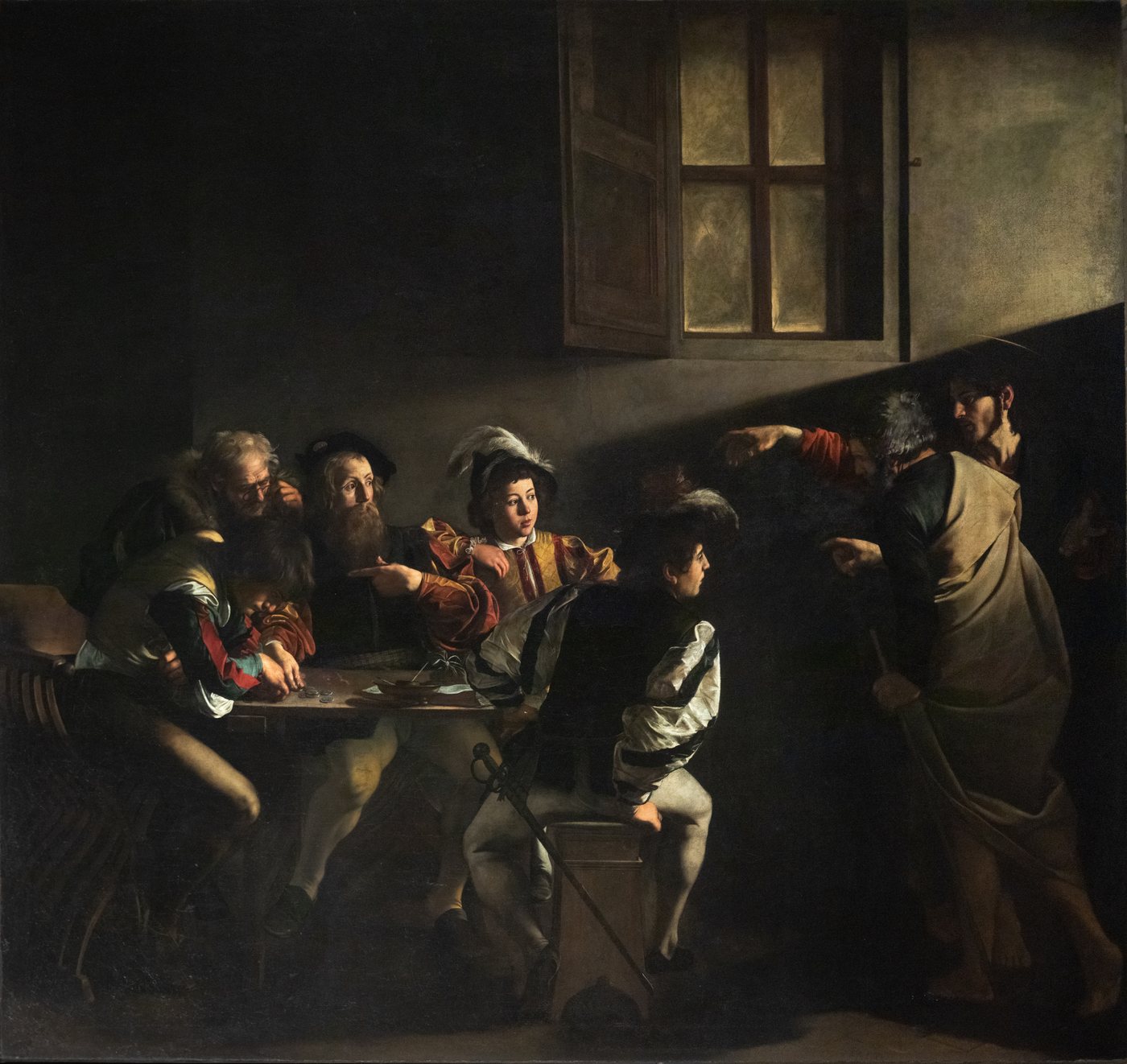
The early period matters because the picture precedes the celebrated Contarelli Chapel canvases. The Calling of Saint Matthew and Martyrdom of Saint Matthew are large public works dated 1599–1600. Boy with a Basket of Fruit is small enough for a private collection and focuses on a single youth. It shows the precise looking and dense presence that would later serve more complex sacred narratives, but its immediate subject is not a biblical event.[2][6]
Biographical accounts of Caravaggio's first years in Rome have been revised by archival discoveries. That is another reason to use an owner catalogue date rather than build a false exact chronology from familiar anecdotes about arrival, illness or a particular patron. The painting's recorded passage through Cesari is more secure than identifying its first buyer from an unsupported story.[1][7]
The Borghese catalogue shows the range behind its short label “about 1595.” It reports older proposals as early as 1589–90 and a 1592–94 dating by Denis Mahon. Alessandro Zuccari later argued for 1596–97 after revising Caravaggio's arrival in Rome, placing this canvas after Young Sick Bacchus and before a Boy Bitten by a Lizard version.[1] Those are reconstructions of a sequence, not dated documents attached to this picture. The disagreement changes how confidently one can say it was painted at a precise point in Cesari's workshop. The secure collection fact is that it was in Cesari's possession by the 1607 seizure.
The Route into the Borghese Collection
The owner records the painting in Cesari's collection before 1607. In that year officials acting under Pope Paul V confiscated Cesari's pictures in a case connected with possession of firearms. The group included 107 paintings; Boy with a Basket of Fruit and Young Sick Bacchus were subsequently given to the pope's nephew Scipione Borghese. The gallery's record cites the confiscation inventory and later Borghese inventories.[1]
This route is remarkable, but it should not be romanticised as a voluntary gift from Cesari or a direct commission by Scipione. The 1607 event explains how an early Caravaggio picture entered a major Roman collection. It does not tell us every transaction by which it first came into Cesari's hands. The cited inventory's description of a youth holding a basket is an important object anchor because it connects a subject, collection and historical moment.[1]
The Galleria Borghese assigns the work inventory number 136. That identifier distinguishes it from other youthful Caravaggio figures in the same institution.
The trail continues after Scipione Borghese. The gallery records the painting in Borghese inventories of 1693 and 1790, in the family's 1833 fideicommissary inventory, and in the Italian state's 1902 acquisition. These entries matter because they connect a picture named for a youth and a fruit basket across changes of catalogue wording and ownership arrangements.[1] They do not fill the earlier gap between Caravaggio's painting of the canvas and Cesari's possession of it.
The 1790 inventory also listed an “uomo con canestra di fiori,” a man with a basket of flowers, under Caravaggio's name. The Borghese catalogue says that other work did not pass through the 1833 fideicommissary inventory.[1] It must not be silently treated as a variant title for the surviving boy and fruit basket, or as proof of another extant Caravaggio painting. The documented descriptions distinguish fruit from flowers and give the second entry a different subsequent record. The point is a limit on identification, not a new attribution.
The gallery's searchable inventory index adds a caution to this trail. It links an 1809 entry headed as a shipment to Turin to today's inventory 136, yet the transcribed line calls the subject a man with a basket of flowers. An 1812 entry also says flowers and marks its identification with 136 with a question mark. An 1816 return-from-Paris list is linked to 136 but describes a head with a flower basket and gives dimensions of 66 × 49.5 cm, unlike the present canvas's 70 × 67 cm.[14] These records show how the museum has grouped possible references for study. Their differing words and measurements do not prove that this particular Caravaggio travelled to Turin or Paris. The fruit-basket descriptions in 1607, 1693 and the separate 1790 entry remain the clearer anchors.[1][14]
Another Fruit Painter in Cesari's Collection
The 1607 seizure included more than Caravaggio's two surviving Borghese pictures. The same museum catalogues a separate Vase of Flowers, Fruit, and Vegetables and its companion Still Life with Birds from Cesari's collection under the provisional name Master of Hartford. Both were once proposed as Caravaggios. The owner now treats them as the work of a still unidentified painter close to the Cesari workshop, while acknowledging that the master's identity has been debated.[12]
The distinction rests on more than the paintings' titles. The Borghese catalogue says 2016 technical examination linked the two large still lifes to one another: both use two horizontally joined canvas pieces, a thin, methodical line on the ground and carefully layered paint. These findings support a common hand for that pair, but the museum explicitly says they do not establish the painter's name. The same entry compares their light and baskets with Caravaggio's early work while keeping Boy with a Basket of Fruit a separate, accepted Caravaggio canvas.[12][1]
This is why Cesari's ownership cannot serve as an attribution shortcut. Several painters and objects could be present in his circle; a shared route into Scipione Borghese's collection establishes provenance, not that every fruit painting came from Caravaggio's brush. It also makes the boy's canvas more distinctive: the fruit is intimately joined to one figure, whereas the Hartford pair builds elaborate still-life fields without a human carrier.[12][1]
Attribution and Dating
The picture is now catalogued as Caravaggio by its owner, yet the record is candid about an earlier debate. Some nineteenth- and early twentieth-century scholars doubted the attribution or regarded it as a copy. Others, including Roberto Longhi and Denis Mahon, argued for Caravaggio. The Borghese account describes later scholarly acceptance of the autograph painting. Its present attribution has a history of reassessment.[1]
That history is more precise than a simple story of discovery. Giovanni Piancastelli questioned the painting in 1891; Adolfo Venturi defended its attribution in the gallery's first catalogue two years later. Matteo Marangoni later published it as an old copy, while Longhi, Mahon and others argued for Caravaggio before the gallery's current consensus formed.[1] The old inventories anchor the picture's presence in the collection, but an early written attribution is not by itself a laboratory test of the paint. Conversely, the 2012 discovery of a sketch beneath this canvas strengthens study of its making without converting every proposed date or symbolic reading into certainty.
The date has a similar need for precision. A c.1595 catalogue date is not a license to assign every detail to one narrow episode in Caravaggio's life. Nor should a provisional date from an older general list override the present owner's record without explanation. The work can be discussed as early Roman Caravaggio while preserving the approximate nature of the dating.[1][2]
The owner's record lists treatment in 1963–64 and 2001, with diagnostic work in 2000.[1] It separately reports a sketch directly on the canvas revealed by investigations described as 2012 in its catalogue essay. These dates tell us that the present painted surface and the evidence beneath it have been examined at different times; the short public record does not explain how every line of the sketch was detected or what each intervention changed. A sketch on this canvas is consistent with preparation, but it cannot identify a lost paper drawing, a named model or a precise year of execution.[1]
Attribution and interpretation are different questions. A painting can be accepted as Caravaggio and still leave its sitter, commission and symbolic intention uncertain. The first question concerns maker; the others require separate evidence. The basket's details may be close observation, allegory, display of skill or some combination. None needs to be settled by inventing a patron's instruction.
Comparing Other Fruit Paintings
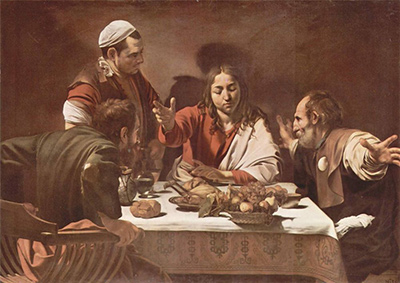
The Ambrosiana Basket of Fruit removes the human carrier and lets the still life stand alone. The Uffizi Bacchus and Borghese Young Sick Bacchus put grapes beside figures associated with the wine god. The Supper at Emmaus sets fruit on a table within a dramatic religious recognition. These are distinct objects made for different settings, but comparison shows how fruit can shift from a principal subject to a narrative detail.[1][4][8]
Close looking begins with each painting's own facts. It is especially important online, where a crop of the fruit could be detached from the boy and mistakenly used as an image of the Milan still life. The full figure-and-basket composition, title and Borghese credit should stay together in the primary image.
The Morgan Library & Museum displayed the Borghese picture on loan in New York from 16 January to 19 April 2026. Its focused exhibition placed the canvas alongside earlier Milanese and Annibale Carracci works and later Roman responses. That curatorial grouping asks a different question from pairing Caravaggio's own fruit paintings: how a naturalistic image of an ordinary youth challenged more idealised figure painting and how later artists responded.[15] The exhibition is evidence of a modern comparison, not a record that Caravaggio saw each work in the display. Its concluded loan also does not change the canvas's Borghese ownership or guarantee a present room assignment in Rome.[1][15]
Explore the Caravaggio collection
| Name | Date | Type |
|---|---|---|
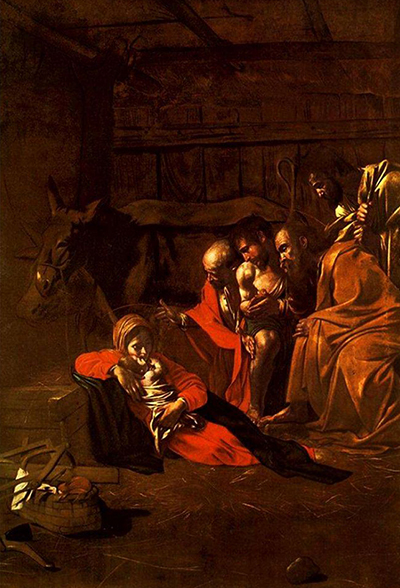
| Adoration of the Shepherds by Caravaggio: The Messina Nativity | 1608–09; precise order relative to Resurrection of Lazarus remains unresolved | Artwork |
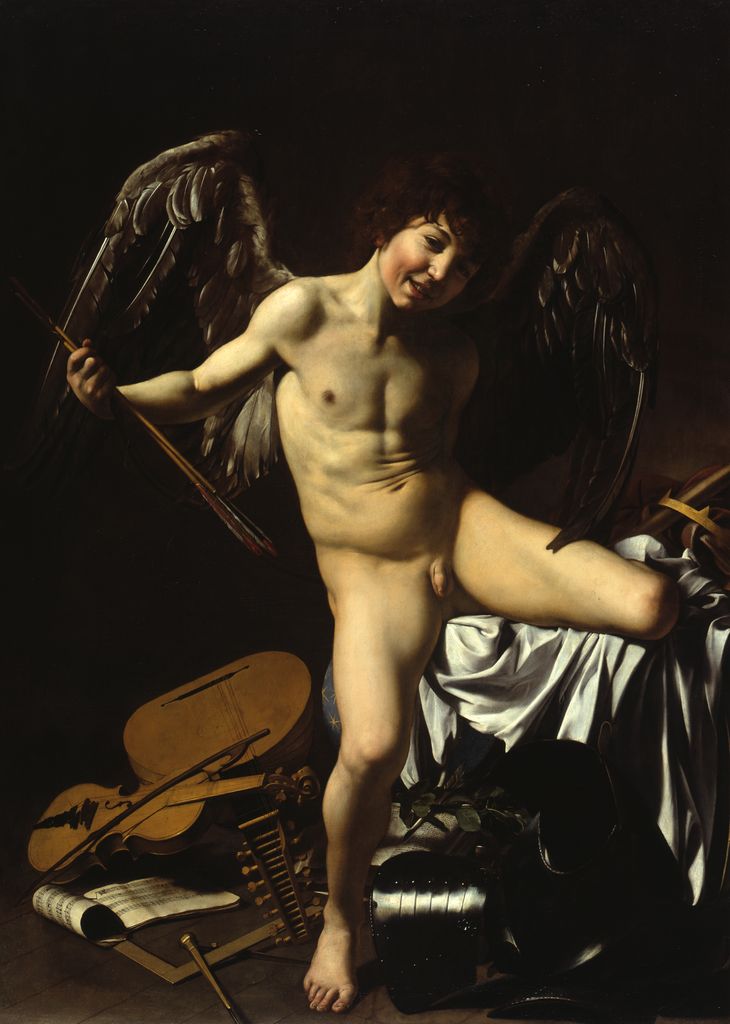
| Amor Victorious by Caravaggio | 1601–02 in the Berlin owner record | Artwork |
| Bacchus by Caravaggio: The Uffizi Painting | about 1598, according to the Uffizi | Artwork |
| Basket of Fruit by Caravaggio | after 1597, probably around the turn of the seventeenth century, according to the Ambrosiana | Artwork |
| Boy Bitten by a Lizard: Caravaggio's London Painting | about 1594–95 in the National Gallery's current catalogue; URL suffix “1596” is inherited | Artwork |
| Boy Bitten by a Lizard: The Florence Version Attributed to Caravaggio | disputed; Longhi's catalogue record preserves historical 1592–93 and other proposed ranges, including c.1597 | Artwork |
| Boy Peeling Fruit by Caravaggio: The Royal Collection Painting | about 1592–93 in the owner's current exhibition record | Artwork |
| Boy Peeling Fruit in Florence: A Derivation from Caravaggio | — | Artwork |
| Boy with a Basket of Fruit by Caravaggio | about 1595 in the Galleria Borghese catalogue | Artwork |
| Caravaggio Paintings in Rome: Churches, Museums and a Practical Route | — | Guide |
| Caravaggio Quotes: What the Documents Actually Record | — | Guide |
| Caravaggio's Lute Player: The Del Monte Painting Once Shown at the Met | about 1596–97 in the Met catalogue | Artwork |
| Caravaggio's Painting Technique: Grounds, Incisions, Revisions and Light | — | Guide |
| Christ at the Column by Caravaggio: The Rouen Flagellation | c.1606 in the owner caption; owner prose gives 1606–07 | Artwork |
| Christ on the Mount of Olives by Caravaggio: The Lost Berlin Painting | — | Artwork |
| Conversion on the Way to Damascus by Caravaggio | about 1601 in the Roma Capitale church record | Artwork |
| Crowning with Thorns by Caravaggio: The Vienna Painting | about 1603 in the 2019 KHM record; “1607” is an inherited URL suffix | Artwork |
| Crowning with Thorns in Prato: Attributed to Caravaggio | about 1602–03 in the collection presentation | Artwork |
| David with the Head of Goliath by Caravaggio: The Borghese Painting | 1606–07 or 1609–10 in the Galleria Borghese catalogue; the later Naples period is favoured by many scholars, while the owner keeps the question open | Artwork |
| David with the Head of Goliath by Caravaggio: The Prado Painting | about 1600 in Prado material; “1599” survives only in the legacy URL | Artwork |
| David with the Head of Goliath by Caravaggio: The Vienna Painting | about 1600–01 in the KHM's 2019 exhibition record; “1607” is a legacy route label | Artwork |
| Did Caravaggio Make Drawings? What Survives and What Paintings Reveal | — | Guide |
| Ecce Homo: Caravaggio's Madrid Rediscovery and the Genoa Painting | — | Artwork |
| John the Baptist in Caravaggio's Paintings: A Guide to the Different Versions | — | Artwork |
| Judith Beheading Holofernes by Caravaggio | beginning of the seventeenth century in the owning museum's account; about 1599–1600 in the Kimbell's 2025 loan label; around 1602 in one specialist catalogue | Artwork |
| Jupiter, Neptune and Pluto: Caravaggio's Ludovisi Ceiling | about 1597; the archive connects the work with Cardinal del Monte's 1597 commission | Artwork |
| Madonna and Child with Saint Anne by Caravaggio: The Palafrenieri Altarpiece | 1605 in the Galleria Borghese object field; completed and delivered by 8 April 1606 | Artwork |
| Madonna of Loreto by Caravaggio: The Pilgrims at Sant'Agostino | broadly c.1604–06; institutional records differ slightly in their starting year | Artwork |
| Madonna of the Rosary by Caravaggio: The Vienna Altarpiece | around 1603 in the Kunsthistorisches Museum's object record | Artwork |
| Martha and Mary Magdalene by Caravaggio: The Detroit Painting | about 1598 in the Detroit Institute of Arts record | Artwork |
| Medusa by Caravaggio: The Uffizi Painted Shield | 1596–98 in the Uffizi's virtual exhibition; specialist research reports the shield delivered to the Medici wardrobe by 7 September 1598 | Artwork |
| Narcissus, Attributed to Caravaggio | dependent on attribution; the Zeri catalogue gives a broad 1610–50 range under Spadarino | Artwork |
| Nativity with Saint Francis and Saint Lawrence: Caravaggio's Missing Painting | somewhere in 1600–09 in the parliamentary report; a specific 1609 execution and place remain debated | Artwork |
| Penitent Mary Magdalene by Caravaggio | 1597 in the owner's catalogue, during Caravaggio's early Roman activity | Artwork |
| Portrait of a Courtesan: Caravaggio's Lost Berlin Portrait | Berlin's data field says c.1590, while its own text compares a Caravaggio work of c.1598; precise date unresolved | Artwork |
| Portrait of Alof de Wignacourt and His Page by Caravaggio | — | Artwork |
| Portrait of Fra Antonio Martelli? Caravaggio's Pitti Knight of Malta | 1608 in the Restituzioni object heading; within Caravaggio's Malta period | Artwork |
| Portrait of Maffeo Barberini: The Seated Corsini Painting | c.1596–97 in the national catalogue | Artwork |
| Portrait of Monsignor Maffeo Barberini: Caravaggio's Newly Acquired Painting | around the late 1590s / age thirty; “1598” in the inherited address is approximate, not an exact document date | Artwork |
| Portrait of Pope Paul V: A Caravaggio Attribution and a Borghese Copy | — | Artwork |
| Prints After Caravaggio: Who Made Them and What They Show | — | Guide |
| Reclining Saint John the Baptist: A Disputed Caravaggio Attribution | often proposed for the artist's final years; the later museum list does not give a precise year. | Artwork |
| Rest on the Flight into Egypt by Caravaggio | about 1597 in the owner's catalogue | Artwork |
| Saint Catherine of Alexandria by Caravaggio: The Thyssen Painting | about 1598–99 in the Museo Nacional Thyssen-Bornemisza catalogue | Artwork |
| Saint Francis in Meditation by Caravaggio: The Cremona Painting | 1603–06 in the owner account; c.1605–06 in a KHM exhibition caption | Artwork |
| Saint Francis in Prayer: Caravaggio's Carpineto Painting | 1606 in a 2016–17 exhibition work list | Artwork |
| Saint Francis of Assisi in Ecstasy by Caravaggio | c.1595–96 in the owner wall text | Artwork |
| Saint Jerome in Meditation: Caravaggio's Montserrat Painting | 1605 in the owner record; an owner publication reports scholarship placing it about 1605–06 | Artwork |
| Saint Jerome Writing by Caravaggio: The Borghese Painting | c.1606 in the owner catalogue; the “1605” URL suffix is inherited | Artwork |
| Saint Jerome Writing by Caravaggio: The Malta Painting | around 1607–08; foundation dates Malaspina's commission to 1608 | Artwork |
| Saint John in the Wilderness at Toledo Cathedral | exact 1598 not established by the cited cathedral account. | Artwork |
| Saint John the Baptist at Galleria Corsini, Rome | about 1606 in the national record; older proposals ranged from the late 1590s onward. | Artwork |
| Saint John the Baptist at the Capitoline Museums, Rome | 1602. | Artwork |
| Saint John the Baptist at the Galleria Borghese | 1609–10 in the current Borghese record. | Artwork |
| Saint John the Baptist at the Spring: The Bonello Painting in Malta | early seventeenth century in the institutional account; a precise 1608 is not established there. | Artwork |
| Saint Matthew and the Angel: Caravaggio's Lost First Altarpiece | — | Artwork |
| Salome Receives the Head of John the Baptist: Caravaggio's London Painting | about 1609–10, likely late Naples period in the Gallery's account | Artwork |
| Salome with the Head of John the Baptist: Caravaggio's Madrid Painting | — | Artwork |
| Sleeping Cupid by Caravaggio: The Painting Made in Malta | about 1608, Malta period | Artwork |
| Still Life with Fruit on a Stone Ledge: Is It by Caravaggio? | — | Artwork |
| Supper at Emmaus (1606): Caravaggio's Brera Painting | — | Artwork |
| The Annunciation by Caravaggio in Nancy | c.1607–10 in the collection record; 1608–10 in the museum's restoration account | Artwork |
| The Basel Saint John the Baptist: Once Labelled Caravaggio, Now Maíno | about 1608–10 in that schedule, rather than the legacy URL's 1600. | Artwork |
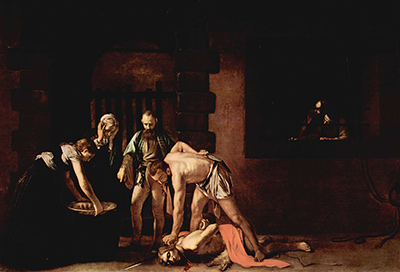
| The Beheading of Saint John the Baptist by Caravaggio | about 1608; installed in the Oratory on 29 August 1608 | Artwork |
| The Burial of Saint Lucy by Caravaggio in Syracuse | 1608, during Caravaggio's Syracuse stay | Artwork |
| The Calling of Saint Matthew by Caravaggio | about 1599–1600 | Artwork |
| The Calling of Saints Peter and Andrew by Caravaggio | about 1602–04 in the Trust's object text | Artwork |
| The Cardsharps by Caravaggio | about 1596–97 in the Kimbell's current object record | Artwork |
| The Conversion of Saint Paul: Caravaggio's Odescalchi Panel | commissioned in 1600; painted around 1600–01 | Artwork |
| The Crucifixion of Saint Andrew by Caravaggio | 1606–07 | Artwork |
| The Crucifixion of Saint Peter by Caravaggio | about 1601 | Artwork |
| The Death of the Virgin by Caravaggio | commissioned 1601; completed late 1605 or early 1606, according to the Louvre | Artwork |
| The Denial of Saint Peter by Caravaggio | 1610 | Artwork |
| The Doria Pamphilj Saint John the Baptist: A Second Youth with a Ram | linked compositionally to the Capitoline 1602 picture; an exact production year for this canvas is not established by the owner pages used here. | Artwork |
| The Entombment of Christ by Caravaggio: The Vatican Deposition | about 1600–04 in Vatican Museums publication material | Artwork |
| The Flagellation of Christ by Caravaggio: The Capodimonte Altarpiece | around 1607, in the first Naples period | Artwork |
| The Fortune Teller by Caravaggio: The Louvre Version and Its Roman Counterpart | — | Artwork |
| The Holy Family with the Infant Saint John the Baptist by Caravaggio | early 1600s in the Met catalogue; no more exact owner date asserted here | Artwork |
| The Incredulity of Saint Thomas by Caravaggio | about 1601 in the SPSG presentation | Artwork |
| The Inspiration of Saint Matthew by Caravaggio | usually 1602; also catalogued 1602–03, for the installed final altarpiece | Artwork |
| The Lute Player by Caravaggio: The Hermitage Painting | about 1596 in the Hermitage collection publication; the Hermitage Friends restoration page gives about 1595–96 | Artwork |
| The Magdalen in Ecstasy: Caravaggio, Copies and a Disputed Original | — | Artwork |
| The Martyrdom of Saint Matthew by Caravaggio | 1599–1600; unveiled with The Calling in 1600 | Artwork |
| The Martyrdom of Saint Ursula by Caravaggio | — | Artwork |
| The Musicians by Caravaggio | 1597 | Artwork |
| The Resurrection of Lazarus by Caravaggio in Messina | 1609; delivered 10 June 1609 in the owner account | Artwork |
| The Sacrifice of Isaac by Bartolomeo Cavarozzi: A Former Caravaggio Attribution | about 1615–17 in the Nicholas Hall catalogue; “1598” is an inherited URL label, not the accepted date | Artwork |
| The Sacrifice of Isaac by Caravaggio: The Uffizi Painting | about 1603 in the Uffizi catalogue | Artwork |
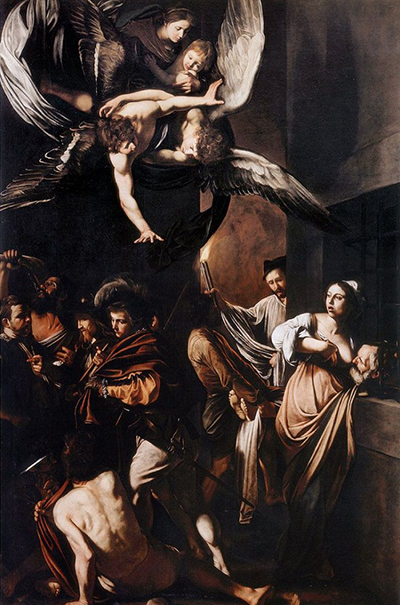
| The Seven Works of Mercy by Caravaggio | 1606–07, according to the Pio Monte | Artwork |
| The Supper at Emmaus by Caravaggio: The London Painting | 1601 | Artwork |
| The Taking of Christ by Caravaggio | 1602 | Artwork |
| The Toulouse *Judith Beheading Holofernes*: A Caravaggio Attribution Debate | c.1606–07 if identified with the recorded Naples work; that identification is debated | Artwork |
| Young Sick Bacchus by Caravaggio | about 1595 in the Galleria Borghese catalogue | Artwork |
| Youth with a Ram: Why Caravaggio's Saint John Looks So Unusual | — | Artwork |
No matching pages found.
Discussion
Share a close observation about Boy with a Basket of Fruit by Caravaggio or a source that clarifies its history.
Which detail changes your reading?
Is there a collection record or document worth comparing?
What remains uncertain?
Join the Conversation
Frequently Asked Questions
Where is Boy with a Basket of Fruit?
It belongs to the Galleria Borghese in Rome, inventory 136. The owner lists it in Sala 8; room placement may change, so a visitor should check the museum's current display information.[1]
When did Caravaggio paint it?
Is it the same painting as Basket of Fruit?
Is the young man identified?
The cited owner record does not securely name the sitter. Describing his pose and appearance is sounder than assigning him a biography.
How did it reach the Borghese collection?
It was recorded among Giuseppe Cesari's pictures, confiscated in 1607 and transferred to Scipione Borghese, according to the gallery's provenance account.[1]
References
- Galleria Borghese, Giovane con canestra di frutta, inv. 136, object, provenance and attribution record.
- Roma Capitale, “I luoghi di Caravaggio”, early Roman group and Contarelli chronology.
- Galleria Borghese, Autoritratto in veste di Bacco (Bacchino malato), inv. 534, paired Cesari provenance.
- Pinacoteca Ambrosiana, Basket of Fruit, distinct Milan work.
- National Gallery, London, Boy bitten by a Lizard, NG6504, early genre comparison.
- Metropolitan Museum of Art, Caravaggio and his followers, 1600 public commission.
- Italian Ministry of Culture, new archival documents on Caravaggio in Rome, revised early-life evidence.
- National Gallery, London, The Supper at Emmaus, NG172, still life in narrative setting.
- Pinacoteca di Brera, Vincenzo Campi, Fruttivendola (Fruit Seller), inventory 397, object date, composition and Lombard still-life context.
- Michael Viktor Schwarz, “What Is Style For?,” ARS 39 (2006), pp. 21–32, scholarly comparison with Zeuxis.
- Pliny the Elder, Natural History, book 35, section 66, English translation of the Zeuxis account.
- Galleria Borghese, Vase of Flowers, Fruit, and Vegetables, inventory 054, Master of Hartford attribution and 2016 technical comparison with Still Life with Birds.
- Jules Janick, “Caravaggio's Fruit: A Mirror on Baroque Horticulture,” Chronica Horticulturae 44, no. 4 (2004), Purdue University text, first-hand horticultural reading of the Borghese fruit basket; plant disorders are proposed from appearances in paint.
- Galleria Borghese digital archive, inventory records linked to present inv. 136, especially the 1809 Turin-shipment entry, 1812 entry and 1816 Paris-return entry; title and dimension discrepancies limit identification.
- Morgan Library & Museum, Caravaggio's “Boy with a Basket of Fruit” in Focus, 16 January–19 April 2026, owner loan and comparative exhibition account.
- Annotated image source: Wikimedia Commons, File:Boy with a Basket of Fruit by Caravaggio.jpg, high-resolution reproduction used for the annotated details.