 by Tom Gurney
Tom Gurney BSc (Hons) is an art history expert with over 20 years experience
Page Created on / Page Updated on
Email: tomgurney1@gmail.com / Phone: +44 7429 011000
Martha and Mary Magdalene by Caravaggio: The Detroit Painting
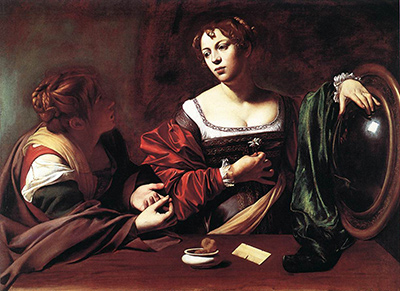
Two women face one another across a table in Caravaggio's Martha and Mary Magdalene. Martha counts arguments on her fingers; Mary turns away from a large mirror and meets the exchange. The Detroit Institute of Arts dates the painting about 1598, catalogues its medium as oil and tempera on canvas, and identifies it as accession 73.268. Its subject is an imagined moment of spiritual change, not a literal illustration of a conversation recorded word for word in the Gospel of Luke.[1]
The mirror, fine clothes, orange blossom and ring give the scene a language of worldly and religious possibilities. The museum explains them as signs in Mary's movement toward conversion. A close look can explore those details without confusing this Detroit canvas with the Penitent Mary Magdalene in the Doria Pamphilj collection, where Mary sits alone after renunciation.[1][2]
Caravaggio in context
The Cardsharps
c.1595Calling of Saint Matthew
1599–1600Supper at Emmaus
1601At a Glance
- ArtistMichelangelo Merisi da Caravaggio[1]
- TitleMartha and Mary Magdalene, also discussed as The Conversion of the Magdalene[1]
- Dateabout 1598 in the Detroit Institute of Arts record[1]
- Mediumoil and tempera on canvas, not simply oil on canvas[1]
- Dimensions100 × 134.5 cm, unframed, height × width[1]
- CollectionDetroit Institute of Arts, accession 73.268[1]
- Acquisition1973, with credit to the Kresge Foundation and Mrs Edsel B. Ford[1]
- Narrativean imagined exchange in which Martha urges Mary toward Christ[1]
Contents
- An Argument Made Visible
- Martha's Hands and Mary's Turn
- Mirror, Blossom and Ring
- Bible, Legend and Mary Magdalene
- Materials and Date
- The Painting's Route to Detroit
- Connections with Catherine and the Penitent Magdalene
- Frequently Asked Questions
An Argument Made Visible
The two women occupy a broad, dark interior. Martha leans into the conversation, counting on her fingers. Mary sits beside a mirror, luxuriously dressed and lit in a way that draws the eye to her face and hands. The action is verbal, yet Caravaggio makes it visible through gesture, attention and objects.[1]
The Detroit Institute of Arts describes Martha as reproaching her sister for worldly behaviour and enumerating Christ's miracles. Mary is shown at a turning point. Her posture and the objects around her suggest that the conversation has begun to affect her. The scene has no haloed vision or supernatural interruption; change is expressed within a human encounter.[1]
The painting's diagonal exchange encourages a viewer to move between the sisters. Martha's fingers seem to form a sequence of points. Mary's hand and glance answer with less explicit speech. The mirror behind her offers another visual focus: a person who might ordinarily look at her own appearance is now engaged with what her sister says.
The effect is dramatic because the central event is inward. A battle scene can show who wins with a gesture or a wound. Spiritual reconsideration is harder to paint. Caravaggio uses the small evidence of hands, eyes and choice of attention to make it legible without stating that Mary's conversion has already been completed.
Martha's Hands and Mary's Turn
Martha's gesture makes her role active. The museum interprets her finger-counting as an enumeration of miracles. That gives a reason for the specific form of her hands, rather than describing them as generic expressive movement. She appears to argue and persuade.[1]
Mary's turn is the answer the painting allows us to see. She remains richly clothed and close to the mirror, so worldly beauty has not simply vanished. Yet she looks toward Martha and holds a small orange blossom twig. The image combines what she has been with what she may become.[1]
The women have different emotional positions without becoming flat opposites. Martha is earnest, and Mary is receptive but still composed. The encounter feels like a conversation between people who know one another. Its closeness helps explain why the Detroit museum calls the subject an imaginary exchange rather than a direct depiction of a biblical verse.[1]
Caravaggio's light brings their faces and hands forward while leaving much of the background quiet. This focuses the story on attention: what Martha says, what Mary notices, and what the viewer notices in response. The painting belongs near other early works in which a small act carries a narrative, such as The Fortune Teller and The Cardsharps, though their subjects and ethical situations differ.[3][4]
Mirror, Blossom and Ring
The large mirror has traditionally been associated with vanity. The DIA interprets it as part of Mary's worldly surroundings at the moment she begins to change. It can also make viewers aware of looking itself: are we attending to a beautiful surface, or to the conversation that may alter Mary's life?[1]
Mary holds an orange blossom twig. The owner explains it as a sign of purity, while the ring on her left hand alludes to her status as the bride of Christ. These readings come from the museum's interpretation of the specific objects. They should be cited as such, not extended into a long speculative code for every item of clothing or reflection.[1]
The objects remain credible physical things even when they carry meaning. Blossom petals, jewellery, cloth and polished glass give Caravaggio different surfaces to paint. The contrast between the mirror's reflective field and the women's exchange is a visible part of the design. Material observation and religious symbolism work together here.
A detail annotation could help readers locate the twig, ring, mirror and counted fingers. It requires a cleared high-resolution photograph. The DIA offers a high-resolution TIFF on its object page, but a download link alone does not settle copyright and commercial website rights. The exact file and policy need review before a new export or crop is staged.
Bible, Legend and Mary Magdalene
The Detroit museum relates the subject to Luke's account of sisters Martha and Mary welcoming Jesus. In that text, Martha is occupied with service while Mary listens to him. The painting draws on a wider Western tradition that identifies the listening Mary with Mary Magdalene and imagines her conversion from worldly life. The Gospel passage itself does not literally name Martha's sister “Mary Magdalene” or recount the painted finger-counting exchange.[1][5]
That distinction matters because the article's title could otherwise suggest a direct biblical scene. Caravaggio presents a devotional narrative familiar to his audience, using the sisters' encounter to picture transformation. The narrative is meaningful even when its details come from later tradition and artistic invention rather than a transcript from scripture.
The Penitent Mary Magdalene provides a useful next step in the cluster. The Doria Pamphilj painting shows a single woman with abandoned jewellery, commonly read as Mary after renouncing a worldly life. It is a separate painting, collection and moment. The Detroit work stages persuasion and possible change between two people.[2]
The relationship between Mary Magdalene and Mary of Bethany has been understood differently across Christian traditions. The museum's subject label reflects one interpretive history; the scriptural distinction helps explain how that history shaped an early modern painting.
Materials and Date
The Detroit Institute of Arts lists the work as oil and tempera on canvas, about 1598, 100 × 134.5 cm unframed. The mixed medium is an object-specific cataloguing fact and should not be simplified to oil alone just because many Caravaggio canvases are described that way.[1]
The date situates the painting in the years before the public Contarelli Chapel works. Its broad horizontal format accommodates two figures and the table that separates and links them. The naturalistic detail of face, fabric and flower belongs to Caravaggio's developing approach to a religious theme in a collector-scale picture.
Technical studies of the Detroit painting have appeared in conservation literature, and the museum lists them among its published references. Any claim about exact pigments, order of painting or changes underneath the surface should be drawn from those object-specific studies, not from a general summary of Caravaggio's technique. The present manuscript limits material facts to what the current owner record states.[1]
The Painting's Route to Detroit
The DIA record traces the picture through the Panzani family in Arezzo, legal export through Milan in 1897, and the collection of Indalecio Gómez, the Argentine ambassador to Berlin. It later passed by descent in the Gómez de Alzaga family in Argentina. The work appeared at a 1971 Christie's London sale and entered the Detroit Institute of Arts in 1973.[1]
The donor line credits the Kresge Foundation and Mrs Edsel B. Ford. The museum's provenance also records the 1973 purchase. Those institutional facts are better than a casual statement that the painting “has always been in Detroit” or that its seventeenth-century ownership is completely known. The early provenance has gaps.[1]
The work's presence in Detroit gives the cluster a useful geographical breadth. Caravaggio's pictures survive in churches and collections across Europe and in North America. Each object's route must be sourced individually; the Detroit path cannot be inferred from that of the Thyssen Catherine or the Met's Musicians.
Connections with Catherine and the Penitent Magdalene
The Museo Nacional Thyssen-Bornemisza compares the female model in its Saint Catherine of Alexandria with a woman in this Detroit painting. It discusses proposed identifications, including Fillide Melandroni, but visual comparison is not a documented name for either sitter. The two works can be viewed together without collapsing their subjects.[6]
The Doria Pamphilj Penitent Mary Magdalene is another early painting centred on a woman's change of life. Its solitary figure and abandoned adornments differ from Detroit's conversational exchange and still-present mirror. The comparison makes the question of conversion visually rich, while each owner record keeps its own date, size and medium.[2]
The Detroit painting's lasting strength is its sense of a decision forming. Martha argues, Mary listens, and familiar objects take on new meanings. The moment remains open enough for viewers to consider what change looks like before it becomes a settled outcome.
Explore the Caravaggio collection
| Name | Date | Type |
|---|---|---|
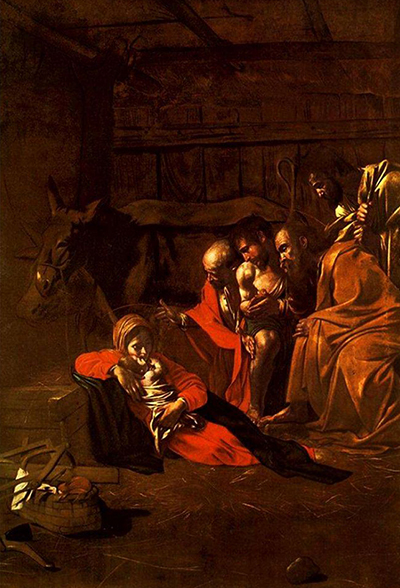
| Adoration of the Shepherds by Caravaggio: The Messina Nativity | 1608–09; precise order relative to Resurrection of Lazarus remains unresolved | Artwork |
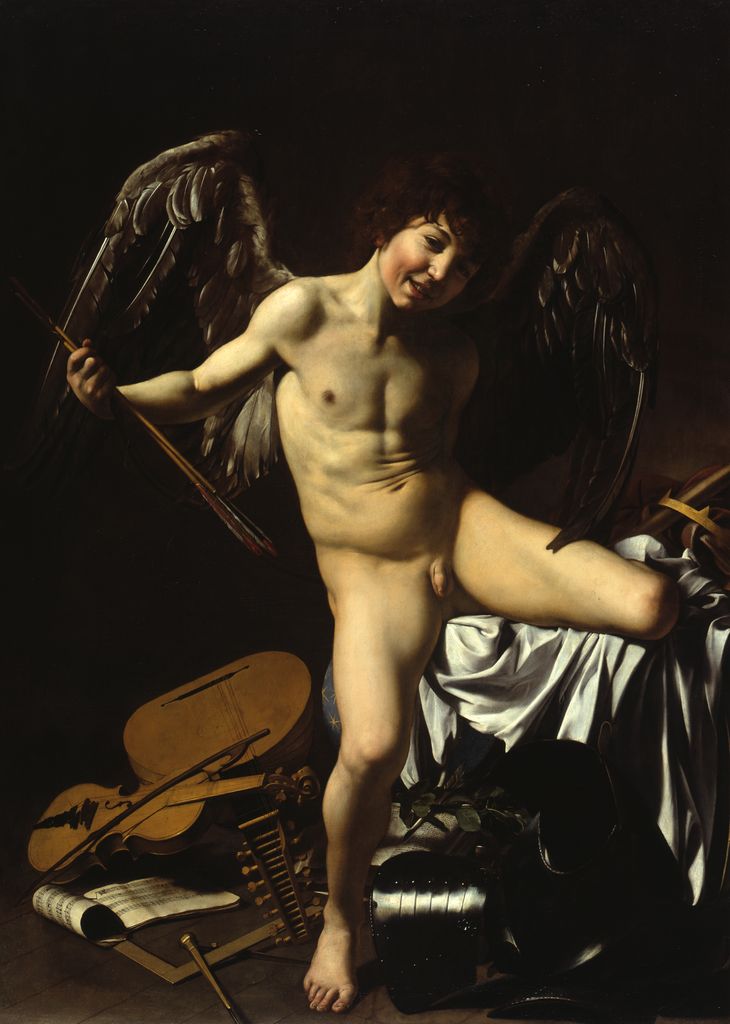
| Amor Victorious by Caravaggio | 1601–02 in the Berlin owner record | Artwork |
| Bacchus by Caravaggio: The Uffizi Painting | about 1598, according to the Uffizi | Artwork |
| Basket of Fruit by Caravaggio | after 1597, probably around the turn of the seventeenth century, according to the Ambrosiana | Artwork |
| Boy Bitten by a Lizard: Caravaggio's London Painting | about 1594–95 in the National Gallery's current catalogue; URL suffix “1596” is inherited | Artwork |
| Boy Bitten by a Lizard: The Florence Version Attributed to Caravaggio | disputed; Longhi's catalogue record preserves historical 1592–93 and other proposed ranges, including c.1597 | Artwork |
| Boy Peeling Fruit by Caravaggio: The Royal Collection Painting | about 1592–93 in the owner's current exhibition record | Artwork |
| Boy Peeling Fruit in Florence: A Derivation from Caravaggio | — | Artwork |
| Boy with a Basket of Fruit by Caravaggio | about 1595 in the Galleria Borghese catalogue | Artwork |
| Caravaggio Paintings in Rome: Churches, Museums and a Practical Route | — | Guide |
| Caravaggio Quotes: What the Documents Actually Record | — | Guide |
| Caravaggio's Lute Player: The Del Monte Painting Once Shown at the Met | about 1596–97 in the Met catalogue | Artwork |
| Caravaggio's Painting Technique: Grounds, Incisions, Revisions and Light | — | Guide |
| Christ at the Column by Caravaggio: The Rouen Flagellation | c.1606 in the owner caption; owner prose gives 1606–07 | Artwork |
| Christ on the Mount of Olives by Caravaggio: The Lost Berlin Painting | — | Artwork |
| Conversion on the Way to Damascus by Caravaggio | about 1601 in the Roma Capitale church record | Artwork |
| Crowning with Thorns by Caravaggio: The Vienna Painting | about 1603 in the 2019 KHM record; “1607” is an inherited URL suffix | Artwork |
| Crowning with Thorns in Prato: Attributed to Caravaggio | about 1602–03 in the collection presentation | Artwork |
| David with the Head of Goliath by Caravaggio: The Borghese Painting | 1606–07 or 1609–10 in the Galleria Borghese catalogue; the later Naples period is favoured by many scholars, while the owner keeps the question open | Artwork |
| David with the Head of Goliath by Caravaggio: The Prado Painting | about 1600 in Prado material; “1599” survives only in the legacy URL | Artwork |
| David with the Head of Goliath by Caravaggio: The Vienna Painting | about 1600–01 in the KHM's 2019 exhibition record; “1607” is a legacy route label | Artwork |
| Did Caravaggio Make Drawings? What Survives and What Paintings Reveal | — | Guide |
| Ecce Homo: Caravaggio's Madrid Rediscovery and the Genoa Painting | — | Artwork |
| John the Baptist in Caravaggio's Paintings: A Guide to the Different Versions | — | Artwork |
| Judith Beheading Holofernes by Caravaggio | beginning of the seventeenth century in the owning museum's account; about 1599–1600 in the Kimbell's 2025 loan label; around 1602 in one specialist catalogue | Artwork |
| Jupiter, Neptune and Pluto: Caravaggio's Ludovisi Ceiling | about 1597; the archive connects the work with Cardinal del Monte's 1597 commission | Artwork |
| Madonna and Child with Saint Anne by Caravaggio: The Palafrenieri Altarpiece | 1605 in the Galleria Borghese object field; completed and delivered by 8 April 1606 | Artwork |
| Madonna of Loreto by Caravaggio: The Pilgrims at Sant'Agostino | broadly c.1604–06; institutional records differ slightly in their starting year | Artwork |
| Madonna of the Rosary by Caravaggio: The Vienna Altarpiece | around 1603 in the Kunsthistorisches Museum's object record | Artwork |
| Martha and Mary Magdalene by Caravaggio: The Detroit Painting | about 1598 in the Detroit Institute of Arts record | Artwork |
| Medusa by Caravaggio: The Uffizi Painted Shield | 1596–98 in the Uffizi's virtual exhibition; specialist research reports the shield delivered to the Medici wardrobe by 7 September 1598 | Artwork |
| Narcissus, Attributed to Caravaggio | dependent on attribution; the Zeri catalogue gives a broad 1610–50 range under Spadarino | Artwork |
| Nativity with Saint Francis and Saint Lawrence: Caravaggio's Missing Painting | somewhere in 1600–09 in the parliamentary report; a specific 1609 execution and place remain debated | Artwork |
| Penitent Mary Magdalene by Caravaggio | 1597 in the owner's catalogue, during Caravaggio's early Roman activity | Artwork |
| Portrait of a Courtesan: Caravaggio's Lost Berlin Portrait | Berlin's data field says c.1590, while its own text compares a Caravaggio work of c.1598; precise date unresolved | Artwork |
| Portrait of Alof de Wignacourt and His Page by Caravaggio | — | Artwork |
| Portrait of Fra Antonio Martelli? Caravaggio's Pitti Knight of Malta | 1608 in the Restituzioni object heading; within Caravaggio's Malta period | Artwork |
| Portrait of Maffeo Barberini: The Seated Corsini Painting | c.1596–97 in the national catalogue | Artwork |
| Portrait of Monsignor Maffeo Barberini: Caravaggio's Newly Acquired Painting | around the late 1590s / age thirty; “1598” in the inherited address is approximate, not an exact document date | Artwork |
| Portrait of Pope Paul V: A Caravaggio Attribution and a Borghese Copy | — | Artwork |
| Prints After Caravaggio: Who Made Them and What They Show | — | Guide |
| Reclining Saint John the Baptist: A Disputed Caravaggio Attribution | often proposed for the artist's final years; the later museum list does not give a precise year. | Artwork |
| Rest on the Flight into Egypt by Caravaggio | about 1597 in the owner's catalogue | Artwork |
| Saint Catherine of Alexandria by Caravaggio: The Thyssen Painting | about 1598–99 in the Museo Nacional Thyssen-Bornemisza catalogue | Artwork |
| Saint Francis in Meditation by Caravaggio: The Cremona Painting | 1603–06 in the owner account; c.1605–06 in a KHM exhibition caption | Artwork |
| Saint Francis in Prayer: Caravaggio's Carpineto Painting | 1606 in a 2016–17 exhibition work list | Artwork |
| Saint Francis of Assisi in Ecstasy by Caravaggio | c.1595–96 in the owner wall text | Artwork |
| Saint Jerome in Meditation: Caravaggio's Montserrat Painting | 1605 in the owner record; an owner publication reports scholarship placing it about 1605–06 | Artwork |
| Saint Jerome Writing by Caravaggio: The Borghese Painting | c.1606 in the owner catalogue; the “1605” URL suffix is inherited | Artwork |
| Saint Jerome Writing by Caravaggio: The Malta Painting | around 1607–08; foundation dates Malaspina's commission to 1608 | Artwork |
| Saint John in the Wilderness at Toledo Cathedral | exact 1598 not established by the cited cathedral account. | Artwork |
| Saint John the Baptist at Galleria Corsini, Rome | about 1606 in the national record; older proposals ranged from the late 1590s onward. | Artwork |
| Saint John the Baptist at the Capitoline Museums, Rome | 1602. | Artwork |
| Saint John the Baptist at the Galleria Borghese | 1609–10 in the current Borghese record. | Artwork |
| Saint John the Baptist at the Spring: The Bonello Painting in Malta | early seventeenth century in the institutional account; a precise 1608 is not established there. | Artwork |
| Saint Matthew and the Angel: Caravaggio's Lost First Altarpiece | — | Artwork |
| Salome Receives the Head of John the Baptist: Caravaggio's London Painting | about 1609–10, likely late Naples period in the Gallery's account | Artwork |
| Salome with the Head of John the Baptist: Caravaggio's Madrid Painting | — | Artwork |
| Sleeping Cupid by Caravaggio: The Painting Made in Malta | about 1608, Malta period | Artwork |
| Still Life with Fruit on a Stone Ledge: Is It by Caravaggio? | — | Artwork |
| Supper at Emmaus (1606): Caravaggio's Brera Painting | — | Artwork |
| The Annunciation by Caravaggio in Nancy | c.1607–10 in the collection record; 1608–10 in the museum's restoration account | Artwork |
| The Basel Saint John the Baptist: Once Labelled Caravaggio, Now Maíno | about 1608–10 in that schedule, rather than the legacy URL's 1600. | Artwork |
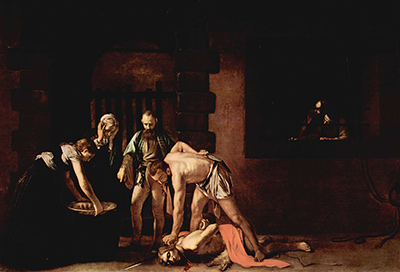
| The Beheading of Saint John the Baptist by Caravaggio | about 1608; installed in the Oratory on 29 August 1608 | Artwork |
| The Burial of Saint Lucy by Caravaggio in Syracuse | 1608, during Caravaggio's Syracuse stay | Artwork |
| The Calling of Saint Matthew by Caravaggio | about 1599–1600 | Artwork |
| The Calling of Saints Peter and Andrew by Caravaggio | about 1602–04 in the Trust's object text | Artwork |
| The Cardsharps by Caravaggio | about 1596–97 in the Kimbell's current object record | Artwork |
| The Conversion of Saint Paul: Caravaggio's Odescalchi Panel | commissioned in 1600; painted around 1600–01 | Artwork |
| The Crucifixion of Saint Andrew by Caravaggio | 1606–07 | Artwork |
| The Crucifixion of Saint Peter by Caravaggio | about 1601 | Artwork |
| The Death of the Virgin by Caravaggio | commissioned 1601; completed late 1605 or early 1606, according to the Louvre | Artwork |
| The Denial of Saint Peter by Caravaggio | 1610 | Artwork |
| The Doria Pamphilj Saint John the Baptist: A Second Youth with a Ram | linked compositionally to the Capitoline 1602 picture; an exact production year for this canvas is not established by the owner pages used here. | Artwork |
| The Entombment of Christ by Caravaggio: The Vatican Deposition | about 1600–04 in Vatican Museums publication material | Artwork |
| The Flagellation of Christ by Caravaggio: The Capodimonte Altarpiece | around 1607, in the first Naples period | Artwork |
| The Fortune Teller by Caravaggio: The Louvre Version and Its Roman Counterpart | — | Artwork |
| The Holy Family with the Infant Saint John the Baptist by Caravaggio | early 1600s in the Met catalogue; no more exact owner date asserted here | Artwork |
| The Incredulity of Saint Thomas by Caravaggio | about 1601 in the SPSG presentation | Artwork |
| The Inspiration of Saint Matthew by Caravaggio | usually 1602; also catalogued 1602–03, for the installed final altarpiece | Artwork |
| The Lute Player by Caravaggio: The Hermitage Painting | about 1596 in the Hermitage collection publication; the Hermitage Friends restoration page gives about 1595–96 | Artwork |
| The Magdalen in Ecstasy: Caravaggio, Copies and a Disputed Original | — | Artwork |
| The Martyrdom of Saint Matthew by Caravaggio | 1599–1600; unveiled with The Calling in 1600 | Artwork |
| The Martyrdom of Saint Ursula by Caravaggio | — | Artwork |
| The Musicians by Caravaggio | 1597 | Artwork |
| The Resurrection of Lazarus by Caravaggio in Messina | 1609; delivered 10 June 1609 in the owner account | Artwork |
| The Sacrifice of Isaac by Bartolomeo Cavarozzi: A Former Caravaggio Attribution | about 1615–17 in the Nicholas Hall catalogue; “1598” is an inherited URL label, not the accepted date | Artwork |
| The Sacrifice of Isaac by Caravaggio: The Uffizi Painting | about 1603 in the Uffizi catalogue | Artwork |
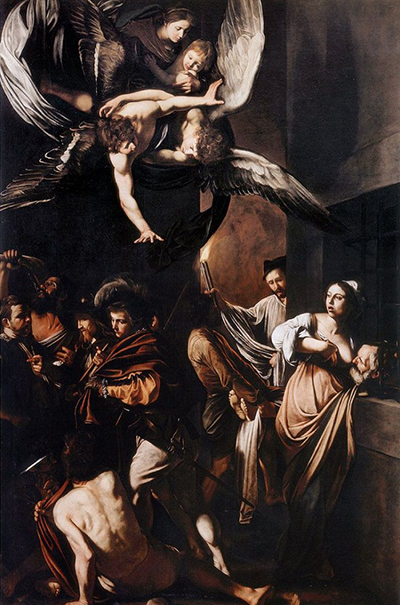
| The Seven Works of Mercy by Caravaggio | 1606–07, according to the Pio Monte | Artwork |
| The Supper at Emmaus by Caravaggio: The London Painting | 1601 | Artwork |
| The Taking of Christ by Caravaggio | 1602 | Artwork |
| The Toulouse *Judith Beheading Holofernes*: A Caravaggio Attribution Debate | c.1606–07 if identified with the recorded Naples work; that identification is debated | Artwork |
| Young Sick Bacchus by Caravaggio | about 1595 in the Galleria Borghese catalogue | Artwork |
| Youth with a Ram: Why Caravaggio's Saint John Looks So Unusual | — | Artwork |
No matching pages found.
Discussion
Share a close observation about Martha and Mary Magdalene by Caravaggio or a source that clarifies its history.
Which detail changes your reading?
Is there a collection record or document worth comparing?
What remains uncertain?
Join the Conversation
Frequently Asked Questions
Where is Martha and Mary Magdalene?
It belongs to the Detroit Institute of Arts, accession 73.268. The museum currently lists it on view, but check its live display information before visiting.[1]
When did Caravaggio paint it?
The DIA dates the work about 1598.[1]
Is it oil on canvas?
The museum's full material description is oil and tempera on canvas, 100 × 134.5 cm unframed.[1]
Is the conversation in the Bible?
What do the mirror and orange blossom mean?
The museum interprets the mirror as linked to Mary's vanity and the orange blossom as a sign of purity. The ring alludes to a spiritual marriage to Christ.[1]
References
- Detroit Institute of Arts, Caravaggio, Martha and Mary Magdalene, accession 73.268.
- Doria Pamphilj Gallery, Caravaggio, The Penitent Mary Magdalene.
- Musée du Louvre, The Fortune Teller collection record.
- Kimbell Art Museum, The Cardsharps collection record.
- Vatican, Luke 10:38–42.
- Museo Nacional Thyssen-Bornemisza, Saint Catherine of Alexandria object record.