 by Tom Gurney
Tom Gurney BSc (Hons) is an art history expert with over 20 years experience
Page Created on / Page Updated on
Email: tomgurney1@gmail.com / Phone: +44 7429 011000
The Inspiration of Saint Matthew by Caravaggio
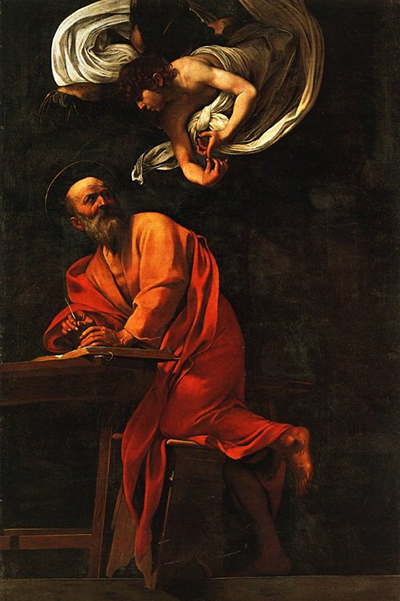
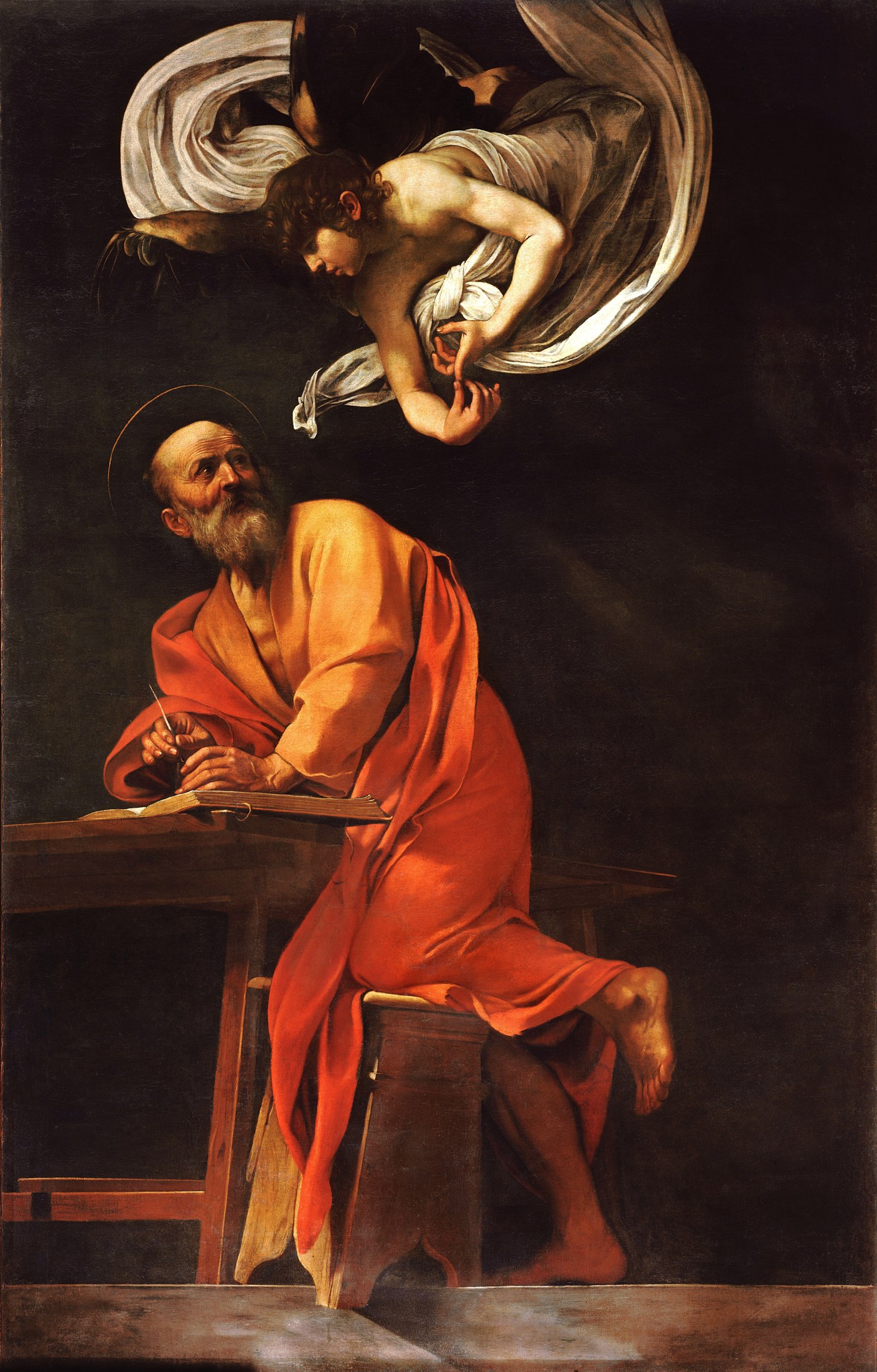
Caravaggio's Inspiration of Saint Matthew shows the evangelist turning from his writing toward an angel who appears above him. The saint's pen is poised over the page; the angel gestures with its fingers from a swirl of pale drapery. This is the painting now over the altar of the Contarelli Chapel in San Luigi dei Francesi, Rome. Usually dated 1602, it followed the two large side canvases, The Calling and The Martyrdom.[1][2][8]
There was also an earlier Caravaggio picture of Matthew and an angel intended for this altar. It passed to the Giustiniani collection and later Berlin, where it was most likely destroyed in 1945. That is a different object, covered on the Saint Matthew and the Angel page. The two pictures are easily confused when a catalogue calls both “Saint Matthew and the Angel.”[2][3]
Caravaggio in context
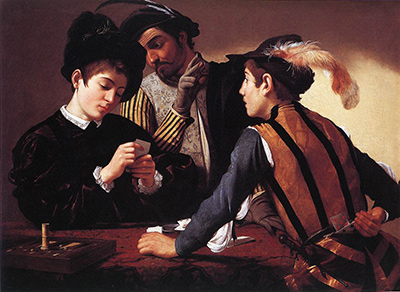
The Cardsharps
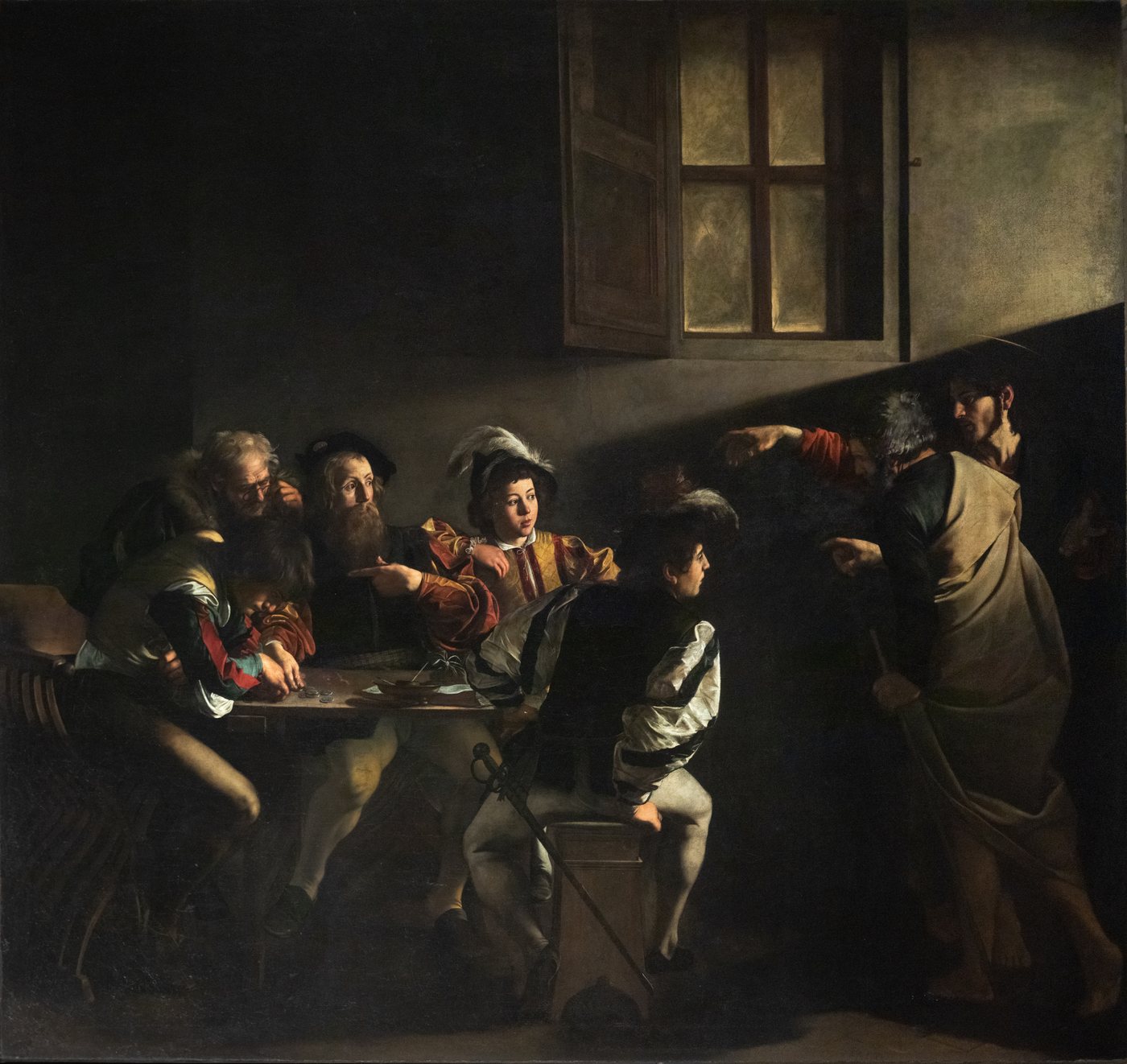
c.1595Calling of Saint Matthew
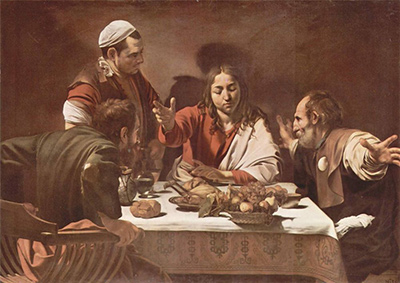
1599–1600Supper at Emmaus
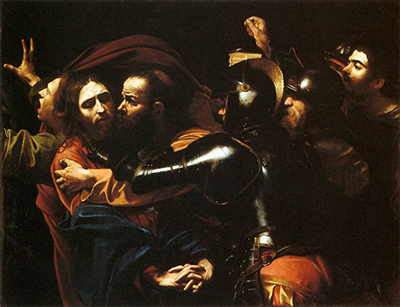
1601At a Glance
- ArtistMichelangelo Merisi da Caravaggio[1][2]
- TitleThe Inspiration of Saint Matthew, also called Saint Matthew and the Angel[1][2]
- Dateusually 1602; also catalogued 1602–03, for the installed final altarpiece[2][8]
- Mediumoil on canvas[4]
- Dimensionsapproximately 292 × 186 cm, height × width[4]
- Locationaltar of the Contarelli Chapel, San Luigi dei Francesi, Rome[1][2]
- Do not confuse withthe earlier Matthew-and-angel painting, formerly in Berlin, most likely destroyed in 1945[3]
Contents
- The Altarpiece in Its Chapel
- How the Altar Commission Changed
- What Matthew and the Angel Are Doing
- Reading the Angel's Gesture
- The Writing Table and Precarious Stool
- Light, Colour and the Open Space
- What Examination Reveals Beneath the Paint
- The Altar Canvas's Conservation Record
- The Earlier Painting in Berlin
- What the 1602 Documents Establish
- What Is Known About Replacement
- The Contarelli Cycle as a Whole
- Frequently Asked Questions
Look closer: The Inspiration of Saint Matthew
Matthew writes beneath a descending angel. The exchange is carried by the angel’s counting fingers, the saint’s gaze and the open book.
 123
Details from The Inspiration of Saint Matthew
Select a detail image to open the full-size gallery, then use the arrows to compare views.
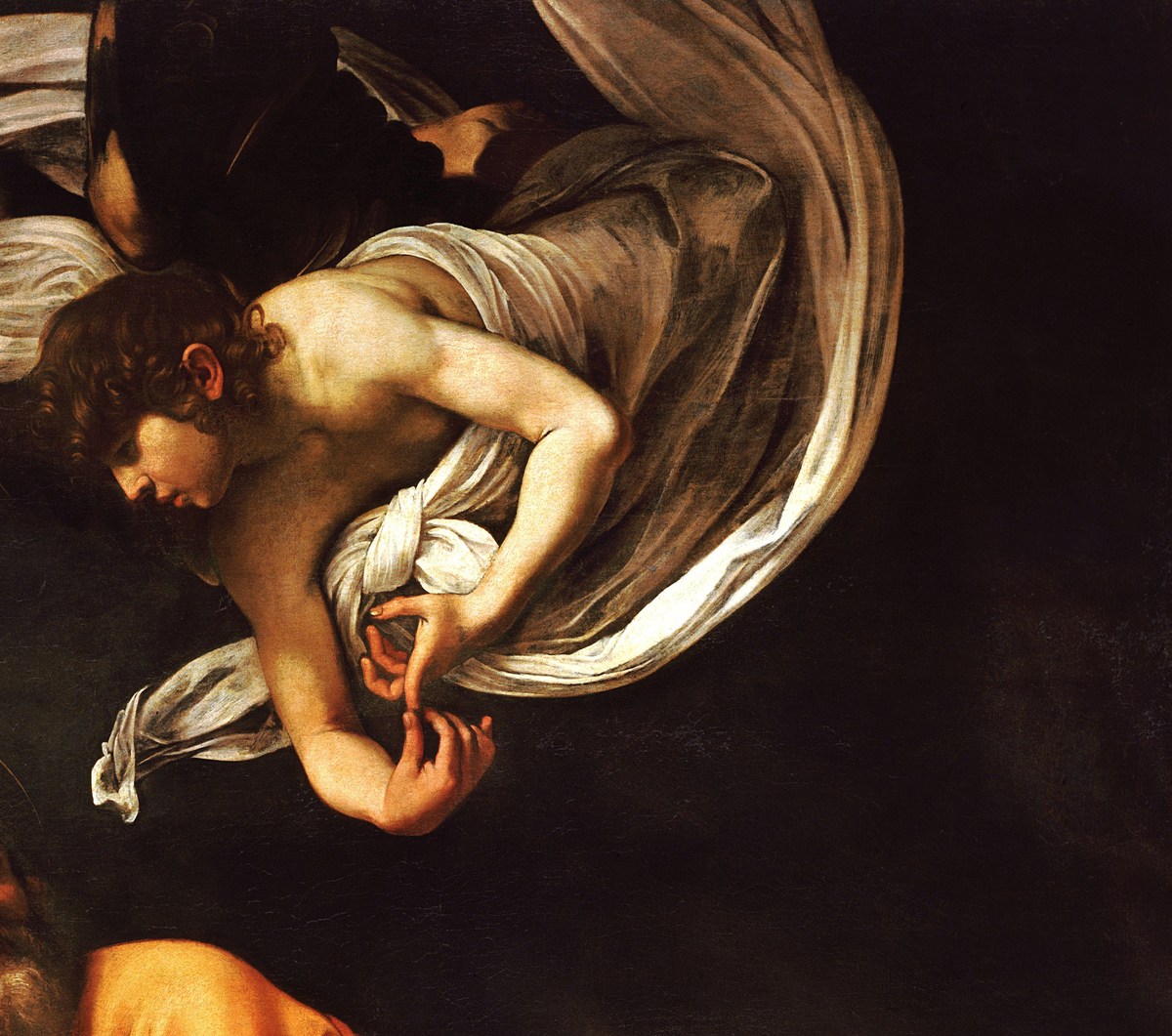
The descending angel
The angel curves down from the darkness, its white cloth and counting fingers set against the broad black field.
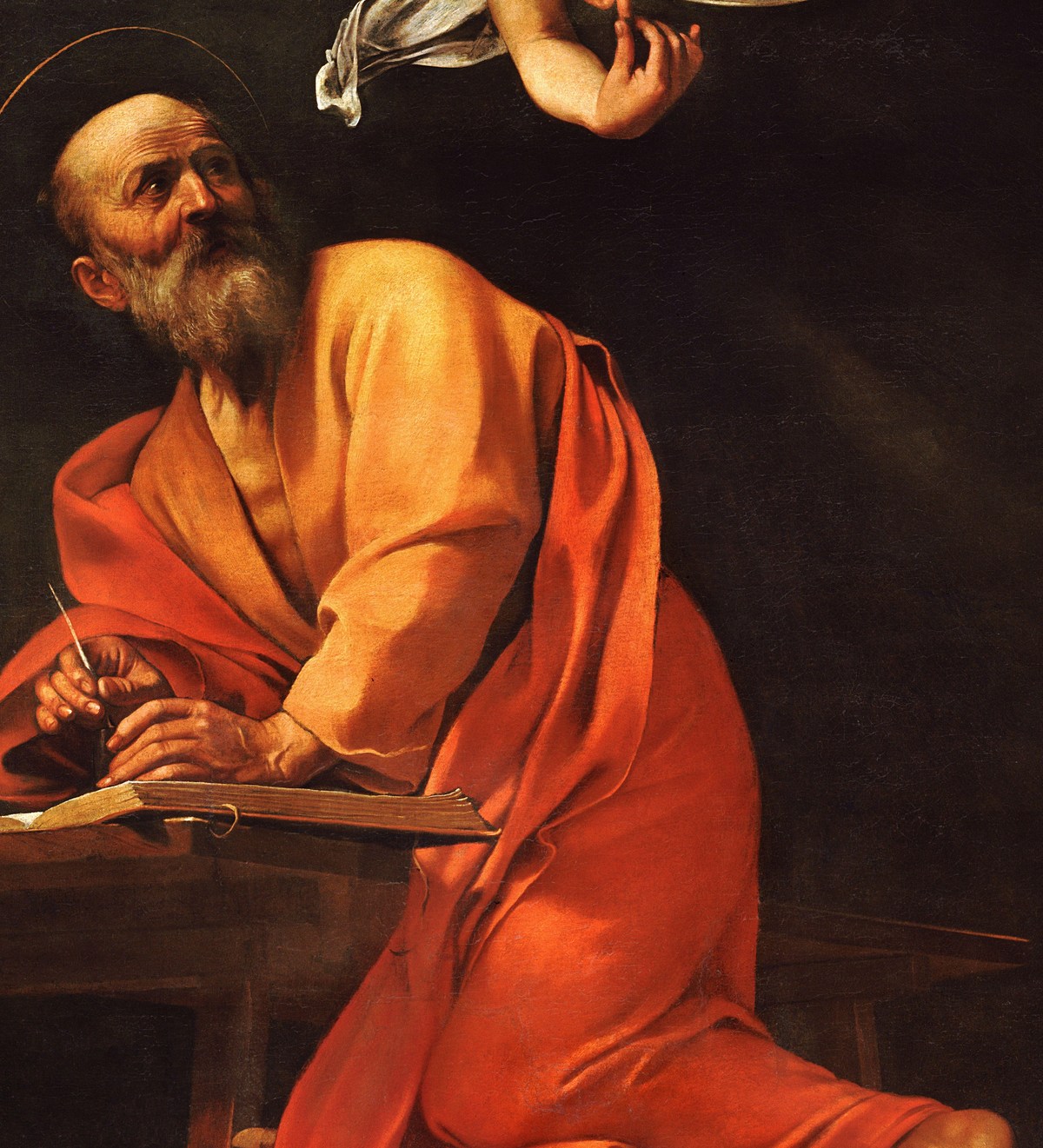
Matthew looks upward
Matthew turns his face away from the page toward the angel, pausing between listening and writing.
The writing hand and book
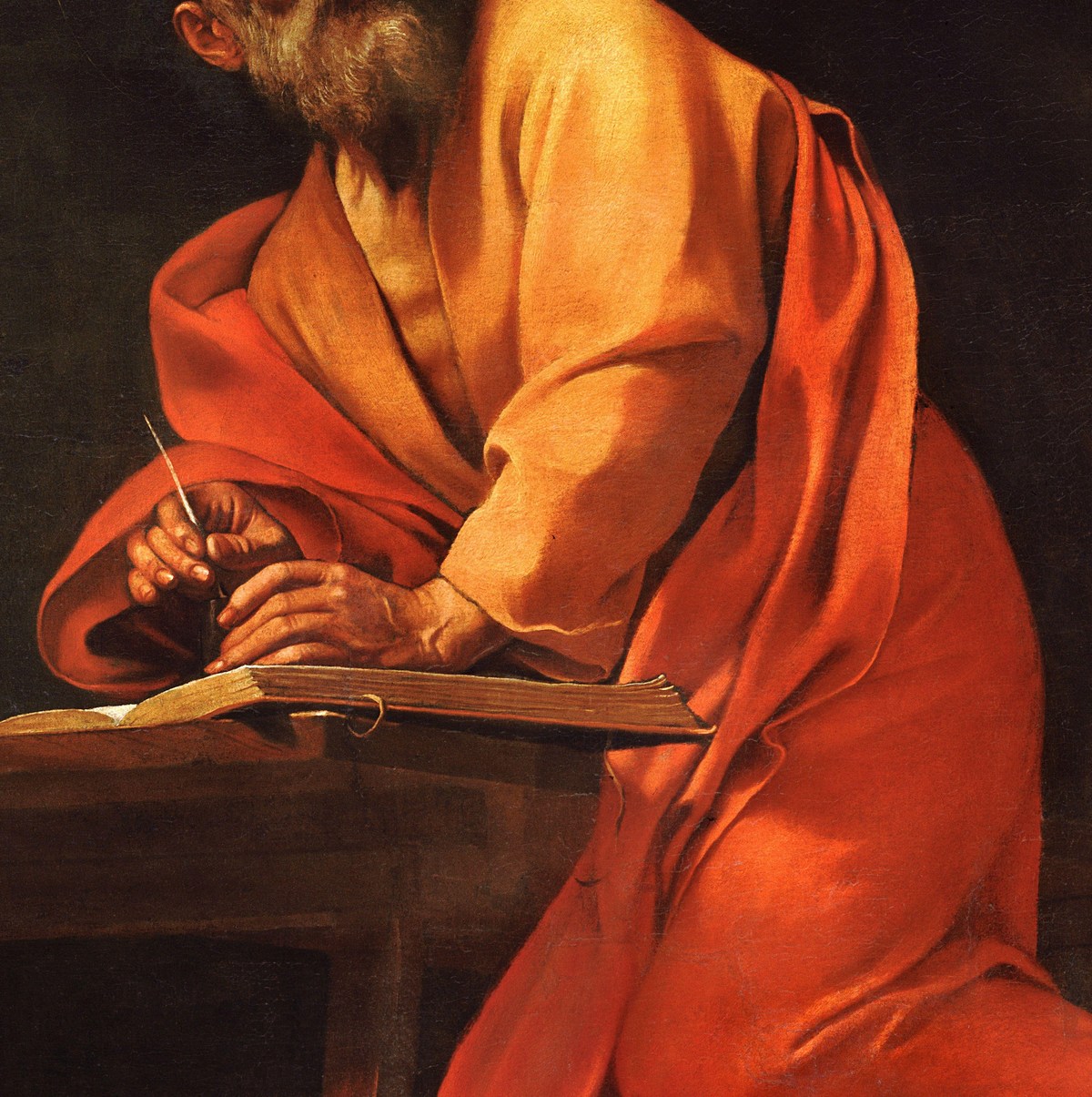
The open book rests on the table as Matthew’s hand holds the pen nearby; the red mantle leads the eye back to his work.
The Altarpiece in Its Chapel
The Contarelli Chapel was dedicated to Saint Matthew, the name saint of its patron, the French cardinal Mathieu Cointrel. Caravaggio's Calling and Martyrdom fill the two side walls. The picture of Matthew writing stands between them at the altar, giving the Gospel author a stable presence at the centre of a cycle that shows his call and death. Rome's official church record names all three paintings and dates the chapel group from 1599 to 1602.[1]
The altarpiece is tall and narrow beside the broad, almost square Martyrdom. Its format brings Matthew and the angel close together vertically. The drama is quieter than the attack across the chapel, yet the saint seems caught in a moment of interruption: he has turned from his book because the angel has arrived. A viewer at the chapel sees the relationship between writing, calling and witness rather than an isolated portrait.[1][2]
Rome's Caravaggio itinerary identifies this as the second and definitive altar painting of 1602. The side canvases were made in 1599–1600. The sequence matters: Caravaggio was returning to the same saint and setting after the public impact of those first chapel works, and the installed altarpiece belongs to the last phase of the commission.[2][5]
How the Altar Commission Changed
The altar was not originally reserved for one of Caravaggio's canvases. Contarelli's 1565 contract with Girolamo Muziano called for an oil painting of Matthew and the angel, alongside frescoes on the chapel walls and vault.[12] That scheme stalled. A later sculptural group of the same two figures was commissioned from the Flemish sculptor Jacob Cobaert in 1578. Luigi Ficacci's biographical study traces the sculpture's prolonged making and eventual move to the church of the Trinità dei Pellegrini, where its angel was supplied by Pompeo Ferrucci.[9] The altar's sequence thus begins with an unexecuted painted plan, passes through a sculptural commission, and returns to painting with Caravaggio.
Bert Treffers's study gives a more precise close to the sculpture episode. A 12 January 1602 arrangement provided for moving Cobaert's incomplete Matthew from his house to the chapel altar. It was taken down by 30 January; the angel had not been completed. Those dated actions show an actual trial of the sculpture in the intended setting, not merely a plan abandoned on paper.[13] They do not, by themselves, explain every judgment that led to its removal.
Caravaggio's altar commission followed a change of medium as well as a change of artist. A contract dated 7 February 1602 required Matthew in the act of writing the Gospel and an angel at his right in the act of dictating, with both figures shown full length.[11][13] That wording establishes a subject and arrangement requested for the altar. Because two Caravaggio versions existed, it should not be treated as a detailed description of the surviving picture alone.
What Matthew and the Angel Are Doing
Matthew's pen rests near the open pages on the desk. He turns his head upward and back, looking toward the angel, while one hand remains at the writing surface. The angel occupies the upper part of the picture, emerging from darkness in flowing white drapery. Its hands are active, as though enumerating or explaining. The painting makes divine inspiration visible as an exchange across a gap, rather than simply placing a halo around a writer.
The gesture should not be flattened into a literal dictation transcript. We cannot read every word the angel supposedly speaks or assume a specific Gospel verse from the visible page. What is clear is the relationship: the saint writes, the angel guides, and the two communicate through turned faces and hands. The dark field around them removes incidental setting and concentrates attention on that relation.
Matthew's body is substantial and human. His red-orange drapery falls around the stool and across his knee; his beard and bald head are lit against a dark background. Caravaggio renders him as a working writer in physical space, not an abstract emblem. At the same time, the angel's unexpected arrival identifies the activity as sacred. The ordinary tools of writing become the site of inspiration.
Reading the Angel's Gesture
The angel's fingers do more than mark its presence. Art historian Irving Lavin reads them as a speaker counting through an argument, with the hand reaching a second point. He connects that count to the opening genealogy in Matthew's Gospel: the first generation has been announced and the next begins. This is a sustained reading of gesture and biblical text, not a transcription of legible words on Caravaggio's painted page. The picture itself does not tell us exactly what the angel says.[16]
Lavin also distinguishes the two altar designs by how inspiration reaches the writer. In the lost first version, the angel beside Matthew physically conducts his hand. In the installed canvas, the angel appears above and behind, and Matthew twists back toward a voice while retaining his own pen. Lavin compares that turned posture with depictions of the Annunciation in which a figure is interrupted by a messenger, and with later images of Saint Jerome and an angel. Those are proposed visual and theological relationships, not records of paintings Caravaggio demonstrably copied.[16]
This distinction gives the empty space between the two figures a purpose. The angel does not need to touch Matthew for the Gospel to be represented as inspired. A visitor can see both the saint's act of writing and an interruption from beyond the ordinary room. Whether Caravaggio aimed at Lavin's precise genealogy reading remains open, but the comparison explains why separating the bodies changes the meaning of their exchange rather than merely changing their positions.[16]
The Writing Table and Precarious Stool
The lower part of the painting gives the encounter weight. The desk projects from the left. Matthew leans toward it, but his torso twists up toward the angel. His legs and the stool form an uneasy arrangement near the altar's edge. Rome's published Caravaggio guide calls attention to the saint's legs on a stool poised precariously by a step.[6]
That instability adds motion without turning the work into an action scene. Matthew may look as if he has suddenly turned in response to the angel. The furniture makes his posture believable: the desk is where he writes, while the stool supports a body twisting between page and vision. The painting invites the visitor to move visually from pen and book through the saint's face to the angel's hands.
It is tempting to say the stool must have been designed to fool a viewer into expecting it to fall. Such a statement would be a hypothesis about effect. What can be described directly is its conspicuous tilt and its position close to the lower edge. The structure contributes to the sense that revelation interrupts an actual act of writing.
Light, Colour and the Open Space
The saint's red-orange robe and the angel's pale drapery create the painting's main colour contrast. Light defines their bodies while a large dark area between and beside them keeps the two figures distinct. The angel's fabric curls across the top; Matthew's robe descends and gathers around the stool. One form appears suspended, the other heavy and grounded.
This is not the same compositional problem as The Calling, where a group at a table must be sorted by a visitor looking for the named saint. Here the two principal figures are unmistakable. The question is how the painter relates them across space: angel above, writer below, hands and eyes connecting them. In The Martyrdom, an angel offers the palm while violence fills the centre. At the altar, the heavenly messenger approaches the saint before the work of writing is complete.
The visible surface can support close observation of light and gesture. Claims about precise studio lighting or the identity of a live model require separate material or documentary evidence. The painting-technique guide explains the evidence available across Caravaggio's works without turning a single visual effect into a universal rule.
What Examination Reveals Beneath the Paint
A technical campaign on the three chapel canvases, presented in Rome in 2011, used digital radiography, infrared reflectography and X-ray fluorescence. Its report describes a finding specific to the installed altarpiece: Caravaggio incised outlines of his models into the ground layer, or mestica. Some marks correspond to parts he did not finally paint, including the angel's right leg.[10] A finished figure can therefore conceal evidence of an earlier placement or pose. The mark is material evidence of how he organised the composition; by itself it does not identify the model or reconstruct every stage of the design.
The campaign also found evidence in the other two chapel paintings, but those findings should not be transferred to this canvas. The earlier architectural arrangement seen beneath The Martyrdom is a revision within that side-wall painting. The compass traces in The Calling belong to its own layout. Neither is an underpainting of the Roman Inspiration, and none of these examinations recovers the lost first Matthew and the Angel once held in Berlin.[10]
The Altar Canvas's Conservation Record
The painting visible in the chapel has a history of treatment that predates modern X-rays. Conservation researcher Claudio Seccaroni followed records in the French establishment's archive for the three Caravaggio canvases. Pietro Palmaroli treated the side pictures in 1824 and the altar picture in 1825; the latter payment, settled on 12 February 1825, was 40 scudi. These are records of work on the installed canvas, not evidence about the later-lost first Matthew.[15]
An October 1865 payment concerns a painting described as representing Saint Matthew. Seccaroni judges the altar canvas the probable referent, whereas an 1869 receipt explicitly names the two side-wall paintings. The different wording matters: it makes the earlier identification plausible without making it certain. An Anderson photograph of the altarpiece from around 1890 shows altered retouching conspicuously on the painted step. That historical photograph records the work's condition after nineteenth-century intervention; it cannot reconstruct its untouched 1602 surface.[15]
All three chapel canvases underwent treatment by Tito Venturini Papari in February–March 1922 before travelling to a Florence exhibition. Seccaroni describes a compressed schedule and reports cleaning, canvas tensioning and repairs among the recorded operations. The three pictures were stored at Carpegna during 1943, returned to Rome, and underwent the ICR's 1965–67 restoration before the later diagnostic campaign discussed above. This sequence explains why a photographed detail, a present dark passage and a technical image are not interchangeable kinds of evidence.[15]
The 1939 water-pipe failure and Mauro Pellicioli's 1940–41 emergency treatment concerned the two side canvases, especially The Martyrdom. Seccaroni's account does not transfer that particular damage and intervention to the altarpiece. Keeping the three conservation histories distinct is as important as distinguishing the chapel's two painted versions of Matthew and the angel.[15]
The Earlier Painting in Berlin
Berlin's Gemäldegalerie records an earlier Evangelist Matthew by Caravaggio for the Contarelli altar. It measured 223 × 183 cm and was acquired with the Giustiniani collection in 1815. The Berlin record says it was most likely destroyed in the Friedrichshain flak tower in May 1945. This history concerns the first painting, not the canvas still in Rome.[3]
In the earlier composition, the angel was beside Matthew and physically guided his writing hand. The installed altarpiece separates the figures: Matthew turns toward an angel above, while his own hand remains at the book. Berlin's object record discusses the difference and says the first version was refused by the congregation, relating that judgment to contemporary ideas of an evangelist's dignity. Those are the museum's account and historical interpretation; the exact motives and documentary basis of the replacement have been debated.[3]
The earlier image survives in historical reproductions, but the original's probable destruction limits what can now be examined. A monochrome photograph cannot give the same evidence about surface, colour or conservation as an extant canvas. Captions must state that its former Berlin location is historical. Showing its photograph next to the Roman altarpiece can be useful if the two are named and dated separately.[3]
What the 1602 Documents Establish
The documented sequence has more dates than a simple story of one rejected picture immediately followed by another. Treffers records the 7 February 1602 painting contract, a payment to Caravaggio on 22 September, and a payment to a carpenter on 5 October. He treats the October carpentry as grounds to suppose the altarpiece now in the chapel was in place by then, while questioning whether the lost first painting was necessarily produced only after the February agreement.[13] The carpentry payment is evidence for work on the altar setting; the inference about the exact canvas hanging on that day is his reconstruction, not an inventory naming the object.
This matters because the February wording, September payment and October carpentry are sometimes made into a continuous timetable for both surviving and lost paintings. The documents establish commission and payment activity; they do not independently date the execution, refusal and transfer of the former Berlin work to the day. Treffers's alternative does not erase the two distinct paintings or the Giustiniani provenance of the earlier one. It shows why their precise order of production and installation remains a research question even when the installed version is commonly dated 1602.[3][13]
What Is Known About Replacement
The sequence is secure at a broad level: an earlier painting of Matthew and the angel was made for the chapel; the version now at the altar replaced it; the earlier picture entered the Giustiniani collection and later Berlin. Rome's official visitor sources identify the installed painting as the definitive 1602 version. Berlin's record gives the first painting's later collection history and probable fate.[2][3]
Why that happened requires more care. Berlin's present catalogue says the first was refused for a perceived lack of decorum. Rome's older guide mentions both size and decorum. Such accounts are evidence of the explanations offered by those institutions, and the older guide is not a newly discovered contract. A simple story in which a named cardinal personally rejected dirty feet or forced Caravaggio to repaint is more specific than the cited evidence allows.[3][6]
The familiar rejection story developed through later biographies. Baglione wrote in 1642 that the earlier painting had pleased no one, while also recording Giustiniani's interest in acquiring it. He did not describe a dated decision by the chapel's overseers. Bellori's account of 1672 is more specific: it says priests removed the picture from the altar because Matthew's crossed legs and exposed feet seemed unworthy of a saint. Giorgia Duò distinguishes these statements in a recent survey and notes Luigi Spezzaferro's later proposal that the first canvas may have served provisionally while the final altar work was prepared.[14] That proposal is one interpretation, not a newly found removal record. The documented January 1602 removal of Cobaert's sculpture concerns a different object and cannot establish why the painted version was replaced.[9][13]
The patron Cardinal Contarelli had died before Caravaggio made the canvas, and other people oversaw the chapel work. The first altarpiece should therefore not be said to have been rejected by Cardinal Francesco Maria del Monte merely because he was an influential Caravaggio patron elsewhere. The later biography of a patron and the decision about a particular church commission are different histories.
The finishing date of the installed replacement is also less exact than a single year in a short caption suggests. Roma Capitale presents it as the definitive altar painting of 1602. An AQA history of art assessment guide dates the same installed replacement 1602–03.[2][8] Both identify the canvas in the chapel; neither changes the February 1602 date of the commission for Caravaggio to supply an altar painting. The September and October records narrow activity around that commission but require interpretation alongside the existence of two painted versions.[13]
The altarpiece in the 2026 chapel record
Factum Foundation's June 2026 campaign recorded all three Caravaggio canvases along with the architecture, marbles and earlier vault painting in the Contarelli Chapel. It also announced plans to recreate the lost first Saint Matthew and the Angel from the surviving evidence. The distinction between a digital reconstruction and the physical painting is important here: the Berlin work was probably destroyed in 1945, while the installed second altarpiece remains in Rome.[7]
The chapel record can help scholars examine how the present altarpiece's surface, colour and placement relate to the two side walls. It does not supply a newly discovered original of the lost version or prove every detail of its former appearance. For a visitor, it reinforces a simpler point: the figure and angel were designed to be encountered at an altar between the Calling and the Martyrdom, rather than as an isolated image.[7]
The Contarelli Cycle as a Whole
The three installed paintings form a sequence the viewer can explore from side to side. In The Calling, Christ's summons enters a room of money and figures. In The Martyrdom, an attacker interrupts Matthew's life and an angel signals the meaning of his death. At the altar, a different angel turns the saint's writing into a visible exchange between human work and divine guidance.[1][2]
Each has its own date, form and narrative. The two side works made Caravaggio's reputation as a public painter when unveiled in 1600, according to the Metropolitan Museum. The altar painting, usually dated 1602, finished the chapel's Caravaggio programme. The lost first painted design and the earlier sculpture belong to separate object histories.[5][8][9]
The chapel has other decoration, including vault frescoes by Cavalier d'Arpino. It is a built and decorated space, not a neutral gallery. Its setting explains why the tall altarpiece should be compared with broad wall paintings without treating them as interchangeable objects.[1]
Explore the Caravaggio collection
| Name | Date | Type |
|---|---|---|
| Adoration of the Shepherds by Caravaggio: The Messina Nativity | 1608–09; precise order relative to Resurrection of Lazarus remains unresolved | Artwork |
| Amor Victorious by Caravaggio | 1601–02 in the Berlin owner record | Artwork |
| Bacchus by Caravaggio: The Uffizi Painting | about 1598, according to the Uffizi | Artwork |
| Basket of Fruit by Caravaggio | after 1597, probably around the turn of the seventeenth century, according to the Ambrosiana | Artwork |
| Boy Bitten by a Lizard: Caravaggio's London Painting | about 1594–95 in the National Gallery's current catalogue; URL suffix “1596” is inherited | Artwork |
| Boy Bitten by a Lizard: The Florence Version Attributed to Caravaggio | disputed; Longhi's catalogue record preserves historical 1592–93 and other proposed ranges, including c.1597 | Artwork |
| Boy Peeling Fruit by Caravaggio: The Royal Collection Painting | about 1592–93 in the owner's current exhibition record | Artwork |
| Boy Peeling Fruit in Florence: A Derivation from Caravaggio | — | Artwork |
| Boy with a Basket of Fruit by Caravaggio | about 1595 in the Galleria Borghese catalogue | Artwork |
| Caravaggio Paintings in Rome: Churches, Museums and a Practical Route | — | Guide |
| Caravaggio Quotes: What the Documents Actually Record | — | Guide |
| Caravaggio's Lute Player: The Del Monte Painting Once Shown at the Met | about 1596–97 in the Met catalogue | Artwork |
| Caravaggio's Painting Technique: Grounds, Incisions, Revisions and Light | — | Guide |
| Christ at the Column by Caravaggio: The Rouen Flagellation | c.1606 in the owner caption; owner prose gives 1606–07 | Artwork |
| Christ on the Mount of Olives by Caravaggio: The Lost Berlin Painting | — | Artwork |
| Conversion on the Way to Damascus by Caravaggio | about 1601 in the Roma Capitale church record | Artwork |
| Crowning with Thorns by Caravaggio: The Vienna Painting | about 1603 in the 2019 KHM record; “1607” is an inherited URL suffix | Artwork |
| Crowning with Thorns in Prato: Attributed to Caravaggio | about 1602–03 in the collection presentation | Artwork |
| David with the Head of Goliath by Caravaggio: The Borghese Painting | 1606–07 or 1609–10 in the Galleria Borghese catalogue; the later Naples period is favoured by many scholars, while the owner keeps the question open | Artwork |
| David with the Head of Goliath by Caravaggio: The Prado Painting | about 1600 in Prado material; “1599” survives only in the legacy URL | Artwork |
| David with the Head of Goliath by Caravaggio: The Vienna Painting | about 1600–01 in the KHM's 2019 exhibition record; “1607” is a legacy route label | Artwork |
| Did Caravaggio Make Drawings? What Survives and What Paintings Reveal | — | Guide |
| Ecce Homo: Caravaggio's Madrid Rediscovery and the Genoa Painting | — | Artwork |
| John the Baptist in Caravaggio's Paintings: A Guide to the Different Versions | — | Artwork |
| Judith Beheading Holofernes by Caravaggio | beginning of the seventeenth century in the owning museum's account; about 1599–1600 in the Kimbell's 2025 loan label; around 1602 in one specialist catalogue | Artwork |
| Jupiter, Neptune and Pluto: Caravaggio's Ludovisi Ceiling | about 1597; the archive connects the work with Cardinal del Monte's 1597 commission | Artwork |
| Madonna and Child with Saint Anne by Caravaggio: The Palafrenieri Altarpiece | 1605 in the Galleria Borghese object field; completed and delivered by 8 April 1606 | Artwork |
| Madonna of Loreto by Caravaggio: The Pilgrims at Sant'Agostino | broadly c.1604–06; institutional records differ slightly in their starting year | Artwork |
| Madonna of the Rosary by Caravaggio: The Vienna Altarpiece | around 1603 in the Kunsthistorisches Museum's object record | Artwork |
| Martha and Mary Magdalene by Caravaggio: The Detroit Painting | about 1598 in the Detroit Institute of Arts record | Artwork |
| Medusa by Caravaggio: The Uffizi Painted Shield | 1596–98 in the Uffizi's virtual exhibition; specialist research reports the shield delivered to the Medici wardrobe by 7 September 1598 | Artwork |
| Narcissus, Attributed to Caravaggio | dependent on attribution; the Zeri catalogue gives a broad 1610–50 range under Spadarino | Artwork |
| Nativity with Saint Francis and Saint Lawrence: Caravaggio's Missing Painting | somewhere in 1600–09 in the parliamentary report; a specific 1609 execution and place remain debated | Artwork |
| Penitent Mary Magdalene by Caravaggio | 1597 in the owner's catalogue, during Caravaggio's early Roman activity | Artwork |
| Portrait of a Courtesan: Caravaggio's Lost Berlin Portrait | Berlin's data field says c.1590, while its own text compares a Caravaggio work of c.1598; precise date unresolved | Artwork |
| Portrait of Alof de Wignacourt and His Page by Caravaggio | — | Artwork |
| Portrait of Fra Antonio Martelli? Caravaggio's Pitti Knight of Malta | 1608 in the Restituzioni object heading; within Caravaggio's Malta period | Artwork |
| Portrait of Maffeo Barberini: The Seated Corsini Painting | c.1596–97 in the national catalogue | Artwork |
| Portrait of Monsignor Maffeo Barberini: Caravaggio's Newly Acquired Painting | around the late 1590s / age thirty; “1598” in the inherited address is approximate, not an exact document date | Artwork |
| Portrait of Pope Paul V: A Caravaggio Attribution and a Borghese Copy | — | Artwork |
| Prints After Caravaggio: Who Made Them and What They Show | — | Guide |
| Reclining Saint John the Baptist: A Disputed Caravaggio Attribution | often proposed for the artist's final years; the later museum list does not give a precise year. | Artwork |
| Rest on the Flight into Egypt by Caravaggio | about 1597 in the owner's catalogue | Artwork |
| Saint Catherine of Alexandria by Caravaggio: The Thyssen Painting | about 1598–99 in the Museo Nacional Thyssen-Bornemisza catalogue | Artwork |
| Saint Francis in Meditation by Caravaggio: The Cremona Painting | 1603–06 in the owner account; c.1605–06 in a KHM exhibition caption | Artwork |
| Saint Francis in Prayer: Caravaggio's Carpineto Painting | 1606 in a 2016–17 exhibition work list | Artwork |
| Saint Francis of Assisi in Ecstasy by Caravaggio | c.1595–96 in the owner wall text | Artwork |
| Saint Jerome in Meditation: Caravaggio's Montserrat Painting | 1605 in the owner record; an owner publication reports scholarship placing it about 1605–06 | Artwork |
| Saint Jerome Writing by Caravaggio: The Borghese Painting | c.1606 in the owner catalogue; the “1605” URL suffix is inherited | Artwork |
| Saint Jerome Writing by Caravaggio: The Malta Painting | around 1607–08; foundation dates Malaspina's commission to 1608 | Artwork |
| Saint John in the Wilderness at Toledo Cathedral | exact 1598 not established by the cited cathedral account. | Artwork |
| Saint John the Baptist at Galleria Corsini, Rome | about 1606 in the national record; older proposals ranged from the late 1590s onward. | Artwork |
| Saint John the Baptist at the Capitoline Museums, Rome | 1602. | Artwork |
| Saint John the Baptist at the Galleria Borghese | 1609–10 in the current Borghese record. | Artwork |
| Saint John the Baptist at the Spring: The Bonello Painting in Malta | early seventeenth century in the institutional account; a precise 1608 is not established there. | Artwork |
| Saint Matthew and the Angel: Caravaggio's Lost First Altarpiece | — | Artwork |
| Salome Receives the Head of John the Baptist: Caravaggio's London Painting | about 1609–10, likely late Naples period in the Gallery's account | Artwork |
| Salome with the Head of John the Baptist: Caravaggio's Madrid Painting | — | Artwork |
| Sleeping Cupid by Caravaggio: The Painting Made in Malta | about 1608, Malta period | Artwork |
| Still Life with Fruit on a Stone Ledge: Is It by Caravaggio? | — | Artwork |
| Supper at Emmaus (1606): Caravaggio's Brera Painting | — | Artwork |
| The Annunciation by Caravaggio in Nancy | c.1607–10 in the collection record; 1608–10 in the museum's restoration account | Artwork |
| The Basel Saint John the Baptist: Once Labelled Caravaggio, Now Maíno | about 1608–10 in that schedule, rather than the legacy URL's 1600. | Artwork |
| The Beheading of Saint John the Baptist by Caravaggio | about 1608; installed in the Oratory on 29 August 1608 | Artwork |
| The Burial of Saint Lucy by Caravaggio in Syracuse | 1608, during Caravaggio's Syracuse stay | Artwork |
| The Calling of Saint Matthew by Caravaggio | about 1599–1600 | Artwork |
| The Calling of Saints Peter and Andrew by Caravaggio | about 1602–04 in the Trust's object text | Artwork |
| The Cardsharps by Caravaggio | about 1596–97 in the Kimbell's current object record | Artwork |
| The Conversion of Saint Paul: Caravaggio's Odescalchi Panel | commissioned in 1600; painted around 1600–01 | Artwork |
| The Crucifixion of Saint Andrew by Caravaggio | 1606–07 | Artwork |
| The Crucifixion of Saint Peter by Caravaggio | about 1601 | Artwork |
| The Death of the Virgin by Caravaggio | commissioned 1601; completed late 1605 or early 1606, according to the Louvre | Artwork |
| The Denial of Saint Peter by Caravaggio | 1610 | Artwork |
| The Doria Pamphilj Saint John the Baptist: A Second Youth with a Ram | linked compositionally to the Capitoline 1602 picture; an exact production year for this canvas is not established by the owner pages used here. | Artwork |
| The Entombment of Christ by Caravaggio: The Vatican Deposition | about 1600–04 in Vatican Museums publication material | Artwork |
| The Flagellation of Christ by Caravaggio: The Capodimonte Altarpiece | around 1607, in the first Naples period | Artwork |
| The Fortune Teller by Caravaggio: The Louvre Version and Its Roman Counterpart | — | Artwork |
| The Holy Family with the Infant Saint John the Baptist by Caravaggio | early 1600s in the Met catalogue; no more exact owner date asserted here | Artwork |
| The Incredulity of Saint Thomas by Caravaggio | about 1601 in the SPSG presentation | Artwork |
| The Inspiration of Saint Matthew by Caravaggio | usually 1602; also catalogued 1602–03, for the installed final altarpiece | Artwork |
| The Lute Player by Caravaggio: The Hermitage Painting | about 1596 in the Hermitage collection publication; the Hermitage Friends restoration page gives about 1595–96 | Artwork |
| The Magdalen in Ecstasy: Caravaggio, Copies and a Disputed Original | — | Artwork |
| The Martyrdom of Saint Matthew by Caravaggio | 1599–1600; unveiled with The Calling in 1600 | Artwork |
| The Martyrdom of Saint Ursula by Caravaggio | — | Artwork |
| The Musicians by Caravaggio | 1597 | Artwork |
| The Resurrection of Lazarus by Caravaggio in Messina | 1609; delivered 10 June 1609 in the owner account | Artwork |
| The Sacrifice of Isaac by Bartolomeo Cavarozzi: A Former Caravaggio Attribution | about 1615–17 in the Nicholas Hall catalogue; “1598” is an inherited URL label, not the accepted date | Artwork |
| The Sacrifice of Isaac by Caravaggio: The Uffizi Painting | about 1603 in the Uffizi catalogue | Artwork |
| The Seven Works of Mercy by Caravaggio | 1606–07, according to the Pio Monte | Artwork |
| The Supper at Emmaus by Caravaggio: The London Painting | 1601 | Artwork |
| The Taking of Christ by Caravaggio | 1602 | Artwork |
| The Toulouse *Judith Beheading Holofernes*: A Caravaggio Attribution Debate | c.1606–07 if identified with the recorded Naples work; that identification is debated | Artwork |
| Young Sick Bacchus by Caravaggio | about 1595 in the Galleria Borghese catalogue | Artwork |
| Youth with a Ram: Why Caravaggio's Saint John Looks So Unusual | — | Artwork |
No matching pages found.
Discussion
Share a close observation about The Inspiration of Saint Matthew by Caravaggio or a source that clarifies its history.
Which detail changes your reading?
Is there a collection record or document worth comparing?
What remains uncertain?
Join the Conversation
Frequently Asked Questions
Which Saint Matthew and the Angel is still in Rome?
What is the angel doing?
The angel gestures above Matthew while he writes. The picture represents divine inspiration as an encounter between messenger and evangelist; it does not identify a readable dictated passage.
Why does Matthew look away from his book?
He turns toward the angel. That movement links the act of writing below with the source of inspiration above. It is a visual reading of the painting rather than a recorded explanation from the artist.
Was the first version rejected because of dirty feet?
Berlin's museum record says the earlier picture was refused, and it discusses perceived decorum, including the saint's bare feet. Rome's guide also mentions size. The vivid detail about the feet comes from Bellori's 1672 account, decades after the event. The exact reasons and decision process should remain attributed to those accounts rather than repeated as a simple eyewitness fact.[3][6][14]
References
- Roma Capitale, San Luigi dei Francesi visitor record, Contarelli Chapel and installed paintings.
- Roma Capitale, “I luoghi di Caravaggio”, dating of the side canvases and second, definitive 1602 altar version.
- Staatliche Museen zu Berlin, Der Evangelist Matthäus, first altar picture, dimensions, Giustiniani provenance, replacement account and probable 1945 destruction.
- British Art Journal, Vol. 23, no. 3, illustrated object identification and dimensions of installed canvas.
- Metropolitan Museum of Art, “Caravaggio (Michelangelo Merisi) (1571–1610) and His Followers”, 1600 unveiling of side canvases.
- Roma Capitale, Caravaggio itinerary guide, pp. 23–24, stool and account of earlier altar picture.
- Factum Foundation, “Digitising the Contarelli Chapel in Rome”, June 2026 recording and reconstruction plan.
- AQA, June 2015 history of art mark scheme, p. 15, 1602–03 dating and identification of the installed replacement.
- Luigi Ficacci, “Cobaert, Jacob Cornelisz”, Dizionario Biografico degli Italiani 26 (1982), documented sculptural commission, January 1602 refusal and later location.
- “Caravaggio. La cappella Contarelli”, Gazzetta Antiquaria 59 (2011), pp. 69–70, report on the Soprintendenza's technical exhibition and findings from the three canvases.
- San Matteo e l'angelo, Mostre Impossibili catalogue, 7 February 1602 contract, original sculptural plan and the two painted versions.
- Gigliola Fragnito, “Contarelli, Matteo,” Dizionario Biografico degli Italiani 28 (1983), archival account of the original 1565 Muziano altar-painting scheme.
- Bert Treffers, Caravaggio: Arte e Fede, Forma e Funzione, Roma 1596–1606, Editori Paparo, 2022, pp. 537–39, dated 1602 sculpture, painting and carpentry records and a qualified reconstruction of the two painted versions.
- Giorgia Duò, “Il rosso e il ‘rumore’: alcune questioni sul Caravaggio maturo tra iconografia e cronaca”, Bollettino Telematico dell'Arte 984 (5 October 2025), discussion of Baglione, Bellori and Luigi Spezzaferro on the first Saint Matthew and the Angel.
- Claudio Seccaroni, “I restauri dei dipinti di Caravaggio in San Luigi dei Francesi precedenti all’intervento ICR del 1965–67,” Kermes 79 (2010), author-uploaded text, archival evidence for treatment and movements of the installed altar canvas and the two side pictures.
- Irving Lavin, “Divine Inspiration in Caravaggio's Two St. Matthews,” The Art Bulletin 56, no. 1 (1974), pp. 59–81, Institute for Advanced Study PDF, pp. 79–81, interpretation of the second altarpiece's gesture and composition.
- Annotated image source: Wikimedia Commons, File:The Inspiration of Saint Matthew-Caravaggio (1602).jpg, high-resolution reproduction used for the annotated details.