 by Tom Gurney
Tom Gurney BSc (Hons) is an art history expert with over 20 years experience
Page Created on / Page Updated on
Email: tomgurney1@gmail.com / Phone: +44 7429 011000
Youth with a Ram: Why Caravaggio's Saint John Looks So Unusual
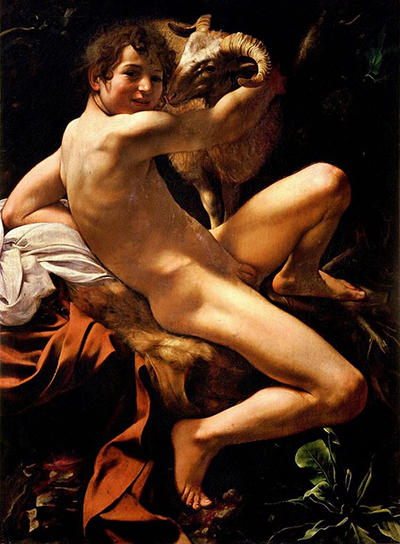
A grinning young figure twists his body around a ram and looks back over his shoulder. The best documented version of this composition is Caravaggio's Saint John the Baptist in the Musei Capitolini, Rome, inventory PC 239, painted in 1602 for Ciriaco Mattei. The alternative title Youth with a Ram draws attention to how little conventional saintly equipment appears in the painting. A closely related version in the Galleria Doria Pamphilj makes the question more intricate: these are two physical canvases, and the status of the second has been debated.[1][2][3]
This page explains the subject, pose, ram and version problem. The Capitoline object page gives PC 239's provenance and measurements. The Doria version page treats that second canvas and its attribution question. The inherited splash here visually depicts the Capitoline composition; it is not evidence of a third Caravaggio Baptist.[1][2]
Caravaggio in context
The Cardsharps
c.1595Calling of Saint Matthew
1599–1600Supper at Emmaus
1601At a Glance
- Anchor paintingCaravaggio, Saint John the Baptist / Youth with a Ram, 1602, oil on canvas 129 × 95 cm, Musei Capitolini PC 239.[1]
- PatronCiriaco Mattei; the museum links the subject to his son Giovanni Battista.[2]
- Original settingprivate rooms of the Mattei palace, according to Musei Capitolini, not a church altar.[2]
- Related versionGalleria Doria Pamphilj holds a closely similar ram painting and attributes it to Caravaggio; scholarly assessment of its autograph status has varied.[3][4]
- Main visual puzzlea playful, nearly nude youth and a ram in place of more familiar reed cross, banner and lamb.[1][2]
Contents
- What Are We Looking At?
- Why Is It Called Saint John the Baptist?
- Why a Ram Rather Than a Lamb?
- The Playful Pose and the Sistine Chapel Comparison
- Two Canvases in Rome
- How to Read the Figure Without Inventing a Model
- Frequently Asked Questions
What Are We Looking At?
The youth half-reclines against a dark setting and wraps an arm around the horned animal. White and red fabrics bunch beneath him, while his body turns outward to meet the viewer's gaze. The face is animated and inviting. Instead of showing John preaching in the desert, the composition offers a close encounter with a young person and an animal.[1]
Caravaggio's choice makes the title more important than it is in a conventional Baptist picture. John is usually easy to identify with a reed cross, a banderole proclaiming Christ, a bowl for baptism or a lamb. Here the most obvious creature is a ram, and the other familiar signs are largely absent. The Musei Capitolini nevertheless catalogue the figure as Saint John the Baptist and link it to a documented patron and family context.[1][2]
That does not mean every viewer must experience the image as solemn. A sacred figure can be pictured through ordinary physical liveliness. The contrast between saintly identity and a playful pose is the painting's visual tension, rather than a defect to explain away with an unproven story about the sitter.[1][2]
The Gospels identify John as a wilderness preacher and the one who points toward Jesus. They do not describe him hugging a ram. The image's religious meaning depends on artistic convention, patronage and interpretation, not a literal transcript of a biblical verse.[5]
Why Is It Called Saint John the Baptist?
The 1602 Ciriaco Mattei commission is the strongest immediate context. The Capitoline museum says the subject was a clear reference to the name of Mattei's son, Giovanni Battista. It was destined for the family's private rooms, where an erudite patron could read a religious title through an unconventional image.[2]
The owner record traces the picture from the Mattei collection through Cardinal Francesco Maria del Monte and the Pio family before entering the Capitoline collection in 1750. Those records fix the museum's physical canvas and help distinguish it from the near-identical Doria painting. A title debate is interesting, but it should not erase the documented object history.[1][2]
The alternative title Youth with a Ram describes the visible contents without committing to a religious identification. It is therefore useful when discussing why viewers hesitate. The museum's official title remains Saint John the Baptist; using both names openly is clearer than implying that one is an entirely separate painting.[1]
The ram itself complicates familiar “Lamb of God” language. John's Gospel associates the Baptist with the announcement of Christ as the Lamb of God. This painting uses a mature, horned animal instead. A viewer may connect it to sacrificial themes, but a precise symbolic programme is an interpretation, not a written instruction left by Caravaggio.[5][1]
Why a Ram Rather Than a Lamb?
The ram's horns and substantial body make the animal unlike the small lamb that often accompanies the Baptist. That difference can make the sacred reading feel unstable. It may evoke sacrifice, vitality or the natural world; the painting offers no inscription choosing just one meaning.[1][2]
The choice also changes the visual relationship. The boy does not stand above a passive emblem; he physically embraces an alert creature. The ram pushes into the same shallow space as the figure. Their linked bodies create a vivid diagonal through the painting, which draws attention before any theological label.[1]
In the late Borghese Saint John the Baptist, a ram appears again, but the mood and posture are very different. The Borghese youth sits by the animal under red cloth and is dated 1609–10 by its owner. A repeated ram can be compared across Caravaggio's work without suggesting that the Mattei and Borghese canvases were made for the same patron or year.[6]
If the story is presented for visitors without religious background, the simple answer is that John is traditionally linked to Christ as the Lamb of God, while Caravaggio chose a ram and suppressed the usual attributes. That is the distinctive choice the viewer can see. A more elaborate claim should identify the scholar or institution that makes it.[5][2]
The Playful Pose and the Sistine Chapel Comparison
The Musei Capitolini say Caravaggio used one of Michelangelo's nude figures on the Sistine Chapel ceiling as a compositional model. This links the twisting body to a prestigious Renaissance example even as Caravaggio makes the youth's skin, smile and contact with the ram feel immediate.[2]
This is a more grounded explanation of the pose than assuming a named studio model. The owner points to a visual source; it does not identify the young man who sat for Caravaggio. The old article's claim that Cecco was definitely the sitter, servant, pupil or partner should not be carried forward without a separate documentary basis.[2]
The dynamic pose also suits a private setting. A large chapel altarpiece had to read from across a church; a household picture could reward close looking at a face, foot, fleece and drapery. The museum explicitly describes the Mattei rooms rather than a place of worship as the initial destination. This does not prove every private viewer interpreted the figure in the same way.[2]
The painting's later history of being treated as a copy shows another reason to retain the museum's technical record. The Capitoline conservation account says examination helped restore agreement that PC 239 is by Caravaggio. It offers evidence for the painting's status while allowing a discussion of how attribution can shift with research.[2]
Two Canvases in Rome
The Capitoline PC 239 is the documented Mattei canvas. The Galleria Doria Pamphilj has another Saint John the Baptist closely related to it and describes that painting among its Caravaggios. The gallery also announced conservation and technical work on its John in 2013.[1][3][4]
Visual comparison shows differences in the youth's face, some drapery and plant details. The legacy image on the /john-the-baptist-1602/ route resembles the Doria composition, while the images on this Youth page and the explicit Capitoline route resemble PC 239. Those matches are a route-mapping aid, not a photographic license or final technical attribution.[1][3]
Some scholarship treats the Doria picture as a copy or derivative; the owning gallery calls it a Caravaggio work. The disagreement should be explained, not concealed behind a generic title that makes two canvases look like one. Both may be worth seeing in Rome, but their separate histories and status belong in separate object cards.[2][3][4]
The Baptist series guide sets this ram picture alongside Kansas City, Corsini and Borghese versions of a different composition. A ram in the Borghese painting is not a third version of Mattei's hugging youth.[6][7]
How to Read the Figure Without Inventing a Model
The viewer can say that the youth appears bodily, intimate and playful. The patronage record allows us to say that Ciriaco Mattei commissioned the Capitoline picture. The museum permits a comparison with a Sistine ceiling nude. None of those facts names the live model or supplies evidence of Caravaggio's personal relationship with him.[1][2]
That boundary leaves room for rich looking. The turn of the shoulders meets the ram's neck; the warm skin separates from dark foliage; folds of white and red fabric frame the exposed body.[1]
For now, the inherited small image should not be enlarged into a technical claim about brushwork or conservation. It lacks a tracked photographer, file license and suitable detail. The article's value comes from correct identity and interpretation, not decorative duplication of uncertain files.
Explore the Caravaggio collection
| Name | Date | Type |
|---|---|---|
| Adoration of the Shepherds by Caravaggio: The Messina Nativity | 1608–09; precise order relative to Resurrection of Lazarus remains unresolved | Artwork |
| Amor Victorious by Caravaggio | 1601–02 in the Berlin owner record | Artwork |
| Bacchus by Caravaggio: The Uffizi Painting | about 1598, according to the Uffizi | Artwork |
| Basket of Fruit by Caravaggio | after 1597, probably around the turn of the seventeenth century, according to the Ambrosiana | Artwork |
| Boy Bitten by a Lizard: Caravaggio's London Painting | about 1594–95 in the National Gallery's current catalogue; URL suffix “1596” is inherited | Artwork |
| Boy Bitten by a Lizard: The Florence Version Attributed to Caravaggio | disputed; Longhi's catalogue record preserves historical 1592–93 and other proposed ranges, including c.1597 | Artwork |
| Boy Peeling Fruit by Caravaggio: The Royal Collection Painting | about 1592–93 in the owner's current exhibition record | Artwork |
| Boy Peeling Fruit in Florence: A Derivation from Caravaggio | — | Artwork |
| Boy with a Basket of Fruit by Caravaggio | about 1595 in the Galleria Borghese catalogue | Artwork |
| Caravaggio Paintings in Rome: Churches, Museums and a Practical Route | — | Guide |
| Caravaggio Quotes: What the Documents Actually Record | — | Guide |
| Caravaggio's Lute Player: The Del Monte Painting Once Shown at the Met | about 1596–97 in the Met catalogue | Artwork |
| Caravaggio's Painting Technique: Grounds, Incisions, Revisions and Light | — | Guide |
| Christ at the Column by Caravaggio: The Rouen Flagellation | c.1606 in the owner caption; owner prose gives 1606–07 | Artwork |
| Christ on the Mount of Olives by Caravaggio: The Lost Berlin Painting | — | Artwork |
| Conversion on the Way to Damascus by Caravaggio | about 1601 in the Roma Capitale church record | Artwork |
| Crowning with Thorns by Caravaggio: The Vienna Painting | about 1603 in the 2019 KHM record; “1607” is an inherited URL suffix | Artwork |
| Crowning with Thorns in Prato: Attributed to Caravaggio | about 1602–03 in the collection presentation | Artwork |
| David with the Head of Goliath by Caravaggio: The Borghese Painting | 1606–07 or 1609–10 in the Galleria Borghese catalogue; the later Naples period is favoured by many scholars, while the owner keeps the question open | Artwork |
| David with the Head of Goliath by Caravaggio: The Prado Painting | about 1600 in Prado material; “1599” survives only in the legacy URL | Artwork |
| David with the Head of Goliath by Caravaggio: The Vienna Painting | about 1600–01 in the KHM's 2019 exhibition record; “1607” is a legacy route label | Artwork |
| Did Caravaggio Make Drawings? What Survives and What Paintings Reveal | — | Guide |
| Ecce Homo: Caravaggio's Madrid Rediscovery and the Genoa Painting | — | Artwork |
| John the Baptist in Caravaggio's Paintings: A Guide to the Different Versions | — | Artwork |
| Judith Beheading Holofernes by Caravaggio | beginning of the seventeenth century in the owning museum's account; about 1599–1600 in the Kimbell's 2025 loan label; around 1602 in one specialist catalogue | Artwork |
| Jupiter, Neptune and Pluto: Caravaggio's Ludovisi Ceiling | about 1597; the archive connects the work with Cardinal del Monte's 1597 commission | Artwork |
| Madonna and Child with Saint Anne by Caravaggio: The Palafrenieri Altarpiece | 1605 in the Galleria Borghese object field; completed and delivered by 8 April 1606 | Artwork |
| Madonna of Loreto by Caravaggio: The Pilgrims at Sant'Agostino | broadly c.1604–06; institutional records differ slightly in their starting year | Artwork |
| Madonna of the Rosary by Caravaggio: The Vienna Altarpiece | around 1603 in the Kunsthistorisches Museum's object record | Artwork |
| Martha and Mary Magdalene by Caravaggio: The Detroit Painting | about 1598 in the Detroit Institute of Arts record | Artwork |
| Medusa by Caravaggio: The Uffizi Painted Shield | 1596–98 in the Uffizi's virtual exhibition; specialist research reports the shield delivered to the Medici wardrobe by 7 September 1598 | Artwork |
| Narcissus, Attributed to Caravaggio | dependent on attribution; the Zeri catalogue gives a broad 1610–50 range under Spadarino | Artwork |
| Nativity with Saint Francis and Saint Lawrence: Caravaggio's Missing Painting | somewhere in 1600–09 in the parliamentary report; a specific 1609 execution and place remain debated | Artwork |
| Penitent Mary Magdalene by Caravaggio | 1597 in the owner's catalogue, during Caravaggio's early Roman activity | Artwork |
| Portrait of a Courtesan: Caravaggio's Lost Berlin Portrait | Berlin's data field says c.1590, while its own text compares a Caravaggio work of c.1598; precise date unresolved | Artwork |
| Portrait of Alof de Wignacourt and His Page by Caravaggio | — | Artwork |
| Portrait of Fra Antonio Martelli? Caravaggio's Pitti Knight of Malta | 1608 in the Restituzioni object heading; within Caravaggio's Malta period | Artwork |
| Portrait of Maffeo Barberini: The Seated Corsini Painting | c.1596–97 in the national catalogue | Artwork |
| Portrait of Monsignor Maffeo Barberini: Caravaggio's Newly Acquired Painting | around the late 1590s / age thirty; “1598” in the inherited address is approximate, not an exact document date | Artwork |
| Portrait of Pope Paul V: A Caravaggio Attribution and a Borghese Copy | — | Artwork |
| Prints After Caravaggio: Who Made Them and What They Show | — | Guide |
| Reclining Saint John the Baptist: A Disputed Caravaggio Attribution | often proposed for the artist's final years; the later museum list does not give a precise year. | Artwork |
| Rest on the Flight into Egypt by Caravaggio | about 1597 in the owner's catalogue | Artwork |
| Saint Catherine of Alexandria by Caravaggio: The Thyssen Painting | about 1598–99 in the Museo Nacional Thyssen-Bornemisza catalogue | Artwork |
| Saint Francis in Meditation by Caravaggio: The Cremona Painting | 1603–06 in the owner account; c.1605–06 in a KHM exhibition caption | Artwork |
| Saint Francis in Prayer: Caravaggio's Carpineto Painting | 1606 in a 2016–17 exhibition work list | Artwork |
| Saint Francis of Assisi in Ecstasy by Caravaggio | c.1595–96 in the owner wall text | Artwork |
| Saint Jerome in Meditation: Caravaggio's Montserrat Painting | 1605 in the owner record; an owner publication reports scholarship placing it about 1605–06 | Artwork |
| Saint Jerome Writing by Caravaggio: The Borghese Painting | c.1606 in the owner catalogue; the “1605” URL suffix is inherited | Artwork |
| Saint Jerome Writing by Caravaggio: The Malta Painting | around 1607–08; foundation dates Malaspina's commission to 1608 | Artwork |
| Saint John in the Wilderness at Toledo Cathedral | exact 1598 not established by the cited cathedral account. | Artwork |
| Saint John the Baptist at Galleria Corsini, Rome | about 1606 in the national record; older proposals ranged from the late 1590s onward. | Artwork |
| Saint John the Baptist at the Capitoline Museums, Rome | 1602. | Artwork |
| Saint John the Baptist at the Galleria Borghese | 1609–10 in the current Borghese record. | Artwork |
| Saint John the Baptist at the Spring: The Bonello Painting in Malta | early seventeenth century in the institutional account; a precise 1608 is not established there. | Artwork |
| Saint Matthew and the Angel: Caravaggio's Lost First Altarpiece | — | Artwork |
| Salome Receives the Head of John the Baptist: Caravaggio's London Painting | about 1609–10, likely late Naples period in the Gallery's account | Artwork |
| Salome with the Head of John the Baptist: Caravaggio's Madrid Painting | — | Artwork |
| Sleeping Cupid by Caravaggio: The Painting Made in Malta | about 1608, Malta period | Artwork |
| Still Life with Fruit on a Stone Ledge: Is It by Caravaggio? | — | Artwork |
| Supper at Emmaus (1606): Caravaggio's Brera Painting | — | Artwork |
| The Annunciation by Caravaggio in Nancy | c.1607–10 in the collection record; 1608–10 in the museum's restoration account | Artwork |
| The Basel Saint John the Baptist: Once Labelled Caravaggio, Now Maíno | about 1608–10 in that schedule, rather than the legacy URL's 1600. | Artwork |
| The Beheading of Saint John the Baptist by Caravaggio | about 1608; installed in the Oratory on 29 August 1608 | Artwork |
| The Burial of Saint Lucy by Caravaggio in Syracuse | 1608, during Caravaggio's Syracuse stay | Artwork |
| The Calling of Saint Matthew by Caravaggio | about 1599–1600 | Artwork |
| The Calling of Saints Peter and Andrew by Caravaggio | about 1602–04 in the Trust's object text | Artwork |
| The Cardsharps by Caravaggio | about 1596–97 in the Kimbell's current object record | Artwork |
| The Conversion of Saint Paul: Caravaggio's Odescalchi Panel | commissioned in 1600; painted around 1600–01 | Artwork |
| The Crucifixion of Saint Andrew by Caravaggio | 1606–07 | Artwork |
| The Crucifixion of Saint Peter by Caravaggio | about 1601 | Artwork |
| The Death of the Virgin by Caravaggio | commissioned 1601; completed late 1605 or early 1606, according to the Louvre | Artwork |
| The Denial of Saint Peter by Caravaggio | 1610 | Artwork |
| The Doria Pamphilj Saint John the Baptist: A Second Youth with a Ram | linked compositionally to the Capitoline 1602 picture; an exact production year for this canvas is not established by the owner pages used here. | Artwork |
| The Entombment of Christ by Caravaggio: The Vatican Deposition | about 1600–04 in Vatican Museums publication material | Artwork |
| The Flagellation of Christ by Caravaggio: The Capodimonte Altarpiece | around 1607, in the first Naples period | Artwork |
| The Fortune Teller by Caravaggio: The Louvre Version and Its Roman Counterpart | — | Artwork |
| The Holy Family with the Infant Saint John the Baptist by Caravaggio | early 1600s in the Met catalogue; no more exact owner date asserted here | Artwork |
| The Incredulity of Saint Thomas by Caravaggio | about 1601 in the SPSG presentation | Artwork |
| The Inspiration of Saint Matthew by Caravaggio | usually 1602; also catalogued 1602–03, for the installed final altarpiece | Artwork |
| The Lute Player by Caravaggio: The Hermitage Painting | about 1596 in the Hermitage collection publication; the Hermitage Friends restoration page gives about 1595–96 | Artwork |
| The Magdalen in Ecstasy: Caravaggio, Copies and a Disputed Original | — | Artwork |
| The Martyrdom of Saint Matthew by Caravaggio | 1599–1600; unveiled with The Calling in 1600 | Artwork |
| The Martyrdom of Saint Ursula by Caravaggio | — | Artwork |
| The Musicians by Caravaggio | 1597 | Artwork |
| The Resurrection of Lazarus by Caravaggio in Messina | 1609; delivered 10 June 1609 in the owner account | Artwork |
| The Sacrifice of Isaac by Bartolomeo Cavarozzi: A Former Caravaggio Attribution | about 1615–17 in the Nicholas Hall catalogue; “1598” is an inherited URL label, not the accepted date | Artwork |
| The Sacrifice of Isaac by Caravaggio: The Uffizi Painting | about 1603 in the Uffizi catalogue | Artwork |
| The Seven Works of Mercy by Caravaggio | 1606–07, according to the Pio Monte | Artwork |
| The Supper at Emmaus by Caravaggio: The London Painting | 1601 | Artwork |
| The Taking of Christ by Caravaggio | 1602 | Artwork |
| The Toulouse *Judith Beheading Holofernes*: A Caravaggio Attribution Debate | c.1606–07 if identified with the recorded Naples work; that identification is debated | Artwork |
| Young Sick Bacchus by Caravaggio | about 1595 in the Galleria Borghese catalogue | Artwork |
| Youth with a Ram: Why Caravaggio's Saint John Looks So Unusual | — | Artwork |
No matching pages found.
Discussion
Share a close observation about Youth with a Ram or a source that clarifies its history.
Which detail changes your reading?
Is there a collection record or document worth comparing?
What remains uncertain?
Join the Conversation
Frequently Asked Questions
Is Youth with a Ram the same painting as Saint John the Baptist?
Where is the securely catalogued original?
Why is there a ram instead of a lamb?
Was Cecco the model?
The owner evidence used here does not identify the sitter. A resemblance or later biographical theory cannot establish the model as fact.[2]
References
- Musei Capitolini, Saint John the Baptist, PC 239.
- Musei Capitolini, restoration of Caravaggio's John the Baptist and Mattei context.
- Galleria Doria Pamphilj, gallery rooms and its Saint John the Baptist.
- Galleria Doria Pamphilj, 2013 conservation project for Saint John the Baptist.
- US Conference of Catholic Bishops, John 1.
- Galleria Borghese, San Giovanni Battista, inventory 267.
- Catalogo Generale dei Beni Culturali, Corsini San Giovanni Battista, record 1201007596.