by Tom Gurney
Tom Gurney BSc (Hons) is an art history expert with over 20 years experience
Published on July 14, 2026 / Updated on July 16, 2026
Email: tomgurney1@gmail.com / Phone: +447429011000
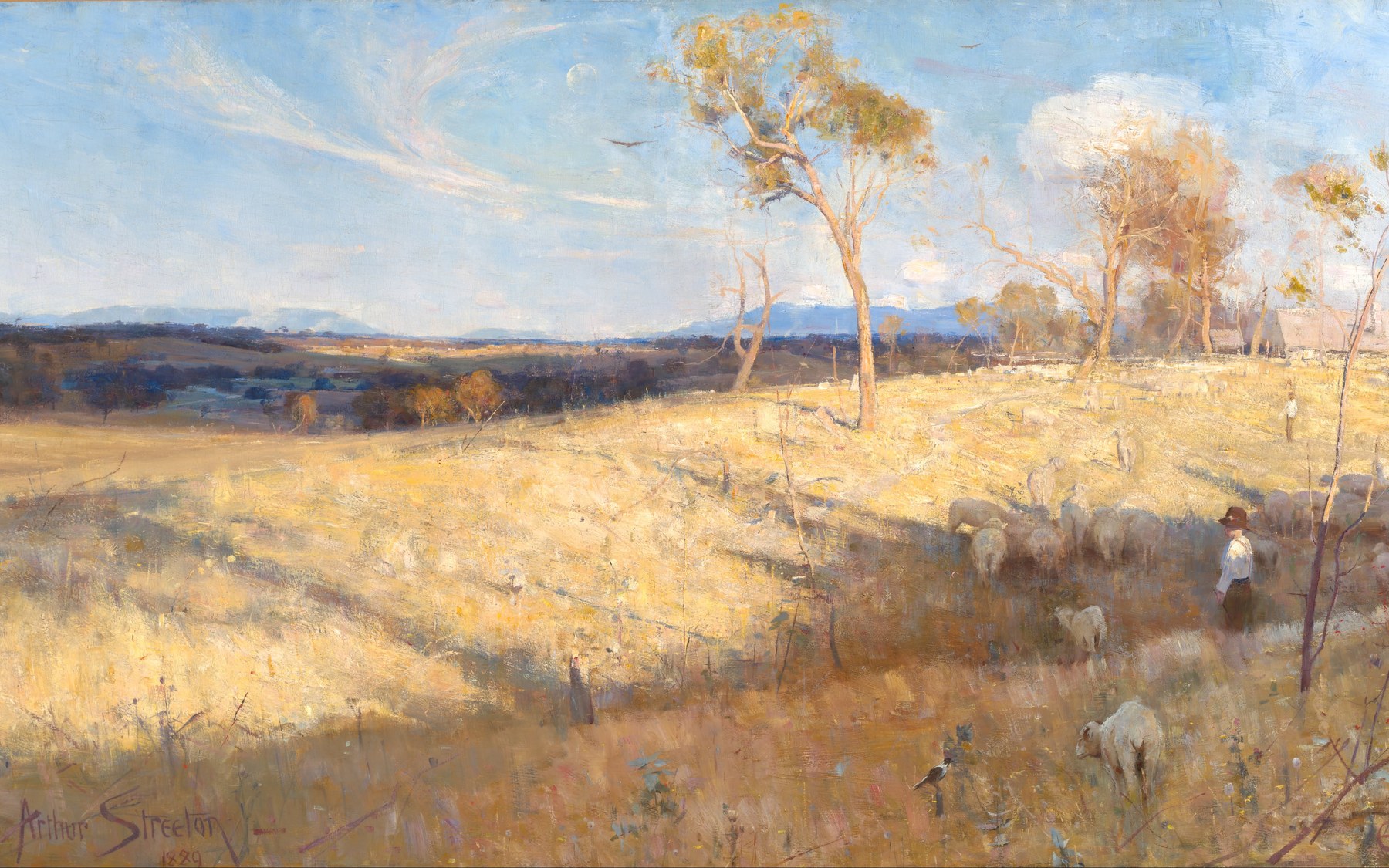
Arthur Streeton - Golden summer, Eaglemont - Google Art Project.jpg by Arthur Streeton; Public domain via Wikimedia Commons. Cropped for TheHistoryOfArt.org. · Image source
What to expect
Australian Impressionism was an NGV exhibition at The Ian Potter Centre: NGV Australia, shown at Federation Square from 31 March to 8 July 2007. Because it has now closed, this page is an archive record rather than a current visit page. It is included because the official NGV record describes it as the first exhibition on the subject since Golden Summers: Heidelberg and beyond in 1985, and because it gives the Melbourne cluster an earlier, concentrated reassessment of Australian Impressionism before the later She-Oak and Sunlight exhibition of 2021.
NGV framed the 2007 exhibition around five major artists of the movement: Charles Conder, Frederick McCubbin, Tom Roberts, Arthur Streeton and Jane Sutherland. The time span was deliberately tight, running from 1883, when Roberts encountered direct painting in Granada, to 1897, when Streeton left for Europe. That fourteen-year frame makes the exhibition useful as a movement-history page. It is not a general survey of all Australian landscape painting, but a focused account of how plein-air practice, local places, exhibitions, friendship and national ambition came together in a short and unusually fertile period.
The official page states that more than 240 works were included, from famous iconic images to lesser-known examples. It traced the development of a radical new landscape at Box Hill, Mentone and Heidelberg, examined the lively art world of "Marvellous Melbourne", returned to the 9 by 5 Impression Exhibition of August 1889, and followed Roberts and Streeton to New South Wales, including Sirius Cove, rural New South Wales and the Hawkesbury River. That gives the archive page a clear geography as well as a clear chronology.
Why it mattered
The strongest reason to preserve this record is that it marks a key modern restaging of Australian Impressionism. By 2007, the movement had already become a familiar national story. The challenge for NGV was therefore not simply to introduce Roberts, Streeton, McCubbin, Conder and Sutherland, but to redefine them for a new generation. The official page uses exactly that language of redefinition, which matters because Australian Impressionism can harden into a small set of cherished images unless exhibitions reopen its questions.
The 1883 to 1897 frame is especially valuable. It begins before the Heidelberg School name becomes comfortable, and it ends before later Federation-era national narratives fully settle. In between, the artists experimented with direct painting, small panels, outdoor sketching, tonal harmonies, portraiture, urban culture, camps and interstate movement. The page should help readers see the movement as unstable and developing, rather than as a finished national style from the start.
Jane Sutherland's inclusion among the five major artists is also important. Earlier accounts of Australian Impressionism often centred the male friendships of Roberts, Streeton, McCubbin and Conder. NGV's artist list makes Sutherland structurally important to the exhibition, not merely a supporting presence. That matters because social restrictions shaped how women artists worked, travelled, studied and joined artists' camps. Placing Sutherland in the core group keeps the movement more accurate and more human.
The exhibition also mattered because it placed portraiture and Symbolism alongside landscape. Australian Impressionism is often remembered through sunlight, gum trees, paddocks, beaches and bush tracks. NGV's official record says the exhibition looked at Roberts and Streeton's portraiture and the emergence of Symbolism in Conder and Streeton. That widens the subject. The movement was not only about painting outdoors; it was also about modern identity, mood, social presentation and the search for larger meanings in local scenes.
What to look for in the archive record
Begin with the places: Box Hill, Mentone, Heidelberg, Sirius Cove and the Hawkesbury River. These are not interchangeable landscape labels. Each place offered different light, distances, social settings and working conditions. Box Hill and Heidelberg belong to the Melbourne story of outdoor painting and artists' camps; Mentone brings the coast into view; Sirius Cove and the Hawkesbury River extend the movement into New South Wales and show how Roberts and Streeton adapted their methods beyond Victoria.
Then look at scale. The 9 by 5 Impression Exhibition remains one of the movement's sharpest moments because its small panels, many painted on cigar-box lids, changed the relationship between sketch and finished work. NGV's 2007 exhibition returned to that event as part of a longer sequence. A reader should ask how a small "impression" could claim independence as a work of art, and why that claim unsettled academic expectations.
The phrase "Marvellous Melbourne" is another route. Late nineteenth-century Melbourne was a boom city, and the artists were working inside a lively urban art world, not in rural isolation. Exhibitions, studios, clubs, newspapers, collectors, criticism and social networks shaped the movement as much as plein-air technique did. The archive record should therefore be read as a story of institutions and audiences as well as landscapes.
Finally, consider the first great "national" pictures that NGV says emerged around the centenary of European settlement in Australia in 1888. That phrase is historically loaded. It points to artworks that helped imagine a national visual identity, while also reminding present-day readers that this national story was built from a settler perspective. The later She-Oak and Sunlight page makes that First Nations Country context more explicit, and the 2007 page can sit beside it as part of a developing museum conversation.
How it fits Melbourne and Australia
This page strengthens NGV Australia by adding an earlier archive layer beneath the 2021 and 2013 records. The 2007 exhibition supplies the core movement-history frame. She-Oak and Sunlight broadens that story through place, First Nations context, women artists and later scholarship. Australian Impressionists in France follows Australian artists overseas and places them inside international networks. Together, the three NGV Australia pages give Melbourne a serious Australian Impressionism cluster rather than a single isolated exhibition.
For current planning, this exhibition has ended. Its value is archival, interpretive and connective. It helps readers understand why The Ian Potter Centre: NGV Australia is a key venue for Australian art history, and why Australian Impressionism remains a recurring subject for NGV. It can also support future artist pages, artwork pages and movement essays around Roberts, Streeton, McCubbin, Conder, Sutherland, plein-air painting, the 9 by 5 exhibition and the relationship between local landscape and national identity.
The page creates internal-link opportunities for Tom Roberts, Arthur Streeton, Frederick McCubbin, Charles Conder, Jane Sutherland, Box Hill, Heidelberg, Mentone, Sirius Cove, Hawkesbury River, 9 by 5 Impression Exhibition, Marvellous Melbourne, Symbolism, plein-air painting and Australian Impressionism.
Image and rights note
The underlying artists and works are historic, so public-domain routes may be possible. However, NGV object photography, private loans, catalogue images, press imagery and exhibition-related photography may carry separate restrictions. This page remains image-free until a reviewed source and credit route is selected.
How to use this page
Because Australian Impressionism has ended, the page should function as an archive record and a route into related artists, works and venues. The most reliable fixed details are the venue, dates, broad subject, media and official source link. The interpretive notes help place the exhibition in art-historical context: what kind of show it is, why it may matter, and which artists or topics are worth exploring next.
It is marked as a major exhibition in this guide, so it should be useful for readers choosing between several possible museum visits.
Looking notes
For a visitor, the most useful approach is to look for patterns rather than isolated highlights. With Tom Roberts, Frederick McCubbin, Arthur Streeton, Charles Conder, Jane Sutherland, Box Hill, Mentone, Heidelberg, Marvellous Melbourne, 9 by 5 Impression Exhibition, Sirius Cove, Hawkesbury River, Symbolism, Golden Summers: Heidelberg and beyond, Australian Impressionism, plein air painting, ask how the exhibition frames the subject: as biography, period survey, focused theme, collection display or reassessment. With media such as painting, landscape painting, portraiture, oil sketch, plein-air painting, national picture, works on paper, pay attention to changes of scale, surface, lighting, material and display sequence, because those details are often lost in online listings.
The guide avoids over-specific claims where the public source does not yet support them. If a museum has not published a full object list, it is better to stay clear about what is confirmed than to imply certainty.
Who it is best for
Australian Impressionism is most likely to help readers who are already interested in Tom Roberts, Frederick McCubbin, Arthur Streeton, Charles Conder, Jane Sutherland, Box Hill, Mentone, Heidelberg, Marvellous Melbourne, 9 by 5 Impression Exhibition, Sirius Cove, Hawkesbury River, Symbolism, Golden Summers: Heidelberg and beyond, Australian Impressionism, and plein air painting, but it may also be useful for visitors building a wider route around The Ian Potter Centre: NGV Australia in Melbourne. If time is limited, use this page to decide whether the subject fills a gap in your knowledge, whether it connects to artists you already follow, and whether the official venue information makes the visit practical.