by Tom Gurney
Tom Gurney BSc (Hons) is an art history expert with over 20 years experience
Published on July 14, 2026 / Updated on July 16, 2026
Email: tomgurney1@gmail.com / Phone: +447429011000
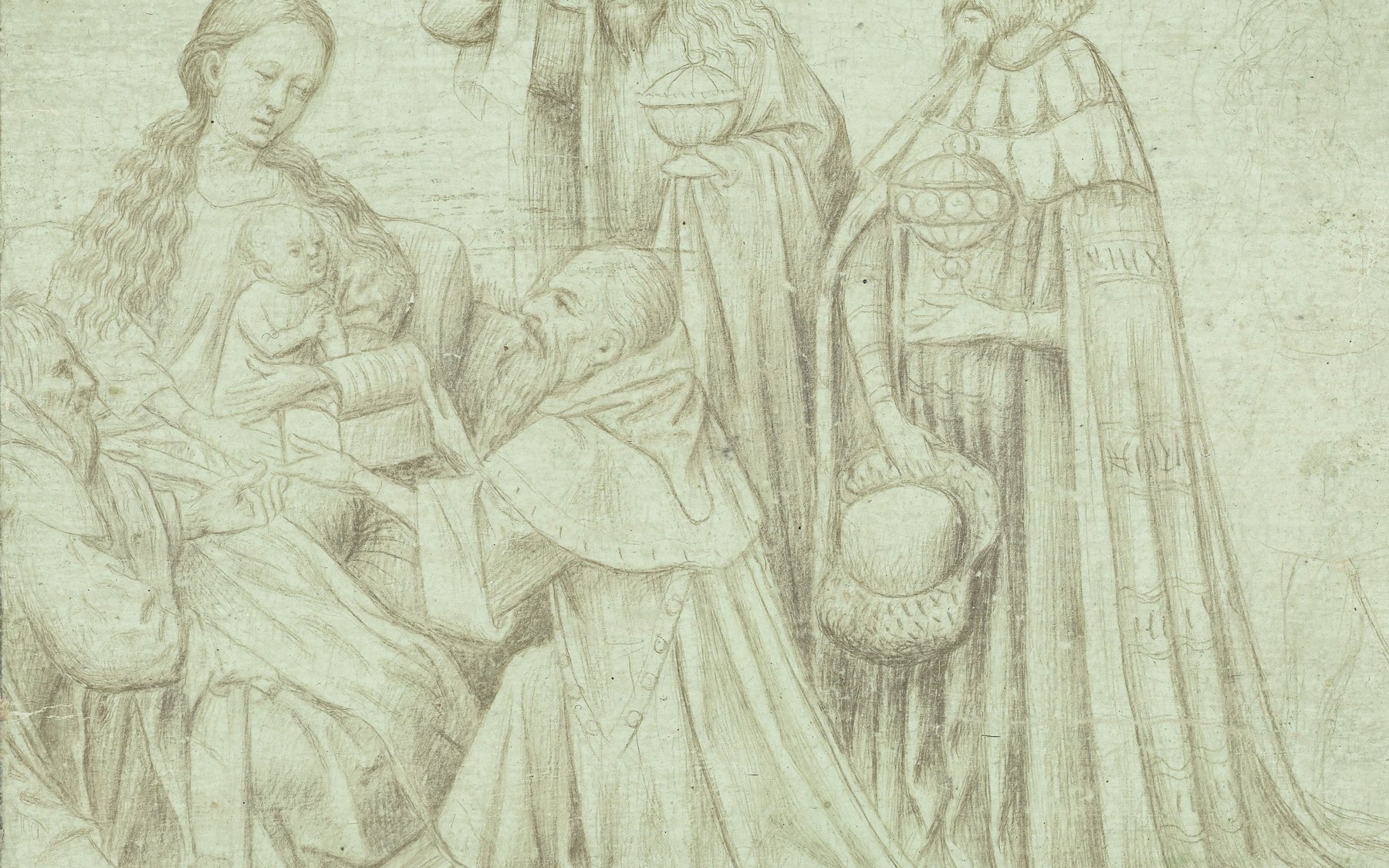
De aanbidding der koningen, RP-T-00-576.jpg by Rijksmuseum; CC0 via Wikimedia Commons. Cropped for TheHistoryOfArt.org. · Image source
What to expect
Early Netherlandish drawings is a free British Museum exhibition in Room 90, focused on drawing in the Low Countries before 1600. It is not a general Northern Renaissance survey. The useful promise is narrower and more revealing: how sheets made for workshops, designs, copies, study and invention came to be understood as works of art in their own right.
The exhibition brings together around 120 works, with artists including Rogier van der Weyden, Lucas van Leyden, Pieter Bruegel the Elder and Hendrick Goltzius. That makes it a strong first British Museum exhibition page for this section because it sits safely before modern copyright trouble, gives the London cluster another major institution, and links naturally to drawing, workshop practice, apprenticeship, prints, tapestries, stained glass and early collecting habits.
Why go
The exhibition is valuable because early Netherlandish drawings are rare survivals. Many were functional objects rather than treasured finished works: workshop models, preparatory studies, copies used in training, or designs that helped move ideas between media. The British Museum frames the show around the transformation of drawing from a working tool into an art form, and that gives visitors a good looking question before they enter: what changes when a sheet is no longer treated only as preparation?
That question suits the material. Metalpoint, chalk, ink and watercolour all ask for slower looking than large paintings usually do. A line may describe a face, test a pose, copy an older composition, plan a tapestry, or preserve an idea that could travel across a workshop. For readers interested in the master-apprentice relationship, this page is especially useful. The official large-print guide notes that fifteenth-century Netherlandish drawings often functioned inside workshops and that pupils copied works as part of their training. That turns the exhibition into a compact lesson in how artistic knowledge moved before modern art schools, public museums and printed art history.
What to look for
Begin with function. Ask whether a drawing seems to be a study, a model, an independent image, a copy, or something between those categories. Early Netherlandish art is often admired for finish and surface in panel painting, but drawings can reveal a different intelligence: correction, repetition, experiment and the practical demands of making images for other media. The show should help visitors see that invention does not always appear as dramatic self-expression. Sometimes it appears as a carefully repeated contour, a workshop exercise, or a face studied closely enough to become reusable.
Then look at materials. Metalpoint is precise and unforgiving, while chalk can feel warmer and more immediate. Ink can clarify design, but it can also expose speed, hesitation and touch. Those differences matter because they change how the artist thinks on the page. A drawing in red chalk does not behave like one in metalpoint, and neither behaves like a finished oil painting. For a reader coming from painter biographies, this is a useful corrective: drawing is not simply painting before paint arrives. It has its own pressures, pleasures and constraints.
How it fits the British Museum
The British Museum is an enormous world collection, so a focused Room 90 display can be easier to use than the building as a whole. This exhibition gives the new British Museum page a specific route into the collection rather than asking readers to tackle everything from antiquities to prints at once. It also fits the museum's strength in prints and drawings, where study, attribution, conservation and object history matter as much as famous names.
For a London art day, the practical decision is whether to pair this with another Bloomsbury or central London visit, or to treat it as a calm works-on-paper stop before moving elsewhere. Because the exhibition is free, it can work well for repeat visitors who want depth without committing to a large paid temporary show. The official page should still be checked before travel, especially for room access, opening hours and any late changes.
Image and rights note
This is one of the safer kinds of exhibition for the museum guide, but the page should still be disciplined. The works are historically old, yet a usable web image still needs a clear source, credit and review. One possible image has already been flagged for later review; the page should keep an image-free version available until a suitable source and credit line are approved.
How to use this page
Because Early Netherlandish drawings is current, the page should help a reader decide whether it deserves time before the closing date, not merely record that it exists. The most reliable fixed details are the venue, dates, broad subject, media and official source link. The interpretive notes help place the exhibition in art-historical context: what kind of show it is, why it may matter, and which artists or topics are worth exploring next.
It is marked as a major exhibition in this guide, so it should be useful for readers choosing between several possible museum visits.
Looking notes
For a visitor, the most useful approach is to look for patterns rather than isolated highlights. With Rogier van der Weyden, Lucas van Leyden, Pieter Bruegel the Elder, Hendrick Goltzius, ask how the exhibition frames the subject: as biography, period survey, focused theme, collection display or reassessment. With media such as drawing, metalpoint, chalk, ink, watercolour, pay attention to changes of scale, surface, lighting, material and display sequence, because those details are often lost in online listings.
The guide avoids over-specific claims where the public source does not yet support them. If a museum has not published a full object list, it is better to stay clear about what is confirmed than to imply certainty.
Who it is best for
Early Netherlandish drawings is most likely to help readers who are already interested in Rogier van der Weyden, Lucas van Leyden, Pieter Bruegel the Elder, and Hendrick Goltzius, but it may also be useful for visitors building a wider route around British Museum in London. If time is limited, use this page to decide whether the subject fills a gap in your knowledge, whether it connects to artists you already follow, and whether the official venue information makes the visit practical.