by Tom Gurney
Tom Gurney BSc (Hons) is an art history expert with over 20 years experience
Published on July 14, 2026 / Updated on July 16, 2026
Email: tomgurney1@gmail.com / Phone: +447429011000
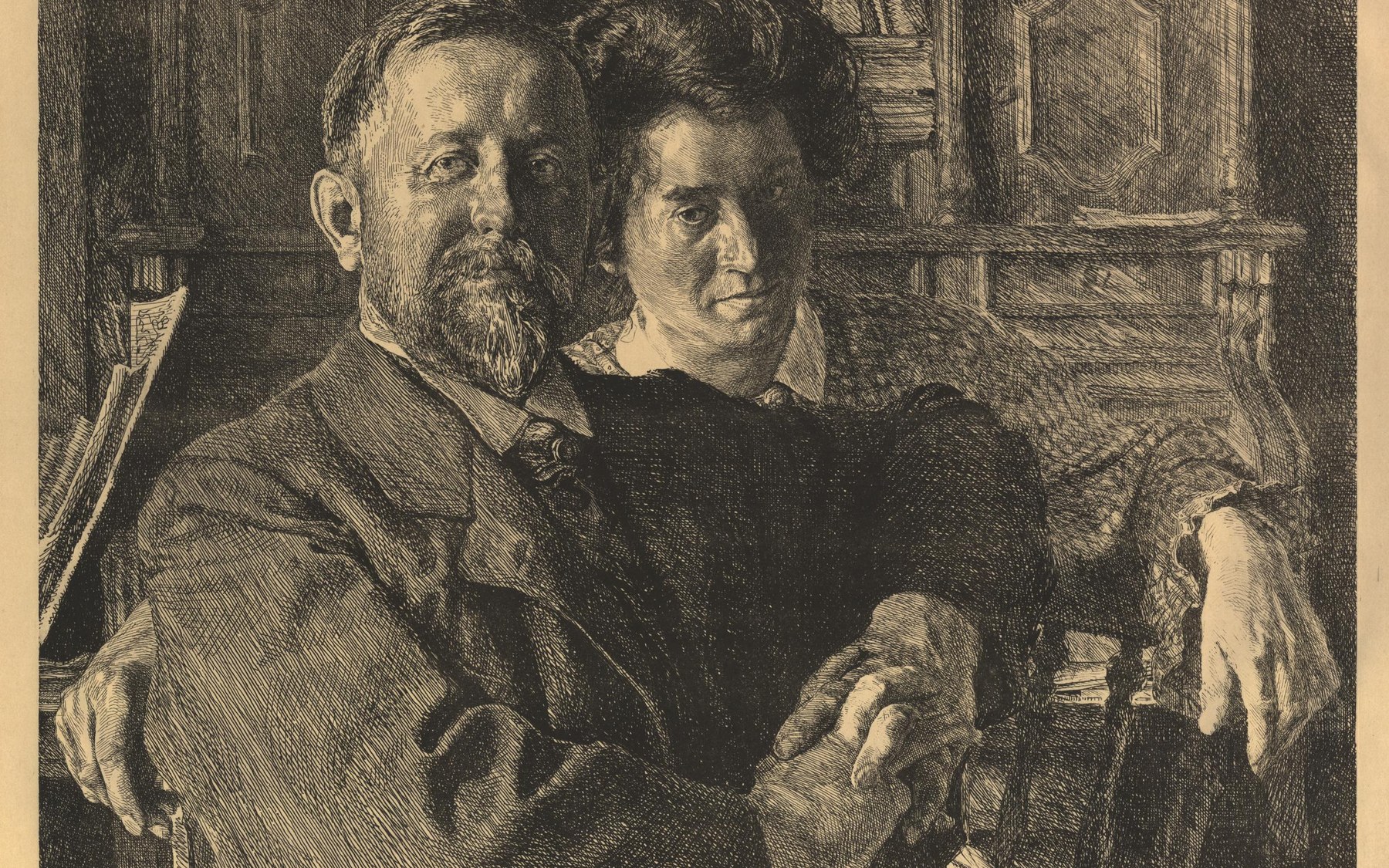
Otto Greiner - Double-portrait of the author Franz Langheinrich and his wife 1901 -British Museum 1978,0121.327 288556001.jpg by Otto Greiner; Public domain via Wikimedia Commons. Cropped for TheHistoryOfArt.org. · Image source
What to expect
Lost. Found. Returned. is a current Getty Center exhibition, running from 23 June to 18 October 2026 at the Getty Research Institute in Gallery II. The official Getty page presents the story of a drawing by Otto Greiner, Standing Male Nude from the Back, with a Smaller Sketch, made in 1892 and acquired by the Kupferstich-Kabinett in Dresden in 1894. After World War II, the drawing was marked as lost. Decades later, it re-emerged in Los Angeles at the Getty Research Institute.
This is a compact exhibition, but its subject is unusually rich. Getty frames it around the drawing's shifting wartime status, the research tools used to identify missing artworks, and the impending return of the work to Dresden. That makes the page different from a normal artist or medium guide. It is about an artwork's biography: creation, collection, disappearance, rediscovery, verification and restitution.
The selected work named by Getty is Greiner's drawing itself, held by the Kupferstich-Kabinett Dresden, Staatliche Kunstsammlungen Dresden. Getty's accompanying article explains that researchers used archival records, a 1900 reproduction, close visual comparison, a distinctive ink spot and partially erased Cyrillic markings to confirm the object's identity. Those details give the exhibition a strong looking route: visitors are not only looking at a drawing, but at the evidence that allows a drawing to be known.
Why go
The strongest reason to go is that the exhibition makes provenance research visible. Provenance can sound like a footnote, but here it becomes the main subject. Where was the drawing made? Who acquired it? How was it recorded? When did it disappear? What marks, inscriptions or records allow researchers to connect the object in front of them to an object described more than a century earlier?
Getty's press release describes the case as a collaboration between teams in Dresden and Los Angeles, with historical, archival, material, forensic and computational evidence brought together to reconstruct the drawing's history. That is important because restitution is not presented as a dramatic single discovery only. It is a process of patient comparison, documentation and institutional responsibility.
For readers interested in art history as method, this is a particularly useful exhibition. It shows that museums are not only places where finished objects are displayed. They are also places where records are checked, gaps are acknowledged, and decisions are made about stewardship. A single drawing becomes a way to understand the ongoing effects of wartime displacement and the ethical responsibilities of collections.
What to look for
Begin with the drawing as an object. Greiner was associated with Symbolism, and the sheet has visual interest in its own right, but this exhibition asks the viewer to look beyond style. Notice the support, marks, inscriptions, condition, cropping, tone and any details that might make this sheet identifiable as this sheet rather than another version or related study.
Then think about evidence. Getty's article makes the ink spot especially vivid: an apparently small, accidental mark became a decisive clue when researchers compared the rediscovered drawing with earlier documentation. That is a useful lesson in connoisseurship. Identification may depend on what looks marginal, not only on the main figure or composition.
The Cyrillic marking on the back of the drawing opens another route. It suggests a possible chapter in the drawing's postwar movement and reminds visitors that the back of an artwork can carry evidence as important as the front. Stamps, inscriptions, inventory numbers, dealer marks, erasures and labels are all part of object history.
Finally, look at how the exhibition tells uncertainty. Provenance research often has gaps. A responsible display should not pretend that every step is known when it is not. The strongest visit will pay attention to what Getty says is confirmed, what is probable and what remains unresolved. That distinction is a form of editorial honesty as well as scholarly caution.
How it fits the Getty and Los Angeles
This page broadens the Getty Center cluster by adding the Research Institute to the museum-led Getty pages. Recent Getty additions in this batch have focused on drawings, manuscripts, Old Master painting, Symbolism and materials. Lost. Found. Returned. adds provenance, restitution, archives, database research and international collaboration. That gives the Los Angeles page another kind of art-history route: not only what to see, but how museums know what they are seeing.
For practical planning, the exhibition is time-sensitive because it closes on 18 October 2026. It can pair naturally with Odilon Redon: Otherworldly Visions, which closes the same day, or with other Getty Center exhibitions and Research Institute tours. Readers should still check Getty's official source before travelling for timed-entry reservations, Research Institute access, tour availability and any changes.
Image and rights note
The central Greiner drawing is historic, but it belongs to the Dresden collection and Getty's exhibition images carry specific institutional credit context. This page therefore remains image-free until a source and credit route is explicitly approved. Any later image should credit the reviewed Getty or Dresden source carefully and should avoid implying ownership by Getty, since the exhibition is explicitly about return to Dresden.
How to use this page
Because Lost. Found. Returned. is current, the page should help a reader decide whether it deserves time before the closing date, not merely record that it exists. The most reliable fixed details are the venue, dates, broad subject, media and official source link. The interpretive notes help place the exhibition in art-historical context: what kind of show it is, why it may matter, and which artists or topics are worth exploring next.
It is marked as a major exhibition in this guide, so it should be useful for readers choosing between several possible museum visits.
Looking notes
For a visitor, the most useful approach is to look for patterns rather than isolated highlights. With Otto Greiner, provenance research, restitution, wartime loss, Getty Research Institute, Dresden Kupferstich-Kabinett, ask how the exhibition frames the subject: as biography, period survey, focused theme, collection display or reassessment. With media such as drawing, works on paper, provenance record, archive research, exhibition case study, pay attention to changes of scale, surface, lighting, material and display sequence, because those details are often lost in online listings.
The guide avoids over-specific claims where the public source does not yet support them. If a museum has not published a full object list, it is better to stay clear about what is confirmed than to imply certainty.
Who it is best for
Lost. Found. Returned. is most likely to help readers who are already interested in Otto Greiner, provenance research, restitution, wartime loss, Getty Research Institute, and Dresden Kupferstich-Kabinett, but it may also be useful for visitors building a wider route around Getty Center in Los Angeles. If time is limited, use this page to decide whether the subject fills a gap in your knowledge, whether it connects to artists you already follow, and whether the official venue information makes the visit practical.