by Tom Gurney
Tom Gurney BSc (Hons) is an art history expert with over 20 years experience
Published on July 14, 2026 / Updated on July 16, 2026
Email: tomgurney1@gmail.com / Phone: +447429011000
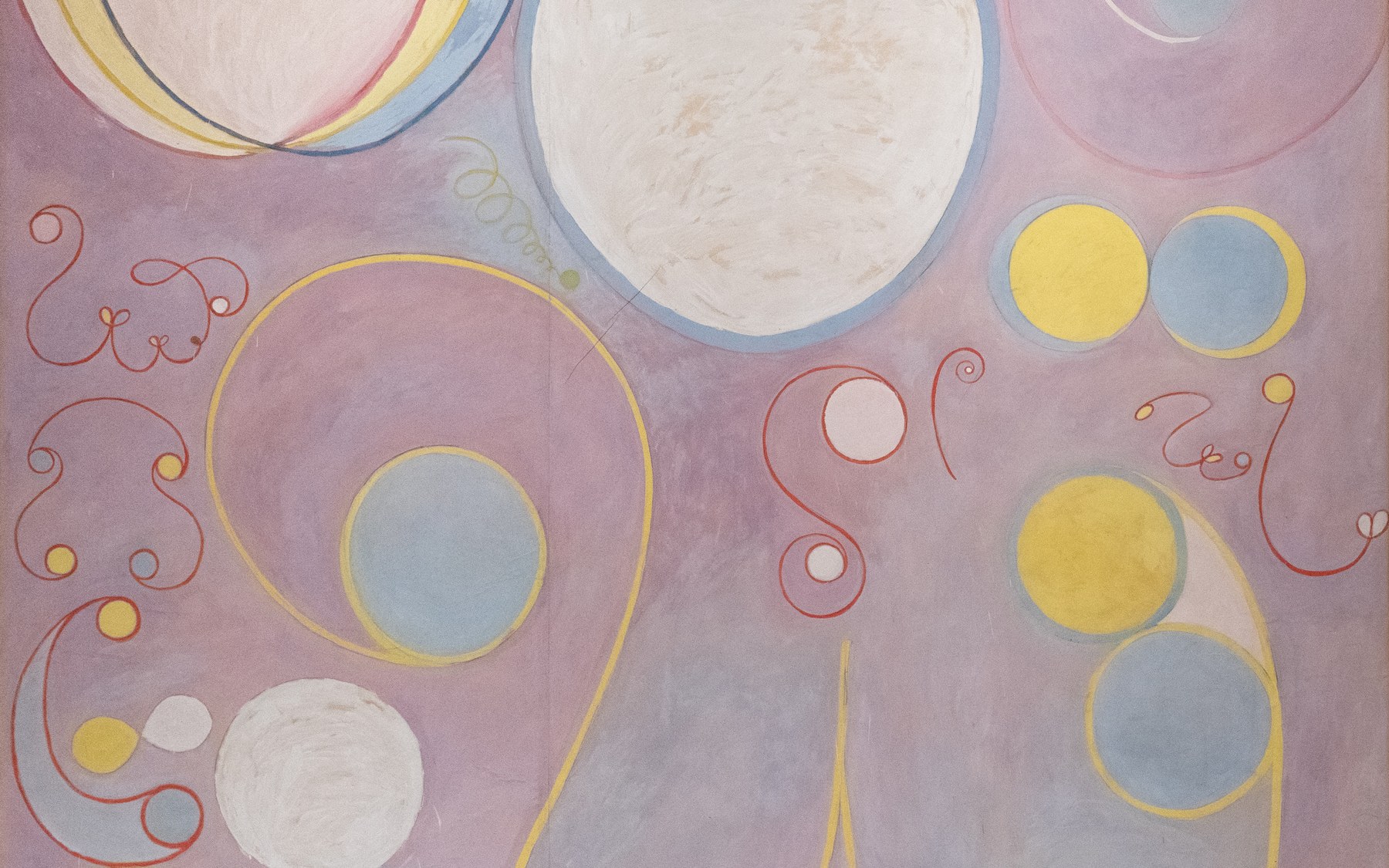
Hilma af Klint — The Ten Largest — Number 8 Adulthood.jpg by Gsimonov; Public domain via Wikimedia Commons. Cropped for TheHistoryOfArt.org. · Image source
What to expect
Hilma af Klint: Paintings for the Temple (1906-1915) is a current Grand Palais exhibition in Paris, running from 6 May to 30 August 2026. The official Grand Palais page presents it as the first monographic exhibition in France devoted to Hilma af Klint, a Swedish artist whose work has changed the chronology of modern art. The focus is the artist's visionary abstract project, especially the Paintings for the Temple and the monumental series The Ten Largest.
The exhibition is a strong addition to the Grand Palais cluster because it gives the venue a current modern-art page with real urgency. Cezanne and Us is upcoming, Matisse is now archived, and Hilma af Klint is the live reason to plan a visit before the end of August 2026. It also widens the batch beyond the familiar male line of modern painting. Af Klint's work asks readers to rethink abstraction through women artists, secrecy, spiritual practice, science, symbolism and delayed recognition.
Grand Palais frames af Klint as an artist with a double artistic life. She trained at the Royal Academy of Fine Arts in Stockholm and maintained a figurative practice that met the expectations of her time. In parallel, largely in secret, she developed a radically avant-garde body of work shaped by theosophy, spiritualism and an interest in invisible forces. From 1906, before the canonical abstraction dates usually attached to Kandinsky, Malevich or Mondrian, she made bold compositions of colour, geometry, organic forms, spirals, circles and beams.
Why it matters
The strongest reason to go is that this exhibition turns chronology into a live question. Modern art is often taught as a sequence of public movements: Impressionism, Post-Impressionism, Fauvism, Cubism, abstraction, Constructivism and so on. Af Klint disrupts that sequence because many of her most radical works were not part of the public avant-garde circuit when they were made. They existed, but they were hidden, protected and in some sense addressed to a future audience.
That hidden status makes the work difficult in productive ways. It would be too simple to say that af Klint was merely "first" and stop there. The deeper question is what kind of abstraction she made. Her paintings were not only formal experiments in colour and shape. They were tied to spiritual systems, séances, theosophy, anthroposophy, scientific imagery, cosmology, gendered collaboration and the idea that painting could visualise forces beyond ordinary sight. That makes her different from many modernist narratives built around optical analysis or pure form.
The Temple project is the reason the exhibition deserves a full guide page. Grand Palais's related magazine material describes the Paintings for the Temple as a 193-painting project conceived as fragments of an ideal spiritual temple. The idea of an imagined building matters. Af Klint was not simply making isolated abstract canvases. She was imagining a total environment, a route, a progression and a sacred architecture for looking.
What to look for
Begin with scale. The Ten Largest are physically commanding works, and scale changes how abstraction behaves. A spiral or oval on a small page can feel like a symbol; at monumental scale it can become environmental, almost bodily. The viewer is not only reading signs but standing before fields of colour, rhythm and motion. That helps explain why the Grand Palais setting is suitable: the work needs room to breathe.
Then look for the relation between geometry and organic form. Af Klint's language is not purely hard-edged. Circles, triangles, spirals, flowers, shells, letters, diagrams and biomorphic forms move between order and growth. That mixture is essential. The paintings can look systematic and alive at the same time, as if spiritual diagrams and natural processes were being fused into one visual structure.
Colour is another route. The official page emphasises vivid colours and symbolic audacity. Rather than treating colour as decoration, ask what work it does. Does it divide states of being, suggest gendered polarities, mark spiritual stages, create harmony, produce vibration, or simply give the composition its energy? Af Klint's abstraction can feel radiant because colour is not only surface. It is part of the system.
Finally, think about collaboration and delayed audience. Af Klint worked with spiritual companions, including women around her, and chose to keep her abstract works hidden, with instructions that they remain sealed for twenty years after her death. Grand Palais notes that the work was not publicly revealed in a major way until the 1986 exhibition The Spiritual in Art in Los Angeles. A visitor should ask how that delay changes the work's meaning. Does it make the paintings prophetic, isolated, protected, misunderstood, or all of these at once?
How it fits Grand Palais and Paris
This page strengthens the Grand Palais venue because it shows the building as more than a large temporary exhibition container. It can host projects that materially change public art history. With Matisse, the venue gathered the late language of colour and cut-outs. With Cezanne, it will examine reception and modern-art myth. With af Klint, it presents an artist whose work forces visitors to reconsider the origin story of abstraction.
For Paris planning, this is time-sensitive. The exhibition closes on 30 August 2026 and is in Gallery 8 at the Grand Palais. Readers should check the official Grand Palais page before travelling for ticket availability, opening hours, access, late openings and any final-week changes. Because the show is current and visually distinctive, it may be one of the strongest Paris options in this batch for visitors interested in modern art, women artists or abstraction.
The page also has strong future reader interest. It can later connect to abstraction, Kandinsky, Malevich, Mondrian, theosophy, spiritualism, women artists, colour theory, scientific imagery, Swedish art, modernism, the 1986 The Spiritual in Art exhibition and the broader question of how art-historical timelines are rewritten. It is especially useful for Tom's future improvement ideas around colour theory, movement timelines and influences across international boundaries.
Image and rights note
Hilma af Klint died in 1944, so underlying-work rights may be more manageable in some jurisdictions than living-artist material. That does not make the most relevant images automatically safe. The official Grand Palais page credits images through the Hilma af Klint Foundation and Moderna Museet, while installation photographs and Grand Palais/Centre Pompidou material have separate rights and credit paths. This page remains image-free until a reviewed source and credit route is selected.
How to use this page
Because Hilma af Klint: Paintings for the Temple (1906-1915) is current, the page should help a reader decide whether it deserves time before the closing date, not merely record that it exists. The most reliable fixed details are the venue, dates, broad subject, media and official source link. The interpretive notes help place the exhibition in art-historical context: what kind of show it is, why it may matter, and which artists or topics are worth exploring next.
It is marked as a major exhibition in this guide, so it should be useful for readers choosing between several possible museum visits.
Looking notes
For a visitor, the most useful approach is to look for patterns rather than isolated highlights. With Hilma af Klint, Paintings for the Temple, The Ten Largest, abstraction, theosophy, spiritualism, Royal Academy of Fine Arts Stockholm, Kandinsky, Malevich, Mondrian, The Spiritual in Art, women artists, Centre Pompidou, ask how the exhibition frames the subject: as biography, period survey, focused theme, collection display or reassessment. With media such as painting, abstraction, large-scale painting, tempera on paper, symbolism, geometric abstraction, organic motifs, spiritual art, modern painting, pay attention to changes of scale, surface, lighting, material and display sequence, because those details are often lost in online listings.
The guide avoids over-specific claims where the public source does not yet support them. If a museum has not published a full object list, it is better to stay clear about what is confirmed than to imply certainty.
Who it is best for
Hilma af Klint: Paintings for the Temple (1906-1915) is most likely to help readers who are already interested in Hilma af Klint, Paintings for the Temple, The Ten Largest, abstraction, theosophy, spiritualism, Royal Academy of Fine Arts Stockholm, Kandinsky, Malevich, Mondrian, The Spiritual in Art, women artists, and Centre Pompidou, but it may also be useful for visitors building a wider route around Grand Palais in Paris. If time is limited, use this page to decide whether the subject fills a gap in your knowledge, whether it connects to artists you already follow, and whether the official venue information makes the visit practical.