by Tom Gurney
Tom Gurney BSc (Hons) is an art history expert with over 20 years experience
Published on July 14, 2026 / Updated on July 16, 2026
Email: tomgurney1@gmail.com / Phone: +447429011000
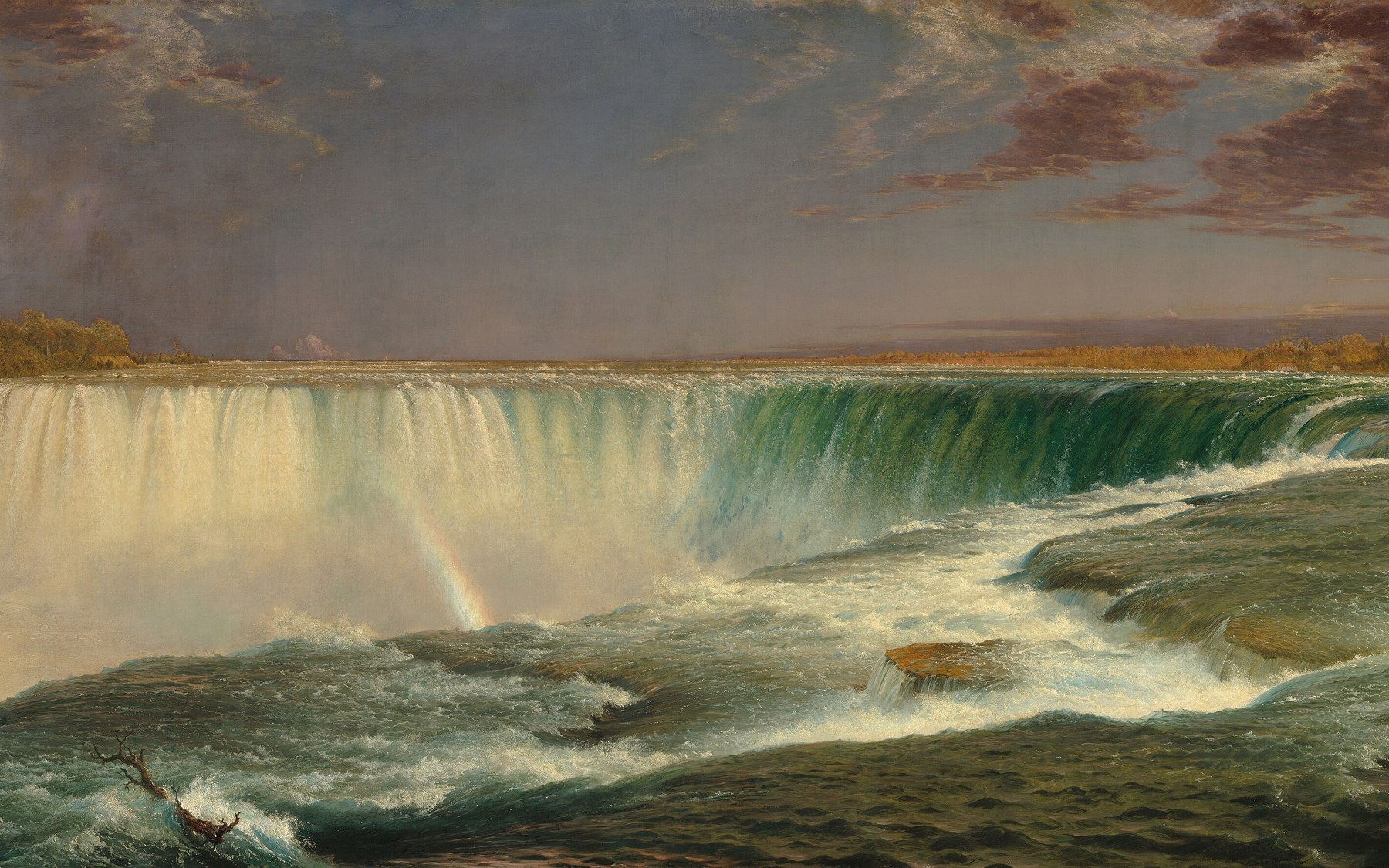
Frederic Edwin Church, Niagara, 1857; public-domain image via Wikimedia Commons · Image source
What to expect
Niagara Falls: Mist and Majesty is a current National Gallery of Art exhibition in Washington DC, running from 2 May to 20 September 2026 in the West Building, Main Floor, Gallery M72. Admission to the National Gallery is free and passes are not required. The official NGA page describes the exhibition as an exploration of Niagara Falls from the early nineteenth century to today, through over 20 works of art.
The exhibition is anchored by Frederic Edwin Church's Niagara, painted in 1857 and now in the National Gallery's Corcoran Collection. The timing is deliberate: 2026 marks the bicentennial of Church's birth in 1826. But the show is not only a Church celebration. NGA frames Niagara as a place whose meanings have shifted across time: sacred homeland, natural wonder, national symbol, tourist destination, route toward freedom, preservation cause, spectacle, commodity and continuing artistic subject.
Selected works named by NGA include Church's Niagara, Charles Hunt and Rudolf Ackermann's 1833 aquatint Falls of Niagara, Alec Soth's 2019 photograph Niagara Falls, Ontario and Kay WalkingStick's 2024 painting The Niagara Cascades. That range gives the exhibition its strength. Visitors should expect painting, print and photography to sit together, showing how the falls have been pictured for different publics and different historical needs.
Why go
The strongest reason to go is that Niagara Falls is almost too famous to see clearly. Its image has circulated through paintings, prints, tourist views, postcards, photographs, guidebooks, advertisements and public memory for two centuries. This exhibition asks what happens when a natural site becomes an image industry. The falls are real water, rock, mist and sound, but they are also a cultural machine for making awe, national identity and commercial spectacle.
Church's 1857 painting remains the obvious anchor because it changed how Niagara could be seen. NGA's object record describes how Church plunges the viewer directly into the rushing water, combining frothing waves, rock surfaces, mist, distance and a broken rainbow. The famous response that this was "Niagara, with the roar left out" captures the painting's ambition: to make a silent canvas feel physically overwhelming.
The deeper reason to go is that NGA does not leave the image at spectacle. The press material points to the Haudenosaunee and Seneca history of the site, European arrival, tourism, preservation, daredevils and profiteers, and the Niagara River as a route used by thousands of enslaved people crossing north toward freedom from the 1840s. Those histories complicate the landscape. A waterfall can be sublime and beautiful while also carrying territorial, political and social histories that a purely scenic view might hide.
What to look for
Begin with viewpoint. Church's Niagara removes the conventional foreground and places the viewer close to the water's edge. That compositional decision matters. It makes the spectator feel suspended over motion rather than safely distant from a picturesque view. Compare that with prints or photographs where the falls may be framed from shore, from above, from a tourist lookout or through a more documentary lens.
Then look for scale. Niagara images often struggle with the problem of making a vast natural force fit inside a manageable picture. Artists can solve that problem with tiny human figures, panoramic formats, plunging viewpoints, mist, rainbow, horizon line, foam, cropping or surrounding architecture. Ask whether each work makes the falls feel knowable, measurable, terrifying, marketable or sacred.
Print culture is especially important. Aquatints, lithographs and other nineteenth-century reproductive images helped Niagara travel to viewers who would never stand at the site. A print can turn landscape into possession: something collected, displayed, remembered and sold. That is different from Church's giant painted event, but the two belong to the same wider culture of spectacle and circulation.
With modern and contemporary works, watch for resistance to the older sublime. Alec Soth's photograph and Kay WalkingStick's painting belong to very different historical moments from Church. Their presence should encourage visitors to ask how Niagara looks after mass tourism, environmental change, Indigenous historical recovery and modern photography. Does the contemporary image renew wonder, question it, fragment it or redirect it toward memory and land?
How it fits the National Gallery of Art
This page strengthens the National Gallery of Art cluster because it gives the museum a current American landscape route alongside its European painting strengths and the archived Little Beasts page. NGA should not read only as Leonardo, Rembrandt, Degas and formal masterpieces. It also has major American holdings and the capacity to build focused historical exhibitions around one site, one painting and one national image.
For Washington DC planning, the exhibition is relatively easy to include because it is free and in the West Building. It can pair naturally with NGA's American painting galleries, works on paper, photography holdings and a wider National Mall visit. Because it closes on 20 September 2026, it is time-sensitive within the current batch, and readers should check NGA's official source before travelling for gallery access, related talks, tours or any late changes.
The page also has strong future reader value. It can connect to Frederic Edwin Church, landscape painting, the Hudson River School, American national imagery, print culture, photography, tourism, environmental history, Indigenous land history and the visual culture of abolition and freedom routes. It is an exhibition page that can later support evergreen American landscape content after the show closes.
Image and rights note
Church's 1857 Niagara is especially promising for a future image review because NGA's object record identifies the image media as public domain and downloadable under its Open Access policy. That said, this page remains image-free until the source and credit route is explicitly approved. Modern works in the exhibition, including Alec Soth's photograph and Kay WalkingStick's painting, are rights-sensitive and should not be used without separate review.
How to use this page
Because Niagara Falls is current, the page should help a reader decide whether it deserves time before the closing date, not merely record that it exists. The most reliable fixed details are the venue, dates, broad subject, media and official source link. The interpretive notes help place the exhibition in art-historical context: what kind of show it is, why it may matter, and which artists or topics are worth exploring next.
It is listed as a recommended exhibition rather than a headline major show, so the main value is a focused subject, strong venue context or a useful route into related artists.
Looking notes
For a visitor, the most useful approach is to look for patterns rather than isolated highlights. With Frederic Edwin Church, Niagara Falls, Haudenosaunee history, freedom seekers, tourism, preservation, American landscape, ask how the exhibition frames the subject: as biography, period survey, focused theme, collection display or reassessment. With media such as painting, print, photography, contemporary painting, aquatint, chromolithograph, pay attention to changes of scale, surface, lighting, material and display sequence, because those details are often lost in online listings.
The guide avoids over-specific claims where the public source does not yet support them. If a museum has not published a full object list, it is better to stay clear about what is confirmed than to imply certainty.
Who it is best for
Niagara Falls is most likely to help readers who are already interested in Frederic Edwin Church, Niagara Falls, Haudenosaunee history, freedom seekers, tourism, preservation, and American landscape, but it may also be useful for visitors building a wider route around National Gallery of Art in Washington DC. If time is limited, use this page to decide whether the subject fills a gap in your knowledge, whether it connects to artists you already follow, and whether the official venue information makes the visit practical.