by Tom Gurney
Tom Gurney BSc (Hons) is an art history expert with over 20 years experience
Published on July 14, 2026 / Updated on July 16, 2026
Email: tomgurney1@gmail.com / Phone: +447429011000
Group at the Kelly Tree.jpg by Oswald Thomas Madeley; Public domain via Wikimedia Commons. Cropped for TheHistoryOfArt.org. · Image source
What to expect
Nolan Origins is an upcoming Art Gallery of New South Wales exhibition in Sydney, scheduled from 3 October 2026 to 7 February 2027. The official AGNSW page places it in the Naala Nura building on Lower level 2 and describes it as a ticketed major survey of Sidney Nolan's formative years in Australia. This page should therefore be treated as an upcoming visit-planning record, with readers asked to check the Art Gallery source before travelling for ticket availability, final admission and any late changes.
The exhibition brings together around 100 major works made before Nolan relocated to the United Kingdom in 1953. AGNSW frames the show around the places, stories and visual language that transformed Australian art: St Kilda, the Wimmera, K'gari, Central Australia and the landscapes associated with the Ned Kelly story in north-eastern Victoria. That geographic spread makes the exhibition more than a biographical survey. It is about how Nolan turned place into myth, memory and modernist image-making.
The headline draw is likely to be the Ned Kelly series of 1946-47, but the official page also emphasises self-portraiture, Central Australia and Nolan's broader interrogation of the idea of "Australia". That language matters. Nolan is not simply illustrating national stories. He is testing how myths, histories, people, creatures and inner meanings can become a distinctive pictorial world.
Why it matters
The strongest reason to include this page is that it moves the Australia cluster from Impressionism and prize culture into modernism. The recent AGNSW additions already give Sydney a strong historical route through Streeton and a current public route through the Archibald, Wynne and Sulman Prizes. Nolan Origins adds a third layer: twentieth-century modernist myth-making, where landscape, story and national identity become stranger and more psychologically charged.
Nolan is one of the artists who changed what Australian art could look like. Earlier landscape painting often worked through light, distance, pastoral vision or national image-making. Nolan's landscapes can be flatter, harsher, more symbolic and more dreamlike. His figures often seem to belong to stories that are already half legend. The Ned Kelly helmet, for example, is not only costume or history; it becomes a pictorial device, a black aperture, a mask through which land, violence and identity are seen.
The pre-1953 frame is useful because it concentrates on the years before Nolan became a long-term expatriate. The exhibition asks how his Australian work took shape before that move. That means readers can approach the show as an origins story in two senses: the origin of Nolan's mature language, and the origin of a modern Australian myth-world that continued to matter after he left.
The places named by AGNSW also need careful attention. St Kilda, Wimmera, K'gari, Central Australia and north-eastern Victoria are not interchangeable backdrops. Each place carries different histories, cultural meanings and visual pressures. A good visit should ask what kind of place Nolan makes visible, what he abstracts or mythologises, and what histories sit behind the image.
What to look for
Begin with the relationship between story and landscape. In Nolan, landscape is rarely neutral. It can feel theatrical, symbolic, desolate, comic, ominous or visionary. The land may hold a figure, expose a figure, or become a kind of stage on which Australian histories are reimagined. Look for how horizon, colour, flatness, silhouette and empty space create emotional force.
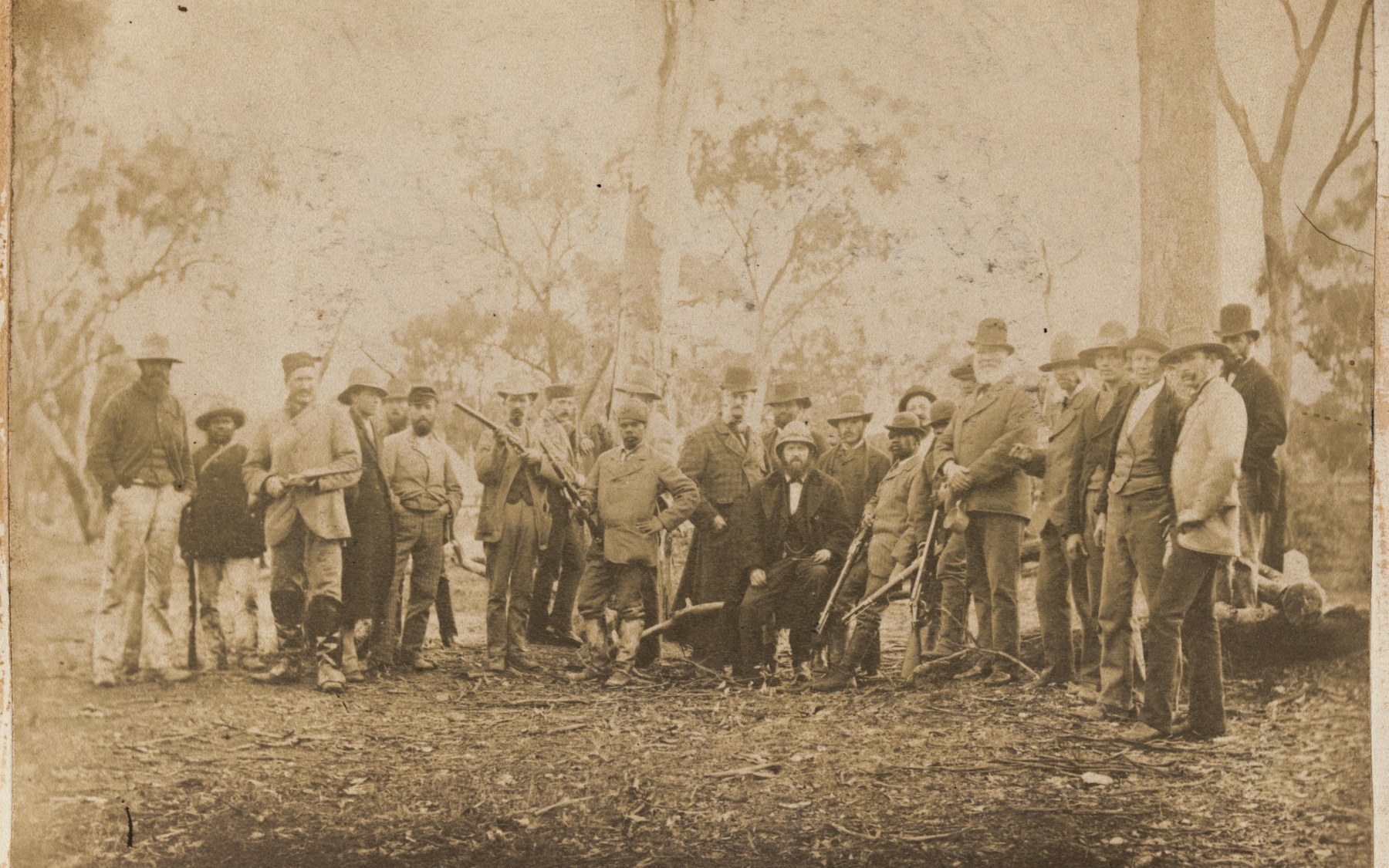
Then follow the Ned Kelly images without treating them only as outlaw pictures. Kelly became one of Nolan's defining subjects because the story allowed him to combine violence, folk memory, pursuit, performance and the Australian bush. The helmeted figure is instantly recognisable, but its simplicity is deceptive. It can read as armour, prison, mask, icon, blank face or viewing frame.
The Central Australia works offer another route. AGNSW describes epic portrayals of Central Australia and Nolan's engagement with place. These works should be read with modern-rights and cultural sensitivity, but also with attention to scale, colour and mythic compression. Nolan's Central Australia is not documentary landscape; it is filtered through modernist imagination and the artist's own symbolic system.
Self-portraiture is also worth watching. The official page foregrounds Nolan's formative years, and early self-images can help visitors understand how he positioned himself as a modern artist. A self-portrait is never only likeness. It can be a declaration of ambition, uncertainty, style and artistic identity.
How it fits Sydney and Australia
This page strengthens the Art Gallery of New South Wales cluster by adding an upcoming major survey after the archived Streeton retrospective and current Archibald/Wynne/Sulman page. Together, those records give AGNSW a strong profile: Streeton for Australian landscape and Impressionism, Archibald for contemporary public portraiture and prize culture, Nolan for Australian modernism and myth.
For Sydney planning, Nolan Origins will likely be one of AGNSW's major 2026-27 draws. The exhibition sits in the Naala Nura building and is ticketed, so readers should check the official page before planning the day. It pairs naturally with the Australian collection, AGNSW's harbour-edge setting and Sydney pages concerned with how place becomes image.
The page also broadens the Australia country page. Melbourne currently carries NGV-led Australian Impressionism and international loan exhibitions. Sydney now carries AGNSW's historical, contemporary and modernist routes. This gives the country hub a stronger spine for future artist, movement and artwork pages.
The page creates internal-link opportunities for Sidney Nolan, Ned Kelly, Australian modernism, St Kilda, Wimmera, K'gari, Central Australia, landscape painting, myth in art, Australian national identity, AGNSW and the relationship between place and modernist storytelling.
Image and rights note
This page remains image-free. Nolan died in 1992, and the official AGNSW imagery carries Sidney Nolan Trust, DACS and Copyright Agency credits, with additional risks around AGNSW photography, National Gallery of Australia loans, catalogue images and press use. A future image review should use no lead image unless a source and credit route is explicitly approved.
How to use this page
Because Nolan Origins is upcoming, the page should help a reader decide whether to plan a future trip or watch for reviews and final venue details. The most reliable fixed details are the venue, dates, broad subject, media and official source link. The interpretive notes help place the exhibition in art-historical context: what kind of show it is, why it may matter, and which artists or topics are worth exploring next.
It is marked as a major exhibition in this guide, so it should be useful for readers choosing between several possible museum visits.
Looking notes
For a visitor, the most useful approach is to look for patterns rather than isolated highlights. With Sidney Nolan, Ned Kelly, Central Australia, St Kilda, Wimmera, K'gari, Fraser Island, north-eastern Victoria, Australian modernism, myth and place, Naala Nura building, Gadigal Country, Art Gallery of New South Wales, Pretty Polly mine, Self-portrait, Nolan's formative years, ask how the exhibition frames the subject: as biography, period survey, focused theme, collection display or reassessment. With media such as painting, modernist painting, landscape painting, narrative painting, self-portrait, mythic imagery, australian modernism, exhibition survey, pay attention to changes of scale, surface, lighting, material and display sequence, because those details are often lost in online listings.
The guide avoids over-specific claims where the public source does not yet support them. If a museum has not published a full object list, it is better to stay clear about what is confirmed than to imply certainty.
Who it is best for
Nolan Origins is most likely to help readers who are already interested in Sidney Nolan, Ned Kelly, Central Australia, St Kilda, Wimmera, K'gari, Fraser Island, north-eastern Victoria, Australian modernism, myth and place, Naala Nura building, Gadigal Country, Art Gallery of New South Wales, Pretty Polly mine, Self-portrait, and Nolan's formative years, but it may also be useful for visitors building a wider route around Art Gallery of New South Wales in Sydney. If time is limited, use this page to decide whether the subject fills a gap in your knowledge, whether it connects to artists you already follow, and whether the official venue information makes the visit practical.