by Tom Gurney
Tom Gurney BSc (Hons) is an art history expert with over 20 years experience
Published on July 14, 2026 / Updated on July 16, 2026
Email: tomgurney1@gmail.com / Phone: +447429011000
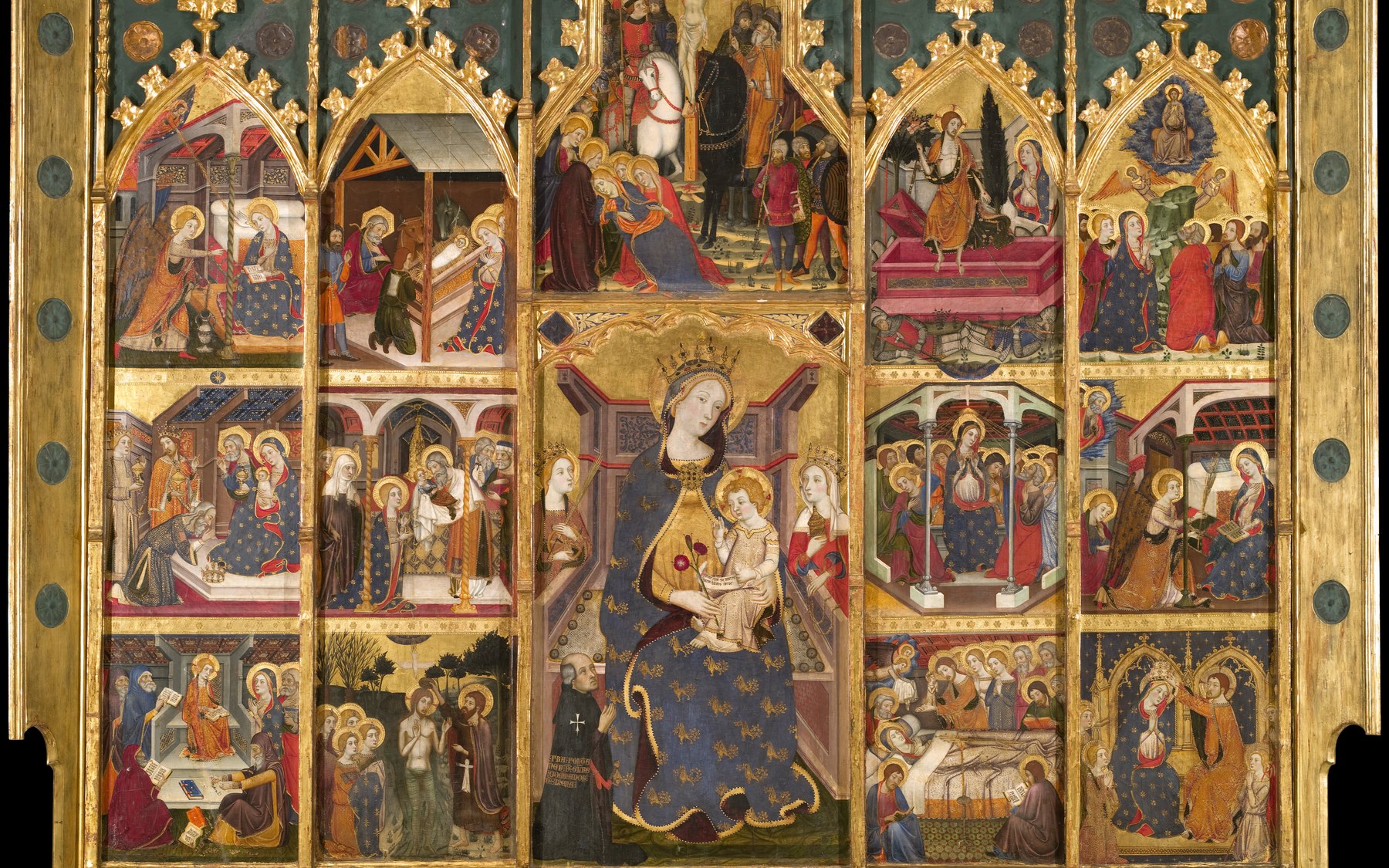
Jaume Serra - Altarpiece of the Virgin - Google Art Project.jpg by Jaume Serra; Public domain via Wikimedia Commons. Cropped for TheHistoryOfArt.org. · Image source
What to expect
In the Italian Manner: Spain and the Mediterranean Gothic 1320-1420 is a Prado exhibition about artistic exchange between Italy and the Iberian kingdoms in the late Middle Ages. The official Prado page states the central argument clearly: without Italy, it is difficult to understand the artistic landscape of late-medieval Spain. Italian artists, imported works and Trecento models brought aesthetic, technical and iconographic changes that left a deep mark on Iberian visual culture.
The exhibition is staged in Rooms A and B of the Jerónimos Building and is curated by Joan Molina Figueras, Head of the Collection of European Painting up to 1500. The Spanish Prado page names Italian artists such as Ambrogio Lorenzetti, Gherardo Starnina, Lupo di Francesco, Barnaba da Modena, Andrea di Petruccio and Geri Lapi, alongside Iberian figures including Ferrer and Arnau Bassa, the Serra brothers, Pedro de Córdoba and Miquel Alcañiz. It also states that works come from 31 national and 25 foreign institutions, which gives the show a serious international-loan profile.
Why go
This is a useful Prado exhibition because it opens a period that many visitors skip. The Prado is often approached through Velázquez, Goya, Bosch, Titian, Rubens and later royal collecting, but the museum also has a deep medieval and early Renaissance story. A show on Mediterranean Gothic art can help readers understand the period before the better-known Renaissance route, when artists and objects moved across a western Mediterranean network rather than sitting neatly inside modern national schools.
The exhibition is also valuable because it complicates the word “influence”. Italian Trecento models did not simply arrive in Spain and overwrite local practice. The official copy points to eclectic and hybrid formulas, with local masters creating original interpretations of Italian models. That is a richer story: not imitation, but adaptation, translation and selective use. For art-history readers, this is exactly the sort of exhibition that can make a familiar museum feel newly specific.
What to look for
Begin with movement. Ask how ideas, artists, objects and techniques crossed the Mediterranean. A panel painting, manuscript, embroidered object or luxury work may carry evidence of travel even when the subject looks devotional or courtly. The exhibition’s related conference page expands the media frame beyond painting, naming sculpture, goldsmiths’ and silversmiths’ work, embroideries, illuminated manuscripts and luxury items. That matters because late-medieval style did not move only through easel painting. It travelled through portable, prestigious and liturgically useful objects as well.
Then look for hybridity. Italian models could change figure types, spatial settings, ornament, emotional tone, devotional intimacy or technical finish, but Iberian artists did not become less local by absorbing them. The most rewarding comparisons will probably be those where the borrowing is visible but unresolved: a Spanish work that looks toward Tuscany while still belonging to a different patronage system, material culture or devotional habit.
The date span, 1320 to 1420, is useful because it sits before the standard High Renaissance story. Visitors should not expect the clean perspective systems or heroic bodies associated with later Italian art. The subject is Gothic Mediterranean exchange: gold grounds, refined surfaces, delicate emotion, courtly taste, workshop mobility and the slow formation of new pictorial possibilities.
How it fits the Prado
For the Prado page, this exhibition strengthens the museum’s medieval and cross-cultural dimension. It sits naturally beside the Prado’s Spanish and European painting strengths while reminding readers that Spanish art did not develop in isolation. The museum’s later royal-collection story is easier to understand when the earlier Iberian and Mediterranean foundations are visible.
For Madrid planning, this is a current exhibition with a firm closing date of 20 September 2026, so it deserves priority before later Prado shows such as Mariana of Austria and Rilke and Spanish Art. As always, readers should check the Prado source for tickets, room access, opening arrangements and any late changes before travelling.
Image and rights note
The image prospects are comparatively good because the subject is medieval, but the page remains image-free until Tom chooses and approves a lead image. A representative medieval or Prado-source image should not be treated as a confirmed exhibited object unless the official checklist or object record supports that claim.
How to use this page
Because In the Italian Manner: Spain and the Mediterranean Gothic 1320-1420 is current, the page should help a reader decide whether it deserves time before the closing date, not merely record that it exists. The most reliable fixed details are the venue, dates, broad subject, media and official source link. The interpretive notes help place the exhibition in art-historical context: what kind of show it is, why it may matter, and which artists or topics are worth exploring next.
It is marked as a major exhibition in this guide, so it should be useful for readers choosing between several possible museum visits.
Looking notes
For a visitor, the most useful approach is to look for patterns rather than isolated highlights. With Mediterranean Gothic, Italian Trecento, Spanish late medieval art, Jaume Serra, Ferrer Bassa, Arnau Bassa, ask how the exhibition frames the subject: as biography, period survey, focused theme, collection display or reassessment. With media such as painting, sculpture, goldsmiths' work, silversmiths' work, embroidery, illuminated manuscripts, luxury objects, pay attention to changes of scale, surface, lighting, material and display sequence, because those details are often lost in online listings.
The guide avoids over-specific claims where the public source does not yet support them. If a museum has not published a full object list, it is better to stay clear about what is confirmed than to imply certainty.
Who it is best for
In the Italian Manner: Spain and the Mediterranean Gothic 1320-1420 is most likely to help readers who are already interested in Mediterranean Gothic, Italian Trecento, Spanish late medieval art, Jaume Serra, Ferrer Bassa, and Arnau Bassa, but it may also be useful for visitors building a wider route around Museo Nacional del Prado in Madrid. If time is limited, use this page to decide whether the subject fills a gap in your knowledge, whether it connects to artists you already follow, and whether the official venue information makes the visit practical.