by Tom Gurney
Tom Gurney BSc (Hons) is an art history expert with over 20 years experience
Published on July 14, 2026 / Updated on July 16, 2026
Email: tomgurney1@gmail.com / Phone: +447429011000
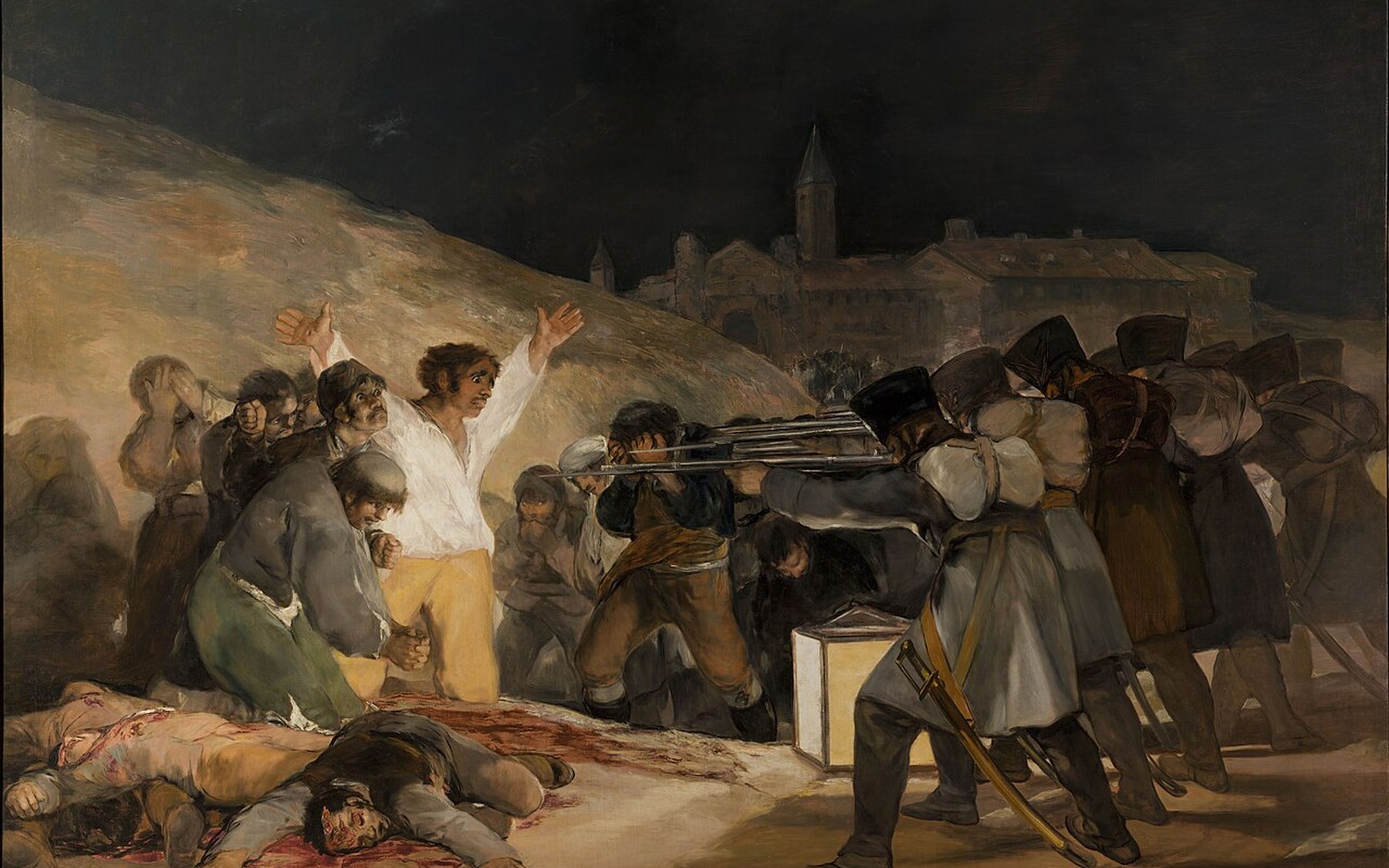
El Tres de Mayo, by Francisco de Goya, from Prado thin black margin.jpg by El_Tres_de_Mayo,_by_Francisco_de_Goya,_from_Prado_in_Google_Earth.jpg : Francisco de Goya derivative work: Papa Lima Whiskey 2; Public domain via Wikimedia Commons. Cropped for TheHistoryOfArt.org. · Image source
What to expect
Rilke and Spanish Art is an upcoming Museo Nacional del Prado exhibition in Room C of the Jerónimos Building, scheduled from 17 November 2026 to 7 March 2027. The exhibition marks the centenary of the death of Rainer Maria Rilke, born in 1875 and dead in 1926, and asks how Spanish painting mattered to a writer whose work was unusually receptive to visual art. This is not a conventional single-artist art exhibition. It is a literary-art historical project about looking, reading and the afterlife of paintings in poems, letters and thought.
The Prado's official material gives the central route clearly. Rilke wrote early pieces connected to Diego Velázquez and Bartolomé Esteban Murillo, later developed a profound response to El Greco, and also showed interest in Francisco de Goya. The exhibition therefore has a natural Prado setting: it can move between canonical Spanish painting and the way a modern European writer encountered those works. The point is not simply that Rilke liked Spanish art. The better question is how paintings helped him imagine intensity, inwardness, spiritual pressure, death, form and vision.
Prado also places Rilke within a wider artistic life. He wrote about the Worpswede artists, Cézanne and Rodin, and lived among artists and sculptors. That wider context matters because his response to Spanish painting was not an isolated tourist reaction. It belonged to a larger habit of thinking across poetry, sculpture, painting, correspondence and lived encounter. A Prado exhibition can make that habit visible by returning the writer to the paintings that shaped him.
Why go
The strongest reason to go is that the exhibition offers a different way into familiar Prado artists. Velázquez, Murillo, El Greco and Goya are often approached through style, biography, patronage, iconography or national history. Rilke gives another route: reception. What happens when a painting becomes a problem for a poet? Which qualities transfer into language, and which resist language? A visitor may know Las Meninas, El Greco's saints or Goya's dark imagination, but Rilke asks what it means to be changed by looking.
The exhibition is also valuable because it connects Madrid to a wider European network of modern sensibility. Rilke's engagement with Rodin and Cézanne is central to his development, and Prado's programme notes those figures as part of his visual world. Spanish painting enters that world not as a provincial curiosity, but as a serious imaginative force. El Greco in particular mattered to many modern artists and writers because his elongated bodies, spiritual unease and charged colour could feel both old and startlingly modern.
For readers, the show should help distinguish influence from illustration. A poem does not need to describe a painting directly in order to carry its pressure. A writer may absorb a painter's handling of space, silence, gaze, spiritual drama or human isolation. The exhibition's usefulness will lie in showing those indirect relations without reducing either art form to the other.
What to look for
Begin with the named artists. Velázquez offers a courtly intelligence in which seeing, status and self-awareness become inseparable. Murillo gives another side of Spanish painting: devotional softness, childhood, charity and emotional access. El Greco introduces visionary distortion, compressed space and spiritual urgency. Goya brings violence, social darkness, witness and late psychological force. These are very different painters, and the exhibition can show why each might have mattered to Rilke in a different way.
Then watch for forms of translation. If the installation includes letters, books, manuscripts or printed material, ask how the written object sits beside the painted object. Is the text explaining the image, responding to it, transforming it, or failing to contain it? Rilke is a strong subject for this because his art writing often treats looking as a disciplined spiritual and imaginative act rather than as passive admiration.
El Greco is likely to be one of the richest routes. For a modern writer, El Greco could appear outside ordinary naturalism: bodies stretch, colours sharpen, earthly settings become unstable and spiritual experience presses against form. That does not make him simply "modern before modernism", a phrase that can be too easy. It means that later viewers could find in his paintings a language for intensity that did not fit academic realism.
Goya asks a different kind of looking. Rilke's interest in Spanish art should not be limited to mysticism or beauty. Goya's work opens questions of darkness, political violence, social satire, old age, fear and the limits of reason. A visitor should ask whether the exhibition connects Rilke to that harsher Prado tradition, or whether it uses Goya more selectively as part of a broader Spanish-image world.
How it fits the Prado and Madrid
This page strengthens the Prado cluster by adding reception history and literature to the museum's exhibition season. Mariana of Austria opens royal female patronage. Hans Baldung Grien adds German Renaissance comparison and restoration. Ricardo de Madrazo adds works on paper and travel. Rilke and Spanish Art turns the museum toward writers, letters and the way paintings live beyond their original contexts.
For Madrid planning, this exhibition overlaps with both Mariana of Austria and Hans Baldung Grien, making late 2026 and early 2027 a dense Prado moment. It is likely to suit readers interested in poetry, modernism, El Greco, Goya, Velázquez, reception history, museum reading rooms and the relation between image and language. Readers should check Prado's official page before travelling for final display details, ticketing, room access and any updates to the exhibition checklist.
The page also creates useful future internal-link territory around El Greco, Goya, Velázquez, Murillo, Rodin, Cézanne, poetry and painting, art writing, reception history and cross-border influence in art. Those links should only be added where existing destination pages give readers a genuine continuation path.
Image and rights note
The image prospects are mixed but manageable. Many Spanish paintings relevant to Rilke's Prado world are historic and may have public-domain reproductions, but portraits of Rilke, manuscripts, book images, installation views and Prado object photographs can carry separate rights and credit requirements. This page remains image-free until a reviewed source and credit route is selected, and any representative image should not be treated as a confirmed exhibition object unless the official source supports that claim.
How to use this page
Because Rilke and Spanish Art is upcoming, the page should help a reader decide whether to plan a future trip or watch for reviews and final venue details. The most reliable fixed details are the venue, dates, broad subject, media and official source link. The interpretive notes help place the exhibition in art-historical context: what kind of show it is, why it may matter, and which artists or topics are worth exploring next.
It is listed as a recommended exhibition rather than a headline major show, so the main value is a focused subject, strong venue context or a useful route into related artists.
Looking notes
For a visitor, the most useful approach is to look for patterns rather than isolated highlights. With Rainer Maria Rilke, Spanish art, Diego Velázquez, Bartolomé Esteban Murillo, El Greco, Francisco de Goya, Cézanne, Rodin, Worpswede, poetry and painting, Madrid literary history, ask how the exhibition frames the subject: as biography, period survey, focused theme, collection display or reassessment. With media such as painting, works on paper, poetry, correspondence, literary response, museum interpretation, spanish painting, pay attention to changes of scale, surface, lighting, material and display sequence, because those details are often lost in online listings.
The guide avoids over-specific claims where the public source does not yet support them. If a museum has not published a full object list, it is better to stay clear about what is confirmed than to imply certainty.
Who it is best for
Rilke and Spanish Art is most likely to help readers who are already interested in Rainer Maria Rilke, Spanish art, Diego Velázquez, Bartolomé Esteban Murillo, El Greco, Francisco de Goya, Cézanne, Rodin, Worpswede, poetry and painting, and Madrid literary history, but it may also be useful for visitors building a wider route around Museo Nacional del Prado in Madrid. If time is limited, use this page to decide whether the subject fills a gap in your knowledge, whether it connects to artists you already follow, and whether the official venue information makes the visit practical.