


 by Tom Gurney
Tom Gurney BSc (Hons) is an art history expert with over 20 years experience
Published on November 6, 2026 / Updated on November 6, 2026
Email: tomgurney1@gmail.com / Phone: +44 7429 011000
Overview
James McNeill Whistler became one of the most visible figures in British Aestheticism, but the movement did not begin or end with him. From roughly the 1860s to the close of the nineteenth century, painters, designers, architects, writers, patrons, manufacturers and consumers renegotiated the relation among beauty, morality, utility and modern life. Their works ranged from nocturne paintings and blue-and-white ceramics to furniture, wallpapers, metalwork, books and carefully arranged rooms. They shared interests without agreeing on one programme. [1][2][4]
Whistler's importance lies in the reach of his practice. He gave paintings musical titles, designed frames, controlled exhibition walls, collected Asian objects, collaborated with architects, transformed a dining room and made dress, speech and publication part of artistic identity. His argument for the artwork's autonomy did not produce social isolation. It required patrons, galleries, journalists, craftspeople, printers, collectors and a public able to recognise—or mock—an Aesthetic way of life.
The phrase “art for art's sake” is often used to make this history sound simple: beauty instead of message. In practice, autonomy was a contested claim about who decides what art is for. Whistler rejected the demand that a picture justify itself through moral story, patriotic emotion or visible labour. Yet his paintings, rooms and exhibitions acted powerfully in the world. They changed markets, viewing habits, domestic aspiration and the image of the modern artist.
Aestheticism also depended on cultural borrowing and unequal access. Japanese art, Chinese ceramics, Greek form, Renaissance painting and contemporary French ideas entered British interiors through trade, collecting, design and imitation. The artistic home could be presented as refined escape from industrial ugliness while remaining filled with manufactured goods. This article keeps those tensions visible rather than treating peacock feathers and sunflowers as a complete definition.
At a Glance
- Broad periodAbout 1860–1900
- Movement typeLoose coalition rather than a formal school
- Central claimArt need not justify itself through moral instruction
- Whistler's mediaPaintings, prints, frames, rooms, exhibitions and publications
- Key galleryGrosvenor Gallery, opened 1877
- Key interiorHarmony in Blue and Gold: The Peacock Room
- Architectural collaboratorEdward William Godwin
- Domestic idealThe House Beautiful
- International sourcesFrench ideas, Japanese art and Chinese ceramics
- Key tensionAutonomy depended on patrons, markets, makers and display
Contents
- What Was the Aesthetic Movement?
- Art for Art's Sake and the Claim to Autonomy
- Whistler's International Formation
- Paintings as Arrangements
- Frames as the Boundary of the Work
- Patronage, Ownership and the Cost of Harmony
- Makers, Shops and the Material Economy
- Gender, Dress and the Performance of Taste
- Shared Ground and Real Differences
- The Grosvenor Gallery and an Alternative Public
What Was the Aesthetic Movement?
The Aesthetic Movement in Britain was a loose and changing coalition rather than a school with membership rules. The V&A dates its broad arc from 1860 to 1900 and identifies participants as different as Dante Gabriel Rossetti, William Morris, Edward Burne-Jones, Frederic Leighton, G. F. Watts, Edward William Godwin, Christopher Dresser, Oscar Wilde and Whistler. Their commitments to medieval craft, classicism, modern painting, design reform or publicity could diverge sharply. [1]
What joined them was a heightened concern with artistic form and sensory experience. Colour, line, material, surface and arrangement could take priority over narrative instruction. Fine and decorative arts were brought into closer relation. A chair, vase, wallpaper or room might embody cultivated judgement instead of serving as a neutral setting for paintings.
This did not mean all Aesthetes denied meaning. Beauty itself carried arguments about modern life, taste, labour, class and individual freedom. Morris linked design to craft and social change in ways unlike Whistler's artistic individualism. Leighton's classical pictures differ from Whistler's fog-bound river. Godwin's furniture responds to use, hygiene and structure as well as appearance. The movement becomes more intelligible when these differences remain inside it.
Its chronology is equally uneven. Romantic and Pre-Raphaelite interiors helped shape the 1860s. Aesthetic painting and the Grosvenor Gallery gave the movement public focus in the 1870s. Domestic goods, manuals, satire and Wilde's celebrity expanded its reach in the 1880s. Decadent writing and Aubrey Beardsley's graphic work changed its associations in the 1890s. No single date turns every phase on or off. [1][4]
Whistler moved through these stages without simply representing them. His early French formation, Realist Thames work and old-master interests preceded the most recognisable Aesthetic settings. His later international exhibitions and American collectors carried the practice beyond a British movement label. [2]
Art for Art's Sake and the Claim to Autonomy
“Art for art's sake” gave concise form to the claim that art need not serve external moral, religious or political instruction. For Whistler, a picture's colour and arrangement could not be judged primarily by whether its subject improved the viewer. His Ten O'Clock made this authority theatrical, personifying Art as independent of reformers and public virtue. [2][8]
Autonomy did not make subject disappear. The Thames, sitters, Venice, shops and interiors remain historically specific. The claim changes the order of judgement: subject does not guarantee artistic value, and narrative cannot compensate for failed relation. A nocturne is not empty because it reduces topographical detail; a portrait is not successful merely because its sitter is important.
The position also challenged measures of labour. Critics could praise finish as the visible record of time and skill. Whistler argued that achieved relation mattered more than displayed effort. That argument became contentious at the Ruskin trial, where price, execution and the legibility of a nocturne were made into legal and cultural questions. [3][9][10]
Yet autonomy depended on material systems. Whistler needed exhibition walls that did not compete with his tones, frames that extended their relations and collectors willing to buy them. The artist's independence was produced through control of conditions, not withdrawal from them. Even the Ten O'Clock required a hall, tickets, publicity and an audience.
The result is a productive contradiction. Whistler insisted that art answer to artistic judgement while using every available social medium to establish that judgement. Painting, room, lecture and book work together, but none can be reduced to the message of another.
Whistler's International Formation
British Aestheticism did not form within a closed island culture. Whistler arrived in Paris in 1855, trained in and around French studios, studied old masters and developed friendships with artists including Henri Fantin-Latour and Alphonse Legros. Gustave Courbet's Realism mattered to his early surfaces and subjects; Charles Baudelaire's writing and contemporary French debates helped make modern life and pictorial harmony urgent. [2]
London gave him the river, patrons, galleries and domestic commissions, but Paris remained an active point of reference. He exhibited across borders and cultivated French critics and writers. His American citizenship and later American collectors added another layer. Calling him a British Aesthete describes a major professional setting rather than a complete national identity.
Older art entered this modern formation. Velázquez offered full-length portraiture organised through dark fields and restrained incident. Dutch interiors and marine painting supplied models of measured space and tone. Greek art and Venetian painting appeared in Aesthetic arguments alongside Japanese prints. Eclectic source did not mean random borrowing; it enabled new relations in contemporary objects.
The international route also prevents a false divide between early Realism and later Aestheticism. Wapping and the Thames etchings attend closely to working environments, yet their cropping and construction already exceed documentary description. The nocturnes reduce detail without abandoning the material river. Aesthetic selection developed from sustained observation rather than replacing it overnight.
Paintings as Arrangements
Whistler's titles helped redirect attention from story to pictorial relation. Arrangements, harmonies, symphonies and nocturnes name structures of colour and tone while familiar subtitles or sitter identities remain available. The system was neither consistent from the beginning nor applied without revision. Titles developed through exhibitions, criticism, correspondence and later cataloguing. [2][3]
The white paintings made the problem public. Viewers looking for literary subject in The White Girl encountered Whistler's insistence on a woman, white dress and white setting as pictorial facts. Later musical wording intensified that claim, yet Joanna Hiffernan's presence, dress, fur, flowers and reception do not cease to matter. Autonomy and historical content coexist.
Nocturnes made economy more controversial. Mist, fireworks, lamps and bridges become intervals across restricted fields. The titles propose an analogy with music's organisation over time, not a claim that viewers should hear an actual composition. Their place within Aestheticism comes from the priority given to relation and sensation, while each canvas retains a site, material history and state of revision.
Portrait arrangements apply the same principle under commission. Anna Whistler, Thomas Carlyle, Théodore Duret, Lady Archibald Campbell and others appear within carefully controlled formats. Naming colour does not depersonalise them completely; it changes the terms under which status, pose, costume and field are judged.
The full theory of musical titles belongs to WHIS009. Here their Aesthetic function is structural: they resist a hierarchy in which subject matter alone determines seriousness and make the title part of viewing.
Frames as the Boundary of the Work
Whistler treated the frame as more than protection or inherited ornament. Its profile, colour and surface negotiated between painting and wall. A broad conventional gilt moulding could impose weight or warmth inconsistent with a restrained canvas; a frame designed in relation to the picture could continue its intervals and prepare the eye for them. [2]
This practice fits Aestheticism's refusal to isolate fine art from its setting. The frame is simultaneously craft object, architectural threshold and commercial presentation. It may carry a butterfly, title or decorative rhythm that asserts authorship beyond the painted support. The ensemble asks where the work ends without pretending that canvas and wood are one material.
Frame history also limits claims. Paintings were reframed by Whistler, owners, dealers and museums. A current frame may be original, artist-designed, associated, reconstructed or later. Colour can change through gilding, abrasion, repainting and conservation. A general resemblance to another Whistler frame does not establish his authorship.
The maker deserves attention. Joinery, carving, compo, gilding and finishing required trained labour. Whistler could specify and revise while a workshop realised the object. Aesthetic unity emerged through collaboration, payment and sometimes disagreement. Recognising that work strengthens rather than weakens the artist's concern with the frame.
Frames became especially consequential in coordinated exhibitions. Repeated profiles and tones could connect separate pictures across a room, while varied internal proportions responded to each object. The gallery then operated through nested boundaries: image, frame, wall and spatial interval.
Patronage, Ownership and the Cost of Harmony
Aesthetic objects needed people willing to commission, buy, lend and live with them. Frederick Leyland, Alexander Ionides, Frances Leyland, Charles Lang Freer and other patrons appear not merely as sources of funds but as owners with tastes, houses and expectations. Their choices shaped which ambitious projects became possible. [2][6][11]
Patronage could enable experiment. Leyland's support connected Whistler to portraits, decorative projects, nocturne terminology and a major interior. It could also create conflict when the artist understood autonomy more expansively than the owner understood a commission. The Peacock Room dispute makes the boundary unusually visible, but less dramatic negotiations accompanied portraits, frames and exhibitions.
Ownership carries legal and material power. A patron can refuse a fee, move an artwork, sell it, alter a room or withhold a picture. An artist can delay delivery, revise beyond agreement or refuse to release work judged incomplete. Aesthetic harmony is therefore never purely optical; it is produced within rights and obligations.
Whistler's rhetoric often made money sound beneath art while his practice showed intense attention to prices, sales and debts. That is not simple hypocrisy. A claim to be paid for artistic judgement required a market capable of valuing it. The conflict arose over who defined completion and worth.
Collectors also shaped afterlives. Freer's acquisitions concentrated Whistler's work and eventually made the Peacock Room part of a museum linking American and Asian art. Rosalind Birnie Philip's stewardship created a different institutional archive in Glasgow. The Aesthetic object seen today has passed through these acts of selection.
Makers, Shops and the Material Economy
The artistic interior was assembled through trades. Cabinetmakers, metalworkers, ceramic manufacturers, textile producers, wallpaper printers, glassworkers, framemakers and builders translated designs into usable things. Retailers and illustrated catalogues then made particular forms visible to consumers who could not commission an architect. [1][4]
This economy produced a range from singular room to mass-market accessory. A Godwin table could embody a precise structural design, while cheaper goods borrowed its attenuated lines. Imported porcelain sat beside British ceramic responses. A fan might be Japanese, European-made in a Japanese manner or merely marketed through an Aesthetic association.
Labels such as handmade and industrial do not map neatly onto good and bad. Machinery could support consistent production; handwork could be repetitive or poorly paid. Morris's critique of industrial labour differed from Whistler's concern with artistic authority. Treating the entire movement as anti-industry conceals the systems that distributed it.
Whistler's own output depended on skilled manufacture. Etchers and lithographic printers, publishers, photographers and framemakers converted designs into objects and publicity. Exhibition rooms required paint, carpentry and installation. Even an art that claimed independence of social purpose remained materially interdependent.
The commodity market also changed meaning. Once peacocks, lilies and Japanese fans became recognisable signs, they could advertise sophistication without any sustained engagement with the art. Satire exploited that gap, but so did Aesthetic promoters. Surface fashion and serious experiment circulated through the same shops and pages.
Gender, Dress and the Performance of Taste
Aestheticism unsettled Victorian expectations about masculine seriousness and feminine domesticity while sometimes reinforcing them. Male Aesthetes were mocked as delicate, idle or insufficiently masculine. Velvet clothes, long hair, flowers and sensitivity to colour became comic evidence. Whistler's aggressive wit and stinging butterfly offered one response to that pressure. [1][14]
Women were essential as artists, designers, models, patrons, consumers and household organisers, yet movement histories often reduce them to beautiful figures inside rooms. Jane Morris, Beatrix Whistler, Maud Franklin, Frances Leyland and many others occupied distinct positions that cannot be covered by the word muse. Their labour and choices helped make the environments through which Aestheticism became visible.
The home intensified this contradiction. Advice literature addressed taste as a domestic responsibility, commonly assigned to women, while celebrated male architects and artists claimed authorship for interiors. Cleaning ceramics, textiles, grates and complex surfaces was ongoing work rarely shown in photographs of the completed room.
Dress connected body and environment. Costume in Whistler's portraits contributes shape and colour; Wilde's lecture clothing turned the Aesthete into a portable image; caricature exaggerated both. Clothing could express cultivated difference while making its wearer vulnerable to policing of gender and sexuality. [1][4]
The later collapse of Wilde's public standing sharpened these associations. It should not be projected unchanged onto every earlier Aesthetic object, but neither should the movement be sanitised into colour schemes. Beauty, body and social permission were entwined.
Shared Ground and Real Differences
Whistler and Morris both resisted debased modern surroundings, valued designed objects and helped challenge the separation of fine and decorative art. Their politics and theories of labour diverged profoundly. Morris tied beauty to craft, collective conditions and social reform; Whistler distrusted reform as an artistic mandate and defended the exceptional individual. [1]
Whistler and Burne-Jones shared Grosvenor visibility and resistance to conventional exhibition expectations. Their pictures differ in narrative, historical imagination, figure type and surface. Grouping them as Aesthetic should lead to comparison, not erase those differences.
Godwin's design could combine Japanese-informed proportion with practical concerns about cleanliness and movable furniture. Whistler shared the linear and spatial sensitivity but was willing to transform an existing room with dense painted decoration. The White House and Peacock Room demonstrate different kinds of collaboration and control. [4][6][7]
Wilde turned Aesthetic language and dress into literary and lecturing celebrity. Whistler also performed himself but grounded priority in practice as painter and printmaker. Their public teasing exposes competition over who could speak for art.
These differences explain why Aestheticism remained generative. It offered a field in which autonomy, domestic reform, luxury, craft, commerce, international borrowing and persona could meet without resolving into one doctrine. Whistler's place is central precisely because his work makes those contradictions hard to ignore.
The Grosvenor Gallery and an Alternative Public
Sir Coutts and Lady Lindsay opened the Grosvenor Gallery in New Bond Street in 1877 as an alternative to the Royal Academy. Its selective invitation system and opulent interior gave artists associated with Aesthetic painting a prominent setting. Burne-Jones and Whistler could be encountered within a gallery whose identity itself signalled distinction from established annual exhibition culture. [3][10]
Whistler showed nocturnes and portraits there in 1877. The setting did not guarantee approval. John Ruskin's published attack joined objections to finish, price and artistic legitimacy, prompting Whistler's libel suit. The gallery became both a home for Aesthetic visibility and the backdrop to a crisis over what modern painting could ask from viewers. [2][3][10]
The trial should not turn the Grosvenor into a one-event story. Its importance lies in creating a public where new alliances and differences became visible. An alternative institution could still reproduce exclusivity and elite taste. Its architecture and social atmosphere framed the art before critics began writing.
The episode also shows that “art for art's sake” was never beyond economics. Two hundred guineas, gallery invitation, patronage and professional reputation entered the courtroom alongside colour and finish. Aesthetic autonomy operated inside a market that critics and artists contested.
Whistler's nominal victory did not settle the aesthetic question. One farthing in damages offered rhetorical material but no financial relief. The dispute continued through pamphlet, book, biography and museum interpretation. Its endurance reveals how effectively controversy became part of the movement's public history.
Exhibitions as Compositions
Whistler increasingly treated the exhibition room as an environment. Crowded walls, ornate gold frames and unrelated colours could overwhelm a restrained painting or print. His response was to coordinate wall tone, frame, spacing, catalogue and sometimes attendants' dress. The show became an arrangement whose elements guided attention. [2][3]
The Venice pastel display of 1881 and the 1883 etching exhibition at the Fine Art Society are central examples. Small works needed proximity and visual calm. Pale or carefully selected surroundings made paper tone, fine line and subtle colour legible. Slender frames and generous intervals opposed the dense salon hang. [2][3]
These rooms were not neutral containers, but neither were they total works owned by Whistler alone. Galleries supplied premises, staff and commercial structures. Framemakers, printers and installers contributed skilled work. Visitors brought expectations and sometimes ridicule. Control was negotiated, even when Whistler narrated it as singular authority.
The designed catalogue extended the room into print. Titles, butterflies, typography and colour scheme let a visitor carry part of the exhibition's identity away. Whistler understood branding before the term acquired its current meaning, but the historical practice was more than marketing: it asserted that presentation affects perception.
Modern gallery conventions—spaced works, coordinated walls and artist-designed installations—make these interventions seem familiar. Their force in the nineteenth century becomes clearer when compared with crowded mixed displays. Whistler did not invent every element, yet he made their coordination a conspicuous artistic position.
The House Beautiful and Aesthetic Consumption
Aestheticism entered the home through architects, designers, manuals, shops and objects at many price levels. The “House Beautiful” promised that rooms, furniture, textiles, ceramics and light could form a cultivated whole. Artists' houses became models even for readers who never entered them, because illustrated articles and advice literature circulated their features. [1][4]
This domestic turn brought fine and decorative arts together. A painting's frame related to wall colour; a sideboard organised ceramics; a chair contributed line and proportion; stained glass changed daylight. Beauty became a repeated practice of placement rather than one precious object added to an indifferent room.
The market translated avant-garde signs into commodities. Japanese fans, blue-and-white porcelain, sunflowers, peacock feathers and attenuated furniture could be purchased and combined. Manufacturers made the look accessible beyond wealthy patrons, while expensive artist-designed interiors retained exclusivity. Aestheticism was both critical of industrial ugliness and distributed through modern commerce. [1][4][5]
Domestic beauty also rested on labour that publicity often hid. Makers produced furniture and fittings; servants cleaned objects and rooms; women were frequently expected to manage taste within the household while male artists and critics received public authorship. A room's apparent harmony was maintained through ongoing work.
Whistler participated in this culture as collector, decorator and resident. His interiors staged art and persona, but they also depended on rent, commissions, architects, builders and household arrangements. The artistic home was lived infrastructure as well as image.
Edward William Godwin and the White House
Edward William Godwin brought architecture, furniture, theatre and Japanese-informed design into the Aesthetic network. His severe linear furniture and concern with movable, cleanable interiors show why the movement cannot be defined by ornamental excess. Reduction and use could be as important as exotic display. [1][4]
Whistler worked with Godwin on the White House in Tite Street, begun during the later 1870s. The studio-residence was intended to coordinate working, display and domestic identity. Its pale exterior and controlled rooms made the building itself part of Whistler's public practice. Construction expense and difficulty selling it also contributed to the financial pressures surrounding bankruptcy. [2][11]
The collaboration matters more than a myth of one artist designing everything. Godwin supplied architectural knowledge and a design language developed through his own career. Whistler brought demands about colour, display and self-presentation. Their priorities could align without becoming identical.
Godwin's relationship to Whistler extended through personal networks: his widow Beatrix later married the artist. Biography should not reduce the architectural collaboration to that later marriage. The White House belongs first to a professional exchange and the material risks of building an Aesthetic home.
The Peacock Room: Collaboration, Expansion and Conflict
The Peacock Room began as Frederick Leyland's dining room at 49 Prince's Gate, designed by Thomas Jeckyll to display Chinese blue-and-white porcelain. Jeckyll created shelving, fittings and architectural structure and incorporated antique gilded leather. Whistler's Princess from the Land of Porcelain occupied the position above the fireplace. When Jeckyll's health failed, Whistler entered as a colour consultant and expanded the intervention dramatically. [5][6][7]
Whistler painted across woodwork, leather, ceiling and other surfaces in blue-green and gold, incorporating peacock motifs and changing how room, ceramics and painting interacted. The result is a mixed-material architectural interior, not a large easel painting. The Princess remains a separate oil within the ensemble. [6][7]
The transformation exceeded Leyland's understanding of the authorised work. Fee and control produced a bitter dispute. Whistler answered through the fighting peacocks on one wall, turning patron-artist conflict into decoration. His later telling is vivid but not the only evidence; Jeckyll's prior design, Leyland's property and the material chronology must remain visible. [6][7][11]
The room shows both power and danger in Aesthetic coordination. Colour can join shelves, ceramics, painting and architecture into an extraordinary environment. The same claim to total relation can override another designer and patron. Artistic autonomy did not settle ownership or consent.
Charles Lang Freer later bought the room, moved it to Detroit and eventually placed it within the Smithsonian. Relocation changed a working London dining room into a collector's installation and museum object. Its present setting brings American and Asian art into relation through Freer's philosophy as well as Whistler's design. [6][7]
Tite Street and *The Yellow Room*
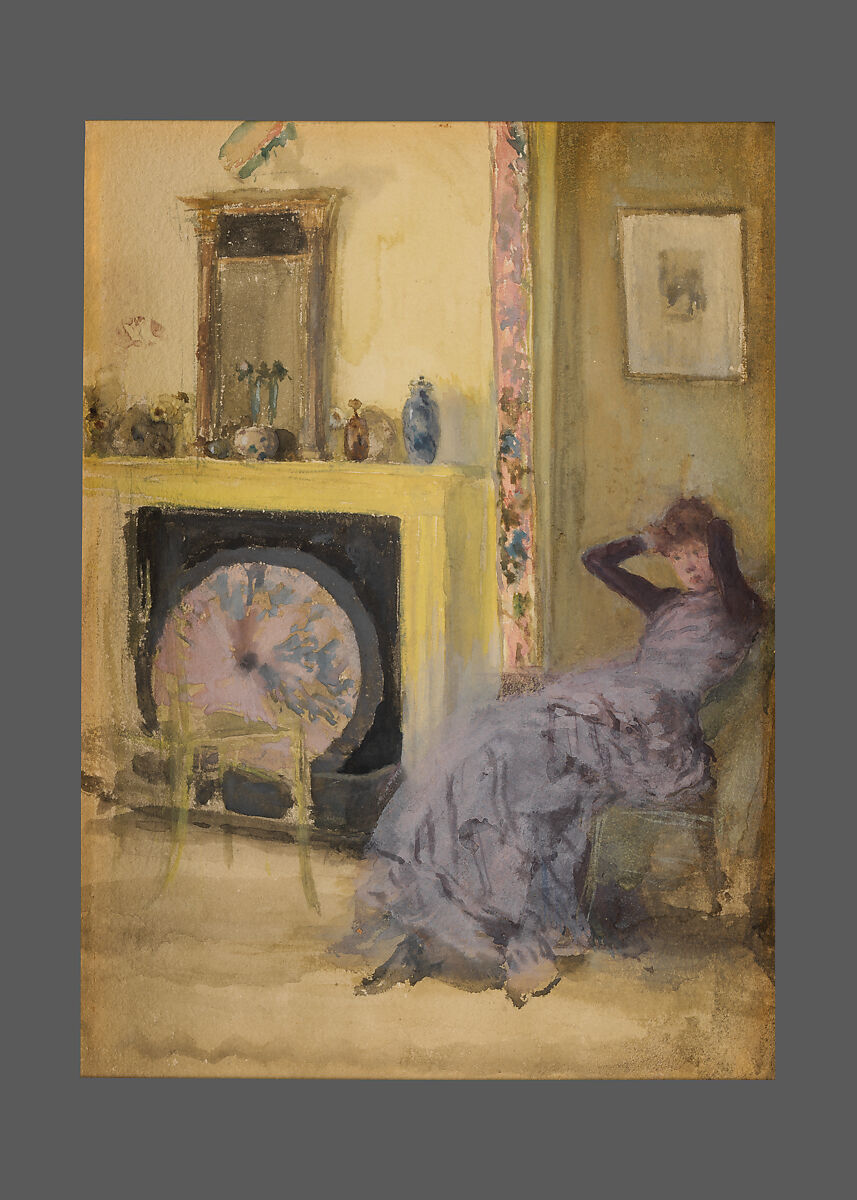
After bankruptcy, Whistler again made domestic interiors part of artistic presentation. The Met's watercolour The Yellow Room, dating to about 1883–84, records a sitting room at 13 Tite Street with Maud Franklin. Violet and yellow relation, Japanese objects and the figure create an image of home, studio and Aesthetic experiment. [12]
The sheet is evidence for a room without being a transparent inventory. Watercolour selects and arranges. Descriptions by visitors add other perspectives, but furnishings and colours could change. A modern reconstruction should not treat one image as a measured architectural plan.
The Tite Street interior connected daily life to the designed exhibitions of the period. Yellow schemes, selected objects and restricted colour moved between private and public settings. This mobility helped make Whistler's taste recognisable as a signature beyond any individual canvas.
Domestic images can also conceal people. Franklin modelled, maintained a household and raised children while Whistler's public identity often left her status ambiguous. The Aesthetic room was not inhabited by the artist alone. Recovering those relations complicates the smooth picture of total control.
Asian Art and the Aesthetic Interior
Japanese prints influenced cropping, asymmetry, flattened pattern and spatial construction in Whistler's art and in Godwin's design. Chinese blue-and-white porcelain supplied different material, collecting and display histories. Nineteenth-century British writers often blurred these cultures under generic language; responsible interpretation names them separately. [1][4][5]
Porcelain became a defining sign of the artistic interior. Cabinets and sideboards were built to show it, while blue and white brightened dark rooms and signalled cultivated taste. Leyland's collection gave the Peacock Room its original function. Whistler's own ceramics shaped studio and domestic display. [5][6]
The market transformed cultural encounter into fashion. Genuine imported objects sat beside British imitations and hybrid designs. Ownership did not imply deep knowledge of origin, and admiration could coexist with stereotype. WHIS008 will examine these histories and terms in full.
Within Aestheticism, the crucial point is that Asian-associated objects were active components rather than background props. They affected line, colour, shelving, room design and the performance of taste. Their acquisition through global trade and empire must remain part of that beauty.
Persona, Butterfly and Publication
Whistler's white lock, monocle, tailored dress, cane and quick reply made the artist publicly legible. The butterfly condensed initials into a mark that could sit within a painting, sign a letter, decorate a catalogue or sting an opponent on a printed page. Persona linked different media without proving they all expressed one doctrine. [2][9][14]
The Ten O'Clock made the Aesthetic artist a performer of authority. The Gentle Art converted criticism into a designed archive. Both belong to the movement's negotiation of art and life: manner, typography and social appearance became aesthetic acts. [8][9]
Whistler differed from Oscar Wilde. They shared publicity, wit and debates about artistic autonomy, and they publicly exchanged barbs. Wilde's lectures and celebrity carried the Aesthete into a broader cultural role, while Whistler guarded priority and individual distinction. Treating one as the other's spokesman erases productive rivalry. [1][4][11]
The persona could secure attention and distort biography. Conflict becomes entertaining; partners, printers and makers recede; financial or contractual problems become questions of taste. Analysis should treat self-fashioning as consequential work without granting it the last word.
Satire, Fashion and the Commodity Aesthete
By the early 1880s Aestheticism was recognisable enough to parody. George Du Maurier's cartoons, Gilbert and Sullivan's Patience and popular imagery condensed the Aesthete into poses, precious speech, lilies, sunflowers, peacock feathers, china and fans. Wilde's American lecture tour operated within that publicity, promoting ideals while benefiting from caricature. [1][4]
Satire records cultural visibility, not neutral appearance. It exaggerates effeminacy, idleness, foreignness and impracticality in ways shaped by Victorian anxieties about gender, class and sexuality. A caricature of Whistler's hair, monocle, nose or butterfly tells us how his persona circulated, not how he physically appeared in every setting. [14]
Parody also helped sell the style. Audiences who laughed at Patience learned its signs; manufacturers and shops could supply them. Aestheticism became a commodity language available to people who had never seen a Whistler nocturne or entered the Grosvenor Gallery.
Whistler participated in this economy while resisting absorption into a type. His quarrels over originality and priority defend an individual brand against the generic Aesthete. The tension between exclusive judgement and mass recognisability was central to his success.
Aestheticism Across the Atlantic
Aesthetic design reached American audiences through exhibitions, publications, imports, lectures, retail and travel. The 1876 Centennial Exhibition in Philadelphia helped accelerate interest, while clubs, museums and wealthy domestic patrons made the movement part of urban cultural formation. [13]
Whistler's American identity and expatriate reputation gave collectors a particularly charged figure. American buyers could claim an internationally controversial artist whose work connected European modernity to national ownership. Charles Lang Freer's collecting ultimately joined Whistler with Asian art in a public institution.
The American movement included furniture, ceramics, glass, textiles, painting and sculpture. It was not a delayed copy of Britain. Designers and consumers adapted ideas to local manufacture, houses, exhibitions and identity. [13]
Relocation changed objects. The Peacock Room's move to Detroit and Washington removed it from Leyland's dining practice and filled it under Freer's collecting logic. That afterlife is Aesthetic history too: harmony was repeatedly reconstructed by new owners.
Decline, Transformation and Afterlives
Oscar Wilde's trials and imprisonment in 1895 damaged Aestheticism's public reputation, intensifying associations with danger and decadence. Yet a movement distributed across interiors, goods, galleries and habits did not vanish in one year. [1]
Art Nouveau developed some of its line, surface and integrated-design ambitions in another international vocabulary. Modern exhibition practice inherited concern with wall colour and spacing. Artist-designed books, houses and public personae continued to link presentation with work.
Whistler's late career also outlasted the movement's fashionable peak. International societies, exhibitions, collectors and students sustained his authority. Calling every later activity Aestheticism would empty the term, but the habits of relation and display remained available.
The afterlife includes criticism. Museums now examine collaboration, cultural appropriation, patronage and conservation alongside beauty. The Peacock Room can be admired while Jeckyll, Leyland, Chinese porcelain and relocation are restored to its account. Aestheticism becomes richer when harmony does not suppress conflict.
Museums, Reconstruction and Aesthetic Experience
A museum changes the conditions that Aesthetic interiors were built to organise. Ropes, glazing, conservation light and visitor circulation protect objects while interrupting domestic use. The Peacock Room no longer hosts Leyland's dinners, and its shelves have carried different ceramics under different owners. Present installation is a historical state, not timeless completion. [6][7]
Reconstruction can make colour and spatial relation intelligible, but it requires documented choices. Paint analysis, photographs, inventories, surviving fittings and correspondence do not always agree or survive equally. Recreated wall colour should be labelled as interpretation rather than quietly presented as untouched original fabric.
Digital rooms offer movement and comparison unavailable to many visitors. They can reunite dispersed objects virtually or show alternate arrangements. They also remove physical scale, surface and the body's relation to architecture. A screen tour is evidence of a model, not entry into the nineteenth-century room.
Exhibitions about Aestheticism face a revealing challenge: they must display an art of total relation through objects now separated by collections. Strong interpretation makes that separation visible and explains the original networks. It does not manufacture false wholeness. The museum can thereby continue Aesthetic attention to presentation while turning its own authority into a subject of scrutiny.
Current ownership must therefore accompany every historical location. A photograph of Prince's Gate, a Detroit installation view and the Washington room record three different contexts. Naming the context prevents a seductive image from silently merging them and lets visitors understand relocation as part of the object's continuing history.
How to Recognise an Aesthetic Context
Begin with the object, not the label. Identify maker, date, material, function, patron or purchaser, original site and later history. A sunflower on a mass-produced object and a Whistler nocturne can both enter Aesthetic culture without becoming equivalent works.
Look for relations among elements: painting and frame, ceramic and shelf, furniture and room, print and wall colour, dress and persona. Aestheticism often operates through coordination. Then ask who designed, made, paid for and maintained that coordination.
Name cultural sources precisely. Japanese compositional influence, Chinese porcelain, Greek form and Renaissance revival carry different histories. Historic labels can be quoted and explained, but should not become current shorthand.
Test autonomy against infrastructure. If an artwork claims freedom from moral story, what gallery, market and publicity make that claim visible? If a home promises cultivated escape from industry, how were its objects manufactured and cleaned?
Finally, use satire and self-presentation as evidence with interests. Neither the caricature nor Whistler's butterfly tells the whole story. Their disagreement is part of the Aesthetic field.
Frequently Asked Questions
It was installed above the fireplace and helped motivate the colour scheme, but it is a separate oil painting. The room is a mixed-material architectural interior. [6]
Discussion
Where does Whistler's claim to artistic autonomy depend most visibly on other people and material systems?
Consider patrons, makers, galleries, frames, interiors, trade and publicity.
Reader Insights
How does colour connect picture, frame and room?
Who made and paid for the Aesthetic environment?
Which cultural sources require more exact naming?
Join the Conversation
Share a close observation or a question for other readers.
References
- Victoria and Albert Museum, “An introduction to the Aesthetic Movement”. https://www.vam.ac.uk/articles/an-introduction-to-the-aesthetic-movement
- H. Barbara Weinberg, “James McNeill Whistler (1834–1903)”, Heilbrunn Timeline of Art History, The Metropolitan Museum of Art. https://www.metmuseum.org/essays/james-mcneill-whistler-1834-1903
- Victoria and Albert Museum, “The wonderful world of Whistler”. https://www.vam.ac.uk/articles/the-wonderful-world-of-whistler
- Metropolitan Museum of Art, “Design Reform”. https://www.metmuseum.org/essays/design-reform
- Victoria and Albert Museum, “Chinese blue-and-white ceramics”. https://www.vam.ac.uk/articles/chinese-blue-and-white-ceramics
- Smithsonian National Museum of Asian Art, “Harmony in Blue and Gold: The Peacock Room”, F1904.61. https://asia.si.edu/explore-art-culture/collections/search/edanmdm:fsg_F1904.61/
- Smithsonian National Museum of Asian Art, “Making the Peacock Room”. https://asia.si.edu/explore-art-culture/interactives/peacock-room/making-the-peacock-room/
- James McNeill Whistler, Mr. Whistler's “Ten O'Clock”, Chatto and Windus, 1888. https://library.si.edu/digital-library/book/mr-whistlers-ten-oclock
- James McNeill Whistler, The Gentle Art of Making Enemies, 1890. https://library.si.edu/digital-library/book/gentleartmaking00whis
- Linda Merrill, A Pot of Paint: Aesthetics on Trial in Whistler v. Ruskin, Smithsonian Institution Press, 1992.
- University of Glasgow, The Correspondence of James McNeill Whistler, 1855–1903. https://www.whistler.arts.gla.ac.uk/correspondence/
- Metropolitan Museum of Art, “The Yellow Room”, 2017.445. https://www.metmuseum.org/art/collection/search/760942
- Metropolitan Museum of Art, “The Aesthetic Movement in America”. https://www.metmuseum.org/exhibitions/listings/2016/aesthetic-movement
- National Portrait Gallery, “James Abbott McNeill Whistler: Iconography”. https://www.npg.org.uk/collections/search/personExtended/mp04794/james-abbott-mcneill-whistler?tab=iconography


