


 by Tom Gurney
Tom Gurney BSc (Hons) is an art history expert with over 20 years experience
Published on June 19, 2020 / Updated on November 6, 2026
Email: tomgurney1@gmail.com / Phone: +44 7429 011000
A backward glance in black
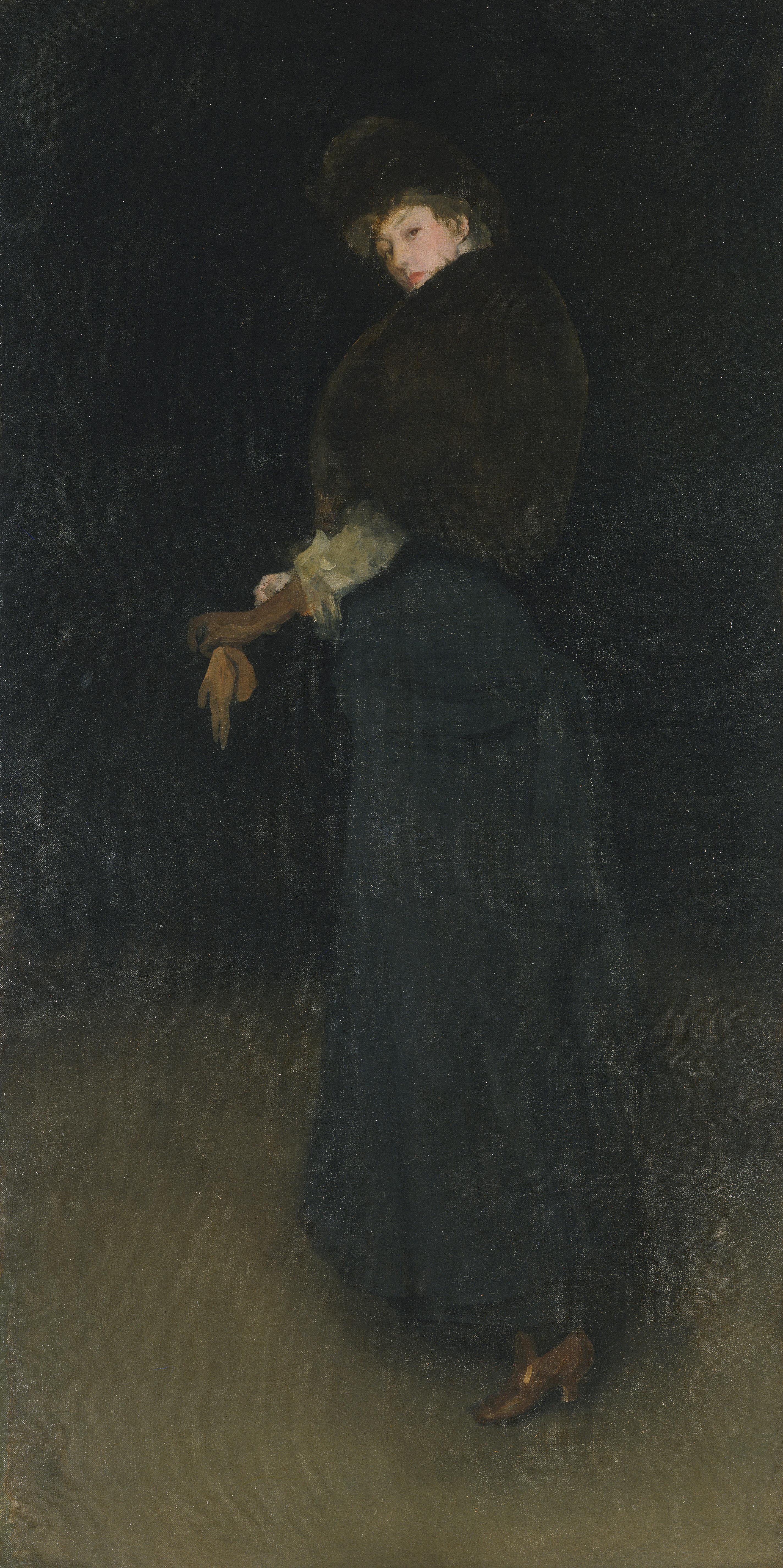
James McNeill Whistler's Arrangement in Black (The Lady in the Yellow Buskin) is a life-size oil portrait of Janey Sevilla Campbell, Lady Archibald Campbell, in the Philadelphia Museum of Art. The museum dates it to about 1883, records it as W1895-1-11 and gives the unframed canvas as 218.4 by 110.5 centimetres. Its catalogue raisonné identity is YMSM 242. That catalogue follows work between 1882 and 1885 and uses the longer title Arrangement in Black: La Dame au brodequin jaune – Portrait of Lady Archibald Campbell. The dates and titles are complementary records, not mistakes to be forced into one formula. [1][3]
Philadelphia acquired the painting with the W. P. Wilstach Fund in 1895. Its current record calls it an English-made painting and identifies the purchase as the first acquisition of a Whistler by an American public collection. On 26 August 2026 the object page published no gallery location. That silence should not be turned into a claim that the canvas is off view; it only means that a current room could not be verified from the public record. [1]
The portrait's immediate drama comes from direction. Lady Campbell's body turns left as though she is leaving, while her head rotates back towards the viewer. Black costume and black atmosphere nearly join, then face, cuff, gloves and one yellow-brown shoe interrupt the darkness. Whistler makes a socially recognisable modern woman appear through calibrated differences inside a narrow tonal range. The buskin is a small part of the surface, but it became the name by which the picture travelled. [1][2][3]
At a Glance
- CatalogueYMSM 242 / Philadelphia W1895-1-11
- DateCirca 1883; documented work extends through 1882–85
- SitterJaney Sevilla Campbell, Lady Archibald Campbell (1846–1923)
- MediumOil on canvas
- Canvas dimensions218.4 × 110.5 cm
- Framed dimensions248.9 × 141.6 × 7 cm
- SignatureButterfly; no inscription recorded
- Current framePortrait Whistler pattern, circa 1884; approximately 17.2 cm wide
- CollectionPhiladelphia Museum of Art, W. P. Wilstach Fund, 1895
- DisplayNo gallery location published on 26 August 2026; verify current status
Contents
- A body going one way and a face another
- The face within the dark silhouette
- Hands, cuffs and the suspended glove
- The shoe that became a title
- Black velvet and painted atmosphere
- The uncertain floor
- A tailored costume built for motion
- Janey Sevilla Campbell beyond the title
- Three attempts at a full-length portrait
- Sittings, changes and the problem of finish
A body going one way and a face another
Lady Campbell stands in profile, yet this is not a stable side view. Her skirt and lower body move towards the viewer's left, while shoulders, neck and face turn in the opposite direction. The glance returns across the line of movement. Instead of presenting a sitter who has stopped and arranged herself squarely for inspection, Whistler constructs an instant in which looking and leaving occur together. [1][3]
The twist begins high in the figure. A dark hat tilts across the upper outline, the fur cape swells around the back and the face appears in the opening between hat, hair and raised collar. Below, the torso narrows before the skirt opens into a long curved mass. The costume does not merely cover an anatomical pose. Its weight, folds and directional contours make the pose visible. [2][3][4]
This movement is deliberately incomplete as narrative. The painting gives no doorway, companion, carriage or identifiable destination. A viewer can see that Lady Campbell appears about to step away, but cannot responsibly say where she is going or why she looks back. That withholding is productive. Whistler converts a socially suggestive gesture into a problem of balance: the head returns, the body departs and the surrounding black must hold both actions in the same field. [1][3]
The face within the dark silhouette
The face is the clearest concentration of light and finish. Warm cheeks, a shadowed eye, reddish lips and a pale forehead emerge from dark hair and hat. The head is small in relation to the enormous canvas, yet it controls the first reading because surrounding values have been lowered. Whistler does not need a hard halo or spotlight. A limited change in temperature and definition makes the face visible from within the dusk. [2][4]
Hair is handled differently. YMSM describes curving sweeps rather than minute strands, allowing it to join the hat and background. The fur collar and cape also resist sharp internal description. They broaden the sitter's upper body, but their brown-black surface is read more through shifts of sheen and edge than through separately itemised hairs. Face, hair, fur and atmosphere therefore form a sequence from precise likeness to almost absorbed material. [3][4]
The silhouette is not uniformly closed. Along one side of the torso a firmer edge clarifies the curve, whereas other boundaries dissolve into the wet dark. This variation prevents the figure from becoming a cut-out. Lady Campbell is conspicuous and elusive at once: her face meets the viewer directly, while much of her body remains embedded in the painting's tonal environment. The distinction is central to the portrait's character, but it is made through paint handling rather than through a claim about her psychology. [4]
Hands, cuffs and the suspended glove
The hands create a compact event near the centre of the composition. Lady Campbell appears to be pulling on a glove, and another long glove hangs below. Their yellow-brown colour is close enough to the surrounding dark to remain integrated, yet warm enough to arrest the eye. The gesture also adds a smaller temporal action to the larger turn of the body: dressing is still under way as departure begins. [1][3]
Pale cuffs or lace flare around the wrists. They are neither a continuous white sleeve nor an ornamental border described stitch by stitch. Broken cream and grey strokes make a soft, irregular interruption between dark arm and warm glove. YMSM notes more visible brushwork on hands and sleeve than across many other passages, with only a few strokes required to establish the glove. [2][4]
These details form a hinge in the composition. Above them are face and broad cape; below is the long skirt. The hanging glove supplies a narrow downward line, while the hands draw the two arms together across the body. Their practical action has formal consequences: an otherwise continuous black garment is opened by skin, cuff and ochre. Whistler makes an accessory legible without allowing it to become an isolated still life. [2][3][4]
The shoe that became a title
Near the lower right, a yellow-tan high-heeled shoe projects from beneath the skirt. It is small, especially beside more than two metres of canvas, but it is placed where the dark garment meets the lighter floor. The contrast gives the foot unusual visibility. Its forward angle confirms the sense that Lady Campbell has shifted her weight and is about to move. [2][3]
The French word brodequin can be translated as an ankle boot or buskin, and the title's old-fashioned wording makes the footwear sound more theatrical than a generic shoe. YMSM records that Whistler's title change followed the shoe on the moving foot. The object is therefore both visible fact and naming device. Its colour wakes the lower field, while its motion offers an alternative identity when the sitter's aristocratic name recedes. [3]
It would be misleading, however, to make the entire costume yellow or to describe the footwear as stage costume. The painting is dominated by blue-grey, brown and black, with only concentrated ochre accents. The brodequin's historicising name and Louis XV-style heel sit within contemporary tailored dress. That mixture is more interesting than a simple opposition between modern clothes and theatrical disguise: a fashionable woman can use historical reference while remaining unmistakably of the 1880s. [3][9]
Black velvet and painted atmosphere
Lady Campbell posed against black velvet in Whistler's Tite Street studio. A literal description might therefore call the background a black hanging, but the finished effect is not a flat sheet of uniform pigment. Contemporary testimony cited by YMSM insisted that the black should contain observable atmosphere in front of it. Whistler needed the sitter's dark costume to remain perceptible against a setting of nearly the same value. [3][4]
He solves that problem without outlining the whole figure. Subtle changes in temperature and reflectance separate fur, cloth and surrounding space. Some edges are worked while the background is wet and become soft transitions rather than borders. Shadows merge into the body, yet the shoulder, skirt and feet do not vanish simultaneously. Local precision is allocated where it will orient the viewer; elsewhere darkness remains continuous. [2][4]
A large unoccupied zone lies to the viewer's left. It is not empty in the sense of being irrelevant. The space gives the figure somewhere to move and makes the backward glance cross an interval. The darker upper field also amplifies the face without framing it symmetrically. Whistler's black is thus spatial, directional and relational. Calling it a void misses the tonal work required to keep a near-black figure alive within it. [2][3][4]
The uncertain floor
At the bottom, the black field loosens into beige, brown and grey. There is enough light to show the projecting shoe and the end of the skirt, but no crisp junction defines wall from floor. Lady Campbell stands securely because the foot, hem and local shadow organise the lower passage, not because Whistler constructs a measured room. [1][2]
The softened floor also changes the scale of movement. A hard stripe across the canvas would stop the downward flow of the skirt and make the shoe a static object on a plane. Instead, colour lightens gradually around the foot. The figure seems to enter a shallow, atmospheric foreground. Her step remains readable while the setting stays deliberately unspecified. [2][4]
This ambiguity does not mean the body is weightless. The visible heel, hem and darker pressure beneath the skirt all contribute to footing. Whistler reduces conventional spatial explanation rather than abandoning it. The floor exists at the threshold of recognition, just as cape and skirt exist at the threshold between described fabric and a large tonal mass. [2][4]
A tailored costume built for motion
The costume was contemporary and socially legible. Scholarship summarised in YMSM identifies a tailored wool ensemble with a relatively short, loosely pleated skirt and a tie-back over the hips. Such `tailor-made` clothing developed partly from women's riding habits and borrowed construction associated with male tailoring. It was practical enough to support the mobility enacted by Lady Campbell's step. [3]
The fur cape and toque likewise adapted elements of men's coachwear. Those references should not be inflated into a claim that this portrait depicts cross-dressing. Lady Campbell did pose in male theatrical costume for another Whistler painting connected with As You Like It, but YMSM 242 presents fashionable women's dress whose design drew selectively on masculine precedents. The distinction matters because clothing could signal modern autonomy without ceasing to operate within elite fashion. [3][9]
Whistler turns these material features into composition. The tie-back and heavy skirt organise the long curve below the waist; fur enlarges the shoulder; the hat redirects the head; the shortened hem allows the shoe to become visible. Dress is not supplementary evidence pasted onto a pose. It is the mechanism by which the pose acquires its speed, social register and changing outline. [2][3][4]
Janey Sevilla Campbell beyond the title
Janey Sevilla Callander was born in 1846 and married Lord Archibald Campbell in 1869. The National Portrait Gallery identifies her profession as theatre producer, a useful correction to any account that treats her only as an aristocratic sitter. She and her husband fostered open-air pastoral performances, and her collaboration with the architect and designer Edward William Godwin connected dress, stage space and aesthetic reform. [9]
The Campbells probably entered Whistler's circle through Lady Meux. Their support mattered during his recovery from bankruptcy, when fashionable patronage could restore visibility as well as income. Yet Lady Campbell's importance was not confined to what her family name could do for the painter. She sustained sittings, explored several costumes and poses and later used reproduction of the portrait in a publication. These actions made her a participant in the image's production and afterlife. [3][7][9]
Her theatrical work also sharpens the portrait's apparent instantaneity. A backward glance, a costume shaped for movement and a gesture with gloves could be read as performance, but not because the canvas documents one of her pastoral roles. The pose is modern dress in a studio. Theatre belongs to the sitter's wider practice and visual intelligence; it should illuminate her ability to inhabit a constructed gesture without turning this particular picture into a scene from a play. [3][9]
Three attempts at a full-length portrait
Whistler tried three full-length portraits of Lady Campbell. The first, YMSM 240, showed her in court dress but was abandoned and probably destroyed. The second, The Grey Lady or YMSM 241, was also left incomplete. Arrangement in Black, YMSM 242, is the only one of the sequence that was finished and survives. The apparent ease of the final design therefore emerged after a much larger investment in looking, clothing and failed alternatives. [3][9]
Lady Campbell later recalled sitting intermittently for roughly a year in many costumes and poses. She connected the surviving canvas with a return to London after the grey portrait had been interrupted: Whistler noticed the dress in which she called on him and proposed a study from it. This account does not provide a complete diary, but it makes the modern costume a contingent discovery rather than an outfit selected from the start of the whole campaign. [3][4]
On 29 March 1882 Whistler told Mrs Maxse that he would not show `Lady Archie's portrait` until it was entirely completed. The correspondence editors identify YMSM 242 as the probable work. That letter supports activity by 1882 and an unusually strict completion boundary, while Philadelphia's circa-1883 date offers a concise museum label and the catalogue retains the broader 1882–85 possibility. Each statement should remain attached to the kind of evidence it represents. [1][3][6]
Sittings, changes and the problem of finish
The Pennells recorded Lady Campbell as saying that the final conception was painted in very few sittings. Duret, by contrast, reported changes proposed by the sitter and a moment when Whistler became discouraged at the prospect of repainting. The two accounts are not necessarily irreconcilable. A concentrated set of sittings may have produced the black arrangement after a much longer sequence of abandoned portraits, pauses and revisions. [3][4]
A dramatic later story places Lady Campbell in a hansom, ready to abandon the process, until Duret persuaded her that a masterpiece would be lost if she did not return. It is memorable, but it reaches us through the Pennells rather than a contemporary studio record. Its safest use is to show how later biography framed the difficulty of obtaining another sitting, not to recreate exact dialogue on a London street. [3]
The technical surface supports labour without supplying a complete calendar. Thin paint, softened wet edges, more precise contours and selectively finished features all require decisions that can be revised. The picture's broad dark unity makes changes hard to count by eye. An economical appearance is not proof of rapid execution, just as the longer documentary range is not proof that Whistler painted continuously for three years. [3][4]
Thin paint and selective definition
YMSM characterises the painting as fairly thinly worked. Shadows flow into the figure, and most boundaries remain soft. The clearer edge along one side of the torso is therefore significant: it locates the body precisely where an all-over haze might have weakened the turning pose. Whistler varies definition according to structural need. [4]
Hands and sleeve retain legible brushstrokes, while a few touches establish the glove. The face is more highly resolved; hair is swept in more broadly. This distribution creates a route through the picture. A viewer finds the eyes, moves to hands and cuffs, follows the suspended glove and skirt, then reaches the warm shoe. Large areas of dark paint sustain the connections between those points. [2][4]
Such handling complicates the usual opposition between finish and sketch. The portrait contains areas that are precise, areas that are abbreviated and edges that were deliberately fused. They belong to one finished arrangement rather than to a hierarchy in which only the face is complete and everything else awaits detail. The Grosvenor and Salon disputes show that nineteenth-century viewers could disagree over that proposition, but disagreement does not justify treating every soft passage as accidental incompletion. [3][4][6]
What the evidence cannot establish
No modern object-specific pigment or binder analysis is locked for this article. Colour names describe visible relationships and catalogue language; they do not identify a laboratory-tested recipe for Whistler's black, ochre or flesh tones. Likewise, the digital image can reveal composition and present photographic appearance but cannot diagnose adhesion, cleaning history or the physical condition of the canvas. [2][4]
YMSM lists the conservation history as unknown. Period letters report that the painting looked sunken or dirty after transport and that varnishing improved its exhibition appearance. Those are important facts about 1884 and 1885, not a licence to describe the varnish now. A canvas can have a long treatment history that is absent from the public catalogue, and responsible interpretation must leave that gap visible. [4][6]
The frame requires similar restraint. YMSM identifies a Portrait Whistler pattern, dates it to about 1884 and gives a width of approximately 17.2 centimetres. That evidence supports discussion of Whistler's designed presentation, but not an invented continuous frame provenance. The butterfly signature is recorded and no inscription is listed; neither fact removes the need to distinguish current museum metadata from catalogue interpretation. [3][4]
At the Grosvenor Gallery in 1884
The painting appeared in the Grosvenor Gallery's 1884 summer exhibition as Portrait of Lady Archibald Campbell, catalogue 192. Before the opening Whistler complained to the co-founder Coutts Lindsay that transport had left it sunken, degraded and begrimed. He believed proper cleaning, varnishing and hanging would recover the appearance it had possessed in the studio. The letter documents an exhibition problem and his response, not the object's present state. [3][5][6]
Reception depended partly on light and placement. Some critics mocked the blackness, imagining a coal hole or an underground railway. Others thought the figure vivid, graceful and forceful. Duret praised the work's originality, simplicity and movement, while Henry James placed it close to his admiration for Whistler's portrait of his mother. These accounts show a contested object, not a simple story in which everyone rejected darkness until later experts corrected them. [3][5]
Whistler himself directed viewers to stand at a distance and look through a doorway so the figure could separate from neighbouring pictures. That concern reveals how strongly the design depended on interval. A crowded, brightly varied exhibition wall could collapse its quiet tonal distinctions; distance allowed the dark silhouette, luminous face and angled step to work as a unified event. [3]
The Paris Salon of 1885
At the Paris Salon in 1885 the painting was catalogue 2459, Portrait de Lady Archibald Campbell. Whistler's portrait of Duret followed as 2460. The pairing linked two full-length modern portraits but their pictorial problems were inverse: Duret's black evening dress stood against a light ground, while Lady Campbell's dark body had to separate from black velvet. [3][5][6]
Transport again troubled Whistler. He wrote to Duret that the Lady Campbell portrait had arrived in poor, sunken condition and had then been varnished, raising fears about dust. A second letter reports Duret's reassurance that varnishing had restored the picture and that it was well hung. These exchanges expose exhibition appearance as a managed condition involving transport, surface and placement, not an unchanging property carried automatically from studio to gallery. [6]
The Salon strengthened the work's international reputation, but it did not yet establish the English Yellow Buskin title. It remained publicly Lady Campbell's portrait. Later naming would draw on the moving shoe, family politics and Whistler's taste for transforming likeness into arrangement. The Salon is consequently a stage in the title history rather than its conclusion. [3][5][6]
Reported family disapproval
Philadelphia summarises a later report that Lady Campbell's family objected because the backward glance made her resemble a street walker encouraging a hesitant follower. The vivid phrase comes from Walford Graham Robertson in 1937, long after the painting was made. It should be identified as retrospective testimony, not placed in the mouth of Lady Campbell or treated as a surviving family resolution. [1][3]
Whistler's own 1895 draft to the sitter offers nearer documentary support for a rupture. He recalled that the Duke's opinion had been invoked, that the clan repudiated the portrait and that its jaunty sauciness was judged unsuitable to the family's rank. Yet his draft is also a performance written after the picture had won medals and entered an American public collection. The painter dramatizes old disapproval to magnify later vindication. [7]
The evidence therefore supports reported family resistance, but not the convenient claim that `Lady Campbell rejected her portrait`. Her position was more complicated. She had sat repeatedly, proposed or accepted costume changes, later sought a signed photograph and replied directly to Whistler's account. Separating the sitter from the clan restores agency that the scandalous anecdote tends to erase. [3][7]
From Lady Campbell to the Yellow Buskin
The title changed repeatedly. It began in public as Portrait of Lady Archibald Campbell, acquired inconsistent numbers among Whistler's Arrangements in Black and appeared in French and German versions at international exhibitions. By the 1892 Goupil exhibition it was Arrangement in Black: La Dame au Brodequin Jaune. Chicago called it The Lady with the Yellow Buskin in 1893, while Philadelphia exhibited it as The Yellow Buskin. [3][5]
Whistler later said he withdrew the sitter's name after the family's objection, allowing the picture to travel under the shoe-derived alias. That gesture changed the balance between portrait and arrangement. The woman remained identifiable, but a small fashion detail could represent the entire canvas. The new title also shifted attention from genealogy to movement and colour: a yellow-brown accent at the foot named a predominantly black painting. [3][7]
Philadelphia now uses Arrangement in Black (The Lady in the Yellow Buskin). YMSM preserves La Dame au brodequin jaune and the sitter's identity in its preferred catalogue title. Both are useful. The museum form is the current public name; the catalogue form exposes the French-language history and refuses to let the sitter disappear completely behind an alias. [1][3]
Lady Campbell answers back
On 21 September 1895 Lady Campbell replied to Whistler's story. Her letter jokes about the `moi-je`—the assertive self—and says it was balm to learn that the Yellow Buskin rather than Lady Archibald Campbell had achieved fame in Philadelphia. She also asked for Whistler's butterfly signature for a photograph. The tone is playful, affectionate and pleased rather than wounded. [7]
That response does not prove that every earlier sitting was harmonious or that no family member objected. It shows something more precise: by 1895 the sitter could claim the transformed title and public recognition as part of her own afterlife. She was not merely the passive victim of Whistler's renaming. Her wit matches his, and the photograph gives her a practical role in circulating the image. [7][9]
The exchange changes how the portrait should be interpreted. `Yellow Buskin` can register Whistler's control over naming and market presentation, but it also became a name Lady Campbell inhabited. The title moved from possible concealment to shared joke and badge of fame. Documentary voices prevent a single moral from taking over: family status, painterly independence, sitterly agency and public reputation remain in tension. [3][7]
Munich and Paris: correcting the medals
International exhibitions supplied the vindication that Whistler emphasised. At Munich in 1888 the painting appeared as an Arrangement in Black and Whistler received a second-class medal. He responded with characteristic irony about the `second-hand` compliment. The distinction mattered, but it was not the first-class gold medal he later implied in his theatrical 1895 recollection. [3][5]
At the Paris Exposition Universelle in 1889 the portrait was shown in the British section and won a first-class gold medal. Critics such as Joris-Karl Huysmans praised the way small brown notes in gloves and boots awakened the surrounding night, while the sitter emerged with elegance from the darkness. Such criticism confirms that the warm accents and black atmosphere were already central to serious contemporary looking. [3][5]
The corrected sequence is simple: second-class medal at Munich in 1888, first-class gold medal in Paris in 1889. Preserving it does more than repair a detail. Whistler's later letter used compressed memory to stage a triumphant reversal, whereas the exhibition record shows recognition accumulating through different institutions and grades. The painting's reputation was made in steps, like the movement it depicts. [3][5][7]
A painting retained, pledged and marketed
The Campbells did not take ownership, and Whistler retained the canvas. In December 1886 Richard D'Oyly Carte lent him £500 against this portrait and Arrangement in Grey and Black No. 1, the portrait of his mother. Both remained security into 1887 and were probably redeemed in 1888. This episode distinguishes exhibition fame from liquidity: even celebrated works could function as collateral while awaiting a buyer. [3]
Whistler negotiated with the Glasgow dealer Alexander Reid in 1892. He argued that the Yellow Buskin was among his most reputed possessions and that a named society sitter increased its public importance. He also complained that later owners often profited far more than he had received. Reid's eventual £600 purchase emerged from bargaining over outright payment, profit sharing and the value that future exhibitions might create. [3][8]
The letter exposes the painter as an active market strategist. He wanted the portrait shown in Chicago with other major works because success there could benefit both artist and dealer. That ambition does not reduce the painting to merchandise. It demonstrates that aesthetic title, critical reputation, sitter identity, exhibition history and asking price were mutually involved. Whistler's autonomy operated through the market rather than outside it. [8]
Chicago, Philadelphia and a public collection
Reid sent the painting to the World's Columbian Exposition in Chicago in 1893, where it appeared as The Lady with the Yellow Buskin. It also entered the Pennsylvania Academy of the Fine Arts annual exhibition as The Yellow Buskin and received the Temple Gold Medal. The abbreviated title suited an object whose shoe had become internationally recognisable. [3][5][8]
The route to public ownership was not automatic. Reid and associates offered prominent Whistlers at high prices, and American institutions did not accept every proposal. John Graver Johnson, acting for the Wilstach collection, ultimately obtained the Lady Campbell portrait from Reid. Philadelphia records the purchase with the W. P. Wilstach Fund in 1895; YMSM reconstructs the negotiation and identifies Johnson's role. [1][3]
The museum describes it as the first Whistler painting bought for an American public collection. That distinction marks an institutional change: a work once entangled in non-commission, reported family unease and collateral entered civic ownership as a prize-winning modern portrait. The acquisition did not erase its earlier identities. Portrait, Arrangement in Black, French brodequin and English Yellow Buskin remain layered within the object now catalogued as W1895-1-11. [1][3]
Frame, signature and current image
YMSM records a butterfly signature and no inscription. It also identifies a Portrait Whistler frame of about 1884, approximately 17.2 centimetres wide. The current Philadelphia record adds full framed dimensions of 248.9 by 141.6 by 7 centimetres. Frame and canvas therefore form an unusually tall ensemble, extending the controlled presentation beyond the painted boundary. [1][3][4]
Philadelphia's current IIIF service supplies a verified 2,848 by 5,706-pixel image named from accession W1895-1-11. That master confirms the complete vertical object, the black field, costume, warm glove and shoe accents, and the gradual lightening of the floor. The museum states, however, that website images are shared for educational use and directs rights enquiries to its library. Availability must not be misreported as an Open Access licence. [1][2]
That distinction affects later publication. The image is authoritative research evidence and a visual identity check, but a commercial website should seek permission or establish another lawful source before reuse. The current object page also gives no live gallery location. Rights and display are mutable practical facts; responsible art history dates them rather than allowing technical access to masquerade as permanent permission or presence. [1][2]
The restored route and its broken image
The retained route for this painting currently redirects to the Whistler paintings hub under rule 1445. Its local source page has the correct canonical subject and heading but contains no body prose. It also points to a root-level Yellow Buskin JPEG that is absent from the protected site folder. The markup contains an image element; the corresponding artwork file does not exist. [10]
A later restoration should therefore build the standalone page from the accepted article and verified object identity, not from inherited copy. It must also solve the image-rights question before replacing the broken reference. Philadelphia's current master is suitable for research and comparison, but its educational-use statement is not a substitute for commercial permission. [2][10]
No live redirect, HTML file or artwork asset changes as part of editorial preparation. That separation keeps editorial repair auditable: title, identity, body and image recommendation can be accepted first, while routing and publication remain controlled implementation decisions. The result is a page plan that is both historically substantial and honest about the one essential asset it still lacks. [10]
Why the Yellow Buskin matters
Arrangement in Black turns portraiture into an encounter between social identity and a nearly monochrome field. Lady Campbell is recognisable as a fashionable, theatrically informed woman, but Whistler removes the conventional room and interrupts rank with motion. The backward glance and projecting shoe make the body active; the dark costume tests how little contrast can sustain presence. [1][3][4][9]
The work also demonstrates that a title can have a history as complex as provenance. Lady Campbell's name, numbered arrangements, French brodequin and English buskin each directed attention differently. Reported family displeasure helped Whistler dramatise the alias, but Lady Campbell later answered with wit and claimed pleasure in its fame. Renaming was neither simple liberation from biography nor simple erasure of the sitter. [3][7]
Finally, the canvas links difficult making to public movement. Repeated portrait attempts led to a selective, thinly painted surface; transport and varnish affected exhibition appearance; Munich and Paris delivered different honours; Reid converted reputation into sale; Philadelphia made the object an American public acquisition. Across those changes, the small warm shoe remained a precise visual fact. Whistler used it to name a darkness that is never merely black. [1][3][5][6][8]
Discussion
How does one warm shoe give direction and identity to a nearly black portrait?
Follow the backward glance, suspended glove, pale cuffs, dark velvet and yellow-brown buskin, then ask how motion, title and sitterly agency change one another.
Reader Insights
Where do the head, hands and forward shoe imply different directions?
How does Whistler keep the costume visible inside a nearly black atmosphere?
What changes when Lady Campbell responds to the Yellow Buskin name herself?
Join the Conversation
Share a close observation or an object-history question.
References
- Philadelphia Museum of Art, “Arrangement in Black (The Lady in the Yellow Buskin),” object 104367, checked 26 August 2026, https://www.philamuseum.org/objects/104367
- Philadelphia Museum of Art and Micrio, IIIF service `bjbGe`, object-image metadata, maximum image and Philadelphia image-use statement, checked 26 August 2026, https://iiif.micr.io/bjbGe/info.json and https://iiif.micr.io/bjbGe/full/max/0/default.jpg
- Margaret F. MacDonald et al., James McNeill Whistler: The Paintings, a Catalogue Raisonné, YMSM 242, date, subject and history records, updated 8 June 2021, https://www.whistlerpaintings.gla.ac.uk/catalogue/display/?mid=y242
- Margaret F. MacDonald et al., James McNeill Whistler: The Paintings, a Catalogue Raisonné, YMSM 242, technical record, https://www.whistlerpaintings.gla.ac.uk/catalogue/display/?mid=y242&xml=tec
- Margaret F. MacDonald et al., James McNeill Whistler: The Paintings, a Catalogue Raisonné, YMSM 242, bibliography and exhibition record, https://www.whistlerpaintings.gla.ac.uk/catalogue/display/?mid=y242&xml=bib
- University of Glasgow, The Correspondence of James McNeill Whistler, GUW 13640, 01868, 09647 and 00230, checked 26 August 2026, https://www.whistler.arts.gla.ac.uk/correspondence/recno/display/?cid=13640
- University of Glasgow, The Correspondence of James McNeill Whistler, GUW 00520 and 00522, Whistler and Janey Sevilla Campbell, 19–21 September 1895, https://www.whistler.arts.gla.ac.uk/correspondence/recno/display/?cid=00520 and https://www.whistler.arts.gla.ac.uk/correspondence/recno/display/?cid=00522
- University of Glasgow, The Correspondence of James McNeill Whistler, GUW 03201 and linked Alexander Reid sale documents, 1892, https://www.whistler.arts.gla.ac.uk/correspondence/recno/display/?cid=03201
- National Portrait Gallery, London, “Janey Sevilla (née Callander), Lady Archibald Campbell,” person and NPG Ax59764 records; University of Glasgow, “Archibald Campbell” biography, checked 26 August 2026, https://www.npg.org.uk/collections/search/person/mp121204/janey-sevilla-nee-callander-lady-archibald-campbell and https://www.whistler.arts.gla.ac.uk/correspondence/people/biog/?bid=Camp_A&initial=
- James McNeill Whistler Waterhouse+ project, route/local, redirect, image, carryover, crosswalk, frozen-corpus and protected-hash inventories, checked 26 August 2026.


