


 by Tom Gurney
Tom Gurney BSc (Hons) is an art history expert with over 20 years experience
Published on June 19, 2020 / Updated on November 6, 2026
Email: tomgurney1@gmail.com / Phone: +44 7429 011000
A critic in formal dress
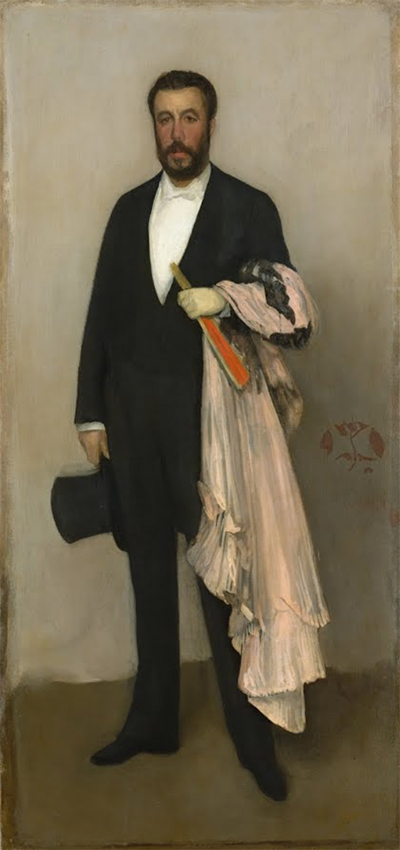
James McNeill Whistler's Arrangement in Flesh Colour and Black: Portrait of Theodore Duret is a life-size oil portrait in The Metropolitan Museum of Art. The Met dates it 1883, records it as object 13.20 and gives its dimensions as 193.4 by 90.8 centimetres. The catalogue raisonné assigns it YMSM 252 and follows work on the canvas through 1883–84, with the possibility of further attention in 1885. Those dates describe different things: 1883 is the museum's concise public identity, while 1883–85 is the documented working range. [1][3]
The picture was acquired in 1913 through the Catharine Lorillard Wolfe Fund and now belongs to the American Wing. On 26 August 2026, the Met listed it on view at Fifth Avenue in Gallery 771. That location is a dated fact, not a guarantee about future display. The museum and its Open Access API also classify the image as Public Domain, making this a rare case in which the current holder supplies both authoritative metadata and a clearly reusable digital master. [1][2]
At first glance the design seems almost austere: a bearded man in black stands against a pale field, with no desk, chair or architecture to explain him. Then the accessories take over. A pink masquerade cloak falls from his bent arm, a bright red fan crosses it, and a black top hat hangs from the other hand. Whistler turned a full-length likeness into a study of how a dark vertical can be held, interrupted and warmed by a few exact colour events. [1][6]
At a Glance
- CatalogueYMSM 252 / Met 13.20
- Date1883; documented work extends through 1883–85
- SitterJules-Emmanuel-Théodore Duret (1838–1927)
- MediumOil on canvas
- Dimensions193.4 × 90.8 cm
- AccessoriesBlack top hat, pink domino and red fan
- SignatureButterfly at right centre; no inscription recorded
- Current framePortrait Whistler pattern, probably circa 1884; approximately 17.2 cm wide
- CollectionThe Metropolitan Museum of Art, Wolfe Fund, 1913
- DisplayThe Met Fifth Avenue, Gallery 771 on 26 August 2026; verify current status
Contents
- A tall figure in a narrow field
- Face, shirt and the black silhouette
- Top hat, glove, domino and fan
- The light ground and uncertain floor
- How the colours hold together
- A portrait proposed in modern dress
- Théodore Duret as sitter and advocate
- Beginning the canvas
- Pentimenti and measured revision
- The long labour behind apparent ease
A tall figure in a narrow field
The canvas is slightly more than twice as high as it is wide. Duret's head sits well above the centre, while his separated feet approach the bottom edge. The long black coat and trousers make the body read as a continuous upright mass before smaller differences emerge. Although Duret faces almost directly outward, the figure is not mechanically centred. His dark weight leans towards the viewer's left, leaving more open ground around the cloak, signature and right edge. [1][6]
That asymmetry prevents a formal pose from becoming rigid. The sitter's right arm drops on the viewer's left and extends the body towards the top hat. His left arm bends across his torso, producing a compact knot of glove, fan, cloak and dark lining. Below it, the pink fabric descends beside the right leg and broadens the silhouette without hiding the foot. The two sides therefore operate differently: one is dark, sparse and pendular; the other is pale, folded and chromatically active. [1][3][6]
The interval around the body matters as much as the body itself. A broad zone of pale grey surrounds the head and shoulders, giving the dark hair and evening coat unusually clear edges. No frame of furniture or patterned drapery presses in from behind. Whistler makes emptiness do the work that a grand room might perform in a more conventional portrait. The sitter appears commanding not because the setting proclaims rank, but because the narrow field has been calibrated around his stance. [1][6]
Face, shirt and the black silhouette
Duret's face is the most specifically modelled part of the painting. Dark hair and a full beard make an enclosing shape around warm cheeks, shadowed eyes and a small reddish mouth. The head remains recognisable at a distance, yet it does not detach from the muted atmosphere. Its flesh tones recur elsewhere in diluted form—in the domino, the fan and the butterfly—so likeness becomes the source of a colour relation rather than an isolated patch of naturalism. [1][6]
The white shirt front creates a second focus immediately below the face. It widens towards the chest and narrows towards the bow, a bright wedge inserted into the black suit. The 1985 Met catalogue observed that its apparent whiteness depends on tactful tonal adjustment rather than on a crude block of white. This is central to Whistler's method. A light passage can appear brilliant because of its neighbours while remaining integrated into the overall grey scale. [6]
By contrast, the coat and trousers are only lightly divided. Lapels, sleeve and leg can be found, but they do not compete with the face for detailed modelling. The black figure comes close to silhouette without becoming flat. Edges soften, overlap and change intensity; a faint shadow and the shift into the floor give the body enough footing to occupy space. Whistler's economy is selective. He withholds internal description where a larger dark unity is more useful, then restores precision at the head, shirt, hands and accessories. [4][6]
Top hat, glove, domino and fan
At the viewer's left, Duret's right hand holds a top hat near his thigh. The hat is dark like the suit, but its rounded crown and brim prevent it from disappearing into the leg. It adds a low circular weight to a composition dominated by straight verticals. The extended arm above it is almost as important: its downward line lengthens the figure while leaving a strip of pale ground between body and hat. [1][6]
The opposite hand is gloved and held across the torso. A pink domino—a hooded cloak worn for masquerades—rests over that left arm and falls nearly to the shin. The word can mislead modern readers, because it names the garment, not a game piece. Dark trimming or lining folds across its upper part, while cream, grey and rose strokes accumulate in the long lower cascade. The cloak is recognisable, yet Whistler does not describe every seam. He uses its unstable folds to break the disciplined outline of evening dress. [1][3][4]
A red ladies' fan projects diagonally from the gloved hand. It is not part of the cloak and should not be described as a ribbon. Its compact orange-red note is the sharpest colour in the picture, cutting across the black-white-pink arrangement like a brief accent in music. The accessory has sometimes encouraged a narrative reading, but the painting never explains whom the fan belongs to or where Duret might be going. Its first job is visible: it energises the centre and links the warmer face to the larger rose-coloured fabric. [1][6]
The light ground and uncertain floor
Duret remembered standing in front of a rose-grey hanging. In the painting, that ground is pale enough to separate every major contour of the black suit, yet it does not become a flat, uniform screen. Warmer and cooler areas drift through it, especially around the figure. The effect can look pinkish beside the cloak and cooler when isolated. That relational change is more defensible than claiming one named pigment or a scientifically measured colour recipe for the entire background. [3][4][6]
Near the bottom, the field darkens towards brown-grey. The change allows the shoes to register, but it never resolves into a crisply drawn junction between wall and floor. There is only a subdued horizontal tendency and a faint suggestion of cast shadow. The source of illumination remains equally indefinite. No painted window, lamp or beam accounts for the light. Instead, tonal differences make the figure legible while preserving an ambiguous space that is neither fully atmospheric nor architecturally mapped. [1][6]
This reduction gives the portrait a modern severity. Conventional depth devices—strong modelling, a pronounced cast shadow, a firm ground line—are present only in weakened form. Duret stands convincingly without being enclosed in a carefully measured room. The result is not abstraction in the sense of abandoning the sitter. It is a controlled thinning of contextual evidence, leaving pose, edge and colour to sustain bodily presence. [6]
How the colours hold together
The title describes a set of relationships rather than a wardrobe inventory. `Flesh Colour and Black` names the principal opposition, but the canvas also depends on grey, white, pink and red. Warmth begins in Duret's face, expands through the domino, sharpens in the fan and reappears in the butterfly signature at right centre. Those repeated notes stop the black suit from becoming detached from its pale surroundings. [1][3]
Grey performs a different task. It occupies the background, moderates the shirt and moves through the cloak's shaded folds. Because it is present in both setting and figure, it allows the pink to seem integrated rather than pasted on. The white shirt and pale glove form a descending sequence between face and fan, while the top hat answers the larger black body at a lower register. Harmony is produced by distribution: similar values recur at different scales and positions. [4][6]
The composition also uses colour to correct shape. Without the domino, a front-facing man in evening clothes would risk becoming two nearly parallel dark legs beneath a rectangular torso. The pale fabric crosses one side, changes the contour and gives the eye a route downward that is less regular than the suit. Colour is therefore structural. It does not decorate a finished outline; it helps invent the outline in the first place. [3][6]
A portrait proposed in modern dress
Duret later traced the portrait to a conversation after an exhibition opening in 1883. He and Whistler had seen a contemporary man represented with fashionable hair but an antique-looking official robe. They objected to the mismatch. Their alternative was not casual dress, but clothing that belonged to the sitter's actual social life and physique. For an English gentleman, they decided, black evening dress could be as historically truthful as any ceremonial costume. [3][6]
Whistler then proposed a full-length, life-size figure against a light ground. That combination was difficult precisely because black had to remain differentiated without the help of a dark background. He asked Duret to bring the suit and a pink domino. Duret obtained the garment from a theatrical costumier in Covent Garden and arrived at the Tite Street studio prepared for a portrait that joined habitual masculine dress to an emphatically unexpected accessory. [3][6]
The choice is both social and formal. Evening dress identifies a cosmopolitan man who moves through exhibitions, dinners and theatres; the borrowed cloak and ladies' fan disrupt a simple record of that identity. Whistler did not take Duret out of social meaning altogether. He staged modernity through clothes, then refused to let clothes settle into documentary plainness. The portrait asks what contemporary male representation can become when likeness, convention and chromatic invention are negotiated on the same canvas. [1][6]
Théodore Duret as sitter and advocate
Jules-Emmanuel-Théodore Duret was born in Saintes in 1838 and came from a family engaged in the Cognac trade. Travel and business exposed him to art beyond Paris, while his criticism and collecting placed him close to the formation of Impressionism. He supported Courbet and Manet early, wrote about the Impressionists and assembled works by artists whose reputations were still contested. The Met consequently describes him not just as a collector but as an early champion. [1][7][8]
Manet introduced Duret to Whistler late in 1880. The relationship quickly exceeded a single sitting. Duret wrote influential articles on Whistler, owned several of his paintings and reviewed Arrangement in Grey and Black No. 1 favourably when the portrait of Whistler's mother appeared at the Paris Salon in 1883. In 1891 he joined the effort that secured that picture for the French state. His later monograph on Whistler, published in 1904, became a crucial source for the Duret portrait's conception and manufacture. [3][7]
This double role changes the encounter. Duret was the man depicted, but he was also an interpreter of the painter's aesthetic. His first-person account describes what he experienced in the studio and explains the finished work through Whistler's theory of tonal relation and concealed labour. It is invaluable testimony, though not neutral evidence. Written two decades later by a committed defender, it should be read as remembered observation shaped by advocacy, not as a verbatim daily record of every sitting. [3][6][7]
Beginning the canvas
According to Duret, Whistler started without developing a complete linear design on the canvas. He placed chalk indications for the top of the head, the feet and the outer limits of the body, then moved into colour and tone. By the end of an early sitting, Duret believed that the general appearance could already be judged. The account presents direct placement as a disciplined method: large relations were established first, even though the picture remained far from complete. [4][6]
That testimony has limits. It does not prove that Whistler made no separate sketch, tested no idea elsewhere or revised nothing after Duret left. It describes what the sitter saw at the canvas. The surviving surface supplies firmer evidence for change. YMSM identifies a fine-weave support, a softly painted background and a figure built through several thin layers. Those facts sit uneasily with the myth of a single rapid performance. [4]
The light ground made early decisions unusually exposed. A misplaced black edge could not easily hide in shadow; a changed foot or hat would alter the balance of open space around it. Whistler's placement marks were therefore a beginning, not an irreversible map. The subsequent history shows him adjusting proportions and repainting broad areas in pursuit of an effect that was meant to appear inevitable only when finished. [3][4]
Pentimenti and measured revision
Several earlier positions remain detectable. YMSM records that the top hat was once about 2.5 centimetres higher. The left foot moved roughly 1.3 centimetres from an earlier location; the right leg shifted about four centimetres, and its foot had previously sat approximately five centimetres higher. These are modest changes in isolation, but in a narrow full-length portrait they alter stance, rhythm and the intervals around the body. [4]
The revisions are especially revealing because the finished image looks so simple. Moving a foot affects the implied weight of the figure; shifting the hat changes the dark counterbalance at lower left; altering a leg modifies the problem that the pink domino was designed to solve. Pentimenti show that Whistler did not merely refine facial likeness. He recalibrated the architecture of the silhouette. [4][6]
Duret said that figure and background were repainted perhaps ten times whenever their tonal relationship drifted. `Perhaps` matters: the sitter was characterising repeated effort, not filing a conservation count. Even so, his recollection agrees with the layered construction and with correspondence asking him to bring the same costume so that the established effect could be preserved. Revision involved the whole arrangement, not a sequence of isolated corrections to anatomy. [3][4][6]
The long labour behind apparent ease
Whistler repeatedly hoped that the next sitting might finish the portrait. Undated notes invited Duret after lunch for perhaps an hour's work or asked him to arrive at midday so they could try to complete the picture. Such messages reveal intention, not completion. Sittings continued through 1883–84 and may have extended into early 1885. A report in November 1884 called the portrait newly completed, yet later exhibition and correspondence leave room for further attention. [3]
Roger Fry, after seeing the picture in Paris in 1909, said that Whistler had worked for three months and allowed successive layers to dry. Fry used that account to praise what he then regarded as the canvas's sound condition. His statement is historically useful but cannot diagnose the painting today. It was written more than twenty years after execution, and it must remain attributed rather than being presented as a modern technical report. [4][6]
The larger paradox is secure. Whistler invested prolonged labour in making labour unobtrusive. Thin layers, softened edges and broad tonal unity allowed the finished canvas to look less worked than it was. Viewers who equated visible detail with time could therefore mistake economy for haste. Duret considered that misunderstanding a sign that Whistler had achieved his purpose: the means no longer advertised the struggle required to coordinate them. [3][4][6]
Rejected at the Grosvenor Gallery
Before the Salon, the portrait encountered a significant refusal in London. Whistler submitted it to the Grosvenor Gallery in April 1884. Sir Coutts Lindsay asked him to withdraw it, judging the work incomplete and insufficiently made out. The gallery had been an important alternative to the Royal Academy and had previously shown major Whistlers, so this was not the easy rejection of an artist by a wholly hostile institution. It exposed uncertainty even within an Aesthetic venue about how little definition a finished portrait could display. [3][6]
The judgement should not be treated as a condition report. Lindsay described how the painting appeared and whether it met his exhibition standard. Whistler replied within a dispute that included the state in which works had travelled and how cleaning, varnish and hanging affected them. Whatever the immediate circumstances, the exchange shows that `incomplete` was already a contested public category rather than an objective measurement of remaining work. [3][6]
The rejection may also have prompted or accompanied further revision, but the evidence does not permit a neat cause-and-effect story. The York press announced in November that Whistler had just completed Duret's portrait. The catalogue raisonné leaves open what happened between the Grosvenor refusal, that report and the 1885 Salon. Responsible chronology keeps those markers separate instead of selecting one as the indisputable final date. [3]
The Paris Salon of 1885
The painting reached a large public audience at the Paris Salon of 1885. It appeared as catalogue number 2460 under the straightforward title Portrait de M. Théodore Duret. Its neighbour in Whistler's submission was the portrait of Lady Archibald Campbell, a more animated figure in black. The Duret canvas, however, was hung so high that Octave Maus complained it could scarcely be judged. Placement became part of reception before viewers could examine surface or likeness at a proper distance. [5][6]
Even from that disadvantage, critics found different problems. A. Michel thought Duret less fully modelled in three dimensions than Lady Campbell. Joris-Karl Huysmans found the work strange and its colours melancholy, comparing its restraint to a subdued Manet, yet he also recognised strength. George Moore attacked the invented situation, asking whether Duret's real habits justified evening dress, a woman's cloak and fan. For Moore, Whistler had painted an idea of arrangement rather than the sitter's observed social world. [6]
Those responses reveal no unanimous verdict. One critic questioned volume, another colour, another the relationship between person and staging. Maus's complaint concerned access rather than quality. Duret later remembered that many people took the portrait for a rapidly executed sketch, but `many` is not `all`. The Salon made the canvas controversial because it tested several expectations at once: finish, resemblance, masculine costume, contextual truth and the authority of formal design. [3][6]
From provocation to admired object
The portrait's reputation changed while it remained with Duret. At the Berlin Secession in 1904, Emil Heilbut singled it out as one of the exhibition's brilliant works and stressed its convincing relation to nature. The 1905 Whistler memorial exhibition in London presented it as catalogue number 10 and identified Duret as a writer on art. A picture once dismissed as insufficiently realised had become a central document of the painter and his critical ally. [5][6]
Agreement did not replace disagreement. Writers continued to compare Whistler's image with Manet's earlier portrait of Duret, and some preferred Manet's compact directness. Others praised Whistler's silhouette, the fusion of grey and rose, or the way a seemingly cool background appeared warmed by neighbouring colour. The terms of debate shifted from whether the canvas was finished to what kind of finish, truth and pictorial intelligence it embodied. [6]
Duret himself helped produce that revaluation. He published the studio story, explained the domino's formal purpose and defended the repeated repainting as the route to apparent ease. His authority was unusual because he could claim the experiences of model, owner, collector and critic at once. That proximity makes his account indispensable, but it also means that the portrait's later fame cannot be separated from the sitter's work in interpreting it. [3][6][7]
Duret seen by Manet and Vuillard
Whistler was not the first major artist to portray Duret. Manet painted a smaller bust-length image in 1868, after the two men had met during travel in Spain. The Petit Palais links their shared experience to Velázquez, whom they studied in Madrid, and notes that Duret kept Manet's portrait until donating it in 1908. Whistler almost certainly knew this earlier image, but knowledge does not make the 1883 canvas a copy. The difference in scale, costume and spatial ambition is fundamental. [6][8]
The comparison became a test of values. Manet's picture was admired for rapid concentration and bodily directness; Whistler's was praised or criticised for elaborately designed illusion. In the larger canvas Duret is not simply a head and torso remembered from a private exchange. He becomes a standing public figure whose black body, pale ground and theatrical accessories have been calculated across nearly two metres. Each portrait can disclose a different truth without one cancelling the other. [6][8]
Édouard Vuillard added another layer in 1912. His portrait shows an older Duret seated in a crowded study with papers, books, a cat and collected art. The Met catalogue identifies Whistler's full-length image reflected in a mirror within that interior. The National Gallery of Art confirms the Vuillard work's date and densely furnished setting. This later portrait situates Duret among the material evidence of a lifetime's looking and writing, with Whistler's canvas incorporated into that self-fashioned environment. [6][9]
The failed purchase of 1909
The Met's acquisition was not immediate. In late 1908 and early 1909, Roger Fry urged curator Bryson Burroughs to pursue the portrait. He believed its light ground, carefully planned silhouette and restrained contrasts made it the kind of Whistler an American museum needed. After inspecting the painting in Paris, he praised its tonal subtlety and seriousness, describing the white shirt, smoky black, grey field and dull rose cloak as an unusually complete orchestration. [6]
Fry's advocacy also contained a practical argument. He reported the work in excellent condition at that time and contrasted it with vulnerable or darkened Whistlers known to the museum. Again, the date is essential: his observations belong to February 1909, not to the present. They show how conservation concerns affected collecting decisions, but they cannot establish the current state of paint, varnish or support from a digital reproduction. [4][6]
Despite his pressure, the Committee on Purchases decided in February 1909 not to negotiate. Price was one concern, and Burroughs had already considered the request high. The refusal complicates any story of inevitable canonisation. Even as scholars and advisers proclaimed the portrait major, a museum could hesitate. Its eventual arrival four years later resulted from renewed negotiation, Duret's intentions and the work of an intermediary, not from a single moment of unanimous recognition. [6]
From Duret's home to the Met
Edward G. Kennedy reopened the question in 1912. He told the museum that Duret would permit the portrait to be inspected if purchase was seriously contemplated and that the sitter wished it to pass directly from his home into a museum, preferably the Metropolitan. Kennedy, a dealer closely associated with Whistler's work in the United States, acted as the agent rather than becoming an intervening private owner. [6]
The Met acquired the canvas in January 1913. Its published provenance is concise: Théodore Duret, Paris, until 1913; Edward G. Kennedy as agent; then purchase through the Wolfe Fund. This chain matters because it links the current object directly to the sitter who had posed, preserved, interpreted and displayed it. The accession number 13.20 records the acquisition year in the museum's own system. [1][2][6]
Duret marked the transfer with a letter explaining why the work had once provoked ridicule. He emphasised the obstacles Whistler had created—a man in black against a light ground and the difficult relation of neutral grey, deep black and pink. Only the sitter, he argued, knew how much effort lay behind the disappearance of effort. The letter is both testimony and farewell: Duret supplied the museum with a framework through which its new acquisition might be understood. [6]
The portrait as Duret's public afterlife
The 1913 acquisition altered the painting's social function. In Duret's home it had formed part of a private collection and a network of memories. At the Met it became a permanent public statement about Whistler's American identity, European career and mature portraiture. The Wolfe Fund, created from an important museum benefaction, converted Duret's desire for institutional permanence into an accession that could be exhibited, published and compared across generations. [1][6]
The sitter remained attached to that public life. He requested a photograph after the sale and expressed satisfaction that Whistler's art was finally being praised even by former sceptics. An anecdote in his published writing tells of a museum director recognising him from the portrait years later. Whether or not such moments prove perfect resemblance, they show how strongly Duret wanted likeness and aesthetic arrangement to be understood as compatible achievements. [3][6]
The painting now presents more than a critic in evening clothes. It records a relationship in which Duret repeatedly crossed roles: he advocated for Whistler, lent and owned his work, explained his procedures, sat through revisions and ultimately selected a public destination for the canvas. The portrait's history therefore makes collecting and criticism visible without adding a bookshelf or pen to the image. Those activities survive through provenance and reception rather than through iconographic props. [6][7]
Frame, signature and object boundaries
Whistler's butterfly appears at right centre, painted in a reddish tone that connects it to the fan and cloak. Its position in the open ground makes it part of the composition rather than a discreet mark at the edge. The catalogue raisonné records no inscription, so the canvas itself does not spell out Duret's name. Identity comes through the titled record, exhibition history and provenance; authorship is condensed into the painter's emblem. [3][4]
YMSM identifies the present frame as a Portrait Whistler design about 17.2 centimetres wide and probably dates it to around 1884, before the sitter acquired the work. `Probably` must remain visible. The frame is strongly connected to the painting's early life, but available evidence does not justify converting that connection into an unqualified claim that every component is exactly as first exhibited. [4]
The Met's Open Access master shows the painted canvas without the surrounding frame and makes its worn or irregular outer edges visible. Those edges are valuable visual information, but they cannot by themselves reconstruct stretching, framing or conservation history. A screen image also cannot decide current surface condition. The object record, catalogue and documented examination remain the basis for material claims; pixels provide close-looking prompts rather than a substitute for the painting. [1][2][4]
The restored route and the public-domain image
The planned website route survives locally but is currently redirected to the general paintings page. Its source HTML contains a self-canonical address, title structure, one correct artwork image and no body prose. Restoration is therefore not an editing job on inherited paragraphs. It requires a new article and, in a later controlled implementation phase, a deliberate decision to retire or amend redirect rule 1435. Research and writing leave that live rule untouched. [10]
The local JPEG is visually the correct object and measures 400 by 850 pixels. The Met now supplies an 883 by 1861 pixel Open Access master linked directly to object 13211. The files are not byte-identical, but their difference creates no identity dispute: both depict YMSM 252. For later publication the Met master is preferable because its provenance, public-domain flag and current object link are explicit. That recommendation is not an instruction to alter the protected site during this project. [1][2][10]
The empty inherited body also removes a common temptation. There is no legacy narrative to preserve merely because it already occupies the route. Metadata and the correct image can be treated as implementation assets, while the article is written from primary institutional records and object scholarship. All live HTML, redirects, images, navigation and sitemap files remain outside the editorial workspace and under checksum guard. [10]
Why this portrait matters
The Duret portrait turns restraint into a demanding form of construction. Its visible ingredients are few: one standing man, a pale field, black clothes and three accessories. Yet each element solves several problems. The hat balances the body, the domino interrupts parallel legs, the fan activates the centre, the shirt raises the face, and the signature carries warm colour into open space. Simplicity is the result of coordinated decisions, not the absence of them. [3][4][6]
Its history sharpens that lesson. A gallery could reject the canvas as insufficiently realised, Salon critics could question volume or social truth, and later viewers could praise the same silhouette and tonal reserve as evidence of mastery. Whistler's finish did not merely divide taste; it forced viewers to decide what work should remain visible in a completed portrait. The documented repainting makes the question more pointed because the apparently economical surface conceals a long process of adjustment. [3][5][6]
Finally, the painting preserves an unusually reciprocal relationship between artist and sitter. Duret submitted to Whistler's formal experiment, but he also became its principal witness, owner, defender and institutional broker. The canvas entered the Met with his interpretation already attached to it. Reading critically means neither discarding that testimony nor accepting it without qualification. The strongest account keeps object, memory and advocacy distinct while showing how all three produced the portrait's public meaning. [1][3][6][7]
Discussion
How can an apparently spare portrait reveal years of adjustment?
Trace the dark vertical figure, open pale ground, pink domino, red fan and lowered hat, then compare visible economy with Duret's account of repeated repainting.
Reader Insights
How do the hat and domino make the two sides of the figure behave differently?
Which selective details allow a near-silhouette to remain a specific likeness?
What can Duret's later memories establish, and where must they remain qualified?
Join the Conversation
Share a close observation or an object-history question.
References
- The Metropolitan Museum of Art, “Arrangement in Flesh Colour and Black: Portrait of Theodore Duret,” current object record, checked 26 August 2026, https://www.metmuseum.org/art/collection/search/13211
- The Metropolitan Museum of Art, Open Access API object 13211 and “Image Resources,” checked 26 August 2026, https://collectionapi.metmuseum.org/public/collection/v1/objects/13211 and https://www.metmuseum.org/policies/image-resources
- Margaret F. MacDonald et al., James McNeill Whistler: The Paintings, a Catalogue Raisonné, YMSM 252, date, subject and history records, updated 4 December 2020, https://www.whistlerpaintings.gla.ac.uk/catalogue/display/?mid=y252
- Margaret F. MacDonald et al., James McNeill Whistler: The Paintings, a Catalogue Raisonné, YMSM 252, technical record, https://www.whistlerpaintings.gla.ac.uk/catalogue/display/?mid=y252&xml=tec
- Margaret F. MacDonald et al., James McNeill Whistler: The Paintings, a Catalogue Raisonné, YMSM 252, bibliography and exhibition record, https://www.whistlerpaintings.gla.ac.uk/catalogue/display/?mid=y252&xml=bib
- Natalie Spassky et al., American Paintings in The Metropolitan Museum of Art, vol. 2, 1985, pp. 385–92, https://libmma.contentdm.oclc.org/digital/collection/p15324coll10/id/41207
- University of Glasgow, The Correspondence of James McNeill Whistler, “Théodore Duret” biography and linked documents, checked 26 August 2026, https://whistler.arts.gla.ac.uk/correspondence/biog/display/?bid=Dure_T
- Petit Palais, Paris Musées, “Portrait of Théodore Duret” by Édouard Manet, https://www.petitpalais.paris.fr/en/oeuvre/portrait-theodore-duret
- National Gallery of Art, “Théodore Duret” by Édouard Vuillard, 1912, https://www.nga.gov/artworks/46545-theodore-duret
- James McNeill Whistler Waterhouse+ project, route, redirect, carryover, image, crosswalk, frozen-corpus and protected-hash inventories, checked 26 August 2026.


