


 by Tom Gurney
Tom Gurney BSc (Hons) is an art history expert with over 20 years experience
Published on November 6, 2026 / Updated on November 6, 2026
Email: tomgurney1@gmail.com / Phone: +44 7429 011000
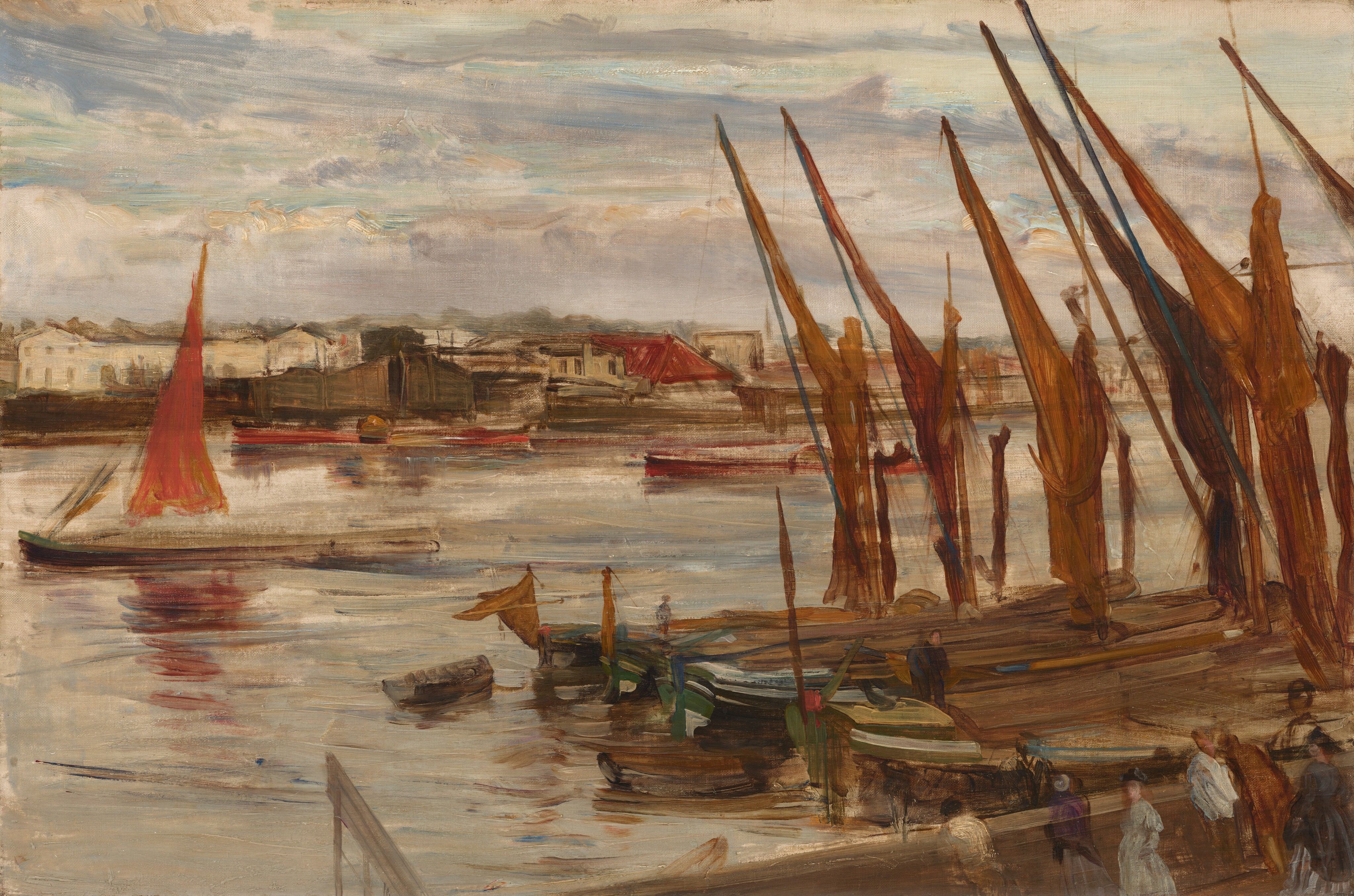
James McNeill Whistler's Battersea Reach is a bright, crowded river picture made before his Thames nocturnes reduced London to low horizons and scattered lamps. Four working boats press into the foreground from the right. Their furled sails and spars climb through the sky, while small figures gather on a walkway below. Across the water, industrial Battersea stretches beneath broad clouds. A red sail moves at left, steam traffic lies nearer the far bank, and broken reflections make the river as active as the shore.[1][4][8]
The painting is YMSM 045 and National Gallery of Art accession 2014.79.35, formerly Corcoran Gallery number 41.30. NGA dates it about 1863, records oil on canvas, and measures the support at 50.8 by 76.36 centimetres. Framed, it measures 70.49 by 95.89 by 7.62 centimetres. No signature or inscription appears on the face, although NGA records Whistler's butterfly monogram on the lower-right reverse.[1][3][5]
When checked on 26 August 2026, NGA listed the painting on view on the main floor of the West Building in Gallery M68. That location is current visitor information, not a permanent promise, and should be confirmed before travel. The accession number remains the stable locator if display arrangements change.[1]
At a Glance
- CatalogueYMSM 045
- Datec.1863 (1862/63)
- SupportOil on canvas
- Dimensions50.8 × 76.36 cm
- SignatureButterfly monogram on lower-right reverse
- ViewpointFrom Lindsey Row, Chelsea, towards Battersea
- Preferred titleBattersea Reach
- CollectionNational Gallery of Art, 2014.79.35
- DisplayWest Building Gallery M68 on 26 August 2026; verify current status
- ImageNGA open-access image, public domain / CC0
Contents
- Which Battersea Reach is this?
- An elevated window on the Thames
- The boats that occupy the right edge
- Figures made from very little paint
- The red sail and river traffic
- Industrial Battersea across the water
- A sky built in bands
- Dating the picture to 1862–63
- A partner to The Last of Old Westminster
- Thin paint and concentrated impasto
Which Battersea Reach is this?
Whistler painted the Chelsea and Battersea riverfront repeatedly, so the short title needs an exact identity. This is YMSM 045, the early daylight or evening view now at NGA. It is not Grey and Silver: Old Battersea Reach, YMSM 046, at the Art Institute of Chicago; Battersea Reach from Lindsey Houses, YMSM 055, at the Hunterian; or either of the later blue-and-silver Battersea nocturnes, YMSM 119 and 152.[3][7][17]
It is also separate from Brown and Silver: Old Battersea Bridge, YMSM 033, and Tate's Nocturne: Blue and Gold—Old Battersea Bridge, YMSM 140. Those works organise the old wooden crossing as a principal form. NGA's canvas looks across the reach from near the bridge but concentrates on boats, people, water and the industrial bank. `Battersea` names a shared geography, not one interchangeable subject.[4][17]
The preferred title is simply Battersea Reach. Its documentary chain, Cavafy ownership and present image do not require a colour-pair subtitle. Keeping the name concise is useful precisely because the catalogue number and accession supply the precision that Whistler's recurrent river language cannot.[1][3][6]
An elevated window on the Thames
The viewpoint is associated with 7 Lindsey Row, Whistler's Chelsea home near Battersea Bridge. He took a three-year lease from March 1863, although research places him there by December 1862. The address is now 101 Cheyne Walk. From its elevated windows he could look south across the Thames towards the opposite Battersea shore.[3][8]
That height explains the unusual amount of foreground activity visible from above. The viewer looks down onto a narrow waterfront walkway, the decks and sterns of boats, and the water immediately beyond. The river does not begin at a conventionally framed bank along the bottom; boats and people are already cut by the edges, as though the scene continued beneath and beside the canvas.[1][8]
Whistler confirmed the basic site in a certificate written thirty years later. He remembered the opposite bank seen from his Lindsey Row window during a brilliant autumn evening. The document secures place and remembered light while admitting that he could no longer supply an exact year. It is evidence from the artist, but evidence shaped by distance and an impending sale.[3][15]
The boats that occupy the right edge
Four long boats are moored side by side at the right. Most of their prows extend beyond the support, so Whistler gives no complete vessel profile. Mossy green, brown and pale edging distinguish their sterns. A small dinghy appears tethered near the group. Their overlapping hulls compress the lower corner into a dense sequence of curves, boards and colour accents.[1][2]
Above them, tied sails create steep brown and reddish shapes. Masts and spars repeat those diagonals at different angles, cutting into an otherwise open cloud field. The crop makes the nearest rigging feel almost too large for the picture. Instead of leading the eye gently into depth, the boats first obstruct it; the distant bank must be reached through their verticals and slants.[1][8]
The craft belonged to the ordinary working environment of the reach. Scholarly reconstruction associates the moored barges with the Greaves family's boat business. A period photograph clarifies the relationship among stairs, people, boats and the waterfront, although the photograph is comparative evidence rather than a source Whistler copied.[8]
Figures made from very little paint
Several people stand or move along the low walkway in the lower-right corner. Most look away or across the water, while one small pale face turns outward. Plum, brown, blue and grey touches distinguish clothing without developing portrait identities. They are pedestrians and loiterers in a working place, not named characters in a supplied story.[1][8]
Their partial transparency is important. Thinly painted bodies allow underlying forms and surface colour to remain visible. Some figures seem spectral in reproduction, yet their setting is emphatically material: gangway, boats and bank. Whistler used scant paint to establish position and gesture, retaining human activity without stopping the river view for an anecdote.[5][8]
This combination of accurate placement and incomplete bodily description contributes to the picture's immediacy. A viewer detects people before resolving what each is doing. The approach differs from the sharply characterised figures of Wapping, but it is not the near-disappearance found in later nocturnes. YMSM 045 occupies its own balance between observed crowd and economical sign.[8][17]
The red sail and river traffic
Left of centre, a narrow scarlet sail rises from a long low boat. It is the most concentrated colour in the open water and counters the crowded brown rigging at right. The sail is not a decorative triangle pasted onto a neutral river: red descends into the reflection below, linking moving craft to the painted surface.[1][2]
Two further red strokes mark vessels nearer the far bank. Steam and sail share the reach. The object-specific study identifies two steamers, one docking at a recently developed steamboat pier. That mixture of propulsion matters historically. Whistler's Thames is not an untouched waterway; older freight craft and modern transport operate at the same time.[8]
The boats also set different tempos. The foreground fleet is moored and densely overlapped. The red-sailed craft seems to drift laterally. Steamers work along the opposite shore. Whistler does not describe one dramatic arrival or departure. He makes the reach legible through simultaneous states of waiting, passing and docking.[1][8]
Industrial Battersea across the water
Low buildings extend along the far bank in cream, ochre, red and many browns. They become smaller and less distinct as the shore angles away. The area included turpentine works, timber yards and sawmills. Morgan Crucible lay farther right, partly concealed behind the foreground masts and sails. These were not picturesque ruins but active commercial premises.[8]
The exact skyline belongs to 1862–63. Over the following decade, the Victoria Steamboat Yard, chemical works and a plumbago factory changed parts of the bank. Later names should not be projected backwards onto every block Whistler painted. Historical maps help identify uses and transport links, while the canvas preserves how that shore appeared from Chelsea at a particular stage of industrial development.[8]
Contemporary writing could cast Battersea as dirty and unhealthy. Whistler supplies no verbal moral about pollution and does not turn factories into symbols of social ruin. Instead, warm light, coloured boats and broad air coexist with manufacturing. The absence of condemnation does not remove industry; it changes the terms in which industrial modernity becomes visible.[8]
A sky built in bands
Clouds occupy approximately the upper half. Wide off-white passages alternate with slate grey, pale violet and aquamarine blue. Some strokes extend laterally; others break into shorter, more abrupt movements. The sky feels spacious without being empty, and its colour continues between the dark rigging rather than stopping cleanly at every line.[1][5]
Below, the river repeats but does not mirror those colours mechanically. Blue-grey, cream and brown marks meet red reflections and darker currents. Long sweeps suggest lateral flow, while short strokes interrupt them. The water's energy comes from this change in handling, not from a conventionally drawn pattern of waves.[1][5][8]
The warm illumination led Whistler to remember an autumn evening and later to praise the painting's colour after conservation. The scene is not a nocturne: boats, pedestrians and far buildings remain substantially available to sight. Yet the time of day already matters because light unifies diverse industrial forms without requiring them to lose their individual functions.[3][14][15]
Dating the picture to 1862–63
NGA uses c.1863, while the catalogue raisonné gives 1862/63. These formulations are compatible. Whistler lived at Lindsey Row by the end of 1862 and formally leased number 7 in March 1863. George John Cavafy acquired the painting during 1863. The period between residence and sale defines a much firmer range than the artist's later inability to recall a year.[1][3][8]
A July 1862 letter by George du Maurier says that Thames canvases were then being made for patrons he collectively nicknamed `the Greeks`. The shorthand covered the Ionides, Coronio, Spartali and Cavafy network; Cavafy himself was a Turkish merchant. YMSM 045 may have belonged to that activity, but du Maurier supplied no itemised commission record.[3][8][16]
A letter from late May or early June 1863 strengthens the commission context. Whistler declined a social invitation because he needed to finish two pictures and receive payment. The correspondence editors identify Battersea Reach as one possibility. The link is plausible, especially given Cavafy's purchase, but must retain its editorial `possibly`.[10]
Whistler's autumn memory produces an interesting inference. If Cavafy had bought the completed canvas by summer 1863, the remembered season could have been autumn 1862. Yet sale timing and recollection are not precise enough to turn that possibility into a dated sitting. The defensible public formula remains c.1863, with 1862–63 explaining how it was reached.[3][6][15]
A partner to The Last of Old Westminster
Cavafy also acquired The Last of Old Westminster, YMSM 039. That painting had a public life in Paris and at the Royal Academy before the two works entered his collection. Battersea Reach appears to have served as its airier companion: both treat modern Thames activity, but one faces the changing Westminster crossing and the other opens across Chelsea water to Battersea.[6][8][17]
YMSM 046, Grey and Silver: Old Battersea Reach, is an even closer spatial comparator. It is signed and dated 1863, uses the same viewpoint, and has been described with YMSM 045 as an effective diptych. The term is interpretive rather than evidence of a surviving hinged object or documented joint frame. It identifies a purposeful dialogue between two separate canvases.[3][17]
The comparison helps date and analyse YMSM 045, but it must not transfer technical facts indiscriminately. The Chicago painting's supplier stamp, pigment findings and incised passages belong to that canvas. NGA's work has its own thin surface, foreground impasto and 1892 treatment record. Similar site and size do not make material evidence communal.[5][17]
Thin paint and concentrated impasto
Most of Battersea Reach is painted thinly. The main exception is the foreground boat group, where thicker accents give hulls and rigging greater material weight. This distribution matches the spatial design: the nearest objects carry more physical paint, while water, sky, distant buildings and many figures remain comparatively open.[5][8]
The foreground boats were applied over an established background. In places, far-bank architecture can still be seen through their sails. Whistler later returned to sky and water, partly veiling lines of rigging. The picture therefore contains an observable sequence even if many broad passages were laid rapidly.[5]
Long sweeping strokes across air and water coexist with short, jerky touches. That variation prevents rapidity from becoming monotony. Extended marks join large zones; abrupt ones make cloud, current, figure or reflected light momentarily distinct. The surface looks immediate because differing gestures remain visible, not because every part was handled identically.[5][8]
Was it painted in one sitting?
During the 1892 sale campaign Whistler remembered that the little Thames painting had been painted `in one go` and described a single evening at his window. Those statements are valuable evidence of the rapid, thin method he associated with the work. They were also made nearly thirty years later while cleaning and marketing were under discussion.[5][13]
The extant surface asks for a more exact conclusion. Foreground boats lie over background paint; later passages obscure parts of the rigging; a possible artist inspection occurred after cleaning in 1892; and a 1923 campaign changed the support and surface again. Whistler may have established the main arrangement very quickly, but the object does not document an untouched one-session state.[5][8]
Rapidity should instead be located in specific actions: broad sky movements, thin figures, swift horizontal craft and compressed colour decisions. A fast stroke can remain visible even when the painting received subsequent adjustments. This distinction respects both Whistler's memory and the physical evidence.[5][13]
The disputed red ground
Restorer Stephen Richards thought the brown warmth beneath thin passages might be a red prepared ground. Whistler rejected that interpretation. He proposed that London dirt had settled into places where paint barely covered the canvas, making them resemble an intentional warm preparation.[5][13]
The exchange reveals genuine anxiety about a delicate surface, but it is not a modern laboratory report. Whistler was recalling his method and defending it against what he regarded as an overcomplicated explanation. Without object-specific cross-section evidence demonstrating the full preparation, the responsible account identifies the suspected ground, the artist's denial and his dirt hypothesis rather than declaring one scientifically proven.[5][8][13]
Whistler's practical instruction was unequivocal: clean very gently. Thin paint made exposure and abrasion serious risks. His concern also explains why the later claim that treatment `improved` the work must be read cautiously. A brighter surface may reveal colour, while every cleaning of a lightly covered canvas carries potential loss.[5]
Cleaning, varnishing and possible retouching in 1892
After John Cavafy agreed to sell four Whistler paintings, the group went to Richards. Whistler asked for careful removal of dirt or old varnish, fresh varnishing and glazing. He insisted that Richards was the person fit to handle his work. Such instructions combined conservation, presentation and market preparation before the paintings travelled to America.[5][13]
Whistler asked that Battersea Reach and The Balcony be sent to him in Paris before final revarnishing so he could decide whether either needed his touch. The surviving record does not establish that he actually repainted YMSM 045. It records an intended inspection and a possible intervention, which should not be converted into a completed restoration event.[5][13]
After treatment he praised the warm colour and called the little evening effect gorgeous. The enthusiasm suggests satisfaction with its appearance but is not a colour measurement. It belongs to correspondence written as the pictures were being admired and sold.[14]
Lining and cleaning in 1923
H. E. Thompson lined and cleaned the canvas at the Museum of Fine Arts, Boston, in 1923. A contemporary account said that the work's qualities had previously been obscured by an owner and dealer and were brought back by treatment. That is a historical assessment of success, not proof that every change restored Whistler's exact surface.[5]
Lining placed another fabric behind the original and altered the object's structure. Cleaning also entered a history already complicated by the 1892 campaign. Present viewers see original thin paint and thicker boats through the consequences of both interventions. Conservation belongs within formal analysis because gloss, colour and visibility are historical conditions.[5]
Three known frame phases
The painting's first frame is unknown and untraced. Around 1892 it received an American Grau-style frame as part of preparation for the transatlantic market. The current surround is an American Whistlerian slope frame dating from about the 1940s. NGA's framed measurement belongs to this later presentation.[1][5]
Unlike the painted frame of Nocturne: Blue and Gold—Old Battersea Bridge, the present frame is not an artist-designed extension of YMSM 045 documented from the 1860s. Calling it `Whistlerian` describes its stylistic relationship to his framing preferences. The distinction prevents a sympathetic later surround from becoming an original component by assumption.[5][17]
Whistler's later quarrel with realism
In an 1867 letter to Henri Fantin-Latour, Whistler looked back critically on the realism of his early years. He characterised his former method as throwing things onto the canvas pell-mell while trusting instinct and colour. The language was deliberately severe, part of his effort to redefine his current artistic position.[8][11]
Battersea Reach fits the material side of that recollection: conspicuous strokes, rapid figures, industrial fact and colour that holds the mixture together. It should not be treated as an embarrassment simply because Whistler later sharpened his identity against `damned Realism`. Artists' retrospective judgments are historical evidence, not final verdicts on earlier work.[8][11]
The painting's place between realism and nocturne is therefore more complex than a ladder of improvement. It provides much more observable activity than the 1870s moonlights, yet its cropped viewpoint, economy of figures and colour-led unity already resist academic finish. The later nocturnes did not correct this canvas; they pursued different answers to the river.[8][17]
George John Cavafy and the first sale
George John Cavafy was a Turkish merchant and Whistler's banker as well as a collector. He bought Battersea Reach in 1863 for £30 and also acquired The Last of Old Westminster. Later he owned The Balcony and Harmony in Blue and Silver: Trouville. His purchases place YMSM 045 within a network of migrant commercial families central to Whistler's early London support.[6][8][16]
The £30 price should not be confused with later group and individual values. It records a direct early transaction when Whistler was short of money and completing commissions. The painting then stayed in the family for nearly three decades, largely removed from public exhibition and contemporary criticism.[6][8][10]
Whistler attempted to borrow Cavafy works in 1886 for proposed exhibitions in London and the United States, but the plans did not produce a showing. In January 1892 John Cavafy refused another request for Whistler's Goupil retrospective. His language about having only a few finished pictures reveals an owner's conception of finish, not an objective finding that the boldly painted reach was incomplete.[8][12]
The 1892 Cavafy group sale
After George Cavafy's death, his son John sold four Whistler paintings. John Chandler Bancroft first pursued the group, but Edward Guthrie Kennedy of Wunderlich secured it for £650 in 1892. The lot comprised Battersea Reach, The Last of Old Westminster, The Balcony and Trouville.[6][8][12]
Kennedy gave Trouville to Whistler as a finder's fee and sold the other three at a substantial profit. Whistler's involvement mixed aesthetic care with financial self-interest: he directed cleaning and framing while helping determine which American buyer would receive the group. The episode shows provenance being actively made through correspondence, treatment and salesmanship.[8][12][13]
Authentication for Isaac Cook
Kennedy sold Battersea Reach to Isaac Cook Jr in 1893. Because no visible signature supported the attribution, Kennedy asked Whistler for a brief statement of authorship and date that could assist the sale. Whistler delayed, then issued a certificate on 17 August.[6][8][15]
The certificate confirmed the title, Lindsey Row window, opposite bank, Cavafy purchase and continued family ownership before Kennedy. It also called the painting a favourite while admitting uncertainty about the year. Its candour about memory makes the document useful, but its commercial purpose remains part of its meaning.[3][15]
NGA now records a butterfly monogram on the lower-right reverse. That mark does not invalidate Kennedy's 1893 concern: the painting still lacked the conventional face signature a purchaser might expect. Documentary authentication supplied a chain stronger than a newly convenient date could have done.[1][15]
From Cook to Parmelee and the Corcoran
After Cook, a short part of the ownership chain is less detailed. The New York dealer John Levy had the painting by 1918. James Parmelee bought it on 30 December that year for $15,000. On his death in 1931 it passed to his widow, Alice Maury Parmelee, who bequeathed it to the Corcoran Gallery of Art in 1941.[1][6][8]
The Corcoran number 41.30 remains important historical information, but the current accession is NGA 2014.79.35. The National Gallery acquired the object in 2014 when Corcoran works entered its collection. Current title, dimensions, credit, display and downloadable image now come from the NGA record.[1][6]
A public life beginning in 1911
The first recorded public exhibition came at the City Art Museum in St Louis in 1911, almost fifty years after the painting was made. Its catalogue warned that subtle colour relations did not reveal themselves immediately and rewarded continued attention. That response is valuable precisely because no 1863 exhibition review can be attached to YMSM 045.[8][18]
The painting later appeared in the 1994–95 Whistler retrospective, the 2013–14 exhibition An American in London: Whistler and the Thames, and the 2022 exhibition The Woman in White. These changing contexts have presented it as Thames picture, expatriate work, early modern landscape and part of Whistler's artistic circle. None alters its catalogue identity.[1][9]
The NGA image and future page
NGA supplies a downloadable 4,096 by 2,711 pixel JPEG that matches YMSM 045. The object page marks it free and in the public domain. NGA's policy releases eligible public-domain collection images under CC0 for commercial as well as non-commercial use and encourages the credit `Courtesy National Gallery of Art, Washington`.[1][2]
This matters because Battersea Reach has no inherited local route or image. A future page can begin with an authoritative, high-resolution reproduction instead of repurposing one of the site's Old Battersea Bridge files. Image identity, legal reuse and adequate resolution are all resolved at source.[1][2]
Why Battersea Reach matters
The painting captures the Thames as a working system. Steamers, barges, boatyard activity, pedestrians and factories occupy the same reach without being reduced to industrial statistics or sentimental poverty. Whistler's elevated crop makes that activity immediate, while brilliant colour prevents modern work from becoming a uniformly brown record.[1][8]
It also reveals how visible brushwork can describe rather than dissolve. Long sky bands create weather; abrupt marks make current and figures; thin sails allow the far bank to show; concentrated impasto gives the nearest boats weight. The surface announces its making while preserving an exact place.[5][8]
Finally, its biography tests attractive myths about speed and progress. Whistler remembered one evening, yet visible adjustments and later treatments complicate that memory. He later disparaged early realism, yet this canvas turns observation into colour with extraordinary assurance. The nocturnes did not make Battersea Reach obsolete. They make its different solution easier to see.[5][8][11][13]
Frequently Asked Questions
Whistler remembered rapid work during one evening, but he wrote nearly thirty years later. Technical description finds boats laid over background and sky or water touches obscuring rigging; the surface was also treated in 1892 and 1923. A rapid main campaign is plausible, while an entirely untouched single sitting is not proved.[5][13]
It belongs to the National Gallery of Art in Washington as accession 2014.79.35. NGA reported it on view in West Building Gallery M68 when checked on 26 August 2026; current location should be rechecked before a visit.[1]
Discussion
How does Whistler make a crowded working river feel both immediate and structurally open?
Follow the cropped boats and masts at right, the tiny figures, central red sail, steam traffic and industrial bank, then compare their concentrated accents with the broad sky and reflective water.
Reader Insights
How does cutting the foreground boats at the edge intensify the elevated viewpoint?
Why does the small red sail carry so much of the painting's colour structure?
Where do thin washes and concentrated impasto separate distance from near activity?
Join the Conversation
Share a close observation or an object-history question.
References
- National Gallery of Art, “Battersea Reach,” artwork ID 82416, accession 2014.79.35, current collection record, checked 26 August 2026. https://www.nga.gov/artworks/82416-battersea-reach
- National Gallery of Art, official IIIF image for 2014.79.35 and “Open Access Policy for Images of Works of Art Presumed in the Public Domain,” checked 26 August 2026. https://api.nga.gov/iiif/ac936d8c-9ae1-491f-8848-421016c51c9b/full/full/0/default.jpg https://www.nga.gov/terms-and-notices
- Margaret F. MacDonald and Grischka Petri, “Battersea Reach: Date,” YMSM 045, The Paintings of James McNeill Whistler: A Catalogue Raisonné, University of Glasgow, 2021. https://www.whistlerpaintings.gla.ac.uk/catalogue/display/?mid=y045
- MacDonald and Petri, “Battersea Reach: Subject and Titles,” YMSM 045, University of Glasgow, 2021. https://www.whistlerpaintings.gla.ac.uk/catalogue/display/?mid=y045&xml=sub
- MacDonald and Petri, “Battersea Reach: Technical Description,” YMSM 045, University of Glasgow, 2021. https://www.whistlerpaintings.gla.ac.uk/catalogue/display/?mid=y045&xml=tec
- MacDonald and Petri, “Battersea Reach: History,” YMSM 045, University of Glasgow, 2021. https://www.whistlerpaintings.gla.ac.uk/catalogue/display/?mid=y045&xml=his
- MacDonald and Petri, “Battersea Reach: Bibliography,” YMSM 045, University of Glasgow, 2021. https://www.whistlerpaintings.gla.ac.uk/catalogue/display/?mid=y045&xml=bib
- Marc Simpson, “James McNeill Whistler, Battersea Reach,” in Sarah Cash, ed., Corcoran Gallery of Art: American Paintings to 1945, Washington, National Gallery of Art/Corcoran Gallery of Art, 2011, pp. 128–29 and notes pp. 265–66. https://www.nga.gov/sites/default/files/migrate_images/content/dam/ngaweb/research/publications/pdfs/corcoran-american-art.pdf
- National Gallery of Art, The Woman in White: Joanna Hiffernan and James McNeill Whistler, 2022 exhibition record and object list. https://www.nga.gov/exhibitions/woman-white-joanna-hiffernan-and-james-mcneill-whistler
- James McNeill Whistler to A. F. A. Sandys, [31 May/June 1863], GUW 09455, The Correspondence of James McNeill Whistler, University of Glasgow. https://www.whistler.arts.gla.ac.uk/correspondence/recno/display/?cid=09455
- James McNeill Whistler to Henri Fantin-Latour, c. September 1867, GUW 08045, University of Glasgow correspondence edition, as transcribed and controlled in Simpson and YMSM. https://www.whistler.arts.gla.ac.uk/correspondence/recno/display/?cid=08045
- John Cavafy correspondence concerning the Goupil loan and sale, January–June 1892, GUW 00557, 00783 and 00784, University of Glasgow correspondence edition. https://www.whistler.arts.gla.ac.uk/correspondence/recno/display/?cid=00557 https://www.whistler.arts.gla.ac.uk/correspondence/recno/display/?cid=00783 https://www.whistler.arts.gla.ac.uk/correspondence/recno/display/?cid=00784
- James McNeill Whistler to Stephen Richards and Edward Guthrie Kennedy, June–July 1892, GUW 08114, 10716 and related letters, University of Glasgow correspondence edition, as controlled in YMSM 045. https://www.whistler.arts.gla.ac.uk/correspondence/recno/display/?cid=08114 https://www.whistler.arts.gla.ac.uk/correspondence/recno/display/?cid=10716
- James McNeill Whistler to Helen Euphrosyne Whistler, 7 August 1892, GUW 06718, University of Glasgow correspondence edition. https://www.whistler.arts.gla.ac.uk/correspondence/recno/display/?cid=06718
- Edward Guthrie Kennedy to James McNeill Whistler, 22 February 1893, GUW 07212, and Whistler's authentication certificate of 17 August 1893, GUW 13533, University of Glasgow correspondence edition. https://www.whistler.arts.gla.ac.uk/correspondence/recno/display/?cid=07212 https://www.whistler.arts.gla.ac.uk/correspondence/recno/display/?cid=13533
- MacDonald and Petri, biographies of George John Cavafy and John Cavafy, YMSM and University of Glasgow correspondence editions. https://www.whistlerpaintings.gla.ac.uk/catalogue/names/
- MacDonald and Petri, comparative YMSM 033, 039, 046, 055, 056, 064, 113, 119, 140 and 152 records, University of Glasgow, 2021. https://www.whistlerpaintings.gla.ac.uk/catalogue/
- The Home Exhibition: A Collection of Paintings Owned in St. Louis and Lent to the Museum, City Art Museum, St Louis, 1911, no. 84, as cited and transcribed in the NGA and Simpson records.


