


 by Tom Gurney
Tom Gurney BSc (Hons) is an art history expert with over 20 years experience
Published on November 6, 2026 / Updated on November 6, 2026
Email: tomgurney1@gmail.com / Phone: +44 7429 011000
Beatrix Whistler was an artist and designer before she became James McNeill Whistler's wife. Born Beatrice Philip in London in 1857, she learned within her sculptor father's Chelsea studio, worked with the architect Edward William Godwin, designed panels and surfaces for commercial manufacture, painted, drew and exhibited. During her marriage to Whistler she added etching to this range, maintained her own studio, designed jewellery, glass and interiors, and helped organize his business and printmaking.[1][2][4]
Her career has been difficult to see because its names and media were divided. Works might appear under Beatrice Philip, Mrs Godwin, Beatrix Whistler or the exhibition pseudonym Rix Birnie. Designs realized by manufacturers could be catalogued under a cabinetmaker or architect. Paintings close to Whistler's manner were sometimes attributed to him. The ordinary label “Whistler's wife” then turned a multi-media practitioner into a biographical supporting character.[1][2][5][9]
Attribution research has materially changed that account. The Hunterian now holds more than 250 items by Beatrix, including oils, drawings, watercolours and etchings. Margaret F. MacDonald's 1997 exhibition and catalogue reconstructed her practice, and museums have since reassigned objects once given to James. The National Gallery of Art's Peach Blossom and jewellery studies demonstrate how a woman's work could survive while her authorship did not.[1][3][5][7]
Beatrix and Whistler did form a close creative partnership after marrying in 1888. She promoted his prints, helped run the studio and shaped their Paris interior; he taught her to etch and represented her in paintings and lithographs. Exchange, however, is not absorption. Their marriage belongs in her history because it affected what both made, not because it marked the beginning of her art.[1][2][11][16]
At a Glance
- Born12 May 1857, London
- Birth nameBeatrice Philip
- TrainingJohn Birnie Philip's Chelsea workshop
- First marriageEdward William Godwin, 1876
- Exhibition nameRix Birnie
- Whistler marriage11 August 1888
- MediaPainting, printmaking, jewellery, glass and interiors
- Key paintingPeach Blossom, NGA 1943.11.8
- Hunterian holdingsMore than 250 works
- Died10 May 1896, London
Contents
- Beatrice Philip and the Chelsea workshop
- Designing with Edward William Godwin
- Widowhood and the Whistler circle
- Marriage without disappearance
- Etching at Loches
- Painting under her own names
- *Peach Blossom* and the attribution problem
- Drawings, jewellery, glass and designed rooms
- Managing a studio and promoting prints
- London, Paris and a shared aesthetic life
Beatrice Philip and the Chelsea workshop
Beatrice Philip was born in London on 12 May 1857, the second of ten children of John Birnie Philip and Frances Black. John was a sculptor whose architectural work included carving and ornament, and the family's Chelsea environment brought design, materials and commissions into daily life. Beatrice learned in his studio rather than through a documented academy course.[1][2][20]
That distinction is important. A family workshop could teach drawing, pattern, modelling, scale, collaboration and the translation of designs into finished objects. It could also leave a young woman's training informal in institutional records. Describing Beatrix as “self-taught” would obscure this practical education; inventing formal study would be equally misleading.[1][2][4]
Her father's death in 1875 changed the family's circumstances. On 4 January 1876 she married Edward William Godwin, an architect and designer associated with the Aesthetic Movement. She had worked in or learned through his office, where architecture, furniture, theatre and decorative schemes were approached as interconnected design problems. Their son Edward was born on 1 October that year and later became a sculptor.[2][12][13]
Godwin had children from his earlier relationship with the actor Ellen Terry. They must not be merged with Beatrix's family. Beatrix and Godwin had one son together, also named Edward. The repeated names and complicated household have encouraged loose summaries, but exact parentage matters in recovering her roles as artist, wife and mother.[12][13]
The family network did not confine her to private accomplishment. Beatrix supplied designs used within Godwin's projects and made work that entered manufacture and exhibition. Her practice developed where Victorian distinctions between fine art, decoration, architecture and household production were especially porous.[1][2][14]
Designing with Edward William Godwin
Beatrix collaborated with Godwin on furniture and architectural decoration. Surviving drawings and descriptions connect her to panels representing the seasons, tile and wallpaper designs, garden imagery and decorative brickwork. A house at the corner of Tite Street and Chelsea Embankment carried panels by her that were published in The British Architect in 1879.[1][2][4]
The lost “Beatrice cabinet,” associated with Godwin and the manufacturer William Watt, bore her seasonal figures. Related panels and studies help identify the character of her contribution even when the original cabinet no longer survives intact. The correct attribution is layered: Godwin designed furniture, Watt's firm manufactured it, and Beatrix supplied pictorial or surface designs. Calling the whole cabinet hers would be as misleading as omitting her.[1][2][14]
Manufacturers including Minton and William Watt and Company acquired or used designs connected with her. This commercial route matters because decorative work is often retrospectively classified as domestic taste. A repeat for wallpaper or tile had to function materially, adapt to production and appeal to a market. It was professional design even where payment records and executed examples are incomplete.[1][2]
Flowers, birds, gardens and female seasonal figures recur across her work. Nineteenth-century commentary often treated such subjects as naturally feminine, which could make skill look instinctive and harmless. Current scholarship instead examines how Beatrix observed plants, structured patterns and moved between garden experience and designed surfaces. Subject choice operated within gendered convention but was not explained by it.[4]
She also designed jewellery. Drawings preserved at the National Gallery of Art and the Hunterian range from rapid ornamental proposals to motifs translated into objects. A love-bird ring in the Hunterian corresponds to a pen design and probably carried a personal association with her marriage to Whistler. Personal symbolism and professional design can coexist; neither makes jewellery a lesser art.[1][2][6]
Stained glass extended her practice into architecture. In 1891 she designed a memorial window for Jane Mary Wilson Holme at Orton in Cumbria, executed by Campbell Smith and Company. The distinction between designer and fabricator is essential. Beatrix controlled the conception recorded by the design, while a specialist workshop translated it into glass and lead.[1][2][19]
Widowhood and the Whistler circle
Godwin died on 6 October 1886. Beatrix and their ten-year-old son were left in difficult financial circumstances. Whistler circulated a petition for assistance and joined a wider campaign, supported by prominent figures, that helped secure her a Civil List pension. He participated materially, but he was not a lone rescuer acting without a network.[11][13]
Beatrix had probably known Whistler since the mid-1870s through Godwin's artistic circle. Godwin worked for Whistler and visited the Peacock Room during its creation. The evidence supports overlapping professional and social networks rather than one cinematic first encounter. By the 1880s Beatrix was regularly present in Whistler's studio and posed for him.[2][8][12]
The best-known painted result is Harmony in Red: Lamplight, made in the mid-1880s. Beatrix stands in red-brown tonal surroundings, wearing a hat and cloak and facing the viewer. Walter Sickert made an etching connected with the sitting. The object records locate Beatrix as sitter within a working studio shared by artists, rather than as an image produced in private isolation.[8]
She joined Whistler's circle of pupils and colleagues, including Sickert, while continuing her own work. “Pupil” describes instruction and exchange but can become a hierarchy that explains every decision as imitation. Beatrix already possessed years of workshop and design experience. Contact with Whistler altered her handling and presentation without erasing what she brought.[1][2][10]
During Whistler's presidency of the Society of British Artists, she exhibited under the name Rix Birnie. The pseudonym combined a form of “Trix” with her family name Birnie Philip. It offered distance from gendered assumptions that classified women as amateurs, although people within the circle knew who she was. Concealment was strategic rather than absolute.[1][2][18]
Contemporary criticism could acknowledge talent while immediately making it dependent on Whistler's influence. That response reveals the bind. Stylistic similarity proved she was derivative, while difference could be judged failure to learn. Recovering her career requires comparing objects and documented practices instead of using marital proximity as an attribution test.[1][9][18]
Marriage without disappearance
Beatrix married James McNeill Whistler on 11 August 1888. Glasgow's current biographical catalogue supplies that date; the often repeated 14 August should not replace it without stronger record evidence. She was thirty-one, a widow, mother, artist and experienced designer. He was fifty-four and internationally known but financially and professionally volatile.[1][2][11]
The marriage was affectionate. Their letters use multiple pet names and describe an intense companionship, but private language is protected and should be paraphrased rather than mined for decorative quotation. Its historical value lies in documenting daily coordination, illness, travel, work and mutual dependence.[2][11]
Whistler modified his butterfly signature by adding a trefoil associated with Beatrix. She used trefoil forms too and designed glasses that incorporated shared emblems. The visual joining celebrated marriage, yet it creates an attribution risk when a sign is assumed to name one hand automatically. Monograms, support, provenance and catalogue research must work together.[1][2]
The partnership joined distinct expertise. Beatrix understood designed interiors, furniture, surface pattern and workshop production. Whistler brought painting, etching, lithography, exhibition design and an established market identity. They advised, encouraged and assisted one another, but a useful account does not convert every household object into joint authorship.[1][2][11]
Marriage also intensified Beatrix's administrative work. She organized domestic and business arrangements, communicated around Whistler's projects and promoted his prints. This labour helped maintain the image of an artist devoted only to aesthetic choice. It deserves recognition without allowing management to replace her own studio practice.[1][2][16]
Etching at Loches
The Whistlers travelled to Loches in France for their honeymoon in 1888. There James taught Beatrix to etch. This was instruction in a new medium, not the origin of her artistic education. She already knew drawing, painting and design; etching allowed those skills to enter the intaglio process of prepared plate, needle, acid, ink and press.[1][2][15]
Beatrix made View from the Château Walls, Loches, while Whistler etched a related view known as From Agnes Sorel's Walk. The pair looked from the same environment but produced separate plates. Comparison can reveal shared attention and technical exchange without treating hers as a copy or using his print as the standard by which it becomes worthwhile.[10][15]
Etching complicated authorship because printing is collaborative and impressions vary. Beatrix probably assisted with printing Whistler's plates and certainly helped promote and sell his etchings. The evidentiary distinction matters: correspondence and career scholarship make marketing clear, while the full extent of her work at the press is less firmly documented.[1][2][11]
Her print practice continued alongside painting and design. A self-portrait exhibited or identified as Portrait of Rix Birnie uses dense parallel marks to build form. Catalogue scholarship notes the impact of Whistler and perhaps Sickert, but influence is not the same as attribution. Beatrix selected a public artistic identity and represented herself within it.[10]
The Loches episode is therefore reciprocal. Whistler transmitted practical knowledge of a medium he had mastered. Beatrix's interest, observation and existing design intelligence produced her plate, and her organizational work supported the market for his. A marriage can be a site of instruction and exchange without one partner becoming the other's anonymous extension.[1][11][15]
Painting under her own names
Beatrix painted portraits, figure studies, gardens, flowers and birds in oil and watercolour. Her surfaces often use restricted harmonies and economical marks associated with Whistlerian Aestheticism. Those affinities place her within a shared artistic language. They do not prove that James made a work, selected every subject or supplied every formal decision.[1][2][4]
She signed at different times with BP or BG monograms, a trefoil, and the name Rix Birnie. Marriage and professional strategy thus produced several cataloguing identities. A small panel detached from its inscription or family provenance could readily enter the wrong oeuvre, especially when scholars began from the assumption that the better-known husband was the artist.[1][2][9]
Beatrix's painting of Whistler in his studio demonstrates the problem. The small work shows him painting, with female figures and shelves or interior elements suggested around him. It was once treated as another Whistler before documentary and inscription evidence restored it to Rix Birnie. The scene is especially revealing because the famous artist becomes a subject inside his wife's picture.[9]
Her women are not simply weaker versions of his models. Works in the Hunterian include women reading, seated at tables or wearing hats, often observed in intimate settings. Family members and professional models, including Philip and Pettigrew sisters, sat for both artists. Attribution depends on the object record, not on guessing which spouse “owned” a sitter.[1][2][9]
Beatrix maintained her own working space. A later servant's recollection described a studio for Mrs Whistler on the top floor of the Tite Street house and remembered that she painted beautifully. Because the testimony was recorded decades later, its precise detail should be treated cautiously. Its broad point accords with surviving work: she did not create only at the edge of James's easel.[2][11]
*Peach Blossom* and the attribution problem
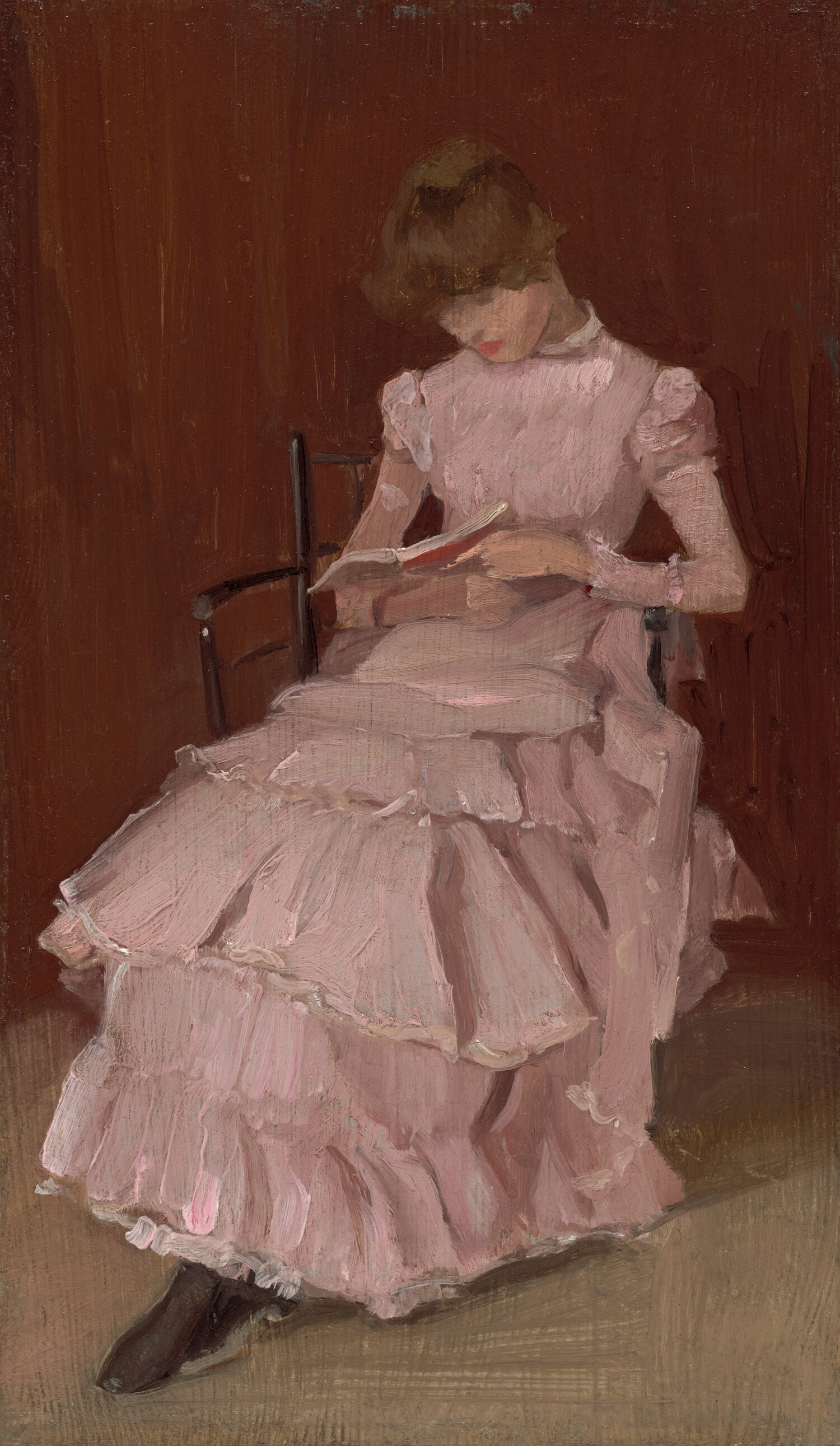
The National Gallery of Art's Peach Blossom, painted around 1890–94 in oil on a small wood panel, is a central case. It shows Rose Pettigrew seated and reading in a pink, fringed dress. The museum records that Beatrix both painted the panel and made the dress. Design, needlework, staging and painting meet in one object.[5]
When the work entered the National Gallery in 1943, it was attributed to James McNeill Whistler. It was reassigned to Beatrix in the 1970s and is now accession 1943.11.8 under her name. The old attribution was not an innocent spelling error. It shows how a familiar tonal manner and a famous surname could pull a woman's painting into her husband's oeuvre.[5]
Current interpretation notes the picture's spare setting, delicate handling and Aesthetic emphasis on colour over narrative. Influence from James is visible, but the museum does not therefore return authorship to him. Beatrix's decision to place the ornate dress against restrained surroundings, and her material involvement in making that costume, make the work an unusually concentrated statement of her cross-media practice.[5]
The title's historical origin is uncertain. Japanese associations of peach blossom may enrich interpretation, given both Whistlers' interest in Japanese art, but they do not provide a proved programme. The safer claim is visual and material: a pink dress, reading figure, narrow support and tuned background create an arrangement whose maker worked across clothing and paint.[5]
The work's acquisition history carries an institutional irony. The National Gallery now describes it as the first painting by a woman to enter the collection, although it entered under a man's name. Recovery changed both an artist's catalogue and the museum's account of itself.[5]
Drawings, jewellery, glass and designed rooms
The attribution problem extends beyond painting. In fiscal year 2008, the National Gallery formally changed several sheets of sketches and jewellery designs from James to Beatrix. The revision followed scholarship and examination rather than an attempt to distribute credit symbolically. Small drawings on folded paper and envelopes had preserved her invention while losing her name.[6][7]
Jewellery studies reveal thought in motion: linked birds, figures, loops and settings are tested rapidly before manufacture. They belong beside paintings not because all media are identical, but because Beatrix moved between line, object and body. A ring changes with movement and touch; a window changes with light; a wallpaper repeat changes through architectural scale.[1][2][6]
Her 1891 memorial window at Orton demonstrates another collaborative chain. Beatrix designed the composition, and Campbell Smith and Company executed it. Crediting the glass workshop does not diminish her; it specifies how nineteenth-century decorative art was made. The designer's authorship rested in drawings, choice and supervision rather than personally firing every piece.[1][19]
Interior design continued in the Whistlers' Paris home at 110 rue du Bac. Beatrix planned or supervised a scheme in pink, green and white and designed austere furniture using checked patterns. Surviving sketches of the wood-panelled rooms are working records of her decisions, not merely illustrations of a house made famous by James.[1][2][15]
The room also held their shared life. Whistler's lithograph The Duet shows Beatrix at home in 1894, participating in music within the rue du Bac interior. The setting was simultaneously domestic space, designed environment and subject. Reading only James's print leaves out the person who helped shape what it depicts.[15][16]
Managing a studio and promoting prints
Beatrix handled substantial parts of the Whistler household and business. She answered within networks of collectors and dealers, organized the studio and promoted print sales. Correspondence with Charles Lang Freer and others sometimes passed through her. These tasks required judgment about availability, impressions, timing and the artist's volatile professional relationships.[1][2][11]
“Manager” is useful but must not become a vague compliment. The archive supports regular organization and marketing, not the claim that every contract or price was hers. Whistler remained an active, often controlling correspondent. Beatrix's contribution lay partly in making that activity operational—keeping people informed, prints moving and domestic arrangements stable.[1][11]
She encouraged renewed work in pastels and prints and supported sessions with models such as the Pettigrew sisters. Encouragement is difficult to quantify, so it should not be presented as sole causation. It nonetheless appears consistently in scholarship as part of the marriage's productive effect.[1][2][16]
Her own work and administrative work competed for time. Victorian culture frequently treated a wife's household support as natural duty, even when it sustained a commercial artistic practice. Recovering management should therefore sharpen, not soften, the question of how much labour was hidden behind Whistler's public autonomy.[1][4]
The partnership was not a modern equal studio firm. James possessed the larger reputation and market; Beatrix's work was judged through his. Yet she had knowledge he used, spaces she designed, relationships she maintained and objects she made. The correct picture is reciprocal but unequal, documented rather than idealized.[1][2][11]
London, Paris and a shared aesthetic life
The Whistlers worked between London and Paris. Movement connected them with artists, writers, printers, dealers and patrons while making household management more complex. Their addresses were not neutral containers. Tite Street and rue du Bac were staged environments in which colour, furniture, clothing and sociability supported public identity.[1][2][11]
Beatrix's experience with Godwin equipped her to think architecturally about those spaces. Checked furniture and restrained colour schemes relate to Aesthetic design without simply reproducing one man's formula. She translated a broad design culture through the practical needs of rooms the couple inhabited.[1][4][15]
James's portraits of Beatrix—from Harmony in Red: Lamplight to later lithographs—record changes in their shared years. But they remain his constructions. A confident standing pose, a figure at music or a woman resting during illness cannot provide a complete account of her feelings. The images become more informative when set beside her own objects and letters.[8][11][16]
Beatrix also participated in social and professional exchange directly. She maintained friendships, exhibited, communicated with collectors and worked among models and artists. The label “wife” tends to make these activities emanations of James's circle. In practice, relationships crossed the Philip, Godwin and Whistler networks she had helped connect.[1][2]
This connected history explains influence without assigning ownership by gender. Godwin's design principles, the Philip workshop, Whistler's tonal language, Sickert's graphic practice and Beatrix's observation all meet in her oeuvre. An artist can learn from a circle and still make accountable individual choices.[1][2][10]
Illness and the late images
Beatrix developed cancer in 1894. The sources establish the diagnosis at that level but do not warrant a more precise retrospective type here. Illness altered travel, work and the couple's correspondence. Their letters communicate pain, worry and care, but protected texts should be paraphrased and not turned into a sequence of intimate quotations.[1][2][11]
Whistler made By the Balcony and The Siesta as Beatrix lay gravely ill in 1895. The lithographs are moving because sparse marks hold a familiar body under changed conditions. They also create an ethical risk: the husband's images of dying can become the final and most famous account of the wife's life.[16]
These works do not disclose whether she welcomed each sitting or what she thought at every moment. Nor should suffering be described as material from which Whistler produced masterpieces. The images record care, observation and artistic mediation; Beatrix's own words and oeuvre prevent them from owning her illness completely.[1][11][16]
Her practice did not become irrelevant when illness intensified. Interior sketches, designs and correspondence belong to the same late years. Even when physical capacity narrowed, the designed environment and studio system she had helped create remained around the couple.[1][2][15]
Beatrix died in London on 10 May 1896, two days before her thirty-ninth birthday. She was buried at St Nicholas in Chiswick, where Whistler was later interred. Her short life helps explain the limited opportunity to consolidate a public reputation, but it should not make the career itself a prelude to a poignant death.[1][2][20]
Rosalind, the estate and Glasgow
After Beatrix died, her youngest sister Rosalind Birnie Philip became closely responsible for Whistler. He made Rosalind his ward and executrix. She acted as companion, secretary, model and keeper of the household, then inherited his estate when he died in 1903.[17]
This route must be stated accurately. Beatrix did not live to inherit Whistler's final estate and did not bequeath it to the University of Glasgow. Rosalind preserved the material, made major gifts in the 1930s and 1950s, and left the remainder of her collection to the University in 1958.[3][17]
The transfers included far more than celebrated Whistler paintings. They encompassed studio contents, prints, drawings, manuscripts, books and correspondence, as well as works by Beatrix and their father John Birnie Philip. Family preservation created the body of evidence through which Beatrix's own practice could later be reconstructed.[2][17]
The Hunterian now describes itself as holding the principal collection of Beatrix's art, numbering more than 250 items across media. That figure is a collection count, not proof of the exact size of everything she made. Works may remain in private hands, be lost, or still be misattributed.[3]
MacDonald's 1997 exhibition and catalogue used this concentration to separate hands, reconstruct designs and present Beatrix as an artist and designer. Later museum changes, including the National Gallery's 2008 reattribution of drawings, show that recovery is continuing. Catalogue authorship is a historical process, not a label fixed forever.[1][7]
Recovery also changes how the Whistler collection is searched. A query confined to the married surname misses Rix Birnie and Beatrice Godwin; one confined to paintings misses glass, furniture panels and jewellery. Reconciliation across names and media is not administrative tidying after interpretation. It is the method that makes an oeuvre available to interpret at all.[1][2][3]
Why the decorative arts matter
Beatrix's paintings fit comfortably within familiar art history, but tiles, clothing, wallpaper, jewellery, glass and rooms are essential to understanding her. These forms organize lived space and require technical translation between design and manufacture. Their historical classification as “minor” or feminine has helped obscure practitioners whose work crossed media.[1][4]
The category “decorative” need not be rejected. It identifies pattern, surface, use and relation to architecture. The problem begins when decoration is assumed to involve less intellect than easel painting. Beatrix's designs solved distinct problems of repetition, material, fabrication, body and light.[1][4][14]
Her practice also complicates the ideal of autonomous “art for art's sake.” Aesthetic attention to colour and form travelled through saleable tiles, a dress worn by a model, a memorial window, a ring and a coordinated Paris room. Beauty was not detached from labour or use simply because narrative was restrained.[4][5][19]
Dressmaking makes the point particularly clearly. In Peach Blossom, the tiered pink costume is not a neutral accessory selected after the painting was conceived. Beatrix made it and then organized the relation between textile, sitter, panel and painted colour. The same practitioner worked on an object worn in the studio and on the representation through which viewers encounter it. Conventional catalogues separate costume from oil painting; her process joined them.[1][5]
Rooms worked similarly at a larger scale. The sketches for rue du Bac record alignments, panelling and colour choices that had to accommodate existing architecture and the couple's furniture. Beatrix's interior was neither an easel picture enlarged nor unrecorded homemaking. It was a designed environment whose inhabitants, possessions and changing daylight continually completed the scheme.[4][15]
Designed objects make collaboration visible. A cabinet involves architect, panel designer and manufacturer; glass joins drawing to specialist execution; a portrait involves artist, model and costume. Rather than using collaboration to dissolve authorship, exact credit shows the different expertise an object contains.[1][5][14]
Beatrix's career is therefore not a footnote attached to Whistler's Aestheticism. It provides evidence of how that culture moved between gallery, workshop, factory and home, and how women's contribution could be central while remaining dispersed under other names.[1][2][4]
The surviving range also changes the questions asked of an Aesthetic career. Instead of measuring success only through large exhibitions and oil sales, it asks who conceived repeat patterns, coordinated rooms, prepared costumes and carried designs through specialist workshops. These activities joined visual judgment to practical constraint and commercial circulation. Beatrix's record makes that infrastructure visible without claiming that every surrounding object was hers.[1][2][4][14]
Frequently Asked Questions
Yes. The National Gallery of Art attributes the c. 1890–94 panel to Beatrix Godwin Whistler. Rose Pettigrew modelled, and Beatrix also made the elaborate pink dress. The painting entered the museum in 1943 attributed to James and was corrected in the 1970s.[5]
Beatrix Whistler's career becomes legible when its divided parts are reunited. The Chelsea workshop explains her formation; Godwin's office and manufacturers explain design practice; Rix Birnie identifies an exhibitor; the Whistler marriage shows reciprocal studio labour; museum reattribution restores paintings and drawings to her.[1][2][7]
No single role is sufficient. She was a daughter within a sculptural workshop, Godwin's collaborator, Edward's mother, a widow, an exhibitor, Whistler's partner, a manager, and an artist working across material boundaries. Naming those roles does not fragment her. It prevents marriage from swallowing the history they compose.[1][13][20]
The strongest evidence lies in objects and records rather than compensatory legend. More than 250 Hunterian works, a National Gallery painting, jewellery studies, prints, panels and room designs do not require invention to establish importance. They require attribution, comparison and a willingness to count decorative labour as art.[1][3][5]
Discussion
How does Beatrix Whistler's career change when paintings and decorative designs are studied together?
Separate design, manufacture, collaboration and attribution while tracing her work across names and media.
Reader Insights
Which object evidence restores Beatrix's authorship?
How does each medium change the designer's task?
Where is creative exchange visible without dissolving authorship?
Join the Conversation
Share a source-specific observation or question.
References
- Margaret F. MacDonald, Beatrice Whistler: Artist and Designer, Hunterian Art Gallery, University of Glasgow, 1997.
- University of Glasgow, “Beatrice Whistler,” biographical entry, The Paintings of James McNeill Whistler, https://www.whistlerpaintings.gla.ac.uk/catalogue/biog/?mid=y203&nid=WhisB&onid=&xml=his
- University of Glasgow, “Whistler—The Hunterian,” collection overview, https://www.gla.ac.uk/whistler/hunterian/
- Patricia de Montfort, “‘The lady of the garden, lawn and blackbird’: Beatrix Whistler,” University of Glasgow research publication, https://eprints.gla.ac.uk/189770/7/189770.pdf
- National Gallery of Art, Peach Blossom, 1943.11.8, https://www.nga.gov/artworks/30218-peach-blossom
- National Gallery of Art, “Beatrix Godwin Whistler,” artist and collection records, https://www.nga.gov/artists/1973-beatrix-godwin-whistler
- National Gallery of Art, “Changes of Attribution,” fiscal year 2008 annual report, pp. 60–61, https://www.nga.gov/content/dam/ngaweb/About/pdf/annual-reports/annual-report-2008.pdf
- University of Glasgow, Harmony in Red: Lamplight, YMSM 253, The Paintings of James McNeill Whistler, https://www.whistlerpaintings.gla.ac.uk/catalogue/display/?mid=y253
- University of Glasgow, Beatrix Whistler's Whistler in His Studio, attribution and exhibition record, https://www.whistlerpaintings.gla.ac.uk/catalogue/display/?mid=y406&xml=his
- University of Glasgow, Beatrix Whistler and Trixie records, The Etchings of James McNeill Whistler, https://www.etchings.arts.gla.ac.uk/catalogue/
- Margaret F. MacDonald, Patricia de Montfort and Nigel Thorp, eds., The Correspondence of James McNeill Whistler, 1855–1903, University of Glasgow, https://www.whistler.arts.gla.ac.uk/correspondence/
- University of Glasgow, “Edward William Godwin,” biographical entry, The Correspondence of James McNeill Whistler, https://www.whistler.arts.gla.ac.uk/correspondence/biog/display/?bid=Godw_EW
- University of Glasgow, “Edward Godwin,” biographical entry, The Paintings of James McNeill Whistler, https://www.whistlerpaintings.gla.ac.uk/catalogue/biog/?mid=y253&nid=GodwE&onid=WhisB&xml=sub
- Victoria and Albert Museum and Hunterian collection records for E. W. Godwin, William Watt and Company and Beatrix's Seasons cabinet panels.
- The Hunterian, Beatrix Whistler's View from the Château Walls, Loches and sketches of 110 rue du Bac, collection records; see University of Glasgow, Connecting Whistler, https://www.gla.ac.uk/media/Media_182035_smxx.pdf
- University of Glasgow, Whistler biography and lithograph records for The Duet, By the Balcony and The Siesta, https://www.whistler.arts.gla.ac.uk/jmw/
- University of Glasgow, “Rosalind Birnie Philip,” biography and Whistler Archive overview, https://www.whistlerpaintings.gla.ac.uk/catalogue/biog/?mid=y124&nid=PhilRB&xml=his and https://www.gla.ac.uk/myglasgow/archivespecialcollections/discover/specialcollectionsa-z/whistlerarchive/
- Royal Society of British Artists exhibition records and “The Fate of an ‘Impressionist’,” Illustrated Bits, 21 July 1888, as documented in MacDonald, Beatrice Whistler.
- Orton parish and Hunterian records for Beatrix Whistler's Jane Mary Wilson Holme memorial window, executed by Campbell Smith and Company, 1891.
- Margaret F. MacDonald, “Beatrice Philip (Mrs Godwin, Mrs Whistler),” Oxford Dictionary of National Biography, Oxford University Press, 2004.


