


 by Tom Gurney
Tom Gurney BSc (Hons) is an art history expert with over 20 years experience
Published on June 19, 2020 / Updated on November 6, 2026
Email: tomgurney1@gmail.com / Phone: +44 7429 011000
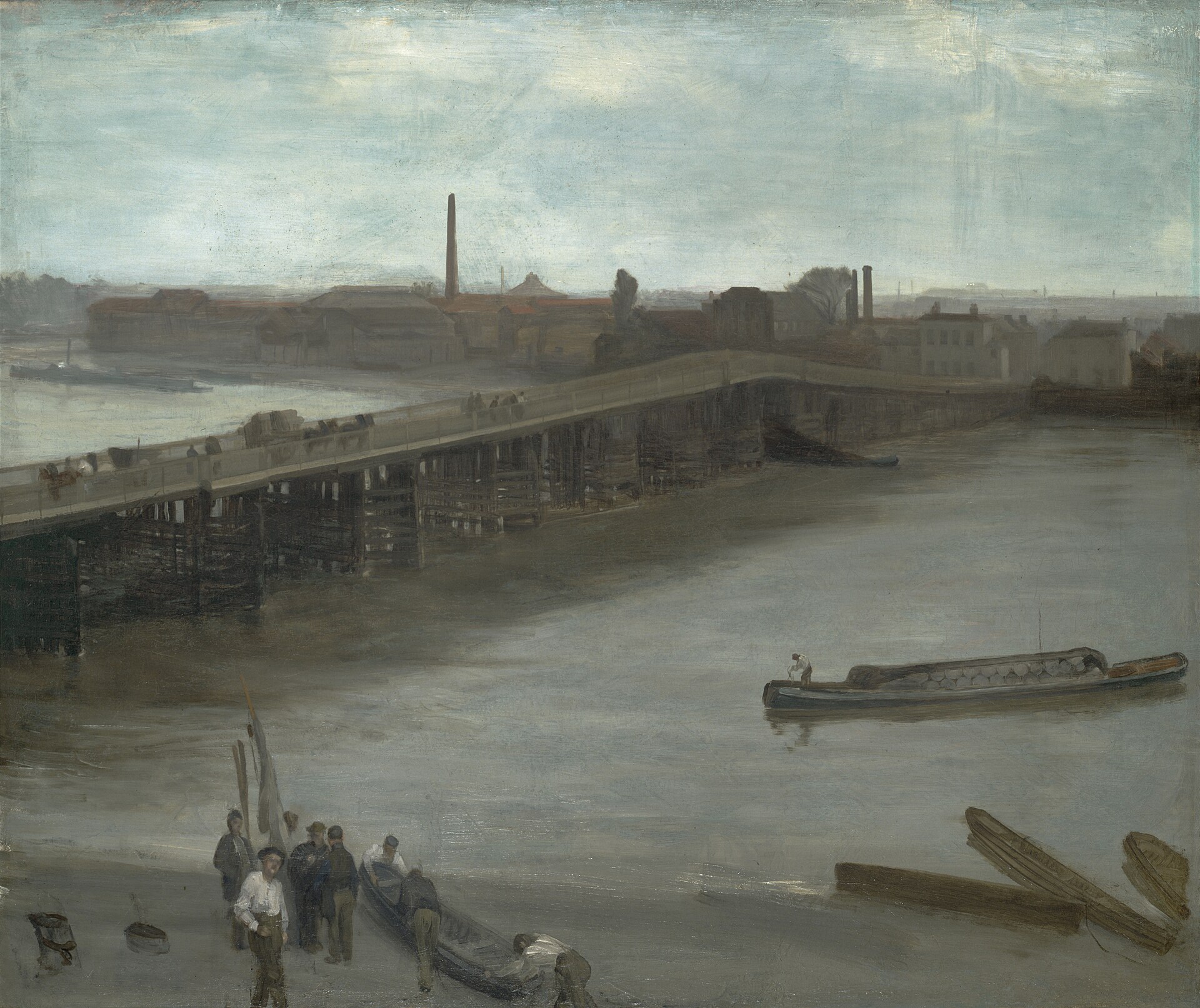
James McNeill Whistler's Brown and Silver: Old Battersea Bridge looks across the Thames from Chelsea towards Battersea. The old timber crossing enters from the left, carrying tiny travellers above water busy with boats. Men work near the foreground shore, while factories and chimneys line the opposite bank. A low, changeable light binds all of it into browns, greys and cool blue.[1][2][16]
The picture is neither the famous vertical nocturne in Tate nor a preliminary version of it. This is YMSM 033, an earlier horizontal oil now at the Addison Gallery of American Art, Phillips Academy, accession 1928.55. It shows the whole bridge in daylight and belongs to Whistler's sustained engagement with the working river during the first half of the 1860s.[1][4][15]
Its long making matters. Alexander Constantine Ionides commissioned the subject after the Royal Academy exhibition of 1859, but the surviving surface cannot securely be dated from that moment. Whistler probably developed it during 1862–64 and certainly completed it by May 1865, when the Royal Academy exhibited it as catalogue number 343.[1][6][9]
The canvas carries an even earlier history. X-radiography reveals an unfinished self-portrait beneath the river and a barge at the right. Whistler turned that rejected or abandoned portrait sideways, rubbed it down and painted the Thames view across it. The hidden figure's brushwork still complicates the visible surface.[2][17]
At the Royal Academy, critics saw unusual power in the ordinary materials of industrial London. They praised the painting's exact tonal relations, moist atmosphere, air and space. Their response helps explain why this carefully described river scene occupies a decisive place between Whistler's youthful realism and the increasingly explicit colour harmonies of his later career.[3][10][11]
At a Glance
- IdentityBrown and Silver: Old Battersea Bridge
- CatalogueYMSM 033
- Date1862/1865; commissioned 1859
- ViewpointLindsey Row, Chelsea, looking south
- MediumOil on fine-weave canvas, mounted on Masonite
- Dimensions63.8 × 76 cm
- Hidden layerUnfinished self-portrait beneath the river view
- Accession1928.55
- Current holderAddison Gallery of American Art
- Image rightsPublic Domain Mark / PD-Art
Contents
- Object identity, medium and current location
- Why the date stretches from commission to exhibition
- The view from Lindsey Row
- Reading the composition from left to right
- Workers, boats and an industrial Thames
- Brown, silver and the weather of London
- An old canvas turned sideways
- Paint handling, pentimenti and support
- The Ionides commission and Anglo-Greek patronage
- Royal Academy exhibition of 1865
Object identity, medium and current location
The University of Glasgow catalogue raisonné assigns the work number YMSM 033 and the preferred title Brown and Silver: Old Battersea Bridge. The Addison Gallery records the painting as oil on canvas mounted on Masonite, measuring 63.8 by 76 centimetres, or 25 1/8 by 29 15/16 inches.[1][4][5]
There is no signature or inscription on the visible surface. That absence is important because it prevents a painted date from settling the work's complex chronology. The documented commission, hidden portrait, correspondence and exhibition record must be read together instead.[1][2]
Addison's accession number is 1928.55, and its institutional credit line is “Gift of Cornelius N. Bliss.” That wording controls the present ownership record. A 2024 Addison exhibition document also dated the picture 1859–63, showing that institutions may compress the making history differently even while identifying the same object.[4]
The Glasgow catalogue uses 1862/1865. Its slash indicates that production falls within a span, not that two separate versions were completed in those years. The article therefore preserves the current specialist notation while explaining the earlier commission and the secure 1865 exhibition terminus.[1][5]
Why the date stretches from commission to exhibition
Luke Ionides recalled that his father commissioned Old Battersea Bridge shortly after Whistler's successful showing of At the Piano at the Royal Academy in 1859. Praise from George Frederic Watts encouraged the patron to order both a portrait of Luke and a view of the bridge.[1][6]
A commission date does not prove that the visible Thames surface began immediately. Whistler could have planned the subject, delayed it, rejected an early state or reused a canvas only later. Glasgow consequently states that the exact start of work is unclear.[1]
The hidden self-portrait narrows part of the sequence. On stylistic and biographical grounds, the sitter's appearance suggests about 1861 or 1862. The bridge picture must postdate at least the portrait layer it covers, even though the commission itself was older.[1][2]
In July 1862, George du Maurier reported that Whistler was painting river pictures for “the Greeks.” The phrase referred to the Anglo-Greek commercial and cultural circle around the Ionides, Cavafy and Coronio families. YMSM 033 fits that network of Thames patronage, though du Maurier did not list each picture by number.[1][7]
Whistler mentioned commissions he hoped to finish for the following Royal Academy later in 1862. The catalogue suggests that he may have worked on the bridge during winter 1862–63. Yet he sent The Last of Old Westminster, not this canvas, to the 1863 Academy.[1][8]
Early in 1864, he told Henri Fantin-Latour that he had made two Thames pictures, an old bridge and a fog effect. He had liked them at completion but had grown dissatisfied. YMSM 033 securely answers to the old bridge; identifying the separate fog picture is less certain.[1][8]
One 1865 critic said that the painting seemed to open the Academy wall onto the previous November. That may simply describe a damp late-autumn atmosphere. It could also preserve knowledge that Whistler was still working in November 1864, but the source does not allow that stronger reading to become fact.[1][10]
May 1865 provides the firm endpoint. Old Battersea Bridge appeared in the Royal Academy's ninety-seventh exhibition, numbered 343, and Whistler arranged for Cundall & Co. to photograph it that year. Whatever the exact sequence of campaigns, the exhibited picture was complete enough to enter public history.[1][3][9]
The view from Lindsey Row
Whistler's Chelsea homes gave him repeated access to the river near old Battersea Bridge. From the Lindsey Row side he looked south, across the Thames, with the crossing extending into the scene from the left. The industrial bank of Battersea occupied the distance.[15][16]
Old Battersea Bridge connected Chelsea and Battersea. John Phillips built the timber structure in 1771–72 under Henry Holland's direction. Its low roadway rested on numerous piles, creating a dense, irregular piece of river architecture rather than the broad masonry arches familiar elsewhere in London.[15]
The tide changes what can be read in Whistler's painting. High water conceals much of the piles' true height, so the roadway seems to skim across the broad grey-brown river. This makes the bridge less monumental and more integrated with the horizontal spread of shore, boats and water.[2][15]
The crossing was already old when Whistler chose it. It closed to traffic in 1883 and was demolished in 1890. Joseph Bazalgette's replacement was constructed between 1886 and 1890, so the painting later became a record of an urban structure that no longer survived.[15]
That documentary value should not obscure pictorial choice. Whistler did not inventory every pile or elevation like an engineer. He selected a high-tide moment, compressed distances and organised the bridge with the waterborne traffic into a tonal whole.[2][10][16]
Reading the composition from left to right
The bridge establishes the principal horizontal at upper left. Its dark deck tapers into the distance, punctuated by upright piles and tiny moving figures. Pedestrians and vehicles create activity without becoming individual portraits.[2][16]
Below, boats and a broad barge break the river into overlapping zones. Their hulls and masts create diagonals that counter the bridge. Shoreline figures at the left and centre give scale, making the wide crossing and industrial distance intelligible through ordinary human labour.[2][17]
The opposite bank runs laterally across the canvas. Common buildings, factory roofs and chimneys offer no conventionally picturesque landmark at the centre. Their modest shapes are held together by atmosphere and by carefully adjusted differences between brown, grey and cool blue.[2][10]
A distant glazed form at far right has been catalogued as the Crystal Palace. From Sydenham Hill it could serve as a pale flash beyond Battersea's riverfront industry. Because the landmark is minute and difficult to verify from every reproduction, it is best treated as a supported but visually qualified identification.[17]
The picture's movement is lateral rather than theatrical. Eye and traffic travel along bridge, bank and boats, while diagonals pull attention into the water. This ordering lets Whistler preserve a remarkable amount of observed information without allowing any single anecdote to dominate.[10][16]
Workers, boats and an industrial Thames
Foreground workmen handle boats close to the shore. Other craft occupy the river, and traffic crosses above them. The picture therefore joins three systems of movement: manual work at the water's edge, commercial or local navigation, and land transport across the bridge.[2][16][17]
The figures remain small, but Whistler painted them with unusual care. The technical catalogue singles out foreground workers, distant city, bridge piles and people on the deck as details more patiently resolved than in many of his oils.[2]
Industrial buildings are not pushed outside the composition to preserve a rural ideal. Chimneys, factories and ordinary riverside structures define Battersea's opposite bank. The 1865 critics noticed precisely this lack of conventionally beautiful subject matter.[3][10][11]
Yet the work is not a social survey of named trades. It does not document wages, employers or a single narrated incident. Labour provides scale and lived activity while remaining part of the larger coordination of colour, interval and atmosphere.[2][16]
Whistler's achievement lies partly in refusing a choice between observation and arrangement. The boats are recognizable and the bridge is locally specific, but they also function as weights, lines and tonal steps. The working river becomes pictorial structure without losing its modern character.[10][16]
Brown, silver and the weather of London
Muted brown and greyish blue dominate the surviving surface. The title's “silver” does not mean literal metallic paint. It names a family of cool, light-reflecting greys that pass among sky, water, haze and pale architectural distance.[1][2][14]
Brown enters through timber, boats, shore and the warmer passages of the river. Whistler avoids a simple warm-versus-cool division. Related browns and greys recur across objects, causing bridge, water and city to belong to the same damp air.[2][10]
The Saturday Review admired the picture's English greyness and moistness, seeing “truth of tone” where another artist might have pursued brightness. The Fortnightly Review likewise stressed how much effect Whistler drew from materials that seemed unpromising.[3][10]
Tone here means a colour's relative lightness and strength in relation to every other passage. The bridge reads as solid because it is darker than the haze, while boats occupy believable distances through smaller shifts. No isolated colour carries the illusion by itself.[10][11]
This relational construction anticipates Whistler's later habit of naming paintings as harmonies, arrangements and nocturnes. It does not make YMSM 033 a disguised night scene. The daylight, bridge traffic and foreground work remain far more explicit than in the later nocturnes.[1][14][15]
An old canvas turned sideways
Whistler did not begin the bridge on a pristine support. He reused a fine-weave canvas bearing his own unfinished self-portrait, turned it ninety degrees and painted across the rubbed-down image. The economical act made one material object carry two incompatible compositions.[2]
X-radiography locates the earlier head and body beneath the barge and water at right. The hidden Whistler appears at work with a brush in hand. His pose makes the sacrifice especially suggestive: an image of the artist making art lies beneath the public, saleable river view.[2]
The portrait may have been made in Paris or London, with London considered more likely by the technical authors. Its abandonment cannot be assigned a single motive. Shortage of money or materials, dissatisfaction, privacy and the demands of a commission are all possibilities rather than established facts.[2]
The earlier layer was partly rubbed down, but not erased materially. Under raking light, traces of the “ghost” can still disturb the bridge surface. Brush ridges from the portrait alter the water and barge painted above them.[2]
This is not merely a hidden curiosity. It changes how the Thames texture should be read. Some complexity belongs to visible descriptive strokes, while some arises from an earlier body rotated beneath them. The surface records revision even where the viewer cannot identify its cause unaided.[2]
Paint handling, pentimenti and support
The bridge view is painted fairly thickly on fine canvas. That finding resists both a generic description of Whistler as always using thin transparent veils and unsupported inherited wording built on that shortcut. In this object, muted colour and atmosphere coexist with materially substantial paint.[2][18]
Pentimenti show decisions made during the river campaign. A small boat right of centre was covered, and changes appear around the figures at left. These corrections reveal adjustment within the observed scene rather than a single uninterrupted transcription.[2]
The exceptional care given to city, piles, passers-by and workmen also complicates the myth that Whistler sought only vague suggestion. He could concentrate precise description within a restricted palette, allowing detail to remain legible without breaking tonal unity.[2][10]
At some later date, conservators or handlers mounted the canvas on prestwood, identified in the current Addison wording as Masonite. Whistler therefore painted on canvas, not directly on hardboard. The rigid backing belongs to the object's conservation history.[2][4]
The source set does not establish when that mounting occurred. The 1865 photograph documents the picture's appearance but does not by itself date the present support construction. A responsible account separates what imaging reveals from what conservation chronology can prove.[1][2]
The Ionides commission and Anglo-Greek patronage
Alexander Constantine Ionides belonged to a wealthy Anglo-Greek mercantile family whose London homes supported artists, musicians and designers. His commission placed Whistler's Thames project within a network of personal recommendation and cosmopolitan patronage rather than an anonymous open-market calculation.[1][6][7]
The catalyst was reportedly the Royal Academy reception of At the Piano. George Frederic Watts praised that painting, and Ionides commissioned both Luke Ionides's portrait and the bridge. One successful picture thus led to subjects in two very different genres.[1][6]
Du Maurier's phrase “river pictures for the Greeks” captures how contemporaries understood the cluster. Other possible works include The Last of Old Westminster, Battersea Reach and Grey and Silver: Old Battersea Reach, associated with Ionides, Cavafy and Coronio family circles.[1][7]
The phrase should not turn those paintings into a formal series with identical dates or owners. Their commissions, titles, sizes and exhibition histories differ. It instead supplies a useful social frame for Whistler's repeated river work around 1862.[1][7][8]
Ionides's early commitment also explains why a difficult, repeatedly reconsidered picture could remain in production for years. Patronage offered an intended destination, although the surviving correspondence shows that Whistler's satisfaction with the work was far from steady.[1][6][8]
Royal Academy exhibition of 1865
The Royal Academy accepted the painting under the plain title Old Battersea Bridge. It hung as catalogue number 343 in the 1865 exhibition. The colour-title form used today developed through later exhibition and catalogue history.[3][9][14]
Its placement was high on the wall, a normal disadvantage in a densely hung Victorian exhibition. Even so, reviewers noticed it repeatedly. Critical attention was not produced by a central eye-level position but by the work's unusual control of an unglamorous London subject.[3][10]
The Saturday Review praised its damp English atmosphere and argued that nothing in the exhibition equalled its tonal truth. Its comparison between a picture and an opening into nature was meant to commend convincing relation, not literal trompe-l'oeil.[3][10]
The Fortnightly Review described bridge, common buildings and chimneys as nearly devoid of splendour. That apparent poverty made Whistler's result more impressive: correct gradations and an unaffected disposition of boats, shore and bridge yielded substantial effect.[3][10]
The Daily Telegraph considered it the room's most remarkable landscape. The critic emphasized the transformation of pictorially resistant elements through air, space and colour harmony. Modern industrial London became a test of painting rather than a defect to be concealed.[3][11]
George Mason and the language of tone
Several reviews compared Whistler with George Mason, an English painter admired for poetic, subdued landscapes. The comparison concerned tonal restraint and feeling. It does not prove that Mason supplied the composition or that Whistler consciously followed him.[3][10][11]
Victorian criticism often grouped works to describe a shared effect. Mason provided reviewers with language for low-key colour and a quiet emotional register, while Whistler's bridge offered a markedly urban and industrial case.[10][11]
The reviews also distinguished convincing appearance from spectacle. Frederick Edwin Church's large panoramas represented one model of optical drama. Palgrave's account praised Whistler for concealing art through measured relations rather than producing a dioramic shock.[3][10]
This rhetoric reveals contemporary expectations. A landscape might be assessed for finish, illusion, sentiment, subject beauty or tonal truth. Old Battersea Bridge succeeded because it made an unfashionable site cohere without depending on heroic scale.[10][11]
Reading the criticism historically avoids turning every compliment into objective fact. The sources tell us how informed viewers responded in 1865 and which problems they believed Whistler had solved.[3][10][11]
Paris in 1867 and a disputed hang
The painting travelled to Paris in 1867 and appeared under Old Battersea Bridge in Salon and Exposition Universelle catalogues. The short title preserved the location and structure as the work's public identity.[3][12]
Whistler was angered by the treatment of his works in the United States section of the Exposition Universelle. In letters to George A. Lucas, he attacked the placement and even considered withdrawal if it could not be changed.[3][13]
His later description of a corridor where the works had been condemned is the artist's interested testimony. It establishes frustration and perceived disadvantage, not a neutral measurement of every visitor's response.[3][13]
The Paris episode nevertheless shows the picture's dual national position. Whistler was an American artist living in London, painting an English site and seeking recognition within French exhibition culture. Administrative nationality could determine where his London river scene was seen.[12][13]
Its 1867 presence also confirms that the bridge painting remained important after the Academy success. It was not merely a discarded commission but part of Whistler's international representation.[3][12]
From Old Battersea Bridge to Brown and Silver
In 1883, Galerie Georges Petit exhibited the painting in Paris as Harmonie en gris et brun. That title translated the scene into a “harmony in grey and brown,” foregrounding colour relations while retaining the same canvas.[3][14]
Goupil's 1892 London retrospective used Brown and Silver. Old Battersea Bridge. The compound form joins abstract colour language to a specific place. David Croal Thomson, organising the display, called the painting one of his favourites.[3][14]
Whistler's mature titles trained audiences to look for relations among colours rather than narrative alone. Applied to the early Thames picture, “brown and silver” identifies what 1865 critics had already admired in different language: a restricted range made coherent through tone.[3][10][14]
The later title should not be treated as the name Whistler necessarily used throughout production. Royal Academy and Paris records first presented Old Battersea Bridge. Title history documents changing interpretation and marketing.[3][9][12][14]
The 1980 catalogue raisonné consolidated Brown and Silver: Old Battersea Bridge, and the current online catalogue and Addison use that form. Older variants remain evidence, but they do not designate lost versions.[1][4][5]
Provenance through the Ionides family
Alexander Constantine Ionides retained the commissioned painting until his death in 1890. It then passed to his widow, Euterpe Sgouta Ionides, and after her death in 1892 to their son Alexander Ionides.[3][6]
This family descent lasted more than three decades after the first exhibition. It also allowed Whistler to recall the original transaction when the market value of his work had risen dramatically.[3]
David Croal Thomson reported in March 1894 that his firm had acquired Old Battersea Bridge from Alexander Ionides for 400 guineas. Whistler thought the dealer should seek at least £1,200 and immediately considered borrowing the picture for Antwerp.[3]
Later, Whistler complained that the Ionides family had paid him only about thirty guineas while the bridge was resold for hundreds. His notes mention a £600 sale, and another letter wavers over the sum received. These figures record resentment and market memory rather than a single perfectly reconciled account.[3][8]
The episode belonged to Whistler's larger campaign to control the prestige, pricing and circulation of his work. A patron's profitable resale could look to him like evidence that early “eccentricities” had been undervalued.[3]
From Edmund Davis to the Addison Gallery
By 1899 the painting belonged to H. Thorburn. Agnew's purchased it from him and sold it to the collector Edmund Davis at the end of January that year. This transfer moved the work beyond Ionides family custody.[3]
David Croal Thomson reacquired the picture in 1926. Agnew's handled it again in 1928, and the recorded chain includes banker Lancelot H. Smith acting on behalf of Thomas Cochran before the institutional gift.[3]
The Glasgow entry says it was presented in 1928 by Cornelius Newton Bliss but also supplies life dates ending in 1911. That internal chronological conflict means the literal donor event should not be repeated without correction.[3]
Addison's own current credit line supplies the safe formulation: “Gift of Cornelius N. Bliss.” It pairs that credit with accession 1928.55, the title, support and dimensions. Institutional language is preferable where earlier provenance compilation contains a name or date inconsistency.[4]
The work remains at the Addison Gallery of American Art, Phillips Academy, in Andover, Massachusetts. It appeared in Addison's Laying the Foundation exhibition from February through July 2024. That dated display history does not establish whether it is on view now.[4]
Not the Blue and Gold nocturne
Whistler painted old Battersea Bridge many times, but YMSM 033 must be separated from Tate's Nocturne: Blue and Gold – Old Battersea Bridge, YMSM 140. The latter dates from about 1872–75 and is a different, vertically proportioned canvas.[15]
The early painting shows the whole bridge receding across the left half of a daylight river. The later nocturne crops the structure into a huge T-like pier and arch, with a barge below, distant lights and a falling firework.[15]
YMSM 140 belongs to Whistler's mature nocturne practice. Its prevailing blues, golden sparks and simplified silhouettes privilege moonlight and colour harmony over the close inventory of bridge traffic, workers and industrial buildings visible in YMSM 033.[2][15]
Japanese woodblock prints help explain the later picture's radical cropping and flattened bridge form. They should not be used as a universal key that erases the earlier painting's European tonal criticism, specific commission and dense river observation.[10][15]
The distinction is more than a cataloguing nicety. Search results and popular discussions often use “Old Battersea Bridge” for the nocturne alone. Correct identifiers, holders, formats and dates keep two major but differently conceived works from collapsing into one.[1][4][15]
Realism, aesthetic harmony and historical position
The picture observes a modern site without idealising away labour or industry. In that limited sense, realism is a useful context. Whistler looked closely at contemporary transport, workers, factories and weather rather than inventing an antique or pastoral setting.[2][16]
Yet “Realism” does not explain every choice. The composition deliberately coordinates lines and tonal intervals, and period critics described poetic feeling. Observation is transformed through selection rather than offered as raw social evidence.[10][11][16]
Likewise, “Aestheticism” becomes misleading if it suggests indifference to subject. The later brown-and-silver title makes colour relation explicit, but bridge, tide, patronage and labour remain historically specific.[1][14]
The canvas is best understood as a hinge rather than a label. It preserves the detailed, materially worked Thames of Whistler's early London years while demonstrating how a restricted palette can make ordinary objects cohere as an autonomous harmony.[2][10][14]
That combination explains its importance. The painting does not need to be renamed Impressionist, proto-modernist or Japanese to matter. Its evidence supports a more precise account of protracted making, technical reuse, industrial observation and tonal intelligence.[1][2][16]
Why Brown and Silver: Old Battersea Bridge matters
The painting gives old Battersea Bridge an unusual double life. It records a timber crossing later destroyed, but it also converts that local structure into a framework for moving bodies, boats, labour and atmosphere.[2][15][16]
Its buried self-portrait adds another double life. Beneath the public commission lies an abandoned image of Whistler himself at work. The river surface literally depends on an earlier act of self-representation that viewers cannot normally see.[2]
Its chronology resists a neat origin story. A 1859 commission, 1861–62 portrait layer, probable 1862–64 river work and 1865 exhibition all belong to the object. Compressing them to one year would remove the process that made the picture historically intelligible.[1][6][8][9]
Its reception also marks a breakthrough. Critics who saw little splendour in the site nevertheless found exceptional air, truth of tone and pictorial effect. Their praise shows that subdued industrial London could carry serious landscape ambition.[3][10][11]
Finally, the work clarifies Whistler's development without forcing a straight line. The later nocturnes do not cancel this careful whole-bridge view. Together, the distinct paintings show how one site could support radically different solutions across a decade.[1][15]
Frequently Asked Questions
It is in the Addison Gallery of American Art at Phillips Academy, Andover, Massachusetts. Its accession number is 1928.55, and Addison's credit line states that it was a gift of Cornelius N. Bliss.[4]
Yes. X-radiography reveals an unfinished, partly rubbed-down self-portrait of Whistler beneath the barge and water at right. He turned the canvas sideways before painting the Thames subject, and ridges from the portrait affect the later surface.[2]
Discussion
Does the bridge read first as a record of working London or as a harmony of brown and silver?
Look closely at the complete timber crossing, the river workers, the industrial bank and the surface under which Whistler’s earlier self-portrait survives.
Reader Insights
How does the long timber structure organise movement across the canvas?
How does knowledge of the buried self-portrait change your reading of the river?
Why did critics value tonal truth in this industrial Thames subject?
Join the Conversation
Share a close observation or an object-history question.
References
- Margaret F. MacDonald and Grischka Petri, “Brown and Silver: Old Battersea Bridge,” YMSM 033, The Paintings of James McNeill Whistler: A Catalogue Raisonné, University of Glasgow, 2020. https://www.whistlerpaintings.gla.ac.uk/catalogue/display/?mid=y033
- Margaret F. MacDonald and Grischka Petri, “Brown and Silver: Old Battersea Bridge: Subject and Technical Description,” YMSM 033, University of Glasgow, 2020. https://www.whistlerpaintings.gla.ac.uk/catalogue/display/?mid=y033&xml=tec
- Margaret F. MacDonald and Grischka Petri, “Brown and Silver: Old Battersea Bridge: History,” YMSM 033, University of Glasgow, 2020. https://www.whistlerpaintings.gla.ac.uk/catalogue/display/?mid=y033&xml=his
- Addison Gallery of American Art, “Laying the Foundation: Exploring the Nucleus of the Addison's Collection—Image Highlights and Credit Lines,” 2024. https://addison.andover.edu/wp-content/uploads/Image-Highlights_Laying-the-Foundation.pdf
- Andrew McLaren Young, Margaret F. MacDonald, Robin Spencer and Hamish Miles, The Paintings of James McNeill Whistler, Yale University Press, 1980, cat. 33.
- Luke Ionides, Memories, Paris, 1924, pp. 40, 275–76.
- George du Maurier, July 1862 correspondence concerning Whistler's “river pictures for the Greeks,” cited in MacDonald and Petri, YMSM 033.
- James McNeill Whistler to Henri Fantin-Latour, November 1862 and January–February 1864, Glasgow University, The Correspondence of James McNeill Whistler, GUW 07952 and 08036. https://www.whistler.arts.gla.ac.uk/correspondence/
- Royal Academy of Arts, The Exhibition of the Royal Academy, 1865: The Ninety-Seventh, London, 1865, cat. 343.
- P. T. Palgrave, Saturday Review, 3 June 1865; and “English Pictures in 1865,” Fortnightly Review 1 (1865), pp. 665–66.
- “Royal Academy Exhibition,” Daily Telegraph, London, 11 and 16 May 1865.
- Salon de 1867 and Exposition Universelle de 1867 catalogues, Paris, 1867, cat. 70/77.
- James McNeill Whistler to George A. Lucas, April and November 1867, Glasgow University, The Correspondence of James McNeill Whistler, GUW 09192 and 09194. https://www.whistler.arts.gla.ac.uk/correspondence/
- Exposition Internationale de Peinture, Galerie Georges Petit, Paris, 1883, cat. 6; and Nocturnes, Marines & Chevalet Pieces, Goupil Gallery, London, 1892, cat. 31.
- Margaret F. MacDonald and Grischka Petri, “Nocturne: Blue and Gold – Old Battersea Bridge,” YMSM 140, University of Glasgow, 2021. https://www.whistlerpaintings.gla.ac.uk/catalogue/display/?mid=y140
- Martha Tedeschi and Britt Salvesen, eds., Songs on Stone: James McNeill Whistler and the Art of Lithography, Art Institute of Chicago, Museum Studies 24, no. 1 (1998).
- Smithsonian American Art Museum, Peter A. Juley & Son Collection, “Brown and Silver: Old Battersea Bridge,” photograph record J0026753. https://siris-juleyphoto.si.edu/
- James McNeill Whistler Waterhouse+ route, redirect, image, inherited-prose and protected-live inventories, frozen 25 August 2026.


