


 by Tom Gurney
Tom Gurney BSc (Hons) is an art history expert with over 20 years experience
Published on June 19, 2020 / Updated on November 6, 2026
Email: tomgurney1@gmail.com / Phone: +44 7429 011000
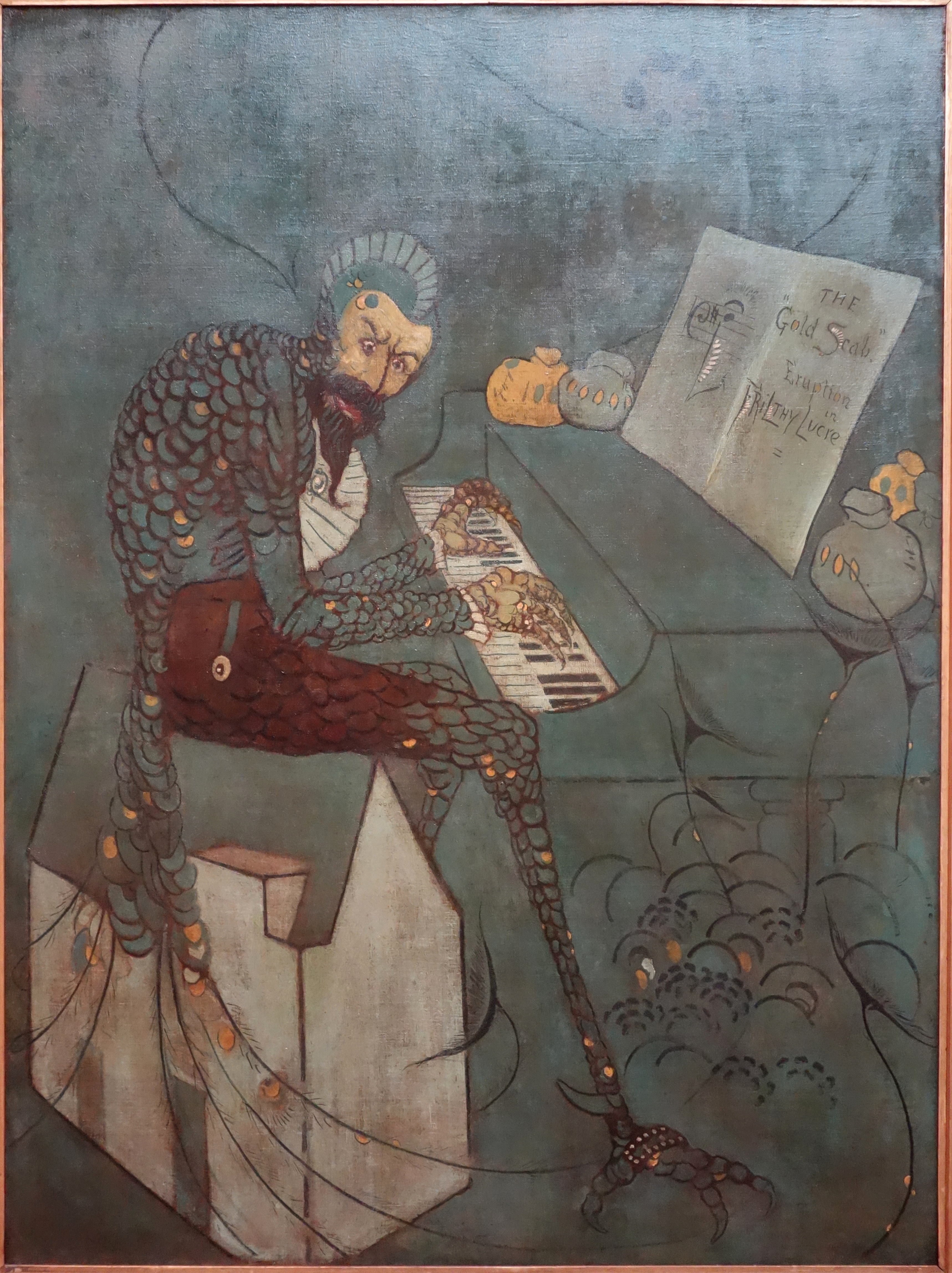
James McNeill Whistler's The Gold Scab is a portrait made as an act of attack. A grotesque creature with Frederick Richards Leyland's face, a peacock's scaled plumage and enormous claws bends over a piano. Gold coins appear to break through its dark body. Beneath it sits a small white house: Whistler's recently built home and studio in Tite Street, Chelsea. On the piano, a sheet of music announces `THE "Gold Scab." Eruption in FRiLTHY Lucre`. The insult is not hidden beneath a neutral title. It is written into the painted scene.
The work dates from 1879, when Whistler's finances had collapsed and his former patron Leyland was among his creditors. It was made for the White House studio, where Leyland and the creditors' committee were expected to inspect the property. The painting is therefore both an easel picture and a staged confrontation. Yet it does not tell the history impartially. It converts Whistler's anger into a body assembled from vanity, money, fashionable dress, music and a predatory bird.[1][2]
Today the Fine Arts Museums of San Francisco record the canvas as The Gold Scab: Eruption in Frilthy Lucre (The Creditor), accession 1977.11. The museum's object page gives the date as 1879, the medium as oil on canvas and the dimensions as 186.7 by 139.7 centimetres. The shorter The Gold Scab, preferred by the University of Glasgow catalogue raisonné, is used here because it distinguishes the painting without losing the longer wording, which remains visible inside the composition.[1][2]
The work can look like a spectacular outburst of private malice, but its construction is unusually exact. Face, frill, feathers, sovereigns, keyboard, building and frame all point back to a particular relationship. Understanding the picture requires two forms of attention at once: close looking at its green-and-gold design, and source criticism about the story Whistler wanted that design to tell.
At a Glance
- CatalogueYMSM 208 / FAMSF 1977.11
- Date1879
- SubjectHostile caricature of Frederick Richards Leyland
- MediumOil on canvas
- Dimensions186.7 × 139.7 cm (73 1/2 × 55 in.)
- InscriptionTHE “Gold Scab.” Eruption in FRiLTHY Lucre
- Setting representedWhistler's White House studio-residence
- Historical frameThree Girls frame by Foord and Dickinson, circa 1872–73, turned and reused
- CollectionFine Arts Museums of San Francisco, Legion of Honor
- DisplayGallery 24 on 26 August 2026; verify current status
Contents
- Object record at a glance
- Looking at the creature
- A name written inside the painting
- Frederick Leyland at the piano
- The White House and the bankruptcy crisis
- More than one cause of insolvency
- The Ruskin trial: a necessary correction
- The frame as a second history
- A first audience that entered the picture
- The bankruptcy sale
Object record at a glance
The painting is YMSM 208 in the catalogue raisonné and 1977.11 at the Fine Arts Museums of San Francisco. Its current institutional title expands the painted phrase with `(The Creditor)`, recalling the name under which it entered Whistler's bankruptcy sale. The current credit line is Gift of Mrs Alma de Bretteville Spreckels through the Patrons of Art and Music. On 26 August 2026, the museum page placed it in Gallery 24; that location is a dated display statement rather than a permanent part of the object's identity.[1][2]
The catalogue records a butterfly signature and the music-sheet inscription. It also identifies a `Flat Whistler` frame with painted flowers and a butterfly, dating from 1872–73. That frame is not a routine surround selected after the caricature was finished. It was designed for an earlier Leyland commission, The Three Girls, and was turned to accommodate The Gold Scab. Canvas and frame consequently carry two moments in the relationship between artist and patron.[2][5]
The museum page's country field says `United States`, reflecting the present collection context. The painting itself was made in London. Its internal architecture is not an American house but a model of the White House, designed for Whistler by E. W. Godwin in Tite Street. The distinction matters because nearly every part of the picture responds to the artist's circumstances in Chelsea during 1879.[1][2]
The current project route has an equally clear but much thinner record. A local page exists at `/james-whistler/gold-scab/`, while the public request redirects to the paintings overview. The retained source supplies a title and metadata but no substantive body text, and it names an artwork image that is absent from the live folder. Restoration as a standalone page is justified by the object's distinct identity; it is not evidence that the missing reproduction may be reused without a rights check.
Looking at the creature
The canvas is tall but not narrowly portrait-like. Its height gives the hybrid body room to unfold from the crest at the upper left through a long limb to the giant claw near the lower right. A dark green field presses against the figure. The palette stays close to green, black, dull gold, white and small red-brown accents, so the creature and its environment appear to belong to the same poisoned decorative atmosphere.[1][11]
Leyland's face is reduced to a sharp pale mask. A moustache, beard and sideways glance preserve enough likeness to make the target recognisable, while a comb-like crest pushes the head towards a bird or reptile. Around the neck, a huge pleated collar spreads like an artificial ruff of feathers. The white shirtfront beneath it is so enlarged that fashionable clothing becomes anatomical display. Whistler does not simply dress Leyland badly; he turns the sitter's preferred frills into the organ of a monster.[2][8][11]
Dark scales or overlapping feathers cover the torso. Across them sit small yellow-gold circles. Some read as coins, while others look like pustules or crusts. This uncertainty drives the title's central visual pun: wealth is both exuded and diseased. The Pennells later described a creature breaking out in scabs of golden sovereigns, a formulation that captures the fusion without making their authorised biography a neutral witness to the quarrel.[8]
The creature's arms end as talons at a keyboard. One lower limb stretches down through the right half of the canvas, becoming more animal as it approaches the foreground. The enormous claw at the bottom is not anatomically plausible, but it is compositionally decisive. It brings the aggression close to the viewer and balances the pale face and shirt above. The painting's deformities are carefully distributed across its rectangle rather than poured out without design.[11]
Bags or bundled heaps gather around the piano and lower-right corner. Golden discs recur on or beside them. A small white gabled building lies under the peacock's weight. Leyland is thus made to play money while sitting on Whistler's house, and the lower part of the composition turns creditor power into an image of occupation. That is Whistler's accusation, not an independent finding about who was legally or morally responsible for every debt.[1][2][4]
A name written inside the painting
The music reads `THE "Gold Scab." Eruption in FRiLTHY Lucre`. Several kinds of wordplay collide within that sentence. `Eruption` describes the coins breaking through the body; `scab` makes their circular forms resemble crusted lesions; and `lucre` casts money as corrupt gain. The wording does not ask the viewer to infer a polite allegory. It supplies the terms of abuse.[2][11]
The invented `FRiLTHY` is especially compressed. Its selective capitals point to Frederick Richards Leyland's initials, while its sound splices `frill` into `filthy`. Whistler had mocked Leyland's clothing in a surviving jibe: “Whom the gods intend to be ridiculous, they furnish with a frill.” The Smithsonian connects that line directly to the strange spelling. Used cautiously, the phrase explains why the collar, the initials and the moral stain of money all meet in one word.[8][13]
The title has sometimes encouraged a further association with `scab` as a strikebreaker. That meaning existed in nineteenth-century labour language, but the locked object evidence does not establish it as Whistler's intention here. The sovereign-like eruptions, skin imagery and creditor context explain the visible pun without importing an unsupported political programme. The insult is already specific and severe.
Whistler also gave the painting less openly abusive names. At the 1880 sale it was A Satirical Painting of a Gentleman styled “The Creditor”. In the Goupil Gallery's 1900 exhibition it became Arrangement in Green and Gold. The second title does not prove that the quarrel had disappeared. It draws attention to a genuine colour structure while temporarily screening the proper name and bodily attack. YMSM's preferred The Gold Scab restores the name Whistler used in 1879.[2][3]
That movement between insult and arrangement is central to the work. The canvas is neither a shapeless document of rage nor a purely self-sufficient harmony. Its green-and-gold organisation makes the satire more memorable, and the satire makes formal choices such as the diseased discs, acidic face and dominating diagonal unusually legible.
Frederick Leyland at the piano
Frederick Richards Leyland was a Liverpool shipowner, collector and important patron of Whistler. He was also an amateur pianist. The instrument in The Gold Scab is therefore not generic shorthand for cultured wealth: it converts a known accomplishment into part of the ridicule. The talons do not merely grasp money; they perform at a keyboard while the sheet music names the performer.[2][10]
Whistler had painted Leyland before. The earlier portrait presented a formally dressed man whose black clothing signalled social and economic authority. Related drawings and later caricatures concentrated increasingly on the frilled shirt. By 1879, the ruffle could carry a history of patronage, fashion and mockery. The creature in The Gold Scab depends upon recognition of a stylish man whose refinement has been turned inside out.[2][10]
The painting belongs to a group of three satires described by the Pennells. The Loves of the Lobsters and Mount Ararat also made Leyland and the creditor crisis subjects for grotesque invention. This was a campaign rather than an isolated sketch made in passing. Even so, the other pictures should not be used to reconstruct details absent from The Gold Scab. The surviving San Francisco canvas has its own scale, frame and unusually integrated vocabulary of music, architecture and coins.[2][8]
Alan Summerly Cole saw it on 10 September 1879. His diary identified a demoniacal Leyland at the piano and called the canvas a “forcible piece of weird decoration”, while also registering its bitter animus. The remark is valuable because it combines an immediate response with a secure date. By early September the work was sufficiently developed to be recognised as a forceful decorative whole and an unmistakably hostile likeness.[2]
Whistler himself wanted it seen. He told Walter Greaves to go up to the studio and look at the `Gold Scab`. The invitation is inconsistent with an interpretation of the work as a shameful private doodle. Its first audience was deliberately managed: friends could admire the invention, while the anticipated creditors and Leyland could encounter an accusation staged inside the property they were inspecting.[2]
The White House and the bankruptcy crisis
The little building beneath the creature represents Whistler's White House, designed by the architect E. W. Godwin as a combined home and studio. Its stark gabled profile makes the identification possible even in caricatural miniature. In 1879 the building was not distant biographical scenery. Rising construction costs, modifications and the loss of the property were immediate components of Whistler's financial collapse.[2]
FAMSF describes the painting as hung to greet officials inspecting the property after bankruptcy. The Glasgow catalogue adds that Whistler intended it to stand in the studio with the two related Leyland satires when Leyland and the committee of creditors made their official inspection. He left the picture in the house when he departed for Venice in late autumn. The studio therefore became a theatre in which an insolvent artist could not control the legal process but could still control what the visitors saw.[1][2]
The visual logic is deliberately accusatory. Leyland's creature sits on the house; its coins spread across the body and floor; the piano converts cultural patronage into a performance of `lucre`. The image makes Whistler the artist crushed by a wealthy creditor. It offers no architectural plan, ledger or legal argument. Its power lies in replacing those forms of evidence with a spectacular bodily metaphor.
This is why the painting's placement must be described precisely. It was in Whistler's White House studio, not in Leyland's dining room at Prince's Gate. It was never part of Harmony in Blue and Gold: The Peacock Room. The Peacock Room contains its own image of `Art and Money`, the fighting peacocks on the south wall. The Gold Scab is a separate canvas made later and staged in another building.[2][4]
Confusing those sites weakens both works. In the Peacock Room, Whistler altered a patron's interior and embedded the quarrel within its decoration. In the White House, he painted the former patron as a monster and placed the caricature before a creditor audience. One conflict generated related imagery, but the material conditions and first encounters were different.
More than one cause of insolvency
Whistler's quarrel with Leyland began when artist and patron disagreed over authority, scope and payment for the Peacock Room transformation. Whistler believed the work deserved a much larger fee; Leyland rejected that demand and paid a smaller sum. The later caricature represents the refusal as an act of greed and betrayal. Its coins and crushing house make the artist's position visually absolute.[2][4]
Historical explanation cannot be equally absolute. The White House exceeded its estimate, and Whistler's design changes added cost. Debts had accumulated from his earlier household. The Ruskin suit imposed legal expense and ended with nominal damages rather than the vindication he sought. Income and commissions were insufficient to restore the balance. Leyland's payment conflict belonged to the crisis, but it was not the only cause.[2][14]
This distinction is not a defence of one man against the other. It separates evidence about bankruptcy from evidence about revenge. The Gold Scab tells us with unusual clarity how Whistler wanted Leyland to be seen in 1879. It cannot, by itself, apportion responsibility among builders, creditors, patron, court costs and the artist's own decisions.
Whistler filed his bankruptcy petition in January 1879 and was declared insolvent in May. The caricature followed the collapse and gave it a face. Its date matters because it places the work among actions taken after legal control of property had begun to move away from the artist. Painting could not reverse that transfer, but it could turn an inspection and auction into episodes within Whistler's own public mythology.[2][3]
The Ruskin trial: a necessary correction
The libel trial between Whistler and John Ruskin took place in November 1878. During the proceedings, the defence referred to `Devil Peacocks` with devils' heads and peacocks' bodies. The Pennells later thought this meant The Gold Scab. Chronology rules that out: the canvas was painted in 1879, after the trial.[6]
The Smithsonian's James McNeill Whistler in Context states the correction explicitly. The trial phrase may relate to peacock imagery and to hostile readings of the Peacock Room, but it cannot be eyewitness evidence for YMSM 208. Repeating the Pennell identification would manufacture a public courtroom history for a work that did not yet exist.[6]
The error is instructive. Whistler's disputes with Ruskin and Leyland became intertwined in later biography because both contributed to the legend of an artist battling philistinism, money and criticism. The Falling Rocket, the Peacock Room and The Gold Scab then risk collapsing into one continuous story. Their sequence is more exact: the room and its patron quarrel preceded the trial; the trial preceded the bankruptcy caricature.
Keeping that order does not make the works unrelated. The one-farthing verdict, legal costs and public controversy formed part of the conditions surrounding insolvency. It does prevent a memorable phrase from being attached to the wrong object. WHIS015 treats the litigation in full; here the essential point is simply that The Gold Scab had no place in the 1878 courtroom.[6]
The frame as a second history
Whistler placed the caricature in a frame designed years earlier for The Three Girls. That unrealised large painting had been intended for Leyland's dining room, opposite La Princesse du pays de la porcelaine. Work began in the late 1860s and continued through repeated alteration. Whistler never delivered it. By the end of his relationship with Leyland, the promised image had been abandoned or destroyed, but its exceptionally elaborate surround survived.[4][5][10]
The frame was made by Foord and Dickinson in London to Whistler's design around 1872–73. Painted flowers were intended to connect it to the garden setting of The Three Girls and to patterned textiles in the dining room. A short passage from Franz Schubert's Six Moments musicaux extended the artist's correspondence between painting and music. The catalogue identifies it more exactly with the opening of the third piece, D. 780, Op. 94.[5][10]
When reused for The Gold Scab, the frame was turned to fit the new canvas. A structure conceived to complete a promised `symphony` now enclosed a creditor caricature. The transformation made absence physically present: the undelivered commission surrounded a new image of the man who had expected it. Frame and painting together converted a history of aspiration, payment and failure into revenge.[4][5]
The contrast is sharper because the frame is beautiful. Its flowers, gilding and musical notation do not civilise the monster. They intensify the affront by bringing the refinement once offered to Leyland into contact with his deformed likeness. Smithsonian exhibition research interprets this repurposing as Whistler's declaration that The Three Girls had been abandoned and its aesthetic promise deliberately reassigned.[4][5]
The commonly circulated FAMSF study image shows the full painted canvas but not this surround. A reader looking only at that file can analyse the composition but cannot see the frame's floral programme or turned orientation. The discussion therefore relies on separate frame documentation rather than pretending that every object claim is visible in one digital reproduction.[5][11]
A first audience that entered the picture
Whistler's departure for Venice did not end the confrontation. A February 1880 letter from Matthew Robinson Elden reports that Leyland visited the White House with Rosa Laura Caldecutt. The attendant did not initially know who he was but recognised him through his resemblance to The Gold Scab and the pair's interest in the lobster satire. Leyland therefore encountered a caricature whose capacity to identify him had already become part of its social life.[9]
Elden's account is jocular and written to Whistler. It should not be converted into a transcript of Leyland's thoughts. He says that Leyland and Caldecutt looked at the pictures and then at one another, smiling in a way he found difficult to define. The scene documents recognition, not a simple confession of humiliation, rage or amusement.[9]
The episode makes the work unusually reflexive. Leyland looks at a creature that is identified as Leyland; another observer reads the living man through the painted monster; and the story is sent to the absent artist in Venice. Portraiture usually claims resemblance between sitter and image. Here resemblance becomes a weapon circulating through a hostile audience.
The painting's social function also changes. Before the visit it was a trap or greeting prepared for creditors. During the visit it became an object through which identities were tested. Once taken to auction, it ceased to be only an instrument within the White House and entered a market where buyers, critics and later owners could decide whether its formal force outweighed its cruelty.
The bankruptcy sale
The White House contents were sold at Sotheby's on 12 February 1880. The Gold Scab appeared as lot 88 under the relatively restrained title A Satirical Painting of a Gentleman styled “The Creditor”. Elden said it went to the sale complete in its frame, unlike the related jokes that had been cut from their stretchers. This preserved the crucial relation between the caricature and the abandoned Three Girls commission.[3][9]
Dowdeswell bought the painting for twelve guineas, or £12 12s. A newspaper correspondent later speculated that the creditor himself had acquired it, perhaps because that would make an irresistible final turn in the story. The sale record identifies the purchaser as the dealer. This is a useful warning against allowing a colourful contemporary report to replace transaction evidence.[3]
Graves and the Pennells said that Leyland tried to have the work removed through legal measures when he learned it was in the sale. The story is plausible within the atmosphere of the dispute, but it survives as later attributed testimony rather than a recovered application or judgment. It should remain a report, not be narrated as a fully documented proceeding.[3][8]
Auction altered the meaning of `creditor` once again. The painting produced little money relative to its later prices, yet the legal sale that stripped Whistler of possessions also gave the caricature an independent chain of ownership. An image made against the creditor system became one of the assets distributed through it.
Owners, dealers and uncertain passages
The catalogue records a sale from Dowdeswell to Captain H. S. Hubbell at an unknown date. By 1892 the painter George Percy Jacomb-Hood owned the work. How it reached him is disputed. The Pennells said he found it in a King's Road pawnshop, while Jacomb-Hood recalled receiving it from a frame-maker who had bought it at a sale. Both accounts preserve a fall into unlikely commercial surroundings, but their disagreement prevents a single picturesque recovery story from being treated as fact.[3]
In 1892 Jacomb-Hood refused an offer of £800. Whistler congratulated him, turning the owner's refusal into evidence of gentlemanly conduct and renewed value. The leap from twelve guineas at bankruptcy to the rejected sum also suited Whistler's long campaign to make market recognition vindicate artistic reputation. It does not prove that the offer represented a completed market sale.[3]
By 1910 the painting belonged to Theron C. Crawford, who offered it to Charles Lang Freer for £2,000. Freer, despite his profound commitment to Whistler, did not buy it. S. & G. Gump subsequently obtained the work, staged a special San Francisco exhibition in 1913 and sold it to Alma de Bretteville Spreckels in 1914.[3]
The later record is not continuous. French & Co. acquired or handled the painting in 1920 or 1921 and still had it in 1946. Knoedler lent it to a Pittsburgh exhibition in 1957. It went to Maryhill Museum on approval in 1959 but was returned. YMSM cautions that the work may have remained Spreckels-owned while appearing with dealers; the exact subsequent ownership is unclear.[3]
The current museum record should govern where the gaps do not. It attributes the acquisition to Mrs Alma de Bretteville Spreckels, working through the Patrons of Art and Music, and assigns accession 1977.11. That statement establishes the museum acquisition without requiring an invented unbroken sequence through every dealer.[1][3]
Exhibition and hostile reception
Alexander Reid arranged for the work to be shown in Glasgow in 1893, although the catalogue leaves some ambiguity between the Glasgow Institute and Boussod, Valadon/Goupil at Wellington Studios. A local review called it an extraordinary Japanese grotesquerie and likened the effect to a nightmare following too much lobster. The joke recognised both its flattened decorative character and its connection with Whistler's wider Leyland menagerie.[3]
At the Goupil Gallery in London in 1900, it was catalogued as Arrangement in Green and Gold. The neutral musical-colour title did not disarm reviewers. The Builder saw a devil playing the piano and found the image repulsive. The Times objected that a huge ugly caricature arising from an old quarrel ought not to have been publicly exhibited.[3]
Those reactions do more than record dislike. They identify a problem created when a private vendetta enters an exhibition. Viewers were asked to judge not only execution and colour but the legitimacy of preserving and displaying an attack on a named man. The work's scale prevented it from behaving like a marginal cartoon. Its frame and decorative authority claimed the space of a major painting.
Charles Lang Freer described it in 1902 through the features still most evident today: the grotesque peacock, talon hands at the piano, clawed feet, gold coins and the `frilthy lucre` score. His close description confirms that the satire's legibility did not depend solely on knowing every episode of the quarrel. The body itself communicates avarice, fashion and aggression.[2]
A careful copy in charcoal, watercolour and gouache, attributed to Thomas Robert Way, is now at the Art Institute of Chicago. It demonstrates that the image was copied and transmitted beyond the primary canvas. It cannot supply evidence about the oil painting's surface or condition, and its attribution remains the museum/catalogue formulation rather than an unquestioned autograph fact.[2][12]
Form, narrative and ethical pressure
Whistler often argued for painting's independence from moral anecdote, and his musical titles encouraged attention to tonal relations. The Gold Scab makes that position difficult to treat as a universal rule. The canvas has a named target, a setting, verbal jokes, a creditor audience and a narrative of blame. Smithsonian scholarship pairs it with Art and Money as evidence that some of Whistler's most formally ambitious works are also irreducibly mischievous and narrative.[7]
This does not require choosing between `art` and `document`. The sheet music is both a pale rectangular interval and a carrier of text. The White House is both a gabled shape supporting the diagonal body and a threatened property. The gold discs punctuate the dark plumage while naming money as disease. The frame extends the picture's decorative harmony while recalling a failed commission. Formal relations make the story more forceful.[5][7]
The painting's ethical aggression must remain visible too. Leyland is denied the dignity of a human body and transformed into an avaricious animal. The attack draws force from class resentment, fashion ridicule and the public exposure of a former associate. Calling the work witty without naming its cruelty would repeat Whistler's own self-justifying performance.
Conversely, moral discomfort does not make the design accidental or negligible. Cole's early description already grasped both weird decoration and bitter animus. The balance of the pale gables, face, frill and sheet music against the dark green mass is deliberate. The long claw pulls the eye through the canvas; repeated circles bind feather, coin and sack; the piano gives the animal's posture an organising scaffold.[2][11]
The Gold Scab is therefore most revealing where its claims conflict. It belongs to an artist associated with non-narrative aestheticism, yet tells a densely particular story. It attacks commercial values, yet moved through auction and dealers. It accuses a patron of reducing art to money, yet surrounds the accusation with the frame of an undelivered paid commission. Its contradictions are not problems to edit away; they are the work's historical substance.
The painting in San Francisco
The Fine Arts Museums of San Francisco now hold the canvas at the California Palace of the Legion of Honor. The official object page's Gallery 24 statement was current on 26 August 2026. Its direct question to visitors—whether confrontation is worse than talking behind someone's back—recognises that the work remains socially awkward rather than converting it into an uncomplicated masterpiece.[1]
The museum's 3,000-by-4,044-pixel study image verifies the full painted composition. It shows the green-black field, Leyland-peacock, piano, White House, money forms, music and butterfly clearly, but excludes the historic frame. The visible page does not expressly grant commercial publication rights for that file. A future live-page restoration should therefore pair correct identity with a documented rights decision rather than treating online accessibility as permission.[1][11]
The present website route has no inherited prose worth retaining, and its named local image is missing. A later standalone page should replace that absence with a properly credited asset, correct object metadata and links to the separate articles on the Peacock Room, Whistler's patrons and the Ruskin trial. Any structural correction belongs to later implementation and remains separate from the object's documented history.
Why The Gold Scab matters
The painting matters because Whistler made resentment operate at every level of an object. Leyland becomes a peacock because the earlier patron dispute already had peacock imagery. He plays a piano because he was a pianist and because musical correspondence was central to Whistler's aesthetic language. His frill becomes plumage; his initials become a diseased adjective; sovereigns become eruptions; and the White House becomes his perch.[2][4][8]
The frame completes that system. Made for The Three Girls, it brings a decade-old promise into the bankruptcy confrontation. Its flowers and Schubert passage preserve an ideal of harmony around an image of hostility. No caption alone can do the work that this physical reuse performs.[4][5]
Historical discipline sharpens rather than diminishes the drama. The painting was made after the Ruskin trial, so it did not appear in court. It stood in the White House, not the Peacock Room. Leyland's payment dispute was one cause within a wider financial failure. The 1880 buyer was Dowdeswell, not the creditor. Later ownership contains gaps and conflicting anecdotes. Each correction prevents Whistler's legend from replacing the object.[3][6]
What remains is more interesting than a simple revenge story. The Gold Scab is a materially separate, formally controlled canvas whose first purpose was confrontation. It exposes the dependence of aesthetic production on houses, frames, patrons, payments, reputations and sales, even as it tries to place all blame inside one monstrous body. Its green-and-gold harmony does not resolve that conflict. It gives the conflict a durable shape.
Discussion
How should formal invention be judged when it serves a deliberately cruel personal attack?
Trace Leyland's hybrid body, the piano, money, White House and inscribed music, then compare the painting's visual coherence with the ethical pressure of its partisan caricature.
Reader Insights
Which visual and verbal devices make the insult legible before its history is known?
How does the painting's blame differ from the documented multiple causes of bankruptcy?
Why does reusing the Three Girls frame intensify the work's meaning?
Join the Conversation
Share a close observation or an object-history question.
References
- Fine Arts Museums of San Francisco, “The Gold Scab: Eruption in Frilthy Lucre (The Creditor)”, accession 1977.11, de Young Content Server, checked 26 August 2026, https://lens.famsf.org/objects/gold-scab-eruption-frilthy-lucre-creditor.
- Margaret F. MacDonald and Grischka Petri, “YMSM 208: The Gold Scab”, The Paintings of James McNeill Whistler: A Catalogue Raisonné, University of Glasgow, 2020, main, date and subject records, https://whistlerpaintings.gla.ac.uk/catalogue/display/?mid=y208.
- Margaret F. MacDonald and Grischka Petri, “YMSM 208: History”, The Paintings of James McNeill Whistler: A Catalogue Raisonné, University of Glasgow, 2020, https://whistlerpaintings.gla.ac.uk/catalogue/names/display/?mid=y208&nid=&xml=his.
- Smithsonian National Museum of Asian Art, “The Gold Scab: Eruption in Frilthy Lucre”, The Lost Symphony: Whistler & the Perfection of Art, https://asia-archive.si.edu/exhibition/the-gold-scab/.
- Smithsonian National Museum of Asian Art, “Framing a Masterpiece” and “Unmaking a Masterpiece”, The Lost Symphony: Whistler & the Perfection of Art, https://asia-archive.si.edu/exhibition/framing-a-masterpiece/ and https://asia-archive.si.edu/exhibition/unmaking-a-masterpiece/.
- Lee Glazer, Margaret F. MacDonald and Nigel Thorp, eds., James McNeill Whistler in Context: Essays from the Whistler Centenary Symposium, University of Glasgow, 2003 (Washington, DC: Smithsonian Institution, 2008), p. 41, https://asia-archive.si.edu/wp-content/uploads/2017/06/Glazer-Whistler-in-Context.pdf.
- Lee Glazer et al., eds., Palaces of Art: Whistler and the Art Worlds of Aestheticism (Washington, DC: Smithsonian Institution, 2013), p. 69, https://www.govinfo.gov/content/pkg/GOVPUB-SI-PURL-gpo51181/pdf/GOVPUB-SI-PURL-gpo51181.pdf.
- Elizabeth Robins Pennell and Joseph Pennell, The Life of James McNeill Whistler, revised edition (Philadelphia: J. B. Lippincott; London: William Heinemann, 1921), chapter XX, Project Gutenberg, https://www.gutenberg.org/cache/epub/47363/pg47363-images.html.
- Matthew Robinson Elden to James McNeill Whistler, February 1880, GUW 01049, The Correspondence of James McNeill Whistler, University of Glasgow, https://whistler.arts.gla.ac.uk/correspondence/people/display/?cid=1049.
- Margaret F. MacDonald and Grischka Petri, catalogue records for Frederick Richards Leyland, Franz Schubert and The Three Girls (YMSM 088), The Paintings of James McNeill Whistler: A Catalogue Raisonné, University of Glasgow, https://whistlerpaintings.gla.ac.uk/catalogue/.
- Fine Arts Museums of San Francisco, digital study image `whistler_goldscab_index.jpg`, https://lens.famsf.org/sites/default/files/2018-12/whistler_goldscab_index.jpg.
- Art Institute of Chicago, Thomas Robert Way, The Gold Scab, collection record, https://www.artic.edu/collection.
- Smithsonian National Museum of Asian Art, “Peacock Room REMIX: Break it Down”, https://asia-archive.si.edu/peacock-room-remix-break-it-down/.
- Linda Merrill, A Pot of Paint: Aesthetics on Trial in Whistler v. Ruskin (Washington, DC: Smithsonian Institution Press, 1992), trial context as catalogued in Smithsonian and University of Glasgow records.


