


 by Tom Gurney
Tom Gurney BSc (Hons) is an art history expert with over 20 years experience
Published on November 6, 2026 / Updated on November 6, 2026
Email: tomgurney1@gmail.com / Phone: +44 7429 011000
Joanna Hiffernan is present throughout some of James McNeill Whistler's most consequential early work. She sat for Wapping, for intimate prints and drawings, and for all three paintings now called the Symphonies in White. In 1865 she worked with Gustave Courbet at Trouville. In 1866 Whistler gave her extensive legal authority over his money, property and pictures while he was abroad. Years after their romantic partnership changed, she and her sister Agnes helped care for Whistler's son, Charles Hanson.[1][3][6][7][16]
Calling Hiffernan Whistler's “muse” does not adequately describe that record. It turns sustained bodily work, household administration, financial trust and caregiving into inspiration supposedly supplied to a male artist. Calling her only a model is more factual but still incomplete. Calling her his wife is legally wrong, although acquaintances sometimes used the word. “Partner” best identifies the continuing personal and practical relationship, provided that the particular form of her work is named whenever the evidence permits.[1][2][5]
Recent scholarship has also corrected basic biography. Exhibition research published in 2022 identified a baptismal record for Johanna, daughter of John Hefferman and Catherine Hannan, in Limerick in 1839. It supersedes the often repeated estimate that she was born around 1843. Her family had moved to London by 1843, where Irish Catholic origin, restricted means and Victorian codes of respectability affected the circumstances through which she entered the artistic world.[3][4][19]
The portraits do not make her inner life visible without mediation. Pose, clothing, studio setting, title and display were constructed, and even the most direct-looking drypoint is an artwork rather than an unguarded psychological document. Hiffernan's importance emerges most securely when those images are read alongside baptismal and death records, correspondence, catalogues and the remarkable power of attorney. Together they recover a historical actor whose contributions extended beyond the painted surface.[1][5][7][8]
At a Glance
- Baptised1839, Limerick
- LondonFamily present by 1843
- Met Whistler1860
- RelationshipPartner and collaborator for more than two decades
- WorkModel, household and studio manager, financial agent, caregiver
- TrouvilleWorked with Whistler and Courbet, 1865
- Power of attorney31 January 1866
- Romantic phaseChanged by about 1868
- Family careHelped raise Charles Hanson
- Died3 July 1886, Holborn
Contents
- Recovering Johanna and Joanna
- From Limerick to a London studio
- Modelling as skilled work
- *Wapping* and the Thames role
- Making *The White Girl*
- Three *Symphonies in White*, not one biography
- Prints, drawings and published roles
- Household, studio and social constraint
- Trouville with Whistler and Courbet
- The 1866 power of attorney
Recovering Johanna and Joanna
The name on the Limerick baptismal record is Johanna, and her father's surname appears as Hefferman. Later records and scholarship use Hiffernan, while Joanna became the familiar form of her first name. These variations are ordinary features of nineteenth-century records shaped by handwriting, accent, clerical practice and self-presentation. They do not indicate several different women. On present evidence, Joanna Hiffernan is the clearest public name, with Johanna and Hefferman recorded as important documentary variants.[1][4][6]
The 1839 baptism matters because an older biographical estimate placed her birth around 1843. That estimate remained influential partly because Hiffernan left no known memoir and only a fragmentary body of direct writing. The newer date rests on a specific family record and research that also identified her parents. It should therefore be preferred, while older publications remain useful for other aspects of her life rather than being dismissed in full.[1][3][4][6]
She was the third daughter of John Hefferman or Hiffernan, described as a schoolmaster, and Catherine Hannan. The family was in London by 1843. This was migration before the Great Famine, so it should not be narrated automatically as famine flight. Nor can poverty and anti-Irish prejudice explain every later decision. They establish a social field in which an Irish Catholic young woman had fewer secure routes into respectable, remunerated cultural work than the men who painted, exhibited and wrote about her.[1][3][4][5]
That imbalance affected what the archive preserved. Whistler's letters, catalogues and paintings survive because institutions collected the artist. Legal documents preserve Hiffernan when she acted in relation to his affairs. Critics noticed the striking red-haired sitter but rarely asked what modelling demanded or how a studio household functioned. The absence of a continuous first-person narrative is therefore not evidence that she lacked agency. It is a warning against filling archival silence with romance.[1][5][8][19]
The National Gallery of Art and Royal Academy exhibitions in 2022 marked a change in emphasis. They assembled nearly every known representation of Hiffernan by Whistler and reunited the three Symphonies in White. More importantly, the accompanying research approached the relationship as a collaboration sustained over two decades. The exhibition did not turn every image into a literal biography; it made scattered documentary and object evidence answer a question older Whistler-centred narratives had often failed to ask.[1][2][3][4]
From Limerick to a London studio
Little is securely known about Hiffernan's childhood and education. Her father's occupation suggests literacy within the family, but it does not justify inventing a comfortable upbringing. Exhibition scholarship describes the family's restricted circumstances in London and the wider prejudice encountered by Irish Catholic migrants. These conditions help explain the stakes of respectability, employment and housing without reducing the adult Hiffernan to a passive product of hardship.[1][3][5]
Hiffernan met Whistler in London in 1860. A later recollection placed the encounter at a studio in Rathbone Place, but the exact scene comes through memory rather than a contemporary diary entry. What is firm is the year and the speed with which she became both a close partner and an essential sitter. She entered his work while he was shifting between Parisian training, Thames subjects and a more experimental language of colour and arrangement.[3][4][6]
Whistler was an American-born artist with family networks, professional ambitions and freedom of movement unavailable to Hiffernan on equal terms. Their relationship was intimate but not legally solemnized. Friends sometimes referred to her as his wife, a socially legible shorthand that should not be converted into a marriage certificate. “Mistress,” another word common in older accounts, makes sexual irregularity the governing fact and carries the moral surveillance that shaped her treatment in the first place.[1][6][17]
“Partner” is not a claim that power was equal. Whistler controlled authorship, signatures, exhibition choices and much of the surviving correspondence. Yet the word accommodates a relationship that combined affection, shared residence, modelling, travel, business trust and later family care. Its forms changed. Modern scholarship identifies an intense romantic phase of about six years and a connection lasting much longer, rather than a single affair that ended cleanly when another woman entered Whistler's life.[1][2][3][6]
The difference is visible in chronology. Hiffernan was already modelling for Whistler in 1860; she received extraordinary legal powers in 1866; the romantic relationship had altered by about 1868; and her work with Whistler's family continued into the 1880s. A vocabulary that only describes the bedroom cannot hold those dates together.[3][7][16][17]
Modelling as skilled work
Victorian art writing commonly made the model disappear into the finished image. The painter supplied invention; the sitter seemed merely available. Hiffernan's record exposes the inadequacy of that division. Modelling required holding difficult positions, returning over long campaigns, managing clothing and hair, responding to revision, and helping sustain the conditions in which pictures could be completed. Repeated collaboration also depended on communication and trust.[1][2][5]
This does not make Hiffernan a co-painter. No evidence shows her applying Whistler's paint or controlling the final composition. Collaboration here means that the image depended on her skilled bodily, temporal and social contribution as well as on the artist's decisions. Naming that labour avoids both extremes: the fantasy of a passive beauty who merely caused inspiration and the unsupported reassignment of Whistler's authorship.[1][3][5]
Hiffernan's range is particularly important. Whistler did not use her for one stable identity. She appeared within a Thames tavern scene, as the standing woman in white, in an Aesthetic interior, among Asian objects, in profile and reclining in works on paper, and in periodical illustrations that cast her as different social types. The recurrence of her face and body allowed formal continuity, while pose, dress and context repeatedly transformed what viewers were invited to see.[1][2][14][20]
Those roles are not fragments of a secret autobiography. A nun in an illustration does not record Hiffernan's vocation, and a working-class figure does not prove a particular job in her own life. A white dress does not establish innocence, sexuality or psychological blankness. Models perform. Artists, publishers and audiences then place that performance inside cultural categories that can outlive knowledge of the sitter.[1][3][5][20]
Surviving accounts suggest that Hiffernan herself drew and painted. The evidence is sufficient to acknowledge artistic practice but not to construct an independent career that has not been documented. No secure body of signed work or exhibition history has been established. The responsible conclusion is modest: she was visually knowledgeable and made art, while the scale and character of that practice remain unknown.[1][6]
*Wapping* and the Thames role
Hiffernan's earliest major appearance in Whistler's painting is Wapping, begun around 1860 and revised over several years. The canvas places a red-haired woman with two men inside a riverside public house, with masts, rigging, barges and waterside labour beyond the window. Current catalogues identify Hiffernan as the principal female model, but the painting's long revision history warns against treating it as a snapshot of the couple's first months.[4][6][13]
The woman's low neckline and her company encouraged viewers to read her as a sex worker or sexually available figure. That was a role within the picture's social narrative, not a statement of Hiffernan's occupation. Whistler used a known person to embody a type intelligible in contemporary representations of the docks. Conflating model and character simply reproduces the moral judgment encoded in the scene.[1][3][13]
At the same time, Hiffernan's participation gave the picture its physical specificity. Her turned head, hair, profile and relation to the men organize attention across the shallow interior and distant river. A model does not cease to be a labouring participant because the finished role is fictional. The distinction between woman and depicted character makes her work more, not less, visible.[1][5][13]
The Thames setting also places Hiffernan at the beginning of a major development in Whistler's career. Wapping belongs to an engagement with modern docks, commerce and the movement of people rather than to the later quiet harmonies alone. Yet a full account of its revisions, maritime detail and exhibition history belongs to the dedicated object page. Here it establishes that Hiffernan's collaboration preceded the white paintings and was not confined to ethereal Aesthetic femininity.[1][13]
Making *The White Girl*
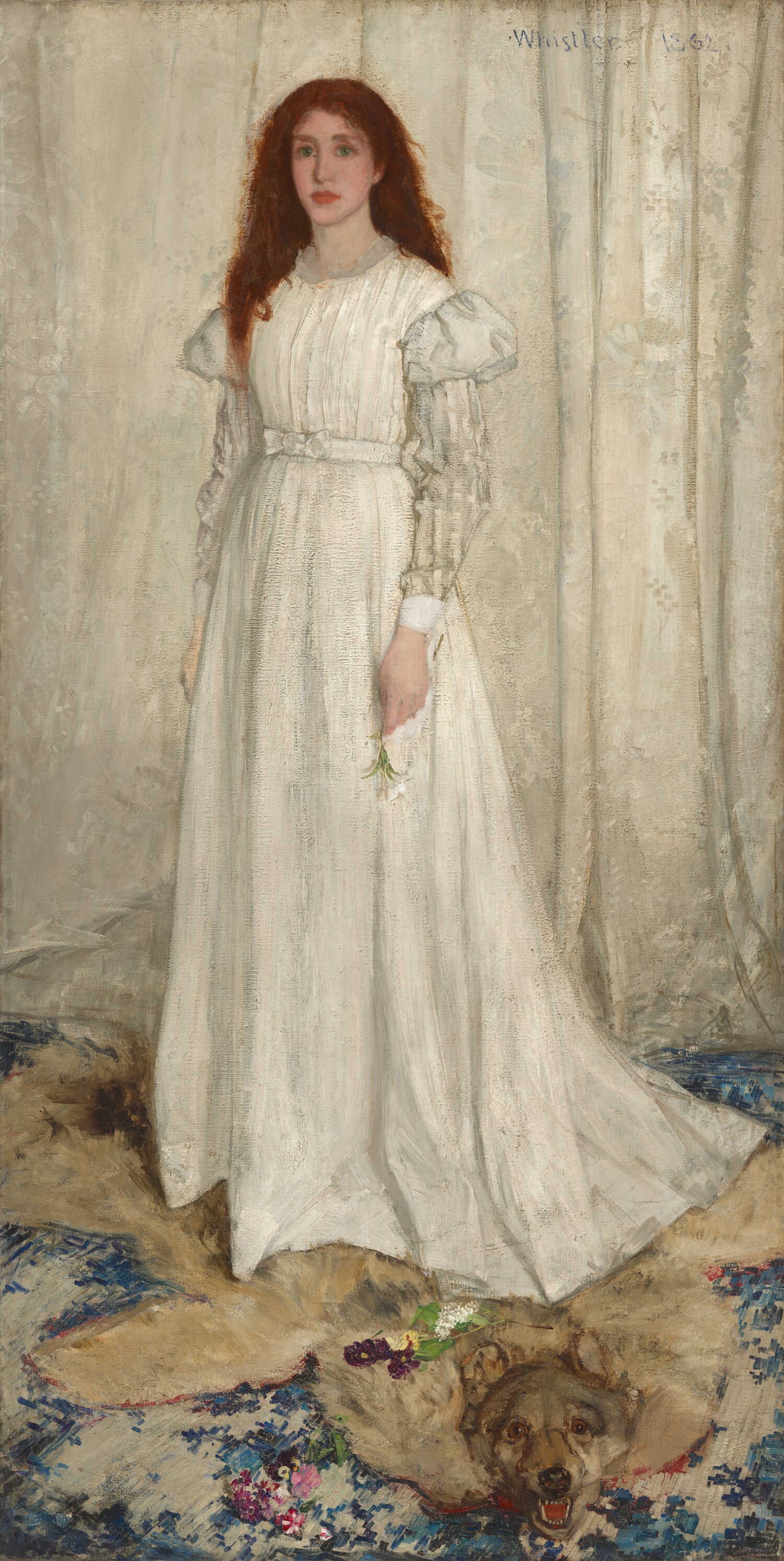
Whistler began Symphony in White, No. 1: The White Girl in Paris during the winter of 1861–62, with Hiffernan standing in a long white dress against a light background. The present painting, now National Gallery of Art 1943.6.2, was not completed in one uninterrupted session. It was worked, exhibited and revised across a longer history whose changing titles became part of its reception.[9][10]
The Royal Academy rejected it in 1862. It appeared at Morgan's Gallery in London in 1862 and at the Salon des Refusés in Paris in 1863. At Morgan's, its exhibition as The Woman in White encouraged association with Wilkie Collins's popular novel. Whistler denied that the painting was an illustration. The distinction is crucial: commercial presentation and audience recognition could attach narrative even when the artist emphasized arrangement.[1][9][10]
Hiffernan's presence made those arguments possible. Her direct stance, loose hair, white dress and bearskin setting offered viewers enough signs to generate stories of purity, fallen sexuality, spiritual vacancy or defiance. Yet those meanings do not identify her own mental state. They show how a painted woman's appearance became a field on which Victorian viewers debated gender, class, morality, realism and formal experiment.[1][5][9]
The word “white” did not mean an absence of decisions. Fabric, flesh, floor and background required fine distinctions within a restricted range. Hiffernan had to sustain the standing pose through a demanding process, while Whistler adjusted the relation of figure and field. To say that she modelled the picture is therefore to name material work. To say that the result reveals exactly who she was would mistake a constructed surface for testimony.[1][2][10]
The painting later received the musical title by which it is now known. That title redirected attention from a sensational literary identity toward colour and arrangement, but it did not eliminate the depicted body or the history of reception. Hiffernan is simultaneously a specific sitter, a working collaborator and a figure transformed through Whistler's aesthetic programme. None of those levels cancels the others.[1][9][10]
Three *Symphonies in White*, not one biography
Hiffernan posed for all three works in the group eventually known as the Symphonies in White. That continuity made the 2022 reunion particularly powerful, but the canvases should not be read as sequential diary entries. Their dates, additional models, objects and exhibition histories differ, and the musical numbering was not a simple plan fixed before the first sitting.[1][2][3]
In Symphony in White, No. 2: The Little White Girl, now at Tate, Hiffernan stands in profile at a mantelpiece, looking toward a reflection that does not return a conventionally complete face. A Japanese fan and blue-and-white ceramics contribute to the arranged interior. Algernon Charles Swinburne's poem “Before the Mirror” was later written in response and displayed on the frame. Painting, poem and setting generated associations, but no single one supplies Hiffernan's private story.[1][11]
The second picture is often made into evidence of melancholy or romantic estrangement. Such readings may describe an effect produced by pose and composition; they cannot diagnose the model. Her lowered gaze was work within a designed image. The mirror, dress, fan and verse belong to a cultural production involving artist, sitter, poet, objects and audience, not to a candid scene accidentally observed.[1][5][11]
Symphony in White, No. 3 presents two women reclining and seated in a spare arrangement. Hiffernan was one of the models, not the only female source for the canvas. That apparently small qualification is methodologically important. When Whistler repeated types, altered poses or combined sitters, the desire to locate one woman everywhere can erase another model and turn catalogue identification into legend.[1][12]
Together, the three paintings demonstrate the reach of Hiffernan's modelling rather than a narrative of her soul. Her body and features helped Whistler test how restricted colour, flattened space, fabric, gesture and decorative objects could hold a large canvas. They also exposed the gendered fact that critics interpreted a woman's appearance while the labour that produced it remained largely unnamed.[1][2][5]
The dedicated object pages will examine medium, dimensions, revisions, provenance and close visual structure. Hiffernan's page establishes the human continuity across them and the limits of that continuity. The trilogy is evidence of sustained collaboration; it is not a substitute for her biography.[9][10][11][12]
Prints, drawings and published roles
Works on paper changed the scale of Hiffernan's representation. In drypoints such as Jo and Weary, Whistler brought her head or reclining body into close, economical contact with the plate. The marks can feel immediate because they are sparse and intimate, yet printed images also pass through preparation, incision, inking, wiping and repeated states. Apparent privacy is an artistic effect, not unrestricted access to a private person.[14]
The titles matter. “Jo” names the sitter familiarly; “Weary” names a condition or pose. Neither tells the complete circumstances of production. A reclining model may have performed fatigue, experienced it, or both. Without corroborating evidence, the image cannot decide. What it establishes is Hiffernan's repeated participation across media and Whistler's reliance on her ability to create legible variation with limited means.[1][14]
In 1862 she also served as model for illustrations published in Good Words and Once a Week. These commissions placed her in roles including a worker, a weaver and a nun. Periodical images entered homes and reading practices different from those of a large oil at the Salon. They demonstrate that her modelling was adaptable labour within commercial print culture, not only an intimate service to a partner.[1][3][20]
The social types are revealing precisely when they are not confused with identity. Publishers needed figures a broad readership could recognize rapidly. Costume, gesture, caption and accompanying text organized that recognition. Hiffernan's body became the visible basis of several imagined women, while her own name could disappear from the page. This mechanism helps explain how a prolific sitter could remain biographically obscure.[1][5][20]
Her images also challenge a division between “major” painting and incidental work. The White Symphonies have museum prominence, but prints and illustrations record repeated sessions, income-producing networks and experiments in pose. They reveal the everyday practice from which iconic images emerged.[1][14][20]
Household, studio and social constraint
Hiffernan shared more than scheduled sittings with Whistler. She participated in a household and studio whose boundaries were porous: models, artists, patrons, relatives, creditors and friends circulated through interconnected spaces. Managing appointments, rooms, clothing, meals, correspondence and pictures was part of sustaining artistic production, even where the archive does not itemize every task.[1][3][6]
The evidence must not be stretched. The 1866 legal instrument proves substantial authority at a specific moment; it does not prove that Hiffernan directed every sale or payment throughout the decade. Conversely, the absence of her signature from routine arrangements does not mean that a studio household ran itself. The most accurate account moves between documented acts and clearly labelled inference about domestic labour.[3][7][8]
Whistler's family did not fully accept Hiffernan. Their resistance operated within Victorian hierarchies of class, religion, nationality, sexuality and marital respectability. Hostile descriptions in correspondence tell us about those hierarchies and the writer's position; they should not be recycled as reliable measurements of Hiffernan's character.[1][6][8]
When Whistler's mother Anna came to London in 1864, domestic arrangements changed, and Hiffernan stayed elsewhere during the visit. Older biographies could make this displacement evidence of shame or instability. It more securely shows the compromises required when an unmarried partnership met family expectations. Temporary separation of households did not erase Hiffernan from Whistler's work or affections.[6][8][17]
She also participated in a wider artistic circle. Surviving references place her among people connected with Dante Gabriel Rossetti and in sociable occasions that included spiritualist séances, a fashionable practice in the period. Such episodes help restore social presence, but they should not turn her into a picturesque eccentric. Her circle was one setting in which information, patronage, entertainment and artistic identity moved.[1][6][8]
Trouville with Whistler and Courbet
In the summer and autumn of 1865, Hiffernan was at Trouville on the Normandy coast with Whistler and Gustave Courbet. The three formed a social and working group during a productive period of marine painting and portraiture. Later retellings often turn the visit into a triangular scandal. The surviving evidence instead records artists working, looking, socializing and making images in one another's company.[1][4][6]
Courbet painted Hiffernan as Jo, la belle Irlandaise, combing or arranging her red hair while looking into a mirror. More than one version survives, now associated with different museum collections. The multiplicity matters because reproductions often present a single canvas as the definitive, private revelation of “Jo.” In fact the image was repeated and circulated within Courbet's practice.[1][15]
Hiffernan's work with Courbet was not simply a transfer between two male rivals. She established a distinct modelling relationship and became an active presence in the memory of the visit. In a letter of 14 February 1877, Courbet recalled Trouville and evoked her humour, Irish songs, spirit and artistic distinction. His description is interested and retrospective, but it preserves characteristics unavailable from a silent pose alone.[18]
The letter also shows that Hiffernan remained memorable to Courbet more than a decade later. It does not prove the full nature of their private relationship. Nor does it establish that a sexual encounter caused Whistler and Hiffernan to separate. The familiar jealousy story reduces her again to an object exchanged between men and imposes a single cause on a relationship that continued in altered form.[1][5][6]
Most sensationally, Hiffernan has been proposed as the model for Courbet's explicit L'Origine du monde. No conclusive evidence identifies that body as hers. Similarity of circumstances, hair or assumed intimacy is not documentation, especially when the painting withholds the face needed for sitter recognition. The attribution should be described as unproven, not repeated as biography.[1][3][5]
Trouville is important without that claim. It shows Hiffernan crossing artistic relationships, contributing to Courbet's portrait practice and participating in a cosmopolitan coastal circle. Her agency is better served by the well-documented portraits and Courbet's letter than by a speculative identification whose notoriety overwhelms everything else.[15][18]
The 1866 power of attorney
On 31 January 1866, Whistler arranged a power of attorney for Hiffernan. The legal draft is among the strongest surviving documents of her practical authority. It was designed to let her act during his absence, and its scope far exceeds a casual instruction to collect mail. It entrusted her with significant financial, property and studio business.[7]
The instrument empowered her to deal with rents, rates, taxes and debts; to pursue or defend legal actions; to manage investments and property interests; and to handle tenancies. It authorized her to sell Whistler's pictures for the best prices she could obtain, including works already in her possession and others sent to her. It also provided for household expenses while he was away.[7]
These powers show why “manager” is justified when carefully dated. Whistler formally relied on Hiffernan to negotiate obligations, protect assets, move pictures into the market and maintain domestic operations. Legal agency required competence recognized by the person granting it and by the third parties expected to deal with her. The document converts a generally assumed supportive role into specific, enforceable responsibilities.[1][3][7]
It does not establish that she exercised every listed power, or that the same authority governed their whole relationship. A power of attorney anticipates needs and risks; its clauses define capacity rather than a diary of completed transactions. Still, Whistler would not have granted such breadth to someone he considered merely decorative. The document records trust at the level of property, credit and reputation.[3][7]
The draft refers to an absence in America, while Whistler's actual 1866 journey took him to Valparaiso in Chile. That discrepancy should be preserved rather than harmonized into a false itinerary. Drafting language may reflect an earlier plan or broad shorthand; the career chronology establishes the voyage that occurred.[7][17]
Whistler also made a will in Hiffernan's favour in 1866. This was a serious contemporary provision, but it should not be called his final testament or used to claim the eventual disposition of his estate decades later. Alongside the power of attorney, it measures the degree of confidence and personal commitment at that date.[1][3][4]
The two documents enlarge the meaning of collaboration. Hiffernan did not only help produce images by posing. She was positioned to preserve the financial and domestic system that allowed Whistler's practice to continue while he crossed the Atlantic. Artistic production depended on that invisible infrastructure as surely as it depended on canvases and plates.[1][3][7]
A relationship that changed but continued
By about 1868 the romantic partnership had changed or ended. The evidence does not support one dramatic cause. Courbet, family pressure, Whistler's behaviour and other relationships have all been recruited into retrospective narratives, but chronology is more secure than motive. Hiffernan and Whistler ceased to live as they had, while remaining connected.[6][17]
This distinction matters because biography often treats a change of sexual partner as the end of a woman's historical relevance. Whistler later had a relationship with Maud Franklin and eventually married Beatrix Godwin. Those women require their own biographies rather than being arranged as replacements in a sequence. Hiffernan's subsequent actions belong to her life and to durable family ties, not to a faded role in Whistler's romance.[1][17]
In 1870 Louisa Fanny Hanson gave birth to Charles James Whistler Hanson, Whistler's son. Joanna Hiffernan was not his biological mother. She and her sister Agnes nevertheless became deeply involved in his care. Correcting the parentage does not diminish that work; it makes the distinction between biological fact and chosen or delegated caregiving clear.[3][16]
Whistler referred to Hiffernan as “Auntie Jo” in relation to Charlie. The family term indicates affection and a recognized place without proving legal adoption. Joanna and Agnes supplied continuity when Whistler's travel and relationships made his household unstable. Their care is one of the clearest reasons the Hiffernan–Whistler connection must be traced beyond the years of famous modelling.[6][8][16]
During Whistler's long stay in Venice in 1880–81, Charlie stayed with the sisters at Thistle Grove. Maud Franklin was with Whistler abroad. The arrangement placed Hiffernan within the practical network supporting his child at a moment of professional reconstruction after bankruptcy. It also demonstrates that later partners and earlier partners occupied intersecting lives rather than a neat succession of erased predecessors.[16][17]
Caregiving, like modelling and household administration, is easy to naturalize as feminine affection instead of work. It required housing, food, supervision, money and sustained responsibility. The record does not permit a complete account of how duties were divided between Joanna and Agnes, but it firmly establishes that they participated. Hiffernan remained someone Whistler trusted with what mattered to him.[3][16]
Later years and death
Hiffernan's later life is less densely documented than the early 1860s. That imbalance follows the structure of Whistler's archive: she appears most clearly when sitting for his art, holding authority in his business or caring for his son. Reduced visibility after the romantic partnership should not be turned into disappearance or decline. It describes a limit in surviving evidence.[1][6][19]
Her continuing relationship with Agnes was central. The sisters shared responsibility for Charlie and were living within reach of one another at the end of Joanna's life. Family relationships are not an incidental background to the famous studio years; they formed the support through which Hiffernan acted independently of Whistler as well as on his behalf.[3][16]
Joanna Hiffernan died in Holborn on 3 July 1886, with Agnes present. The recorded cause was bronchitis. The date and place come from modern archival work and replace vague accounts in which she simply vanishes from Whistler's biography.[3][4][19]
Exhibition scholarship has raised the possibility that exposure to artists' materials aggravated respiratory illness. Models, studio workers and household members could encounter pigments, solvents, dust and smoke without later occupational documentation. In Hiffernan's case this remains a hypothesis. Bronchitis is recorded; toxic exposure as a contributing cause has not been demonstrated.[3]
She died before Whistler's marriage to Beatrix Godwin and long before his own death in 1903. This chronology prevents a sentimental scene in which all stages of his life coexisted. Her historical afterlife was instead carried by the images, scattered documents, family memory and labels that too often reduced her to appearance.[1][19]
Why “muse” is not enough
“Muse” can seem complimentary because it grants a woman creative importance. Its grammar is nevertheless evasive. Inspiration appears to flow from her beauty while decisions and labour remain with the artist. The word does not say that Hiffernan stood for prolonged sessions, travelled, participated in print culture, maintained a household, received legal authority or cared for a child.[1][2][3][5]
“Model” names real work and should not be discarded. The problem arises when it becomes an entire identity. Hiffernan modelled skilfully across oils, prints, drawings and illustrations, and she modelled for Courbet as well as Whistler. She was also a partner, financial agent, household participant, amateur art maker, sister and caregiver. Specific nouns recover more history than one romantic category.[1][6][7][14][15]
“Mistress” is narrower still. It classifies her by non-marital sexuality and by relation to a man whose own social freedom is rarely summarized with an equivalent label. “Wife” avoids the insult but invents legal status. “Partner” provides the least distorting general term because it can include intimacy and practical cooperation without pretending equality or marriage.[1][5][17]
Modern recovery must also avoid replacing one fantasy with another. Hiffernan's contributions do not prove that she secretly authored Whistler's aesthetic programme. Her power of attorney does not make every sale hers, and Courbet's memory does not provide an unfiltered personality portrait. Responsible biography values partial evidence without forcing it to deliver a complete modern heroine.[1][5][7][18]
The 2022 exhibition offered a productive model by assembling objects and documents around the partnership. Reuniting the three Symphonies in White made Hiffernan's sustained modelling visible, while the catalogue placed class, fashion, gender, morality and artistic labour around the pictures. The result was not merely a better identification of “the woman in white.” It was a revision of whose work counts in an artist's career.[1][2][5]
Hiffernan's archive changes Whistler too. The image of the solitary stylist depends on networks of models, family, publishers, printers, dealers and household managers. Her documented authority reveals that aesthetic independence was materially supported by other people. Recognizing this structure does not reduce Whistler's achievement; it describes how achievement became possible.[1][3][7]
Reading Hiffernan in the pictures
A careful reading begins by separating sitter, figure and person. The sitter is the historical Hiffernan who attended a session. The figure is the woman constructed in paint or print. The person had relationships and activities beyond the image. Evidence can connect those levels, but it should not collapse them.[1][5]
Object records establish identity, medium, date and revision more securely than facial resemblance alone. They distinguish the white paintings from one another, identify the second sitter in the third, and track variants of Courbet's portrait. This cataloguing work is essential because a compelling visual similarity can encourage overconfident attribution.[9][10][11][12][15]
Pose and expression require particular restraint. A lowered head may produce an effect of contemplation; it does not prove sadness. Loose hair could signify intimacy, sexuality, naturalness or formal movement depending on setting and audience. White clothing accumulated moral and aesthetic associations without turning Hiffernan into an allegory in daily life.[1][5][9][11]
Titles are historical actions too. The White Girl, The Woman in White and Symphony in White, No. 1 direct attention differently. “Jo” creates familiarity; Jo, la belle Irlandaise foregrounds nationality and beauty; Weary supplies a state. None is a neutral name tag. Each participates in how the sitter became publicly knowable.[1][9][10][14][15]
Finally, viewing should restore duration. Finished surfaces compress days or months into one encounter. Hiffernan's repeated poses across years reveal a working relationship, not a sequence of effortless appearances. Looking for labour—where weight is held, how hair is arranged, how a gesture is sustained—does not solve every historical question, but it prevents beauty from erasing the person who helped make it visible.[1][2][5]
Frequently Asked Questions
Current research identifies a baptismal record in Limerick in 1839 for Johanna, daughter of John Hefferman and Catherine Hannan. Her family moved to London by 1843. Older estimates of a birth around 1843 should now be treated as superseded, though the sources containing them may remain valuable in other respects.[1][3][4][6]
At least in 1866, yes in a precisely documented sense. Whistler granted her power of attorney to manage rents, debts, taxes, legal matters, investments, property, household expenses and sales of pictures during his absence. The document proves broad authority for that period, not control over every transaction in his career.[3][7]
No. Charles James Whistler Hanson was born in 1870 to Louisa Fanny Hanson and Whistler. Joanna and Agnes Hiffernan helped raise and care for him, and Whistler referred to Joanna as “Auntie Jo.” Caregiving should be recognized without changing biological parentage or inventing formal adoption.[3][16]
Joanna Hiffernan's documented life does not fit the single part assigned to her by posterity. She was the Irish-born partner who helped make Whistler's early figure paintings, the adaptable model whose work crossed media, the trusted agent empowered to handle money and pictures, and the caregiver who remained connected to his family after their romance changed.[1][3][7][16]
Her images remain indispensable, but they are not transparent windows. A painting can preserve the form of a collaboration while withholding the sitter's thoughts. Legal, family and archival records return what appearance alone cannot: dates, responsibilities, relationships and acts of trust.[1][5][8]
The best correction is therefore not to replace “muse” with another totalizing label. It is to name Hiffernan's work in its different settings and to mark what is still unknown. That approach gives her a history larger than Whistler's canvas without severing her from the artistic partnership through which so much evidence survives.[1][2][3]
Discussion
Which kinds of work become visible when Joanna Hiffernan is treated as a historical actor rather than only a muse?
Keep modelling, management, intimacy, legal authority and caregiving distinct while respecting what the archive cannot prove.
Reader Insights
What did sustained modelling and studio work require?
Which claims rest on objects, legal documents, correspondence or later memory?
What does each label reveal or conceal about Hiffernan's life?
Join the Conversation
Share a source-specific observation or question.
References
- Margaret F. MacDonald, Ann Dumas and Charles Brock, eds., The Woman in White: Joanna Hiffernan and James McNeill Whistler, National Gallery of Art and Royal Academy of Arts in association with Yale University Press, 2022.
- National Gallery of Art, “The Woman in White: Joanna Hiffernan and James McNeill Whistler,” exhibition page, 2022, https://www.nga.gov/exhibitions/woman-white-joanna-hiffernan-and-james-mcneill-whistler
- National Gallery of Art, “First Exhibition to Explore the Collaborative Partnership of James McNeill Whistler and Joanna Hiffernan,” press release, 2022, https://www.nga.gov/press/first-exhibition-explore-collaborative-partnership-james-mcneill-whistler-and-joanna-hiffernan
- Royal Academy of Arts, Whistler's Woman in White: Joanna Hiffernan, press biography, 2022, https://royal-academy-production-asset.s3.amazonaws.com/uploads/be8557c1-7387-48cc-b035-3790cebf2888/Press%20release.pdf
- Yale University Press, The Woman in White: Joanna Hiffernan and James McNeill Whistler, catalogue description, https://yalebooks.yale.edu/book/9780300254501/the-woman-in-white/
- University of Glasgow, “Joanna Hiffernan,” biographical entry, The Paintings of James McNeill Whistler, https://whistlerpaintings.gla.ac.uk/catalogue/biog/?mid=y060&nid=HiffJ&onid=HiffJ&xml=sub
- James Anderson Rose, draft power of attorney from James McNeill Whistler to Joanna Hiffernan, 31 January 1866, GUW 12127, The Correspondence of James McNeill Whistler, https://whistler.arts.gla.ac.uk/correspondence/people/display/?cid=12127&firstname=&nameid=Hiffernan_J&rs=20&sr=0&surname=
- University of Glasgow, Joanna Hiffernan documents and correspondence records, The Correspondence of James McNeill Whistler, https://www.whistler.arts.gla.ac.uk/correspondence/
- National Gallery of Art, Symphony in White, No. 1: The White Girl, 1943.6.2, https://www.nga.gov/artworks/12198-symphony-white-no-1-white-girl
- University of Glasgow, Symphony in White, No. 1: The White Girl, YMSM 038, The Paintings of James McNeill Whistler, https://www.whistlerpaintings.gla.ac.uk/catalogue/display/?mid=y038
- Tate, Symphony in White, No. 2: The Little White Girl, N03418, https://www.tate.org.uk/art/artworks/whistler-symphony-in-white-no-2-the-little-white-girl-n03418
- University of Glasgow, Symphony in White, No. 3, YMSM 061, with Barber Institute collection record, https://www.whistlerpaintings.gla.ac.uk/catalogue/display/?mid=y061
- University of Glasgow, Wapping, YMSM 035, The Paintings of James McNeill Whistler, https://www.whistlerpaintings.gla.ac.uk/catalogue/display/?mid=y035
- University of Glasgow, Jo and Weary, catalogue entries, The Etchings of James McNeill Whistler, https://etchings.arts.gla.ac.uk/
- Nationalmuseum, Metropolitan Museum of Art and National Gallery of Art, collection and exhibition records for Gustave Courbet's Jo, la belle Irlandaise variants, https://collection.nationalmuseum.se/eMP/eMuseumPlus?service=ExternalInterface&module=collection&objectId=18130 and https://www.metmuseum.org/art/collection/search/436005
- University of Glasgow, “Charles James Whistler Hanson,” biographical entry, The Paintings of James McNeill Whistler, https://www.whistlerpaintings.gla.ac.uk/catalogue/biog/?nid=HansCJW
- University of Glasgow, “James McNeill Whistler,” biographical entry, The Correspondence of James McNeill Whistler, https://www.whistler.arts.gla.ac.uk/correspondence/biog/display/?bid=Whis_JM
- Gustave Courbet to James McNeill Whistler, 14 February 1877, GUW 00695, The Correspondence of James McNeill Whistler, https://www.whistler.arts.gla.ac.uk/correspondence/recno/display/?cid=00695
- National Gallery of Art and Royal Academy of Arts, Joanna Hiffernan biographical and exhibition materials, 2022.
- Good Words and Once a Week, 1862 illustration records, as catalogued in MacDonald, Dumas and Brock, eds., The Woman in White.


