


 by Tom Gurney
Tom Gurney BSc (Hons) is an art history expert with over 20 years experience
Published on June 19, 2020 / Updated on November 6, 2026
Email: tomgurney1@gmail.com / Phone: +44 7429 011000
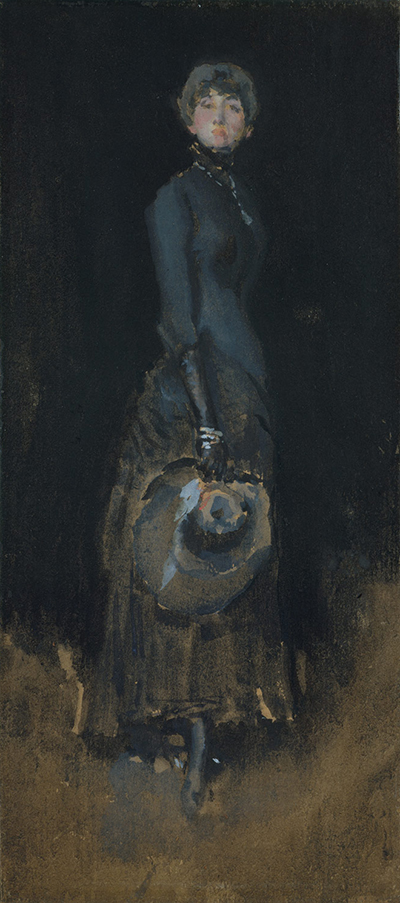
James McNeill Whistler's Lady in Gray is easy to mistake for a painting on canvas when seen online. A woman in a fitted dark jacket stands against a nearly black field. Her pale face, high collar, long skirt and large feathered hat possess the gravity of a formal full-length portrait. Yet the entire image is only 28.6 centimetres high, and its materials are watercolour and gouache on dark brown paper.[1]
That correction is more than a catalogue detail. Transparent colour, opaque body colour and the paper's own tone divide the work among themselves. The woman's face and selected accessories emerge through concentrated pale marks; her skirt and feet lose substance as the brown support becomes increasingly visible. What resembles the deep background of an oil is partly the sheet upon which Whistler worked.[1][3]
The sitter has never been securely identified. The Metropolitan Museum of Art currently offers Millie Finch and the actress Kate Munro as possibilities, not alternatives from which a final answer must be chosen. A proud or challenging pose cannot settle a name. Those qualities tell us how viewers, including an outspoken Chicago critic in 1889, interpreted the image; they are not documentary proof of the woman's identity.[1][4]
The sheet's history is unusually revealing for so small an object. It passed through a New York dealer and collector before reaching Chicago in 1889, where Charles K. Miller bought it for $250. Miller kept it until 1906, when he sold it to the Met. The journey links an intimate work on paper to Whistler's developing American reputation, a competitive exhibition culture and the formation of a public collection.[3][4]
At a Glance
- CatalogueM.0933 / Met 06.312
- DateAbout 1883
- Object typeIndependent full-length figure on paper
- MediumWatercolour and gouache on dark brown wove paper
- Dimensions28.6 × 12.7 cm (11 1/4 × 5 in.)
- SignatureButterfly monogram at lower right
- SitterUnidentified; Millie Finch or Kate Munro proposed
- ProvenanceWunderlich; Clarke; Miller; Metropolitan Museum
- CollectionThe Metropolitan Museum of Art, Rogers Fund, 1906
- DisplayNot on view, checked 26 August 2026; verify current status
Contents
- Object record at a glance
- A full-length portrait compressed into five inches
- An irregular axis rather than a rigid pose
- Brown paper is part of the image
- What watercolour and gouache do differently
- Small does not mean preparatory
- Who was the woman?
- The Velázquez comparison
- Watercolour at the start of the 1880s
- From Wunderlich to Chicago
Object record at a glance
The work is M.0933 in Margaret F. MacDonald's catalogue of Whistler's drawings, pastels and watercolours and object 06.312 at the Metropolitan Museum of Art in New York. The museum dates it to about 1883 and classifies it as watercolour and gouache on dark brown wove paper. Its dimensions are 28.6 by 12.7 centimetres, or 11 1/4 by 5 inches.[1][2][3]
The Met's current title uses the American spelling Lady in Gray. That proper title should remain unchanged even when the surrounding discussion follows British spelling. It supplies neither a personal name nor a technical description of every colour in the sheet. `Gray` identifies the accepted object; it does not establish who posed or reduce the image to monochrome.
A butterfly monogram appears at lower right. The 2002 Met catalogue records it as the signature and locates it on the sheet rather than on a separate frame. The same catalogue gives metric dimensions of 28.5 by 12.8 centimetres, a minor rounding difference from the current online record. The current-holder measurement governs.[1][3]
The credit line is Rogers Fund, 1906. On 26 August 2026 the museum marked the object not on view. That dated display statement may change. It does not mean the work is lost, deaccessioned or considered unimportant; works on paper are especially sensitive to light and are commonly shown in limited rotations.[1][5]
A full-length portrait compressed into five inches
The sheet is extraordinarily narrow. At more than twice as high as it is wide, it gives the standing body only a slim vertical channel. Whistler nevertheless avoids squeezing the figure against every edge. Darkness remains broad around the head and shoulders, with a particularly deep interval to the woman's right. Her small body therefore appears isolated rather than cramped.[2][3]
Her head occupies the upper third. The face turns towards the viewer while the chin rises slightly. Dark hair or headwear merges into the surrounding black, leaving pink, grey and cream patches to establish cheeks, nose, eyes and mouth. Facial modelling is concise, but the face is the lightest and most resolved part of the figure.
A high collar wraps the neck. Below it, a grey-blue jacket follows the torso closely, narrows at the waist and continues into an elongated sleeve. The gloved right hand hangs near the hip and holds a large hat. Pale bands at the wrist interrupt the long dark arm, acting almost like a small hinge between body and accessory.[2][3]
The hat is disproportionately important. Its wide dark brim projects across the skirt, while a grey-blue crown, a pale feather and a small warm accent give it internal structure. It is not simply an attribute placed beside the body. Its rounded form answers the shape around the woman's head and concentrates more colour at the centre of the sheet.
Below the hat, the skirt descends through increasingly thin and broken marks. One stockinged leg and foot extend forward; the other disappears beneath the hem and into darkness. A tiny pale accent catches the forward shoe. The ground is never constructed as a room with a clearly drawn floor. Brown tone, scattered pigment and the fading body are enough to support the stance.
An irregular axis rather than a rigid pose
The woman's posture can look upright at first, but it is not organised around a straight central line. Kevin J. Avery traces a more animated axis from the face down through the arm, the hat feather and the extended foot. This subtle deviation prevents the narrow format from becoming static.[3]
Several smaller repetitions reinforce that movement. The covering around the head, the carried hat and the rounded light patch within the hat echo one another at different scales. Pale notes move down the figure in another sequence: face, collar, wrist, feather and shoe. They guide the eye without describing every fold or fastening.
The shoulder line and torso also resist symmetry. One side of the jacket catches enough blue-grey to appear substantial, while the opposite side slips towards the background. The figure is simultaneously formal and unstable: firmly present at the face and upper body, less materially certain towards the floor.
This design helps explain why historical viewers reached for words such as proud, impertinent or supercilious. The raised chin, frontal attention and forward foot can support those impressions. They should not be converted into a psychological diagnosis. Pose is a pictorial construction, and the woman's actual thoughts, social position and relationship with Whistler are not preserved in those angles.
Brown paper is part of the image
The current medium line names three things that must be read together: watercolour, gouache and dark brown wove paper. Watercolour can permit the support to remain visible through a coloured wash. Gouache contains enough opaque material to cover or lighten it more decisively. Whistler alternated those possibilities instead of hiding the entire sheet beneath one uniform layer.[1][3]
At the top, a dense near-black field makes the head and jacket emerge with little environmental information. Towards the bottom, brown support becomes much more assertive. The skirt contains dark paint, but its borders are not sealed. The area beneath the hem is still less defined, allowing the figure to seem as if it is being absorbed by its own ground.
That absorption is not evidence that the sheet was merely abandoned. The most opaque passages are placed selectively. Face, collar, wrist and hat need concentrated light to remain legible; the forward foot receives a discreet body-colour accent; the skirt can relinquish detail without losing the body's vertical rhythm. Uneven finish is functioning as design.[3]
The paper also changes the meaning of `background`. In an oil portrait, a brown or black field might consist of layered paint over a prepared canvas. Here the support already provides a dark tonal resource. Some passages add black or grey-blue above it; others let brown participate almost directly. The difference matters even when a reproduction makes both kinds of darkness look identical.
What watercolour and gouache do differently
Watercolour is often treated as synonymous with transparency, but Lady in Gray depends equally upon opaque gouache. Thin colour lets the dark sheet lower the value of the skirt and ground. More concentrated body colour lifts the face and selected accents out of that same darkness. The interaction creates a large apparent range from a physically small set of materials.[1][3]
The jacket demonstrates the middle ground between those extremes. It is not a flat blue shape. Grey-blue changes run across the sleeve and torso, some sufficiently opaque to separate the body, others close enough to the background to preserve uncertainty at the contour. The result is a silhouette that can be read immediately but not exhaustively.
The face works differently. Opaque pale colour supplies a compact mask of light, then warmer pink and ochre notes bring variation without continuous academic modelling. Whistler does not build every plane from brow to jaw. He makes a small number of adjustments sufficient for presence, direction and contrast.
The carried hat combines both methods. Its broad dark shape relates to the skirt, but pale blue-grey and cream accents establish feather and crown. A small orange-red line prevents the accessory from sinking into a purely cool harmony. The title's grey is therefore surrounded by brown, black, blue, pink, cream and a minute warm note.[2][3]
No locked technical examination identifies an exact pigment list, binder sequence or underdrawing. Nor does the dark surface justify a diagnosis of fading, staining or varnish. The responsible account stops at the museum's medium identification, the visible behaviour of opaque and transparent passages, and Avery's object-specific visual analysis.
Small does not mean preparatory
Many drawings and watercolours were made as studies for larger objects, but medium alone cannot make Lady in Gray subordinate to a missing oil. The Met describes it as unusually highly articulated and one of a small group of early-1880s watercolours with an authority comparable to Whistler's full-length painted portraits.[1]
Its finish lies in selection rather than exhaustive detail. The image contains no furnished room, elaborate costume inventory or fully modelled floor. It does contain a resolved scale relation, repeated forms, a deliberate light sequence, a stable title and signature, and sufficient material differentiation to sustain independent viewing. Nothing in the current record identifies it as a preparatory stage for another work.
The five-inch width intensifies rather than diminishes the effect. A full-length oil can make its sitter imposing through physical size. This sheet must create authority inside the span of a hand. It does so by making the face bright, the silhouette tall and the empty dark field disproportionately large around the body.[3][5]
Digital viewing can obscure that achievement. Once the image fills a screen, the viewer loses an immediate sense of the actual 28.6-centimetre height. Dark paper can resemble painted canvas, and gouache can look like dense oil. Dimensions and medium restore the physical terms under which the work was made.[2][6]
Who was the woman?
The sitter remains unidentified. The present Met record proposes Millie Finch or Kate Munro on the basis of facial features and attitude. It describes Finch as a frequent model and Munro as an actress whom Whistler painted several times. The wording is deliberately provisional.[1]
Avery's 2002 catalogue preserves a wider history of suggestions. It places the sheet among Whistler's female figure studies of the early 1880s and discusses several women who modelled for him. That historical field of possibilities does not produce a document stating who stood for this work.[3]
Frequency is not identification. Finch's repeated presence in Whistler's studio may make her a plausible candidate, but it does not transform resemblance into a sitting record. Munro's occupation and appearances in other works likewise supply comparison rather than proof. The title Lady in Gray gives neither name, profession nor kinship.
The woman's clothing cannot close the gap. A fitted jacket, high collar, glove, wrist ornament and feathered hat can be examined as forms and fashions, but similar garments could be worn by more than one model. Even the distinctive raised chin records a pose produced for an image, not a unique biometric sign.
Uncertainty is productive here. It redirects attention from a speculative biography to the labour visible in the sheet: holding the posture, managing heavy clothing and accessories, and sustaining the relation between face, arm and hat. The sitter's name is unknown, but her participation need not disappear behind that absence.
The Velázquez comparison
The Met relates the figure to Whistler's admiration for Diego Velázquez. The comparison concerns darkly dressed sitters emerging from deep or neutral grounds, the economy of setting and the authority of a full-length pose. It is an interpretive framework offered by the museum, not evidence that Whistler copied one named Spanish portrait.[1][3][5]
Brown paper is crucial to the analogy. Avery compares its earthy tone with the grounds or underpainting visible in Spanish portraiture. Whistler then uses concentrated body colour to give the small face and upper figure an almost severe presence. The result retains the austerity of a monumental portrait while changing its material and scale.[3]
The transformation is as important as the resemblance. Velázquez worked in oil on canvas at a scale that could approach the human body. Whistler's figure occupies a strip of paper five inches wide. Opacity, transparent wash and untouched or lightly worked support replace the layered physical structure of a large oil.
Nor is the sitter merely a diluted version of a Spanish prototype. The carried hat, irregular axis and dissolving lower body make the image distinctly mobile. Her presence is concentrated at the face and torso, then released into paper below. Historical authority and modern abbreviation coexist rather than cancel one another.
Watercolour at the start of the 1880s
Whistler had known watercolour since his student years at West Point and renewed his use of it in the late 1870s while drawing Chinese porcelain for an illustrated catalogue. Avery argues, however, that sustained and authoritative production developed around 1880 and that Whistler was fully commanding the medium by about 1883.[3]
Landscapes formed an important part of that renewed practice, including small works made around Venice and in Britain. Female figure subjects then became another field of experiment. Lady in Gray belongs to that mature expansion rather than to a first attempt at the medium.[1][3]
The broader history of watercolour in nineteenth-century American art also matters. The medium moved beyond instruction, topography and preparation into independent exhibition and collecting. Gouache continued to offer body and opacity even as transparent handling gained prestige. Whistler's ability to make a small work resemble an oil in reproduction is one unusually concentrated example of that larger development.[5][6]
This article does not need to repeat the full history of Whistler's drawings, pastels and watercolours. For this object, the decisive point is narrower: by circa 1883 he could make paper tone, transparent wash and opaque accent support a finished standing figure whose effect depended upon remaining a work on paper.
From Wunderlich to Chicago
The Met catalogue first records the sheet with H. Wunderlich & Company in New York from 1883 to 1888. `With` is the appropriate provenance language: it documents the dealer's association without inventing an earlier transfer directly from Whistler. The known chain begins there.[3]
Thomas Benedict Clarke held the work in New York from 1888 to 1889. Clarke was an important collector, but the object record's value lies in the dated custody rather than a complete account of his collecting career. Within a year the watercolour travelled to Chicago.[3]
In June 1889 it appeared in the Art Institute of Chicago's Second Annual Exhibition of American Oil Paintings, catalogue number 54. The event's category is revealingly awkward. A watercolour and gouache could enter an exhibition advertised around oils because viewers and organisers treated its pictorial authority as comparable, but the label did not change its physical medium.[3][4]
Chicago newspaper publisher Charles K. Miller bought the sheet for $250. A Chicago Tribune writer announced the sale with the expectation that the `English girl` would remain in the city. The remark attached nationality and attitude to an unnamed model, but its prediction was only partly right: Miller kept the work in Chicago until 1906, not permanently.[4]
This transaction matters beyond price. It records an American market responding to Whistler before the 1893 World's Columbian Exposition usually associated with his Chicago reputation. A small work on paper could attract attention, provoke criticism and find a buyer within an exhibition dominated rhetorically by painting.[4]
The 1889 critic and the performance of attitude
The Tribune critic read the woman's posture as an extension of Whistler's public personality. The review admired what it called the artist's `intrepid arrogance` and found an impertinence in the sitter that was simultaneously intrusive and welcome. It contrasted that apparent candour with the theatricality attributed to academic portraits.[3][4]
Such language reveals as much about reception as about the sheet. By 1889 Whistler's combative wit, lawsuits and public statements had become part of how audiences approached his art. The critic saw the raised chin and narrow silhouette, then interpreted them through a pre-existing image of the artist as provocative and self-assured.
The sitter thereby became a vehicle for Whistler's persona. An unknown woman was called an `English girl`, given a haughty disposition and imagined as frowning upon Chicago. None of those descriptions identifies her. They show how gender, nationality and artistic celebrity were projected onto pose.
The favourable comparison with large oils is more securely tied to the object. The reviewer believed that this diminutive watercolour could command attention beside conventionally substantial works. That response matches the formal evidence: expansive darkness, a concentrated face and an assertive vertical make physical size an unreliable measure of pictorial force.[3][4]
Reception should therefore be used twice. It helps reconstruct the sheet's 1889 public life, and it warns against repeating historical adjectives as neutral description. The woman can look challenging without being known to have been arrogant; the image can resist academic polish without revealing the sitter's character.
Entering the Metropolitan Museum
Miller retained Lady in Gray until 1906, when he sold it to the Metropolitan Museum of Art. The Rogers Fund financed the acquisition, and the object received number 06.312. This short chain—from Wunderlich to Clarke, Miller and the Met—is documented more firmly than any ownership before 1883.[1][2][3][4]
Public ownership changed the conditions under which the sheet could be seen. In Chicago it had been a newly purchased private object associated with a provocative exhibition. At the Met it entered a permanent collection in which watercolours, drawings and pastels could be catalogued, conserved and periodically displayed alongside other American works on paper.
The museum included it in American Drawings and Watercolors in The Metropolitan Museum of Art: Highlights from the Collection, 1710–1890, shown from 3 September to 1 December 2002. That exhibition explicitly addressed the varied status of works on paper, from informal studies to highly finished independent objects. Lady in Gray represented the latter possibility.[5]
Current non-display is consistent with the museum's explanation that fragile and light-sensitive works on paper appear periodically. The object record, accession and Open Access images remain available even when the original sheet rests away from gallery light.[1][5]
The present route and image
The existing website has the correct canonical source route and a correct image but no public article. Its live request redirects visitors to the general paintings page, which reinforces the very medium error the new object record must correct. Later implementation should restore it as an independent works-on-paper route.[7]
The local JPEG measures 400 by 903 pixels. It identifies the right work but provides a close, low-resolution view compared with the Met's official 1,762-by-3,722-pixel primary master. The larger file preserves more of the complete sheet and surrounding boundary context, making the relation between painted field and paper easier to assess.[2][7]
The Met labels the image Public Domain, and its API sets the public-domain field to true. The museum's Open Access policy permits unrestricted commercial and non-commercial use of qualifying images. Unlike pages where reuse remains uncertain, this route has a verified institutional replacement available for later implementation.[1][2]
An additional official image shows the work inside a frame in a historical black-and-white photograph. It is useful evidence that the sheet has had a framed presentation, but it does not identify the original surround or prove that the same frame is used today. The public article should not turn an archival image into an unsupported frame history.
Why Lady in Gray matters
The work concentrates several large questions inside a very small area. It shows that a full-length portrait effect does not require life-size canvas; that brown paper can function as a visible part of the image rather than a support to be concealed; and that watercolour and gouache can divide transparency and opacity with unusual precision.[1][3]
Its unknown sitter also tests responsible portrait writing. Millie Finch and Kate Munro remain plausible names, but the evidence does not authorise a choice. The woman's pose, clothes and historical reception can be discussed fully without manufacturing a biography.
The 1889 Chicago episode gives the sheet a public history proportionate to its visual authority. A critic treated its impertinence as Whistlerian, Miller paid $250, and the work became part of Chicago's early engagement with the artist. Its departure for the Met in 1906 then converted that private acquisition into a public one.[3][4]
Most importantly, the physical object corrects the assumptions encouraged by reproduction. What looks like a little oil is a constructed relation among wash, body colour and dark woven paper. Face, jacket, hat and foot appear with different degrees of opacity; the rest of the woman is permitted to return towards the sheet. Lady in Gray is finished not because every contour is complete, but because presence and disappearance have been made to depend upon one another.
Discussion
How does a sheet five inches wide achieve the authority of a full-length portrait?
Follow where transparent wash, opaque gouache and exposed brown paper define the face, jacket, hat, skirt and disappearing lower body.
Reader Insights
Where does the paper remain a visible part of the image rather than a hidden support?
What can the pose establish, and what cannot it prove about the unnamed sitter?
Which visual decisions make the small sheet feel unexpectedly monumental?
Join the Conversation
Share a close observation or an object-history question.
References
- The Metropolitan Museum of Art, “Lady in Gray”, accession 06.312, current object record, checked 26 August 2026, https://www.metmuseum.org/art/collection/search/13245.
- The Metropolitan Museum of Art, Open Access API record for object 13245, metadata checked 26 August 2026, https://collectionapi.metmuseum.org/public/collection/v1/objects/13245.
- Kevin J. Avery, American Drawings and Watercolors in The Metropolitan Museum of Art, vol. 1 (New York: Metropolitan Museum of Art; New Haven: Yale University Press, 2002), cat. 105, pp. 284–85, https://www.metmuseum.org/met-publications/american-drawings-and-watercolors-in-the-metropolitan-museum-of-art-vol-1-a-catalogue-of-works-by.
- Sarah Kelly Oehler, “A Chicago Boy: The Second City Meets James McNeill Whistler”, in Jay A. Clarke and Sarah Kelly Oehler, eds., Whistler Paintings and Drawings at the Art Institute of Chicago (Chicago: Art Institute of Chicago, 2020), paras. 73–76 and notes 33–36, https://publications.artic.edu/whistlerart/reader/paintingsanddrawings/section/69.
- The Metropolitan Museum of Art, American Drawings and Watercolors in The Metropolitan Museum of Art: Highlights from the Collection, 1710–1890, exhibition 3 September–1 December 2002, https://www.metmuseum.org/exhibitions/listings/2002/american-drawings-and-watercolors.
- Kevin J. Avery, “Nineteenth-Century American Drawings”, Heilbrunn Timeline of Art History, The Metropolitan Museum of Art, 2004, https://www.metmuseum.org/essays/nineteenth-century-american-drawings.
- James McNeill Whistler Waterhouse+ route, redirect, carryover, image and protected-hash inventories, checked 26 August 2026.


