


 by Tom Gurney
Tom Gurney BSc (Hons) is an art history expert with over 20 years experience
Published on November 6, 2026 / Updated on November 6, 2026
Email: tomgurney1@gmail.com / Phone: +44 7429 011000
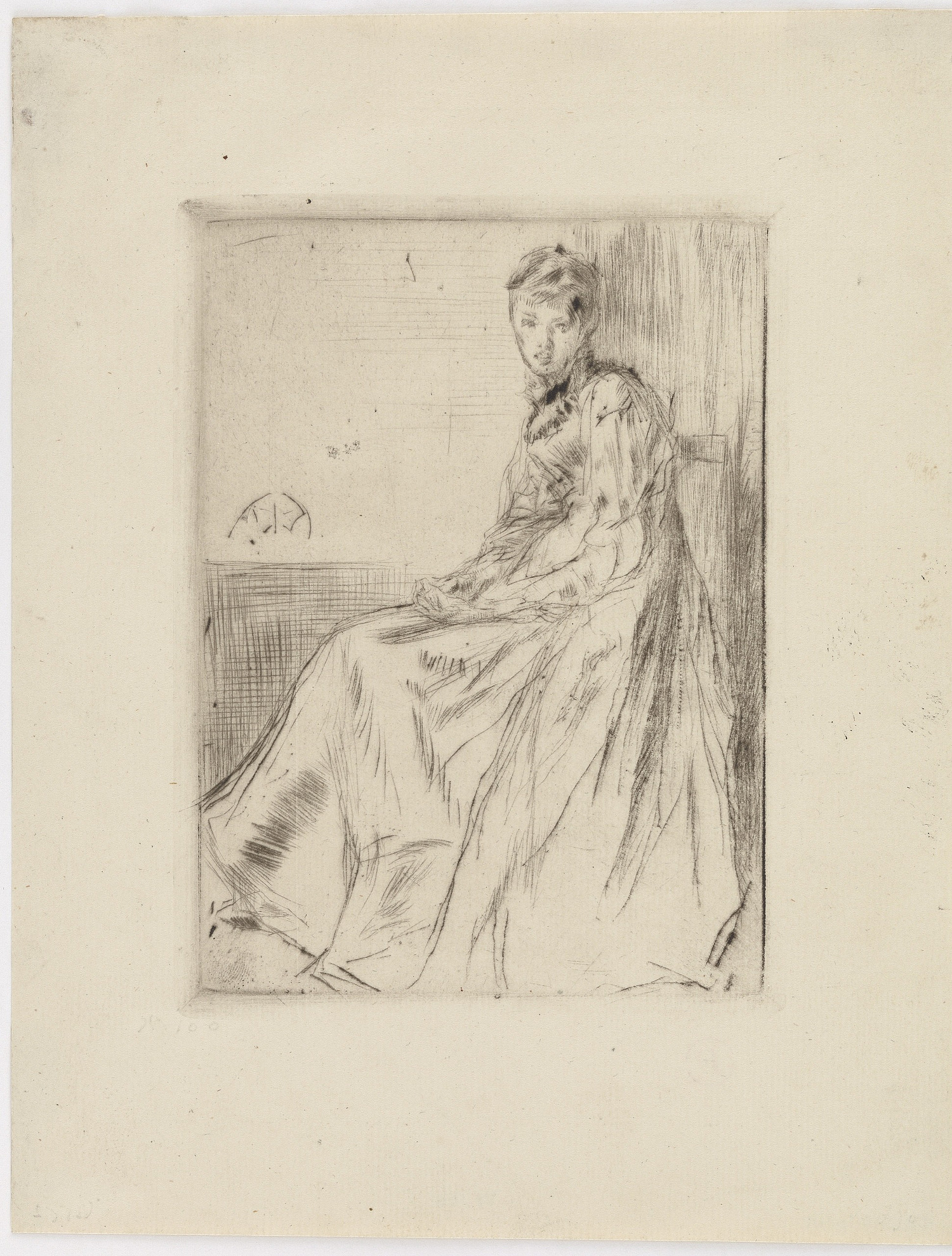
Maud Franklin was still a teenager when she began the modelling work that would place her throughout James McNeill Whistler's art of the 1870s and 1880s. She appears in paintings, drawings, watercolours, etchings and some of his earliest lithographs. She also became his partner, bore two daughters, joined his working household in Venice, printed etchings and exhibited paintings under the name Clifton Lin.[1][2][4][6]
Her history is often made to end in 1888, when Whistler married Beatrix Godwin. Maud instead lived for another half-century. She worked for a time in Paris, married John A. Little, had a son, later married Richard H. S. Abbott and lived in France at Yport and near Cannes. She refused to tell Whistler's biographers about their years together, maintaining a silence that should be respected as an archival boundary rather than filled with melodrama.[1][2][19]
The word “muse” is especially inadequate here. It converts demanding modelling sessions into inspiration, removes pregnancy and childcare from the studio economy, and ignores the surviving document in which Maud says she was printing Whistler's etchings in 1886. “Mistress” identifies non-marital sexuality but makes it the whole relationship. Model, partner, mother, artist and print worker describe the evidence more precisely.[1][3][6]
Whistler did not always treat her well. In 1879, while Maud was pregnant, he left her in a London hotel and arranged letters to make her believe he was in Paris while he remained in London. That deception belongs beside the intimate images, the years of collaboration and their later deterioration. A responsible biography can recognize attachment without using artistic beauty to excuse conduct.[1][2][5]
At a Glance
- Born9 January 1857, Bicester
- Birth nameMary Franklin
- Modelling beganAbout 1873–74
- PartnershipWhistler's partner from the mid-1870s
- ChildrenTwo daughters, Ione and Maud Mary
- VeniceWorking household, 1879–80
- Print workSecond Venice Set, documented 1886
- Exhibition nameClifton Lin
- Relationship ended1888
- Died18 November 1939, near Cannes
Contents
- Mary Franklin becomes Maud
- A teenage model in the Leyland portraits
- Modelling across media
- *Arrangement in White and Black*
- Lithography and the working body
- Partner, household and two daughters
- The 1879 deception
- Venice after bankruptcy
- Printing the Second Venice Set
- Clifton Lin, exhibiting artist
Mary Franklin becomes Maud
She was born Mary Franklin in Bicester, Oxfordshire, on 9 January 1857. Her father, Charles Franklin, was a cabinetmaker and upholsterer; her mother was Mary Clifton. The family included two brothers and three sisters. A household linked to furniture trades may have given her familiarity with materials and skilled making, but no record permits the invention of formal artistic training there.[1][2]
“Maud” became the name by which she was known in Whistler's circle and later art history. Other names record different strategies and phases: Mary M. Whistler in the 1881 census, Clifton Lin for exhibiting, and Mrs Little or Mrs Abbott after legal marriages. These are not aliases belonging to separate women. They show how sex, class, professional ambition and marital status altered the name under which one life became visible.[1][14]
Her use of Mrs Whistler did not make her legally married to James. For an unmarried woman living with a man and raising children within Victorian society, a married name could offer social legibility or protection. It could also express how she understood the partnership. Correcting the legal record should not turn her self-presentation into fraud.[1][2][14]
The name Clifton Lin drew from her mother's Clifton surname and perhaps from an abbreviated or rearranged personal identity. It allowed paintings to enter exhibitions without being immediately classified through Maud's sexual relationship with Whistler. People in the circle knew who she was, so the pseudonym was professional positioning rather than perfect disguise.[1][16][17]
Names also govern retrieval. A search for “Maud Franklin” can miss census, exhibition, marriage and probate evidence filed under other forms. Reuniting those records is the first step in restoring a life that older narratives divided between model, abandoned lover and wealthy American wife.[1][2][19]
A teenage model in the Leyland portraits
The exact first meeting between Maud and Whistler is unknown. Current catalogue scholarship places her earliest secure work around 1873–74, when she was sixteen or seventeen. Claims that she began at fourteen or fifteen depend on less certain dating and should not be repeated as fact.[1][2][20]
She is said to have stood in for Frances Leyland while Whistler developed Symphony in Flesh Colour and Pink: Portrait of Mrs Frances Leyland, first exhibited in 1874. A stand-in held the pose and allowed work on dress, placement and colour when the commissioned sitter was unavailable. The final portrait remained identified with Mrs Leyland, but Maud's bodily labour could be embedded in its making.[1][3]
She also participated in studies connected with a portrait that became Portrait of Miss Florence Leyland. These cases expose the difference between model and named sitter. A painted figure can be developed through one body and finished as the likeness of another. Catalogue evidence must trace that process rather than assign every preparatory pose to the final title.[1][2][20]
The circumstances placed a working-class teenager inside a wealthy patron's visual world. Clothes, interiors and composed deportment could temporarily transform her into the structural basis of a society portrait. Modelling required learning how to repeat a gesture and sustain costume while remaining responsive to an artist whose working periods were long and irregular.[2][3][4]
Stand-in labour also remained intentionally invisible to the portrait buyer. The patron expected her own likeness and dress to authorize the finished canvas, not a record of the younger woman who kept work moving between sittings. Maud's contribution survives because preparatory drawings and catalogue reconstruction reconnect bodies that the completed title separated.[2][3][20]
By the mid-1870s Maud was no occasional stand-in. She had become Whistler's principal model and partner. The transition is not preserved as one documented agreement. It emerges through repeated objects, addresses, correspondence and the increasing intimacy of pose.[1][2][7]
Modelling across media
Maud's modelling ranged from large full-length canvases to small drawings and prints. Secure paintings include early portraits, Harmony in Grey and Peach Colour, Arrangement in Black and Brown: The Fur Jacket, Arrangement in White and Black, reading figures and later harmonies. The breadth matters more here than a complete checklist, because each object has its own dating and attribution questions.[1][10][20]
Works on paper multiplied the demands. In etchings such as Maud, Standing, The Letter and The Desk, position had to be translated into incised line and later printed states. Drawings and watercolours could record rapid changes, while lithographs allowed Whistler to experiment with transfer, wash and repeated impressions.[4][11][12][13]
Modelling was skilled labour. The model controlled balance, muscle tension, gaze and the repeatability of a pose while wearing clothes selected for visual effect. Long sessions produced boredom, discomfort and fatigue. Maud's familiarity with Whistler's practice likely made subtle variations possible, but that collaboration did not give her control over which version he signed, exhibited or sold.[2][3][4]
Her image is not transparent biography. A direct gaze can create confrontation without proving personality; a collapsed pose may perform or record exhaustion without explaining its cause. Costume can mark class within a composition rather than document what Maud ordinarily wore. Every image mediates her through technique, title, selection and audience.[3][4]
Nor is every red-haired or dark-haired woman in Whistler's work automatically Maud. Catalogue scholarship distinguishes secure identifications, probable sitters and competing proposals. The desire to recognize a famous model everywhere can erase less documented women and turn resemblance into certainty.[1][20]
*Arrangement in White and Black*
Whistler painted Arrangement in White and Black around 1876, with Maud standing in a fitted white walking dress against a dark field. The work, now in the Freer Gallery of Art, presents her with hands at her hips, one foot advanced and gaze directed outward. Its fashion is purposeful, not a transparent record of daily dress.[3][8][9]
When exhibited at the Grosvenor Gallery in 1878, the pose drew a critical charge of vulgarity. The judgment joined gesture to social rank. A high-status female sitter could be read as self-possessed; a model's directness could be classified as improper or proletarian. The review tells us how gendered respectability governed vision, not that Maud possessed a vulgar character.[3][4][8]
The title abstracts colour, but viewers still encountered a recognizably fashionable young woman. White fabric, black scarf and dark background made formal contrasts through Maud's body. Whistler's aesthetic vocabulary did not remove class and sexuality from reception merely by calling the work an arrangement.[3][8]
Maud's work in the pose is visible in its apparent ease. Balance across the advanced leg, held train, arms and forward torso had to remain stable while projecting movement. A painting may condense many sessions into one instant; the model supplied the duration that the final surface conceals.[2][3]
Full analysis of medium, costume, provenance, frame and exhibition belongs to the object's later page. Within Maud's biography, the portrait establishes that her collaboration helped Whistler test how fashion, class and reduced colour could make a figure both formal and socially provocative.[8][9]
Lithography and the working body
Maud was central to Whistler's first sustained experiments in lithography in 1878–79. The Toilet, Study: Maud Seated and related images allowed him to test crayon, wash, paper and successive states. Her repeated presence provided continuity while technical treatment changed.[4][13]
In The Toilet, he revised dark early proofs by scraping and lightening until the dress appeared brighter and more delicate. The sitter's costume became a technical problem in reproduction. Maud's pose remained the human structure across changes made on stone and in printing.[4][13]
Other images show her seated, reading or resting with less public formality. Art Institute scholarship connects these poses with the exhausting character of sessions and the intimacy of the partnership. Such interpretation is persuasive when kept at the level of pictorial effect. A slumped figure suggests fatigue; it cannot tell us everything she felt or whether the pose was spontaneous.[4]
Reading could be both activity and device. It gave a model something to do during a long sitting and organized lowered head, hands and book. When a title names reading, it identifies the represented act but not the actual text or Maud's thoughts.[4][20]
The early prints therefore document a working relationship rather than a private diary. Limited impressions may indicate experiment not intended for broad sale, but even intimate images were selected, printed and preserved. Their closeness is an aesthetic construction produced through collaboration.[4][13]
Partner, household and two daughters
Maud and Whistler lived as partners through much of the late 1870s and 1880s. She sometimes used Mrs Whistler, and the 1881 census records her as Mary M. Whistler. They were not legally married. “Partner” holds shared residence, sex, work and family together without falsely granting legal protection.[1][7][14]
They had at least two daughters. Ione was born on 15 October, but current research leaves the year between 1876 and 1877. The uncertainty should remain visible. Maud Mary Whistler Franklin was born on 13 February 1879.[1][2][7]
The younger child's registration left the father's name blank, included Whistler among her names and recorded Maud's occupation as artist. The blank reflects the legal and social position of an unmarried birth; it does not outweigh the biographical evidence identifying Whistler as father. “Illegitimate,” the period's legal stigma, should not become the children's identity.[1][7][14]
The younger Maud died in childhood. Ione was brought up by foster parents and later married Warwick A. Tyler on 14 October 1899. Foster care may have resulted from finances, travel, social pressure or negotiated family arrangements, but the record does not permit a single motive or a claim that Maud lacked affection.[1][2][19]
Pregnancy and childcare belonged to the same economy as modelling and art production. They altered health, housing, time and money, while Whistler's public career usually concealed them. Recognizing the daughters changes the studio from a romance between artist and model into a family structure whose risks were distributed unequally.[2][3][7]
The daughters also complicate the word “household.” A census could present Mary M. Whistler as a wife, a birth certificate could leave paternity blank, and foster care could place a child at another address. Legal, social and lived family did not coincide neatly. Biography must compare these records instead of selecting whichever produces the simplest domestic picture.[1][7][14]
The 1879 deception
During Maud's pregnancy in January 1879, Whistler left her at a London hotel. He told her he was going to Paris but remained in London and arranged for letters to pass through the Paris-based George Aloysius Lucas so that they would appear to come from abroad. The documentary scholarship describes this as deliberate deception.[1][2][5]
The surviving record does not establish whether Maud realized the scheme at the time. It is therefore wrong to supply a confrontation or forgiveness scene. What can be judged is Whistler's conduct: he manipulated location and correspondence while a pregnant partner was isolated in a hotel.[1][5]
Maud Mary was born the following month. Whistler was also dealing with the financial consequences of the Ruskin trial, creditors and the White House. Bankruptcy followed in May. These events interacted, but the child did not cause the bankruptcy, and financial strain does not explain away the hotel deception.[2][7]
The episode corrects a tendency to use intimate portraits as proof of an equitable relationship. Artistic attention can coexist with neglect. A model represented with sensitivity may still possess less financial, legal and social power than the painter.[2][4]
It also shows correspondence as action. Letters were not neutral reports; rerouting them created a false geography. The archive reveals the mechanism because envelopes, dates, intermediaries and related documents can be compared.[5]
Venice after bankruptcy
After Whistler's bankruptcy Maud joined him in Venice, where he had travelled in 1879 for a Fine Art Society etching commission. Their baby appears to have gone to foster care. The Venice journey should not be narrated as an artist travelling alone into productive exile.[1][2][7]
Maud helped sustain the working household. She cooked and entertained friends while Whistler drew and etched. Such tasks made social and artistic production possible, particularly during a stay that extended far beyond the original plan. They were labour even when performed within an intimate relationship.[1][2]
She was not readily “received” in respectable society. Non-marital partnership and class followed her into expatriate circles. Whistler could be treated as an eccentric male artist; Maud bore a different reputational cost for the same household.[1][3]
Evidence for direct print work during or immediately after the first Venice campaign is cautious. Scholarship suggests she may have helped print and sell, but the clearest surviving declaration concerns the Second Venice Set several years later. The distinction prevents a plausible role from expanding into undocumented control of both sets.[1][6][15]
Venice also belonged to their domestic history. Hospitality, food, models, lodgings, paper and plates formed one system. Maud's contribution sits between the heroic image of solitary creation and the opposite fantasy that she secretly produced Whistler's prints. Specific labour is enough.[1][2][15]
Hospitality could itself serve professional purposes. Visitors carried news, introductions and impressions of the artist's work back into international networks. Preparing a meal and receiving them was therefore both domestic service and reputational infrastructure. Maud's exclusion from some respectable gatherings made the asymmetry sharper: she helped create sociability from which social codes could exclude her.[1][2][3]
Printing the Second Venice Set
On 23 October 1886 Maud wrote to George Lucas about delayed business and said that she was printing etchings. The editorial note identifies the work with the twenty-six plates of Whistler's Second Venice Set. This is the only direct documentary record of her involvement in printing.[6][15]
That sentence is unusually important. Printing an intaglio plate requires preparation of ink and paper, wiping, pressure and judgment about tone. Even if Whistler or other assistants directed standards, Maud's statement identifies her at the press rather than merely nearby.[6]
It does not mean she alone printed the edition. Mortimer Menpes, Walter Sickert and other assistants also participated in Whistler's printmaking environment. Nor does it prove identical involvement in 1880. The evidence is strong because it is narrow: one participant, one task and one 1886 production context.[5][6][15]
The same letter handled a note sent by Lucas and sought to explain timing. Maud was communicating within an international network of artist, dealer and friends. Business correspondence, postal arrangements and print labour converge in her own hand.[5][6]
The document also contains casual offensive language that need not be reproduced to establish the printing claim. Paraphrase preserves the relevant evidence without circulating a racial slur. Archival completeness does not require quotation of every harmful phrase.[5][6]
The letter's brisk handling of postage and deadlines further demonstrates competence. Maud anticipated when a note could be registered, explained the delay and promised prompt return. Print production did not occur apart from this logistical work. Press, correspondence and delivery together moved Whistler's art through the dealer network.[5][6]
Clifton Lin, exhibiting artist
Maud identified her profession as artist on the 1879 birth registration and later exhibited paintings as Clifton Lin. Records place her work at the Grosvenor Gallery and the Society of British Artists. These are public professional acts, not an honorary status inferred from proximity to Whistler.[1][14][16]
The available evidence does not establish a large surviving oeuvre. Works may be lost, unrecognized or privately held, but absence cannot be replaced by imagined masterpieces. The responsible claim is that she painted, exhibited and understood herself as an artist while also earning historical visibility as a model.[1][2][20]
Her access to the Society of British Artists came within Whistler's institutional period, when friends including Clifton Lin and Rix Birnie could exhibit. Patronage matters: the route was not independent of him. Yet an opportunity to show did not make the submitted painting his.[16][17]
Pseudonym and style complicate attribution. Clifton Lin detached an object from Maud Franklin's sexual reputation, but also separated it from the name later cataloguers knew. If her paintings resembled Whistler's circle, they could be dismissed as derivative or reassigned. Recovery requires exhibition catalogues, inscriptions and provenance rather than confidence from visual resemblance alone.[1][2]
Exhibition itself required resources beyond making a picture. An artist needed notice of deadlines, a suitable title, transport, fees or sponsorship and access to selectors. Maud's position in Whistler's circle helped with that infrastructure while her pseudonym managed its reputational consequences. Professional opportunity and personal dependence were intertwined rather than mutually exclusive.[1][16][17]
Maud's art changes the model relationship. She possessed experience on both sides of representation, even if the precise scale of training and output is unclear. Calling her artist does not require denying Whistler's influence; it prevents influence from becoming erasure.[2][3]
Health and the images in bed
Several works of the 1880s show Maud reading or resting in bed. Scholars have connected these images with poor health following pregnancies. The chronology makes that possible, but a precise medical cause has not been documented.[1][4][20]
Bed imagery carried sexual and social meanings beyond illness. A man's evening cloak, domestic intimacy or informal dress could suggest the demimonde to contemporary viewers. Those pictorial signs were constructed. They should not be converted into proof of Maud's sexual availability or moral character.[3][4]
Nor can a picture diagnose chronic disease. A model may pose in bed because she is recovering, because the artist wants a domestic subject, or because lying down supports a particular composition. Multiple explanations can coexist, and the object alone cannot choose among them.[4][20]
What the sequence establishes securely is repeated collaboration under changing conditions. Maud continued to be drawn and painted as the partnership aged, with public fashion giving way in some works to more private settings. The shift can suggest increasing complexity without narrating each pose as a direct report of relationship decline.[1][4]
The images deserve attention, but they should not trap Maud in passive convalescence. During the same decade she corresponded about business, printed etchings and exhibited art. The documentary person remained active beyond the body Whistler showed resting.[1][6][16]
The relationship ends in 1888
The partnership deteriorated during the 1880s. Beatrix Godwin, an artist and widow within the social circle, became increasingly close to Whistler. Sources record severe conflict between Maud and Beatrix, but the history should not be structured as two women competing for a male prize.[1][2][5]
Both women had work, family responsibilities and unequal exposure to Whistler's choices. Beatrix's presence did not create all earlier problems, and Maud's anger does not explain the marriage. A replacement narrative would repeat the same habit that makes women significant only while chosen by an artist.[2][3]
In 1888 Maud went to convalesce with friends in the household of William Stott of Oldham. While there she learned that Whistler had married Beatrix. The news brought a long non-marital partnership to a sudden public end without the legal process or financial protections of divorce.[1][4][18]
Retellings sometimes turn the possibility of a scene into entertainment. That approach asks audiences to enjoy a woman's exclusion and makes temperament the cause of her treatment. The documentary fact is sufficient: Whistler married another member of their circle while Maud was away recovering.[1][2]
Maud subsequently went to Paris and modelled for a time. This was not a disappearance into inevitable poverty. It was a transition whose surviving evidence is less dense because Whistler's archive no longer organized every movement.[1][4]
Paris offered a larger artistic labour market but did not guarantee safety or status. Modelling remained paid bodily work governed by studios, introductions and reputation. The evidence does not allow a catalogue of artists for whom Maud sat, so her Paris period should be recognized without supplying famous names from speculation.[1][2][4]
Paris, marriage and later family
Maud eventually married John A. Little, a wealthy New Yorker. They had a son, John Franklin Little. Her legal and family life after Whistler cannot be treated as an epilogue consisting only of financial rescue; it extended across new relationships, parenthood and residence.[1][19]
John A. Little died in 1904. Around 1911 Maud married another American, Richard H. S. Abbott. They lived in France, including Yport and Villa Mon Gri near Cannes. These locations place her later decades within an Anglo-American expatriate world distinct from Whistler's studio.[1][19]
Family connections continued. John Franklin Little later lived near his half-sister Ione in California, where she cared for him before his death in 1948. The relation connects children from Maud's different partnerships across geography and decades.[1][19]
The provenance of Whistler's drawing Maud on a Stairway also runs through Maud, Ione and Tyler descendants. An image made in the studio remained family property rather than moving immediately into an institutional Whistler collection. Provenance becomes evidence of Maud's ownership and her daughter's later role.[11]
This record refutes the idea that she was simply abandoned into destitution after 1888. It does not justify an opposite fairy tale of effortless prosperity. The surviving evidence establishes marriage, a son, homes and family continuity while leaving many everyday details unknown.[1][11][19]
Later security also should not be used to minimize earlier vulnerability. A profitable marriage years afterward could not retroactively supply legal rights during pregnancy, prevent the hotel deception or keep her daughters at home. The phases belong to one life, but later outcomes do not settle the justice of earlier conditions.[1][2][19]
Silence, death and historical recovery
When later biographers sought information about Whistler, Maud refused to discuss their relationship. That refusal deprives historians of testimony they would value, but it was also her decision about a past in which Whistler already possessed overwhelming public authority.[1][2][4]
Silence cannot prove one motive. It may reflect anger, privacy, loyalty, fatigue with scandal or a wish to protect later family. Assigning a definite explanation would override the boundary she set. Her refusal should be reported rather than psychoanalyzed.[2][4]
The current Glasgow biography contains an internal date discrepancy: its header says 1941, while the detailed life gives 18 November 1939. The more specific body record accords with other current summaries and is preferred here, with uncertainty acknowledged in older scholarship. Maud died near Cannes at the age of eighty-two.[1][2][19]
Her long life makes the imbalance of the archive striking. Around fifteen years with Whistler generated hundreds of images and references; roughly five subsequent decades are compressed into marriages, residences and probate. That is not evidence that nothing happened later. It shows whose papers institutions preserved and why.[1][2]
Even the best documented years privilege Whistler's viewpoint. His pictures and correspondence survive in catalogued abundance, while Maud's own letters are rare. A biography built from that imbalance must mark when it is describing her action, when it is reporting another person's account and when the record simply stops.[1][5][6]
Recovery therefore works from multiple records: pictures, prints, censuses, birth registration, letters, exhibition catalogues, probate and family provenance. No source restores an unbroken voice. Together they move Maud from visual type to historical participant.[1][11][14][16][19]
Frequently Asked Questions
Maud Franklin's place in Whistler's art was earned through sustained work. Her body and attention supported experiments in painting, etching, watercolour and lithography; her household labour supported Venice; her own letter documents print production. Two daughters and the unequal risks of non-marital partnership belonged to that same working life.[1][4][6]
Her history also exceeds Whistler. Clifton Lin exhibited, Mary M. Whistler negotiated social identity, Mrs Little and Mrs Abbott built later family life, and an elderly woman near Cannes declined to supply the famous artist's biographers with a story. The different names register adaptation rather than disappearance.[1][2][19]
To call her a muse is to make all of this happen inside his imagination. The documentary record instead shows a model, partner, mother, artist and printer whose choices can be traced from Bicester to France. Where her voice stops, biography should stop inventing and acknowledge what remains unknown.[2][5][11]
That restraint does not make her peripheral. It makes the surviving acts—holding a pose, naming herself artist, printing an edition, exhibiting under Clifton Lin, preserving a drawing and refusing an interview—carry their proper historical weight.[1][6][11][16]
Together, those acts establish professional skill and personal agency without pretending that the archive has preserved every choice she made.[1][2]
Discussion
What changes when Maud Franklin is understood as a worker and artist rather than only as Whistler's muse?
Keep modelling, domestic labour, print production, motherhood, exhibition and later life within the same historical account.
Reader Insights
Which forms of work made Whistler's studio and prints possible?
Where does Maud's own documentary voice survive?
How does biography continue after the artist's archive recedes?
Join the Conversation
Share a source-specific observation or question.
References
- University of Glasgow, “Maud Franklin,” biographical entry, The Paintings of James McNeill Whistler, https://whistlerpaintings.gla.ac.uk/catalogue/biog/?nid=FranM
- Margaret F. MacDonald, “Maud Franklin,” in Ruth Fine, ed., James McNeill Whistler: A Reexamination, Studies in the History of Art 19, National Gallery of Art, 1987, pp. 13–26.
- Margaret F. MacDonald, Susan Grace Galassi, Aileen Ribeiro and Patricia de Montfort, Whistler, Women and Fashion, Yale University Press, 2003.
- Martha Tedeschi, “Early Experiments: Images of Maud Franklin,” Art Institute of Chicago Museum Studies 24, no. 1, https://publications.artic.edu/whistlerart/sites/publications.artic.edu.whistlerart/files/file_assets/Whistler-Museumstudies-vol24-no1-EarlyExperiments_Images_of_Maud_Franklin-min.pdf
- Margaret F. MacDonald, Patricia de Montfort and Nigel Thorp, eds., The Correspondence of James McNeill Whistler, 1855–1903, University of Glasgow, https://www.whistler.arts.gla.ac.uk/correspondence/
- Maud Franklin to George Aloysius Lucas, 23 October 1886, GUW 09209, University of Glasgow, https://www.whistler.arts.gla.ac.uk/correspondence/people/display/?firstname=&nameid=Menpes_ML&rs=55&sr=0&surname=
- University of Glasgow, “James McNeill Whistler,” biographical entry, The Correspondence of James McNeill Whistler, https://www.whistler.arts.gla.ac.uk/correspondence/biog/display/?bid=Whis_JM
- University of Glasgow, Arrangement in White and Black, YMSM 185, The Paintings of James McNeill Whistler, https://whistlerpaintings.gla.ac.uk/catalogue/display/?mid=y185
- Freer Gallery of Art, Arrangement in White and Black, collection record, Smithsonian Institution.
- University of Glasgow, Arrangement in Black and Brown: The Fur Jacket, YMSM 181, and related secure Maud Franklin portrait records, The Paintings of James McNeill Whistler.
- Terra Foundation for American Art, Maud on a Stairway, collection and provenance record, https://collection.terraamericanart.org/objects/536/maud-on-a-stairway
- University of Glasgow, Maud, Standing, The Letter (Maud, seated) and The Desk, The Etchings of James McNeill Whistler, https://etchings.arts.gla.ac.uk/
- University of Glasgow and Art Institute of Chicago, catalogue records for The Toilet, Study: Maud Seated and related lithographs.
- UK civil registration and 1881 census records for Mary Maud Franklin, Maud Mary Whistler Franklin and Mary M. Whistler, as collated in the University of Glasgow biography.
- University of Glasgow, First and Second Venice Set records, The Etchings of James McNeill Whistler, https://etchings.arts.gla.ac.uk/catalogue/sets_texts/
- Grosvenor Gallery and Society of British Artists exhibition catalogues for Clifton Lin, as documented in MacDonald, “Maud Franklin.”
- Whistler Society, “Whistler and the Royal Society of British Artists,” https://www.whistlersociety.org/post/whistler-and-the-royal-society-of-british-artists
- Gallery Oldham and Art UK, William Stott of Oldham research concerning Maud Franklin, https://artuk.org/discover/stories/five-must-see-paintings-in-william-stott-of-oldham-great-painters-are-rare
- Probate, marriage and family records in the Spirer papers and University of Glasgow scholarship concerning John A. Little, Richard H. S. Abbott, Ione Tyler and John Franklin Little.
- Margaret F. MacDonald, James McNeill Whistler: Drawings, Pastels and Watercolours—A Catalogue Raisonné, Yale University Press, 1995.


