


 by Tom Gurney
Tom Gurney BSc (Hons) is an art history expert with over 20 years experience
Published on June 19, 2020 / Updated on November 6, 2026
Email: tomgurney1@gmail.com / Phone: +44 7429 011000
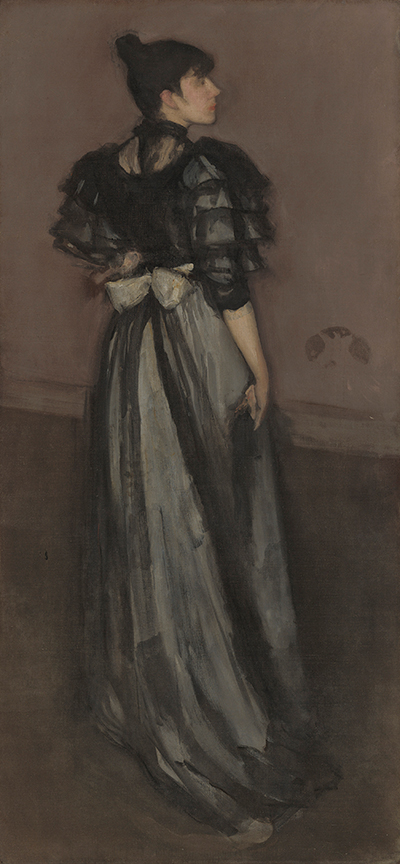
James McNeill Whistler's Mother of Pearl and Silver: The Andalusian looks as though it might have been stated in one concentrated encounter. Ethel Philip turns her back, presents her face in profile and lets a long silver-grey skirt descend through the narrow canvas. Black gauze, a pale bow and a mauve wall meet in softened edges, while the last marks on her arm and dress still seem immediate.[1][3][4]
That appearance is the painting's most productive deception. Whistler worked on the portrait across much of the 1890s, refused to release it while he considered it incomplete, had the canvas relined, rubbed and scraped passages, changed the head, sleeve, bow and skirt, and only declared it finished for the Paris Exposition Universelle in 1900. Fresh final strokes sit over years of revision and negotiation.[2][3][4][5]
At a Glance
- CatalogueYMSM 378 / NGA 1943.6.1
- Date1888(?)–1900 (NGA); 1891–1900 (YMSM)
- SitterEthel Birnie Philip (1861–1920)
- MediumOil on coarse plain-weave canvas
- Dimensions191.5 × 89.8 cm
- Framed dimensions212.4 × 109.9 cm
- SignatureButterfly at centre right
- CompletionParis Exposition Universelle, 1900
- CollectionNational Gallery of Art, Harris Whittemore Collection
- DisplayNot on view on 26 August 2026; verify current status
Contents
- The National Gallery portrait
- Ethel Philip, later Mrs Whibley
- Why the start date remains open
- From the back, face in profile
- Hair, neck and silhouette
- Grey dress and black gauze
- A Spanish style, not a Spanish sitter
- Mother-of-pearl colour
- Wall, dado and butterfly
- Earlier poses transformed
The National Gallery portrait
The National Gallery of Art in Washington owns the painting as accession 1943.6.1. Its current record gives oil on canvas, an overall size of 191.5 by 89.8 centimetres and a framed size of 212.4 by 109.9 centimetres. The Harris Whittemore Collection is the credit line. On 26 August 2026 the work was listed as not on view, a status that should be checked again before a visit.[1]
The Whistler catalogue raisonné identifies it as YMSM 378 and describes the support more precisely as coarse canvas. YMSM prints the accession with an `F` prefix, but the current holder's public number without that prefix governs here. A butterfly appears at centre right, and the specialist record notes no separate inscription.[1][3]
NGA dates the portrait 1888(?)–1900, whereas YMSM uses 1891–1900. The disagreement concerns the uncertain beginning, not the end. Both records recognise a long campaign and definite completion in 1900. Rather than selecting one opening year as fact, the evidence allows the painting's development to be followed through sightings, fashion, letters, technical changes and the final exhibition.[1][3]
Ethel Philip, later Mrs Whibley
The sitter is Ethel Birnie Philip, born in 1861. She was a sister of Beatrice Philip, whom Whistler married in 1888, and consequently became the artist's sister-in-law. After Ethel married Charles Whibley in 1895, letters and later catalogues refer to her as Ethel Whibley or Mrs Whibley. These changing names describe one person rather than rival sitter candidates.[1][3]
Whistler painted Ethel repeatedly. Red and Black: The Fan is among the other full-length portraits associated with the same years, and correspondence sometimes mentions “the black one”, “the pink one” or several portraits of Mrs Whibley without enough detail to distinguish them. Every documentary reference must therefore be matched to YMSM 378 cautiously.[3][5]
Ethel's presence matters without turning the article into a general biography. She sat, corresponded about completion and appeared in a network of family and commercial dealings around the pictures. Yet the portrait does not narrate her marriage or her sister's death. It presents a fashioned figure whose identity is known while the meanings often projected onto her clothing remain unsupported.[1][3][6]
Why the start date remains open
Edward Guthrie Kennedy later called the work a portrait painted shortly after Whistler married Ethel's sister and done in Chelsea. That would imply 1888 or 1889 and helps explain NGA's earliest possible date. Kennedy wrote the note in 1900 or later, however, after years of negotiations involving several Ethel portraits. YMSM does not treat the recollection as completely reliable.[1][3]
Théodore Duret saw an unfinished picture in Whistler's London studio in 1891, but it could have been this canvas, Red and Black: The Fan or another Ethel portrait. In December 1892 a correspondent asked Whistler to return a Spanish costume; the garment may have served a fancy-dress occasion or the painting. Neither item identifies YMSM 378 beyond doubt.[3][6]
Costume and signature supply stronger cumulative evidence. The dress belongs to the fashion for Spanish-inspired clothes around 1892–94, and the butterfly type points towards 1894 or later. Joseph Pennell remembered seeing this portrait with other works under way in Whistler's Paris studio in 1894. These clues make an early-1890s campaign secure without proving a first brushstroke.[3]
From the back, face in profile
Ethel stands almost full length on a very tall canvas. Her back faces us, but her head turns to the right so that forehead, nose, lips and chin form a profile against the wall. The pose lets Whistler show both the broad architecture of the costume from behind and enough of the face to sustain an individual likeness.[1][3]
Her right arm descends along the visible side of the body. The hand holds a dark item described cautiously as a scarf or gloves; the object is not clear enough to settle. Her left arm disappears within the turned body and dress. The uneven visibility of the arms strengthens the rotation rather than presenting a symmetrical frontal stance.[1][3]
The face is softly modelled, and its contour blends into nearby mauve. A straight nose and warm lips remain readable while the eye and cheek are quieter. Such softness can encourage claims about haughtiness, withdrawal or grief, but paint cannot establish those states. The responsible sequence is profile, colour and edge first; psychological interpretation comes later and remains optional.[1][4]
Hair, neck and silhouette
Dark brown hair rises into a bun at the back of the head. A fringe curves across the visible brow. The mass of hair is broad and dark, yet its upper and rear edges blur into the wall, preventing the head from becoming a cut-out. The profile projects more sharply on the right, giving the turn a directional force.[1][3][4]
Below the bun, transparent black fabric climbs to a high neck. Pale skin shows intermittently through gauze at the nape and shoulder, so the boundary between body and garment cannot be followed as one continuous line. Whistler used translucency to connect warm flesh, black net and brown-mauve background rather than isolating each material.[1][3]
The silhouette changes character as it descends. Hair and upper gauze are compact; frilled sleeves enlarge the shoulders; the waist contracts around the bow; the skirt widens and finally swings right in a train. These expansions and contractions give motion to a figure whose feet remain hidden and whose stance is otherwise nearly still.[3][7]
Grey dress and black gauze
The underlying evening dress is grey—the “silver” of the title. Its upper section is close fitting and has a low rounded neckline beneath a high-necked black gauze or net layer. NGA describes the overlay as a transparent silk bolero. The two wordings approach the same layered effect from different directions and need not be forced into one rigid garment classification.[1][3]
Three-quarter-length sleeves are built from four abundant gauze frills. Dark transparent tiers lie over lighter grey, producing alternating bands of black, brown and silver. The fabric's structure is legible without being itemised through hard seams. Whistler rendered its visual behaviour—overlap, translucency and tonal change—more insistently than tailoring detail.[1][3]
A broad pale bow sits at the back of the waist. It is almost as wide as the narrow torso and acts as a hinge between dark bodice and long silver skirt. Small touches of cream, grey and brown prevent it from becoming pure white. Beneath it, thin paint and visible drips keep the bow from reading as a pasted-on ornament.[3][4]
A Spanish style, not a Spanish sitter
“The Andalusian” names the portrait's fashionable Spanish association; it does not make Ethel Spanish. She was an English sitter wearing a dress loosely inspired by Andalusian and wider Spanish styles that circulated in Parisian fashion. The title belongs to costume, colour and artistic presentation rather than ethnic documentation.[1][3]
Whistler took close interest in women's clothing, followed fashion imagery and sometimes shaped the way models were dressed. YMSM suggests that Ethel, whose income was not large, probably wore a dressmaker's version of couture rather than a costly original. The inference is plausible, but no surviving bill identifies the garment's maker or purchase.[1][3]
Nor should black gauze be converted automatically into mourning. Ethel married in 1895, and Beatrice died in 1896, but the painting was under way before and after those events. NGA and YMSM reject a simple bride-or-mourner reading. Fashion, translucency and tonal design provide the documented explanation for the dress.[1][3]
Mother-of-pearl colour
The title's “mother of pearl” evokes colour that changes across a reflective surface rather than one fixed pigment. Grey skirt passages move between blue, green, brown, cream and black. The pale bow catches a warmer light, while gauze lets lighter cloth show through. Silver is therefore made from neighbouring notes and variable opacity, not metallic paint.[1][3][7]
Black is equally unstable. In the bodice and sleeves it shifts towards brown, charcoal and blue-grey; at the floor it becomes a transparent veil over lighter strokes. These differences prevent the costume from closing into a single dark shape. They also allow the figure to remain distinct from the similarly muted wall without resorting to a hard contour everywhere.[1][4][7]
The smallest warm accent is Ethel's mouth. Its restrained pink-red opposes the wide field of greys, while flesh at face and forearm carries peach and ochre. Those warmer notes help the body remain present inside the costume, but they do not dominate. The title's mineral and nacreous vocabulary keeps attention on subtle transition rather than local colour labels.[1][7]
Wall, dado and butterfly
A warm grey-mauve wall fills the upper background. Below, a darker charcoal field creates a dado or lower wall zone. A narrow skirting board crosses behind Ethel on a diagonal, rising towards the left in pictorial space. This slight architectural cue makes the wall recede while the figure remains almost parallel to the canvas.[1][3]
The butterfly mark sits on the wall at centre right, near the hanging hand but separated from it. Its darker oval and spreading wings loosely answer the dark head above. Because the emblem occupies the background rather than a conventional lower corner, signature becomes part of the arrangement of shapes.[1][3]
The floor is grey-brown and merges quietly with the lower wall. The skirt's train sweeps across it towards the right, its pale central folds bordered by black. Whistler supplies just enough tonal difference to separate cloth from floor. The absence of furniture keeps the room spare and makes the diagonal board the principal spatial measure.[1][3][7]
Earlier poses transformed
YMSM calls the composition a dramatic variation on a pose Whistler had used before. Symphony in Flesh Colour and Pink: Portrait of Mrs Frances Leyland (YMSM 106) and Harmony in Flesh Colour and Black: Portrait of Mrs Louise Jopling (YMSM 191) both offer relevant comparisons in their turned bodies and presentation of costume.[3][4]
The relationship is structural rather than repetitive. Frances Leyland's pale dress and surrounding frame belong to the early 1870s; Louise Jopling presents another sitter and chromatic problem. In The Andalusian, the viewer sees more of the back, the head turns into a sharper profile and black gauze complicates a silver dress on a coarse, heavily worked support.[3][4]
Old-master comparisons operate similarly. Velázquez and Goya provide precedents for Spanish-inflected portraiture, restrained backgrounds, commanding silhouettes and economical tonal modelling. Whistler's ironic response when paired with Velázquez was not a literal claim that he had surpassed him. Comparison should identify formal problems, not manufacture an artistic contest or a Spanish identity for Ethel.[3]
A dark ground on coarse canvas
NGA's technical catalogue describes a very rough, irregular plain-weave canvas. Over it lies a thin dark ground, closer to a wash than to an opaque levelling layer. Because neither ground nor later paint completely conceals the fabric, thread thickness and weave remain active across the visible surface.[2][4]
This material choice affects every passage. On the wall, the weave interrupts otherwise broad tonal fields. In the dress, raised threads break washes into tiny shifts of light and dark. Above the bow at left, the canvas texture is particularly conspicuous. What may look like decorative grain in reproduction is part support, part paint and part later treatment.[2][4]
The coarse weave does not mean the canvas was damaged before use. NGA found no evidence that structural harm required its later lining. Whistler may have valued preservation, a tauter support or the visual texture created by the procedure, but the exact balance among those motives remains uncertain.[2][4]
Wash, rub and scrape
Whistler built the portrait with thin washes, then alternated added paint with rubbing and scraping down. These actions do opposite material work: a wash deposits a translucent film; rubbing thins or spreads it; scraping removes or levels passages. Their repetition allows the canvas weave to emerge while contours soften and earlier decisions remain partly legible.[4]
The face shows the effect clearly. Flesh colour is present, yet boundaries around cheek, brow and hair blur into adjacent tones. Softness is not produced only by blending new wet paint. It also reflects the reduction and redistribution of material across a rough support whose threads catch colour unevenly.[2][4]
At the waist the paint is exceptionally thin. Drips below and to the right of the bow record fluid material moving before it dried. They should not be treated as negligence or random damage. Within this canvas they belong to an execution that allowed wash, gravity, exposed weave and fresh accent to coexist.[4][7]
Pentimenti around the figure
Visible pentimenti occur around Ethel's head, waist and dress edges. YMSM suggests that the bun may once have been higher, larger or farther left. The skirt originally extended farther towards the left. Such changes show that the silhouette was repeatedly adjusted rather than fixed by one uninterrupted sitting.[4]
X-radiography sharpens that account. NGA found that the head was originally larger, the right sleeve slightly larger and the bow higher on the back. These are not speculative optical impressions: hidden paint structures confirm that Whistler reduced and repositioned major elements of the upper figure.[2]
The changes all affect proportion. A smaller head lengthens the body; a reduced sleeve narrows the shoulder; a lower bow alters the waist and the start of the skirt. Revision therefore served the total silhouette. Whistler was not merely correcting details but recalibrating how Ethel's dark upper body balanced the pale descending train.[2][4]
Fresh last strokes after years of work
Despite scraping and pentimenti, YMSM finds the final brushstrokes fresh and direct, with few obvious signs of reworking. The right arm is particularly clearly outlined. That surface freshness belongs to the last campaign. It does not cancel the material reductions beneath it or the documentary record of work continuing through 1900.[3][4]
The distinction explains why the painting can seem rapid. A final contour may be placed once over an area prepared through repeated change. Viewers encounter that decisive upper stroke before they reconstruct the altered forms underneath. Directness is therefore a property of some final actions, not a reliable duration for the whole picture.[4]
Whistler himself tied completion to renewed work. In 1896 he would not release the full lengths “as they are”, and in 1900 he announced that one had finally been completed. The painter's statements, buyer frustration and X-radiography converge: apparent ease was achieved through extended selection.[2][3][5]
Relining during Whistler's lifetime
The canvas was relined while Whistler still controlled it. A probable June 1896 letter reports that the work had been sent home relined and in good condition. NGA found a finer secondary fabric behind the rough original support. This was an artist-authorised intervention before the painting reached its first documented exhibition.[2][4][6]
Nineteenth-century lining applied pressure and hot glue. On this canvas the process flattened some impasto and made irregular weave more prominent, particularly where paint was thin. The texture visible now is thus not simply untouched raw support: it reflects Whistler's original material choices modified by a treatment he requested.[2]
That history complicates the language of authenticity without undermining the object. The present surface joins painting, scraping, rubbing, lining pressure and later conservation. Each belongs to a different moment. A good account identifies those layers rather than pretending either that treatment had no visual effect or that it erased Whistler's decisions.[2][4]
Condition and 1995 treatment
NGA records fine crackle near the centre and slight abrasion across the paint, but otherwise describes the surface as being in excellent condition. These limited issues should not be confused with the deliberate thinness and rubbed handling found throughout. Condition and technique can look similar in a digital image but have different causes.[2]
In 1995 conservators removed discoloured varnish. That treatment changed the clarity and balance through which the painting is now seen, not the underlying design of profile, gauze, bow and skirt. Any account of colour should recognise that present appearance reaches us through both original execution and conservation history.[2]
The gilded frame may be original. “May” remains necessary because compatibility of period, design and object does not equal a surviving commission document. The framed dimensions are significantly larger than the canvas and remind us that the tall portrait was presented as a complete object, not only as an unbounded painted surface.[1][2]
Kennedy asks for the full length
Edward Guthrie Kennedy of Wunderlich & Co. asked Whistler in February 1896 about the full-length woman in black or grey and demanded a cash price. Whistler did not provide immediate terms. He sent for the portrait from Paris and insisted that the full lengths required further attention before he could let them go.[3][5][6]
Kennedy's records describe three full-length portraits of Mrs Whibley—one black, one grey and black, and one pink—that he expected when complete. Because titles remained fluid, not every reference maps cleanly to one canvas. The Andalusian is the strongest match for the grey-and-black or black-and-mauve descriptions, but caution remains essential where a letter could concern another Ethel portrait.[3][5]
The exchange reveals a conflict in time. The dealer wanted saleable objects and definite delivery; Whistler retained the paintings while deciding what completion required. Ethel entered that process too, telling Kennedy in 1897 that the picture would be sent when finished. Commercial pressure did not supply the final date; it documents why the delay was repeatedly noticed.[3][5][6]
A bargain involving several paintings
In September 1896 Wunderlich's tried to clarify an agreement involving multiple works. The letter referred to packages of £1,500 and £2,000, a £500 payment to secure the bargain and further sums due when full-length portraits arrived. It also mentioned finishing hands and completing a black-and-mauve portrait to Whistler's satisfaction.[5][6]
Those figures cannot be divided mechanically into a sale price for The Andalusian. Different combinations of paintings, substitutions and delivery conditions were under discussion. The money paid on account proves commercial commitment, not the final value assigned to this one canvas. Whistler still held and worked on it years later.[3][5]
When Whistler announced completion in 1900, he said he ought to receive two thousand guineas for the work. That was an artist's valuation during renewed negotiation, not a recorded final transaction. Asking value, package bargain, deposit and eventual sale are separate categories; collapsing them would make the provenance look more precise than the evidence allows.[5][6]
Completion at the Paris exposition
Whistler supplied the decisive completion statement in May 1900. He told Kennedy that the slate-coloured portrait was complete, hung in the American section of the Exposition Universelle and bore the French title Nacre et Argent, l'Andalouse. The exhibition therefore anchors end date, public title and finished status together.[3][5][6]
The official English form was Mother-of-Pearl and Silver—The Andalusian. The current title regularises punctuation without changing its structure. Earlier phrases such as “black and grey one” belong to studio and market discussion; the 1900 title presents the painting publicly as a finished tonal arrangement and character type.[1][3]
Whistler's decision to exhibit after years of refusal matters as much as the word “complete”. Friends and dealers had sought an Ethel portrait for exhibitions since at least 1891. Requests in 1894 and later did not persuade him. The Paris debut records a threshold he himself chose after revision, relining and renewed finishing.[3][5]
Reviews, Grand Prix and Temple Medal
Contemporary responses emphasised economy and distinction. One correspondent described a subtle and elegant portrait; another called it original in conception. These reactions are evidence of reception, not objective properties to be repeated without attribution. They show that the back-turned pose and quiet palette registered as deliberate when the picture first appeared publicly.[3][5]
Whistler received a Grand Prix for his Paris exhibits. The award belonged to the group rather than to The Andalusian alone. A dispute briefly arose over whether his entries qualified, but the portrait counted among recent works. Its long execution did not prevent it functioning as a new completion in 1900.[3][5]
After crossing the Atlantic, the portrait appeared at the Pennsylvania Academy of the Fine Arts and the Society of American Artists in 1902. Whistler received the Temple Medal at the Pennsylvania Academy exhibition. Later displays used shorter French or English titles, extending the work's reputation while its custody settled in Connecticut.[1][3][5]
Sale, copyright and shipment
The sale to Kennedy or Wunderlich was settled around 1900–01. Whistler retained copyright, distinguishing ownership of the canvas from rights in reproduction. He arranged for the picture to leave Paris after the exposition, pass through London and travel onward to New York. Exhibition, shipment and sale were coordinated but not identical events.[1][5]
NGA's provenance uses 1900/1901 for the acquisition from the artist, and a later company letter specifies May 1901. YMSM formerly summarised the transfer as 1900. The range is the honest resolution because correspondence fixes negotiation and planned movement more clearly than a single surviving artist-to-dealer invoice.[1][3][5]
The portrait's transatlantic passage also changes the meaning of Kennedy's earlier persistence. He did not receive the work when first requested in 1896, but the repeated pursuit eventually connected Whistler's Paris completion with an American buyer and exhibitions. Delay was not failure; it was part of a prolonged sale shaped by the painter's refusal to release an unresolved canvas.[3][5]
Which Whittemore bought it?
The strongest contemporary evidence identifies John Howard Whittemore as the purchaser from Wunderlich in January 1902. The invoice was made to “J. H. Whittemore” on 6 January, and payment was received on 22 January. Exhibition loans before John Howard's death likewise credit John H. or J. H. Whittemore.[1]
Later Whittemore Company correspondence sometimes said that Harris Whittemore had owned the painting, and the 1980 catalogue raisonné conflated the names at one point. The NGA credit line “Harris Whittemore Collection” can reinforce that confusion if treated as a purchase document. A collection credit is not proof of which family member signed the 1902 invoice.[1][3]
The responsible account therefore names John Howard as the probable buyer and explains the conflicting family record. It does not erase Harris from the history; it assigns him the roles the evidence supports. This correction matters because provenance is not just a list of surnames—it is an argument about which document establishes each transfer.[1]
Gertrude and the gift to Washington
After John Howard Whittemore died in 1910, the painting probably passed to the J. H. Whittemore Company while his daughter Gertrude B. Whittemore held a life interest. Exhibition catalogues before her death in 1941 repeatedly credited her as owner, supporting that arrangement even though an explicit bequest document has not been located.[1][3][5]
The portrait was lent to the National Gallery after Gertrude's death. In 1943 the company presented it to the museum. Harris Whittemore Jr, then company president, and Gertrude Spencer Whittemore acted on the organisation's behalf. Their donor role is documented and should not be backdated into the 1902 purchase.[3][5]
Accession 1943.6.1 now fixes the portrait in a national public collection. Its subsequent exhibition history ranges widely, but current online stewardship adds especially useful evidence: framed dimensions, updated provenance reasoning, detailed visual description, technical imaging and a primary open-access image whose scale far exceeds the inherited website file.[1][2][7]
What completion means here
Completion cannot be assigned to the first plausible sitting. Kennedy's late memory may push activity towards 1888–89, Duret's uncertain studio sighting supplies 1891, fashion and costume point towards 1892–94, Pennell remembered the canvas in Paris in 1894, and correspondence proves further handling after 1896. Each date identifies a different kind of evidence; none alone defines the whole making.[3][5][6]
Nor does completion mean that every passage received equal density. The profile remains soft, the right arm ends in a clear final contour, thin washes reveal coarse fabric and the skirt carries traces of changed width. Whistler could declare the total relation ready for exhibition while allowing its parts to retain different histories of addition, reduction and direct accent.[2][4]
The 1900 statement is decisive because it joins the artist's word to public action. Whistler said the slate-coloured portrait was complete and placed it on the Exposition wall under a formal title. That combination is stronger than later attempts to infer finish solely from brushwork: documentary completion and materially varied surface coexist rather than cancel one another.[3][5]
This distinction also protects the painting from a familiar false choice. It is neither an untouched improvisation nor a labour so overworked that freshness became impossible. The canvas shows how an artist can revise proportions, alter support texture, remove paint and then recover decisive final relations. Its long duration is visible through evidence, while its immediacy remains a genuine viewing experience.[2][3][4]
The official open-access image
The protected local JPEG is an exact full composition at 400 by 864 pixels. It is sufficient for identification but too small to reveal the coarse weave, waist drips and many pentimenti clearly. Its inherited presence carries no file-specific rights record, and this project leaves it unchanged.[7][8]
NGA's official open-data row for object ID 12197 identifies a primary image 13,215 by 28,563 pixels and sets `openaccess=1`. The persistent UUID is `357b1f5b-2d1b-4bb1-8246-02e38b08476a`. The object page likewise states that its media is free and in the public domain.[1][7][8]
A checked 925-by-2,000 IIIF derivative matches the full painting exactly. Later implementation should use the official IIIF source, cite National Gallery of Art and retain accession 1943.6.1. That recommendation is both clearer and better documented than silently enlarging the inherited 400-pixel file.[1][7][8]
How to look at the painting
Start at the head. Follow the bun's blurred edge into the mauve wall, then trace the sharper right profile. Move down through transparent neck fabric and widening sleeve frills to the pale bow. This route shows how Whistler alternated soft transition with decisive accents rather than applying one degree of finish everywhere.[1][3][4]
Then examine the skirt. Look for blue-grey, cream, brown and black within what the title calls silver; find the drips near the bow, exposed coarse weave and long strokes that carry the train rightwards. Remember that some texture was heightened when the canvas was relined, so present surface records both painting and artist-authorised treatment.[2][4][7]
Finally, hold first impression against chronology. The right arm may look directly drawn, but the head, sleeve, bow and skirt changed; the canvas was rubbed, scraped and relined; buyers waited; and Whistler did not publicly complete it until 1900. The Andalusian makes slowness look fresh. Its strongest lesson is that immediacy can be the visible end of a sustained process rather than its opposite.[2][3][4][5]
Discussion
How can years of revision culminate in a portrait that still feels immediate?
Follow Ethel Philip's turned back, profile, black gauze, pale bow and silver-grey train while distinguishing first impression from the long documentary and technical history.
Reader Insights
Which traces reveal repeated work across the 1890s?
How do washes, scraping and coarse weave remain visible?
Why does the 1900 exhibition settle the ending without simplifying the start?
Join the Conversation
Share a close observation.
References
- National Gallery of Art, “Mother of Pearl and Silver: The Andalusian”, accession 1943.6.1, current object data, display, provenance and exhibitions, checked 26 August 2026: https://www.nga.gov/artworks/12197-mother-pearl-and-silver-andalusian
- National Gallery of Art, American Paintings of the Nineteenth Century, Part II, systematic catalogue entry for accession 1943.6.1, technical notes and provenance: https://www.nga.gov/sites/default/files/migrate_images/content/dam/ngaweb/research/publications/pdfs/american-paintings-of-the-nineteenth-century-part-ii.pdf
- University of Glasgow, The Paintings of James McNeill Whistler, YMSM 378, consolidated date, title, sitter and history: https://www.whistlerpaintings.gla.ac.uk/catalogue/printdisplay/?mid=y378
- University of Glasgow, The Paintings of James McNeill Whistler, YMSM 378, composition, technique and conservation: https://whistlerpaintings.gla.ac.uk/catalogue/exhibitions/display/?eid=&mid=y378&xml=tec
- University of Glasgow, The Paintings of James McNeill Whistler, YMSM 378, provenance, negotiations, exhibitions and reception: https://whistlerpaintings.gla.ac.uk/catalogue/exhibitions/display/?eid=&mid=y378&xml=his
- University of Glasgow, The Correspondence of James McNeill Whistler, letters linked and transcribed through the YMSM 378 record: https://www.whistler.arts.gla.ac.uk/correspondence/
- National Gallery of Art Open Data Program, `published_images.csv`, object ID 12197, primary IIIF UUID `357b1f5b-2d1b-4bb1-8246-02e38b08476a`, checked 26 August 2026: https://github.com/NationalGalleryOfArt/opendata
- National Gallery of Art, Open Access policy and exact object-page public-domain media declaration, checked 26 August 2026: https://www.nga.gov/open-access-images


