


 by Tom Gurney
Tom Gurney BSc (Hons) is an art history expert with over 20 years experience
Published on November 6, 2026 / Updated on November 6, 2026
Email: tomgurney1@gmail.com / Phone: +44 7429 011000
James McNeill Whistler's arrangements, harmonies, symphonies and nocturnes changed the way a painting announced itself before a viewer had properly looked. The words did not ask anyone to hear an imaginary tune. They proposed that colour, tone, interval, line and mass could be organised as relations whose value did not depend upon a story. A portrait might still portray a recognisable person, and a night view might still show Battersea or Cremorne Gardens, but neither had to justify itself chiefly through biography, anecdote or topographical inventory. The title encouraged the viewer to attend to how the whole was made.
That principle is often compressed into the claim that Whistler gave paintings musical names because he wanted art to be abstract. The history is more interesting and less tidy. His terminology accumulated across several decades, partly through critics and patrons, partly through exhibition practice, and partly through his own increasingly combative statements. Individual works acquired new titles, numbers and subtitles as they moved between studios, galleries, owners and languages. “Symphony”, “harmony” and “arrangement” could all describe ordered colour, while “nocturne” gathered particular associations with dim light and evening atmosphere. None formed a precise dictionary entry valid for every picture.[1][2]
Whistler's musical language was therefore both an aesthetic argument and a public instrument. It helped him resist literary readings, distinguish his work in crowded exhibitions and claim authority over how it should be judged. It also served the cultivated identity through which he promoted his art. The names express real convictions, but they must be read alongside the pictures, their changing documentary records and the occasions on which Whistler deployed them.[3][8]
At a Glance
- Core termsArrangement, harmony, symphony and nocturne
- Musical analogySelection, interval and relation—not a coded score
- First secure symphony titleSymphony in White, No. 3, exhibited in 1867
- Nocturne suggestionFrederick Richards Leyland, 1871
- Key lectureTen O'Clock, delivered 1885 and published 1888
- Central principleNature supplies elements; the artist selects and orders
- Subject statusCompressed and subordinated, not erased
- Famous disputeWhistler v. Ruskin, 1878
- PresentationTitles, frames, walls and spacing worked together
- Reading methodCheck title chronology, object relations and historical subject
Contents
- What Musical Titles Do—and Do Not Mean
- From The White Girl to the White Symphonies
- Moonlights Become Nocturnes
- Arrangement, Harmony and the Persistence of Subject
- Why Whistler Changed Titles
- Nature as Material for Selection
- Autonomy Without Emptiness
- Ruskin, The Falling Rocket and Competing Standards
- The Artwork Beyond the Canvas
- Reception, Tonalism and Later Modernism
What Musical Titles Do—and Do Not Mean
Music offered Whistler a persuasive analogy because instrumental sound could be understood as structured relation without having to illustrate an event. A chord mattered through the notes placed together; rhythm depended on spacing and recurrence; a composition produced a whole from selected elements. When Whistler compared the painter's ordering of colour and form to a musician's handling of notes, he described artistic judgement rather than a transferable code. Nothing in a blue-and-silver nocturne corresponds securely to a particular key, tempo or sequence of pitches.[4][8]
The analogy redirected attention from naming objects to perceiving relations. A grey wall changes beside a black dress; a pale figure gains force against a light curtain through minute differences within apparent whiteness; a bridge holds a field of blue through its horizontal reach and the interruptions of lamps, boats or reflections. “Harmony” makes sense in this relational way. It does not mean that every colour is gentle or that contrast disappears. “Arrangement” similarly stresses placement and proportion, but Whistler used it for works that remain portraits. A musical title is an invitation to examine organisation, not permission to ignore what is represented.[1][11][12]
The four best-known terms are consequently related without being interchangeable. “Symphony” acquired a serial dimension in the white paintings and suggests an ambitious, extended organisation of related tones. “Nocturne” attached particularly strongly to evening and night subjects, first in oil and then in other media, although it says more than “night view”. “Harmony” and “arrangement” appear across figure subjects, portraits and colour schemes. Whistler also used “note”, “variation” and “caprice”, enlarging rather than systematising the vocabulary. The result resembles a family of metaphors, not a classification chart.[1][8][9]
From The White Girl to the White Symphonies
The title history of Symphony in White, No. 1: The White Girl demonstrates why familiar names must not be projected backwards. Whistler painted Joanna Hiffernan standing in white against a pale curtain in 1861–62. When the picture appeared at a London gallery, it was promoted as The Woman in White, encouraging comparison with Wilkie Collins's popular novel. Whistler objected that the work was not an illustration. It was rejected by the Royal Academy and the Paris Salon, then became a conspicuous exhibit at the Salon des Refusés in 1863.[1][12]
In Paris, the critic Paul Mantz called it a symphony of white. The phrase provided a useful way to describe Whistler's close gradations without converting the picture into narrative. Yet the current numbered title is a later catalogue reconciliation: the painting was not exhibited as Symphony in White, No. 1 during Whistler's lifetime. Hiffernan's identity, the bear skin, cambric dress, dropped flower and curtain remain integral historical and visual facts even when colour relation governs the interpretation.[1][12][13]
The secure public adoption of the language came with Symphony in White, No. 3, shown at the Royal Academy in 1867 under that title. Its two women, pale dresses, fan, flowers and shallow setting form an asymmetrical ensemble. Contemporary criticism recognised the musical borrowing and the refusal of highly coloured display. The numbering retrospectively placed earlier white pictures into a sequence, but the sequence did not originate as a fully planned trilogy with stable names. It was assembled through making, exhibiting and renaming.[1][13]
This distinction matters because titles can otherwise be made to prove too much. Mantz's critical metaphor in 1863, Whistler's title in 1867 and later catalogue numbering are three different acts. Together they show an idea becoming useful. They do not show that Whistler conceived every earlier brushstroke under a settled musical programme. The gradual history also undercuts the image of an isolated genius suddenly inventing an entire language. Critics, exhibition organisers and the artist all participated, though Whistler became its most forceful advocate.[1][2]
Moonlights Become Nocturnes
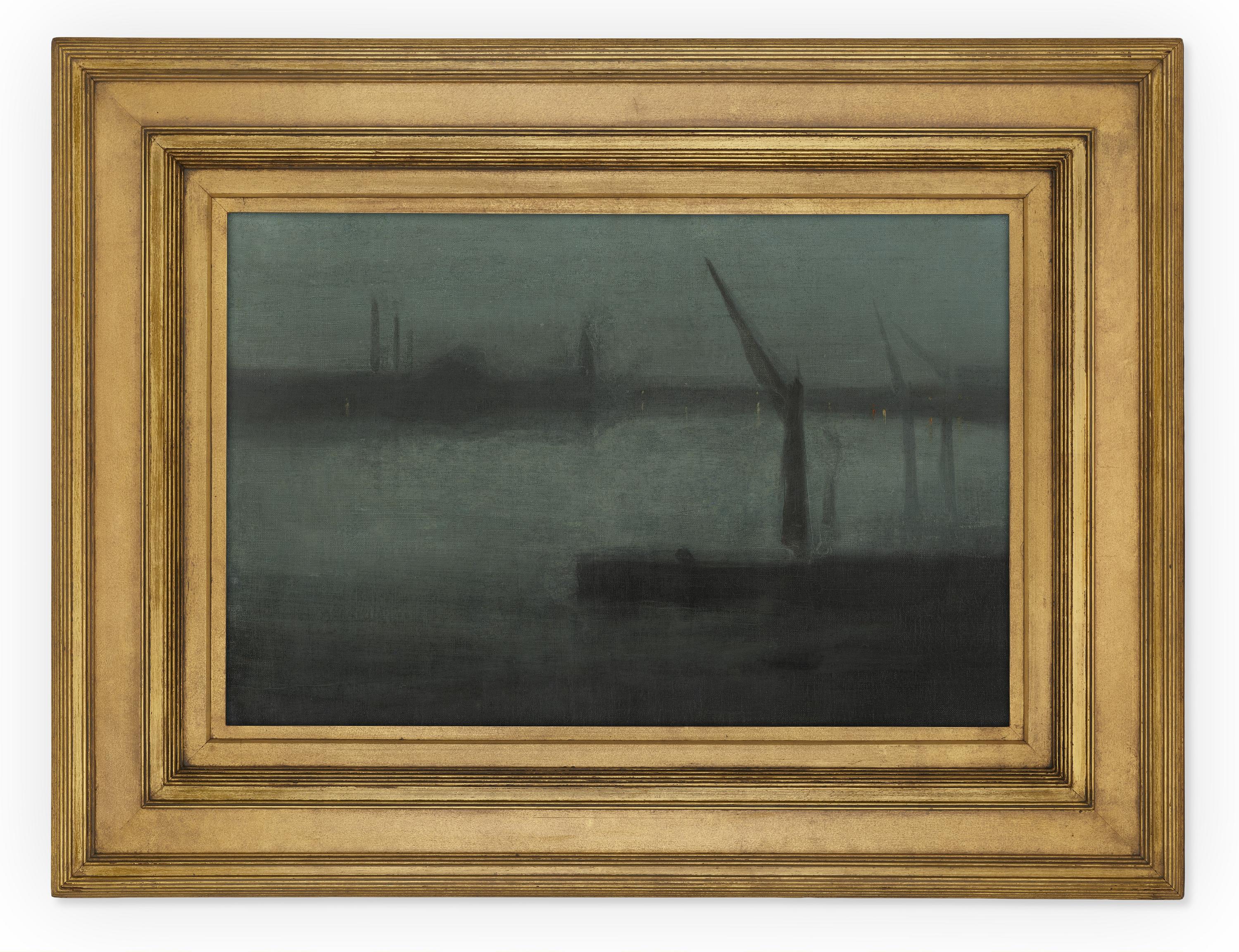
The nocturnes have an equally collaborative naming history. After moving to Chelsea, Whistler repeatedly looked across and along the Thames in dusk, fog and darkness. During the early 1870s he referred to some of these paintings as moonlights. Frederick Richards Leyland, the Liverpool shipowner, collector and amateur musician who bought Whistler's work, suggested “nocturne” in 1871. The word already named a musical composition associated with night, but in Whistler's hands it came to designate a new pictorial proposition.[1][3][13]
Leyland's role should be credited without turning him into author of the pictures. Whistler adopted the word because it concentrated several qualities of the moonlights: evening subject, restricted tonal range, suspended incident and an appeal beyond factual description. In later explanation he associated a nocturne with the arrangement of line, form and colour. That account did not abolish subject. It placed the depicted site inside a more exact statement about the painter's work.[1][4][9]
Thus Nocturne: Blue and Silver—Chelsea remains a view connected with Chelsea, while Nocturne in Black and Gold: The Falling Rocket concerns fireworks at Cremorne Gardens. Other titles retain Battersea, Southampton Water, Valparaiso or Venice. Whistler reduced many of the signs by which a place is normally catalogued—architectural detail, labour, weather report, anecdotal action—yet local anchors persist. The term “nocturne” asks how little can establish a world and how strongly tonal intervals can hold it together.[1][10]
The name also allowed related experiments across media. Whistler made oil paintings, prints and works on paper called nocturnes, but the common title does not make their processes identical. A fluid oil skin, a lithotint manipulated by scraping and a watercolour wash create atmosphere through different material operations. The shared word identifies an aesthetic problem—how to make sparse marks and close values carry a night effect—while each object requires its own technical account.[1][9]
Arrangement, Harmony and the Persistence of Subject
Whistler's portrait of Anna Matilda Whistler was shown at the Royal Academy in 1872 as Arrangement in Grey and Black: Portrait of the Painter's Mother. The double title contains the argument. “Arrangement” directs attention to the broad grey wall, the seated black figure, the framed print, curtain and footrest. “Portrait of the Painter's Mother” identifies the sitter and genre. The two descriptions do not cancel each other; they establish a productive tension between personal identity and pictorial order.[1][11]
Critics immediately noticed that tension. Some thought the eccentric wording distracted from Whistler's strength as a portraitist. Whistler later insisted that public sentiment about motherhood should not determine the work's artistic value. His provocation opposed the demand that a picture appeal through devotion, patriotism, pity or another emotion imported from its subject. It did not make Anna Whistler anonymous, nor did it prevent the work from accumulating powerful familial and national associations after it entered the French state collection in 1891.[1][5][11]
The same caution applies to the white pictures. Calling a painting a symphony helps describe the orchestration of close tones, yet Joanna Hiffernan was not pigment in human form. She was Whistler's model, partner and at times manager, and her pose was achieved through embodied labour. A formal reading becomes poorer, not purer, if it erases the conditions under which a picture was made. Whistler's rhetoric establishes what he wanted criticism to privilege; historical interpretation can examine that priority without accepting all its exclusions.[1][12]
“Harmony” could be similarly expansive. It named relations among colour, figure, costume and setting, sometimes in paintings that changed greatly while being worked and reworked. A title such as “harmony in amber and black” might be attached in an exhibition record to a canvas whose later state and preferred identification differ. The catalogue history warns against assuming that a colour phrase permanently identifies one stable surface. Whistler revised both paintings and labels, and the surviving object may embody several moments.[1][2]
Why Whistler Changed Titles
Titles change for ordinary documentary reasons as well as theoretical ones. A gallery may shorten a label. A foreign exhibition may translate it. An owner, critic or catalogue compiler may favour the sitter's name. Whistler might add a number, alter a colour, revive an earlier phrase or use a subtitle to make identification possible. Posthumous catalogues then have to reconcile conflicting evidence. A preferred modern title is a scholarly judgement grounded in records, not a time machine returning the words first conceived at the easel.[1][2]
The catalogue for Arrangement in Grey and Black: Portrait of the Painter's Mother records variants ranging from “Mrs Whistler” and “Portrait de ma mère” to German and Dutch descriptions. These labels reveal the work's movement through different institutions and audiences. They also show why the musical component never fully displaced portrait identity. Even when Whistler wished formal relation to govern judgement, exhibitors and viewers needed to say whom they were seeing.[1][11]
Revisions could sharpen a series. Numbering the white symphonies or the grey-and-black arrangements created connections among works and encouraged viewers to compare them. It could also create confusion when a number was applied inconsistently or a canvas was repainted. Scholars now distinguish Whistler's inscriptions, exhibition catalogues, correspondence, photographs and later testimony. The safest reading asks which title was used, by whom, when and for what state of the work.[1][2][3]
This documentary approach does not drain the poetry from the names. It reveals their activity. A title participates in the life of a work: it may oppose a literary interpretation, court a patron, frame a new display or absorb a critic's phrase. Whistler understood labels as part of presentation, so their instability is evidence of strategic attention rather than merely careless cataloguing.[3][8]
Nature as Material for Selection
Whistler gave his fullest public account of artistic selection in the lecture known as the Ten O'Clock. Delivered in London in 1885 and published in an authorised form in 1888, it is both a declaration of principles and a performance of the artist's superiority to critics and public taste. Its famous musical analogy treats nature as containing the components of pictures just as a keyboard contains musical notes. The artist chooses and groups those components until they form a convincing order.[4][13]
The argument rejects passive transcription. Nature rarely presents all pictorial relations in an ideal state; a painter must decide what to omit, intensify, move or subordinate. “Science” in this rhetoric means trained intelligence and purposeful ordering, not a mechanical formula. Whistler's painter is distinguished by selection. The analogy also makes mockery of the idea that simply placing oneself before nature guarantees art, just as physical contact with a piano does not produce music.[4][8]
Selection explains the nocturnes more accurately than the vague word “impression”. A riverside scene contains innumerable facts, but Whistler suppresses most of them. A bank becomes a band, a boat a dark interval, a lamp a small accent, smoke a change of value. These reductions are not proof that he saw nothing specific. They are evidence that observed material was reorganised according to a pictorial threshold: enough to hold place and atmosphere, not enough to break the tonal whole.[1][4]
Yet the Ten O'Clock is not a diary of how every painting was made. It was delivered after years of disputes about criticism, exhibition and value, and it fashions “the artist” as a rare figure opposed to the crowd. Whistler's own practice involved models, patrons, sites, repeated sittings, alteration, scraping, failure and negotiation. The lecture turns that contingent labour into a sovereign principle. It is indispensable evidence for his public theory, but it should not overrule the material or documentary record.[3][4][5]
Autonomy Without Emptiness
Whistler's demand for independence is often summarised as “art for art's sake”. He was closely associated with British Aestheticism, but his particular position is clearer when stated as a question of criteria. Should a painting be praised because its subject is morally elevating, its story moving, its sitter admirable or its labour conspicuous? Whistler answered that pictorial value lay in the achieved relation of its parts. A noble subject could result in a poor picture, and an ordinary riverside could become compelling through selection.[5][8]
This is autonomy, but it is not emptiness. The Falling Rocket keeps the social geography of Cremorne Gardens and the event of fireworks. The white symphonies keep bodies, textiles and studio objects. The portrait of Anna Whistler retains a named sitter whose presence shaped the composition. Even the most reduced nocturnes depend upon learned recognition: a vertical may read as a mast, scattered lights as traffic on water, a dark arch as a bridge. Representation is compressed rather than eliminated.[1][10][12]
Musical titles help to balance these conditions. They prevent the subtitle or subject name from monopolising interpretation, while the visible world prevents formal vocabulary from becoming self-sufficient. Whistler's best titles often preserve both sides: arrangement and mother, symphony and white girl, nocturne and falling rocket. Their punctuation makes an argument about hierarchy without resolving it entirely.[1]
Later critics could therefore find in Whistler a precedent for abstraction and modernism. His restricted palettes, flattened spaces and insistence on independent artistic relations anticipate concerns that became central in the twentieth century. But anticipation is not identity. Whistler did not pursue a systematic disappearance of subject, nor did his terms have the same meaning as later non-objective theories. It is more exact to say that he enlarged the critical space in which colour and arrangement could be discussed as primary values.[8][9]
Ruskin, The Falling Rocket and Competing Standards
The conflict with John Ruskin made this issue dramatically public. After seeing Whistler's work at the Grosvenor Gallery in 1877, Ruskin condemned Nocturne in Black and Gold: The Falling Rocket and its price in language that compared the painter's act to throwing paint at the public. The phrase was Ruskin's, not a boast by Whistler. Whistler sued for libel, and the case was heard in November 1878.[6][7][10]
The painting now held by the Detroit Institute of Arts is dated 1875, executed in oil on panel and measures about 60.3 by 46.7 centimetres unframed. Its dark field, sparks and falling fire identify a display at Cremorne while withholding the detailed finish Ruskin associated with responsible labour. The case consequently brought aesthetic disagreement into contact with price, reputation and professional injury.[1][10]
At trial, questioning pressed Whistler on how long the picture took and why he asked two hundred guineas. His answer redirected value from the hours spent on that surface to the knowledge accumulated across a career. The exchange is frequently reduced to a triumphant one-liner, but the transcript shows a contested performance under legal pressure. Execution time, visible finish, market price and trained judgement were being treated as rival measures, and no single remark settles their relation.[6][7]
Whistler won a verdict but received damages of one farthing. That mixed outcome should replace the simple story that modern art defeated Victorian criticism. The suit vindicated his claim sufficiently for liability, yet the token award and costs did not deliver practical victory. His finances collapsed amid wider debts and expenditure. The trial nonetheless became central to his self-presentation because it dramatised the difference between a critic who saw insolent incompletion and an artist who claimed concentrated selection.[5][6][7][10]
The controversy also warns against using theory as a substitute for looking. “Nocturne” did not exempt the painting from judgement; it proposed a different basis for judgement. A viewer can ask whether the spatial intervals, tonal field and sparks form a sustained relation, how much representational evidence they need, and whether the surface carries its scale. Whistler wanted those questions to supersede a count of objects or hours, not to forbid critical disagreement.
The Artwork Beyond the Canvas
Whistler's relational thinking extended into presentation. He designed or modified frames, placed the butterfly signature as a compositional element and paid close attention to wall colour, spacing, catalogues and invitations. A painting was not an isolated rectangle dropped into any room. Its border and surroundings could strengthen or damage the tonal relations for which it had been made.[1][8]
His one-man displays turned that conviction into an environment. Pale or coloured walls, carefully spaced objects and coordinated printed matter distinguished his exhibitions from crowded salon hanging. Musical names worked within this ensemble: rows of notes, harmonies and nocturnes suggested a concert-like sequence, while the visual intervals between frames gave each object room. The method brought aesthetic theory into exhibition design and also made the Whistler brand instantly recognisable.[8][13]
There was a commercial advantage in this coherence. An unconventional title could attract press attention, separate the work from descriptive competitors and make Whistler's authorship legible before his name was read. His butterfly, sometimes given a sting in polemical settings, joined elegance to aggression. The same artist who argued for art's independence was acutely aware of publicity, patronage and sales. Commercial intelligence does not invalidate aesthetic belief; it describes the conditions through which that belief reached an audience.[3][5][9]
Reception, Tonalism and Later Modernism
Whistler's terminology was never received in one way. Some nineteenth-century critics found it pretentious or evasive, especially when a recognisable portrait seemed to be disguised as a colour exercise. Others found the musical analogy an apt language for subtle gradation. Responses could also change as a work travelled. The mother portrait that troubled Royal Academy reviewers was acquired by the French state and became one of Whistler's most publicly familiar images.[1][11]
The nocturnes offered later artists a durable model for city atmosphere. The Victoria and Albert Museum connects Whistler's naming and mood to American Tonalism and to nocturnal photography, where reduced contrast and uncertain detail could evoke modern urban experience. This is an afterlife rather than proof that every tonal painter followed Whistler directly. The spread of the word indicates how effectively he made “nocturne” available as a visual category.[9]
The Ten O'Clock also circulated internationally. Stéphane Mallarmé translated it into French, helping to place Whistler's claims before Symbolist audiences. The lecture's image of the artist selecting rare order from commonplace nature suited a culture that prized suggestion over exhaustive description. Yet Symbolism, Tonalism and later abstraction each adapted Whistler for different purposes. They should not be collapsed into one inevitable genealogy.[3][13]
Modernist histories often celebrate Whistler for shifting critical attention towards the autonomy of form. That judgement is justified if “autonomy” is kept specific: the work demands evaluation as an organised visual object, and its quality cannot be guaranteed by subject matter. It becomes misleading if it removes Whistler from nineteenth-century patronage, exhibition systems, urban sites, models and debates. The paintings carry those histories even when their titles ask the eye to begin elsewhere.[1][8]
How to Read a Whistler Musical Title
A useful reading begins with chronology. Establish the title attached to the work at the relevant exhibition, then compare later variants and the present preferred form. Ask whether Whistler supplied the wording, adopted a critic's phrase, accepted a patron's suggestion or modified an existing label. Numbers and subtitles deserve the same scrutiny. They may define a series, disambiguate a sitter or record a posthumous scholarly decision.[1][2][3]
Next, test the musical word against the object rather than using it as praise. In an arrangement, what is positioned in relation to what? In a harmony, where do similarity and contrast occur? In a symphony, how are repeated tones varied across a larger structure? In a nocturne, which marks retain the site and which details have been suppressed? This method converts metaphor into close looking without pretending that the categories have fixed technical meanings.[1][4]
Finally, restore the subject and circumstances. Name the sitter, place or event when the evidence permits. Consider the model's labour, the patron's interest, the gallery's presentation and the critic's expectations. Whistler wanted viewers to resist sentimental or literary shortcuts, not to become historically incurious. Formal relation and historical specificity can correct each other's excesses.
Three Titles Under Close Examination
Symphony in White, No. 1: The White Girl places the most complicated chronology inside one familiar name. The canvas originated as The White Girl and was briefly caught in the publicity surrounding The Woman in White. Mantz's 1863 review supplied a symphonic comparison, but the numbered form familiar today belongs to a later ordering of Whistler's white paintings. A good interpretation can therefore move through three layers: Hiffernan as a specific sitter; the visual problem of distinguishing whites; and the retrospective series that made the canvas appear to inaugurate a musical programme.[1][12]
Looking only for symbolism would make every accessory deliver a message. Looking only for formal unity would make the sitter and objects interchangeable. The title instead makes their friction visible. Hiffernan's hair, skin, dress and posture create differences that prevent the whites from becoming a blank field. The colour experiment depends on bodily presence, while her frontal stillness refuses the easy animation expected of narrative illustration. “Symphony” describes the sustained interaction of variations; it does not exhaust the picture's social or material meanings.[1][12]
Arrangement in Grey and Black: Portrait of the Painter's Mother poses a different problem because its subtitle encourages a strong emotional response. Anna Whistler's profile, mourning dress and upright posture have supported readings of character, family and age, while the room's severe geometry seems to confirm them. Whistler's title cautions that those meanings are not identical with pictorial value. The body, curtain and framed print make a set of verticals; the platform and footrest extend the horizontal base; small warm notes keep the greys and blacks from becoming inert.[1][11]
The work's later fame proves that an artist cannot permanently control reception. Its acquisition by the French state, reproductions and public familiarity made “Whistler's Mother” a cultural image far beyond Whistler's formal argument. That afterlife does not refute the arrangement. It shows that titles establish a first frame, after which institutions and audiences add others. The complete name usefully holds together the artist's priority and the sitter's identity rather than choosing one as the authentic picture.[1][11]
Nocturne in Black and Gold: The Falling Rocket tests how little description a public could accept. Its subtitle supplies motion and spectacle, but the surface distributes that event as flecks, trails, clouds and near-darkness. “Black and gold” identifies the governing contrast; “nocturne” places the contrast within a family of suspended night effects; “falling rocket” reconnects the arrangement to an observed entertainment. Each phrase changes the scale of attention, from pigment relation to pictorial type to event.[1][10]
Ruskin treated the sparse finish and price as evidence of imposition. Whistler treated concentrated selection as evidence of knowledge. Neither position can be reconstructed from the title alone, yet the title helps explain why the dispute became so intense. It claimed a category in which atmosphere and relation outweighed detailed description, precisely when a hostile critic judged the missing description as missing labour. The court could decide libel; it could not make one standard of finish compulsory for art.[6][7][10]
Together the three examples show that the musical word does not perform the same task every time. In the white painting, it joins an emergent sequence. In the portrait, it disputes sentimental hierarchy. In the nocturne, it defines a radical economy of means. The method is consistent at the level of relation, but responsive at the level of the object. That flexibility was the vocabulary's strength and is the reason a rigid glossary distorts it.[1][4]
Authority, Taste and the Right to Name
Whistler's theory was also a claim about professional authority. Victorian art criticism routinely connected technique to moral seriousness, patient labour or fidelity to nature. Whistler separated artistic knowledge from those visible signs. A rapidly executed passage might embody years of trained judgement, while a laborious surface might remain badly organised. The argument did not prove that every Whistler was successful. It asserted that the standard must be the achieved picture rather than an external virtue attributed to effort.[4][6][7]
Naming was part of that contest. A literary title could recruit a novelist's plot; a sitter's name could recruit social rank or affection; a geographical label could invite the picture to be checked as a report. Musical language made the artist's act of ordering explicit at the threshold. It announced that Whistler, not the critic or exhibitor, would propose the terms. His objection to The Woman in White concerned more than factual correction: it resisted having a painting converted into an illustration by someone else's label.[1][12]
That insistence could be liberating and imperious at once. It freed colour from compulsory service to narrative, yet it elevated the artist above models, patrons and audiences whose participation remained necessary. Leyland's contribution to “nocturne” is a useful reminder that even Whistler's most personal vocabulary emerged through exchange. Catalogue research supplies further reminders whenever a critic, gallery or later scholar contributed words that became inseparable from a work.[1][2][3]
Taste enters because selection requires discrimination. The Ten O'Clock imagines the artist recognising rare harmonies missed by ordinary observers. Such language supported Aestheticism's defence of cultivated perception, but it could also turn preference into social distinction. Whistler's refined installations, restricted palettes and witty polemics addressed audiences able to recognise the codes of advanced taste. The theory's history therefore includes classed spaces—studios, private collections, fashionable galleries and lecture halls—as well as universal statements about beauty.[4][8][9]
Its continuing value does not depend on accepting Whistler's hierarchy of persons. The durable insight is that representation is made through choices and that criticism should account for them. Every apparently natural view is framed; every portrait distributes emphasis; every title directs attention. Whistler made those mediations impossible to overlook. His exaggeration of artistic sovereignty can itself be examined as one choice among the many conditions surrounding a work.
Selection, Relation and the Visible World
Whistler's musical titles endure because they sharpen a genuine problem. A painting is made from the visible world and is also an ordered object with demands of its own. If subject controls everything, colour and interval become illustration's servants. If form is treated as wholly independent, the lives, places and material circumstances carried by the picture disappear. Whistler weighted the balance decisively towards organisation, but his works remain powerful because neither side vanishes.
The names chart that negotiation rather than solving it. The white symphonies turned critical metaphor into a series; the moonlights became nocturnes through conversation with a musically informed patron; arrangements and harmonies reframed portraits and figure paintings; the Ten O'Clock elevated selection into a theory of artistic authority. Across these uses, music is not an escape from sight. It is Whistler's language for making sight answerable to relation.
Frequently Asked Questions
He made them a defining and unusually systematic part of his public identity, but the development was collaborative. Paul Mantz described The White Girl through a symphonic metaphor in 1863; Whistler publicly used Symphony in White, No. 3 in 1867; Frederick Leyland suggested “nocturne” for the moonlights in 1871. Whistler selected, expanded and defended the vocabulary with exceptional force.[1][3][13]
No secure system maps Whistler's colours, lines or forms onto particular notes or compositions. Music serves as an analogy for selection, interval and relation. A picture can be organised as a whole without narrating a story, just as instrumental music can make structure perceptible without illustrating an event.[4][8]
His restricted tones, reduced description and emphasis on autonomous relation helped later artists and historians articulate abstraction. His works are not generally non-objective: they continue to portray sitters, rivers, bridges, rooms and events. “Precursor” is more accurate than direct equivalence.[1][8][9]
Discussion
Which Whistler title most changes the way you look at its painting?
Test the musical word against colour, interval, subject and the title's documentary history.
Reader Insights
Who supplied the title, and when did it enter the record?
Which colours, masses or intervals does the term help you see?
What sitter, place or event remains present?
Join the Conversation
Share a close reading or a question for other readers.
References
- Margaret F. MacDonald and Grischka Petri, The Paintings of James McNeill Whistler: A Catalogue Raisonné, University of Glasgow, including entries for YMSM 38, 61, 101, 103, 137 and 170: https://www.whistlerpaintings.gla.ac.uk/catalogue/
- University of Glasgow, “The Project,” The Paintings of James McNeill Whistler: https://www.whistlerpaintings.gla.ac.uk/project/
- Margaret F. MacDonald, Patricia de Montfort, Nigel Thorp and Georgia Toutziari, eds., The Correspondence of James McNeill Whistler, 1855–1903, University of Glasgow: https://www.whistler.arts.gla.ac.uk/correspondence/
- James McNeill Whistler, Mr. Whistler's “Ten O'Clock” (London, 1888), Smithsonian Libraries and Archives: https://library.si.edu/digital-library/book/mrwhistlersteno00whisa
- James McNeill Whistler, The Gentle Art of Making Enemies (London, 1890; revised edition 1892), Smithsonian Libraries and Archives: https://library.si.edu/digital-library/book/gentleartmaking00whis
- James McNeill Whistler, Whistler v. Ruskin: Art and Art Critics (London, 1878), Smithsonian Libraries and Archives: https://library.si.edu/digital-library/book/whistlervruskin00whisa
- University of Glasgow, edited court transcript for Whistler v. Ruskin, 25 November 1878, Correspondence of James McNeill Whistler: https://whistler.arts.gla.ac.uk/correspondence/people/display/?initial=W&nameid=Whistler_Gwa&rs=103&sr=0
- H. Barbara Weinberg, “James McNeill Whistler (1834–1903),” Heilbrunn Timeline of Art History, Metropolitan Museum of Art, 2010: https://www.metmuseum.org/essays/james-mcneill-whistler-1834-1903
- Victoria and Albert Museum, “The wonderful world of Whistler,” updated 17 April 2024: https://www.vam.ac.uk/articles/the-wonderful-world-of-whistler
- Detroit Institute of Arts, Nocturne in Black and Gold, the Falling Rocket, 1875, 46.309: https://dia.org/collection/nocturne-black-and-gold-falling-rocket/64931
- Musée d'Orsay, Arrangement en gris et noir no 1, 1871, RF 699: https://www.musee-orsay.fr/en/artworks/arrangement-en-gris-et-noir-ndeg1-974
- National Gallery of Art, Washington, Symphony in White, No. 1: The White Girl, 1861–62, 1943.6.2: https://www.nga.gov/artworks/12198-symphony-white-no-1-white-girl
- University of Glasgow, “James McNeill Whistler: Biography,” The Paintings of James McNeill Whistler: https://www.whistlerpaintings.gla.ac.uk/biog/


