


 by Tom Gurney
Tom Gurney BSc (Hons) is an art history expert with over 20 years experience
Published on June 19, 2020 / Updated on November 6, 2026
Email: tomgurney1@gmail.com / Phone: +44 7429 011000
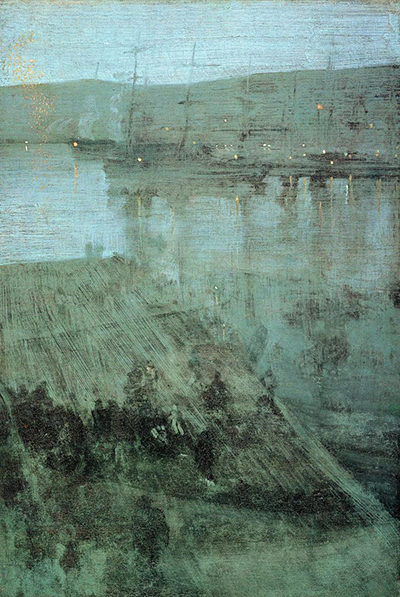
James McNeill Whistler's Nocturne in Blue and Gold: Valparaiso Bay began as a harbour painting during his 1866 stay in Chile and became a night scene through later work, probably completed around 1874. This double chronology is fundamental: the canvas remembers Valparaiso, but the nocturnal surface belongs equally to Whistler's mature London practice.[1][2][5]
The painting is YMSM 076, held by the Freer Gallery of Art as F1909.127a-b. The Smithsonian National Museum of Asian Art currently calls it Nocturne in Blue and Gold: Valparaiso, without “Bay”; the catalogue raisonné retains the longer title established from its 1887 exhibition name.[1][4][5]
At a Glance
- CatalogueYMSM 076
- Date1866–about 1874
- MediumOil on canvas
- NMAA dimensions76.4 × 50.7 cm
- YMSM dimensions75.6 × 50.1 cm
- SignatureNone
- Museum titleNocturne in Blue and Gold: Valparaiso
- CollectionFreer Gallery of Art, F1909.127a-b; Gift of Charles Lang Freer
- FrameFlat Whistler frame; date unknown
- DisplayCheck NMAA; no current object-specific gallery claimed
Contents
- At a glance
- Two measurements, one object
- How the title evolved
- What “nocturne” changes
- What does the nocturne show?
- The pier and high horizon
- A crowd without individual stories
- Whistler and Hiroshige
- Four Valparaiso paintings must remain separate
- Three upright variations
At a glance
- Artist: James McNeill Whistler (1834–1903).[1][5] - Date: 1866–about 1874.[2][5] - Medium: oil on canvas.[1][5] - Format: vertical.[1] - Current-holder dimensions: 76.4 × 50.7 centimetres; 30 1/16 × 19 15/16 inches.[5] - Catalogue dimensions: 75.6 × 50.1 centimetres; 29 3/4 × 19 3/4 inches.[1] - Catalogue number: YMSM 076.[1] - Accession: Freer Gallery of Art F1909.127a-b.[5] - Signature and inscription: none.[1] - Frame: Flat Whistler type, date unknown.[1][3][16] - Credit: Gift of Charles Lang Freer.[5] - Digital image: CC0 and identified by the Smithsonian as public domain.[5]
Two measurements, one object
The Smithsonian's current record gives a height of 76.4 centimetres and width of 50.7, while YMSM gives 75.6 by 50.1. The differences are small but real enough to report rather than hide. They may reflect separate measuring campaigns or conventions; the locked sources do not explain them.[1][5]
Both records agree on the medium, support, upright format and accession identity. F1909.127a-b also binds the painting to its museum object record, including associated framing, without proving that the present frame surrounded it in 1866.[1][5][16]
How the title evolved
The work's first known public label was not its present one. Brighton displayed it in 1875 as Nocturne in blue and silver. The Royal Society of British Artists introduced Nocturne in blue and gold: Valparaiso Bay in 1887, the form YMSM later selected as preferred.[1][2][14]
Paris again used blue and silver in 1890. Goupil chose Nocturne: Blue and Gold – Valparaiso two years later, while Chicago and several later catalogues shortened the wording to versions of Nocturne, Valparaiso.[1][4][14]
These shifts reveal changing description more than changing identity. Silver and gold name perceived accents in a dark field; “Bay” expands the geography; Valparaiso anchors the atmospheric title to place. The current Smithsonian form omits “Bay” but retains blue, gold and city.[1][5]
What “nocturne” changes
The musical word directs attention away from a harbour inventory towards an orchestrated effect. Forms recur like muted phrases: the pier supplies a sustained diagonal, masts form narrow vertical beats, and isolated lights interrupt the blue darkness.[1][3]
That language does not make subject matter irrelevant. Without the specific elevation, waterfront traffic and Chilean hills, the arrangement would lose its spatial resistance. Whistler's achievement lies in making recognisable material submit to a tonal order without disappearing altogether.[1][5]
The long working period clarifies the term's significance. Valparaiso provided the observed configuration in 1866, but “nocturne” describes what Whistler eventually made of it as his musical titles became more systematic.[2][17]
What does the nocturne show?
The viewpoint is high above the waterfront. A jetty pushes steeply through the lower portion of the canvas, carrying a crowd of small figures. Beyond it, tall-masted vessels occupy the bay, while hills rise beneath the high horizon.[1][3][5]
Darkness reduces the difference between human bodies, pier, ships and water. They remain detectable through slender silhouettes and small coloured accents rather than through continuous modelling. The scene rewards adjustment of the eye more than immediate inventory.[3][15]
Its vertical format turns the harbour into a descending arrangement. The gaze moves from distant hills to masts, down along the wharf and across the compressed band of water. The dominant diagonal prevents the darkness from becoming an undirected field.[1][5]
The pier and high horizon
The wharf is both observed infrastructure and formal engine. Its sharp angle announces depth, yet it also acts as a flat band crossing the picture. People along it create a sequence of minute pauses within that larger movement.[1][3]
The high horizon leaves relatively little space for open water. Ships are pressed between the pier and the hills, and their vertical masts tie those zones together. This compression gives the narrow canvas a density absent from Whistler's broad horizontal Valparaiso marines.[1][3][6]
The Smithsonian label calls the combination of high horizon and forceful diagonal unprecedented in European painting and compares it with late landscapes by Utagawa Hiroshige. That is a museum interpretation of structural affinity, not evidence that Whistler copied a particular identified print.[5]
A crowd without individual stories
Geffroy perceived people moving to and fro, dark and nearly transparent except for paler touches of clothing. Earlier reviewers likewise recognised a crowded quay. Their testimony confirms human activity more securely than the present worn surface alone might allow.[3][4][15]
No source names a single figure. They may represent ordinary harbour movement, spectatorship or remembered animation, but the painting does not preserve uniforms, gestures or attributes sufficient for firm social identities.[1][3]
Their reduction serves the nocturne's scale. Tiny walkers make ships and hills feel distant, while their repeated marks carry the eye along the pier. Human presence is essential to the rhythm even though anecdotal character is withheld.[3][15]
Whistler and Hiroshige
Japanese prints offered nineteenth-century European artists alternatives to centred perspective, continuous depth and evenly distributed detail. In this nocturne, a tilted wharf can dominate the foreground while a high boundary compresses distance, producing the asymmetry emphasised by the Smithsonian.[5]
The comparison is most useful at the level of visual organisation. It does not require Valparaiso to look Japanese, nor does it replace Chilean geography with an imagined East Asian scene. Pier, ships and hills still belong to a South American port.[1][5]
Nor does “no European precedent” need to become an absolute survey of every European harbour painting. It is the museum label's way of stressing the design's originality. Attribution keeps the argument forceful without turning curatorial language into universal fact.[5]
Four Valparaiso paintings must remain separate
YMSM 076 is one member of a larger Chilean group. YMSM 073, Tate's Crepuscule in Flesh Colour and Green: Valparaiso, is a horizontal twilight marine with shipping spread across open water. Its inscription, layered preparation and analysed pigments belong only to that canvas.[6]
YMSM 074 is the Smithsonian American Art Museum's daylight Valparaiso Harbor, catalogued as a sketch related to the nocturne. YMSM 075 is the Hunterian's The Morning after the Revolution, Valparaiso, another upright daylight scene.[7][8]
Shared harbour, date and motifs do not make the works interchangeable. Present holders, proportions, titles, conservation histories and visible states differ. Catalogue numbers are the clearest defence against a composite story assembled from four objects.[1][6][7][8]
Three upright variations
The Smithsonian sketch, Hunterian morning and Freer nocturne all look down towards a pier with shipping beyond. YMSM considers the Freer painting the most elaborate of these vertical versions because it adds figures and organises the motif into a fully nocturnal atmosphere.[3][7][8]
YMSM 075 includes small boats beside the pier and a white sail on the foremost vessel. Those details are absent in YMSM 076. The pier also rises more steeply in the Freer picture and in YMSM 074 than in the Hunterian variant.[3][7][8]
Such comparisons indicate repeated treatment of a shared prospect, not a proven series of tracing transfers. Later repainting of the Freer canvas makes its 1866 configuration impossible to recover merely by looking at its present surface.[2][3]
Was the Smithsonian canvas its sketch?
Way, Dennis and the Pennells treated YMSM 074 as an unfinished study for YMSM 076. Both use an elevated position, diagonal pier, ships and surrounding hills, so the proposed connection is substantial.[1][3][7][11]
Other scholarship has questioned a direct preparatory relation because the spatial arrangements differ. Yet those differences may have widened when Whistler revised the Freer canvas years after leaving Chile.[3][7]
The word “sketch” remains a catalogue hypothesis rather than a signed instruction from the artist. YMSM 074 may preserve aspects of an earlier daylight organisation, but neither canvas supplies a complete physical record of how one became related to the other.[3][7]
The Club-window tradition
In 1921 W. McQueen told the Pennells that his father had entertained Whistler at a Club in Valparaiso. He said the artist painted the beautiful upright harbour from its windows.[1][11]
The downward angle accords with an elevated building. However, the memory was relayed decades after the visit, and the institution has not been securely identified. It could refer to YMSM 074, YMSM 076 or a shared point of departure for both.[1][7][11]
No surviving evidence fixes the exact window, floor, compass direction or daily sequence. The account should remain a plausible local tradition rather than a recovered studio address.[11]
Whistler in Chile
Whistler arrived at Valparaiso on 12 March 1866 and stayed in Chile until early September. His South America notebook records the voyage, contacts, expenses and movements, though it does not provide a stage-by-stage account of YMSM 076.[2][12]
Spain and Chile were then at war. A Spanish squadron blockaded the coast, diplomatic pressure intensified, and foreign naval vessels occupied the bay. On 31 March Spanish ships bombarded the undefended commercial port after prior warning.[12][13]
The Smithsonian label says Whistler witnessed the fleet's attack on the city. That biographical setting is secure at a broad level. The surviving nocturnal appearance, however, was developed long after the attack and cannot be read as an untouched report of that day.[2][5][13]
Does the picture depict the bombardment?
Pier figures, clustered shipping and isolated lights can be placed within a wartime harbour. They cannot be assigned confidently to Spanish gunners, neutral fleets, refugees or observers. The present painting offers no legible flags or inscribed date that would settle such identities.[1][3][13]
Gustave Geffroy saw what he called scattered sparks in 1890, and an 1898 reviewer interpreted a mark in the upper corner as spray from a spent rocket. These are valuable records of early viewing, not proof of a depicted shell or firework.[3][15]
The strongest historical claim is therefore layered. Whistler developed the image from experience of Valparaiso during the conflict, but its nocturnal form emerged in the 1870s. History informs the subject without converting every light into ordnance.[2][5][13]
From daylight to night
The catalogue dates the first work to 1866 and says the canvas probably did not begin as a nocturne. The Smithsonian similarly explains that Whistler likely transformed a daylight scene when he returned to the painting in 1874.[2][5]
This was more than darkening a finished view. Nocturnal revision altered which edges survive, how figures relate to the pier and how coloured lights punctuate the bay. The later surface reorganised the subject around limited visibility.[3][5]
That transformation prevents the painting from being called simply the first nocturne because it originated in 1866. It began earliest among the relevant works, but its nocturne identity belongs to the period when Whistler was already developing night subjects around the Thames.[2][17]
The decisive 1874 letter
On 22 June 1874 Whistler acknowledged payment from Alfred Chapman for two other nocturnes. He then added that William Grapel had once been promised first chance at “the Valparaiso piece” if he ever finished it.[9]
The correspondence editors identify that piece as probably YMSM 076. The conditional phrase establishes that Whistler still regarded it as unfinished in mid-1874, although it does not map every subsequent brushstroke.[2][9]
Some catalogue text gives 22 July, but the official transcription and database record date the letter 22 June. The primary document date should lead. More important than the month discrepancy is its evidence for a work carried forward across eight years.[2][9]
What did “finish” mean for Whistler?
Finishing need not imply adding conventional descriptive detail. In a nocturne, completion could mean securing the tonal relation among sky, water, pier and lights while suppressing distracting information.[2][3]
The 1874 wording also shows that apparent immediacy was compatible with prolonged revision. The canvas may retain quick passages, but the whole object was not the product of a single Chilean evening.[2][9]
Whistler's uncertainty had a market dimension. Grapel was promised an opportunity when the work became saleable, so artistic completion and prospective ownership were linked in the same sentence.[4][9]
Lead white and historical reports of the ground
Technical reporting identifies lead white as the matrix pigment. That finding is secure but limited; it is not a full list of every colour used across the picture.[3]
Bernhard Sickert wrote in 1908 that the canvas appeared to have been primed in black and that crepuscular blue was glazed over it. His account helps reconstruct how the dark surface looked to an informed early observer.[3][15]
It should not be presented as modern microscopic analysis. “Appeared” marks a visual judgement, and the later history of cleaning and abrasion complicates any confident reconstruction of the entire layer structure.[3][15]
What Geffroy saw in 1890
Gustave Geffroy described a jetty projecting over pale-blue water. Transparent-black people seemed to move along it, their lighter clothes registering as livid spots. Boats appeared through hulls and masts marked with red, yellow, blue and white lights.[3][4][15]
He also saw widely spaced sparks, distant hills and a clear night populated by ghostly boats and restless walkers. His language makes the darkness active rather than blank.[3][15]
This contemporary description matters because several features are less distinct now. It provides written evidence of earlier legibility without authorising a modern reconstruction of forms no longer securely visible.[3]
Coloured lights and “sparks”
Small points of colour articulate the night. They can suggest harbour lamps, reflections or lights attached to vessels while also working as isolated notes across a blue field.[3][15]
Geffroy's “shower” of sparks and the later rocket interpretation show how readily viewers sought events in those accents. Neither account securely locates the Spanish bombardment within the composition.[13][15]
Their uncertainty is productive. The lights animate scale and movement without resolving the nocturne into a single anecdote. They belong to a harbour remembered and rearranged rather than to a diagram of one military episode.[2][3]
Early viewers adjusted to the darkness
At the Royal Society of British Artists in 1887, reviewers praised a crowded quay, shadowy vessels and masthead lights. M. H. Spielmann admired the picture's translucent darkness and sense of limitless air.[4][14]
Other notices called it beautiful, subtle or a tour de force. The language shows that darkness was understood as an achievement requiring perceptual participation, not simply an absence of finish.[4]
In 1898 a critic described a dark patch slowly resolving into a pier crowded with watchers and phantom ships. The delayed recognition recorded by that review remains an apt account of how a nocturne structures looking.[3][15]
Brighton in 1875
The Brighton exhibition gives the first firm terminus for public completion. Henry Hill lent the canvas under a blue-and-silver title only months after Whistler's letter had left its finish in doubt.[2][4][14]
That rapid transition need not mean the entire nocturnal surface was added after June 1874. The letter proves continuing uncertainty; the exhibition proves that by 1875 Whistler and an owner accepted the work as showable.[2][9]
Brighton also places the painting within a market for modern pictures rather than a Chilean documentary display. Audiences first encountered it as a nocturne, not as a freshly returned report from the Pacific war.[2][14]
The 1887 critical success
At the Royal Society of British Artists, the work received the blue-and-gold title that now defines it. One critic admired the effective night scene, crowded quay, shadowed vessels and masthead lights; another emphasised subtle darkness and immense aerial space.[4][14]
The responses balance legibility and atmosphere. Reviewers could identify harbour features, but they praised the way those features entered a difficult tonal field. The picture was neither celebrated as topographic precision nor dismissed as an illegible patch.[4]
Whistler himself described it shortly afterwards as among his finest nocturnes. Critical approval and the artist's promotion together helped elevate a canvas that had once remained unfinished for years.[4][10]
Paris and Geffroy in 1890
Alexander Ionides lent the picture to the Paris Salon, where it was well placed. Geffroy's unusually exact response records the state of the image before later condition loss became more severe.[4][15]
He did not describe undifferentiated darkness. Pale water, moving pedestrians, light clothing, coloured lamps, hulls, masts and hills were all perceptible. His clear night contained ghosts, but ghosts with spatial and chromatic roles.[3][15]
The account is therefore both criticism and condition evidence. Its language cannot substitute for physical examination, yet it proves that a sensitive observer in 1890 recovered more detail than many viewers can easily see today.[3]
Condition changed the experience
The 1898 reviews and photographs from 1892 and the later decade indicate that the picture had deteriorated. Details described clearly by Geffroy became harder to recover.[3][15]
Freer conservation files report abrasion and evidence of frequent cleaning. Repeated attempts to clarify a dark surface can remove or weaken precisely the thin distinctions on which its atmosphere depends.[3][15]
Condition must therefore be included in formal analysis. Today's obscurity is partly intentional nocturnal compression and partly an object history of wear; the available evidence cannot assign every unclear passage exclusively to one cause.[3]
The 1965 conservation campaign
Ben Johnson treated the painting in 1965. Old varnish and retouches were removed, after which the canvas was restretched, revarnished and inpainted.[3][15]
That campaign addressed accumulated coatings and losses. It did not turn the surface back into an untouched 1875 state, nor could it restore every detail removed by earlier abrasion and cleaning.[3][15]
The treatment is later than the evidence supplied by photographs and reviews. Comparing those records makes it possible to separate nineteenth-century decline from the documented twentieth-century intervention.[3]
Is the frame original?
The current surround is classified as a Flat Whistler frame. Its date is unknown.[1][3][16]
“Whistler” in the type name does not by itself prove that the artist designed this exact frame for the canvas in 1866 or chose it when completing the nocturne around 1874. The locked documentation does not identify an original Chilean frame.[3][16]
The safe account gives the current classification and preserves the gap. An undated frame can still shape the work's flat tonal boundary without becoming evidence for the first campaign.[16]
From promised picture to Henry Hill
William Grapel's anticipated first chance did not lead to a documented purchase. By the 1875 Brighton exhibition, the owner was Henry Hill, a former Bond Street tailor sometimes styled “Captain.”[2][4][9]
A later account by E. A. Ward says the work was first offered to Sir Thomas Sutherland for 700 guineas and subsequently commissioned by Hill. Ward confused this painting with another nocturne elsewhere, so both offer and commission language require caution.[4]
Hill's secured role is simpler: he possessed and lent the picture by 1875. That date places ownership immediately after the period in which Whistler still wondered whether he would finish it.[2][4][14]
Ionides and the 1889 sale
After Hill's death, Christie's sold the nocturne on 25 May 1889. The catalogue called it Nocturne in blue and silver, Valparaiso, and Alexander Ionides bought it for £67 4s.[4][5]
Later that year Whistler urged Theodore Child to arrange a reproduction. He described the Ionides picture as one of his very finest nocturnes and pressed for its loan.[10]
The judgement is revealing but not disinterested. Whistler was directing publication, photography and access to his work. His superlative belongs to both genuine valuation and a campaign for favourable presentation.[10]
Goupil and John Charles Day
In 1892 several buyers showed interest. Goupil told Whistler that an English customer had acquired the picture within a transaction in which the gallery paid Ionides £300.[4]
The customer was Sir John Charles Day. Whistler later wrote that the sale was £400, leaving a price discrepancy between gallery report and artist's statement. Both figures need attribution rather than forced reconciliation.[4][10]
When Whistler saw the work at Goupil's exhibition that March, he told Beatrix that the Valparaiso nocturne was glowing. The response demonstrates continued attachment while also serving his effort to promote further exhibitions.[4][10][14]
McCulloch, Chicago and Freer
George McCulloch acquired the painting from Day by 1898. It passed to his widow after his death in 1907 and was subsequently handled by Wallis & Son.[4][5]
Charles Lang Freer had seen the nocturne at the World's Columbian Exposition in Chicago in 1893 and called it supremely fine in later correspondence. In July 1909 he bought it through David Croal Thomson for £3,000 according to YMSM.[4]
The leap from £67 4s in 1889 to the stated 1909 price reflects two decades of exhibitions, criticism and Whistler's growing reputation. It should not be treated as a simple index of condition, which had worsened over part of the same period.[3][4]
Chicago before Freer's purchase
At the 1893 World's Columbian Exposition, the nocturne hung in an adjoining gallery rather than with the main Whistler group. The organiser Charles Kurtz defended the arrangement as part of achieving the strongest ensemble under crowded conditions.[4][14]
Freer encountered Whistler's paintings at the fair and soon told the artist that he considered the Valparaiso supremely fine. That response preceded ownership by sixteen years and helps explain why the 1909 opportunity mattered to him.[4]
Chicago joined an international itinerary that moved the canvas between London, Paris and the United States. Those journeys increased public stature while exposing a delicate, dark surface to repeated transport and installation.[3][4]
Whistler arranged its 1898 surroundings
For the International Society exhibition, Whistler sent a diagram controlling the relative positions of his works. He placed the Valparaiso nocturne between The Philosopher and La Petite Souris, two comparatively small portraits.[4]
He asked that the pictures sit on the line, with minor height adjustments, proper forward tilt and nothing hung beneath them. Such instructions show that display was part of the artist's conception of visibility, especially for a dark and easily obscured canvas.[4]
Reviews again called the nocturne delicious, beautiful and much discussed. Its success depended not only on an isolated image but on placement, neighbouring scale, angle and the time viewers allowed their sight to adapt.[4]
A busy exhibition life
After Brighton in 1875, the nocturne appeared at the Royal Society of British Artists in 1887 and the Paris Salon in 1890. Goupil showed it in 1892 before American displays in Philadelphia and Chicago the following year.[1][4][14]
Further exhibitions in 1898 placed it at Goupil and with the International Society of Sculptors, Painters and Gravers. Whistler sent detailed hanging instructions for the International Society display, locating the nocturne between small portraits and controlling height and tilt.[4]
The work continued to Edinburgh, New York and the 1905 memorial exhibition. These repeated appearances explain its changing titles, accumulating praise and considerable exposure to handling and travel before Freer acquired it.[4][14]
Whistler's own changing claims
In 1874 the picture was something he might never finish. By 1889 it was one of his finest nocturnes. In 1892 it appeared to him simply glowing.[2][9][10]
Those statements trace a shift from open studio problem to celebrated public work. They also show Whistler actively managing buyers, reproduction and exhibition, rather than standing outside the object's market history.[4][10]
His language should be read as evidence of artistic valuation and self-presentation together. Neither promotional purpose nor later condition erases the importance he assigned to the nocturne.[10]
The Freer gift and loan restriction
Freer bequeathed the painting with his collection. The original gift deed was signed in 1906, the object was purchased in 1909, and the completed Freer Gallery received the collection in 1920. Its credit line is Gift of Charles Lang Freer.[5]
YMSM states that under the terms of Freer's bequest the painting cannot be lent to another venue. This restriction is important visitor information because it limits assumptions drawn from exhibition publicity.[4]
The Smithsonian supplies the digital image under CC0, allowing copying, modification and distribution without a copyright request. Accurate artist, title, collection and accession credit remain good scholarly practice.[5]
Is it currently on view?
The NMAA object page lists a long sequence of internal displays, most recently A Perfect Harmony, which ended on 8 October 2023. The checked record does not provide a present gallery or an explicit on-view status.[5]
Tate Britain's current Whistler guide, for the exhibition running through 27 September 2026, names the Chilean Valparaiso nocturne as the chronological beginning of its nocturne discussion. The page does not give Freer accession F1909.127a-b or lender details.[17]
Because that wording sits beside the documented Freer restriction on outside loans, it is unsafe to announce that the physical canvas is at Tate. Visitors should check the Smithsonian National Museum of Asian Art's current display information for F1909.127a-b before making a journey.[4][5][17]
Why this nocturne matters
The canvas joins two decisive moments in Whistler's development. Direct observation in a wartime Pacific port provided the pier, shipping, hills and elevated structure; later London work converted that material into a sustained meditation on night.[2][5][13]
Its high horizon and diagonal wharf also make the nocturne more than a darkened marine. The Smithsonian's Hiroshige comparison identifies a compositional departure in which asymmetry and compressed depth govern the subject.[5]
Finally, its condition history changes interpretation. Geffroy's lively people and coloured lights, early photographs, later abrasion and the 1965 treatment remind us that the painting's darkness is both artistic construction and altered material inheritance.[3][15]
Route and image status
The retained address is `/james-whistler/nocturne-in-blue-and-gold-valparaiso-bay/`. It currently redirects to the Whistler paintings hub, although its local source keeps the title, canonical and one resolved image.[18]
The local file is `Nocturne in Blue and Gold Valparaiso Bay James Abbott McNeill Whistler.jpg`. It remains a later standalone-page candidate; the Smithsonian's CC0 image provides a strong future rights reference.[5][18]
This account does not implement the page. No live HTML, redirect, sitemap, hub, canonical or image asset has been modified, and the empty inherited shell supplied no prose for reuse.[18]
Frequently Asked Questions
The object is in the Freer collection at the Smithsonian's National Museum of Asian Art. Its accession is F1909.127a-b and its credit records Charles Lang Freer's gift.[5]
Discussion
How does a daylight harbour become a nocturne without losing its earlier structure?
Trace the steep pier, compressed water, masts, hills, figures and coloured lights, then distinguish Whistler's later darkening from abrasion, repeated cleaning and modern conservation.
Reader Insights
Which parts still suggest a daylight design beneath the nocturnal surface?
How do the small coloured accents organise forms that otherwise merge into darkness?
Where might deliberate ambiguity and later material loss be difficult to separate?
Join the Conversation
Share a close observation or an object-history question.
References
- Margaret F. MacDonald and Grischka Petri, “Nocturne in Blue and Gold: Valparaiso Bay,” YMSM 076, subject and titles record, The Paintings of James McNeill Whistler: A Catalogue Raisonné, University of Glasgow, 2021. https://www.whistlerpaintings.gla.ac.uk/catalogue/display/?mid=y076&xml=sub
- MacDonald and Petri, “Nocturne in Blue and Gold: Valparaiso Bay: Date,” YMSM 076, University of Glasgow, 2021. https://www.whistlerpaintings.gla.ac.uk/catalogue/display/?mid=y076&xml=dat
- MacDonald and Petri, “Nocturne in Blue and Gold: Valparaiso Bay: Technical Description,” YMSM 076, University of Glasgow, 2021. https://www.whistlerpaintings.gla.ac.uk/catalogue/display/?mid=y076&xml=tec
- MacDonald and Petri, “Nocturne in Blue and Gold: Valparaiso Bay: History and Bibliography,” YMSM 076, University of Glasgow, 2021. https://www.whistlerpaintings.gla.ac.uk/catalogue/display/?mid=y076&xml=his
- Smithsonian National Museum of Asian Art, “Nocturne in Blue and Gold: Valparaiso,” F1909.127a-b, object, provenance, exhibition and rights record. https://asia.si.edu/explore-art-culture/collections/search/edanmdm:fsg_F1909.127a-b/
- MacDonald and Petri, “Crepuscule in Flesh Colour and Green: Valparaiso,” YMSM 073; Tate N05065. https://www.whistlerpaintings.gla.ac.uk/catalogue/display/?mid=y073
- MacDonald and Petri, “Sketch for ‘Nocturne in Blue and Gold: Valparaiso Bay,’” YMSM 074; Smithsonian American Art Museum 1929.6.159. https://www.whistlerpaintings.gla.ac.uk/catalogue/display/?mid=y074
- MacDonald and Petri, “The Morning after the Revolution, Valparaiso,” YMSM 075; Hunterian GLAHA 46325. https://www.whistlerpaintings.gla.ac.uk/catalogue/display/?mid=y075
- James McNeill Whistler to James Alfred Chapman, 22 June 1874, GUW 11251, The Correspondence of James McNeill Whistler, University of Glasgow. https://www.whistler.arts.gla.ac.uk/correspondence/recno/display/?cid=11251
- Whistler to Theodore Child, October/November 1889, GUW 09264; Whistler to Beatrix Whistler, 14 March 1892, GUW 06613. https://www.whistler.arts.gla.ac.uk/correspondence/recno/display/?cid=09264
- Elizabeth Robins Pennell and Joseph Pennell, The Whistler Journal, Philadelphia, 1921, pp. 43, 48.
- James McNeill Whistler, South America notebook, February 1866–January 1867, GUW 04335, University of Glasgow. https://www.whistler.arts.gla.ac.uk/correspondence/recno/display/?cid=04335
- U.S. Department of State, diplomatic correspondence from Valparaiso, March 1866, Foreign Relations of the United States, 1866, part 2; Armada de Chile, “Bombardeo de Valparaíso—31 de marzo de 1866.” https://history.state.gov/historicaldocuments/frus1866p2/d317
- Brighton 1875, Royal Society of British Artists 1887, Paris Salon 1890, Goupil 1892 and World's Columbian Exposition 1893 catalogues and records, cited in YMSM 076.
- Gustave Geffroy, 1890 Salon account; Bernhard Sickert, 1908; 1898 press reviews; and Freer conservation file for Ben Johnson's 1965 treatment, cited in YMSM 076.
- Sarah L. Parkerson Day, Whistler frame research report, 2017; University of Glasgow, “Picture Frames.” https://www.whistlerpaintings.gla.ac.uk/catalogue/essaydisplay/?eid=frames
- Tate, “James McNeill Whistler” and exhibition guide, Tate Britain, 21 May–27 September 2026. https://www.tate.org.uk/whats-on/tate-britain/whistler/exhibition-guide
- James McNeill Whistler Waterhouse+ route, redirect, image, carryover, inherited-prose and protected-live inventories, frozen 25 August 2026.


