


 by Tom Gurney
Tom Gurney BSc (Hons) is an art history expert with over 20 years experience
Published on November 6, 2026 / Updated on November 6, 2026
Email: tomgurney1@gmail.com / Phone: +44 7429 011000
James McNeill Whistler liked to present the artist as a sovereign intelligence. He named prices, designed frames, arranged exhibitions, corrected catalogues and rebuked owners who displayed his pictures badly. Yet the career produced through this language of independence rested on an unusually dense commercial system. Models held poses, printers pulled impressions, framers built gilded boundaries, publishers made editions, creditors advanced money, galleries supplied rooms and publicity, patrons commissioned work, and collectors carried objects into museums.[1][2][19]
That system cannot be reduced to a list of rich supporters. Patron, dealer and collector were overlapping but different roles. A patron could commission a portrait and later become a creditor. A dealer might lend money, stage an exhibition, negotiate a public purchase and acquire pictures personally. A collector could advise friends, lend to shows, resell at auction or design a museum in which ownership became interpretation.[1][2][20]
Whistler used these relationships actively. He cultivated scarcity, urged buyers to think in groups, supervised frames and treated a decorated exhibition as an artwork. He also missed deadlines, disputed accounts, resisted access and sometimes attacked the people whose money or work had sustained him. His control was therefore neither fiction nor mastery. It was a recurring negotiation with other people who possessed capital, buildings, clients, printing knowledge and legal rights.[1][2][16][19]
The most important networks crossed borders. Greek families linked London and Paris; British dealers converted Venice into editions and exhibitions; French and Scottish advocates secured public purchases in 1891; American collectors bought prints, pictures and interiors. By the time Charles Lang Freer planned a national collection in Washington, objects once made in private studios had travelled through commissions, debts, auctions and friendships into institutional custody.[2][10][11][17][18]
The result was not a smooth progress from misunderstood artist to museum classic. Bankruptcy removed works from Whistler's control. Resale could increase value without paying him. A patient collector might wait years for a commissioned picture, while an owner could refuse a new frame or decline a loan. Whistler's public legacy emerged from these conflicts as well as from admiration.[2][5][12][20]
At a Glance
- Early print marketP. & D. Colnaghi and family networks
- Greek networksIonides and Coronio families
- Major patronFrederick Richards Leyland
- Venice commissionFine Art Society, 1879
- Exhibition dealerDowdeswell and Dowdeswell, 1884
- International dealerGoupil Gallery under David Croal Thomson
- Public turning pointFrench and Glasgow acquisitions, 1891
- Museum makerIsabella Stewart Gardner
- American collectorCharles Lang Freer, first Whistlers in 1887
- Smithsonian legacyFreer gift planned in 1906; gallery opened 1923
Contents
- What patron, dealer and collector meant
- Early circulation and the Greek family networks
- Frederick Leyland and the limits of a great patronage
- Charles Augustus Howell and informal dealing
- Credit, collateral and the bankruptcy market
- The Fine Art Society turns Venice into a market
- Dowdeswell and the exhibition as sales instrument
- Goupil, David Croal Thomson and an international market
- The public purchases of 1891
- Isabella Stewart Gardner as collector and museum maker
What patron, dealer and collector meant
A patron supplied support in anticipation of work, access or association. The support might take the form of a commission, purchase, introduction, hospitality or repeated buying. Unlike a wage, it did not necessarily secure a predictable object at a predictable date. Whistler's patrons often entered relationships in which a portrait evolved slowly and an initially bounded decorative project expanded.[1][2][4]
A dealer provided market infrastructure. Dealers found buyers, offered credit, negotiated prices, arranged transport and insurance, issued catalogues, rented or owned display rooms, placed advertisements and maintained records. Some bought outright and assumed risk; others worked on commission or held works as security. Calling every intermediary exploitative misses the services without which Whistler's small paintings and serial prints could not reach dispersed audiences.[1][2][16][20]
A collector selected and kept objects, but collecting was not passive accumulation. Collectors compared impressions, sought advice, competed at sales, lent to exhibitions and determined how works were framed or installed. Howard Mansfield's print rooms introduced Charles Lang Freer to Whistler, while Isabella Stewart Gardner and Freer later made highly personal museum arrangements. Their choices changed how other viewers understood the artist.[10][11][13][14]
Creditors, printers, publishers and museums require their own names. A creditor possessed an enforceable financial claim, not simply an emotional investment in genius. A printer transformed a plate or stone into individual impressions. A publisher organized an edition and its sale. A museum acquisition shifted custody toward public law and institutional policy. One person or firm might cross several categories, but the transaction still matters.[5][7][8][20]
Price is equally specific. An asking figure records Whistler's ambition; a paid price records one agreement; a commission fee may concern labour not ownership; a collateral valuation secures debt; an auction result belongs to a resale; and a museum purchase is a public expenditure. Treating them as one rising numerical series creates a market history that the documents do not support.[2][5][20]
The sources also describe different moments. A letter may record an intention to buy, a dealer's stock book an object received, an invoice a charge, and an auction catalogue an offer to the public. None alone proves final payment or permanent ownership. The foundational 1980 catalogue raisonné brought many of these records into one chronology, while the current online catalogue revises provenance as new documents and collections emerge.[2][3][20]
Market language can conceal labour. “Sold by Goupil” compresses packing, insurance, bookkeeping, correspondence, viewing and payment into one phrase. “From the collection of Leyland” can hide the sitters, household decisions and decorators that gave a picture its first setting. Reopening these compressed descriptions makes economic history part of art history rather than a list appended after style.[1][2][16]
Early circulation and the Greek family networks
Before the famous one-man exhibitions, Whistler's work travelled through family, fellow artists, print publishers and established firms. P. & D. Colnaghi participated in the early circulation of etchings, while relatives and friends carried impressions and information between Britain, France and the United States. There was no single moment when a first dealer invented his market.[1][7][8]
The Ionides and Coronio families formed one especially important transnational network. Greek diaspora wealth and kinship connected commercial London with cosmopolitan Paris. Members bought art, introduced artists and displayed modern work in domestic settings where further viewers encountered it. Their significance lies not in ethnicity as a decorative label but in the social routes through which objects, knowledge and trust moved.[1][2][15]
Alexander Constantine Ionides owned Nocturne in Blue and Gold: Valparaiso Bay. That provenance gives a concrete instance of the network, while the painting's later transfers belong to its object history. Ownership here meant more than possession: a radical nocturne entered a respected collection and could be seen beside other contemporary and historic art.[2][15]
Aglaia Coronio later acted as friend, correspondent and buyer. She belonged to the Whistler circle in her own right, not simply as a female relative within a male collecting dynasty. Her participation in the competition surrounding works from the Leyland collection demonstrates that women could assess, pursue and help circulate objects in the resale market.[1][2][15]
William Cleverly Alexander offers another form of sustained patronage. He commissioned portraits of family members, bought paintings and prints, and advised Whistler about exhibitions and prices. Such counsel moved in both directions: the artist educated the buyer's taste, while the buyer supplied information about what other collectors and institutions might accept.[1][2][15]
These early relationships established a recurring pattern. Whistler did not address an anonymous public first and meet collectors afterward. His audience was assembled through households, letters, loans, introductions and the visibility of one purchase to another prospective buyer.[1][2][20]
Domestic display performed a kind of private exhibition. A visitor could encounter a nocturne beside family portraits, decorative arts and furniture selected by its owner. That context differed from Whistler's later harmonized galleries, yet it supplied sustained looking and conversation. Owners became interpreters even before Gardner and Freer made that function architecturally explicit.[2][3][13]
Loans carried this private authority into public rooms. A catalogue could name a respected lender and thereby reassure viewers that a difficult picture already possessed a serious custodian. The owner, however, could refuse, impose conditions or withdraw. Exhibition histories are consequently records of negotiation, not transparent inventories of everything the artist wanted shown.[1][2][20]
Frederick Leyland and the limits of a great patronage
Frederick Richards Leyland, a Liverpool shipowner, became one of Whistler's most consequential British patrons. He bought portraits, seascapes and nocturnes, commissioned family images and gave the artist access to ambitious domestic settings. Work at Speke Hall and later at 49 Prince's Gate allowed Whistler to relate pictures, frames, furnishings and walls on a scale that an isolated canvas could not provide.[2][4][15]
The relationship depended on money but was not only a sequence of payments. Leyland offered interiors, introductions and the authority of a celebrated collection. Whistler offered portraits, decorative expertise and the social distinction of advanced art. Frances Leyland and the Leyland children were participants and sitters within this system; the household should not be collapsed into Frederick alone.[1][2][4]
The Peacock Room exposed the instability of this exchange. Whistler expanded his decoration of the dining room beyond the work initially contemplated. Leyland disputed both authorization and fee. Each man believed he possessed a legitimate power: the artist over the unity of the room, the owner over his house and expenditure. The disagreement became memorable partly because Whistler transformed it into a public moral drama.[4]
His later caricature The Gold Scab and the stories surrounding it are partisan afterlives. They reveal how Whistler represented the quarrel, not an impartial account of Leyland's personality. Documents about scope, payment, correspondence and ownership are firmer evidence than the artist's insulting imagery.[1][4]
Leyland's later position as a major creditor in the 1879 bankruptcy makes the change of roles unmistakable. The man described as patron now held a legal financial claim. This did not mean that he single-handedly caused the collapse, which involved the cost of the White House, litigation, debts and unstable income. It did mean that former cultural intimacy had become enforceable obligation.[2][5][15]
The 1892 sale of the Leyland collection produced another transformation. Works that once expressed a patron-artist relationship became auction lots pursued by buyers including Potter Palmer, Aglaia Coronio and Alexander Reid. The resale could strengthen Whistler's reputation and prices while removing his power to decide the destination or profit directly from the transfer.[2][15][20]
Frances Leyland's place in the story is important here. She was a named sitter, an inhabitant of the decorated houses and a person through whom the family's relation with Whistler was lived. Treating “the Leyland collection” as Frederick's isolated possession reproduces the legal catalogue at the expense of the household history. It also makes the rupture look like a duel between two men when its effects extended through a family and its rooms.[1][2][4]
Patronage could therefore make experiments possible without granting the patron ownership of artistic meaning. Conversely, artistic authorship did not grant Whistler unlimited authority over Leyland's property. Their conflict was unusually theatrical, but the underlying problem—how commission, ownership, access and interpretation divide power—recurred throughout the career.[2][4][19]
Charles Augustus Howell and informal dealing
Charles Augustus Howell worked between artists, owners and potential buyers in the Whistler and Rossetti circles. He located opportunities, conveyed gossip, negotiated transactions and helped pictures move. His usefulness came partly from informality: he could operate through personal trust where a large firm would require a documented procedure.[1][15]
That flexibility also produced danger. Questions of title, payment, authenticity and authority could become inseparable from friendship. Howell might be acting as agent for an artist, dealer to a buyer or interested owner. Unless a specific letter or receipt defines the capacity, later narrative should not grant him one stable role.[1][2][15]
The dispute involving the Paddon cabinet and the rupture around 1882 show how decorative objects could destabilize the circle. Competing understandings of ownership and permission became accusations about conduct. The episode matters here as evidence that an informal market depended on confidence that could collapse; the exact cabinet history requires its own object record.[1][4][15]
Whistler's later hostility toward Howell should not erase the intermediary's earlier work. Nor should Howell's reputation for manoeuvre turn every disputed transaction into proven fraud. Correspondence gives voices within a conflict, and those voices require labels rather than adoption as a neutral verdict.[1][20]
Credit, collateral and the bankruptcy market
Paintings did not enter commerce only when a collector paid cash and carried them home. H. Graves and Company handled works, loans and security arrangements. A picture could support credit, remain physically elsewhere, be promised to one party or appear as inventory against debt. Provenance must therefore distinguish possession, legal title and exhibition custody.[1][2][5]
John Robert Parsons similarly crossed media and market roles. He photographed Whistler and his work, participated in dealing and became entangled in debt. Photography aided identification and publicity, but a reproduction also raised questions about authorization and the commercial use of an image. Documentation, art and obligation occupied the same relationship.[1][2][15]
Bankruptcy in 1879 converted private disarray into a legal redistribution. Creditors asserted claims, assets were inventoried and the contents of the White House entered sale processes. Works, furniture and household objects could pass to new owners without Whistler selecting them. Bankruptcy was not simply an emotional low before Venice; it materially changed provenance.[2][5]
The auction also created buyers. An object released by debt could enter a collection that later lent, sold or gave it to an institution. That later prestige does not make the forced transfer benevolent. Nor does Whistler's loss of control prove that every buyer exploited him. The legal mechanism and the subsequent collecting decision are separate events.[2][5][20]
Credit remained essential after bankruptcy. Dealers could advance funds against future work, cover exhibition expenses or wait for reimbursement. These services granted the artist time, but they also generated deadlines, accounts and leverage. Whistler's aesthetic independence was exercised inside that material dependence.[1][2][16]
Records of collateral also warn against reading every movement as a sale. A work deposited to secure a debt might be returned when the obligation was met, transferred if it was not, or remain disputed. A picture shown from a dealer's address might still belong to the artist or to a lender. The verb must follow the document: consigned, pledged, lent and sold are not synonyms.[2][5][20]
Bankruptcy catalogues are rich but interested evidence. They identify assets for legal disposal, not for an ideal catalogue of the artist's achievement. Titles may be abbreviated, objects grouped and valuations conditioned by urgency. Matching an entry to a surviving work requires dimensions, description, later provenance and cautious comparison.[2][3][5]
The Fine Art Society turns Venice into a market
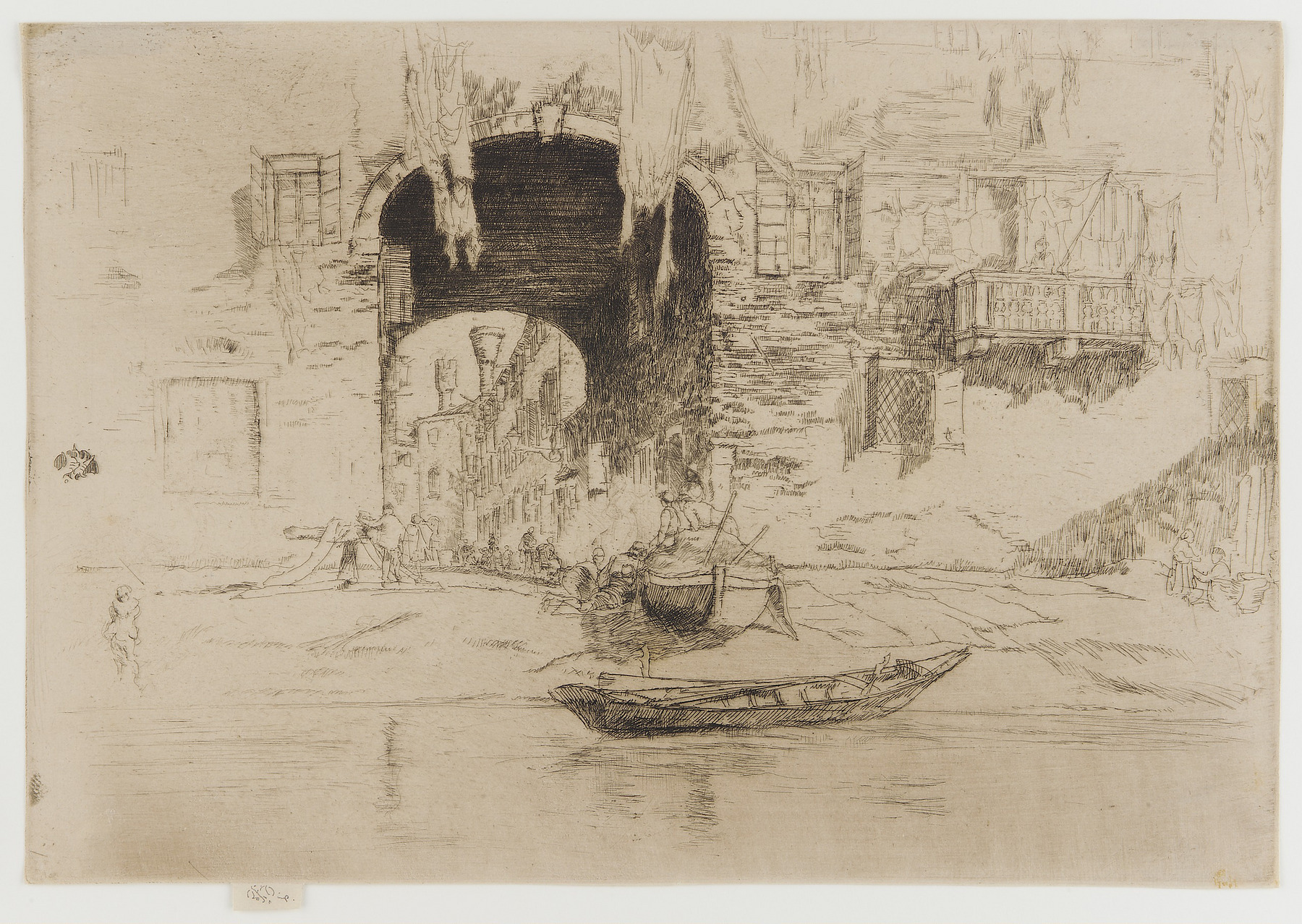
The Fine Art Society commissioned twelve Venice etchings in 1879 and funded Whistler's journey at a moment when bankruptcy had narrowed his alternatives. The commission was bounded; it did not authorize an unlimited edition or predict how long he would remain. Whistler stayed far beyond the expected period and produced a much larger body of plates, drawings and pastels.[5][6][7]
That expansion created artistic wealth and commercial strain. The Society needed deliverable works and a saleable exhibition. Whistler tested plates, papers, ink and wiping, and treated differences between impressions as meaningful. The same variability that collectors valued made production slower and complicated expectations about a completed edition.[6][7]
Ernest George Brown and his colleagues relayed information, planned presentations and managed the gap between the artist's working rhythm and the firm's commitments. They should not appear as faceless paymasters. Their rooms, mailing lists, catalogues and administrative labour converted objects made in Venice and printed in London into an event for buyers.[1][6][15][16]
The Fine Art Society exhibitions of etchings and pastels monetized Venice through scarcity and arrangement. Individual plates could be compared as a set, while small works on paper gained force from their collective display. Printing, mounting, frames, wall colour and catalogue titles guided the buying eye.[6][7][16]
Disputes over delivery and presentation were therefore structural, not incidental. The Society had assumed commercial risk; Whistler wanted to protect the appearance and rarity of his work. The resulting friction demonstrates that a commission could finance experimentation without giving either side complete command of its outcome.[1][6][7]
Dowdeswell and the exhibition as sales instrument
Dowdeswell and Dowdeswell hosted Notes—Harmonies—Nocturnes in 1884 and participated in Whistler's market for small paintings and works on paper. The gallery supplied an address, rooms, staff and access to buyers. Whistler supplied not only objects but an encompassing visual programme.[1][2][16]
He designed wall treatments, controlled spacing, used distinctive titles and treated the catalogue as part of the encounter. This was aesthetic authorship and commercial strategy at once. A carefully tuned room separated his work from the mixed salon, made small pictures command attention and offered buyers the feeling of entering a coherent world.[2][16][19]
Frames performed similar work. Whistler developed profiles and colours intended to mediate between each picture and its wall. A frame identified the object as his product, but ownership limited his power. J. G. Potter and other owners could resist replacement, dispute a bill or retain a setting the artist disliked.[1][2][19]
Press management amplified the temporary display. Invitations, catalogues and arguments with critics created attention beyond the visitors who could attend. Whistler's provocative language often looks anti-commercial because it attacked vulgar judgment. In practice, controversy helped define a recognizable artistic identity in a crowded London market.[1][16][20]
The gallery was thus neither a neutral room nor a corrupting intrusion between maker and viewer. It was a co-produced instrument whose architectural and administrative resources Whistler bent toward his own presentation.[2][16]
The one-man exhibition also changed the unit offered for judgment. Instead of competing with hundreds of artists, Whistler could surround visitors with repeated titles, tones and frames. A small panel that seemed slight in isolation could operate as one note in an ensemble. The sales instrument was therefore a theory of viewing: value accumulated through relation as well as scale.[1][2][16]
This strategy did not guarantee purchases. Some visitors came to inspect a notorious personality, reviewers could mock the room, and owners of loaned works retained their property afterward. Spectacle made attention available; dealers still had to convert that attention into inquiries, agreements and payment.[1][16][20]
Goupil, David Croal Thomson and an international market
Boussod, Valadon and Company operated the Goupil Gallery network linking London and Paris. David Croal Thomson directed the London branch from 1878 to 1896 and handled many Whistler works. Corporate identity, gallery name and individual manager should remain distinct: “Goupil” does not mean that every decision came from one person or one city.[1][9][16]
The firm published six lithographs as Notes in 1887. Publication organized the technical collaboration of artist, printer and dealer into a named group for sale. Paper, impression quality and edition structure mattered because lithographs were multiples whose differences collectors scrutinized.[8][9]
In 1892 Goupil staged Nocturnes, Marines and Chevalet Pieces. The exhibition extended Whistler's integrated presentation into a major commercial venue and gathered small works into an argument about finish and value. Thomson coordinated loans, owners, catalogue information and sales while negotiating the artist's detailed demands.[1][2][9]
He was an operational ally, promoter and correspondent, not Whistler's obedient servant. Dealer records reveal work that artistic rhetoric hides: tracing owners, securing availability, moving objects, answering clients and reconciling dates. They also reveal the dealer's interested perspective, since a successful exhibition strengthened Goupil's own standing.[1][9][20]
Goupil's trade in photographs, albums and reproductions placed Whistler within a broader visual economy. Even when he sought tight control over images of his works, the international firm's channels supplied audiences beyond the unique object's location.[8][9][16]
The public purchases of 1891
In 1891 Arrangement in Grey and Black No. 1, the portrait of Whistler's mother, was purchased for the French state and placed in the Luxembourg. Maurice Joyant and David Croal Thomson were among the advocates and intermediaries who helped make the acquisition possible. Recognition was negotiated through relationships, not bestowed automatically by the picture's quality.[1][9][17]
In the same year Glasgow Corporation purchased Arrangement in Grey and Black No. 2: Portrait of Thomas Carlyle. It was the first painting by Whistler bought for a public collection. The Scottish acquisition had its own local advocates, committees and institutional circumstances and should not be merged with the French transaction.[2][18]
Together, the purchases changed the terms in which dealers and collectors could discuss Whistler. A work accepted into a national French collection and another bought by a British municipal collection supplied public validation that private enthusiasm alone could not. They could affect confidence and price expectations without creating a simple official consensus.[2][17][18]
The year also demonstrates why a museum is not merely a collector with a building. Public money, administrative approval, access obligations and institutional custody altered the transaction. The works entered frameworks governed by civic or state decisions rather than one owner's taste.[17][18][20]
There was no inevitable march toward this outcome. Different advocates could have failed, committees could have chosen other artists, and collectors might not have lent the relevant prestige. Public legacy depended on people, law, budgets and institutional priorities.[2][17][18]
Isabella Stewart Gardner as collector and museum maker
Isabella Stewart Gardner met Whistler through Henry James in London in 1879. She bought pastels and paintings, maintained contact and advocated possible American opportunities, including a mural proposal for the Boston Public Library and interest in finding a buyer for the Peacock Room. Not every proposal became a completed commission, which is precisely why advocacy should be separated from purchase.[1][13][14]
By 1896 Gardner owned more works by Whistler than by any other painter. Her collecting was selective rather than comprehensive. She placed his objects among historic European art, textiles, furniture and architecture, creating visual relationships that the artist had not necessarily prescribed.[13][14]
Her museum installation was authored interpretation. Position, light and adjacency made Whistler part of Gardner's own aesthetic argument. This differs from a catalogue raisonné, which organizes an artist's output, and from a dealer exhibition, which ordinarily anticipates sales. She designed a durable experience around a personal collection.[13][14]
Gardner's role also corrects a masculine account of the market. Aglaia Coronio, Frances Leyland, Beatrix Whistler and Anna Whistler likewise displayed work, relayed messages, managed households or participated in sales. Their financial and social capacities differed, but none should be treated merely as the wife or relative of a male collector.[1][2][13][15]
Collectors could preserve art and evidence together. Receipts, letters, frames and installation records help reconstruct transactions. Yet preservation was selective. What entered Gardner's museum acquired protection and visibility; what she declined or later rearranged followed another history.[13][14][20]
American print collectors and dealer networks
Whistler's American market developed through print study as well as major paintings. Etchings were portable and available at several price levels, while their states, papers, ink and wiping rewarded close comparison. A collector could build connoisseurship impression by impression.[7][20]
Howard Mansfield and Howard Whittemore helped form this audience. Their collections, advice and connections allowed prospective buyers to see groups that no ordinary exhibition kept together. Mansfield's display of Whistler etchings in 1887 gave Charles Lang Freer the encounter from which his own collecting accelerated.[10][11][15]
Freer bought the Second Venice Set the next day. The sequence illustrates social proof without reducing the decision to imitation. Mansfield supplied access and a framework for looking; Freer made a rapid purchase and then developed a distinct philosophy of collecting.[10][11]
Edward Guthrie Kennedy and H. Wunderlich and Company promoted Whistler's prints in the United States, connected buyers and handled objects. Their expertise helped distinguish impressions and maintain a market across the Atlantic. An American collector did not need to negotiate every state directly with the artist in London or Paris.[1][7][15][16]
Print scarcity was constructed but not necessarily false. A copper plate could yield many impressions, yet changes of state, deliberate cancellation, paper and printing created meaningful differences. Signatures and provenance could further differentiate sheets. At the same time, posthumous reprinting or contested attributions threatened the boundaries collectors valued.[7][8][20]
The network consequently produced knowledge as well as prices. Catalogues, annotations, correspondence and collections preserved comparative evidence. Dealers and collectors were interested witnesses, but their records remain indispensable when read against objects and other documents.[1][7][20]
American collecting also altered the direction of expertise. London and Paris remained essential supply centres, but Mansfield, Kennedy, Whittemore and Freer did not merely receive European judgments. They compared impressions, assembled sequences and sent questions and advice back across the Atlantic. A mature market became a conversation among collections rather than a one-way export trade.[1][10][15]
Works on paper made this conversation materially demanding. Two impressions from the same plate could differ in ink film, burr, paper tone or wiping. Reputable dealers had to describe those differences and collectors had to learn to see them. Connoisseurship could support exclusivity, but it also preserved technical information later cataloguers use to reconstruct printing histories.[7][8][20]
Charles Lang Freer: patronage, patience and a national legacy
Charles Lang Freer first met Whistler in London in March 1890. Their relationship grew through purchases, commissions, advice, hospitality and correspondence. Freer became Whistler's most consequential American collector, but the connection was not a simple exchange of money for promptly delivered pictures.[10][11]
The Little Blue Girl makes the delay visible. Freer commissioned and paid for the work in 1894, yet delivery came years later. His patience protected the relationship and gave Whistler working freedom; it also left the patron waiting for an object he had funded. Trust, not an ordinary retail timetable, held the transaction together.[10][12]
Freer supported Beatrix during illness and engaged with the couple's circumstances beyond buying. Whistler in turn advised Freer's eye and encouraged relationships among works. Friendship did not erase the economic structure, and payment did not make friendship unreal. The categories coexisted.[10][11]
Freer assembled nearly seventy oil paintings and a remarkably comprehensive body of prints, drawings and related material. The National Museum of Asian Art now holds more than 1,300 works by Whistler. The difference between Freer's original counts and current institutional totals must remain clear, since later cataloguing and holdings produce the larger figure.[10][11]
Whistler was only one part of Freer's programme. Freer placed his work in relation to Asian painting and ceramics and to selected American artists. Conversation with Whistler contributed to this comparative aesthetic, but Freer's philosophy became his own. The collection should not be described as a monument to one artist.[10][11]
The Peacock Room entered this programme after its Leyland history. Freer acquired it, installed it in his Detroit house and ultimately made it part of the Washington institution. The movement joined two very different patrons: Leyland had commissioned a domestic dining room; Freer collected the completed interior as a work and comparative setting.[4][11][12]
Freer's 1906 gift and bequest arrangements with the Smithsonian led to a purpose-built national art museum. This was not the natural destination of private collecting. It required his decisions, federal acceptance, architectural planning and rules governing the collection. Personal taste became public legacy through law and institution.[10][11]
The restrictions that protected Freer's vision also limited later curatorial freedom. A museum founded from one collector's programme inherits both extraordinary concentration and the boundaries of selection. That tension is part of the legacy: preservation depends on rules, while interpretation continues around them through cataloguing, exhibitions and comparison with other collections.[10][11]
Late buyers, resale and the limits of control
Alfred Atmore Pope and Arthur Jerome Eddy were among American buyers who collected Whistler during the later career. They corresponded, compared works and participated in a market where the artist's reputation was increasingly international. Potter Palmer's activity around the Leyland sale provides another instance of American capital entering British provenance.[1][2][15]
Richard Albert Canfield became a major late collector and portrait patron. His gambling-business reputation belongs to his biography, but it cannot substitute for evidence about particular purchases or the portrait transaction. Moral notoriety neither authenticates nor invalidates collecting judgment.[1][2][15]
Whistler cultivated such buyers through advice and controlled availability. He encouraged the idea that pictures, prints and decorative objects formed harmonies rather than miscellaneous holdings. A collector purchasing a group could see himself as learning an advanced taste inaccessible to a casual buyer.[1][2][10]
Control remained aspirational. Owners refused loans, retained unwanted frames, resold works and contested bills. Dealers pressed for deliveries and usable catalogues. Collectors could be patient, but patience had limits. Once title passed, Whistler's aesthetic claim over an object did not always match the owner's legal power.[1][2][19]
Resale was especially double-edged. A strong auction result could publicize demand and make existing owners proud, yet the artist usually received no share. A weak result could damage expectations. Provenance therefore records transfers through debt, inheritance, auction and gift, not a prestige parade of famous names.[2][5][20]
Nor did collectors always secure the artist's intended legacy. They could preserve rare proofs and correspondence, but they could also support reprinting, separate ensembles or accept doubtful attributions. The museum catalogue and technical study remain necessary because ownership history alone does not settle authorship.[7][8][20]
Frequently Asked Questions
There is no single answer across the whole career. Frederick Leyland enabled major portraits and the Peacock Room before becoming a creditor. The Fine Art Society financed Venice. Charles Lang Freer became the most consequential American patron and collector and carried a vast group into the Smithsonian.[4][5][6][10][11]
Whistler's market was not an external force acting on a solitary maker. It was part of how the art came into public existence. A plate needed printing and distribution; a nocturne needed a frame and wall; a one-man show needed rooms, catalogues and loans. His aesthetic decisions reached viewers through other people's labour and property.[1][7][16][19]
The relationships were productive because they were unequal and negotiated, not because everyone agreed. Leyland's house made a total interior possible and his ownership limited Whistler's authority. The Fine Art Society's money enabled Venice and its deadlines generated conflict. Goupil's international system amplified Whistler while requiring information and deliverable works. Gardner and Freer preserved objects by placing them within interpretations of their own.[4][6][9][10][13]
Collecting then carried private decisions into public history. The French and Glasgow purchases of 1891, Gardner's museum and Freer's Smithsonian gift were contingent acts. Advocates persuaded institutions; collectors selected what to protect; law determined custody. Other works continued through auction, inheritance and debt.[2][11][14][17][18]
Whistler's insistence on autonomy should therefore be read as a practice rather than a description of isolation. He performed authority by naming, arranging, pricing and disputing inside a system he could influence but never own. Patronage and commerce did not disprove his agency. They supplied the resistant material through which he exercised it.[1][2][20]
Discussion
How did Whistler perform artistic autonomy inside a market he could influence but never fully control?
Distinguish commissions, sales, credit, loans, auctions, gifts and public acquisitions while tracing the labour and property behind each object.
Reader Insights
What legal and financial form did each transfer take?
Who supplied rooms, credit, transport, publicity and audiences?
How did private collecting become public interpretation?
Join the Conversation
Share a source-specific observation or question.
References
- Margaret F. MacDonald, Patricia de Montfort and Nigel Thorp, eds., The Correspondence of James McNeill Whistler, 1855–1903, University of Glasgow, https://www.whistler.arts.gla.ac.uk/correspondence/
- Margaret F. MacDonald and Grischka Petri, eds., The Paintings of James McNeill Whistler: A Catalogue Raisonné, University of Glasgow, https://www.whistlerpaintings.gla.ac.uk/catalogue/
- Andrew McLaren Young, Margaret F. MacDonald, Robin Spencer and Hamish Miles, The Paintings of James McNeill Whistler, Yale University Press, 1980.
- Linda Merrill, The Peacock Room: A Cultural Biography, Yale University Press, 1998.
- University of Glasgow, “Bankruptcy” and associated legal and financial records, The Paintings of James McNeill Whistler, https://www.whistlerpaintings.gla.ac.uk/catalogue/essaydisplay/?eid=bankruptcy
- Margaret F. MacDonald, Palaces in the Night: Whistler in Venice, University of California Press, 2001.
- University of Glasgow, First and Second Venice Set histories, The Etchings of James McNeill Whistler, https://etchings.arts.gla.ac.uk/catalogue/sets_texts/
- University of Glasgow, The Lithographs of James McNeill Whistler, catalogue and edition histories, https://etchings.arts.gla.ac.uk/lithographs/
- University of Glasgow, “Boussod, Valadon et Cie” and David Croal Thomson correspondence and biography, https://www.whistler.arts.gla.ac.uk/correspondence/people/biog/?bid=Bous_E&initial=
- Linda Merrill, ed., With Kindest Regards: The Correspondence of Charles Lang Freer and James McNeill Whistler, Smithsonian Institution, 1995.
- National Museum of Asian Art, Freer archive, collection histories and “Freer and Whistler: Points of Contact,” Smithsonian Institution, https://asia.si.edu/whats-on/exhibitions/freer-whistler-points-of-contact/
- National Museum of Asian Art, The Little Blue Girl commission history and Peacock Room records, Smithsonian Institution, https://asia.si.edu/?p=39406
- Linda J. Docherty, “Transatlantic Correspondence: James McNeill Whistler and Isabella Stewart Gardner,” in Whistler 2003: An International Symposium, University of Glasgow, https://www.whistler.arts.gla.ac.uk/whis2003/conference/abstracts/
- Isabella Stewart Gardner Museum, Isabella Stewart Gardner biography and Whistler collection records, https://www.gardnermuseum.org/story/isabella-stewart-gardner-life
- University of Glasgow, biographical entries for Frederick Leyland, Charles Augustus Howell, William Cleverly Alexander, the Ionides family, Ernest Brown, Alfred Atmore Pope, Howard Mansfield, Edward Guthrie Kennedy and Richard Canfield, The Correspondence of James McNeill Whistler.
- Fine Art Society, Dowdeswell, Goupil and H. Wunderlich exhibition and dealer records, as catalogued by the University of Glasgow.
- Musée d'Orsay, Arrangement en gris et noir no 1 collection record, and University of Glasgow YMSM 101 and Goupil correspondence concerning the 1891 French purchase.
- Glasgow Museums, Arrangement in Grey and Black No. 2: Portrait of Thomas Carlyle collection record, and University of Glasgow YMSM 137.
- University of Glasgow, “Whistler's Frames,” The Paintings of James McNeill Whistler, https://www.whistlerpaintings.gla.ac.uk/catalogue/essaydisplay/?eid=frames
- University of Glasgow, “Researching Whistler's Paintings” and catalogue methodology, https://www.whistlerpaintings.gla.ac.uk/catalogue/essaydisplay/?eid=research


