


 by Tom Gurney
Tom Gurney BSc (Hons) is an art history expert with over 20 years experience
Published on November 6, 2026 / Updated on November 6, 2026
Email: tomgurney1@gmail.com / Phone: +44 7429 011000
James McNeill Whistler made delicacy through physical means that were often strenuous, unstable and subject to revision. A nocturne may look as if mist settled on its support in one breath, yet its surface can preserve prepared grounds, fluid and paste-like paint, abrasion, later retouching and the consequences of ageing. A portrait whose tones seem inevitable may have demanded prolonged sittings and repeated scraping. Even the gold boundary around a canvas can belong to a sequence of redesigned, repainted or regilded frames rather than a neutral museum accessory.[1][3][4]
There is no single Whistler technique. He worked across half a century, used canvas, wooden panels, millboard and many kinds of paper, and adjusted his handling to portraits, seascapes, small studies, decorative schemes and prints. Commercially prepared materials existed beside artist-modified grounds. Broad brushes, pointed touches, knives or rigid tools, rubbing and incision could appear within one painting. The restricted harmony visible from a distance might contain a materially diverse palette when examined closely.[1][6][7]
Technical study makes that variety legible, but it has limits. An X-radiograph, pigment sample or conservation report describes a particular object under particular conditions. It cannot turn one examined picture into a recipe for all the others. Nor is present appearance identical with the surface that left Whistler's studio. Paint becomes more transparent, varnish yellows, canvas is lined, frames are altered and treatments leave histories of their own. Understanding Whistler's material practice therefore means holding visual effect, physical evidence and uncertainty together.[2][6][9]
At a Glance
- PracticeChanged by date, object, support, scale and effect
- SupportsCanvas, panel, millboard and many papers
- GroundsCommercial and artist-modified preparations
- HandlingWet-in-wet, dry brush, fluid paint, paste, scraping and incision
- PaletteRestricted appearance can contain materially diverse pigments
- NocturnesThinness does not prove speed or one universal recipe
- PortraitsRepeated sittings, rubbing, scraping and reconstruction
- ButterflySignature and design element, not a date by itself
- FramesFunctional, visual and historically changing objects
- ConservationEvidence is bounded; condition is not original appearance
Contents
- From Academic Training to Material Experiment
- Supports: Canvas, Panel, Board and Paper
- Grounds and the Construction of Tone
- Drawing, Blocking In and Revision
- Brushes, Knives, Rubbing and the Varieties of Paint
- Palette, Pigments and the Myth of a Secret Formula
- Nocturnes: Fluidity, Economy and Accumulated Labour
- Portraiture: Sittings, Scraping and Delayed Resolution
- Watercolour, Pastel and Drawing
- Print Processes Are Materially Separate
From Academic Training to Material Experiment
Whistler learned within European academic and Realist traditions. Early work could involve careful preparation, substantial paint and the tonal weight associated with French painting of the 1850s. Those foundations did not simply disappear when his palette grew quieter. Drawing, measured placement and the construction of a figure remained available to him even as he rejected detailed narrative and developed flatter, more selective compositions.[1][13]
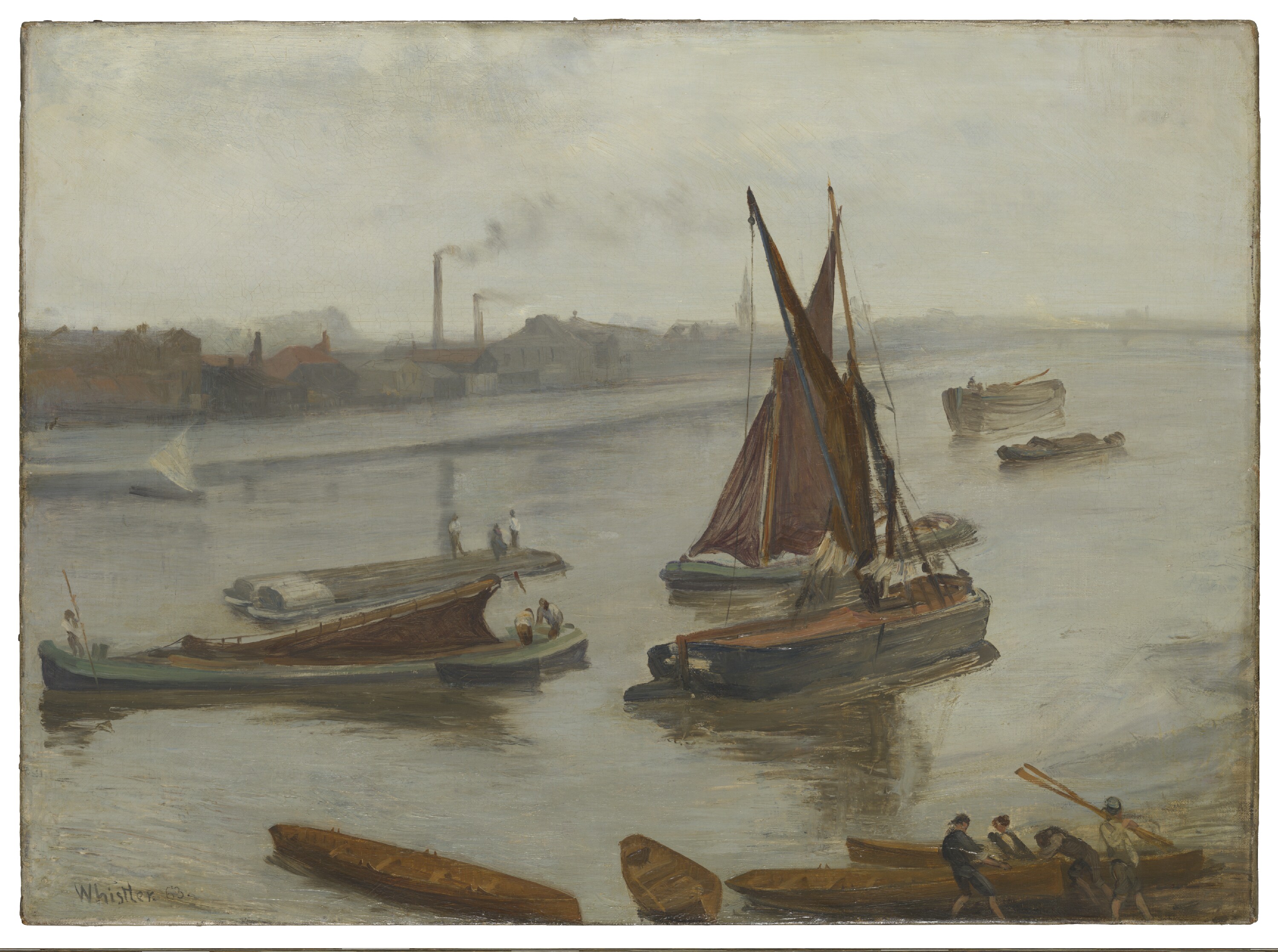
Grey and Silver: Old Battersea Reach of 1863 offers a useful early technical case. Examination at the Art Institute of Chicago found a relatively coarse plain-weave canvas prepared and stretched by Winsor & Newton. Whistler used paint of several consistencies: smooth layers, marked paste, fluid shadows, dry-brush effects and low impasto. Some passages expose the off-white commercial ground, while others are blended, scraped or incised. The river view is unified in tone without being uniform in application.[7]
Two years later, Trouville (Grey and Green, the Silver Sea) shows a different economy. Long horizontal bands of thin grey-green and grey-blue paint reinforce the canvas surface while describing sea and sky. Its support has a notably thick, three-layer lead-white-based ground; analysis leaves open whether Whistler added to commercial preparation. The sparse composition and close values make the material overlap of translucent paint and ground essential to the view.[6][8]
These examples trace a change, not a clean conversion. The earlier Battersea painting already combines thin and thick handling, and the Trouville canvas still depends on multiple layers and deliberate construction. Across Whistler's career, a light effect might require a loaded touch, a dragged brush or an exposed preparation. Chronology helps, but the individual object remains the authority.
The exceptional survival of material associated with Whistler is one reason comparisons can extend beyond finished pictures. The Hunterian holds more than eight hundred of his works together with tools, materials and papers derived from the artist's estate through Rosalind Birnie Philip. That collection can connect an object to the practical world in which it was made, though an item surviving in the studio at Whistler's death cannot automatically be assigned to every earlier canvas. Estate provenance establishes availability and context; direct analysis establishes use.[5]
Change was also responsive to purpose. A large commissioned portrait required different control of drying, proportion and repeated access to a sitter than a small coastal panel carried outdoors. An exhibition-bound watercolour needed mounting and framing decisions unlike an etching intended to be printed in several states. Whistler's aesthetic preference for unity ran through these activities, but unity was achieved by adapting technique rather than imposing one procedure.
Supports: Canvas, Panel, Board and Paper
The support is the material that physically carries an image. For an oil painting it may be woven fabric stretched over a wooden stretcher, a wood panel or a manufactured board. Paper can be the primary support for watercolour, pastel, drawing and lithographic transfer, or it can be mounted to another material. These distinctions affect absorbency, flexibility, texture, scale and survival. “Oil on canvas” is therefore not a complete technical description, and “work on paper” is not one material category.[1][6][14]
Nineteenth-century artists could buy canvas in standard formats with a ground already applied. The Winsor & Newton stamp on Old Battersea Reach identifies its supplier, while its proportions approximate a French standard landscape size. Such evidence connects Whistler to an international trade in artists' materials, but it cannot be carried onto an unstamped canvas. Tacking edges, selvage, thread count and weave distortions can help conservators assess original dimensions and later changes.[6][7]
Rigid supports offered other possibilities. Nocturne in Black and Gold: The Falling Rocket is painted on panel rather than canvas. The Detroit Institute of Arts records an unframed size of roughly 60.3 by 46.7 centimetres. A panel does not flex like fabric and can accept very thin paint differently, though wood has its own response to humidity and structural stress. Millboard and related paper-based boards appear in smaller works, where portability and a ready surface could support rapid study.[1][6][12]
The back of a painting can be as informative as its front. Supplier stamps, old labels, stretcher marks, added strips, tack holes and inscriptions may clarify date, scale, exhibition or treatment. Lining—the attachment of a secondary fabric to the reverse of an original canvas—can strengthen a weakened support but also flatten texture, introduce adhesive or change how dark layers are perceived. A stretcher keeps canvas under tension; it is not the decorative frame surrounding the picture.[2][9]
The National Gallery of Art's systematic catalogue records Symphony in White, No. 1 on a coarse plain-weave fabric that has been lined, perhaps during treatment in 1892. X-radiography and infrared examination disclosed no major underlying composition, a result that narrows one question without proving an untouched first conception. Its current holder identifies the work as oil on canvas and preserves the modern object record; technical notes add support and treatment history. Using the records together prevents a famous title or reproduction from floating free of the physical canvas.[9][10]
Dimensions may also have histories. Edges can be folded, cut, extended with fabric or wood strips, and later hidden by frame rebates. A change in stretcher does not necessarily change the painted area, while trimming can remove cusping or original margins. Measurements should specify whether they refer to the unframed support, sight size or framed ensemble. Small discrepancies between catalogues may reflect method rather than a different object.
Paper requires a separate vocabulary. Fibres, manufacture, surface sizing, colour and thickness influence the movement of watercolour or chalk. A sheet's natural tone may function as a middle value, with dark marks and pale opaque additions moving in opposite directions. Reserve—the deliberately unpainted paper—can produce light without white pigment. Mounting, old hinges and exposure history become part of the object's condition and should not be mistaken for Whistler's original design.[1][14]
Grounds and the Construction of Tone
Between support and image lies the ground, a preparatory layer that isolates and modifies the surface. Whistler often used commercially primed supports, but he could add another coat or work on preparations of different colours and absorbencies. Off-white, grey, brown or red grounds do more than prevent oil from entering canvas. They establish a starting tone against which every subsequent value is judged.[3][6]
A mid-grey ground can remain visible between strokes and knit an image together. If sky and water are laid in thinly, small exposed intervals prevent the painting from becoming a mosaic of separate marks. A warm preparation can influence cool paint above it, while a pale ground can give luminosity to translucent layers. The effect depends on layer thickness, pigment, binder and later change; “painted on grey” is only the beginning of the explanation.[3][6][8]
Absorbency matters because it controls how quickly a stroke loses oil and becomes matt or “sinks”. An absorbent surface can help a painter obtain dry, veil-like effects and reduce gloss, but it may also make layers underbound or visually uneven. Whistler's later portraits sometimes used very absorbent preparations. That choice belongs to the desired surface and to the painting's future vulnerability: a thin, lean passage above a dark ground can change markedly as materials age.[6]
The three-layer ground found on Trouville demonstrates why cross-sections are valuable. Microscopic samples and instrumental analysis show successive lead-white-based preparations with differing fillers. Their cumulative thickness probably contributed to brittleness and the painting's unusual cracking. The observation is specific to that canvas; it is not evidence that Whistler habitually used three coats or sought cracks as an effect.[6][8]
Ground can also be confused with underpaint. A commercial preparation belongs to the supplied support; an artist-applied overall toning layer may sit above it; a rough lay-in establishes shapes; later paint defines the visible image. Scientific layer diagrams make these distinctions possible in sampled areas, but not every border is clear. Conservators combine cross-sections with surface examination, imaging and documentary records rather than relying on one test.[2][6]
Opacity changes the ground's role. Lead-white-rich paint may conceal preparation when newly applied, then become slightly more translucent as its oil medium ages. A dark or coloured layer below can consequently become stronger. The reverse can happen visually when old varnish fills surface irregularities and saturates dark paint. These material shifts help explain why a historic photograph, current gallery view and cleaned detail may appear to describe different tonal schemes without any deliberate repainting.
Preparation also determines the character of an edge. On a smooth, moderately non-absorbent surface, fluid colour can travel and level; on a toothy or absorbent ground, the same brush load breaks and catches. Whistler's apparently atmospheric edges are therefore meetings of gesture and surface. Their softness should not automatically be attributed to blurred eyesight, weather or solvent when ground structure offers a material explanation.
Drawing, Blocking In and Revision
Whistler did not follow one preparatory sequence. Some paintings preserve evidence of graphite, charcoal or crayon beneath paint; others show little detectable underdrawing. A composition might be established through a few linear indications, broad tonal masses or direct brushwork. Infrared examination can reveal carbon-rich marks beneath some layers, but a negative image does not prove that no drawing existed: the material may be invisible to the method or covered by opaque paint.[3][6][9]
Blocking in means establishing the main masses before details. In Old Battersea Reach, figures were rapidly placed with thin dark-brown paint before selected forms were clarified. Broad marks for water and sky could cross or cover earlier work. Fine brushes then supplied rigging and small accents. Such sequencing allows the whole to be judged early while leaving local decisions open.[7]
Revision was not an embarrassment to Whistler's method. Paintings were rubbed, scraped, repainted and sometimes returned to after long intervals. Removal could lower an unsatisfactory passage to the ground, soften a contour or create a broken texture that new paint absorbed. The visible thinness of a portrait may therefore record subtraction, not merely swift initial application. Documentary accounts of exhausting sittings make that distinction especially important.[1][3]
Technical examination can identify some changes. X-radiography records differences in the absorption of radiation, often making lead-rich paint and altered forms visible. Infrared may disclose underlying carbonaceous drawing; transmitted light can show thinness and losses; raking light reveals texture. Yet an apparent shape below the surface must be interpreted. It may be an abandoned pose, a reused support or simply a dense stage of the same form.[6][9]
Whistler also continued to alter works after exhibition or sale negotiations. A title and historical photograph may describe an earlier state that differs from the surviving canvas. Reworking complicates date, palette and finish: the object can contain campaigns separated by years. A technical narrative should identify those campaigns where evidence permits rather than compressing them into a single moment of inspiration.[1]
Reused supports require especially careful language. An X-radiograph may show an earlier figure beneath a later portrait, but overlapping densities can be difficult to separate. Documentary reference to scraping does not prove that another complete image lies underneath. Conversely, a support may be rotated, reduced or repurposed without leaving an easily readable buried composition. A claim of reuse is strongest when imaging, edge evidence and historical records agree.
Revision can be visible without instruments. A contour may be ghosted by a thin covering, a scraped patch may interrupt the weave, or a later stroke may sit with different gloss above a dry layer. These are often called pentimenti—visible changes made by the artist—but not every irregularity qualifies. Damage, retouching or an altered varnish boundary can mimic a change of mind. Layer sequence and material compatibility decide the attribution.
Brushes, Knives, Rubbing and the Varieties of Paint
Whistler's handling ranged from long, nearly continuous sweeps to minute points. On a seascape, a horizontal brush could connect water across the entire width; in a portrait, vertical strokes could reinforce the fall of a dress. Smaller pointed brushes articulated eyes, fingers, rigging or the butterfly. Brush size inferred from a mark describes the tool's contact width at that moment, not a fixed studio kit.[7][8]
Paint consistency was equally varied. Paste-like oil retains ridges and records bristle pressure. Fluid paint levels, runs or spreads into adjacent layers. Dry brush catches the high points of a textured surface and leaves broken colour. Wet-in-wet application blends new strokes into paint that has not set; wet-over-dry preserves clearer boundaries between sessions. Whistler combined these behaviours instead of choosing a single signature touch.[3][7]
Rigid tools expanded the range. A knife could spread or remove paint; the end of a brush or another point could incise a wet passage. On Old Battersea Reach, examination found scraped lines breaking the dark shadows of boats. Smoothed areas may have involved a knife, another rigid implement or even fingertip contact, though responsible description preserves that uncertainty. The tool is inferred from the trace, not witnessed.[7]
Rubbing differs from scraping even when both remove material. Abrasion can soften transitions or expose a mottled underlayer, while a blade produces a more directed edge. Cleaning damage caused decades later can also abrade a surface. Conservators distinguish artist's working marks from later loss through their relation to original layers, old photographs, varnish and retouching, but certainty is not always possible.[1][3][6]
The variety explains why reproductions can mislead. A digital image may flatten the difference between a thin veil and bare ground, or make an old glossy varnish look like rich paint. Scale changes turn a small touch into a broad patch. Close viewing, raking light and technical photography reconnect tonal restraint with the physical actions that made it.
Palette, Pigments and the Myth of a Secret Formula
A restricted palette is a visual strategy, not proof that a painting contains only two pigments. Old Battersea Reach appears governed by greys and subdued river colours, but analysis identified lead white; red and yellow iron-oxide or earth pigments; umber; vermilion; cobalt blue; viridian; bone black; and probable red lakes in local areas. Those materials were mixed, layered and exposed in proportions that produced restraint.[7]
The list must remain attached to the object. Instrumental analysis samples selected points and may miss a pigment used elsewhere. Historical colour names also do not map neatly onto chemical identities. “Blue and silver” is a title describing relationship and effect, not a materials invoice. Conversely, finding many pigments does not mean a picture was intended to look colourful; mixtures can neutralise one another.
Whistler's fluid oil paint is often associated with “sauce”, a studio word preserved in recollection. It should not be treated as one secret recipe poured over every nocturne. Technical literature cited by the Art Institute notes analysis of palette material suggesting stand oil, mastic resin and small quantities of a lead drier in one relevant mixture, while historical accounts also mention thinning agents. Components and proportions likely varied between paintings and purposes.[6]
Each ingredient behaves differently. Oil binds pigment and forms a film; a volatile solvent changes working viscosity and then evaporates; resin can alter flow and gloss; a metal compound can accelerate drying. Adding too much fluid medium can encourage runs, wrinkling, uneven saturation or later darkening. Without analysis, calling a passage “turpentine-thinned” or “resinous” turns an appearance into an unsupported recipe.
Whistler's achievement lies less in an exotic substance than in control of consistency. He could make a broad stroke cover, stain or skip; allow ground to participate; reinforce one accent after surrounding paint dried; or abrade a passage until it settled into the whole. Material knowledge becomes visible as adjustment. The mythology of one formula distracts from that responsive practice.
Pigment names also carry histories of manufacture and risk. Lead white gave covering power and useful drying properties but is toxic; vermilion supplied a strong red; cobalt blue and viridian expanded the nineteenth-century palette beyond traditional earths. Bone black and umber could slow or modify mixtures. These properties help explain choices, yet modern safety knowledge should not be turned into a claim that Whistler pursued a colour because of one chemical behaviour. Artists bought prepared colours, combined them and judged results through practice.
Some colour changes are pigment-related, others arise from medium, coating or environment. A red lake can fade; a resin coating can yellow; a dark mixture can become harder to distinguish as adjacent values shift. Instrumental identification does not by itself reconstruct original colour. Conservators compare protected edges, cross-sections, light-ageing knowledge and early descriptions, then state a range of probability rather than digitally “correcting” the work to certainty.
Nocturnes: Fluidity, Economy and Accumulated Labour
Nocturnes encouraged the legend of effortless speed. Their sparse lights and close tones can look instantaneous, and the Ruskin trial made the duration of execution a public issue. But the time required to apply a visible layer is not the full labour of a painting. Preparation of support and medium, repeated observation, failed versions, drying intervals, abrasion, framing and accumulated judgement all sit outside a simple count of hours.[1][3]
Nor are all nocturnes technically alike. Some are on canvas, others on panel or paper. Grounds vary in colour and absorbency. A fluid sky may be followed by thicker lights; a dark field may be rubbed down; an image may have been revised after first exhibition. The Detroit panel carrying The Falling Rocket supplies one set of facts, not a template for Chelsea, Southampton Water or Venice.[1][12]
Economy is nevertheless real. Whistler learned how a few value changes could establish depth: a darker strip for shore, a vertical accent for mast, a pale interruption for water or sky. Fluid paint allowed long connections without fussy edges. Small lights gained extraordinary force because surrounding contrasts were suppressed. The method makes each accent structurally consequential; an insensitive retouch or yellowed coating can therefore disturb more than its physical size suggests.
Atmosphere also depends on surface. Matt and glossy passages reflect light differently. Ageing resin or oil can make a shadow warmer and more opaque, while increased transparency can allow a dark preparation to dominate. A nocturne seen today may be darker, flatter or more contrasty than it was when exhibited. Technical study does not remove its mystery; it identifies some of the material conditions now producing it.[6]
Portraiture: Sittings, Scraping and Delayed Resolution
Whistler's portraits test the opposite myth: that refinement arrived through calm, continuous progress. Sitters and correspondence document prolonged campaigns, interrupted appointments and severe revision. A full-length figure had to work simultaneously as likeness, posture, tonal mass and relation to its surroundings. If one component failed, Whistler could scrape large areas and begin again.[1][3]
Arrangement in Grey and Black: Portrait of the Painter's Mother looks controlled because its large divisions have been resolved, not because every passage was easy. The current Musée d'Orsay object is oil on canvas, approximately 144.3 by 163 centimetres, acquired from Whistler in 1891. Its scale makes the coordination of profile, chair, curtain, print and floor a bodily undertaking. Current measurements and ownership come from the holder; claims about layer construction require technical and catalogue evidence beyond the concise museum record.[1][11]
An absorbent ground could help suppress shine and permit velvety darks, but it also made correction difficult. Repeated rubbing might leave a weakened, porous surface. Later oiling, varnishing or restoration could resaturate colour unevenly. The apparent softness associated with Whistler's late portraiture can thus belong partly to preparation, partly to handling, partly to removal and partly to ageing.[3][6]
Portrait technique also carries social history. Models held poses, returned for sessions and negotiated the demands of work. Clothing, props and background were chosen and adjusted. Treating a sitter merely as a patch of tone repeats the hierarchy of Whistler's most provocative rhetoric. Technical evidence brings labour back into the picture: both the artist's and the sitter's.
Watercolour, Pastel and Drawing
Whistler's works on paper do not reproduce oil technique at smaller scale. Watercolour uses water-soluble colour whose movement depends on paper sizing, wetness and previous layers. Transparent wash allows the sheet to illuminate colour from below; opaque watercolour or bodycolour covers more completely. Graphite, black chalk, coloured chalk and pastel create different edges and attachments to the fibres. Mixed media must be named rather than reduced to “drawing”.[1][14]
The tone of the paper can do much of the compositional work. On a coloured sheet, Whistler could establish dark contours and add pale highlights while leaving broad areas untouched. Sparse marks may describe a figure through interval rather than continuous outline. Pastel offers dry, velvety colour but remains vulnerable to rubbing; fixative can change saturation and texture. Watercolour can fade or shift under excessive light, while paper itself responds to humidity, acidity and poor mounting.[14]
Exhibition history affects survival. The Smithsonian's reconstruction of Whistler's 1884 presentation shows works on paper placed in substantial gold-toned frames without conventional mats, integrated into an environment of coordinated wall colour, furnishings and printed matter. That display demonstrates how strongly he wished small sheets to occupy architectural space. It does not mean the same mounting is safest for long-term preservation.[14]
Conservators balance intended presentation with material risk. Glazing can protect a fragile surface, spacers prevent contact, and low light slows fading. Old mounts may carry inscriptions or exhibition evidence even when acidic. Treatment must preserve documentary information along with image, support and medium. A stain is not automatically removable, and a flattened cockle is not always worth the intervention required.
Print Processes Are Materially Separate
Whistler's etchings and drypoints depend on metal plate, ink, wiping, paper and pressure, not on diluted paint. In etching, acid bites lines drawn through a resistant ground; in drypoint, a needle directly raises a burr that can print a soft edge but wears with repeated impressions. A plate can be reworked into states, and impressions from one state can differ through ink, wiping, paper and printing. “Original print” therefore names a process and object history, not a reproduction of an oil.[15]
Lithography is different again. Greasy drawing material establishes an image on stone or a prepared surface through the chemical opposition of grease and water. Transfer lithography allowed Whistler to draw on specially coated paper away from the heavy stone, after which a printer transferred and printed the image. Paper choice, transfer, presswork and professional collaboration shape the result.[16]
These distinctions matter on a page about technique because Whistler pursued related tonal effects without using interchangeable operations. A nocturne in lithotint, an etched Thames view and an oil nocturne may share economy and atmosphere, but scraper, acid, plate tone, fluid oil and watercolour wash belong to separate material chains. Their full plate, state and impression histories require print-specific treatment.[15][16]
The Butterfly: Signature, Date and Design
Whistler developed the butterfly from his initials during the later 1860s and used variants across paintings, works on paper, letters, frames and exhibition design. Its placement could balance another accent or complete an empty interval, so it functioned as more than a maker's name. On some surfaces it appears as part of the depicted world; elsewhere it reads as an emblem laid over it.[1][13][14]
The mark changed in outline, complexity and mood. Polemical contexts could turn its tail into a sting, joining elegance with aggression. Colour and scale were adjusted to surroundings. A butterfly on a frame extended authorship beyond the painted support, and a butterfly on a gallery wall could sign the installation itself.[4][14]
Because the form evolved, it can assist dating when combined with other evidence. It cannot date an object by itself. Whistler sometimes added or changed signatures later, retained an earlier written name, or applied a butterfly during reworking. Copies and Whistler-style frames also reproduce the emblem. Support, provenance, photographs, exhibition records and layer relation must confirm what the mark suggests.[1][2]
Frames as Part of the Work
Whistler treated frames as active transitions between picture and room. A frame protects edges and allows handling, but profile, width, ornament and surface also change perception. Pale gold can continue a muted harmony; a painted pattern can answer forms inside the canvas; reeds can establish rhythm. The boundary becomes an extension without ceasing to be a separate crafted object.[4]
His designs changed substantially. The frame catalogue distinguishes profiles and surfaces from the 1860s, painted types of the 1870s and later gilded and reeded designs. Basketweave, fish-scale, chequered and bamboo patterns describe particular constructions or decorations, not a single house style. The generic phrase “Whistler frame” is too broad when it treats every reeded moulding as equivalent.[4]
The frame for Harmony in Grey and Green: Miss Cicely Alexander shows the complexity. Its original wooden moulding survives, but the painted basketweave surface that related to the sitter's carpet was removed when the frame was scraped and regilded for an 1892 exhibition. Whistler intended to repaint ornament later. Is the frame original? Its structure is, its current surface belongs to a documented alteration, and the first designed relation is only partially visible.[1][4]
Other paintings passed through several frames selected or approved by Whistler. Later dealers, owners and museums also altered pairings. Frame scholars consequently record every known state while distinguishing changes made under the artist's direction from posthumous reframing. The first frame is not automatically the only meaningful one, and the last Whistler-approved frame may better express his mature presentation.
Surface examination helps. Moulding profile is harder to change than gilding and can provide a stable clue to type and date. Beneath later gold, conservators may find paint, patterns or earlier preparation. Labels and nail holes record use. Yet stripping a frame to expose an earlier state would destroy later history; documentation, imaging and selective analysis are safer than restoration driven by a fantasy of singular originality.[4]
Authorship is distributed across frame making. Whistler designed, selected colours, specified patterns and sometimes painted ornament, but professional carvers, joiners, gilders and suppliers converted decisions into objects. Correspondence names makers such as Frederick Henry Grau and records instructions about the tone of gold. Attributing a frame to Whistler should therefore describe his role rather than erase workshop labour. “Designed by Whistler” and “made by Grau” can both be true.[1][4]
The frame also connects picture to market and institution. A durable moulding protects during transport; a recognisable profile identifies the artist in a sales room; a museum replacement may accommodate glazing or security hardware. Such later requirements are legitimate parts of stewardship, though they differ from Whistler's aesthetic direction. Reversible fittings and complete records allow future scholars to understand the compromise.
Condition Is Not Original Appearance
Condition describes what has happened to an object, not whether it is aesthetically good. Cracks, cleavage, abrasion, tears, deformations, discoloured coatings, overpaint and frame loss all have different causes and risks. A stable old crack may require observation rather than treatment; lifting paint may demand urgent consolidation. The visible result is a compound of Whistler's materials, environment, handling and previous intervention.[3][6][9]
Oil paint changes as it cures and ages. Some films become more transparent, allowing a dark ground or earlier layer to exert greater influence. Oil or resin can yellow. Matt areas may remain porous while varnish saturates others. Lining adhesive can affect a thin painting from behind, and pressure during lining can flatten impasto. These processes are especially consequential when Whistler calibrated close values and sparse highlights.[6][9]
Varnish is a separate coating, not the paint binder. A natural-resin varnish may yellow and accumulate dirt, making cool harmonies warmer and reducing distinctions in dark passages. Removal can reveal colour but involves risk where original paint is soluble, underbound or previously abraded. Some Whistler surfaces were intended to be relatively matt, so a glossy coating can be historically inappropriate even if it seems to “enrich” colour.[3][9]
Cleaning is likewise not a return button. Earlier treatments may have removed glazes or left residues; later retouching can conceal damage. Conservators use ultraviolet fluorescence, magnification, solvents tests and documentary records to distinguish coatings and additions. Treatment aims for stability and a defensible visual reading, not an imaginary untouched state whose exact appearance is unknown.
Frames have condition histories too. Gilding wears at high points, bronze paint darkens, wooden joins open and decorative layers are overpainted. Since Whistler valued the frame-picture relation, an overly bright regilding can alter the ensemble as strongly as a yellowed canvas varnish. Conservation should examine the pair while documenting each component separately.[4]
Treatment decisions are shaped by significance as well as chemistry. A later varnish may be visually disruptive but historically associated with an exhibition supervised by Whistler. An old lining may obscure reverse inscriptions while providing necessary structural support. Removing either involves loss. Conservators develop options, test minimally, document condition before and after intervention and make the reasoning available to future custodians.
Preventive conservation often protects more evidence than active treatment. Stable temperature and relative humidity reduce movement in canvas, panel and frame. Controlled light limits fading of paper and sensitive colourants. Safe handling, backing boards and appropriate glazing reduce physical and environmental hazards. These measures are unobtrusive, but for thinly painted, delicately balanced works they preserve distinctions that an ambitious restoration could never reliably recreate.
How Technical Examination Works
Normal viewing begins the investigation. Conservators study the surface under even and raking light, examine edges and reverse, compare old photographs and read provenance or treatment records. Magnification distinguishes bristle marks, cracks, later fills and pigment particles. No instrument compensates for a poorly framed question.[2][6]
X-radiography records how materials absorb X-rays. Dense pigments such as lead white often appear light, revealing changes, concealed shapes, nail patterns or support structure. Infrared imaging can penetrate some paint and register selected drawing materials. Ultraviolet illumination may distinguish varnishes, retouching and surface coatings through fluorescence. Each produces an image that requires interpretation rather than a direct photograph of Whistler's intention.[6][9]
X-ray fluorescence spectroscopy identifies elements at analysed points. Detecting cobalt can support the presence of a cobalt pigment; mercury may indicate vermilion. But an element can occur in several materials, mixtures complicate interpretation and unsampled passages remain unknown. Cross-sections remove microscopic fragments, embed and polish them to show layer order. Scanning electron microscopy and related analysis can refine composition, but sampling is necessarily limited and must be justified.[6][7][8]
Thread-count mapping and weave analysis can connect canvas fragments, identify standard formats or examine distortions. Transmitted light reveals thin regions and losses. Raking light maps texture. Together, methods can test a proposition—for example, whether an apparent revision lies beneath the final paint or whether a ground consists of several layers. Agreement among techniques is stronger than a spectacular image read alone.
Documentary evidence remains another technical instrument. Bills can identify suppliers; letters may record a request for regilding; exhibition photographs show a frame or earlier paint state; treatment files describe materials added by a conservator. Memories written decades later are weaker than contemporary records but can suggest a question for examination. The strongest account reconciles document and object, acknowledging when each points in a different direction.[1][2][3]
Comparative study is most persuasive when the comparison is controlled. Similar weave and supplier marks may link supports bought together, while matching frame profiles can clarify workshop practice. Shared pigments alone prove little because many artists used the same commercial colours. A technical feature becomes historically meaningful through a cluster of evidence: date, provenance, format, layer order and documented access.
Material Intelligence and the Finished Ensemble
Whistler's refinement was not immaterial. It depended on the drag of a brush across preparation, the degree to which a sheet absorbed wash, the pressure that printed an etched plate and the gold surface that mediated canvas and room. His art could seem effortless because correction, reduction and construction had been absorbed into the final relation. Technical evidence restores those actions without reducing the picture to chemistry.
The same evidence also protects against legend. There was no single sauce that explains every nocturne, no butterfly that authenticates by itself and no generic frame that can be called original without history. An examined palette belongs to its sampled work. A thin passage may be swift, abraded or aged. A present harmony includes interventions Whistler never saw. Precision does not weaken the aesthetic effect; it shows how contingent and difficult that effect was to achieve.
Frames complete the lesson. Whistler understood a painting as an ensemble extending through boundary, wall and display, yet the ensemble continued to change after him. Conservation cannot freeze one ideal instant. It can stabilise material, distinguish documented states and make choices transparent. Seen this way, Whistler's technique is neither a theatrical secret nor a list of ingredients. It is a career-long practice of selecting physical means, testing their relations and revising them until matter could carry atmosphere.
Frequently Asked Questions
The question may have several answers. A painting can retain its first moulding but not its first decorated surface, or it can occupy a later frame selected by Whistler. Frame history should document the profile, finish, date and agency of each known pairing.[4]
Conservation can remove some discoloured additions, stabilise structure and clarify layer history, but ageing is not wholly reversible and the original appearance is incompletely documented. Responsible treatment preserves evidence and acknowledges uncertainty rather than manufacturing newness.[3][6][9]
Discussion
Which kind of technical evidence most changes your reading of a Whistler?
Keep each observation tied to the examined object, its support and its treatment history.
Reader Insights
Which support, ground, pigment or tool is securely identified?
What can the imaging or sample establish—and what can it not?
How have ageing, treatment or reframing altered the ensemble?
Join the Conversation
Share a precise technical observation or question.
References
- Margaret F. MacDonald and Grischka Petri, The Paintings of James McNeill Whistler: A Catalogue Raisonné, University of Glasgow: https://www.whistlerpaintings.gla.ac.uk/catalogue/
- Margaret F. MacDonald, “Using the Website,” The Paintings of James McNeill Whistler, University of Glasgow: https://www.whistlerpaintings.gla.ac.uk/catalogue/essaydisplay/?eid=intro
- Margaret F. MacDonald and Grischka Petri, “Researching the Paintings,” The Paintings of James McNeill Whistler, University of Glasgow: https://www.whistlerpaintings.gla.ac.uk/catalogue/essaydisplay/?eid=research
- Sarah Parkerson Day, “Picture Frames,” The Paintings of James McNeill Whistler, University of Glasgow: https://www.whistlerpaintings.gla.ac.uk/catalogue/essaydisplay/?eid=frames
- The Hunterian, University of Glasgow, “The Whistler Collection”: https://www.gla.ac.uk/whistler/hunterian/
- Kimberley Muir, “Ground and Atmosphere: Observations on Whistler's Painting Supports,” Whistler Paintings and Drawings at the Art Institute of Chicago: https://publications.artic.edu/whistlerart/reader/paintingsanddrawings/section/24
- Art Institute of Chicago, “Grey and Silver: Old Battersea Reach, 1863,” curatorial entry and technical summary, Whistler Paintings and Drawings: https://publications.artic.edu/whistlerart/reader/paintingsanddrawings/section/4/4_anchor
- Art Institute of Chicago, “Trouville (Grey and Green, the Silver Sea), 1865,” curatorial entry and technical summary, Whistler Paintings and Drawings: https://publications.artic.edu/whistlerart/reader/paintingsanddrawings/section/77
- National Gallery of Art, American Paintings of the Nineteenth Century, Part II, systematic catalogue: https://www.nga.gov/content/dam/ngaweb/research/publications/pdfs/american-paintings-of-the-nineteenth-century-part-II.pdf
- National Gallery of Art, Washington, Symphony in White, No. 1: The White Girl, 1861–62, 1943.6.2: https://www.nga.gov/artworks/12198-symphony-white-no-1-white-girl
- Musée d'Orsay, Arrangement en gris et noir no 1, 1871, RF 699: https://www.musee-orsay.fr/en/artworks/arrangement-en-gris-et-noir-ndeg1-974
- Detroit Institute of Arts, Nocturne in Black and Gold, the Falling Rocket, 1875, 46.309: https://dia.org/collection/nocturne-black-and-gold-falling-rocket/64931
- H. Barbara Weinberg, “James McNeill Whistler (1834–1903),” Heilbrunn Timeline of Art History, Metropolitan Museum of Art, 2010: https://www.metmuseum.org/essays/james-mcneill-whistler-1834-1903
- Smithsonian National Museum of Asian Art, Whistler in Watercolor: https://publications.asia.si.edu/whistler-in-watercolor/
- Margaret F. MacDonald, Grischka Petri, Meg Hausberg and Joanna Meacock, James McNeill Whistler: The Etchings, a Catalogue Raisonné, University of Glasgow: https://etchings.arts.gla.ac.uk/
- Harriet K. Stratis and Martha Tedeschi, eds., The Lithographs of James McNeill Whistler: The Digital Edition, Art Institute of Chicago: https://publications.artic.edu/digitalwhistler/reader/lithographs


