 by Tom Gurney
Tom Gurney BSc (Hons) is an art history expert with over 20 years experience
Published on June 19, 2020 / Updated on July 19, 2026
Email: tomgurney1@gmail.com / Phone: +44 7429 011000
Ada Rehan by John Singer Sargent: Introduction
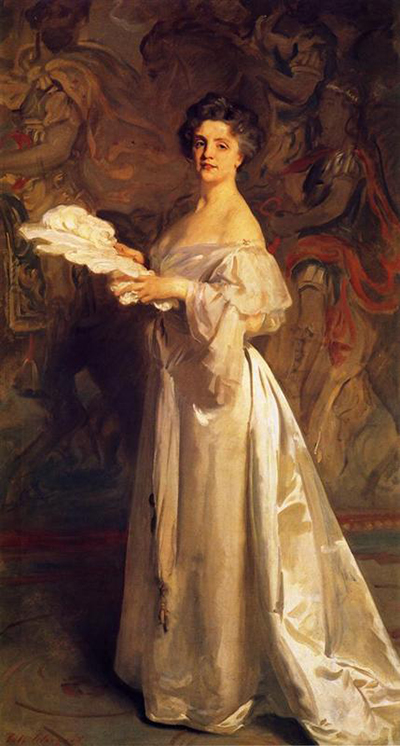
John Singer Sargent's Ada Rehan is a portrait of theatrical presence without being a portrait of a theatrical role. Rehan was one of the most admired actors of her generation, internationally known through Augustin Daly's company and especially through Shakespearean comedy. Yet the Metropolitan Museum of Art makes an important distinction: Sargent shows her imposing stage presence, but he does not show her in character [1].
That distinction gives the portrait its force. Rehan does not need a named role, a dramatic scene, or a stage set to appear theatrical. Sargent gives her the height, scale, costume presence, and public command of grand portraiture. The actor's fame remains visible, but it is translated into the language of aristocratic status.
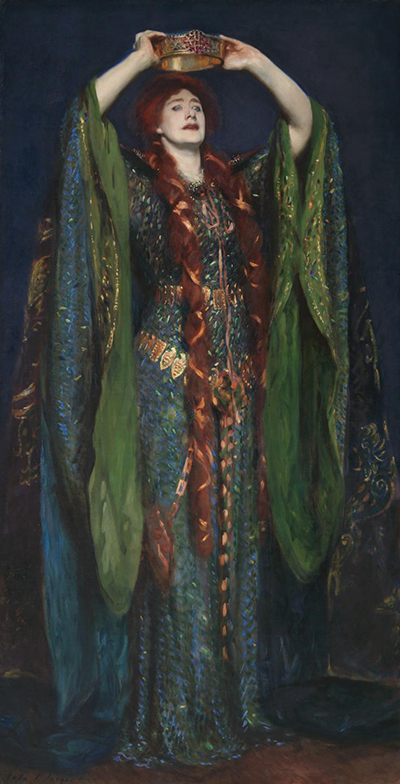
Painted in 1894-95, the work belongs to Sargent's mature portrait period, when he had already learned how to make public identity vivid through pose, clothing, hands, and scale. The portrait stands near Ellen Terry as Lady Macbeth, but it is quieter and more ambiguous. Terry becomes a Shakespearean role. Rehan remains Ada Rehan, an actor seen with the authority of someone whose body, name, and reputation had already been shaped by the stage.
The painting matters because it widens the usual view of Sargent's portrait world. His sitters were not only aristocrats, patrons, presidents, soldiers, and fashionable society figures. They included performers whose fame depended on becoming visible before an audience. Rehan gave Sargent a subject who already understood command, timing, costume, and spectatorship. He answered with a portrait that turns stage presence into painted stature.
At a Glance
- ArtistJohn Singer Sargent [1]
- TitleAda Rehan [1]
- Date1894-95 [1]
- MediumOil on canvas [1]
- Dimensions93 x 50 1/8 in. (236.2 x 127.3 cm) [1]
- Framed dimensions8 ft. 6 1/4 in. x 58 3/4 in. x 4 1/2 in. (259.7 x 149.2 x 11.4 cm) [1]
- CultureAmerican [1]
- CollectionThe Metropolitan Museum of Art, American Wing [1], [2]
- Object number40.146 [1]
- Credit lineBequest of Catharine Lasell Whitin, in memory of Ada Rehan, 1940 [1]
- Display notethe Met record lists the painting as not on view [1], [2]
- SitterAda Rehan, born Delia Crehan in Limerick, Ireland, 1860-1916 [1]
- Theatre contextRehan moved to America as a child, began acting at sixteen, joined Augustin Daly's company in 1879, and became internationally known for Shakespearean comedies and other plays [1]
Contents
- Introduction
- Ada Rehan As Sitter
- A Performer Not In Character
- Scale, Dress And Grand Manner
- Theatre Celebrity And Public Image
- Sargent's 1890s Portrait Practice
- Met Collection And Afterlife
- How To Look At The Portrait
- Related Works And Where To Go Next
Ada Rehan As Sitter
The Met's account gives enough biography to explain why Rehan mattered without turning the painting into a full life story. She was born Delia Crehan in Limerick, Ireland, in 1860, moved to America as a child, and began performing on stage at sixteen. The name by which she became famous came from accident: a theatre bill printed her as Ada C. Rehan rather than Crehan, and the new form endured [1].
That detail is useful because it shows how theatrical identity can be made by public circulation. A name on a bill, repeated by audiences and companies, becomes the professional name. Rehan's identity as a performer was not separate from print, publicity, theatre schedules, reviews, and audience memory. By the time Sargent painted her, she was already a public figure whose name carried a stage history.
In 1879, Rehan joined Augustin Daly's theatre company. The Met identifies that move as the beginning of the career context most relevant to the portrait. Daly's company made Rehan internationally known, especially for Shakespearean comedies and other plays [1]. This matters because Sargent was painting someone whose fame had been earned through live performance, not inherited title or office.
The portrait does not need a long list of Rehan's roles to make that point. Its subject is the meeting of painter and performer. Rehan's career explains the kind of presence Sargent had to paint: not simply private likeness, but the authority of a woman trained to hold attention. An actor brings a different body to portraiture. Posture, stillness, gaze, and costume are never merely passive. They are professional instruments.
Sargent's task was therefore delicate. If he painted Rehan too much as a role, he would narrow her to one part. If he painted her too much as a private sitter, he would lose the public force that made her worth painting. The Met's wording makes clear that he chose a third answer: Rehan appears as herself, but with the stage still pressing through her stance and scale. [1], [2]
A Performer Not In Character
The most important fact in the Met record is also the easiest to miss: Rehan is not in character [1]. That separates this painting from Ellen Terry as Lady Macbeth. Terry's portrait depends on a named Shakespearean role, a famous green costume, and an invented gesture with Duncan's crown. Rehan's portrait depends on stage presence without a role attached.
That difference changes how the viewer should look. Rehan is not being asked to become Katherine, Rosalind, Beatrice, or any other comic heroine. Sargent does not provide a dramatic prop or narrative cue that would place her inside a scene. Instead, he converts the actor's general authority into portrait form. The subject is not performance in progress. It is the public stature produced by performance.
This makes the portrait modern in a quieter way than Ellen Terry. Terry's image asks how far a portrait can merge person and role. Rehan's image asks whether an actor can ever be seen outside role once fame has made theatrical presence part of the person's public identity. Sargent does not answer by stripping away theatre. He answers by removing character while keeping command.
The absence of a specific role also protects the sitter from being reduced to theatrical illustration. Rehan is not a visual footnote to Shakespeare. She is the central presence. The portrait acknowledges her fame as an actor, but it gives her the dignity of a stand-alone likeness. That dignity is not neutral. It is heightened, staged, and grand.
Sargent often understood that public identity is constructed. Society sitters perform rank and taste. Military sitters perform command. Presidents perform office. Actors perform transformation as a profession. Rehan's portrait belongs to that larger pattern. The painting does not show a mask dropping. It shows the actor's authority after the mask has become part of public recognition.
Scale, Dress And Grand Manner
The painting's size is central to its meaning. At 93 x 50 1/8 inches, Ada Rehan is tall enough to feel ceremonial [1]. The frame dimensions make the total object still more imposing. Sargent does not treat Rehan as a small private likeness. He gives her the scale of a major public portrait.
The Met says that Sargent elevates Rehan's status by showing her in the grand manner and scale typical of paintings of royalty or aristocracy [1]. That statement gives the best starting point for interpretation. Grand manner portraiture traditionally belongs to rulers, nobles, military leaders, and other figures whose image must carry authority beyond personal resemblance. Sargent applies that language to a modern actor.
The choice matters socially. Rehan was not aristocracy. Her fame came from work before paying audiences. By granting her a scale associated with rank, Sargent treats theatrical celebrity as a modern form of public power. The painting does not pretend she has inherited station. It suggests that the stage has given her another kind of stature.
Costume helps make that stature visible. Sargent was one of the great painters of fabric, but fabric in his portraits is rarely mere display. The Met's essay on Sargent's theatrical use of dress notes his interest in textiles collected during travel, his studio use of them, and his habit of asking sitters to wear garments he wanted to highlight. Clothing could set the mood and compete with likeness [2].
That insight matters for Ada Rehan because the portrait's clothing is part of its argument. The sitter's dress gives Sargent a broad field of light, surface, and structure. It is not a documentary costume for a named role. It is portrait costume, chosen and painted to create status. The body becomes legible through fabric.
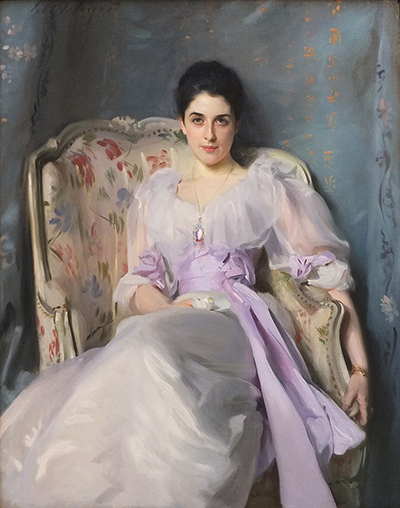
The white or pale costume also places Rehan near other Sargent problems. In Lady Agnew of Lochnaw, a white dress and lilac sash help turn seated ease into social command. In Portrait of Charles Deering, a white suit carries outdoor light and friendship. In Rehan's portrait, light fabric helps stage authority. It catches attention, enlarges the figure, and lets Sargent make theatrical presence from surface rather than anecdote. [3]
The scale and dress therefore work together. A small portrait of Rehan in similar clothing might feel elegant. A full-length or near full-length portrait of Rehan in this register becomes a statement. Sargent makes the actor's body occupy the pictorial space with the confidence usually reserved for inherited power.
Theatre Celebrity And Public Image
Rehan's portrait belongs to a late nineteenth-century world in which actors were public figures across more than the stage. Audiences knew them through performances, playbills, reviews, photographs, gossip, touring, and admiration. Sargent's painting enters that world, but it does not behave like ordinary publicity. It turns fame into a museum-scale object.
The Met says the portrait was commissioned by an American admirer [1]. That fact is small but revealing. The commission did not come from a state institution or a family dynasty. It came from admiration. Actor celebrity could generate patronage, and patronage could then transform a stage figure into a grand portrait sitter.
The portrait therefore records more than Rehan's appearance. It records the cultural value placed on her presence. Someone wanted Sargent, the most brilliant portraitist of the age, to fix that presence in oil. Rehan's fame had become worthy of scale, expense, and permanence.
This is why the painting should not be read as a simple crossover between theatre and society. It is not only an actor entering high portraiture. It is high portraiture adjusting itself to a modern performer. Sargent understood that Rehan's authority did not depend on the same signs as aristocratic sitters. She did not need a title, estate, uniform, or office. Her sign was trained visibility.
That visibility can be hard to recover because live acting disappears. A performance ends; the body leaves the stage; the audience memory changes. Paint cannot preserve the voice, timing, or movement of Rehan's acting. What it can preserve is the idea that she had presence. Sargent's portrait is a substitute of a very specific kind. It does not replay her art. It makes the social force of her art visible.
Sargent's 1890s Portrait Practice
The date 1894-95 places Ada Rehan within Sargent's confident 1890s portrait practice. He had rebuilt his British career after the Paris scandal of Madame X. He had painted Lady Agnew of Lochnaw in 1892, a portrait whose Royal Academy success helped secure his standing in Britain. He was also painting sitters whose public identities depended on art, theatre, fashion, politics, or friendship. [3]
The Met's "Sargent's Theatrics" essay is especially useful because it places theatre and costume at the center of his portrait imagination. Sargent had a strong appetite for the performing arts and sought out musicians, composers, dancers, singers, and actors as portrait subjects [2]. Rehan therefore belongs not at the edge of his portrait career, but within one of its most fertile fields.
The same essay preserves a revealing anecdote about W. Graham Robertson. When Robertson learned that Sargent wanted to paint him, he asked Ada Rehan why. Rehan answered that Sargent found him "so paintable," especially the lines of the long overcoat and the dog [2]. The anecdote is useful not because it explains Rehan's own portrait directly, but because it shows her moving within Sargent's theatrical and artistic circle. She understood the language of paintability, costume, and pose.
Sargent's portrait of Robertson became famous for the black overcoat. His answer to Robertson's discomfort was blunt: the coat was the picture [2]. That idea helps illuminate Ada Rehan. In Sargent, clothing can become the picture because clothing organizes the sitter's public presence. The actor's costume, the society sitter's dress, the military officer's uniform, and the friend's overcoat each carry identity through surface.
Rehan's portrait also belongs beside Ellen Terry as Lady Macbeth. Both sitters were actors, both were women of public visibility, and both allowed Sargent to make theatre into portraiture. But the comparison is strongest when the difference remains clear. Terry is absorbed by Shakespearean role. Rehan is elevated as a performer without role. Together they show two forms of theatrical portraiture: transformation into character and transformation into public stature.
Met Collection And Afterlife
The painting is now in the Metropolitan Museum of Art's American Wing, object number 40.146 [1]. The credit line records it as the bequest of Catharine Lasell Whitin, in memory of Ada Rehan, in 1940. That phrase gives the portrait an afterlife of remembrance. It entered the Met not only as a Sargent painting, but as an object explicitly tied to Rehan's memory.
The Smithsonian Catalog of American Portraits record provides related documentation for the same portrait [4]. The connection between the Met and the Smithsonian catalog helps place the work within American portrait history. Rehan was born in Ireland and became famous in America; Sargent was American-born, European-trained, and transatlantic in career; the painting now sits within an American museum context. Its identity is not confined to one nation or one stage tradition.
The Met record currently lists the painting as not on view [1]. That status does not diminish its importance, but it does remind readers that a museum object has a changing display life. A portrait may be central to an artist's story even when it is not physically hanging for visitors at a given moment.
The image note in the Met record also matters for visual use. The record states that the image cannot be enlarged or viewed at full screen [1]. For readers, the important point is simple: the Met record is the authority for object facts and interpretation, while image access is more limited than for some other Sargent works in the collection.
The bequest date also places the painting's museum life after Rehan's death in 1916 and after Sargent's death in 1925. By 1940, both painter and sitter belonged to cultural memory. The painting no longer served the immediate theatre world that had produced Rehan's fame. It had become evidence of that world and of Sargent's ability to monumentalize it.
How To Look At The Portrait
Begin with scale. The portrait's height gives Rehan authority before any detail is read. Sargent asks the viewer to meet her as a major public presence, not as a private anecdote.
Then look at the absence of role. There is no named Shakespearean scene to decode. That absence is active. It shifts attention from character to performer, from theatre story to theatrical bearing.
Next, look at the clothing. The dress is not simply pretty fabric. It gives the body structure, brightness, and pictorial command. Ask how the garment turns Rehan into a grand portrait sitter while still allowing her stage identity to remain visible.
The pose should be read as trained stillness. Actors know how bodies communicate. Sargent makes that knowledge useful in portrait form. Rehan does not need to move for the viewer to sense performance behind the still image.
The face and gaze should be approached cautiously. It is tempting to invent a private psychology for a famous actor. The stronger reading stays with what the painting and sources support: public presence, scale, grand manner, and a sitter whose fame depended on being watched.
Finally, compare the portrait with Ellen Terry as Lady Macbeth. Terry's raised arms and role costume create theatrical transformation. Rehan's portrait creates theatrical authority without role. The difference makes each painting sharper.
Related Works And Where To Go Next
For Sargent's wider portrait practice, move to Portraits. That essay places Rehan beside society sitters, actors, artists, children, presidents, collectors, military figures, and self-portraits.
The closest individual comparison is Ellen Terry as Lady Macbeth. Terry and Rehan show Sargent responding to performers, but they do so in opposite ways: role image in one case, grand-manner stage presence in the other.
For costume, hands, pose, fabric, and staging, use Style and Technique. For high society comparison, Lady Agnew of Lochnaw shows how Sargent uses dress and gaze to create social command. For broader oil painting context, use Paintings, and for the larger life story, use Biography.
Frequently Asked Questions
Ada Rehan was the stage name of Delia Crehan, born in Limerick, Ireland, in 1860. She moved to America as a child, began acting at sixteen, joined Augustin Daly's theatre company in 1879, and became internationally known for Shakespearean comedies and other plays [1].
Sargent painted Ada Rehan in 1894-95. The Met gives the date, medium, dimensions, credit line, and object number for the work [1].
No. The Met states that Sargent accentuates Rehan's imposing stage presence, though she is not in character [1]. That makes the portrait different from Ellen Terry as Lady Macbeth.
The painting is in the Metropolitan Museum of Art, American Wing, object number 40.146. The Met record currently lists it as not on view [1].
The Met states that the portrait was commissioned by an American admirer [1]. The record's credit line later identifies the painting as the bequest of Catharine Lasell Whitin, in memory of Ada Rehan, in 1940.
The large scale lets Sargent present Rehan in a grand manner associated with royalty or aristocracy. The Met explicitly notes that Sargent elevates her status through this grand-manner scale [1].
Both are Sargent portraits of famous actors, and both connect portraiture to theatre. Terry is painted as Lady Macbeth in a role-defining costume and pose. Rehan is painted as herself, with stage presence but without a named character.
It shows Sargent adapting grand portraiture to modern theatre celebrity. Rehan's fame came from performance, and Sargent gives that fame the stature usually associated with inherited or official status.
Discussion
Ada Rehan asks whether an actor can be painted outside character without losing the stage. Sargent's answer is yes, but only because he makes stage presence itself the sitter's grandest attribute.
Reader Insights
What is the first detail that shapes your reading of Ada Rehan by John Singer Sargent: pose, setting, light, costume, brushwork or historical context?
Which small visual decision begins to matter more after a longer look, and how does it change the mood of the page?
Which comparison helps most: another Sargent portrait, a travel subject, a public commission, or a work by one of his contemporaries?
Join the Conversation
Share a thoughtful comment below about what you notice, question or compare when looking at this page.
References
- Metropolitan Museum of Art, *Ada Rehan* https://www.metmuseum.org/art/collection/search/12026
- Elizabeth Mankin Kornhauser, Metropolitan Museum of Art, "Sargent's Theatrics: Dressing His Friends" https://www.metmuseum.org/exhibitions/listings/2015/sargent-portraits-of-artists-and-friends/blog/posts/sargent-theatrics
- Metropolitan Museum of Art, *Sargent: Portraits of Artists and Friends* https://www.metmuseum.org/exhibitions/listings/2015/sargent-portraits-of-artists-and-friends
- Smithsonian Catalog of American Portraits, *Ada Rehan* https://npg.si.edu/object/npg_40.146_MMA