 by Tom Gurney
Tom Gurney BSc (Hons) is an art history expert with over 20 years experience
Published on June 19, 2020 / Updated on July 19, 2026
Email: tomgurney1@gmail.com / Phone: +44 7429 011000
Beatrice Townsend by John Singer Sargent: Introduction
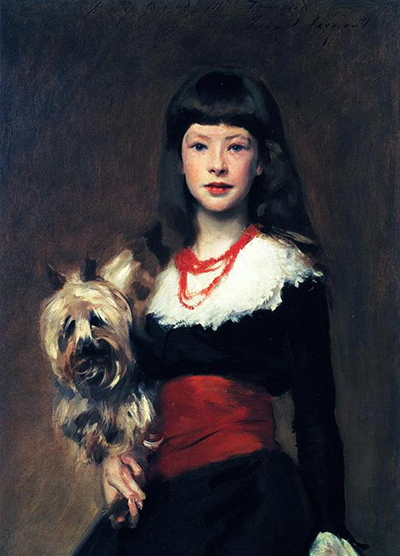
John Singer Sargent's Miss Beatrice Townsend is a small portrait with a large charge of presence. Painted in 1882, it shows Eleanor Beatrice Townsend from the hips up, dressed in black with a cream lace collar, coral-red sash and necklace, holding a shaggy terrier against her side while she looks directly outward. The image is intimate in scale, but it is not slight. Sargent gives the young sitter the alertness, style, and pictorial seriousness that he brought to adult portraiture.
The painting matters because it shows how Sargent could paint childhood without reducing it to sweetness. Beatrice is young, but she is not treated as a decorative emblem of innocence. Her costume is carefully arranged, her gaze is steady, and the dog she holds is not a cute accessory alone. It is part of the portrait's language of character: a living companion that makes the sitter more particular.
The National Gallery of Art record gives the portrait unusually strong object evidence. It identifies Beatrice as the sixth of seven children of John Joseph Townsend, a New York attorney and politician, and Catherine Rebecca Bronson Townsend, a friend of Sargent who was also painted by him. The same record notes the painting's inscription to Mrs Townsend, its likely descent through the Townsend family, its passage through Carroll Carstairs Gallery, Andrew Mellon, Paul Mellon, and finally the National Gallery of Art [1].
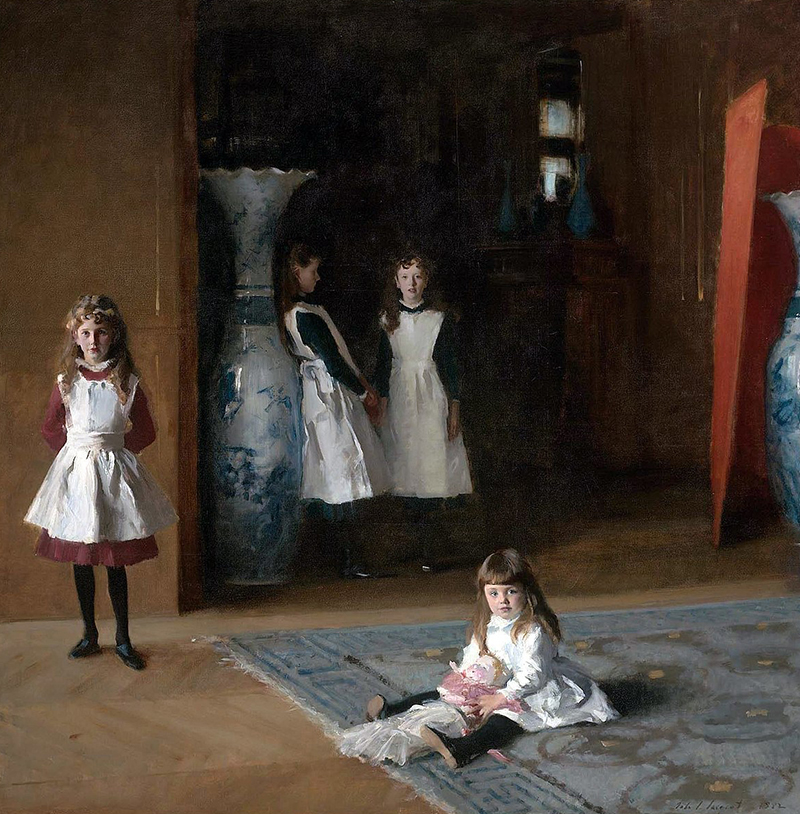
That history keeps the work close to both family memory and museum afterlife. Miss Beatrice Townsend is a likeness, a gift-like inscription, a child portrait, a patronage trace, and a Mellon collection object. It belongs beside Sargent's larger 1882 child and family work, especially The Daughters of Edward Darley Boit, because both pictures ask how a painter can give young sitters dignity without pretending to explain them completely.
At a Glance
- ArtistJohn Singer Sargent [1]
- TitleMiss Beatrice Townsend [1]
- Date1882 [1]
- MediumOil on canvas [1]
- Dimensions79.4 x 58.4 cm, or 31 1/4 x 23 inches; framed dimensions 97.8 x 74.1 x 3.2 cm [1]
- SitterEleanor Beatrice Townsend (1870-1884) [1]
- Inscriptionupper center and right, "to my friend Mrs Townsend / John S. Sargent." [1]
- CollectionNational Gallery of Art, Washington, DC [1], [2]
- Credit lineCollection of Mr. and Mrs. Paul Mellon [1]
- Accession number2006.128.31 [1]
- Displaythe National Gallery of Art record lists the painting on view in the West Building, Main Floor, Gallery 69 [1], [2]
- Image statusthe NGA record states that the media is free and in the public domain [1], [2]
Contents
- Introduction
- Annotated Details
- Beatrice Townsend And The 1882 Portrait
- Family Ties And The Inscription To Mrs Townsend
- Pose, Gaze And Young Self-Possession
- Costume, Color And Brushwork
- The Terrier And The Language Of Character
- Childhood Without Sentiment
- Provenance, Exhibition History And The Mellon Gift
- How To Look At The Portrait
- Related Works And Where To Go Next
Annotated Details from Miss Beatrice Townsend
The numbered details follow Beatrice's direct expression, blunt fringe, bright necklace, small dog, red sash and loosely described hands and skirt.
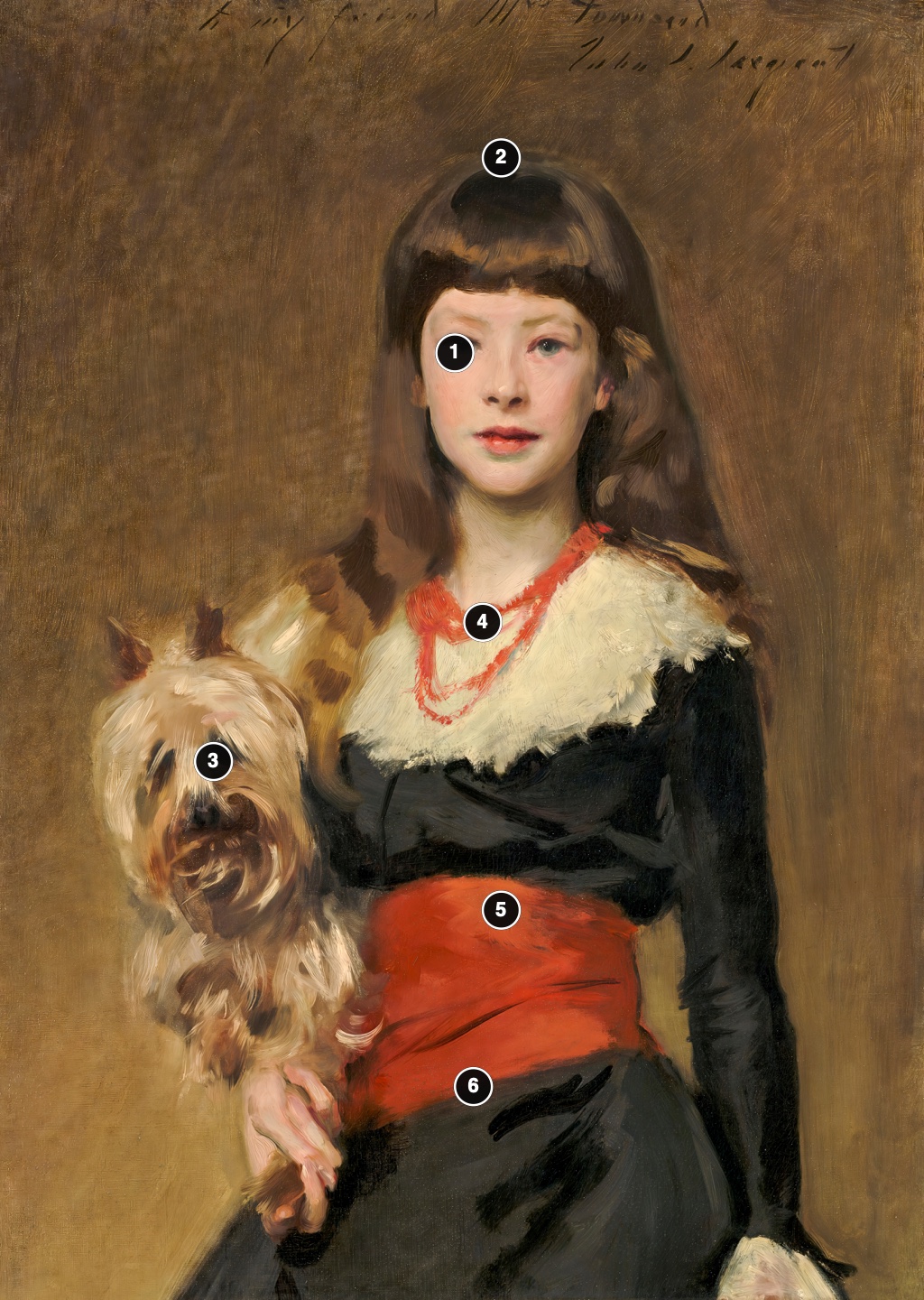
Details from MISS BEATRICE TOWNSEND
Close looking reveals how a few strong red, black and cream shapes establish the sitter while rapid brushwork keeps the portrait lively and informal.
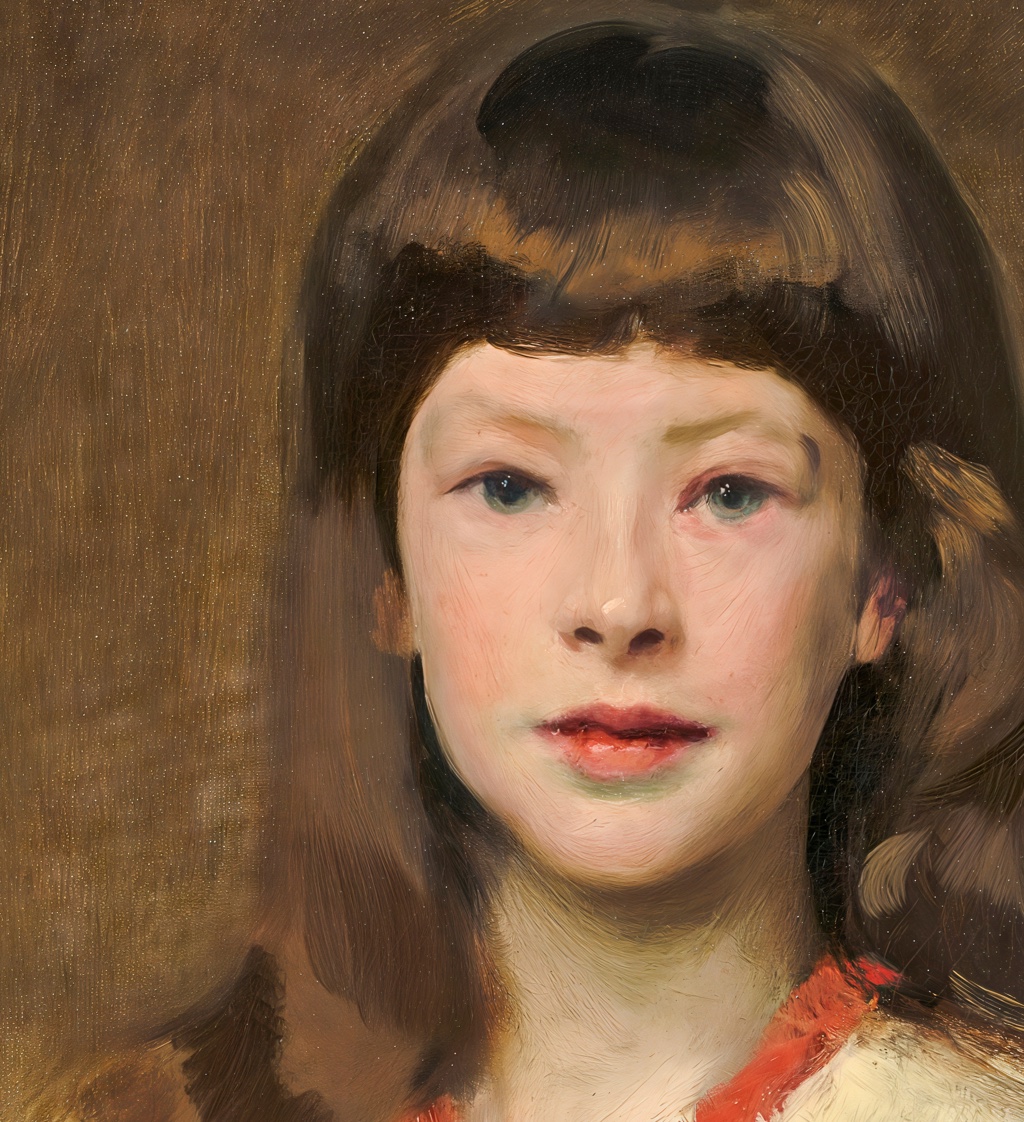
Face and direct gaze
Beatrice meets the viewer directly, with small touches of blue, pink and red sharpening the eyes, cheeks and mouth.
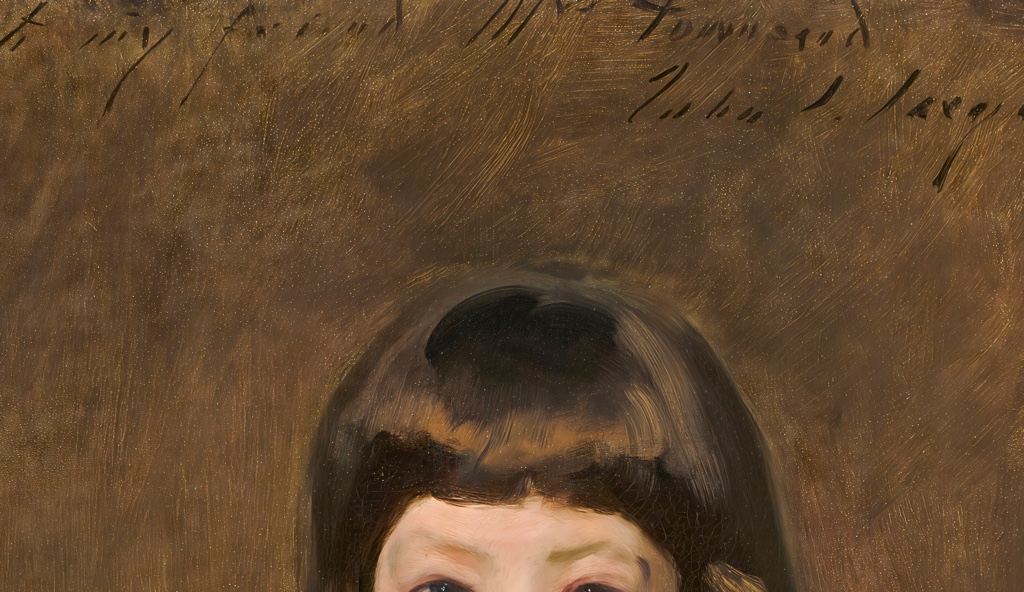
Blunt fringe and inscription
The dark fringe forms a strong horizontal edge beneath the freely brushed hair, while the dedication crosses the upper brown field.
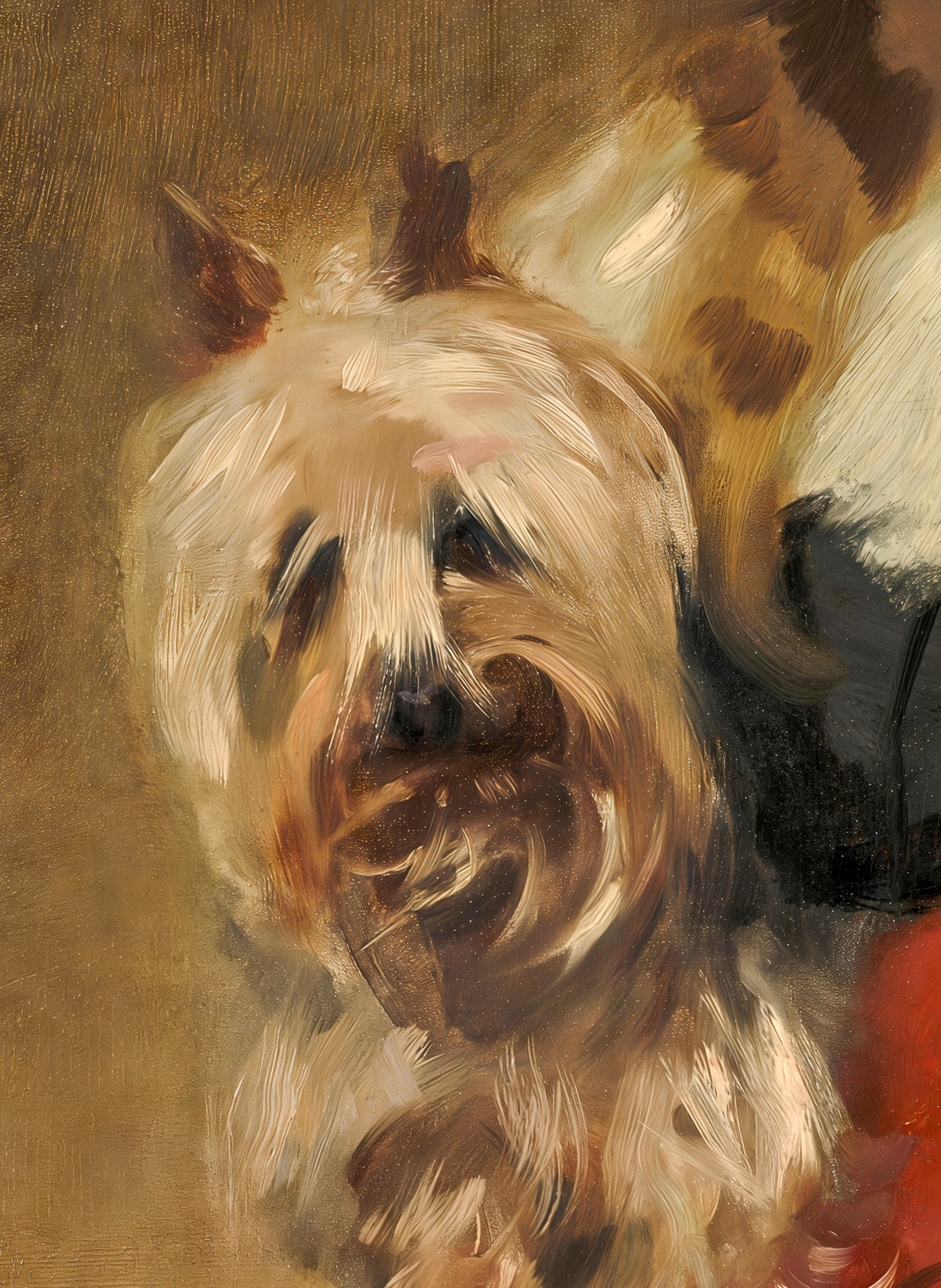
Small dog at her side
The dog's face is assembled from quick cream, ochre and black strokes, pressed close to the sitter's dark sleeve.
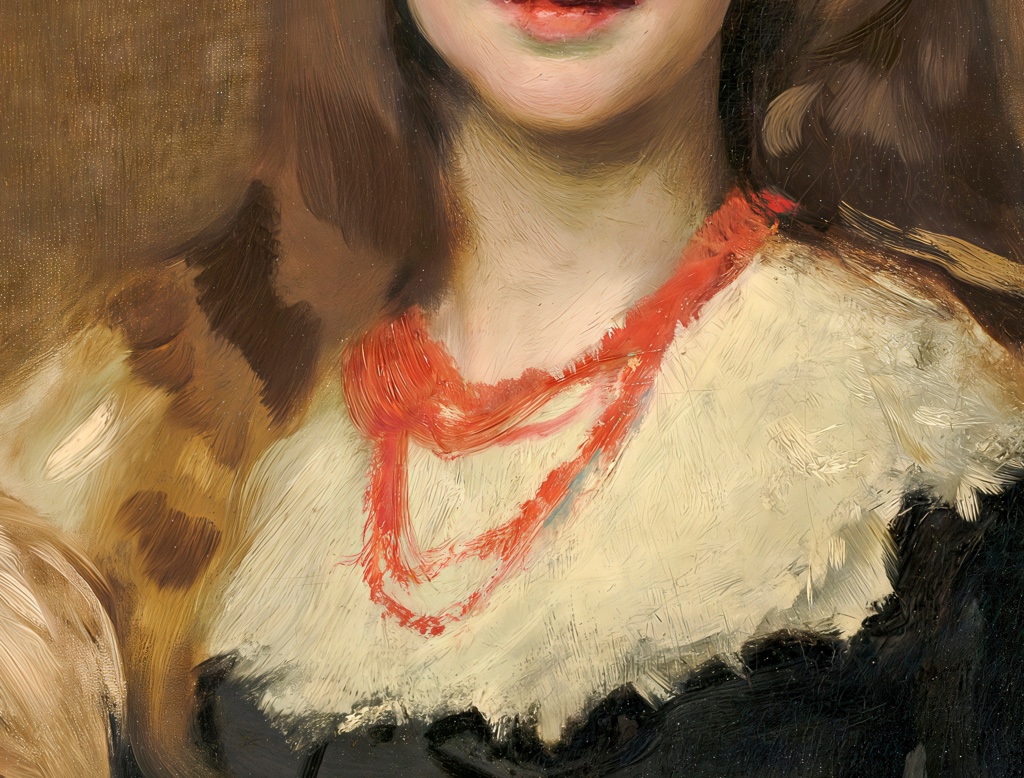
Red necklace and cream collar
Two loose red loops stand out against the broad cream collar, whose ragged edge meets the black bodice.
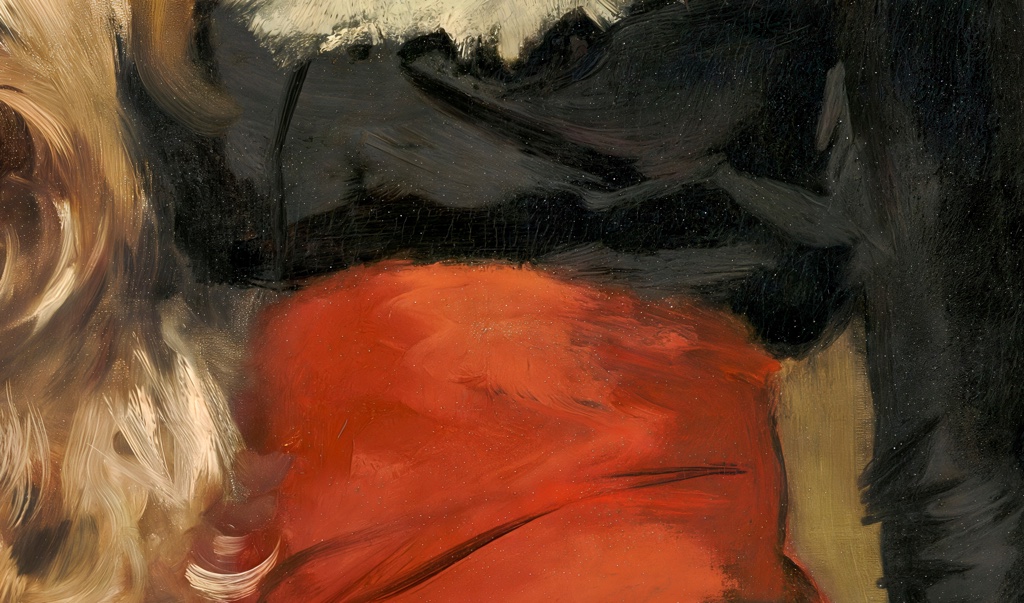
Brilliant red sash
The sash cuts across the middle as a saturated red-orange band, its broad strokes anchoring the restrained brown and black palette.
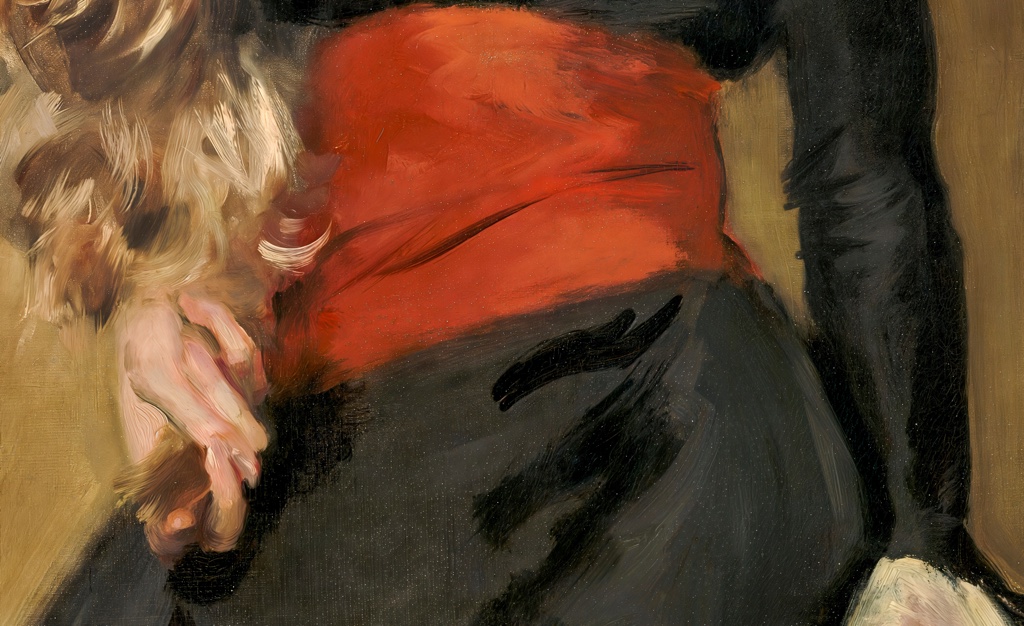
Hands and dark skirt
One hand rests near the dog while the other drops at the edge of the frame, both described with quick light strokes against the dark skirt.
Beatrice Townsend And The 1882 Portrait
Eleanor Beatrice Townsend was born in 1870 and died in 1884. Sargent painted her in 1882, when she was about twelve. That date places the portrait in one of the most important years of his early career. He was still based in the ambitious Paris-centered world that had formed him, and he was about to become known for increasingly daring portraits and figure pictures. The same year also produced The Daughters of Edward Darley Boit, his unsettling portrait of four young sisters in a Paris apartment.
The Townsend portrait is not grand in that way. It is a vertical, hip-length likeness of one child rather than a large square interior with four figures. Yet the smaller work shares the same refusal of easy childhood imagery. Sargent does not gather Beatrice into a sentimental scene. He brings her close, gives her a bold costume arrangement, places the dog against her body, and lets the direct gaze do much of the work.
The National Gallery of Art describes the figure as a young girl in an ink-black garment with a cream-white collar and coral-red sash and necklaces. Her body is angled slightly to the viewer's left, while her face turns outward. She has pale blue eyes, chestnut-brown hair with thick bangs, and a closed red mouth. The dog is held at her side, its shaggy fur and small face worked into the same painterly surface as the sitter's hair, dress, and background [1].
That physical description matters because Sargent's portrait is built from contrasts. Black costume meets pale lace. Coral red punctuates cream and brown. The young sitter's face is smooth and still, while the terrier adds texture and small bodily complication. The background warms from fawn brown to golden brown, keeping the picture intimate and tonally unified. Nothing in the image is neutral decoration. Each element helps establish the sitter as a named young person with poise, taste, and individuality.
Family Ties And The Inscription To Mrs Townsend
The inscription is one of the most important facts in the painting: "to my friend Mrs Townsend / John S. Sargent." It shifts the portrait from a simple commissioned likeness into a work with a personal and familial address. Mrs Townsend was Catherine Rebecca Bronson Townsend, Beatrice's mother. The National Gallery of Art notes that Catherine was a friend of Sargent and the subject of her own portrait by him [1].
The Townsend connection also reaches into Sargent's wider social world. Beatrice's father, John Joseph Townsend, was a New York attorney and politician. Beatrice was the sixth of seven children. The NGA provenance note adds that Sargent painted John J. Townsend in 1882 and made two portraits of Catherine Bronson Townsend. It further records that the Bronsons were part of Sargent's expatriate circle in Florence and that the Townsend family's patronage most likely resulted from old family ties, even though the detailed circumstances of the commissions are not known [1].
That caution is important. The portrait should not be inflated into a fully documented family saga. What can be said securely is more precise: Sargent knew or was connected to Catherine Bronson Townsend; the inscription names Mrs Townsend as friend; the wider Townsend group sat for him around the same moment; and the painting likely remained with Beatrice's parents before entering the art market.
The family setting helps explain the portrait's balance between formality and affection. Beatrice is not shown in casual domestic disorder. She is carefully dressed, posed, and presented. Yet the inscription and the terrier soften the transaction. This is not a society portrait designed only for public display. It is also an image addressed to a mother, shaped by friendship, memory, and the private pride of a family.
Sargent's early portrait practice often depended on exactly such networks. Families, friends, expatriates, patrons, and inherited social ties brought sitters to the studio. The artist's career did not grow from anonymous brilliance alone. It grew through circles of trust, recommendation, and reputation. Miss Beatrice Townsend preserves one of those circles in a remarkably compact form.
Pose, Gaze And Young Self-Possession
The most striking feature of the portrait is Beatrice's direct gaze. She does not look down, turn aside, or smile to please. She looks out with a composed, slightly questioning presence. The NGA description notes the slight cock of one brow and the large pale blue eyes [1]. Those small details give the image its living tension.
It would be easy to over-read the expression. The painting does not tell viewers exactly what Beatrice thought or felt. Sargent gives no narrative scene, no anecdote, and no explanatory gesture beyond the dog held at her side. What he does give is self-possession. The sitter is young, but she occupies the picture as someone capable of meeting the viewer.
This is where the portrait joins Sargent's larger handling of children. In The Daughters of Edward Darley Boit, the four sisters are separated by room, shadow, and age; the viewer sees them but cannot fully possess them. In Miss Beatrice Townsend, the separation is not spatial in the same way. Beatrice is close, frontal, and clear. Yet she too remains resistant to simplification. Her directness does not make her transparent.
The body angle helps create that complexity. Beatrice's torso turns slightly, while her face returns to the viewer. This twist is modest but effective. It prevents the portrait from becoming stiffly frontal, and it gives the sense that she has paused rather than been locked into position. The dog adds another pressure point: one arm supports it, and the animal's body interrupts the clean vertical line of the sitter's dark dress.
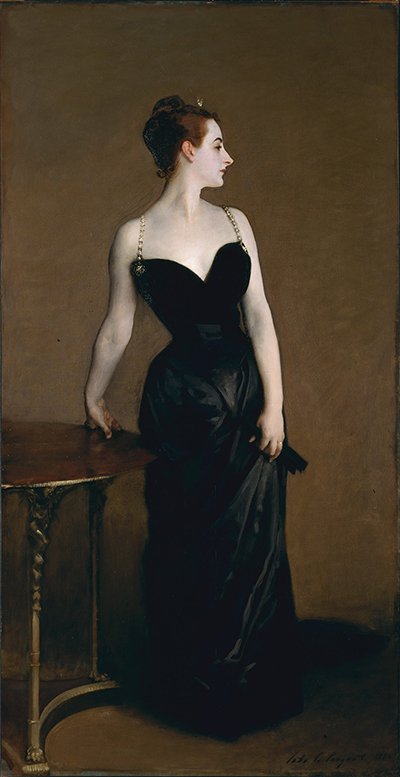
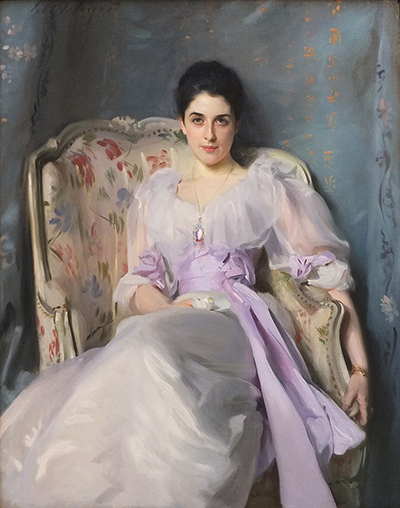
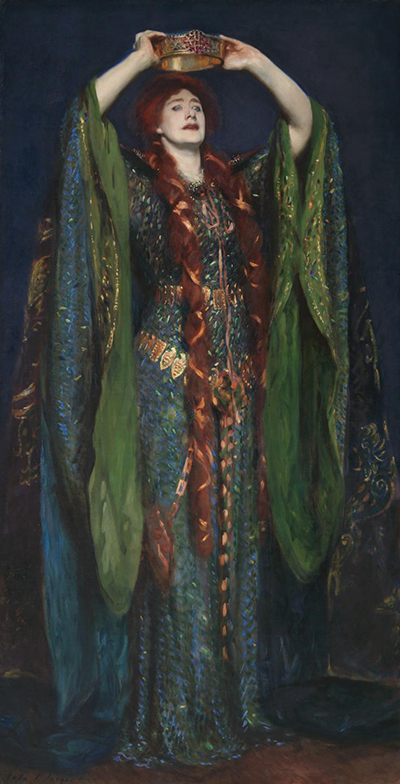
Sargent often used pose to give a sitter social temperature. A reclining Lady Agnew can look relaxed and commanding at once. Ellen Terry's raised arms turn theatrical ambition into image. Beatrice's pose works on a quieter scale. A child holds a pet, but the direct gaze and formal costume keep the image from becoming merely charming. The result is alert, compact, and serious.
Costume, Color And Brushwork
The costume gives the portrait much of its authority. Beatrice wears a black dress with long, closely fitted sleeves. Against that dark ground, Sargent sets a layered cream-white lace collar that spreads just past the shoulders. A coral-red necklace and a broad coral-red sash create vivid accents across the center of the picture. The black, cream, and red arrangement is simple enough to read instantly, but rich enough to hold attention.
Sargent's handling of black is crucial. The dress is not a flat dark shape. It supports the figure, frames the collar, and gives the young sitter a severity more often associated with adult portraiture. The black garment makes the face and hands more prominent. It also allows the red sash and necklace to become active notes rather than decorative clutter.
The cream collar changes the tone. It lightens the area around Beatrice's face and chest, but it also introduces a delicate texture that contrasts with the heavier dress and shaggy dog. Sargent's portrait art often depends on such fabric contrasts. In other works, white dress, black satin, red robes, green theatre costume, or patterned hangings do more than display virtuosity. They build identity through surface.
Here the color design is unusually concentrated. The coral accents connect necklace and sash, pulling the viewer's eye from face to torso and back again. The red also echoes the closed lips, giving the portrait a restrained warmth. The background, moving from fawn brown to golden brown, keeps the whole image from becoming stark. It makes the black dress less severe and gives the dog and hair a sympathetic tonal field.
The NGA visual description emphasizes visible brushstrokes in the hair, clothing, dog, and background [1]. That is important because the portrait's liveliness is not only in Beatrice's expression. It is in the surface itself. Sargent lets the terrier's fur, the hair, and the warm ground remain painterly rather than hard. The young sitter's face is smoother and more controlled, while surrounding passages carry more obvious movement.
This hierarchy of finish is characteristic of Sargent. He sharpens where presence requires it and loosens where paint can suggest texture, light, and atmosphere. The face holds the encounter. The dress holds the structure. The dog and background keep the image alive around that encounter.
The Terrier And The Language Of Character
The dog is essential to the portrait. Beatrice holds a terrier against her right hip, supporting it with one hand while the animal's shaggy head and fur emerge near the dark dress. The NGA description notes the long fur around the dog's dark eyes, the caramel-brown ears, and Beatrice's hand holding the tail [1]. These details prevent the dog from being a generic studio prop.
The NGA interpretation points out that in Sargent's child portraits, a favorite toy or pet could emphasize the individual personality of the sitter [1]. That is exactly what happens here. The dog gives Beatrice an action, however small. She is not simply placed before the viewer to be admired. She is occupied by the practical task of holding a lively companion still enough for the portrait.
The terrier also changes the emotional temperature. Without it, the black dress, formal collar, coral jewelry, and direct gaze might make Beatrice seem almost adult in presentation. With it, the image remains rooted in childhood and family life. The dog introduces touch, texture, affection, and a small comic complication into the otherwise poised composition.
At the same time, Sargent avoids making the animal sentimental. The dog is not painted as a cute story beside the child. It is integrated into the design. Its tawny fur mediates between Beatrice's hair and the warm background. Its body breaks the dark plane of the dress. Its presence makes the sitter more specific, but it also gives Sargent another surface to paint with speed and sensitivity.
In this sense, the terrier is both companion and pictorial device. It helps tell the viewer that Beatrice was a particular child with attachments and habits. It also helps Sargent vary the painting's textures and rhythms. The portrait becomes more alive because it includes another living body, one that Beatrice controls only partly.
Childhood Without Sentiment
The National Gallery of Art places Miss Beatrice Townsend among Sargent's early child portraits and describes such works as lively likenesses and character studies rather than idealized images of childhood [1]. That distinction is the key to the painting. Sargent can be tender without being soft. He can acknowledge youth without turning it into a formula.
Beatrice's age matters because she stands near a threshold. She was about twelve when painted, no longer a very small child and not yet an adult sitter in the social portrait mode. The portrait registers that in-between state through costume, pose, and gaze. The lace collar, coral necklace, sash, and pet all belong to the world of a young person presented by a family; the direct gaze and dark dress give her a surprising gravity.
The NGA record includes a poignant fact: Beatrice died of peritonitis in 1884, two years after the painting was completed [1]. That knowledge inevitably affects later viewing, but it should be handled with restraint. Sargent was not painting an elegy in 1882. The portrait became memorial through later history, not through its original visual program. Its first force lies in presence, not loss.
This restraint matters because Sargent's child portraits often invite projection. Viewers may want to turn Beatrice's steady gaze into a story of sadness, confidence, defiance, or foreknowledge. The painting does not support such certainty. It supports attention. It asks us to look at how a young sitter is made visible through clothes, pet, light, surface, and gaze.
Compared with The Daughters of Edward Darley Boit, the Townsend portrait is more direct. The Boit sisters are dispersed in a room; Beatrice is brought close. But both works resist a simple adult fantasy of childhood. The children are not explained away. They are painted as presences with their own opacity. That seriousness is one of Sargent's lasting contributions to images of young sitters.
The portrait also shows that child portraiture could be technically ambitious at a small scale. Sargent did not need a large canvas or complex interior to make childhood serious. A single figure, a dog, a dark dress, and a controlled gaze were enough.
Provenance, Exhibition History And The Mellon Gift
The painting's later history is unusually clear in the NGA record. It was probably first owned by Beatrice's parents, John Joseph Townsend and Catherine Bronson Townsend. By at least 1931 it was with Carroll Carstairs Gallery in New York. A 1936 Art News notice reported that the painting had recently been sold by Carroll Carstairs Gallery to a private collector in Washington and had come directly from the Townsend estate. The NGA notes that the buyer was probably Andrew W. Mellon [1].
Andrew Mellon then gave the painting to his son Paul Mellon. The NGA provenance records a 2006 letter from Mrs Paul Mellon stating that it was the only picture Andrew Mellon gave to Paul Mellon. That detail gives the object another private layer. A portrait made for the Townsend family became a meaningful gift inside the Mellon family before entering the National Gallery of Art. [1], [2]
Paul Mellon's bequest brought the painting to the NGA, with a life interest to Rachel Lambert Mellon that ended in 2006. The accession number, 2006.128.31, marks that final transition into the Gallery's collection. The credit line, Collection of Mr. and Mrs. Paul Mellon, preserves the connection to the couple whose collecting shaped so much of the Gallery's holdings [1].
The exhibition record is concise but useful. The painting appeared in Pictures of People 1870-1930, a loan exhibition for the benefit of Hope Farm at M. Knoedler & Co. in New York in 1931. It was also included in American Painting & Sculpture at the Museum of Modern Art in New York in 1932-1933 [1]. These showings placed Beatrice's portrait within broader histories of modern portraiture and American art rather than leaving it only as a family image.
The bibliography also traces the work's scholarly afterlife, including references in Carroll Carstairs's Postscript to Criticism, David McKibbin's Sargent's Boston, Charles Merrill Mount's biography, Richard Ormond's 1970 survey, Ormond and Elaine Kilmurray's catalogue of the early portraits, and Barbara Dyer Gallati's Great Expectations: John Singer Sargent Painting Children [1]. The pattern confirms what the painting itself suggests: although modest beside Sargent's most famous pictures, it has long mattered to the study of his early portraiture and child sitters.
How To Look At The Portrait
Begin with the gaze. Beatrice looks directly outward, and that directness controls the whole image. Notice that Sargent does not make the expression easy to name. The face is composed, alert, and slightly questioning, but not reduced to one mood.
Then look at the turn of the body. The torso angles away while the face returns to the viewer. This small twist gives the portrait movement and prevents the sitter from appearing pinned flat against the background. It also makes the dog feel naturally held rather than pasted into the design.
Move next to the color structure. The black dress gives the portrait weight. The cream collar opens the area around the face. The coral sash and necklace sharpen the center. The warm brown background gathers the hair, dog, and costume into one tonal atmosphere.
The terrier deserves slow attention. It individualizes Beatrice, but it also changes the painting's texture. The dog is shaggy, warm, and slightly awkward against the controlled lines of the dress and collar. It makes the portrait less formal without making it careless.
Finally, notice where Sargent lets the brushwork show. The face is steadier and more finished than the hair, dress, dog, and background. That difference is not accidental. It tells the eye where likeness is held and where the surface can remain active. The painting feels alive because Sargent controls that balance.
Related Works And Where To Go Next
The closest Sargent comparison is The Daughters of Edward Darley Boit. Both works were painted in 1882 and both show Sargent treating young sitters with gravity rather than easy sentiment. The Boit picture is spatially complex and large; Miss Beatrice Townsend is focused and intimate. Together they show how flexible his child portraiture could be.
The broader portraits essay places Beatrice among Sargent's society sitters, performers, artists, political figures, and children. The paintings essay helps situate the portrait among his early oils, while style and technique explains the handling of costume, surface, direct gaze, and selective finish. The biography gives the wider story of Sargent's expatriate training, family networks, and career in the early 1880s.
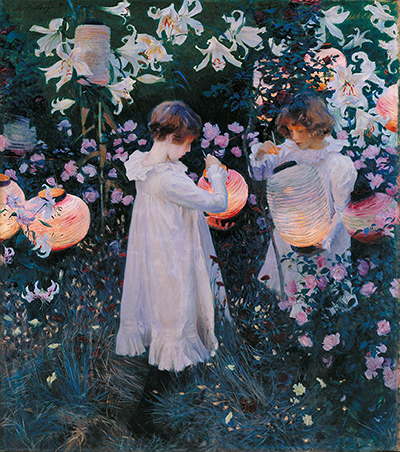
Useful contrasts include Lady Agnew of Lochnaw for direct gaze and costume, Ellen Terry as Lady Macbeth for clothing as staged identity, and Carnation, Lily, Lily, Rose for Sargent's ability to paint children without making them merely decorative.
Frequently Asked Questions
Eleanor Beatrice Townsend was born in 1870. She was the sixth of seven children of John Joseph Townsend, a New York attorney and politician, and Catherine Rebecca Bronson Townsend, a friend of John Singer Sargent. Beatrice died of peritonitis in 1884, two years after the portrait was painted [1].
Sargent painted the portrait in 1882. The date places it in the same year as The Daughters of Edward Darley Boit, one of his most important child and family portraits.
The painting is in the National Gallery of Art, Washington, DC. The NGA record lists it as on view in the West Building, Main Floor, Gallery 69, with the accession number 2006.128.31 [1].
It is oil on canvas. The overall dimensions are 79.4 x 58.4 cm, or 31 1/4 x 23 inches. The framed dimensions are 97.8 x 74.1 x 3.2 cm [1].
The inscription reads "to my friend Mrs Townsend / John S. Sargent." It connects the portrait to Beatrice's mother, Catherine Bronson Townsend, who was Sargent's friend and also sat for him. The inscription helps show that the painting belonged to a family and friendship network, not only to a formal commission.
The terrier helps individualize Beatrice. The NGA notes that in Sargent's child portraits, a favorite toy or pet can emphasize the sitter's personality. Here the dog also gives Sargent a lively texture and a small action within the otherwise composed pose. [1], [2]
No. It is affectionate in the sense that it attends closely to a young sitter, but it avoids easy sweetness. Beatrice's direct gaze, dark dress, formal collar, and controlled pose give the image seriousness.
After likely passing from the Townsend family to Carroll Carstairs Gallery, the portrait was sold in 1936 to Andrew W. Mellon. Mellon gave it to his son Paul Mellon. It entered the National Gallery of Art through Paul Mellon's bequest, with Rachel Lambert Mellon's life interest ending in 2006 [1].
Discussion
Miss Beatrice Townsend asks how much individuality a portrait can hold in a small space. Sargent answers through gaze, costume, pet, inscription, and touch: a young sitter made vivid without being simplified.
Reader Insights
What is the first detail that shapes your reading of Beatrice Townsend by John Singer Sargent: pose, setting, light, costume, brushwork or historical context?
Which small visual decision begins to matter more after a longer look, and how does it change the mood of the page?
Which comparison helps most: another Sargent portrait, a travel subject, a public commission, or a work by one of his contemporaries?
Join the Conversation
Share a thoughtful comment below about what you notice, question or compare when looking at this page.
References
- National Gallery of Art, *Miss Beatrice Townsend* https://www.nga.gov/artworks/96999-miss-beatrice-townsend
- National Gallery of Art, John Singer Sargent artist record https://www.nga.gov/artists/1858-john-singer-sargent