 by Tom Gurney
Tom Gurney BSc (Hons) is an art history expert with over 20 years experience
Published on June 19, 2020 / Updated on July 19, 2026
Email: tomgurney1@gmail.com / Phone: +44 7429 011000
Charles Deering by John Singer Sargent: Introduction
John Singer Sargent's Portrait of Charles Deering is one of his most revealing late portraits because it does not behave like a formal commission. Deering sits in a cane chair in Miami, dressed in white, surrounded by tropical vegetation, with boats and blue sky opening behind him. The sitter is relaxed, the scale is compact, and the painting carries an inscription of friendship rather than the grand public language of a society likeness. [1]
That informality is the point. Charles Deering was not simply another rich sitter passing through Sargent's studio. He was a longtime friend, an amateur artist, a major collector, an industrialist, and a patron whose family became closely connected with the Art Institute of Chicago. Sargent had known him since 1876, when the painter first visited the United States and met Deering at Newport. More than forty years later, in 1917, Sargent visited Deering at Brickell Point in Miami and painted him in a setting that joins portraiture to landscape and to the bright outdoor practice Sargent loved in his later career. [2]
The result is a portrait about relationship as much as likeness. Deering's white suit gives Sargent a field of light and shadow. The foliage places the sitter inside a lived landscape rather than against studio decor. The cane chair, relaxed posture, and small format make the image feel candid without making it casual. Sargent shows Deering as a friend and host, but also as a person whose collecting, travel, and patronage belonged to the network that sustained the painter's reputation.
At a Glance
- ArtistJohn Singer Sargent [3]
- TitlePortrait of Charles Deering [3]
- Date1917 [3]
- MediumOil on canvas [3]
- Dimensions72.4 x 53.3 cm, or 28 1/2 x 21 in [3]
- SitterCharles Deering, 1852-1927 [3]
- PlaceMade in the United States, with the painting signed and inscribed in Miami in 1917 [3]
- Inscriptionlower left, "To My Friend / Charles Deering"; lower right, "John S. Sargent Miami 1917." [3]
- Collection contextArt Institute of Chicago, anonymous loan, reference number 8.2002; the AIC record lists the work as on view in Gallery 171 [3]
- Image statusthe AIC record is the key object and display authority; image use would require separate rights checking [3]
Contents
- Introduction
- Charles Deering And Sargent's Long Friendship
- Miami, Brickell Point And The 1917 Setting
- Portrait Form And Outdoor Ease
- White Clothing, Foliage And Painterly Surface
- Patron, Collector And Amateur Artist
- Deering's Sargent Collection And Mrs. Hugh Hammersley
- Place In Sargent's Late Portrait Practice
- How To Look At The Portrait
- Related Works And Where To Go Next
Charles Deering And Sargent's Long Friendship
The portrait depends on a relationship that began early. The Met's essay on Sargent and Charles Deering records that Sargent met Deering at Newport, Rhode Island, in 1876, during Sargent's first trip to the United States. Deering was then connected to Sargent's family circle through Annie Case, the daughter of family friends, whom Deering had married. Sargent marked that meeting by painting Deering in his United States Navy uniform. [2], [1]
That first portrait matters because it makes the 1917 Miami picture the late return of an old subject. The earlier image presented Deering as a young naval officer. The later one presents him as an older friend, no longer defined by uniform or career office, but by ease, hospitality, collecting, and a tropical home. Between those two portraits lay four decades of personal connection.
The relationship also included family memory. The Met notes that Sargent later painted a posthumous portrait of Annie Case Deering, who died in childbirth. That fact should not turn the Miami painting into a sentimental biography, but it does show that Sargent's connection with Deering was not a one-time transaction. The painter had entered the sitter's family history. [2], [1]
By 1917, Sargent's career had moved through Paris, London, Boston, travel, public commissions, and a long fatigue with formal portrait demand. Deering's life had also changed. After leaving the Navy, he became a successful businessman and chairman of the machinery company that would become International Harvester. He studied painting in Paris for a year, collected old and contemporary masters, and developed a deep interest in Spain. The 1917 portrait rests on all of this without needing to narrate all of it.
That is why the inscription is so important. "To My Friend / Charles Deering" does more than identify the recipient. It announces the social temperature of the painting. Sargent is not hiding the personal relation behind formal dignity. He gives the friendship a place on the canvas. [1]
Miami, Brickell Point And The 1917 Setting
The Met explains that Sargent traveled to Florida in 1917 to work on a portrait of John D. Rockefeller. While there, he stayed with Deering at Brickell Point in Miami. The AIC record also emphasizes that Sargent stayed with Deering for two months and spent considerable time painting outdoors in oil and watercolor. The Deering portrait comes directly out of that period of hospitality and outdoor work. [2], [1]
The setting is therefore not decorative background. Brickell Point gave Sargent a Florida environment of light, water, boats, vegetation, and leisure quite different from the dark studio spaces of many formal portraits. It also gave him a host whose friendship allowed a more informal image. Deering is not arranged before a curtain or posed as a civic monument. He sits in his own warm-weather world. [1]
Nearby, Charles's half-brother James Deering was building Vizcaya, the Italianate villa that became one of the most elaborate estates in Miami. The Met essay notes that Sargent visited James Deering as well and found the villa's European echoes compelling at a moment when World War I made many of his favorite painting sites inaccessible. This context matters because it places the portrait within Sargent's wartime geography. Europe was disrupted; Florida offered light, architecture, water, gardens, and bodies outdoors. [2], [1]
Sargent's Florida stay also produced watercolors. The Met connects the visit with works such as Man on Beach, Florida and Man and Pool, Florida, both made in watercolor and graphite. Those sheets show Sargent using Florida subjects for the kind of bright, flexible looking that had become central to his later work. The Deering portrait is oil on canvas, not watercolor, but it belongs to the same appetite for outdoor light and open-air observation. [2], [1]
The 1917 date also places the portrait late in Sargent's life. He was no longer the young Paris painter trying to secure Salon reputation, nor the London portraitist building a fashionable practice. He had long since proven himself, and he increasingly preferred murals, travel works, watercolors, and informal subjects. In Miami, the old portrait gift remained alive, but it was loosened by friendship and setting. [1]
Portrait Form And Outdoor Ease
The painting's scale is modest: 28 1/2 x 21 in. That is far from the grand dimensions of Sargent's society portraits such as Mrs. Hugh Hammersley or Lady Agnew of Lochnaw. The compact size helps the image feel intimate. Deering is close enough to be encountered as a person in a chair rather than as a public emblem.
The AIC describes the portrait as uncommissioned. That distinction matters. A commissioned portrait usually has obligations: likeness, status, display, and the patron's desired social image. An uncommissioned portrait of a longtime friend can move differently. It can accept a less formal pose, a more open setting, and a tone closer to affectionate observation than public presentation.
Deering's body is relaxed but not shapeless. He sits in a cane chair, dressed in white, within a field of foliage. The pose suggests comfort in the heat and light of Miami. Yet Sargent still gives the figure enough structure to hold the picture. The white suit organizes the body; the chair supports the pose; the surrounding greens and blues keep the figure from floating.
The cane chair is crucial. In a society portrait, furniture can act as a prop of rank. Here the chair belongs to climate and place. It suggests veranda leisure, outdoor air, and a sitter at home rather than staged in a European studio. The chair also lets Sargent paint Deering as a body at ease, not as a standing figure asserting authority.
The result is not simply casual. Sargent was too controlled a painter for that. The portrait looks spontaneous because the major relations are secure: pale clothing against dark greenery, seated form against vertical foliage, intimate scale against open distance, inscription against image. The ease is constructed.
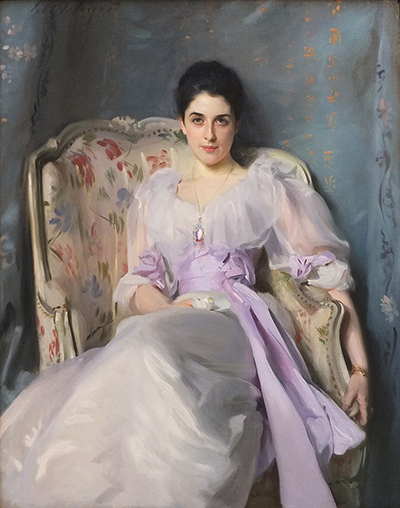
This makes the Deering portrait a useful contrast with Sargent's formal society work. In Lady Agnew of Lochnaw, a seated pose becomes social command through gaze, costume, chair, and studio silk. In Portrait of Charles Deering, a seated pose becomes friendship through white clothing, outdoor vegetation, cane chair, and inscription. Both are staged forms of ease, but their social meanings differ. [1]
White Clothing, Foliage And Painterly Surface
The white suit is the painting's main field of painterly activity. Sargent loved the challenge of pale fabric because white is never only white. It holds reflections, cool shadows, warm light, and the small accidents of surrounding color. In the Deering portrait, the white clothing catches the Florida brightness while also giving the older sitter a crisp, almost weightless presence.
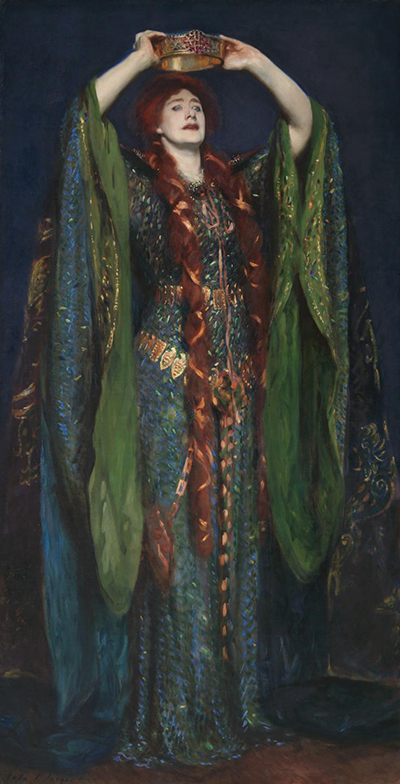
The Met essay compares the handling of light and shadow across Deering's white suit with Sargent's rendering of textiles in formal portraits such as Ada Rehan. That comparison is helpful because it keeps the portrait from seeming merely informal. Even when Sargent is painting a friend in Miami, he is still using the high skills of his portrait career: fabric as structure, light as drama, clothing as character. [2], [1]
Yet the setting changes the effect of those skills. In a dark studio, white clothing can become a theatrical spotlight. In Florida, it becomes part of the weather of the picture. The suit belongs to warmth, glare, and outdoor living. It allows Sargent to make Deering both visible and absorbed into place.
The foliage around him is not a botanical inventory. It is a painterly environment. The AIC record notes tropical vegetation, boats, and blue sky. Those details open the portrait beyond the sitter's body. Deering is framed by a world of green growth and distant water, which makes the painting partly a landscape. Sargent does not separate person from place; he weaves them together.
This is where the portrait comes close to Sargent's watercolors. The Met notes that the bright palette and fluid style echo his watercolor technique. That does not mean the oil painting imitates watercolor mechanically. It means Sargent uses oil with a lightness suited to the Florida subject: quick notation of leaves, glimpsed distance, air around the chair, and the pleasure of surfaces struck by sun. [2], [1]
The boats and sky in the distance matter because they keep the image open. A portrait can easily close around a sitter, especially when the sitter is important. Here, the distance eases pressure. Deering's identity includes travel, collecting, Miami, water, and hospitality. The background gives those ideas pictorial form without turning them into symbols.
Patron, Collector And Amateur Artist
Charles Deering's biography is useful only insofar as it explains why this portrait exists and what kind of relationship it records. The Frick Archives Directory identifies him as an art collector, industrialist, and amateur artist. It also lists Chicago as his city, with other cities including Paris, Bar Harbor, New York, and Miami. The list helps explain the portrait's world: Deering moved through exactly the transatlantic and coastal circuits in which Sargent's career flourished.
Deering's industrial wealth gave him the means to collect, but the portrait should not reduce him to money. He studied painting in Paris for a year and was deeply interested in art. The Met calls him an amateur artist and an important collector and patron. This makes him different from a sitter who approaches Sargent only for social display. Deering understood painting from the side of practice as well as ownership. [2], [1]
His Hispanist interests also mattered. The Met notes that he owned a castle in Sitges, south of Barcelona, and amassed works for homes in Spain and the United States. Sargent's own career was deeply marked by Spain, especially Velazquez, Spanish travel, and works such as El Jaleo. Deering's collecting world and Sargent's artistic memory therefore overlapped in more than one way. [2], [1]
The Frick directory records that Deering's collection included paintings, sculptures, prints, and rugs by artists including Sargent and Augustus Saint-Gaudens. It also notes that some works from his collection went to the Art Institute of Chicago, while others were transferred to his Florida estate and later given to his daughters. That pattern links private collecting to public museum culture and family inheritance.
This background clarifies the portrait's tone. Deering was a host and friend, but also a person who helped preserve and circulate art. The painting is not an advertisement for his collection. It is more intimate than that. Still, the collector's role sits behind the image, giving the inscription of friendship a larger cultural weight. [1]
Deering's Sargent Collection And Mrs. Hugh Hammersley
The strongest evidence of Deering's role in Sargent's legacy is his ownership of Sargent works. The Met states that Deering eventually owned more than a dozen works by Sargent. That is a significant fact because it makes Deering not only a sitter but a guardian of Sargent's art. [2], [1]
The most important case is Mrs. Hugh Hammersley. The Met essay explains that Deering purchased Sargent's portrait of Mrs. Hammersley in 1923. The painting had been made in London in the 1890s and later entered Deering family descent before being given to the Metropolitan Museum of Art in 1998. Through that chain, a collector's taste helped one of Sargent's major society portraits reach a major museum. [2], [1]
This matters for the Deering portrait because it turns the sitter into part of the afterlife of Sargent's portraiture. Deering did not merely sit for Sargent. He collected Sargent, pursued important works, and helped keep them in American hands. His family and descendants later formed part of the museum history of those works.
The Met also notes that Portrait of Charles Deering, Mrs. Hugh Hammersley, and Sargent's portrait of Hercules Brabazon Brabazon were reunited in the 2015 exhibition Sargent: Portraits of Artists and Friends. That reunion is revealing. It placed Deering inside a web of sitters, owners, artists, and patrons rather than treating him as an isolated subject. [2], [1]
In that sense, Deering's portrait is a portrait of a network. The image shows one man in one chair in Miami. The evidence around it connects Newport, Paris, Chicago, Miami, Sitges, London portraiture, the Met, the Art Institute of Chicago, and Sargent's circle of friends and collectors. The small canvas opens into a much larger map. [2], [1]
Place In Sargent's Late Portrait Practice
Sargent's late portraits often complicate the idea that he simply abandoned portraiture. He did grow tired of formal commissions and increasingly devoted himself to murals, watercolors, travel subjects, and other projects. But he continued to make portraits when the subject, setting, or relationship mattered. Deering's portrait shows that portraiture could still be alive for him when freed from the most burdensome social expectations.
The painting belongs with Sargent's portraits of friends and artists more than with his grand society pictures. Like Claude Monet Painting by the Edge of a Wood, it treats a known person through a setting and a mode of work or life rather than through ceremonial pose. Monet is shown painting outdoors; Deering is shown at ease in Florida. Both pictures make identity emerge from context. [1]
It also belongs with Sargent's larger interest in outdoor light. The 1917 Miami portrait appears after decades in which Sargent had become one of the great painters of travel subjects and watercolors. The AIC record stresses that he spent considerable time painting outdoors during his Deering stay. That fact helps explain the portrait's freshness. It is not a studio formula transported to Florida. It is portraiture opened by landscape.
At the same time, the picture remains fully a Sargent portrait. The sitter's clothing, posture, chair, and relation to the viewer are all carefully managed. Sargent does not dissolve Deering into scenery. He uses the scenery to make the sitter's presence more specific. Deering is old friend, collector, host, and man of place at once.
This late combination of categories is what gives the painting its interest. It is a portrait, a landscape-inflected oil, a token of friendship, and a record of patronage. Its modesty is deceptive. The work gathers many of Sargent's lifelong concerns into a small frame: the sitter encounter, white fabric, outdoor light, transatlantic friendship, travel memory, and the circulation of art through collectors. [1]
How To Look At The Portrait
Begin with the white suit. Notice how it gives Deering immediate visibility, but also how it breaks into light, shadow, and reflected color. The suit is not a flat costume. It is the main surface through which Sargent turns Florida light into portrait form.
Then look at the pose. Deering reclines in the cane chair, but the figure does not collapse. The chair's structure, the angle of the body, and the concentrated handling of the sitter keep the image firm. The relaxation is part of the portrait's meaning.
Next, look at the foliage. It surrounds Deering without swallowing him. Sargent uses leaves and tropical growth as a living screen, giving the picture a sense of heat and place. The foliage also sets off the white clothing, sharpening the sitter's presence.
The distance matters too. Boats and blue sky open the space beyond the chair. They remind the viewer that this is Miami, not a neutral studio interior. Deering is seen in relation to water, air, and outdoor leisure.
Finally, read the inscription as part of the image. "To My Friend / Charles Deering" changes the portrait's social contract. It tells us that the painting is not only a likeness. It is a gift, a memory of hospitality, and a mark of a relationship Sargent had maintained for decades.
Related Works And Where To Go Next
For Sargent's broader portrait practice, start with Portraits. That essay places Deering beside society sitters, artist friends, political figures, actors, children, and military subjects. [1]
For oil painting and outdoor handling, use Paintings and Style and Technique. For travel, watercolor, and the freer late practice that helps explain the Miami setting, use Watercolors.
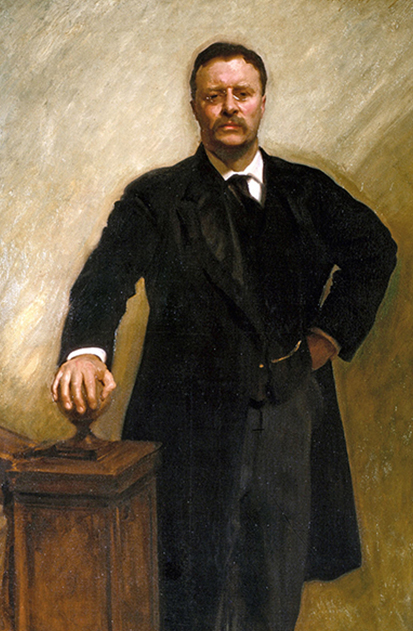
The strongest comparison among individual works is Claude Monet Painting by the Edge of a Wood, another portrait shaped by artistic friendship and outdoor setting. Lady Agnew of Lochnaw offers a useful contrast with formal society portraiture, while Theodore Roosevelt Portrait shows Sargent handling public authority in a very different key. For the larger life story behind these connections, use Biography. [1]
Frequently Asked Questions
Charles Deering, 1852-1927, was an American collector, industrialist, amateur artist, and patron. The Frick Archives Directory identifies him with Chicago and other cities including Paris, Bar Harbor, New York, and Miami.
Sargent painted Portrait of Charles Deering in 1917. The AIC record gives the date as 1917, and the painting is signed and inscribed "John S. Sargent Miami 1917."
The portrait was painted in Miami during Sargent's 1917 stay with Deering at Brickell Point. The Met explains that Sargent visited Deering while in Florida to work on a portrait of John D. Rockefeller. [2], [1]
The AIC describes it as an uncommissioned likeness of Sargent's longtime friend. The inscription "To My Friend / Charles Deering" supports the sense of the painting as a personal gift or token of friendship. [1]
The Art Institute of Chicago lists the painting as an anonymous loan, reference number 8.2002, and records it as on view in Gallery 171.
The white suit gives Sargent a way to paint Florida light across fabric. It also helps define Deering's warm-weather ease, separating this portrait from darker, more formal studio likenesses.
Deering collected Sargent's work and eventually owned more than a dozen pieces by him, according to the Met. His purchase of Mrs. Hugh Hammersley later became part of the painting's path to the Metropolitan Museum of Art. [2], [1]
It shows Sargent late in life joining portraiture, landscape, friendship, and patronage. The painting is small and informal, but it opens onto a long relationship and a major collector's role in Sargent's world. [1]
Discussion
Portrait of Charles Deering asks how informal a portrait can become before it stops being public image and becomes personal memory. Sargent's answer is to let friendship, white fabric, Florida light, and collecting history share the same chair.
Reader Insights
What is the first detail that shapes your reading of Charles Deering by John Singer Sargent: pose, setting, light, costume, brushwork or historical context?
Which small visual decision begins to matter more after a longer look, and how does it change the mood of the page?
Which comparison helps most: another Sargent portrait, a travel subject, a public commission, or a work by one of his contemporaries?
Join the Conversation
Share a thoughtful comment below about what you notice, question or compare when looking at this page.
References
- Metropolitan Museum of Art, *Sargent: Portraits of Artists and Friends* https://www.metmuseum.org/exhibitions/listings/2015/sargent-portraits-of-artists-and-friends
- Stephanie L. Herdrich, Metropolitan Museum of Art, "Tracing Connections between Sargent and Charles Deering" https://www.metmuseum.org/exhibitions/listings/2015/sargent-portraits-of-artists-and-friends/blog/posts/sargent-and-charles-deering
- Art Institute of Chicago, *Portrait of Charles Deering* https://www.artic.edu/artworks/159721/portrait-of-charles-deering