 by Tom Gurney
Tom Gurney BSc (Hons) is an art history expert with over 20 years experience
Published on June 19, 2020 / Updated on July 19, 2026
Email: tomgurney1@gmail.com / Phone: +44 7429 011000
Colonel Ian Hamilton by John Singer Sargent: Introduction
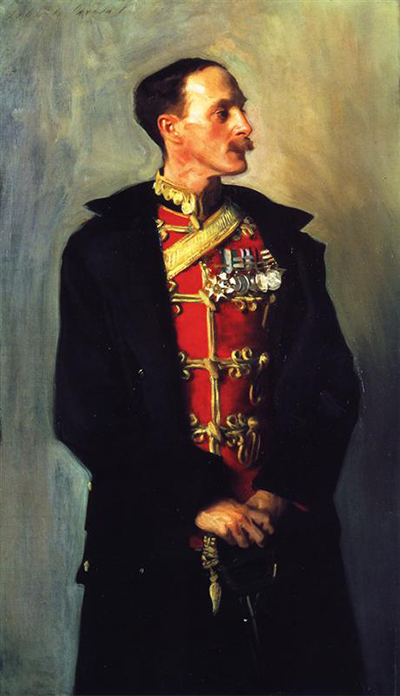
John Singer Sargent's Colonel Ian Hamilton, C.B., D.S.O. is a military portrait about rank, public image, and the discipline of pose. Hamilton stands in uniform before a dark, compressed space, his body organized by coat, medals, sword, and the upright bearing expected of a senior officer. The painting is not a battle scene. It is a portrait of military identity made still.
Painted in 1898, the work belongs to Sargent's mature portrait career, when he was already famous for making social presence feel immediate. Here the problem is different from the society portraits that made his reputation. A military sitter arrives with signs that can dominate the image before the painter has done anything: uniform, rank, decorations, headgear, sword, and the memory of service. Sargent's task was to make those signs speak without letting them flatten the sitter into a costume.
The result is controlled and severe. The Smithsonian Art Inventories record describes the work as a three-quarter-length standing portrait of Ian Hamilton wearing full military uniform, signed by Sargent at the upper left [1]. The Smithsonian CAP record identifies the sitter as Sir Ian Standish Monteith Hamilton, 1853-1947, and places the portrait under topics including medal, military headgear, coat, army officer, general, writer, and portrait [2]. Those categories are plain, but the painting's interest lies in how Sargent makes them visual. Hamilton appears as a person whose body has been shaped by office, ceremony, and command.
At a Glance
- ArtistJohn Singer Sargent [2]
- TitleColonel Ian Hamilton, C.B., D.S.O. [2]
- Date1898; the Smithsonian Art Inventories record gives ca. 1898 [2], [1]
- MediumOil on canvas [2]
- Dimensions54 1/2 x 31 in., or 138.5 x 79 cm, in the Smithsonian Art Inventories record; related object data gives 138.4 x 78.7 cm [1], [3]
- SitterSir Ian Standish Monteith Hamilton, 1853-1947 [2]
- TypePortrait [2]
- OwnerTate Gallery [3]
- AccessionTate accession number 5246; also connected with Tate N05246 [3]
- Provenance notepresented by Ian Hamilton in 1940, according to the Smithsonian Art Inventories record [1]
- Exhibition noteshown at the Pennsylvania Academy of the Fine Arts Seventieth Annual Exhibition in 1901, no. 28 [1]
- Related archive notea National Gallery archive record for 1942 press cuttings lists General Sir Ian Hamilton's gift of Sargent's Colonel Ian Hamilton, CB, DSO and Jean, Wife of Colonel Ian Hamilton among Tate bequests and gifts [4]
Contents
- Introduction
- A Military Portrait In Sargent's 1890s
- Ian Hamilton As Sitter
- Uniform, Sword And Medals
- Pose, Scale And Restraint
- Public Authority And Imperial Context
- Tate, National Gallery And The Portrait's Afterlife
- How To Look At The Portrait
- Related Works And Where To Go Next
A Military Portrait In Sargent's 1890s
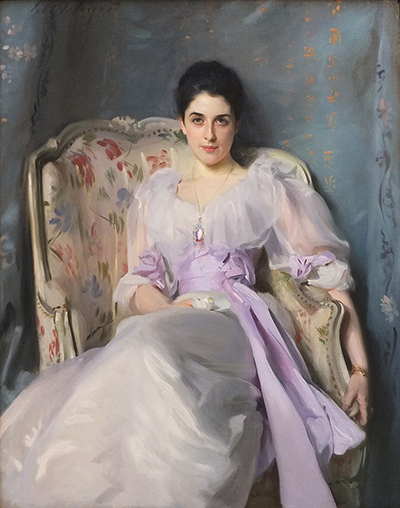
Sargent's portraits of the 1890s are often remembered through fashionable women, grand rooms, shimmering fabric, and the social drama of display. Lady Agnew of Lochnaw gives seated ease the force of aristocratic confidence. Mrs. Hugh Hammersley turns dress, chair, and color into a brilliant performance of presence. But Sargent's portrait practice was broader than society elegance. It could adapt to artists, actors, children, presidents, collectors, and soldiers.
Colonel Ian Hamilton sits within that wider range. It asks how Sargent's portrait language changes when the sitter's identity is already formalized by military dress. In a society portrait, clothing may help create fashion, mood, or rank. In a military portrait, clothing is closer to institutional language. The uniform announces service before the face can make an individual claim.
That makes military portraiture a risky category. It can easily become a record of costume and decoration rather than a portrait. If the painter gives the uniform too much authority, the sitter becomes secondary. If the painter downplays the uniform too far, the portrait loses the role it was meant to hold. Sargent's solution is balance. Hamilton's uniform is central, but the painting does not dissolve into inventory. The body, hands, gaze, and dark setting keep the image concentrated.
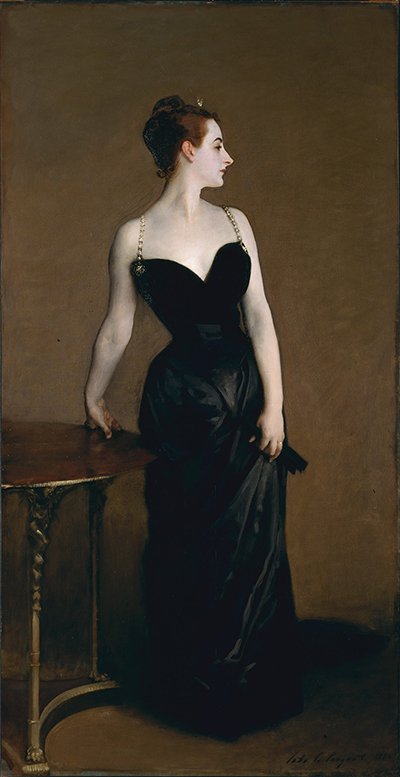
The date matters too. 1898 places the painting after Sargent's move into the London portrait world and long after the Paris rupture around Portrait of Madame X. He was no longer proving that he could paint a commanding likeness. He was refining how different kinds of sitters could be made visible under different social pressures. Hamilton gave him the pressure of military status.
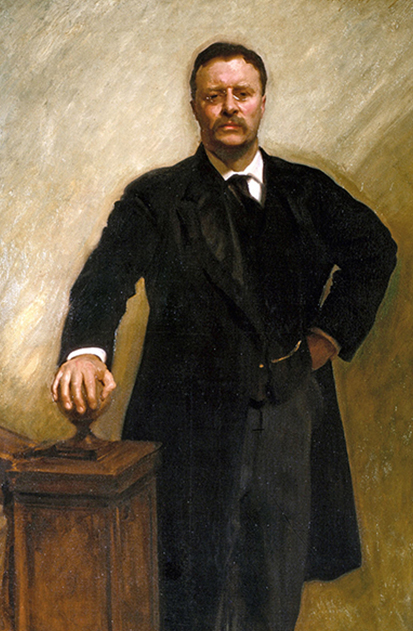
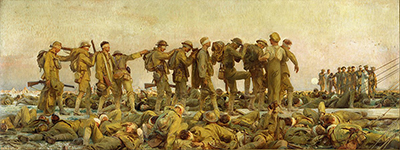
The portrait also belongs near Sargent's later images of public authority. Theodore Roosevelt turns a president's hand on a banister into a bodily image of office. Gassed turns a line of soldiers into a monumental image of shared vulnerability. Colonel Ian Hamilton stands between those kinds of meaning: not an official state portrait in the White House sense, and not a war memorial image, but a portrait in which the figure cannot be separated from power, service, and historical conflict. [3]
Ian Hamilton As Sitter
The Smithsonian CAP record identifies the sitter as Sir Ian Standish Monteith Hamilton, born in 1853 and died in 1947 [2]. That long life extended far beyond the 1898 portrait, but the article's focus belongs to the image Sargent made near the end of the nineteenth century. Hamilton appears not as an elderly memoirist or later commander, but as a uniformed officer whose rank and decorations structure the painting.
The recorded title is important: Colonel Ian Hamilton, C.B., D.S.O. The initials belong to honors attached to the sitter's military identity. The painting does not need to explain every stage of Hamilton's career to make those letters meaningful. They tell the viewer that the portrait concerns recognized service and official distinction. In the image, that recognition becomes costume, medal, bearing, and the sword held before the body.
The Smithsonian Art Inventories record supplies a revealing alternate title: General Sir Ian Hamilton as Commander of 3rd Brigade Just Before the Battle of Dargai (1897) [1]. That title should be handled carefully. It does not turn the painting into reportage, and it should not encourage a long detour through campaign history. Its value is narrower and more useful: it connects the portrait to a specific military role and to the way Hamilton's image was framed around command.
The same record describes Hamilton as wearing full military uniform and classifies the subject under both colonel and general [1]. That double language suits a sitter whose public identity shifted over a long army career. The title fixes the portrait around the colonel rank and the 1898 object, while the broader subject headings recognize Hamilton's later or wider military status.
The CAP record also includes writer among Hamilton's topic categories [2]. That detail is easy to overlook, but it helps keep the sitter from becoming only a decorated body. Hamilton's later identity included authorship as well as command. Sargent's painting, however, does not show books, papers, or literary tools. It shows the military person. That selection is itself meaningful. The portrait remembers Hamilton through uniformed visibility, not through private intellectual work.
Uniform, Sword And Medals
The most immediate fact of the portrait is uniform. The Smithsonian Art Inventories record calls it full military uniform [1]. That phrase matters because Sargent is not painting Hamilton in informal service dress or civilian clothing. The portrait depends on ceremonial force. Uniform is the painting's architecture.
Sargent had always understood clothing as more than covering. In his society portraits, dresses, robes, gloves, shawls, and collars often shape the sitter's social meaning. With Hamilton, that habit becomes stricter. Military clothing comes with rules. It carries rank, service, regiment, honor, and allegiance. Sargent uses it as a visual system, but he keeps it alive through paint.
The CAP record's topic tags help identify the elements that structure the image: medal, military headgear, coat, and outerwear [2]. These are not casual accessories. Each is part of the sitter's official presentation. Medals turn past action into visible sign. Headgear completes the military identity even when not worn on the head. The coat adds weight and vertical gravity.
The sword is equally important. In the portrait, Hamilton's hands are gathered around the sword hilt before him. That placement gives the body a center. The sword is not being raised, brandished, or used. It is held. The difference matters. Sargent does not show active combat; he shows command under restraint. The weapon becomes a prop of authority rather than an event.
Hands are often decisive in Sargent. They can steady a sitter, expose tension, perform elegance, or command space. In Theodore Roosevelt, the hand on the banister post makes political authority physical. In Colonel Ian Hamilton, the hands around the sword make military authority contained. The gesture is formal, but it is not empty. It gives the viewer a place to read control.
The uniform also produces color and surface. Against the dark surrounding space, the decorated front of the figure has visual pressure. Braid, medals, and the structure of the coat catch attention without needing a detailed setting. Sargent can reduce the background because the sitter carries his environment with him. Rank supplies the stage.
That economy is characteristic of Sargent at his best. He does not need to paint a battlefield, barracks, or imperial map to make the military subject legible. He places the signs on the body and lets the portrait become a study in how identity is worn. The viewer reads Hamilton through face, posture, decorations, and the organized fall of the coat.
Pose, Scale And Restraint
The Smithsonian Art Inventories record gives the dimensions as 54 1/2 x 31 inches, or 138.5 x 79 cm [1]. This is a tall, narrow format suited to a standing figure. It gives Hamilton enough vertical presence to feel imposing, but it is not a vast ceremonial canvas. The scale is concentrated rather than theatrical.
The record calls the work a three-quarter-length standing portrait [1]. That format focuses attention on head, torso, hands, and the upper structure of the body. It is especially useful for a military subject because it includes the key signs of identity without requiring a full ceremonial environment. The viewer sees enough of the figure to understand rank and bearing, but not so much surrounding space that narrative takes over.
Hamilton's stance is upright and frontal enough to carry authority, yet not aggressively confrontational. The gaze is controlled. The face does not tell an anecdote or invite psychological speculation. Sargent avoids turning the sitter into an exposed inner drama. That restraint suits the subject. A military portrait in formal uniform is about the self as held, arranged, and made fit for viewing.
The dark background intensifies that effect. With little setting to explain, the body becomes the site of meaning. The painting does not place Hamilton in a room full of props. It allows the uniformed figure to emerge from a subdued field. This makes the portrait feel less like a story and more like an emblem.
But the emblem is not mechanical. Sargent's strength lies in keeping the surface active. A shoulder, collar, medal, hand, and face do not receive the same degree of emphasis. The viewer's eye moves according to a hierarchy. The face carries likeness; the hands carry control; the decorations carry service; the coat and background carry mass and atmosphere.
The signed inscription at the upper left, recorded by Smithsonian Art Inventories, reminds us that the image is also a made object [1]. Sargent's authorship sits in the field of the painting, not only in the style. In a portrait so tied to institutional identity, the signature quietly asserts another authority: the painter's.
Public Authority And Imperial Context
The alternate title connecting Hamilton to command of the 3rd Brigade before the Battle of Dargai gives the portrait a historical frame [1]. It would be a mistake to turn that clue into a long military narrative. The painting itself does not show combat, landscape, enemies, or soldiers under command. It shows one man, dressed for military recognition.
Still, the context cannot be treated as neutral decoration. A British military portrait from 1898 belongs to a world in which uniformed service was closely tied to empire, status, and the public celebration of command. Hamilton's medals and full dress make that system visible. They present service as honor, hierarchy, and identity.
Modern looking has to hold two truths together. The portrait is a powerful work of painting: disciplined, economical, and visually commanding. It is also an image of imperial military authority. Admiring Sargent's handling of the uniform does not require accepting the values that uniform was designed to project. The painting gives viewers a chance to see how compelling official images can be, and therefore why they deserve careful reading.
That is one reason Colonel Ian Hamilton belongs beside Theodore Roosevelt. Roosevelt is not in uniform, but Sargent similarly makes public power bodily. The president grips an architectural form; Hamilton grips the hilt of a sword. Roosevelt stands inside the White House; Hamilton stands inside the conventions of military portraiture. In both works, Sargent understands authority as posture before he understands it as explanation.
The comparison with Gassed is sharper. In Hamilton's portrait, uniform helps make command dignified and legible. In Gassed, uniformed bodies are blinded, dependent, and damaged. The later painting does not erase the earlier one, but it changes how Sargent's military imagery can be read. Across the career, the uniform moves from a sign of rank to a sign of collective vulnerability.
That difference matters for Sargent's reputation. If one only looks at society portraits, he can seem like a painter of elegance. If one looks at Hamilton and Roosevelt, he becomes a painter of public role. If one looks at Gassed, he becomes a painter who could subject public role to historical suffering. The Hamilton portrait is smaller and more contained, but it is part of that larger field.
Tate, National Gallery And The Portrait's Afterlife
The painting's institutional history is unusually revealing. The Smithsonian Art Inventories record identifies Tate Gallery as owner, gives the accession number 5246, and states that the portrait was presented by Ian Hamilton in 1940 [1]. That means the sitter himself gave the work into a national collection late in his life.
The National Gallery archive record NG24/1942/4 adds a wartime afterlife. The record concerns press cuttings from March to August 1942 and lists bequests and gifts, including General Sir Ian Hamilton's gift of two Sargent works: Tate N05247, Jean, Wife of Colonel Ian Hamilton, and Tate N05246, Colonel Ian Hamilton, CB, DSO [4]. The paired gift matters because it places Hamilton's portrait beside a related family portrait rather than as an isolated military relic.
The same archive record notes The Tate Gallery's War-Time Acquisitions, an exhibition held at the National Gallery and opened on 2 April 1942 by Canadian High Commissioner Vincent Massey, with a visit by Queen Elizabeth [4]. That setting adds another layer. A portrait painted in 1898, given by the sitter in 1940, and noted in 1942 enters institutional visibility during another war. Its image of military authority was no longer only Victorian or Edwardian memory; it was being seen amid the pressures of the Second World War.
The 1901 exhibition note in the Smithsonian Art Inventories record gives an earlier afterlife across the Atlantic. The portrait was shown at the Pennsylvania Academy of the Fine Arts Seventieth Annual Exhibition, no. 28 [1]. This exhibition history suits Sargent's transatlantic career. An American-born painter established in Europe could paint a British officer and have the work exhibited in Philadelphia. The portrait's audience was never only one nation.
The Tate connection is also important for Sargent's presence in British collections. The painting's Tate number, N05246, fixes it within a national museum record. The Tate artwork record remains the key owner authority for the object [3]. Even when the image is discussed through Smithsonian and National Gallery records, the portrait's museum identity is anchored in Tate.
Collection history changes how a portrait works. A private portrait may begin by serving a sitter, family, or patron. Once it enters a museum, it becomes evidence for a larger history: Sargent's portrait practice, British military imagery, the display of rank, and the memory of empire. Hamilton's own gift helped move the painting from personal image into shared cultural record.
How To Look At The Portrait
Begin with the vertical format. The tall, narrow canvas makes Hamilton's body the main structure. There is little room for anecdote. Everything depends on how the figure stands.
Then look at the hands. Their position around the sword hilt concentrates the portrait. The sword is present, but action is withheld. The result is authority held in reserve, not violence in motion.
Next, look at the decorations. Medals and military details do not simply add sparkle. They translate past service into visible form. Sargent uses them to give the sitter's career a surface.
The coat and darker passages are just as important. They keep the figure from becoming only a bright costume. The darker mass gives weight, and the restrained setting keeps the portrait severe.
Finally, look at the face. Sargent does not over-explain Hamilton. The face is individualized, but it is also disciplined by the role. That tension between person and office is the painting's central subject.
Related Works And Where To Go Next
For Sargent's wider portrait practice, the natural starting point is Portraits. That essay places Hamilton beside society sitters, actors, children, artists, collectors, presidents, and other military subjects.
The closest individual comparison is Theodore Roosevelt Portrait. Roosevelt and Hamilton are different kinds of public sitter, but both portraits show Sargent using body language and a few charged objects to construct authority.
For the later transformation of military imagery, use Gassed. It shows Sargent turning soldiers away from rank and toward vulnerability, care, and public memory. For the broader institutional side of Sargent's career, Public Commissions helps connect portraits to images made for wider audiences.
For method, Style and Technique is useful because Hamilton depends on pose, costume, hands, omission, and the hierarchy of finish. Paintings and Biography place the portrait in the larger career.
Frequently Asked Questions
The sitter was Sir Ian Standish Monteith Hamilton, 1853-1947. The Smithsonian CAP record identifies him as a military officer and general, and also includes writer among his topic categories [2].
The Smithsonian CAP record gives the date as 1898. The Smithsonian Art Inventories record gives ca. 1898 [2], [1].
The portrait is oil on canvas. Smithsonian Art Inventories gives the dimensions as 54 1/2 x 31 in., or 138.5 x 79 cm [1].
The portrait is a military likeness. Smithsonian Art Inventories describes Hamilton as wearing full military uniform, and the CAP record tags the work with medal, military headgear, coat, army officer, and general [1], [2]. Uniform is the image's main language of rank and service.
Smithsonian Art Inventories records an alternate title: General Sir Ian Hamilton as Commander of 3rd Brigade Just Before the Battle of Dargai (1897) [1]. The portrait should be read through that military framing, but it is not a battle scene.
The portrait is owned by Tate Gallery and associated with Tate accession N05246. The Smithsonian Art Inventories record gives the accession number as 5246 [1], [3].
Smithsonian Art Inventories states that it was presented by Ian Hamilton in 1940. A National Gallery archive record for 1942 press cuttings lists Hamilton's gift of both Sargent's portrait of him and Sargent's Jean, Wife of Colonel Ian Hamilton among Tate bequests and gifts [1], [4].
It widens the view of Sargent's portraiture. Hamilton shows him handling military rank, uniform, medals, and command with the same formal intelligence he brought to society, theatre, artist-friend, and political portraits.
Discussion
Colonel Ian Hamilton asks how a portrait can make authority visible without turning a person into a symbol. Sargent's answer is concentrated: uniform, sword, medals, hands, face, and a dark field that lets rank and individuality press against each other.
Reader Insights
What is the first detail that shapes your reading of Colonel Ian Hamilton by John Singer Sargent: pose, setting, light, costume, brushwork or historical context?
Which small visual decision begins to matter more after a longer look, and how does it change the mood of the page?
Which comparison helps most: another Sargent portrait, a travel subject, a public commission, or a work by one of his contemporaries?
Join the Conversation
Share a thoughtful comment below about what you notice, question or compare when looking at this page.
References
- Smithsonian Art Inventories, *Colonel Ian Hamilton* https://siris-artinventories.si.edu/ipac20/ipac.jsp?aspect=Browse&index=SUBJX&menu=search&profile=ariall&ri=6105&session=1761P49582NO9.272492&source=~%21siartinventories&term=Portrait+male+--+Hamilton%2C+Ian%2C+Sir+--+Knee+length&uri=link%3D3100012~%21332388~%213100001~%213100002
- Smithsonian Institution, *Colonel Ian Hamilton, C.B., D.S.O.* https://www.si.edu/object/npg_N05246
- Tate, *Colonel Ian Hamilton, C.B., D.S.O.* https://www.tate.org.uk/art/artworks/sargent-colonel-ian-hamilton-cb-dso-n05246
- National Gallery, London, Archive record NG24/1942/4 https://www.nationalgallery.org.uk/research/research-centre/archive/record/NG24/1942/4