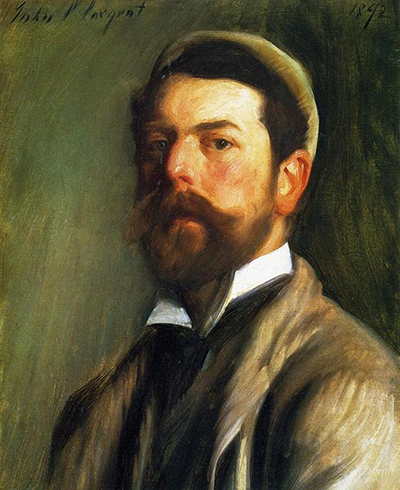
 by Tom Gurney
Tom Gurney BSc (Hons) is an art history expert with over 20 years experience
Published on June 19, 2020 / Updated on July 19, 2026
Email: tomgurney1@gmail.com / Phone: +44 7429 011000
John Singer Sargent Self-Portrait, 1892: Introduction
John Singer Sargent's 1892 self-portrait belongs to a different professional moment from the 1886 image. Six years earlier, Sargent was still working through the aftermath of Portrait of Madame X and the move toward London. By 1892, he was no longer simply recovering. He was becoming one of the defining portrait painters of the Anglo-American world, and the question of how he himself should appear had changed.
The work is therefore best read as a mature self-image rather than a private confession. Sargent spent his career constructing other people's visible presence through gaze, pose, costume, surface, and restraint. In the 1892 self-portrait, that same intelligence turns inward without becoming merely autobiographical. The painter becomes the sitter, but the problem remains outward-facing: how does a portraitist make his own authority visible?
The Smithsonian inventory record is the main museum record named for the 1892 Self-Portrait, with a connection to the National Academy [1]. A conservation and frame context is also part of the work's recorded afterlife [2]. Those records are enough for a concise article, but they also call for care. The strongest reading does not depend on invented dimensions, a guessed medium, or unsupported psychological claims. It depends on date, career position, and Sargent's larger portrait practice.
Contents
- Introduction
- Why 1892 Matters
- A Portraitist As His Own Sitter
- The National Academy And The Work's Afterlife
- Between 1886 And 1906
- How To Look At The Portrait
- Related Works And Where To Go Next
Why 1892 Matters
The year 1892 sits inside Sargent's mature portrait career. It is close enough to the Paris crisis for the memory of Madame X still to matter, but far enough away that the terms of his career had changed. The Metropolitan Museum of Art's account of Portrait of Madame X shows how the 1884 Salon reception damaged Sargent's position in Paris and helped redirect him toward London [3]. By the early 1890s, that redirection had become a working professional world.
The Sargent biography presents the London move as one of the great turns in his career. After Paris, he rebuilt his position through British and American patronage and became a painter of aristocratic women, artists, children, actors, military figures, presidents, and patrons [4]. That background matters because a self-portrait made in 1892 is no longer the self-image of an artist asking whether he can recover. It is the self-image of an artist whose recovery has become authority.
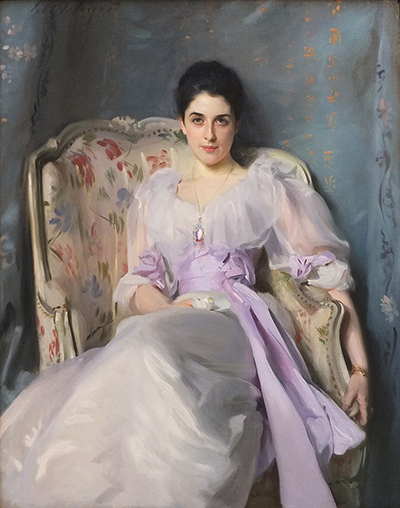
This was also the period in which Sargent's London portrait language was gaining its most visible public force. Lady Agnew of Lochnaw, painted in 1892, became one of the defining images of his early-1890s success. The National Galleries of Scotland record and the Lady Agnew article emphasize the sitter's direct presence, the relaxed pose, and the way Sargent's fluid handling helped make the portrait feel immediate and commanding [5], [6].
The self-portrait belongs beside that world, but not as another society commission. It asks what happens when the portraitist who can give authority to others turns that skill toward his own image. Sargent did not need to present rank, wealth, theatre, or political office. He needed to present the painter: the maker behind the visible performances.
That is why 1892 is a useful date. It gives the portrait a middle position. The 1886 self-portrait is charged by transition. The 1906 self-portrait belongs to later recognition and a more formal self-portrait tradition. The 1892 image stands between them as the statement of a painter who has found professional command but has not yet become a late-career institution.
A Portraitist As His Own Sitter
Sargent's portraits are rarely simple likenesses. The portraits article frames them as performances of identity under pressure: social, theatrical, artistic, familial, political, and personal [7]. That is the right frame for the 1892 self-portrait. Sargent is not merely recording his face. He is deciding how the person who makes portraits should enter view.
Self-portraiture can invite too much certainty. Viewers often want it to reveal hidden feeling, private doubt, or secret confidence. With Sargent, that shortcut is especially risky. His art is strongest when it understands identity as something staged, negotiated, and made visible through controlled means. A self-portrait by Sargent is therefore not an open diary. It is a portrait problem with unusually high stakes.
The painter and sitter are the same person, but the roles do not disappear. The sitter has to appear. The painter has to control appearance. Sargent knew how much could be done with a turn of the head, an arrangement of clothing, the relation of light to dark, the pressure of a gaze, and the distribution of finish. Even when exact object-label details are not part of the current record packet, the work can be read through that mature method.
The style-and-technique article describes Sargent's method as controlled freshness: large decisions about tone, pose, edge, surface, and emphasis made with discipline, so that the finished image seems alive rather than labored [8]. That idea is central to the 1892 self-portrait. The portraitist's authority is not only a matter of expression. It is also a matter of how paint makes presence feel inevitable.
This also connects the self-portrait to Sargent's images of artists and friends. His portraits of creative figures often ask how artistic identity can be made visible without becoming a conventional status portrait. The artist's body, gaze, and bearing have to stand for a way of working. In the 1892 self-portrait, Sargent gives that question to himself.
The National Academy And The Work's Afterlife
The Smithsonian inventory record gives the 1892 self-portrait its main public catalog identity for readers using current museum resources [1]. The National Academy connection matters because it places the work within an institutional portrait context rather than only within Sargent biography. A self-portrait may begin as an artist's image of himself, but once attached to a collection record, it also becomes part of how institutions remember an artist.
That afterlife is especially important for Sargent. He was a cosmopolitan American born in Florence, trained in Paris, professionally remade in London, and claimed by collections on both sides of the Atlantic [9], [4]. His self-portrait does not belong to a simple national story. It belongs to a transatlantic one, in which American institutions helped preserve the image of an artist whose formation and career were deeply European.
The conservation and frame context named in the Sargent research adds another kind of afterlife [2]. Frames, surfaces, conservation decisions, and institutional care shape how a painting reaches later viewers. That does not mean every technical conclusion can be imported into the article. It means the 1892 self-portrait should be understood as a physical work with a history after Sargent, not only as an illustration of his face.
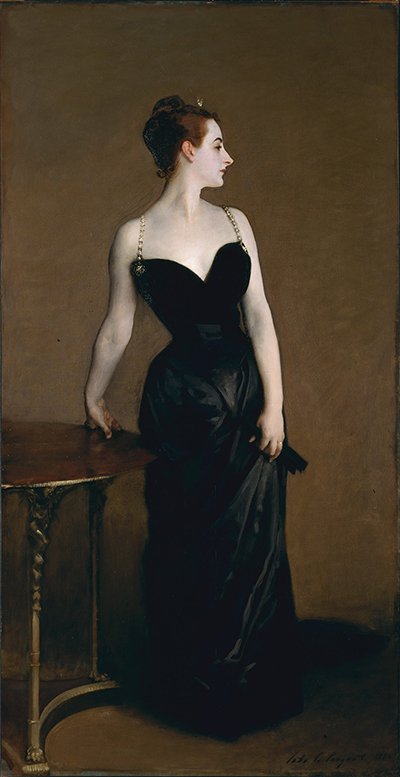
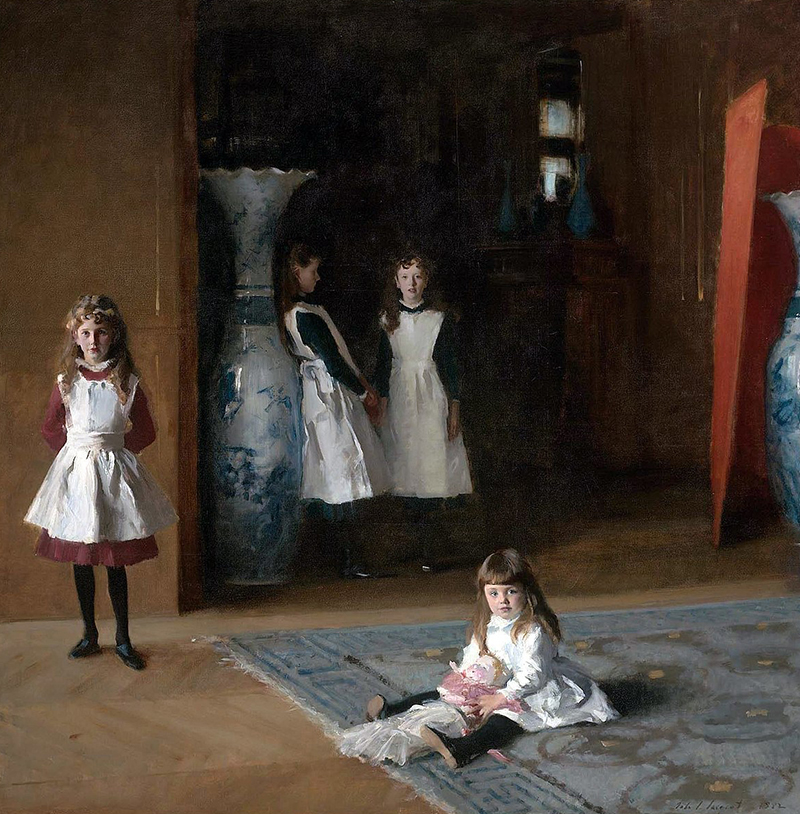
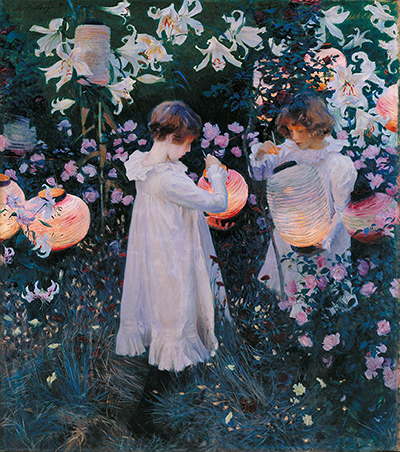
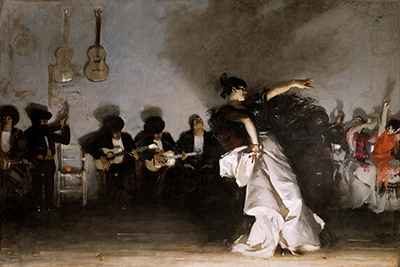
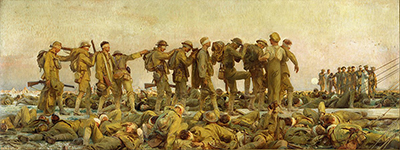
Collection and care also change the function of self-portraiture. In the studio, the image may be an artist's exercise in self-presentation. In a collection, it becomes a document of artistic identity. Later viewers approach it already knowing Sargent's reputation: Madame X, Lady Agnew, The Daughters of Edward Darley Boit, Carnation, Lily, Lily, Rose, El Jaleo, Gassed. The self-portrait sits among those works as a quieter answer to the same question: what kind of presence can paint make? [6]
Between 1886 And 1906
The 1892 self-portrait is best understood as the center of a three-part sequence. The 1886 self-portrait, documented by Aberdeen and Smithsonian records, belongs to a vulnerable career hinge after Madame X and during Sargent's turn toward London [10]. The 1906 self-portrait, represented through Smithsonian/National Portrait Gallery material connected with the Uffizi, belongs to mature recognition and a longer tradition of artists presenting themselves for historical memory [11].
The 1892 work does not simply split the difference. It has its own character because it belongs to establishment rather than recovery or retrospective honor. In 1886, Sargent had to hold professional steadiness at a moment when the public meaning of his portrait art had become unstable. In 1892, he could present himself from within renewed command. In 1906, the frame shifts again toward the artist as a recognized figure in a museum lineage.
That sequence helps prevent a common error: treating all self-portraits as the same kind of personal revelation. The dates matter because Sargent's public role changed. The young painter after the Paris crisis, the early-1890s portrait master, and the later artist connected with the Uffizi tradition do not answer the same problem. Each self-portrait asks how Sargent should be seen at a particular stage.
The comparison also keeps the 1892 work from being overshadowed by biography. The point is not to retell Sargent's life three times. It is to notice how self-image changes as the career changes. The painter who could make sitters appear glamorous, guarded, exposed, official, theatrical, or severe understood that his own image would also be read as a public sign.
How To Look At The Portrait
Begin with role. Sargent is both maker and subject, but he is not simply revealing himself. He is making a portrait of the painter as a public figure. That distinction keeps the work from sliding into unsupported psychology.
Then consider the gaze. In Sargent's portraits, a gaze can challenge, withhold, judge, or stabilize the entire encounter. The 1892 self-portrait should be read through that portrait language. Ask how the artist positions the viewer: as observer, visitor, equal, or audience.
Next, look at restraint. Sargent's finest portraits often depend on what they do not over-explain. Selective finish, dark and light, clothing, edges, and surface can create authority without narrative. The self-portrait asks those devices to carry professional identity rather than sitter biography.
Clothing and presentation also deserve attention. Sargent often used costume or dress as structure, not decoration. A self-portrait may be quieter than a grand society commission, but it still depends on how the painter chooses to appear before others.
Finally, keep the sequence in mind. The 1892 image is not the wounded aftermath of 1886 and not yet the later institutional self of 1906. It is the image of Sargent in the moment of regained command.
Related Works And Where To Go Next
For the full career, begin with Biography and John Singer Sargent. They place the self-portrait inside Sargent's movement from Florence and Paris to London, Boston, travel, public commissions, and late war art.
For the portrait problem, use Portraits. That essay explains how Sargent made identity visible through pose, gaze, costume, and surface. For method, Style and Technique is the natural companion because the 1892 self-portrait depends on restraint, selective finish, and painterly authority.
For the career pressure behind the earlier self-image, compare Self-Portrait, 1886 and Portrait of Madame X. For Sargent's early-1890s portrait authority, look at Lady Agnew of Lochnaw. For the later self-image, continue to Self-Portrait, 1906.
Frequently Asked Questions
The Smithsonian inventory record and the Sargent research identify the work as John Singer Sargent's 1892 self-portrait [1].
The date places the work after the 1886 self-portrait and after Sargent's turn toward London, but before the 1906 self-portrait connected with the Uffizi tradition. It belongs to a moment of mature portrait consolidation rather than early recovery or late institutional recognition.
The main record used here is the Smithsonian inventory record for the 1892 self-portrait, connected with the National Academy [1]. A conservation and frame context is also part of the work's recorded afterlife [2].
It is safer to read it as self-presentation. Sargent was a portraitist who understood public image, gaze, pose, costume, and surface. The sources support a professional reading more strongly than a private psychological one.
The 1886 self-portrait belongs to the period after the Madame X crisis and during the London turn. The 1892 work belongs to a more established phase, when Sargent's mature portrait authority was taking firmer shape [10].
The 1906 self-portrait is connected through Smithsonian/National Portrait Gallery material with the Uffizi tradition, giving it a later and more institutional frame [11]. The 1892 image comes earlier, before that late-career public framing.
Discussion
Sargent's 1892 self-portrait asks how a painter of other people's presence should present himself once professional authority has been regained. It is not a confession so much as a controlled appearance by an artist who knew the power of being seen.
Reader Insights
What is the first detail that shapes your reading of John Singer Sargent Self-Portrait, 1892: pose, setting, light, costume, brushwork or historical context?
Which small visual decision begins to matter more after a longer look, and how does it change the mood of the page?
Which comparison helps most: another Sargent portrait, a travel subject, a public commission, or a work by one of his contemporaries?
Join the Conversation
Share a thoughtful comment below about what you notice, question or compare when looking at this page.
References
- Smithsonian inventory record for John Singer Sargent self-portrait, 1892 https://www.si.edu/object/john-singer-sargent-self-portrait-painting%3Asiris_ari_44346
- Conservation/frame context for the 1892 self-portrait https://www.art-conservation.org/?p=3013
- Metropolitan Museum of Art, *Portrait of Madame X* and related history https://www.metmuseum.org/art/collection/search/12127
- John Singer Sargent Biography: Biography
- National Galleries of Scotland, *Gertrude Vernon, Lady Agnew of Lochnaw* https://www.nationalgalleries.org/art-and-artists/5396
- *Lady Agnew of Lochnaw* by John Singer Sargent: Lady Agnew of Lochnaw
- John Singer Sargent Portraits: Portraits
- John Singer Sargent Style and Technique: Style and Technique
- Museum of Fine Arts, Boston, John Singer Sargent biography https://www.mfa.org/news/sargent-bio
- John Singer Sargent Self-Portrait, 1886: Self-Portrait, 1886
- Smithsonian/National Portrait Gallery record for Sargent's 1906 self-portrait https://npg.si.edu/object/npg_Inv._1890_n._3351_GU