 Buy Art Prints Now
from Amazon
* As an Amazon Associate I earn from qualifying purchases.
Image reference [image]
 by Tom Gurney
Tom Gurney BSc (Hons) is an art history expert with over 20 years experience
Published on August 14, 2026 / Updated on August 14, 2026
Email: tomgurney1@gmail.com / Phone: +44 7429 011000
Penelope and the Suitors: Introduction
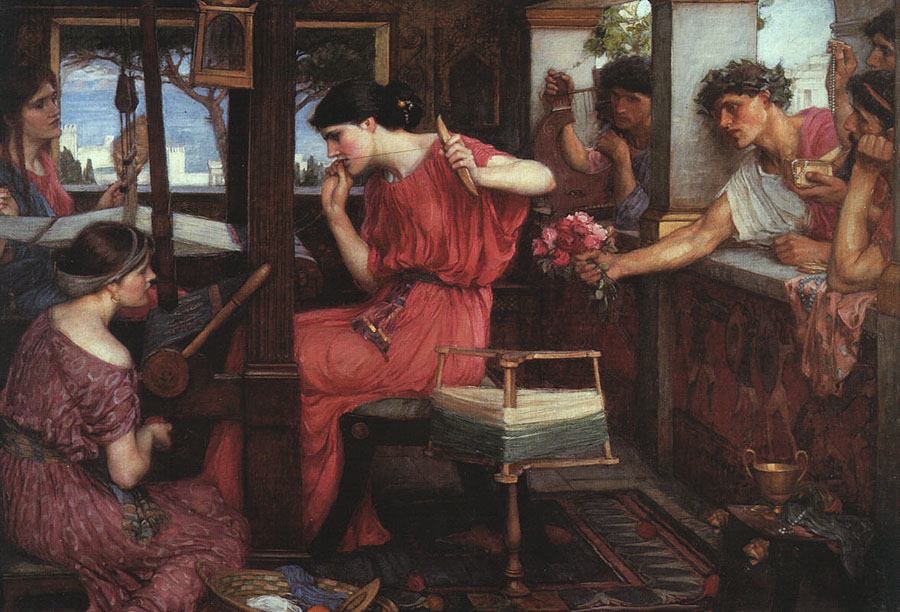
Penelope sits at her loom while the men who want to replace her absent husband press gifts into the room. They can reach through the opening, crowd her field of vision and consume the household's wealth. They cannot make her turn around.
John William Waterhouse's Penelope and the Suitors transforms one of the most famous acts of resistance in Homer's Odyssey into a contest over space, time and attention. Painted in 1911–12 and purchased by Aberdeen Art Gallery in 1912, the large late canvas shows Penelope working on the cloth whose completion she has promised will release her to marry again. The work appears calm, but everything in it depends upon delay. [1] [2]
At a Glance
- ArtistJohn William Waterhouse (1849–1917)
- TitlePenelope and the Suitors [1]
- Date1911–12 [1]
- MediumOil on canvas [1]
- Dimensions129.8 × 188 cm; framed, 158.5 × 218 cm [1]
- CollectionAberdeen Art Gallery & Museums [1]
- AcquisitionPurchased in 1912 [1]
- Object numberABDAG003035 [1]
- Principal literary sourceHomer's Odyssey, especially Books 2 and 19 [2] [3]
- SubjectPenelope at the loom while suitors competing to marry her offer gifts and attention
- Essential distinctionThe shroud is for Laertes, Odysseus's father—not for Odysseus himself [2]
Contents
- Introduction
- A Room Divided between Work and Courtship
- Penelope's Position in the Odyssey
- The Weaving Ruse and the Time It Creates
- Suitors, Gifts and the Pressure of Looking
- The Loom, Attendants and Enclosed Space
- Fidelity, Intelligence and Agency
- A Late Waterhouse Painting in Aberdeen
A Room Divided between Work and Courtship
Waterhouse does not show Penelope secretly undoing the web by torchlight. He chooses the public half of her strategy: the hours in which she must appear to advance the work while the suitors watch and wait.
The loom fills much of the left side of the wide canvas. Penelope sits with her back partly turned towards the men, her face close to the threads and her attention directed inward. Her red and rose-coloured clothing makes her the strongest concentration of colour, but her posture refuses the open display that the suitors seek.
The men approach from the right through a broad opening. Their bodies do not enter the workroom completely. Instead, heads, shoulders, arms and offerings project across its boundary. One presents jewellery; another holds a musical instrument; flowers and other gifts turn courtship into a visible campaign.
Two female attendants share Penelope's side of the picture. Their presence makes the loom a collective working space rather than an isolated emblem. They also strengthen the separation between the interior world of textile labour and the noisy masculine group beyond it.
The division is not absolute. Gifts cross the opening, a suitor leans into the room and the women's bodies remain exposed to inspection. Waterhouse therefore avoids an easy opposition between safe interior and threatening exterior. The pressure is already inside.
Penelope's most decisive gesture is withholding. She neither reaches for the presents nor rewards the performance with a returned look. Her suitors are active, colourful and numerous, yet they cannot secure the response that would complete their courtship.
This choice gives stillness an argumentative force. Penelope does not need to raise a weapon or make a theatrical refusal. Continuing to work is itself her answer.
Penelope's Position in the Odyssey
Odysseus leaves Ithaca to fight at Troy and remains absent for twenty years: ten associated with the war and ten with the dangerous return narrated by Homer. During the later years of that absence, suitors occupy his household and demand that Penelope choose a new husband. [2] [3]
The situation is domestic, economic and political. The men feast at Odysseus's expense, diminish the estate and treat marriage to Penelope as a path to status. Telemachus, her son, has reached adulthood but has not yet established the authority needed to remove them.
Penelope cannot simply announce that Odysseus will return on a particular day. She does not possess that knowledge. Nor can she expel the suitors by force. Her power lies in speech, interpretation, household management and the ability to make decisions appear conditional.
Homer allows different characters to describe her. The suitor Antinous complains in Book 2 that she has deceived the Achaeans, encouraged hopes and sent messages while keeping another purpose in mind. [2] The accusation inadvertently recognises her skill. The men who want to control the timetable find themselves living inside one she has designed.
When Penelope tells the story in Book 19, she presents the same device to the disguised Odysseus. Her version places the pressure of her parents and her son's coming of age beside the suitors' waste of the household. The ruse is not a picturesque pastime. It is a response to narrowing options. [3]
The epic does not reduce Penelope to patient immobility. She questions visitors, tests information, manages appearances and devises the bow contest that precipitates the final crisis. [3] [4] Waterhouse concentrates these capacities in one sustained act of work.
The painting should therefore be read with the whole household conflict in mind. The flowers and music are not harmless decoration. They belong to a siege conducted through hospitality, appetite and compulsory choice.
The Weaving Ruse and the Time It Creates
Penelope tells the suitors that she must finish a burial cloth for Laertes before remarrying. It would be shameful, she says, for the wealthy father of Odysseus to die without a proper shroud. [2]
The stated duty is credible because weaving belongs to the responsibilities and honour of the household. Refusing it could be condemned as neglect; completing it would activate the promise to marry. Penelope turns an expected form of women's work into a mechanism for postponement.
By day she weaves. By night, after torches are set, she unravels what she has made. The Odyssey says that the deception succeeds for three years. In the fourth, one of her women reveals it and the suitors catch her undoing the cloth, forcing her to finish. [2] [3]
Waterhouse paints neither darkness nor discovery. The web stands upright in open daylight, and the suitors look directly towards it. This is the strategy's dangerous public face: Penelope must produce enough visible progress to preserve belief without reaching the end.
The loom is consequently more than a source attribute. It is a structure for governing time. Each pass of thread appears to move the story towards marriage; each unseen reversal moves it away again.
The painting freezes this unstable balance. Viewers know that the woven surface has two histories: the labour visible in daylight and the contrary labour performed at night. What looks like production is also planned erasure.
This double action makes the cloth a fitting counterpart to the Odyssey itself. A textile grows by crossing separate threads; the epic builds through departures, returns, concealments and recognitions. Penelope works materially with the same patterns of delay that organise the narrative around her.
It is tempting to call the unfinished shroud a symbol of hope. That is possible, but incomplete. It also records coercion, vigilance and risk. Once her secret is betrayed, the device cannot protect her indefinitely.
Waterhouse's daylight scene preserves the interval before exposure. The viewer sees the tension the suitors do not: every apparent step towards completion has been designed to disappear.
Suitors, Gifts and the Pressure of Looking
The suitors are not differentiated as named Homeric characters. Waterhouse does not securely identify Antinous, Eurymachus or Amphinomus by individual attributes. He presents courtship as collective pressure.
Their group is visually restless. Faces overlap, arms extend and objects compete for notice. A lyre or kithara promises music; jewellery offers wealth; flowers turn desire into abundance. The accumulation risks becoming comic because every new attraction confirms the failure of the last.
The opening through which they lean resembles a stage edge, balcony or service aperture. It lets Waterhouse compress a large social threat into a shallow band beside Penelope. The men appear close enough to interrupt but not established enough to possess the room.
Their gaze matters as much as their presents. Penelope is watched while performing the labour on which their hopes depend. Her bent head protects attention, but it cannot remove her from display.
This creates an unequal exchange. The men offer objects in expectation of a personal answer. Penelope gives them only the sight of continued work. They translate wealth into spectacle; she converts labour into delay.
Nothing proves that each painted gift corresponds to a particular incident in Homer. The Odyssey does include a later episode in which Antinous, Eurymachus and another suitor send Penelope valuable presents after she has encouraged their generosity. [3] Waterhouse may draw upon that broader economy of courtship, but he condenses narrative elements rather than illustrating one line with archaeological precision.
The crowd also clarifies Penelope's isolation. She has attendants, but no equal partner shares the decision. Odysseus is absent, Telemachus is not shown and Laertes exists only as the ostensible future user of the cloth.
The suitors possess numbers, noise and access. Penelope controls the one thing they most urgently want: consent to an ending.
The Loom, Attendants and Enclosed Space
The loom creates a second architecture inside the room. Its uprights and horizontal beam frame Penelope, while stretched threads form a partial screen between her body and the viewer.
This framework can look protective, but it also confines. Penelope works within a narrow compartment, pressed between the textile and the wall while the suitors occupy the open, sunlit approach.
The two attendants extend the rhythm of female labour. One works close to the loom; another occupies the foreground with thread or wool. Their tasks give physical credibility to the production of a large cloth and prevent Penelope from becoming an abstract emblem detached from process.
At the same time, the Odyssey makes female loyalty inside the household uncertain. A maid eventually discloses the nightly unweaving. [2] [3] The painting does not tell us whether either attendant is that betrayer. Identifying one by expression would exceed the evidence.
Waterhouse uses textile, garments and cushions to make the interior sensuous, but the softness does not dissolve structure. Loom, sill, floor and opening establish a sequence of limits. The suitors have crossed some of them and not others.
Beyond the group, landscape and water introduce distance. The view can evoke Ithaca's island setting, yet it also measures Penelope's enclosure. Open sky is visible through the same zone occupied by men who will not leave.
The cloth itself remains difficult to read as a completed image. That ambiguity is appropriate. A clearly finished design would contradict the strategy, while a merely empty loom would not demonstrate sustained work.
Rather than recreating Bronze Age textile technology with documentary exactness, Waterhouse builds a classical-poetic interior recognisable to his own audience. The painting's authority lies less in archaeological proof than in the relation among bodies, objects and boundaries.
Its horizontal format is essential. Penelope and the suitors need room to exist in adjoining but contested zones. The eye travels from concentrated labour to multiplying offers, then back to the woman who will not turn.
Fidelity, Intelligence and Agency
Penelope has often been treated as a simple emblem of marital fidelity. Faithfulness is central to the Odyssey, but Waterhouse's scene becomes weaker if she is understood only as a woman who waits.
Waiting here is manufactured. Penelope creates it through an argument about ritual duty, skilled work by day and deliberate undoing by night. Her constancy depends upon invention.
Homer's suitors recognise this intelligence even while condemning it. Antinous attributes to Athena her knowledge of fine handiwork, understanding and cunning. [2] The qualities that make Penelope admirable also make her intolerable to men who assume she must choose among them.
Her agency remains constrained. She cannot make Odysseus arrive, guarantee that he lives or prevent servants from betraying her. The strategy delays a forced decision; it does not abolish the structure that makes the decision necessary.
Waterhouse captures that mixture by refusing both triumph and collapse. Penelope neither celebrates her cleverness nor appears defeated. Her absorbed, guarded posture belongs to someone sustaining a difficult performance one day at a time.
The red dress makes her visually commanding without requiring her to face outward. Colour establishes presence while gesture withdraws consent.
Modern viewers may also notice that the suitors' attention turns Penelope into the prize of a competition staged around her. The painting partly reproduces that spectacle: it gives us access to the room and to her concentrated figure. Yet it also frustrates possession by making her refusal of attention the centre of the composition.
Her intelligence is not hidden from the viewer even though the night-time act is. Knowledge of the story lets us see two Penelopes at once: the dutiful weaver the suitors expect and the strategist undoing their timetable.
Fidelity in this painting is therefore neither passivity nor decorative virtue. It is a practice maintained through labour, secrecy and control over pace.
A Late Waterhouse Painting in Aberdeen
Aberdeen Art Gallery dates the work 1911–12 and records its purchase in 1912. Its dimensions make it a substantial horizontal canvas, nearly 1.9 metres wide before framing. [1]
The date places it in Waterhouse's late career, after his major treatments of Tennyson, Shakespeare, Keats and Greek myth had established the combination now associated with him: literary women, richly imagined settings, emotional suspension and paint handling looser than the hard finish of some earlier Victorian classicism.
Aberdeen's collection record specifically notes the broad handling and loose brushwork of his later manner, relating it to the influence often attributed to French painters such as Jules Bastien-Lepage. [1] That observation helps prevent the subject's detail from being mistaken for uniformly minute finish.
The canvas rewards viewing at two distances. From across a gallery, the red figure, pale loom and crowd of men form an immediately legible drama. Closer inspection allows passages of textile, flowers, jewellery and faces to break into more mobile handling.
The museum purchased the painting in its year of completion. A later account records that Aberdeen's curator defended the price against criticism and praised Waterhouse for giving an old myth romance and an individual point of view. [5] The defence is evidence of contemporary debate around acquisition, not an objective verdict that every viewer was obliged to share.
Its public collection is especially valuable because Penelope's story concerns access and attention. Unlike many Waterhouse canvases now known chiefly through reproductions or auctions, this work can be considered at its intended scale.
The painting also complements Aberdeen's 1906 Danaïdes. Both treat women from Greek myth through repetitive labour, water or distant landscape and large multi-figure design. Yet their temporal structures differ sharply. The Danaids work without hope of completion; Penelope keeps her cloth unfinished because delay preserves hope.
In one painting, endless labour is punishment. In the other, repeated labour becomes defence.
The pairing also clarifies Waterhouse's treatment of collective and individual experience. The Danaids move as a chain, each repeating a sister's action. Penelope works within a small female group but remains the single intelligence directing the delay. Her attendants can assist with material labour; they cannot assume the political and emotional consequences of the choice.
The Aberdeen canvas also resists the idea that a late Waterhouse woman is necessarily detached from practical action. Penelope is not merely dreaming beside a flower or listening to distant music. Hand, shuttle, yarn and loom make thought inseparable from making. Even her refusal is conducted through technique.
This attention to work matters at gallery scale. The loom is large enough to compete with the human figures, and the textile is not a token attribute held lightly in one hand. It is equipment, enclosure and timetable at once.
Related Pages
- Literary and Mythological Sources: Connect Penelope's Homeric source with Waterhouse's wider mythological painting.
- Circe Offering the Cup to Ulysses: Compare another late-Victorian/Edwardian Homeric subject by Waterhouse.
- Paintings: Return to the Waterhouse paintings hub.
Frequently Asked Questions
Penelope works at the loom while men seeking to marry her offer gifts and attention. She has promised to choose a husband when the textile is finished, but secretly undoes her work at night to delay that choice. [1] [2]
A shroud for Laertes, the elderly father of Odysseus. It is often mistakenly described as a shroud for Odysseus. [2]
Unravelling at night cancels the progress made by day and postpones the completion on which her promise to remarry depends. The ruse succeeds for three years before a maid reveals it. [2] [3]
Not necessarily. Waterhouse combines the loom, the suitors' pressure and their gifts into one intelligible scene. The painting should be understood as a condensation of the household conflict rather than a line-by-line reconstruction.
He is absent from the painting, as he is from Ithaca during most of Penelope's struggle with the suitors. His absence creates the crisis but does not occupy visual space.
She receives reports and tests claims, but she does not possess simple certainty throughout the epic. Her resistance combines loyalty with judgement under uncertainty. [3]
Aberdeen Art Gallery dates it 1911–12 and records that it was purchased in 1912. [1]
The unframed canvas measures 129.8 × 188 cm. [1]
It belongs to Aberdeen Art Gallery & Museums, object number ABDAG003035. Display status can change, so visitors should check the museum's current information before travelling. [1]
Discussion
1. How does Penelope exercise power without leaving her loom? 2. What changes when weaving is understood as both productive and destructive labour? 3. Do the suitors' gifts make them appear generous, invasive or faintly ridiculous? 4. How does the opening between the room and the outside organise gender, access and pressure? 5. What can the painting show about Penelope that a scene of the night-time unravelling could not? 6. Does Waterhouse invite viewers to admire fidelity, intelligence or the combination of both? 7. How does knowledge of the maid's eventual betrayal affect the attendants in the painting? 8. Compare Penelope's unfinished task with the endless labour in Waterhouse's The Danaïdes. How do hope and punishment alter the meaning of repetition?
Reader Insights
Which visible detail most changes the way you read this page?
Which source or comparison helps the work feel less familiar and more specific?
What question would you bring back to the painting after reading?
Join the Conversation
Share your reading of this page below.
References
- Main image: John William Waterhouse, Penelope and the Suitors, 1911-12, Aberdeen Art Gallery & Museums, source-limited public-domain reproduction via Wikimedia Commons.
- Aberdeen Art Gallery & Museums, “Penelope and the Suitors,” collection record, object ABDAG003035, accessed 6 August 2026, View source.
- Homer, Odyssey, Book 2, especially lines 85–128, translated by A. T. Murray, Perseus Digital Library, Tufts University, accessed 6 August 2026, View source.
- Homer, Odyssey, Book 19, translated by A. T. Murray, Perseus Digital Library, Tufts University, accessed 6 August 2026, View source.
- Homer, Odyssey, Book 21, translated by A. T. Murray, Perseus Digital Library, Tufts University, accessed 6 August 2026, View source.
- Jacqueline Banerjee, “J. W. Waterhouse's ‘Penelope and the Suitors,’” The Victorian Web, 21 February 2021, View source.