 Buy Art Prints Now
from Amazon
* As an Amazon Associate I earn from qualifying purchases.
Image reference [image]
 by Tom Gurney
Tom Gurney BSc (Hons) is an art history expert with over 20 years experience
Published on August 14, 2026 / Updated on August 14, 2026
Email: tomgurney1@gmail.com / Phone: +44 7429 011000
John William Waterhouse Literary and Mythological Sources: Introduction
John William Waterhouse did not paint one imaginary world. His pictures move between Homer's wandering sailors, Ovid's transformations, Shakespeare's heroines, Tennyson's enchanted rooms, Keats's dangerous lovers, Christian martyrdom and the dynastic violence recorded by Josephus. Their visual family resemblance can disguise how different these sources are.
The distinction matters. A painting may illustrate a precise line from a poem, reshape an episode from an ancient narrative, attach a modern title to a mood, or use a mythological name without following one identifiable text. Waterhouse's art becomes more intelligent—not less magical—when those levels of certainty are kept apart.
At a Glance
- ArtistJohn William Waterhouse (1849–1917)
- Principal source traditionsGreek and Roman epic and myth; Victorian poetry; Shakespearean drama; medieval and Renaissance narrative; ancient history; Christian hagiography [1]
- Core authors repeatedly associated with the paintingsHomer, Ovid, Shakespeare, Alfred Tennyson and John Keats [1]
- Other important textsApuleius's story of Cupid and Psyche, Boccaccio's Decameron, Josephus's Jewish Antiquities, Prudentius's martyrdom poetry and Procopius's histories [2] [3] [4] [5] [6]
- Documented reading evidenceWaterhouse drew in volumes of Tennyson and Shelley shown in the 2009 retrospective, but a surviving book does not automatically prove the source of every related painting [1]
- Typical methodHe selects a charged interval, then adds, removes or relocates details to make the wider narrative visible in one composition
- Most important cautionA familiar myth does not always identify the exact edition, translation or literary passage Waterhouse used
- Best way to read the paintingsBegin with the documented title and visible action; compare them with the proposed source; then mark Waterhouse's inventions rather than forcing perfect correspondence
Contents
- Introduction
- A Source Map and Four Levels of Certainty
- Homer: Ulysses, Circe and Penelope
- Ovid and the Art of Transformation
- Ancient Narratives beyond Homer and Ovid
- Tennyson and the Drama of Enclosed Vision
- Keats, Boccaccio and Inherited Stories
- Shakespeare: Painting before Catastrophe
- History, Hagiography and the Edge of Myth
- How Waterhouse Transforms a Text
A Source Map and Four Levels of Certainty
Waterhouse's titles often sound like labels attached to an illustrated anthology. They are more varied than that. Before interpreting a picture, it helps to ask what kind of source claim the evidence can support.
Direct textual identification is the strongest category. A title may name a character and action found in a particular work, or a Royal Academy catalogue may print a quotation. “I Am Half-Sick of Shadows,” Said the Lady of Shalott quotes Tennyson; Circe Offering the Cup to Ulysses corresponds to Homer's Odyssey; Miranda – The Tempest identifies Shakespeare's play. [7] [8] [9]
A known story with an invented painted moment is different. Psyche Opening the Door into Cupid's Garden belongs to Apuleius's Cupid and Psyche narrative, but Apuleius does not describe Psyche secretly opening that garden door. Waterhouse creates a threshold that concentrates the story's concern with incomplete knowledge. [2]
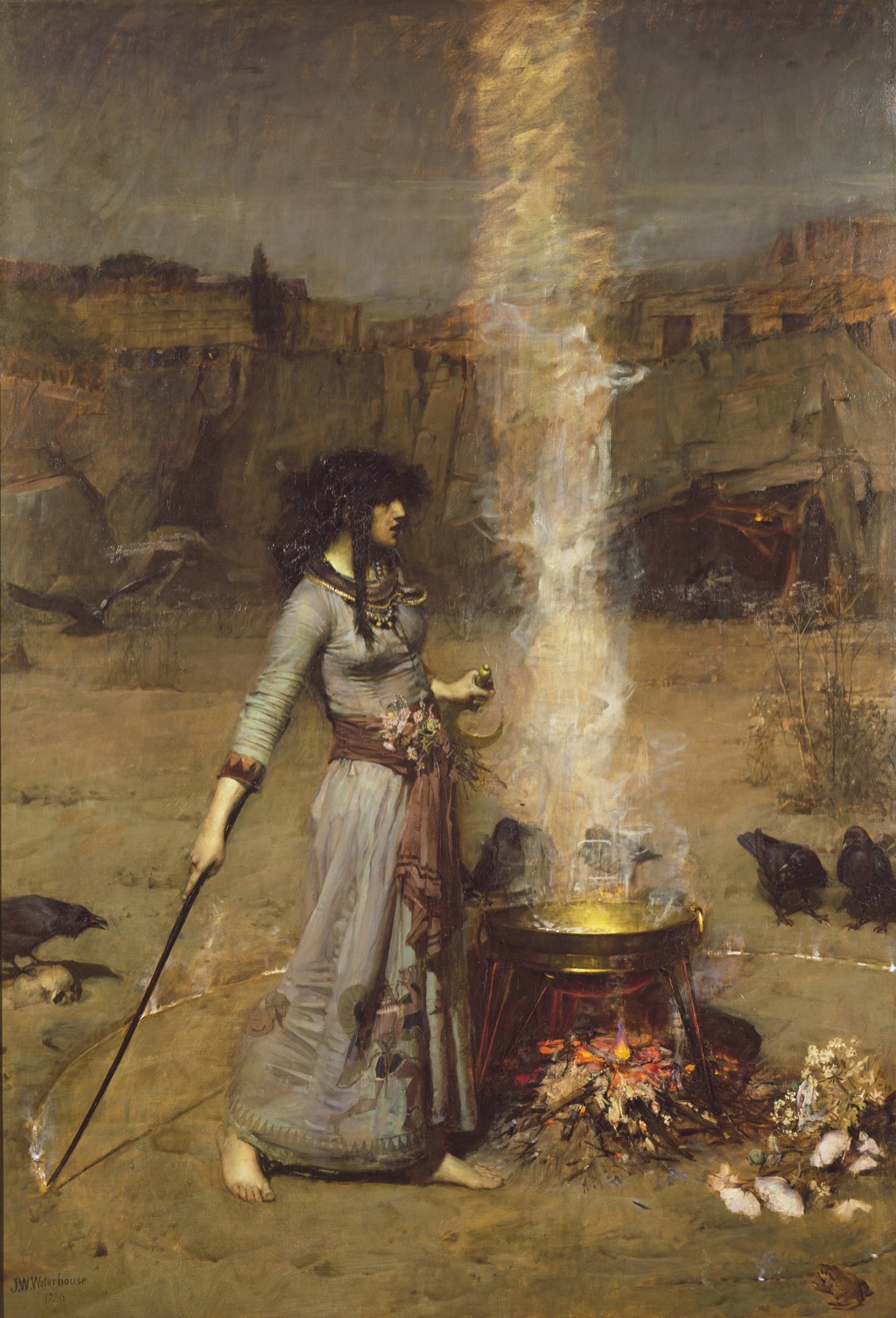
A probable or proposed literary source requires attribution. The Magic Circle has been persuasively connected with Simaetha's spell in Theocritus's second Idyll through an 1881 review of an earlier version and recent scholarship, but the finished Tate painting should not be reduced to a line-by-line illustration. [10]
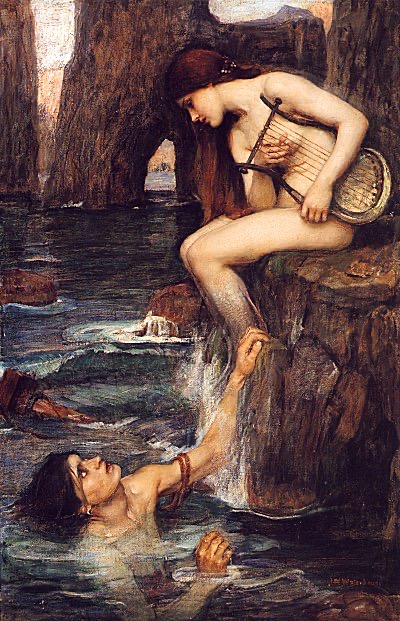
A mythic or poetic atmosphere without one proven text is the most open category. Boreas names the north wind but does not depict the famous abduction of Oreithyia. A Mermaid, The Siren and The Crystal Ball draw upon established supernatural types, yet their titles do not establish a single poem as the complete source.
These categories can be arranged as a practical map:
| Source tradition | Representative Waterhouse paintings | Evidential relationship | |---|---|---| | Homer, Odyssey | Ulysses and the Sirens; Circe Offering the Cup to Ulysses; Penelope and the Suitors | Named characters and episodes; direct narrative relationship [7] [8] [11] | | Ovid, Metamorphoses | Circe Invidiosa; Echo and Narcissus; Nymphs Finding the Head of Orpheus | Specific transformations or their aftermaths [12] [13] [14] | | Apuleius, Metamorphoses | The two “Psyche Opening” paintings | Ancient story, with significant pictorial invention [2] | | Tennyson | Three Lady of Shalott paintings; Mariana in the South; title phrase of The Soul of the Rose | Direct quotation or strong literary relationship; details can be added or rearranged [15] [16] | | Keats | La Belle Dame sans Merci; Lamia; Isabella and the Pot of Basil | Named poems and characters; the selected moment may be invented or compressed [17] | | Shakespeare | The Ophelia paintings; the Miranda paintings; Juliet | Named dramatic characters, usually isolated before the catastrophe [9] [18] | | Boccaccio | A Tale from the Decameron; remote source for Isabella through Keats | Direct Renaissance narrative in one case; a chain of retelling in the other [4] | | Ancient history and hagiography | Mariamne; Saint Eulalia; The Favourites of the Emperor Honorius | Josephus, Prudentius and Procopius provide very different kinds of written evidence [3] [5] [6] | | Uncertain or composite inspiration | The Magic Circle; The Soul of the Rose; A Mermaid; The Crystal Ball | Titles, visual conventions and proposed texts must be distinguished [10] [16] |
The map prevents two common errors. The first is to call every classical painting “Greek mythology,” even when its immediate source is a Roman author, an ancient historian or a Victorian poem set in Greece. The second is to assume that every visible object came from the text.
Waterhouse's literary world is a network of retellings. Ovid preserves Greek myths in Latin poetry; Keats reshapes Boccaccio and ancient Lamia traditions; Tennyson transforms medieval material; Waterhouse then converts words into bodies, objects and spaces. “Source” may therefore mean the text he most directly followed, the older tradition behind that text, or the wider imagery available to a nineteenth-century painter. Those meanings should not be silently merged.
Homer: Ulysses, Circe and Penelope
Homer's Odyssey offered Waterhouse three distinct kinds of dramatic intelligence: a man who chooses dangerous knowledge, a magician whose hospitality becomes transformation, and a woman who survives by controlling time through work.
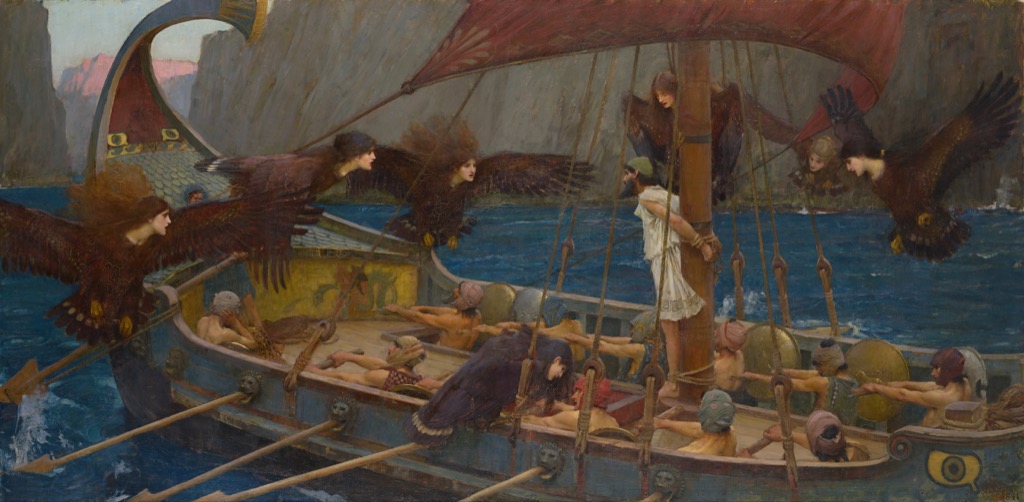
In Book 12, Circe warns Odysseus about the Sirens. He seals his crew's ears with wax and orders them to bind him to the mast so that he alone can hear the song without steering the ship towards destruction. [7]
Ulysses and the Sirens of 1891 expands that compact passage into an attack. Bird-bodied women crowd around the ship while the hero strains against his ropes and the crew row on. The National Gallery of Victoria records that Waterhouse drew the hybrid siren form from an ancient Greek vase in the British Museum. [19]
This is a crucial example of two sources working together. Homer supplies the episode, actions and danger; ancient visual culture supplies a bodily type. Waterhouse does not choose the fish-tailed mermaid familiar from later folklore. Textual fidelity in action coexists with archaeological looking in form.
The Sirens promise knowledge, not merely sexual pleasure. Odysseus wants to hear and plans a mechanism that separates experience from consequence. Waterhouse makes the arrangement precarious: restraint is visible as bodily struggle, and wisdom appears inseparable from appetite. [7]
Book 10 provides the encounter behind Circe Offering the Cup to Ulysses. Circe drugs the hero's companions, strikes them with her wand and transforms them into swine. Protected by the herb moly supplied by Hermes, Odysseus drinks without changing and forces her to swear that she will not harm him. [8]
Waterhouse gives Circe a throne, cup and wand. A round mirror behind her reflects Ulysses, while the transformed crew appears at the sides. Homer narrates a sequence; the painting folds several states into one arrangement. The mirror lets the enchantress face the viewer while keeping her opponent inside her visual field.
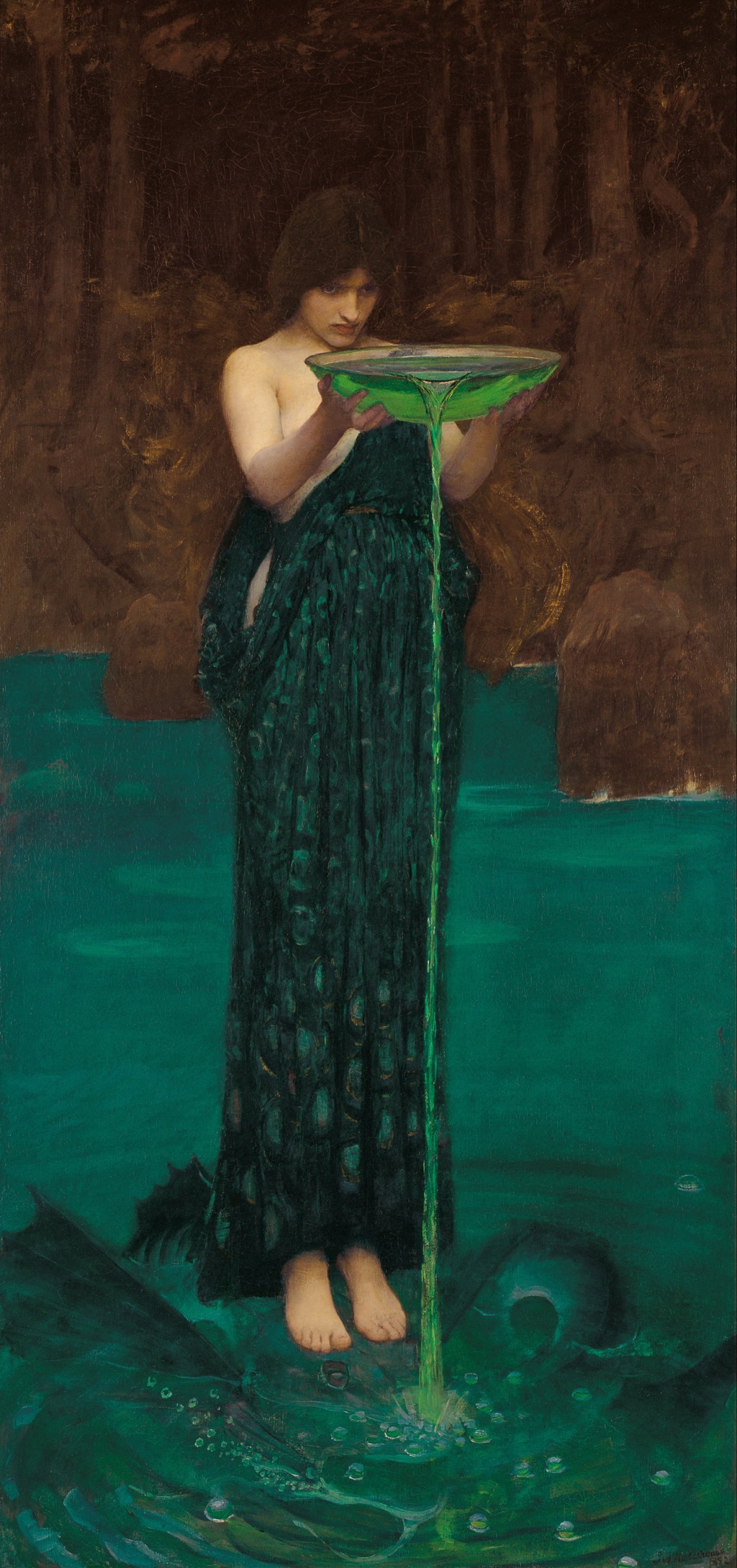
The following year's Circe Invidiosa turns away from Homer. Its source is Ovid's account of Circe poisoning the pool used by Scylla because Glaucus has rejected the goddess's love. [12] Treating both paintings simply as “Circe from the Odyssey” erases the change from resisted transformation to successful revenge.
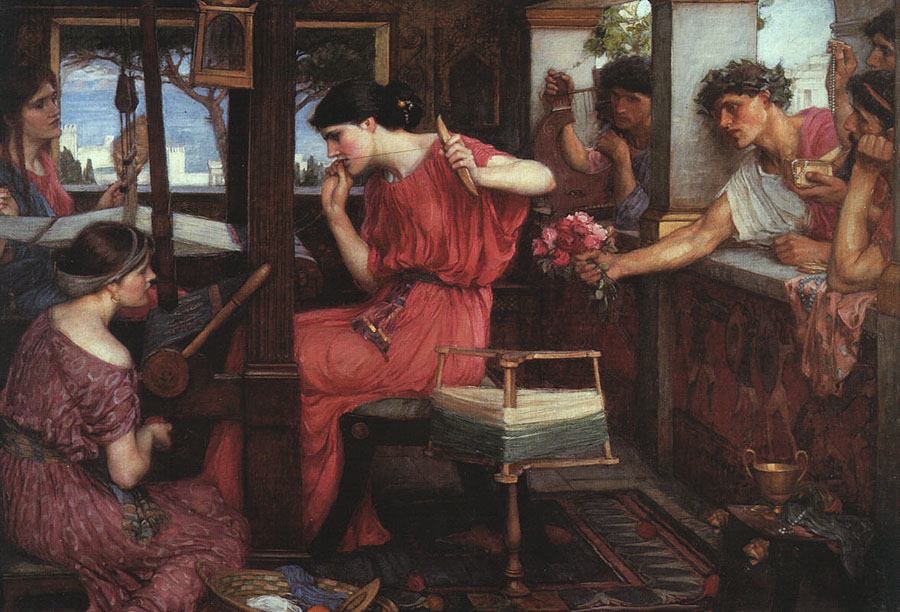
Penelope and the Suitors, painted in 1911–1912, returns to the Odyssey late in Waterhouse's career. Penelope delays remarriage by weaving a shroud for Laertes by day and undoing it at night. Aberdeen's collection account identifies the suitors, gifts and weaving that structure Waterhouse's canvas. [11]
The painting does not represent magic, yet making becomes a form of control. Penelope's loom creates protected time just as Circe's vessel creates transformation and Odysseus's ropes create constrained hearing.
Together the Homeric pictures warn against reducing Waterhouse to female enchantresses and endangered men. Circe commands, Odysseus designs his own trial, and Penelope resists an entire court through repetitive labour. The common subject is not one gendered role but the management—or loss—of attention.
Ovid and the Art of Transformation
Ovid's Metamorphoses gave Waterhouse narratives in which emotional pressure alters bodies and landscapes. The painter often chooses the instant immediately before or after the supernatural change, when identity remains visible but cannot remain secure.
Circe Invidiosa shows poison descending from Circe's bowl into the water. Glaucus, whom she desires, and Scylla, whom she will transform, are absent. Ovid describes Circe's rejection, her preparation of destructive substances and the pool in which Scylla's lower body becomes monstrous. [12]
Waterhouse concentrates motive and consequence into the stream of green-blue liquid. The colour spreads through water and air, making metamorphosis atmospheric before the victim enters.
Echo and Narcissus draws upon Book 3. Ovid's Echo can repeat only the last words spoken by others; rejected by Narcissus, she wastes until voice remains. Narcissus then falls in love with his own reflected image and cannot possess it. [13]
Waterhouse shows both figures in one landscape: Echo watches from a distance while Narcissus bends over the pool. Ovid tells their sufferings in sequence, but the canvas lets viewers see the emotional structure simultaneously. One person cannot make herself heard; the other cannot look beyond himself.
The painting stops before completed transformation. Echo still has a body, and Narcissus has not become the flower that bears his name. Knowledge of the text makes the landscape feel temporary.
Nymphs Finding the Head of Orpheus turns to Book 11 and the aftermath of violence. Ovid describes the Thracian women tearing Orpheus apart, after which his head and lyre travel down the river while voice and instrument continue their lament. [14]
Waterhouse omits the murder. Two nymphs discover the severed head floating beside the lyre. Their looking transfers the shock from action to recognition.
The three works demonstrate that “illustration” need not mean the most spectacular event. Scylla's monstrous body, Echo's disappearance and Orpheus's murder would all offer obvious climaxes. Waterhouse instead paints poisoned water, a still-human sufferer and the witnesses who arrive afterwards.
Ovid also matters beyond these securely identified examples. Apollo and Daphne, Flora and the Zephyrs and other mythological subjects belong to transformations widely transmitted through classical literature. Yet the presence of an Ovidian version does not prove that Waterhouse followed a particular translation or passage unless title, catalogue or scholarship supplies the connection.
That restraint is especially important because myth has multiple tellings. “The Greek myth says” can conceal disagreement among ancient authors and the Victorian editions through which the story was known. The correct question is often narrower: which aspect of which surviving version explains what Waterhouse chose to paint?
Ancient Narratives beyond Homer and Ovid
Waterhouse's classical imagination is often summarised through Homer and Ovid, but several important paintings require other texts—or no securely identified one.
The Cupid and Psyche story comes from Books 4–6 of Apuleius's Latin novel Metamorphoses, also known as The Golden Ass. Psyche lives with an unseen husband, violates the condition that protects his identity, is separated from Cupid and undergoes trials imposed by Venus before becoming immortal. [2]
Waterhouse painted Psyche Opening the Golden Box and Psyche Opening the Door into Cupid's Garden. The box belongs to Apuleius's narrative: Psyche opens the container she has been warned to keep closed and falls into a deathlike sleep. The garden door is Waterhouse's invention. [2]
Pairing the works exposes his method. A literal object from the ancient text and an invented architectural threshold can carry the same larger concern: the moment when curiosity converts a boundary into knowledge.
The Danaïdes come from a myth of endless punishment. Condemned to fill a leaking or bottomless vessel, they supplied Waterhouse with a late image of repetitive labour that can never be completed. The story was transmitted in many ancient forms; identifying one exact source edition requires more evidence than the title alone provides.
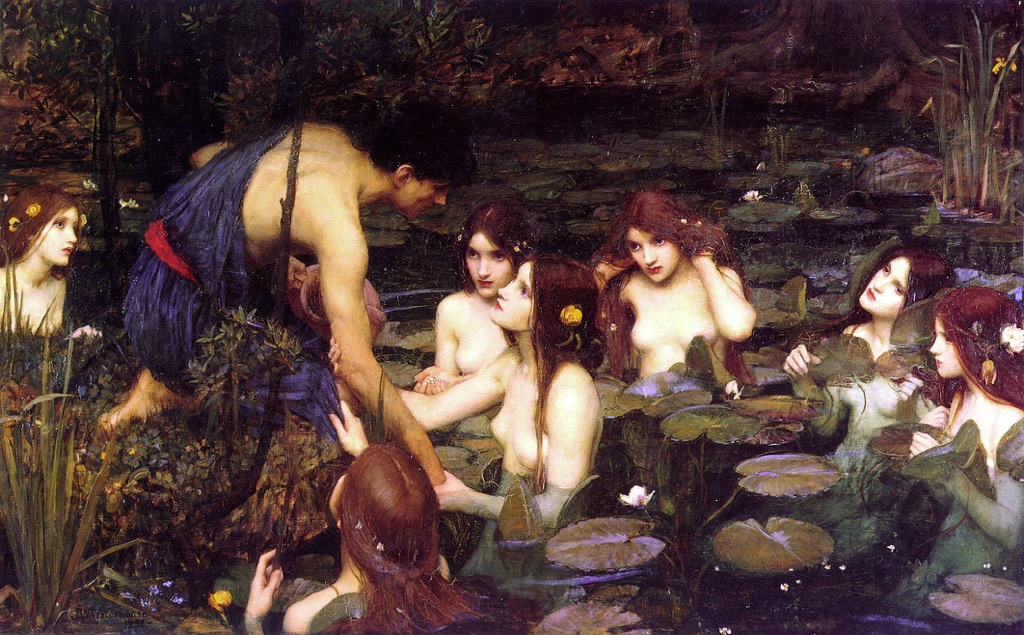
Hylas likewise belonged to several classical traditions. His disappearance while fetching water for the Argonauts appears in Apollonius and Theocritus, among others. Hylas and the Nymphs clearly names the myth, but the painting's seven near-repeating nymphs, dense lilies and exchange of hands are Waterhouse's compositional decisions rather than an inventory from one line of poetry.
The Magic Circle illustrates the value of cautious reconstruction. Tate's title and visible action establish a woman making a magical boundary. [10] A recent study joins an 1881 contemporary notice to Theocritus's second Idyll, in which Simaetha performs a love spell. That is persuasive contextual evidence, but it does not justify identifying every bird, plant and vessel as a prescribed part of Theocritus's rite.
Consulting the Oracle presents a further limit. Its Royal Academy explanation describes a community seeking advice from an embalmed head, but the architecture, clothing and ritual are a hybrid imaginative construction. Assigning the scene to one named ancient civilisation or surviving text would give false precision.
The same principle applies to The Crystal Ball. Divination has long literary and visual traditions, and the restored skull strengthens the work's encounter with mortality. No cited evidence, however, establishes a single poem that explains the woman, book, ball and enclosed interior.
Waterhouse could be textually specific and mythically suggestive. These are not competing levels of quality. The difference lies in what kind of interpretation the evidence permits.
Tennyson and the Drama of Enclosed Vision
Alfred Tennyson gave Waterhouse more than medieval costume and melancholy women. His poems offered systems of controlled experience: mirrors, webs, rooms, gardens and repeated tasks through which a character meets the world indirectly.
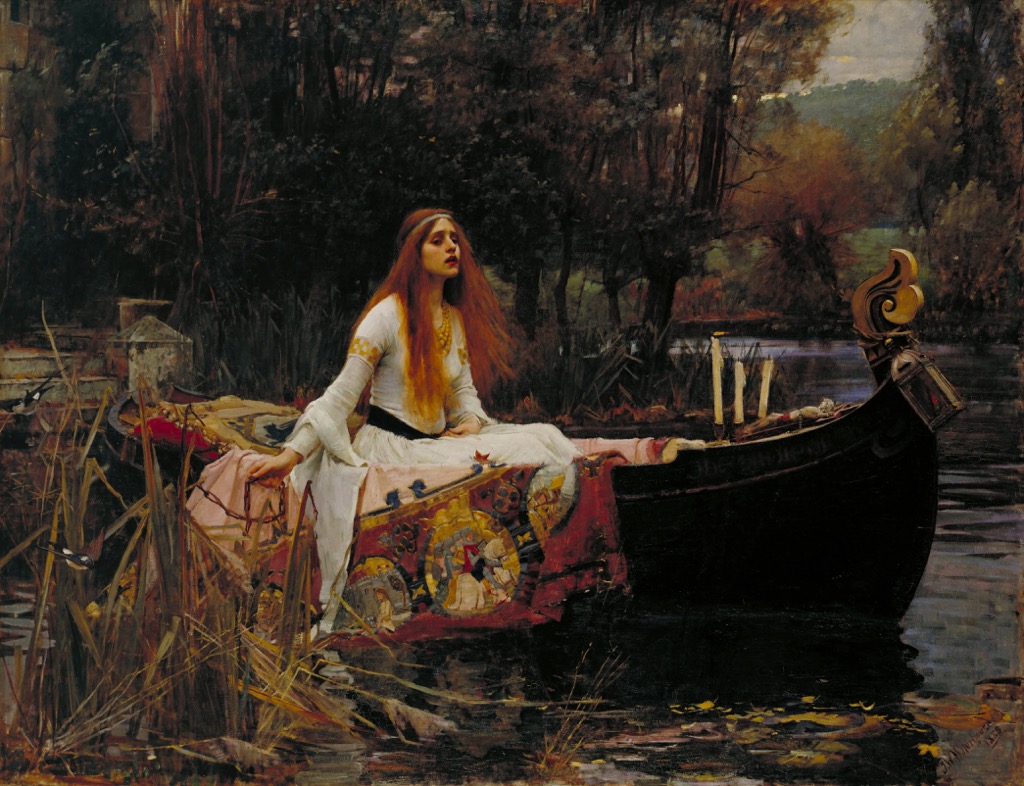
The three Lady of Shalott paintings show how deeply one poem could be reorganised. Tennyson's Lady lives under a curse in a tower, weaving images of the world as they appear in a mirror. She looks directly towards Lancelot, the web flies out and the mirror cracks. She leaves in a boat, sings as she travels to Camelot and dies before arrival. [15]
Waterhouse first painted the late voyage in 1888. He then moved backward to the disturbance at the loom around 1894 and, in 1915, to the earlier dissatisfaction expressed by the phrase “I am half-sick of shadows.” The order of paintings is not the order of the poem.
This reversal proves that a source is not merely a script to be completed once. Each return asks a different question: what does departure cost, what does direct sight disrupt, and what does confinement feel like before it is broken?
The 1888 painting also adds or relocates objects. Waterhouse carries the Lady's woven textile into the boat, where it trails towards the water. The poem describes the web flying free at the moment of transgression but does not instruct the heroine to gather it for the voyage. [15]
That invention gives artistic labour a physical afterlife. The Lady leaves the loom but cannot leave the object through which she had experienced the world.
Tennyson's influence extends to Mariana in the South and the late Saint Cecilia, figures whose waiting, music or withdrawal becomes the visible event. The Royal Academy retrospective explicitly identifies Tennyson, Keats and Shakespeare as part of the Pre-Raphaelite literary inheritance Waterhouse renewed. [1]
The Soul of the Rose presents a more delicate source question. The exact phrase occurs in Tennyson's Maud, in a garden lyric charged with love, scent and listening. [16] The painting's walled garden and rose also invite comparison with the medieval Roman de la Rose and its English reception.
The Tennysonian phrase is a strong title source; it does not prove that the painted woman is a named character from Maud. Nor does medieval courtly-love imagery cancel the modern poem. Several literary contexts can illuminate the work without being treated as equally documented commissions.
Waterhouse's own books make the relationship tangible. The 2009 retrospective included volumes of Tennyson and Shelley in which he had drawn sketches. [1] Those surviving objects show active reading and looking. They do not license a claim that every untitled flower woman illustrates a particular page.
Keats, Boccaccio and Inherited Stories
John Keats supplied Waterhouse with beauty that carries its own uncertainty. His lovers and supernatural women do not divide neatly into innocent victims and evil temptresses.
In “La Belle Dame sans Merci,” a speaker encounters an abandoned knight who recounts meeting a mysterious woman, setting her on his horse, entering her grotto, dreaming of pale kings and waking alone on a cold hillside. [17]
Waterhouse paints the earlier encounter rather than the desolate aftermath. The woman loops her hair around the armoured knight and draws him close. Keats does not prescribe this exact hair-binding gesture. It is a pictorial invention that lets attraction already resemble restraint.
The poem reaches readers through two times—the framing question and the knight's memory. The painting removes that structure and gives the seductive meeting a present tense. Viewers know more about the outcome than the figures appear to know.
Lamia creates another problem of sympathy. Keats's serpent woman becomes human, loves the young Corinthian Lycius and tries to sustain their life together. The philosopher Apollonius exposes her at the wedding feast; she vanishes, and Lycius dies. [17]
Waterhouse's 1905 Auckland painting shows Lamia kneeling before an armoured young man in a woodland. A shed snakeskin reveals what he cannot see. Keats's Lycius is not a medieval knight, so the armour is Waterhouse's transformation of the poem's antique setting.
That anachronism is productive. Armour promises protection but cannot defend against incomplete knowledge. Lamia's kneeling body may appear vulnerable even while the skin identifies supernatural danger.
Isabella and the Pot of Basil reaches Keats through a longer chain. Boccaccio's Decameron tells of Lisabetta, whose brothers murder her lover Lorenzo; she places his head in a pot of basil and tends it with tears. Keats retells the story as “Isabella; or, The Pot of Basil,” and Waterhouse paints Isabella embracing the pot at an altar-like table. [4] [17]
The source is therefore not a choice between Boccaccio and Keats. Boccaccio provides the Renaissance tale; Keats reshapes it for Romantic poetry; Waterhouse responds to the Keatsian title and a Victorian visual tradition already interested in Isabella.
A Tale from the Decameron returns more directly to Boccaccio late in Waterhouse's career. A garden group listens to a story, emphasising the social act of narration rather than illustrating one of the hundred tales' disasters.
These works reveal why source chains matter. Without Boccaccio, Isabella's history is incomplete. Without Keats, the emotional and verbal form most immediate to Waterhouse's nineteenth-century context disappears. Without Waterhouse's additions, the paintings become mere summaries of texts they actively change.
Shakespeare: Painting before Catastrophe
Waterhouse's Shakespearean women are often shown before the moment for which their stories are most famous. The result is suspense shaped by a viewer's memory of the play.
His major Ophelia paintings of 1889, 1894 and 1910 all precede the drowning. Shakespeare's Hamlet gives Ophelia's disordered songs, distribution of flowers and death through Gertrude's report, but leaves unresolved questions around accident and intent. [18]
Waterhouse does not repeat John Everett Millais's floating Ophelia. He shows her lying in a meadow, seated near water or standing against a tree. Flower, body and river change their relationship while the catastrophe stays ahead.
This delay restores duration to a character often reduced to one beautiful death. The paintings ask how knowledge of the ending affects the interpretation of an earlier gesture.
Miranda – The Tempest selects the opening storm. Miranda watches a ship apparently destroyed and begs Prospero to stop the suffering. Prospero assures her that no one has been harmed; the vessel carries both his enemies and Ferdinand, the man Miranda will love. [9]
Waterhouse's 1916 canvas withholds that reassurance. The ship lists among waves and rocks while the wind presses Miranda's dress and hair across her body. The painting makes her compassion immediate before identity or romance can explain it.
The late Miranda also demonstrates return across a career. Waterhouse had painted her in 1875 as a much quieter figure on the shore. More than forty years later, the same literary character becomes the centre of a physically violent seascape. [9]
Juliet offered another Shakespearean image of anticipation. As with Ophelia and Miranda, the name may summon a complete tragedy, but the painting must still be read through its specific pose, setting and documented title rather than through every event in the play.
Waterhouse's Shakespeare is therefore not theatrical in the sense of reproducing a staged scene with all its speaking characters. He often removes dialogue partners and gives the emotional burden to landscape, costume and a solitary body.
The play remains essential because it creates dramatic irony. We know who is on Miranda's ship, what lies near Ophelia's river and what future waits for Juliet. The painting uses that knowledge without showing it.
History, Hagiography and the Edge of Myth
Not every Waterhouse subject belongs to imaginative literature. Mariamne Leaving the Judgement Seat of Herod draws on Josephus's Jewish Antiquities, a historical narrative about Herod the Great's Hasmonean wife. [3]
Josephus describes a fabricated potion accusation, torture, a compliant trial and pressure from Herod's sister Salome to carry out the execution. Waterhouse condenses this sequence into Mariamne descending from the court while turning a final look towards her husband. [3]
The painting should not be moved into the New Testament story of John the Baptist. Its Herod is Herod the Great, and its Salome is his sister, not the dancer of the later tradition.
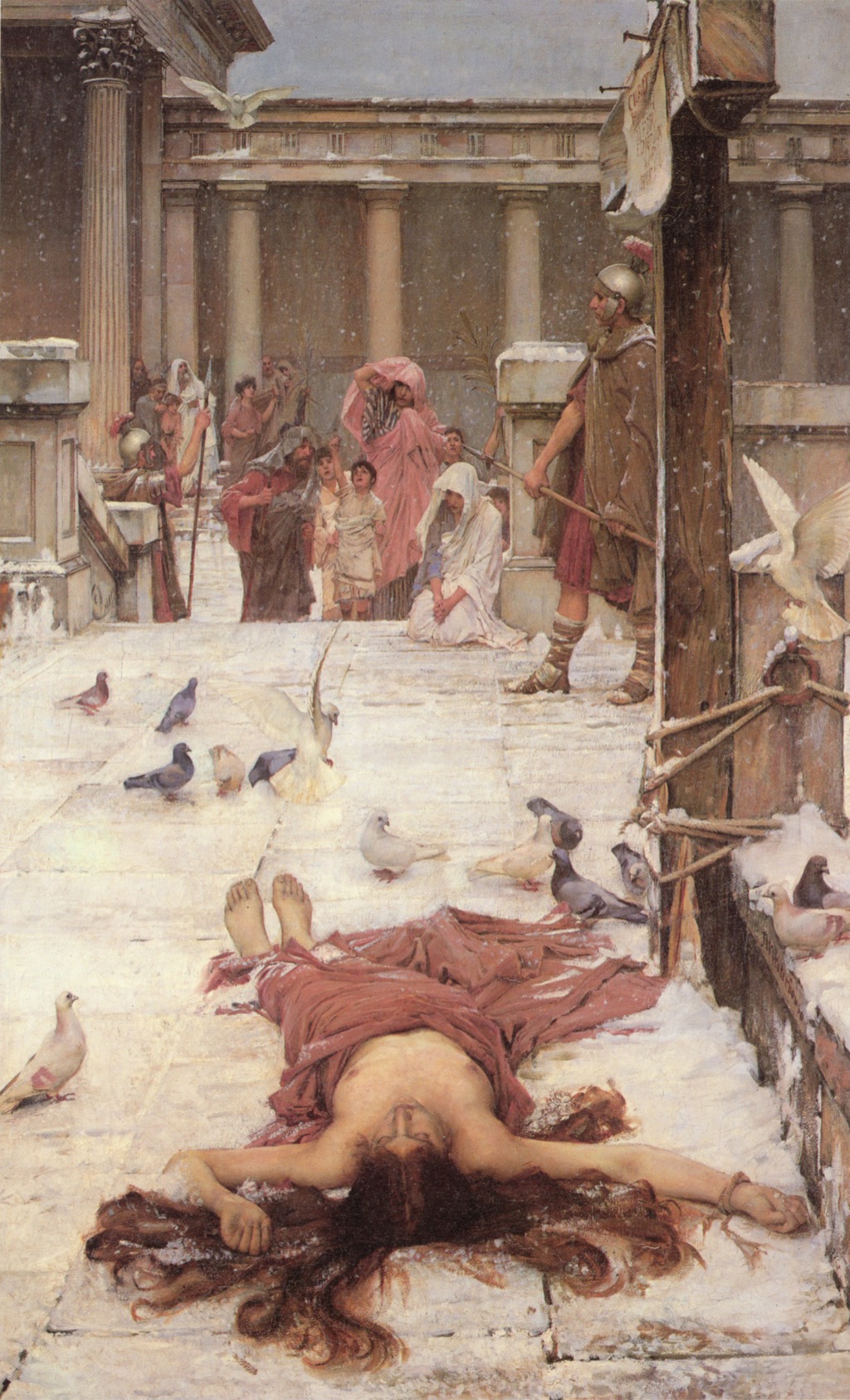
Saint Eulalia occupies a different evidential category. Waterhouse drew on the Christian martyrdom tradition developed in Prudentius's Peristephanon. The poem describes a young Christian's death, a dove leaving her mouth and snow covering the body. [5]
Hagiography expresses religious memory and meaning; it is not the same kind of source as a modern documentary biography. Waterhouse paints the aftermath and miraculous signs rather than claiming to reconstruct a verifiable execution scene.
The Favourites of the Emperor Honorius uses late Roman history more obliquely. Procopius tells an anecdote in which Honorius hears that “Rome” has perished and initially thinks of a favoured bird bearing that name before learning that the city has fallen. [6]
Waterhouse shows the young emperor feeding birds while officials wait. The painting is often connected with Procopius's story, but it does not literally depict the reported exchange or clearly identify one bird as Rome. The ancient anecdote can illuminate imperial disengagement without functioning as an eyewitness account of the canvas.
Consulting the Oracle is more invented still. The catalogue explanation provides a ritual premise, but no single ancient author securely supplies the room and its participants. The Crystal Ball invokes divination without a documented named narrative. Boreas personifies the north wind without showing the Oreithyia abduction.
These edge cases are not failures to identify a hidden answer. They show the continuum between history painting, literary illustration and poetic invention.
Calling every beautiful woman “a mythological goddess” collapses that continuum. Mariamne was presented as a historical queen, Eulalia as a Christian martyr, Ophelia as a dramatic character and the woman of The Crystal Ball as an unnamed practitioner of divination. Their visual kinship is Waterhouse's; their identities come from different traditions.
How Waterhouse Transforms a Text
Waterhouse's most consistent literary method is selection. A long poem or play becomes one interval in which past and future remain active without being shown.
He often avoids the expected climax. Ophelia has not drowned; Orpheus has already been killed; Scylla has not entered the poisoned water; Psyche has not fully crossed the doorway; the Lady of Shalott has just released or is about to release the boat.
This interval creates dramatic irony. The viewer's knowledge presses upon a figure who may not yet possess it.
His second method is condensation. In Circe Offering the Cup, throne, mirror, transformed crew, cup, wand and reflected Ulysses bring successive narrative facts into one visual field. In Mariamne, the king, sister, judges and departing queen compress accusation, trial and execution into a final exchange of looks.
The third method is invention. The Shalott tapestry enters the boat, Psyche opens a garden door absent from Apuleius, La Belle Dame's hair becomes a loop around armour, and Lamia leaves a snakeskin beside a medievalised lover.
Such changes are not evidence that Waterhouse misunderstood his sources. They are the means by which verbal time becomes visible structure.
The fourth method is omission. Prospero disappears from Miranda; Glaucus and Scylla disappear from Circe Invidiosa; Cupid disappears from the Psyche doorway; the murderers disappear from Nymphs Finding the Head of Orpheus. Absence makes the remaining figure or action carry greater pressure.
The fifth method is material translation. Poetry's curse becomes a mirror and web. A magical act becomes cup, wand, smoke or circle. Repetitive delay becomes Penelope's loom. Grief becomes the physical care of a basil pot.
Water, mirrors, doors, vessels and textiles recur because they can make relations visible. They divide, reflect, contain or bind. Their meaning still changes with the source. Narcissus's pool returns an image; Circe's sea carries poison; the Lady's river carries a body; Psyche's door controls access.
Finally, Waterhouse translates stories through the body. A turn of the head can oppose a whole court; a hand at the breast can register disaster across an ocean; a lean towards water can show attraction before contact.
Reading the source should therefore sharpen close looking, not replace it. The text explains why an action matters; the painting explains why Waterhouse chose that action and gave it this space, colour and bodily weight.
Related Pages
- Paintings: Browse the paintings where Waterhouse transforms myth, poetry and history into images.
- The Lady of Shalott: Read a close guide to one of his central Tennysonian paintings.
- Technique and Style: Compare source choice with Waterhouse's visual handling and studio method.
Frequently Asked Questions
Homer, Ovid, Shakespeare, Tennyson and Keats are the central recurring names identified by the major Waterhouse retrospective. Apuleius, Boccaccio, Josephus, Prudentius and Procopius are important for particular works. [1] [2] [3] [4] [5] [6]
He is best known for independent exhibition paintings rather than a career as a book illustrator. Surviving volumes of Tennyson and Shelley contain his sketches, showing that reading and drawing could meet directly. [1]
No. Some use Greek epic, others Roman retellings, Latin novels, ancient history or Christian poetry. A classical-looking interior may also be an imaginative construction without one identifiable source.
Painting cannot reproduce narrative duration in the same way as a poem or play. Waterhouse condensed events, added objects and selected charged pauses so that past and future could be sensed in one image.
Its title phrase appears in Tennyson's Maud, providing a strong literary connection. The walled rose garden also invites medieval courtly-love associations, but the woman is not securely identified as a named character from the poem. [16]
A contemporary notice for an earlier version and recent research make Theocritus's Simaetha a persuasive source. The finished painting remains an imaginative transformation, and not every object can be matched securely to the poem. [10]
No. He often chose the threshold before catastrophe or the discovery after it: Ophelia before drowning, Scylla's water before transformation and Orpheus's head after murder.
No. Model continuity and visual resemblance do not merge fictional identities. Circe, Ophelia, Psyche, Mariamne and unnamed flower women belong to different narratives.
Discussion
The popular image of Waterhouse as a painter of dreamlike women is not wrong, but it is radically incomplete. His paintings are arguments with stories.
The argument may be gentle: Psyche receives a doorway that lets curiosity become architecture. It may be structural: Echo and Narcissus, separated in Ovid's sequence, suffer simultaneously across one landscape. It may be corrective: Miranda's compassion occupies the canvas while her father's powerful strategy remains unseen.
Reader Insights
Which visible detail most changes the way you read this page?
Which source or comparison helps the work feel less familiar and more specific?
What question would you bring back to the painting after reading?
Join the Conversation
Share your reading of this page below.
References
- Main image: John William Waterhouse, The Lady of Shalott, 1888, Tate, public-domain photographic reproduction via Wikimedia Commons / Google Art Project.
- Royal Academy of Arts / The Victorian Web. “J. W. Waterhouse: The Modern Pre-Raphaelite,” retrospective account identifying the artist's engagement with Homer, Ovid, Shakespeare, Tennyson and Keats, and the display of his sketchbooks and annotated literary volumes. View source
- Apuleius / Project Gutenberg. The Golden Asse, translated by William Adlington, including the tale of Cupid and Psyche. View source
- Flavius Josephus / University of Chicago LacusCurtius. Jewish Antiquities, Book 15, Mariamne's trial and execution. View source
- Giovanni Boccaccio / Project Gutenberg. The Decameron, Day 4, Story 5, the tale of Lisabetta and the pot of basil. View source
- Paula Hershkowitz. “The Portrait of St Eulalia of Mérida in Prudentius, Peristephanon 3,” Arctos 38 (2004), study of the poem and its martyrdom imagery. View source
- Procopius of Caesarea. Wars, Book 3, 2.25–26, the anecdote of Honorius, Rome and the imperial poultry. View source
- Homer. Odyssey, Book 12, translated by A. T. Murray, including the Sirens, wax and binding of Odysseus. View source
- Homer. Odyssey, Book 10, translated by A. T. Murray, including Circe's cup, wand, transformations and encounter with Odysseus. View source
- Folger Shakespeare Library. William Shakespeare, The Tempest, Act 1, Scene 2, Miranda's response to the storm and Prospero's account. View source
- Tate and Mark Williams/Jennifer Williams. The Magic Circle collection record and “The Inspiration behind The Magic Circle,” evidence for the proposed Theocritus source. View Tate · View source study
- Aberdeen Archives, Gallery & Museums. “Penelope and the Suitors,” collection record and subject account. View source
- Ovid. Metamorphoses, Book 14, translated by Brookes More, the story of Glaucus, Circe and Scylla. View source
- Ovid. Metamorphoses, Book 3, translated by Brookes More, Echo and Narcissus. View source
- Ovid. Metamorphoses, Book 11, translated by Brookes More, the death of Orpheus and the journey of his head and lyre. View source
- University of Rochester, The Camelot Project. Alfred Tennyson, “The Lady of Shalott,” parallel 1833 and 1842 texts. View source
- Alfred Tennyson / Project Gutenberg. Maud, and Other Poems, including the garden lyric containing “the soul of the rose.” View source
- John Keats. Full primary texts of “La Belle Dame sans Merci,” Lamia and “Isabella; or, The Pot of Basil.” Read “La Belle Dame” · Read Lamia · Read “Isabella”
- Folger Shakespeare Library. William Shakespeare, Hamlet, including Ophelia's flowers and Gertrude's report of her death. View source
- National Gallery of Victoria. “Ulysses and the Sirens,” collection record explaining the Homeric episode and Waterhouse's use of an ancient Greek vase type. View source