 Buy Art Prints Now
from Amazon
* As an Amazon Associate I earn from qualifying purchases.
Image reference [image]
 by Tom Gurney
Tom Gurney BSc (Hons) is an art history expert with over 20 years experience
Published on August 14, 2026 / Updated on August 14, 2026
Email: tomgurney1@gmail.com / Phone: +44 7429 011000
I Am Half-Sick of Shadows: Introduction
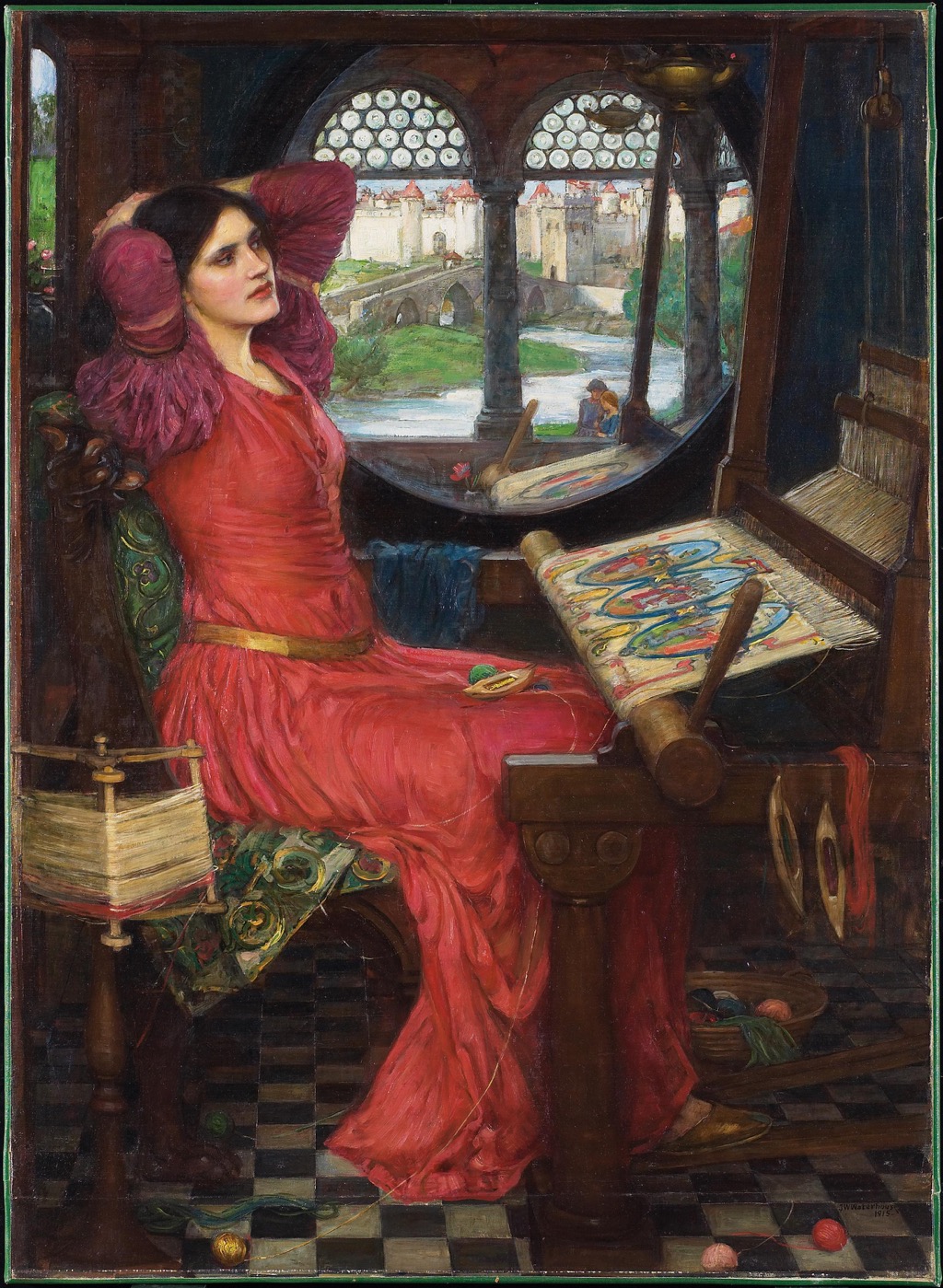
John William Waterhouse’s late Lady of Shalott has not yet looked directly at the world. She sits before her loom in a red dress, stretches her arms behind her head and gazes towards a large circular mirror. Within its reflection, two young lovers pass through a sunlit landscape. The Lady can see their life but cannot join it. Her work reproduces the world that excludes her.
Painted in 1915 and exhibited at the Royal Academy in 1916, “I am half sick of shadows,” said The Lady of Shalott returns to Alfred Tennyson’s poem almost three decades after Waterhouse’s famous 1888 boat scene. Instead of repeating the final voyage, the artist moves backwards. The curse has not fallen, the mirror has not cracked and the web has not flown from the loom. Tragedy exists only as knowledge brought by the title and by Waterhouse’s earlier paintings. What the canvas makes present is the condition that comes before rebellion: the moment when mediated experience is no longer enough.
At a Glance
- ArtistJohn William Waterhouse (1849–1917)
- Title“‘I am half sick of shadows,’ said The Lady of Shalott” (Alfred, Lord Tennyson, The Lady of Shalott, Part II)
- Date1915
- MediumOil on canvas
- Dimensions100.3 × 73.7 cm
- CollectionArt Gallery of Ontario, Toronto
- Object number71/18
- Credit lineGift of Mrs Philip B. Jackson, 1971
- SignatureSigned and dated at lower right, “J. W. Waterhouse 1915” [1] [2]
- ExhibitedRoyal Academy, London, 1916, with A Tale from the Decameron and Miranda—The Tempest [3]
- Literary sourceAlfred Tennyson’s 1842 version of The Lady of Shalott, Part II [4]
Contents
- Introduction
- The Moment Before the Decision
- Tennyson’s Poem: Four Grey Walls and a Moving Mirror
- The Lady’s Pose: Rest, Stretch or Resistance?
- The Circular Mirror and the Unequal Reality of Images
- Loom, Thread and the Labour of Making
- The Lovers in the Mirror
- Floor, Columns and the Architecture of Confinement
- Red, Gold and Blue: Colour Across Two Worlds
- Three Shalott Paintings, Made Against the Poem’s Sequence
The Moment Before the Decision
Nothing has broken. The mirror remains whole, the loom stands firm and the threads still pass across its frame. The Lady has not crossed the room to look directly from the window. She is alive, physically safe and visibly restless.
This choice of moment distinguishes the painting from the best-known visual treatments of Tennyson’s poem. Artists often seized upon catastrophe: the Lady turning towards Lancelot, the mirror cracking, the web flying or the dead heroine arriving at Camelot. Waterhouse chooses dissatisfaction before action.
The title is essential. Without it, the scene might show a woman pausing from weaving to watch people in a mirror. The quoted line gives the pause a voice: “I am half sick of shadows.” [4] Weariness becomes conscious and spoken, though the painted mouth does not visibly form the words.
“Half” matters as much as “sick.” The Lady is not represented at complete rejection. Tennyson says that she still delights in weaving the mirror’s sights even as funerals and married lovers sharpen her exclusion. Her position remains divided. Art gives pleasure, but what it reproduces has begun to expose the inadequacy of reproduction.
Waterhouse makes that division bodily. Her lower body remains at the loom. Her torso straightens and her arms lift away from the work. She has stopped without leaving. The pose occupies the interval between discipline and release.
The lovers in the mirror provide the immediate object of longing, but the feeling exceeds romance. They can move through space, meet another person and exist outside the tower. The Lady sees social life, landscape and bodily freedom compressed into a surface she is forbidden to bypass.
The viewer knows more than she appears to know. Anyone familiar with the poem anticipates Lancelot, the fatal look, the boat and death. Yet the painting does not ask us to hurry forward. It holds the moment in which the Lady recognises deprivation before she knows the price of answering it.
Tennyson’s Poem: Four Grey Walls and a Moving Mirror
Tennyson’s 1842 poem begins outside. Fields, river, road, barges and Camelot surround the island of Shalott. People move through a landscape whose silent centre is the unseen Lady. Reapers hear her song but do not see its source. [4]
Part II moves into the tower and establishes the curse. The Lady weaves continuously and must not look directly towards Camelot. She does not know what the curse is; its rule arrives without an origin or explanation. A mirror hanging before her shows “shadows of the world,” and she weaves those reflected sights into a coloured web. [4]
The mirror contains a social procession. Churls, market girls, an abbot, a shepherd, a page and knights pass along the road. The catalogue of ordinary life matters. The Lady is not excluded only from heroic romance. She cannot participate in work, religion, courtship, travel or chance encounter.
Tennyson then introduces spectacles that expose the emotional cost of distance: a funeral passing at night and, beneath the moon, two recently married lovers. The Lady’s declaration closes this section. Waterhouse’s reflected couple identifies the exact stanza more securely than a generic scene of boredom would. [2] [4]
Part III brings Lancelot. Sun flashes upon his armour and bridle; his image moves through the mirror; his song reaches the tower. The Lady leaves web and loom, crosses the room and looks directly. Mirror and web respond immediately: one cracks, the other flies out. Only then does she recognise that the curse has come. [4]
Part IV carries her to death. She finds a boat, writes her name upon it, lies down and sings while the river bears her towards Camelot. By the time knights and townspeople see her, direct public recognition is possible only through her dead body and the name on the prow.
Waterhouse’s 1915 painting concentrates on Part II but gains pressure from this complete arc. Mirror, loom and lovers are not neutral furnishings. Each belongs to a structure that will turn desire for direct experience into catastrophe.
The painting nevertheless changes the poem’s mode. Tennyson moves among exterior landscape, repeated refrain and sequential action. Waterhouse must place inside and outside within one stationary rectangle. The mirror solves that problem. It makes the Lady’s room and the passing world visible together while preserving their separation.
The Lady’s Pose: Rest, Stretch or Resistance?
The Lady sits upright with her arms crossed or joined behind her head. The gesture opens the upper body and withdraws both hands from the loom. It can be recognised as a stretch after prolonged labour, but its expressive range is wider.
A person who stretches still occupies the place of work. The movement offers temporary relief without yet refusing the task. That ambiguity perfectly answers the word “half.” She is neither weaving nor escaping. Her body tests freedom while remaining seated.
The raised elbows widen her form and bring it into relation with the circular mirror. Head and shoulders interrupt the reflected world rather than sitting passively below it. The Lady appears almost to push against the visual field that governs her life.
Her gaze is distant rather than alarmed. No Lancelot in glittering armour has yet shocked her into action. The lovers invite a slower longing. Waterhouse avoids the theatrical distress of a figure struggling in flying threads. Dissatisfaction becomes sustained thought.
The posture also resists the narrowest image of female work as docile absorption. The Lady’s hands are capable of weaving, but they are deliberately unavailable to it at this instant. Labour has stopped because consciousness has turned elsewhere.
It would be too strong to call the gesture open rebellion. She has not stood, broken the loom or approached a direct view. The mirror still commands attention. Waterhouse captures resistance as potential—a bodily refusal not yet converted into irreversible action.
The red dress intensifies her presence. Against cooler architecture, floor and mirror, the warm body becomes the room’s active centre. Tennyson gives no such colour instruction. Waterhouse uses red to make frustration physically immediate and to distinguish the Lady from the shadow-world she watches.
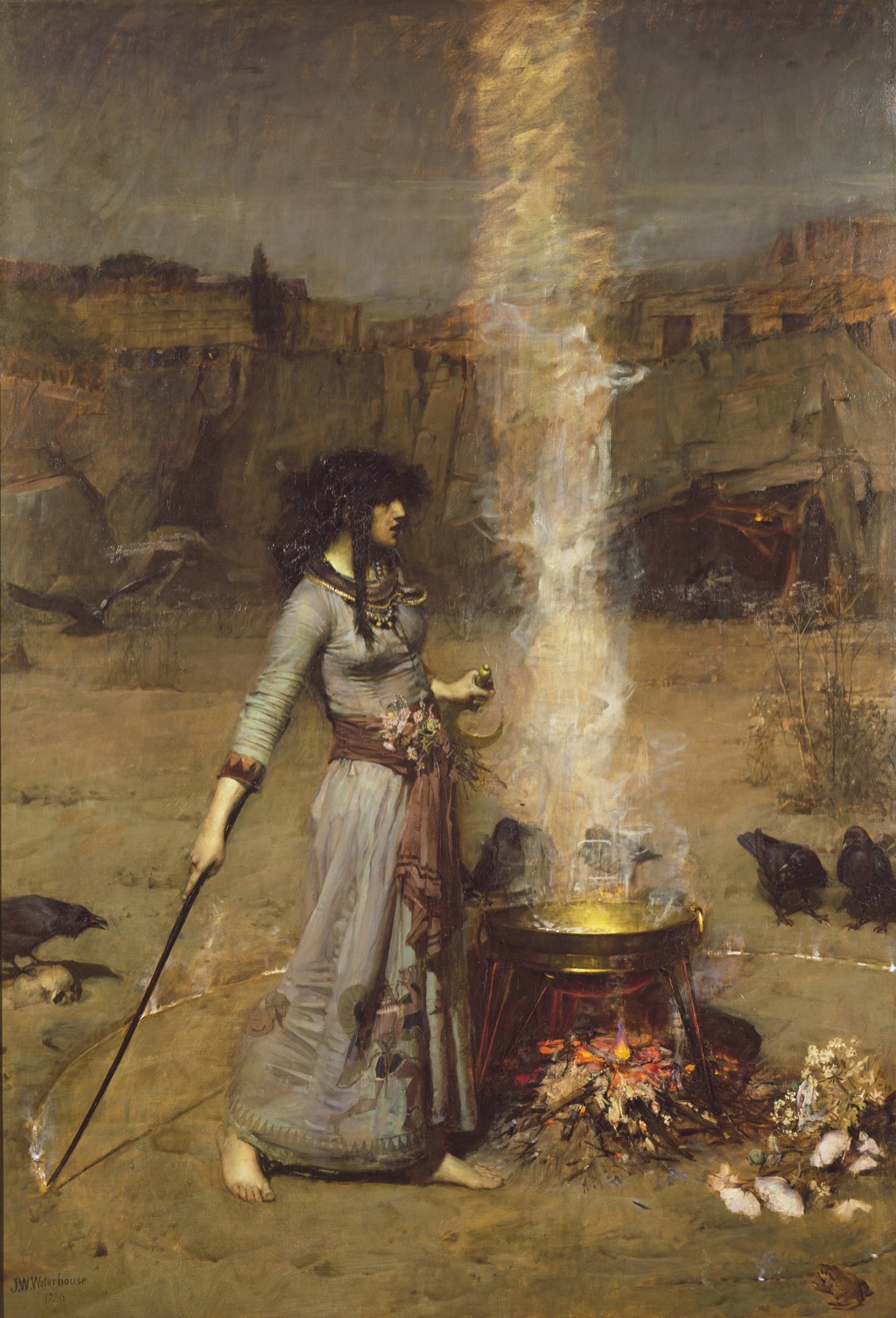
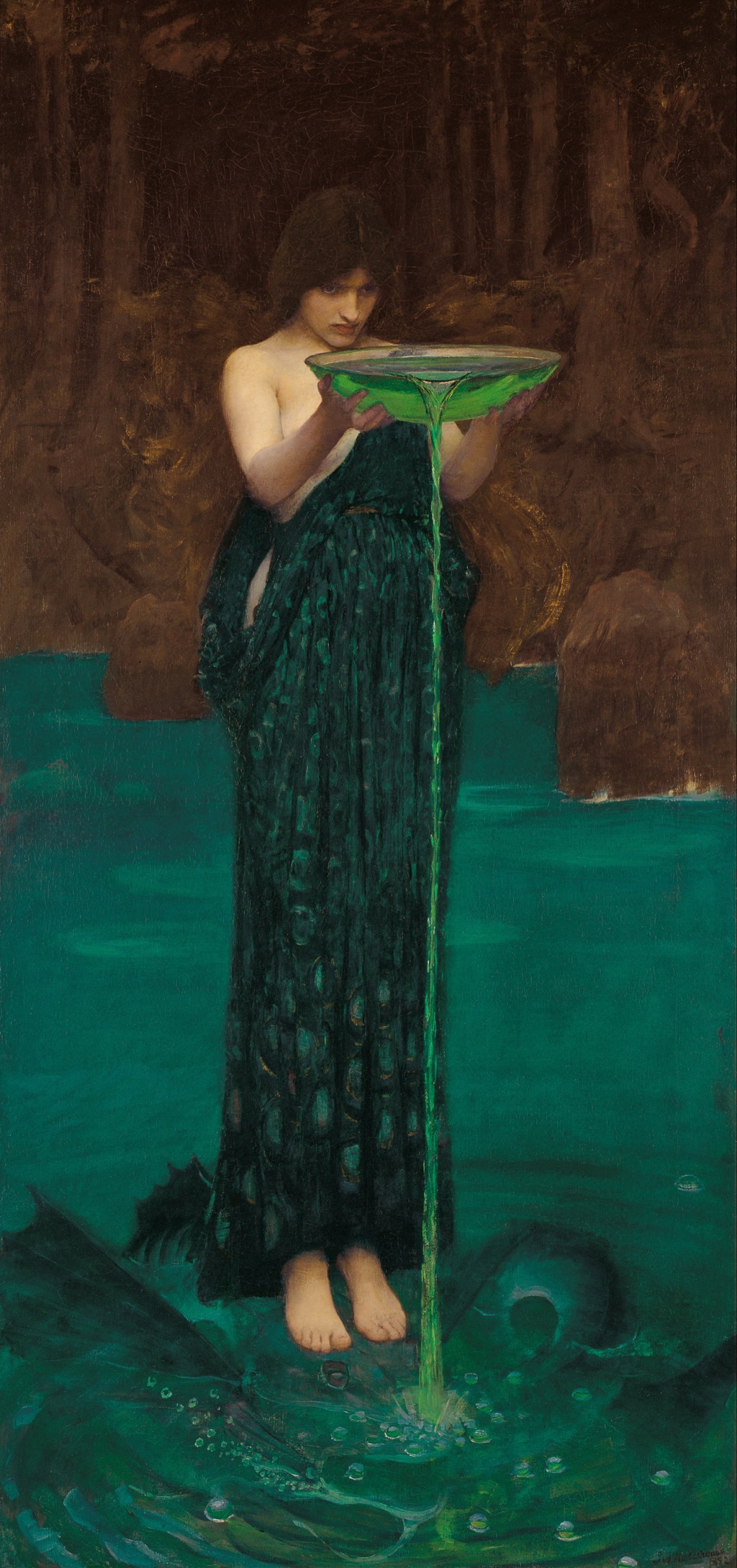
Her long hair and historicising dress connect her to Waterhouse’s larger group of literary women, yet the pose gives her a particular identity. Circe extends a cup or pours poison; Ophelia handles flowers; the Lady of Shalott suspends making. The interruption is her action.
The Circular Mirror and the Unequal Reality of Images
The mirror occupies much of the wall behind the Lady. At first glance it can resemble an open arch or window because its reflection contains bright architecture, landscape, water and figures. Details near its lower edge and its relation to the loom confirm that this is a surface within the room, not direct access to the exterior. [2]
Waterhouse relies upon the viewer to experience the same uncertainty the Lady inhabits. The reflected world is visually persuasive. It has colour, depth and movement. Only after recognising the mirror do we understand that apparent openness is another boundary.
The circle has no beginning or end, an apt shape for the Lady’s repeated labour. Life passes; reflection receives it; the web translates it; the process continues. The world changes within a system that keeps her position fixed.
The mirror also performs a difficult compositional task. It gives the vertical interior distance without cutting a literal window through the wall. Elizabeth Nelson’s catalogue account emphasises how columns, loom and floor tiles construct a calm, believable room while the mirror opens a view towards castle, bridge and river. [2]
Two young lovers appear within the reflection. They are small compared with the Lady, yet their narrative importance is enormous. Their relationship is public, mobile and mutual. The Lady’s looking is private, stationary and unreturned.
Because the couple are reflections, they cannot see her. The mirror conveys information in only one direction. It lets the Lady witness intimacy without entering an exchange. Her gaze reaches them; theirs cannot reach her.
This asymmetry defines the “shadows.” In ordinary language a shadow may be dark and insubstantial. Tennyson’s mirrored sights are often bright and detailed, but they remain secondary: images of lives rather than lives shared. Waterhouse makes their beauty part of the problem. A poor reflection would be easy to reject. This one is tantalisingly complete.
The mirror is unbroken. Later knowledge may tempt viewers to imagine a crack or see every line as foreshadowing. At the painted moment, the catastrophe has not occurred. The intact surface is the mechanism of confinement, not yet the record of transgression.
Loom, Thread and the Labour of Making
The loom occupies the foreground, between the viewer and the Lady. Its strong horizontal and vertical frame creates a threshold inside the tower. We cannot approach her without visually crossing the instrument of her labour.
Tennyson calls the product a “magic web of colours gay.” The Lady does not weave freely chosen subjects. Her images derive from the mirror’s sights, so production and surveillance become inseparable. [4] She is both artist and compelled translator.
Waterhouse gives the loom substantial physical presence. It is not a symbolic label placed beside the figure. Wood, threads, woven surface and tools create a credible working structure. The Lady’s frustration consequently belongs to labour performed through real resistance and repetition.
Coloured yarn or thread gathers around the loom and floor. These materials bring the mirror’s colours into the room. What exists outside as moving life becomes fibre, pattern and image inside. Waterhouse makes mediation material.
A shuttle associated with the weaving has often been noticed near the Lady or foreground. Its elongated form may remind a viewer of the boat in Waterhouse’s 1888 painting, but that resemblance should remain a visual comparison rather than a proven secret symbol. The object’s first role is functional: it belongs to the work she has interrupted.
The woven image is not given greater clarity than the Lady. Waterhouse avoids turning the tapestry into a competing picture that would require its own full narrative. The loom remains legible while attention returns to body and mirror.
This balance differs from William Holman Hunt’s climactic Shalott composition, in which dense symbolic objects and violently released threads surround the heroine. Nelson argues that Waterhouse treats loom and mirror as elements that enhance the Lady’s presence rather than distract from her. [2] The distinction is useful: he simplifies the room’s hierarchy without emptying it.
The web can be read as artistic creation under constraint. The Lady possesses skill and transforms images into a new medium, but neither subject nor conditions are freely chosen. When she tires of shadows, dissatisfaction touches her art as well as her seclusion.
That tension has made the poem attractive to discussions of the artist’s relation to life. Must art depend upon distance and mediation? Does direct experience destroy the conditions of creation, or does forced isolation make creation intolerable? Waterhouse does not answer. He paints the instant when the question becomes unavoidable.
The Lovers in the Mirror
The reflected couple are easily missed because they occupy a small part of the circular field. Once noticed, they explain the title. Tennyson places the “two young lovers lately wed” immediately before the Lady’s declaration. [4]
Waterhouse does not bring them forward as independent portraits. Their small scale belongs to distance and to the Lady’s mode of seeing. They are both real within the poem and images within the tower. The viewer encounters them under the same mediated condition.
Marriage is only one of the freedoms they embody. The lovers move together through an exterior world. Their bodies share one spatial plane; the Lady remains alone in another. Relation is contrasted with reflection.
The picture does not prove that the Lady envies this particular man or woman individually. Her response can include longing for companionship, embodied life, mobility or social recognition. Reducing the scene to a simple wish for a husband would narrow both poem and painting.
Nor does the reflected couple cause the curse. The Lady does not turn from the mirror towards them. They deepen her discontent. Lancelot later provides the dazzling sight and audible song that prompt direct looking. Waterhouse distinguishes awakening dissatisfaction from final catalyst.
This sequence gives the Lady more psychological history than a single climactic image can contain. When Lancelot arrives, her action will not be an inexplicable impulse caused by male beauty alone. She has already recognised that reflected life is insufficient.
The couple therefore creates moral sympathy. The spectator sees what she lacks before judging her transgression. If the curse makes direct vision fatal, the painting asks what kind of safety such obedience offers.
Waterhouse makes the answer uncomfortable. The room is beautiful, spacious and materially rich. Confinement need not look like a cell in order to be deprivation. The lovers’ small reflected freedom exposes what architectural luxury cannot supply.
Floor, Columns and the Architecture of Confinement
The tower interior is not a dark dungeon. Light reaches the room, colours remain warm and classical columns appear within or beyond the mirrored view. Patterned floor tiles lead the eye towards the Lady and then into the reflection. [2]
This openness complicates the mood. A visibly brutal prison would tell the viewer exactly how to respond. Waterhouse gives the Lady beauty, space and work, yet denies direct relation to the world. The room’s attractions make the restriction more subtle rather than less real.
Horizontal and vertical forms establish calm. Loom rails, tiles, columns and architectural edges hold the composition steady. The Lady’s raised arms introduce the principal expansion against this order. Her body is the element that does not fully submit to the grid.
The circular mirror opposes those straight lines. It offers apparent infinity inside a room of measured structure. Its curve also gathers the reflected fragments into one controlled field. Even the view of freedom is framed.
Waterhouse does not attempt to reconstruct a named Arthurian tower. The architecture is a persuasive imaginative setting, combining medieval romance with classical or Italianate elements familiar across his work. Exact historical dating is less important than the spatial logic.
The viewer’s position remains inside the room, on the same side of the mirror as the Lady. We do not receive a privileged direct view of the lovers. We see their reflection too. Waterhouse makes us share her visual system while retaining our external knowledge of the poem.
That position creates sympathy and distance at once. We can leave the picture; she cannot leave the tower without consequence. We recognise the reflected world as an artistic construction; for her it is the only permitted reality.
The room can consequently be read as mind, studio or social enclosure, but these metaphors should remain interpretations. Its visible function is clear: architecture, loom and mirror produce a complete environment in which looking is regulated.
Red, Gold and Blue: Colour Across Two Worlds
The Lady’s red dress dominates the interior. It gathers light along the body and contrasts with cooler passages in mirror, floor and distance. Colour makes her more immediate than the people she watches.
Red can carry love, danger, vitality or impending death in other contexts. No evidence requires one fixed meaning here. Its secure function is structural: it makes the Lady the warm, embodied centre of a scene otherwise organised around reflected images.
Gold and yellow move among thread, architecture and exterior light. Blue enters distant sky, water or patterned areas. These hues connect room to mirror while maintaining unequal intensity. The world beyond may be brighter in places, but the Lady’s dress has greater mass.
The relation matters because the poem opposes life and “shadows” conceptually, not through simple colourlessness. Waterhouse’s shadows are colourful. Their seduction depends upon visual richness.
The yarns allow reflected colour to cross into the room as material. Blue or gold seen in the mirror can reappear at the loom, as though the Lady has extracted colour while losing movement, sound and reciprocity.
Waterhouse’s handling is selective. Face, arms, loom and essential architectural divisions remain clear, while reflected distance can soften. The variation imitates mediated sight: the room is physically near; the outside is optically present but less graspable.
No published technical examination cited here supplies a pigment analysis or complete record of layers beneath this canvas. Named pigments, exact glazing sequences and hidden revisions should not be inferred from reproduction. Visible colour and edge can be described without pretending to know their chemical construction.
The painting’s chromatic intelligence lies in relation. Warm body, coloured work and bright reflection compete, ensuring that the Lady is neither swallowed by the room nor able to detach herself from it.
Three Shalott Paintings, Made Against the Poem’s Sequence
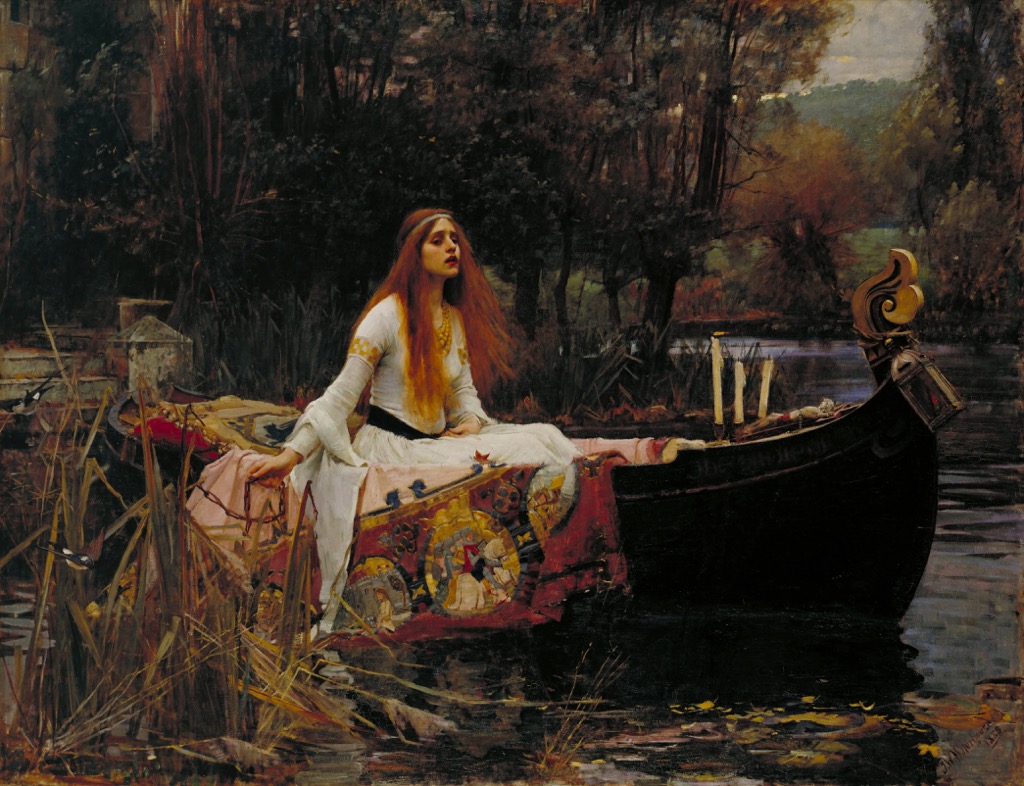
Waterhouse painted three major episodes from Tennyson’s poem: the final river journey in 1888, the fatal turn towards Lancelot around 1894, and the earlier declaration of weariness in 1915. The order of production moves backwards through the story. [1] [5] [6]
The 1888 Tate canvas is broad and outdoor. The Lady sits in a boat, one hand near the chain that connects it to the bank. Her tapestry spills over the side; candles and vegetation accompany a journey whose outcome the poem has already determined. The image joins departure, freedom and death. [5]
The Leeds painting of about 1894 moves inside the tower. The Lady twists towards the direct view of Lancelot while the mirror behind her reflects him and threads entangle the room. Waterhouse chooses the instant of transgression and consequence. [6]
The 1915 picture steps still farther back. The Lady has not yet acted. The mirror is intact, the loom orderly and the cause of dissatisfaction a pair of lovers rather than Lancelot. The emotional drama is quieter because it concerns recognition rather than catastrophe.
This reverse sequence changes the meaning of repetition. Waterhouse was not trying to correct an earlier failure or produce decorative variants. Each painting isolates a different relation among art, vision and freedom.
In 1888, woven art travels with the Lady as she leaves. Around 1894, web and loom erupt as direct vision breaks their governing system. In 1915, weaving continues but has become psychologically inadequate. The same materials change function with the chosen verse.
Format reinforces the distinction. The horizontal boat scene needs landscape and forward journey. The two loom interiors use vertical formats suited to a standing or seated body and enclosing architecture. Scale and orientation translate narrative stage into visual form.
Seeing the late work first can also change the earlier pictures. It gives the 1894 turn a history of sustained frustration and makes the 1888 departure more than sudden romantic doom. The Lady’s final movement begins with a long deprivation of direct experience.
Waterhouse and the Pre-Raphaelite Shalott Tradition
The Lady of Shalott had occupied Pre-Raphaelite artists long before Waterhouse’s first treatment. The 1857 Moxon edition of Tennyson’s poems included designs by William Holman Hunt, Dante Gabriel Rossetti and John Everett Millais. Hunt chose the climactic turn from loom to window; Rossetti chose the dead Lady arriving by boat. [7] [8]
The Metropolitan Museum describes Hunt’s illustration as the moment when Lancelot’s song draws the heroine from her work, the tapestry unravels and the mirror cracks. [7] The small wood engraving established an influential visual solution: hair, thread and fabric become forces of catastrophe inside the tower.
Waterhouse knew this tradition, but the 1915 picture is not a late copy. He removes the storm of released materials and goes back to the preceding stanza. The loom remains a stable object; the Lady’s body contains the disturbance.
The comparison clarifies his individual technique. Early Pre-Raphaelite illustration can compress numerous symbolic and narrative details within a small, intense field. Waterhouse opens a more spatially continuous interior and creates a hierarchy around the figure. Nelson specifically contrasts Hunt’s intricate detail with Waterhouse’s concentration on the Lady. [2]
He nevertheless shares foundational interests with the movement: Tennysonian literature, medievalising romance, coloured textiles, female subjectivity, and the moral pressure of looking. “Modern Pre-Raphaelite” is helpful when it describes this inherited field together with his broader, later handling.
The 1915 date also matters. Waterhouse was a senior Royal Academician working during the First World War, not a participant in the Brotherhood of 1848. The medieval subject exists alongside, not outside, a modern historical crisis. Sotheby’s has suggested that a return to English literary subjects among artists of the period could carry patriotic associations, although that broader context does not prove a specific wartime allegory for this canvas. [3]
The painting’s power does not depend upon identifying the Lady as Victorian or Edwardian woman in disguise. It emerges from a condition the visual structure makes intelligible: a person produces images of a world from which she is excluded.
Weaving, Art and the Question of Agency
The Lady’s weaving has often encouraged an allegory of artistic creation. She sees images indirectly and turns them into another work. Her tower can resemble the artist’s studio; her web can resemble a poem or painting; the curse can resemble the danger of abandoning aesthetic distance.
That reading is persuasive because it grows from the poem’s machinery, but it should not erase the gendered conditions of the story. The Lady is not simply “the artist” in a neutral philosophical example. Her movement, sight and labour are controlled, and the penalty for direct looking is death.
Waterhouse gives her skill real material weight. The loom is large, the thread colourful and the interior shaped by work. She is not idle before dissatisfaction. Her problem is not absence of creative activity but creation without chosen relation to life.
Her raised hands can therefore signify fatigue, suspension or a momentary claim over her own body. They no longer serve the loom. The pause is minor in physical terms and radical within a system that demands continuous weaving.
Agency does not require the painting to promise a successful escape. The poem will punish the Lady’s decision. Yet a tragic outcome does not make the decision meaningless. Waterhouse’s reverse chronology asks viewers to encounter the need before the penalty.
The title gives her speech unusual authority. “Said the Lady of Shalott” identifies her as the source of judgement. She names the reflected world insufficient. Even before she acts, language breaks the silence of confinement.
The painting does not show whether she addresses anyone. There is no companion inside the room. The declaration may be spoken to herself, to the absent world or to the reader. Its lack of recipient parallels the unreturned gaze towards the lovers.
Art and agency remain unresolved. The web gives the Lady a form of making, but one tied to restriction. Direct sight gives freedom, but within the poem it triggers doom. Waterhouse preserves the force of both sides by stopping before either becomes final.
The Royal Academy in 1916
Waterhouse exhibited the painting at the Royal Academy in 1916. It appeared alongside A Tale from the Decameron and Miranda—The Tempest, three works drawn from medieval or Renaissance literary worlds rather than classical myth. [3]
This was the last Academy exhibition of his lifetime; four works were shown after his death in 1917. [9] The Shalott painting therefore belongs near the end of a professional relationship that had begun with his first Academy exhibit in 1874.
The 1916 group demonstrates that late Waterhouse was not confined to one format. A Tale from the Decameron is a multi-figure composition; Miranda confronts an exterior storm; the Lady of Shalott sits within an ordered interior. Literature supports varied spatial and emotional problems.
The Shalott canvas measures just over one metre high, large enough for bodily presence but smaller than the great horizontal 1888 painting. In a crowded exhibition, its red figure, circular mirror and strong loom geometry would offer immediate legibility at a distance.
Its quoted title also functioned as an interpretive tool. Academy visitors could connect it directly to Tennyson’s Part II even if they did not remember every stanza. The painting announced that it was not another version of the boat scene.
Late return should not be confused with nostalgia alone. By moving back within the poem, Waterhouse reconsidered a subject central to his public identity. The 1915 work asks what had to happen inwardly before the famous 1888 image could occur.
The exhibition date also explains why the canvas is sometimes called a work of 1916. The Art Gallery of Ontario’s object record gives the date as 1915, confirmed by the signature; 1916 is the year of Royal Academy display. [1] [2] [3]
Provenance and the Art Gallery of Ontario
The documented provenance published with the 1985 Ladies of Shalott exhibition records the painting with Mrs Frederick Cowan and then Mrs Philip B. Jackson. [2] The Art Gallery of Ontario received it as Mrs Jackson’s gift in 1971 and assigned object number 71/18. [1]
The museum identifies it as oil on canvas, 100.3 by 73.7 centimetres, and displays the full quoted title with its reference to Part II of Tennyson’s poem. [1] That title matters for cataloguing because shortened versions can lose both speech and source.
In 1985 the painting was included in Ladies of Shalott: A Victorian Masterpiece and its Contexts in Providence. Nelson’s catalogue entry situated it beside other treatments and emphasised Waterhouse’s concentration on the Lady within a realistically constructed interior. [2]
It returned to a major international Waterhouse context in the 2008–2010 retrospective that travelled from Groningen to London and Montreal. [10] Such exhibitions allow the late interior to be compared with the 1888 Tate painting, preparatory work and Waterhouse’s wider sequences of literary women.
Its Toronto location gives Waterhouse’s public geography a transatlantic dimension. Major paintings entered Australian collections during his lifetime; the Shalott work reached a Canadian public collection later through private gift. Its present importance depends upon both histories: late Royal Academy exhibition and later museum stewardship.
Current display can change, so visitors should consult the Art Gallery of Ontario before travelling. The collection record identifies a gallery location at the time consulted, but museum rotations are not permanent facts. [1]
What the Painting Can—and Cannot—Be Said to Mean
The most secure meaning begins with mediation. The Lady sees other people only through a mirror and turns their lives into woven images. Her pause and quoted words declare that this system no longer satisfies her.
The painting can be read as an image of constrained female life. Movement, looking and labour are governed by a rule whose authority is absolute but unexplained. The reflected lovers make socially permitted intimacy visible to someone denied participation.
It can also be read as an image of artistic crisis. The Lady is skilled and productive, yet art made only from reflections begins to feel separate from life. Her hands leave the loom before her body leaves the chair.
These readings overlap, but neither should become a claim that Waterhouse supplied one hidden allegorical key. The painting remains an illustration and reinterpretation of Tennyson’s stanza. Social and artistic meanings arise through its structure rather than through a documented statement of intention.
Specific symbolic claims need similar restraint. Red may intensify life, desire and danger, but it is not assigned one meaning by a surviving Waterhouse note. Coloured yarn may suggest interrupted labour, yet it is also the ordinary material of weaving. A small poppy-like form in the reflection should not automatically be turned into a universal Victorian code for death.
The two lovers are securely grounded in the poem. Lancelot is not necessarily present in this reflected pair. Confusing the lovers with the knight collapses Part II into Part III and weakens Waterhouse’s careful choice of moment.
The Lady’s expression also remains open. She may be bored, wistful, frustrated, envious or absorbed in thought. The title supports dissatisfaction; it does not prove every emotional shade.
What the painting makes certain is enough: she has stopped working, she looks towards a reflected life and she has named shadows insufficient. The tragedy begins as an act of judgement.
Related Pages
- The Lady of Shalott: Compare the late interior scene with Waterhouse's 1888 Tate boat painting.
- Study for The Lady of Shalott: Set the 1915 Toronto painting beside the earlier Falmouth study of the tower episode.
- Literary and Mythological Sources: Follow Tennyson's poem and the literary frame behind Waterhouse's Shalott sequence.
Frequently Asked Questions
He signed and dated it in 1915. It was shown at the Royal Academy in 1916, which explains the two dates sometimes attached to it. [1] [2] [3]
It belongs to the Art Gallery of Ontario in Toronto, which received it from Mrs Philip B. Jackson in 1971. Its object number is 71/18. [1]
It illustrates the close of Part II. The Lady sees two newly married lovers in the mirror and declares herself “half sick of shadows.” [4] Lancelot’s arrival and the cracking of the mirror occur later, in Part III.
They are the reflected sights of the outside world that appear in the Lady’s mirror. She weaves them into her web but may not look directly towards Camelot. [4] They are images of life rather than life experienced firsthand.
They correspond to Tennyson’s “two young lovers lately wed,” whose appearance immediately precedes the title line. [4] They should not automatically be identified as Lancelot and a companion.
The pose can be read as physical relief after weaving and as a temporary withdrawal from compelled labour. It gives bodily form to the word “half”: she has stopped but has not yet left.
No. The mirror is intact and the Lady has not looked directly from the window. The curse falls after she turns towards Lancelot in Part III of the poem. [4]
Three major paintings are generally grouped together: the 1888 boat scene at Tate, the about-1894 loom scene in Leeds and this 1915 interior in Toronto. [1] [5] [6] They depict different episodes and were painted in reverse narrative order.
It belongs to the later Pre-Raphaelite tradition through its Tennysonian subject, medieval romance, colour and material detail. Waterhouse was not a member of the original Brotherhood, and his spacious composition and selective finish are distinctly his own.
No model is securely identified in the institutional and catalogue sources used here. Repeated facial types across Waterhouse’s late paintings are not sufficient evidence for a name.
Discussion
The mirror makes “I Am Half-Sick of Shadows” unusually relevant to any culture saturated with images. The Lady is not deprived of visual information. She sees a constant, beautiful stream of other lives. Her deprivation lies in the absence of participation, reciprocity and direct experience.
That distinction complicates an easy opposition between art and life. The woven web is real work. The mirror conveys real people. Waterhouse’s own canvas is another mediated image, asking viewers to sympathise with someone who has grown dissatisfied with images.
Reader Insights
Which visible detail most changes the way you read this page?
Which source or comparison helps the work feel less familiar and more specific?
What question would you bring back to the painting after reading?
Join the Conversation
Share your reading of this page below.
References
- Main image: John William Waterhouse, “I Am Half-Sick of Shadows,” Said the Lady of Shalott, 1915, Art Gallery of Ontario, public-domain faithful reproduction via Wikimedia Commons.
- Art Gallery of Ontario. “‘I am half sick of shadows,’ said The Lady of Shalott (Alfred, Lord Tennyson, The Lady of Shalott, Part II),” object record: date, medium, dimensions, credit line, object number and collection location. View source
- *Elizabeth Nelson / The Victorian Web. “‘I Am Half-Sick of Shadows,’ Said the Lady of Shalott,” catalogue entry from Ladies of Shalott: A Victorian Masterpiece and its Contexts*, including signature, provenance, exhibition history and compositional analysis. View source
- Sotheby’s. “John William Waterhouse, Miranda—The Tempest,” catalogue note recording Waterhouse’s three Royal Academy exhibits of 1916 and their late literary context. View source
- Alfred Tennyson. “The Lady of Shalott” (1842), complete text, especially Parts II–IV. View source
- Tate. “The Lady of Shalott,” object record and display text for Waterhouse’s 1888 oil painting. View source
- Art UK and Leeds Museums and Galleries. “The Lady of Shalott,” object record for Waterhouse’s about-1894 oil painting. View source
- Metropolitan Museum of Art. “The Lady of Shalott,” wood engraving by John Thompson after William Holman Hunt’s design for the 1857 Moxon Tennyson, with curatorial account of the depicted climax. View source
- Metropolitan Museum of Art. “The Lady of Shalott,” wood engraving after Dante Gabriel Rossetti’s 1857 design, showing the dead Lady arriving beneath Camelot. View source
- Christie’s. “John William Waterhouse, R.A., Miranda,” catalogue record noting the 1916 Royal Academy group and the posthumous 1917 display. View source
- Elizabeth Prettejohn, Peter Trippi, Robert Upstone and Patty Wageman. J. W. Waterhouse, 1849–1917: The Modern Pre-Raphaelite, exhibition-catalogue and retrospective record, University of Bristol Research Portal, 2008. View source