 Buy Art Prints Now
from Amazon
* As an Amazon Associate I earn from qualifying purchases.
Image reference [image]
 by Tom Gurney
Tom Gurney BSc (Hons) is an art history expert with over 20 years experience
Published on August 14, 2026 / Updated on August 14, 2026
Email: tomgurney1@gmail.com / Phone: +44 7429 011000
John William Waterhouse Contemporary Criticism and Quotations: Introduction
John William Waterhouse was discussed by critics throughout his career, but he left remarkably little public explanation of his own art. That imbalance matters. Many phrases now attributed to him online are unsupported, while the most revealing period testimony often comes from reviewers, fellow artists and museum debates rather than from Waterhouse himself.
Contemporary criticism did not speak with one voice. Reviewers praised his imagination, colour and individuality; questioned his departures from literary sources; compared his technique with French painting; admired the emotional stillness of his heroines; and sometimes found his supernatural women repellent. Read together, these responses recover a painter more provocative than his present reputation for decorative beauty suggests. They also require care: a critic's interpretation is evidence of reception, not a transcript of Waterhouse's intention. [1] [2] [3]
At a Glance
- Waterhouse's own surviving voiceSparse; isolated letters exist, but no extensive published diary or manifesto is known [1] [4]
- Important early critical sourceA. L. Baldry, “J. W. Waterhouse and His Work,” The Studio, 1895 [5]
- Technical testimonyHubert von Herkomer on the direct, repeatedly repainted method of Ulysses and the Sirens, 1892 [2]
- Major lifetime surveyRose E. D. Sketchley, The Life and Work of Mr. J. W. Waterhouse, R.A., 1909 [6]
- Late critical surveyA. L. Baldry, “Some Recent Work by Mr. J. W. Waterhouse, R.A.,” 1911 [7]
- Contemporary reference judgmentThe 1911 Encyclopædia Britannica ranked him highly for imagination, drawing, colour and personal style [3]
- Recurring points of debateLiterary accuracy, French influence, gender, colour, emotional ambiguity and public acquisition
- Quotation standardAttribute every quotation and separate the critic's claim from the artist's documented words
Contents
- Introduction
- Why Waterhouse's own words are scarce
- What contemporary criticism can and cannot prove
- Early recognition and the language of imagination
- French influence and The Lady of Shalott
- Ulysses and the Sirens: criticism and technical testimony
- Circe: beauty, colour and repulsion
- Rose Sketchley's psychological Waterhouse
- Baldry on Waterhouse's late modernity
- The 1911 Britannica: standing and error
Why Waterhouse's own words are scarce
Waterhouse's pictures invite the belief that their creator must have explained his private symbols at length. The documentary record does not support that expectation. The National Portrait Gallery notes a shortage of personal anecdote and information despite his success, Academy rank and wealthy patrons. [1] No large published body of diaries, theoretical essays or intimate correspondence gives a continuous first-person account of his subjects.
A letter from Waterhouse to the critic Harry Quilter survives at the Yale Center for British Art. [4] It is valuable precisely because such documents are uncommon. One letter, however, cannot be expanded into a manifesto. Statements about what Waterhouse “always believed,” what a repeated flower “meant to him,” or which model he “loved” require evidence that the accessible archive rarely supplies.
The absence creates two opposite risks. One is false quotation: polished sayings circulate beneath an artist's name because they sound appropriate. The other is false silence: assuming that nothing can be known because the artist did not provide a modern interview. Exhibition records, reviews, collection correspondence, preparatory studies and colleagues' testimony give substantial evidence, but of a different kind.
The safest public language therefore identifies the speaker. “Waterhouse said” should be reserved for a traceable letter or recorded remark. “A contemporary critic wrote,” “Herkomer argued,” or “Sketchley interpreted” keeps the chain of evidence visible. Close visual analysis can then explain what the painting does without pretending that the artist dictated the reading.
What contemporary criticism can and cannot prove
A review records an encounter among picture, writer, venue and moment. It may reveal which qualities surprised viewers, what standards they applied, or how a museum purchase became controversial. It does not automatically reveal Waterhouse's motive. A critic might misunderstand a literary source, react to an imperfect reproduction, or use a painting to advance a larger argument about British art.
Nearness in time is valuable but not infallible. The 1911 Encyclopædia Britannica praised Waterhouse while he was alive, yet printed the wrong birth year. [3] The error demonstrates why a contemporary source should not override stronger modern documentation on every factual question. It remains excellent evidence for his public standing in 1911.
Critical language also reflects period assumptions. A late Victorian reviewer might praise a heroine's purity, call a sorceress unwholesome, or treat fidelity to Homer as a moral as well as artistic issue. Such words disclose the culture of reception. Repeating them without context can make a historical judgment sound like the present site's own voice.
The strongest method triangulates. An exhibition catalogue establishes title and venue; a museum record documents acquisition and surviving debate; a contemporary review shows response; the painting and its studies support visual analysis; modern scholarship tests broader interpretation. No single type of source needs to carry the whole argument.
Early recognition and the language of imagination
Waterhouse's first Royal Academy exhibit appeared in 1874, and his election as an Associate followed in 1885. [1] By the mid-1890s his career was substantial enough for extended critical treatment. A. L. Baldry published “J. W. Waterhouse and His Work” in The Studio in 1895, the same year Waterhouse became a full Royal Academician. [5]
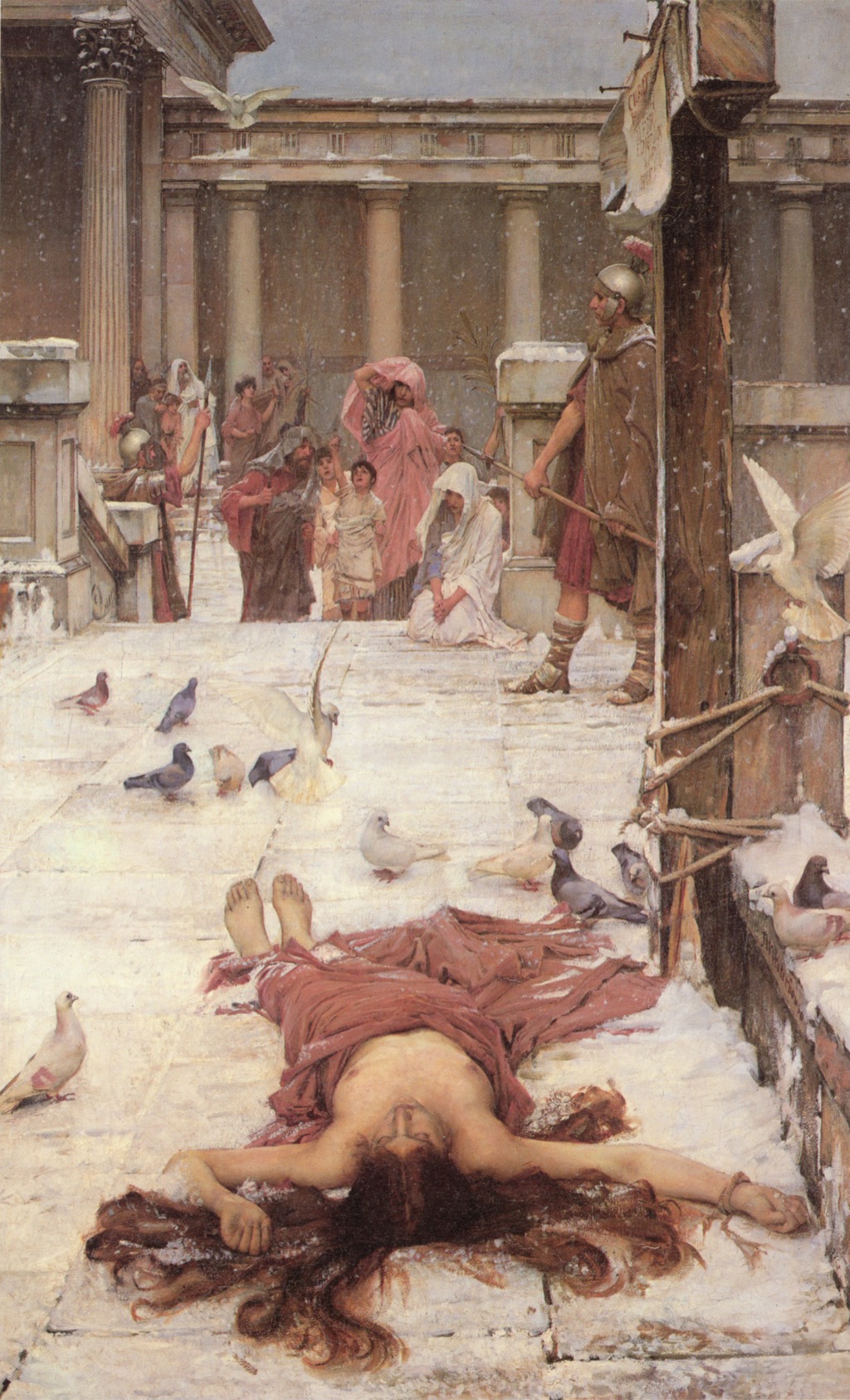
That timing is significant. Baldry was not rescuing a neglected painter after death. He was interpreting an artist at the moment of institutional maturity, after Saint Eulalia, The Lady of Shalott, Ulysses and the Sirens and the two Circe paintings had demonstrated an unusual range of classical, poetic and supernatural narrative.
“Imagination” became a recurring critical term because Waterhouse did not merely reconstruct costume. He chose moments in which visible reality seemed penetrated by song, curse, prophecy, transformation or inward vision. Even when the setting was archaeological in flavour, the psychological event mattered more than a complete inventory of antiquity.
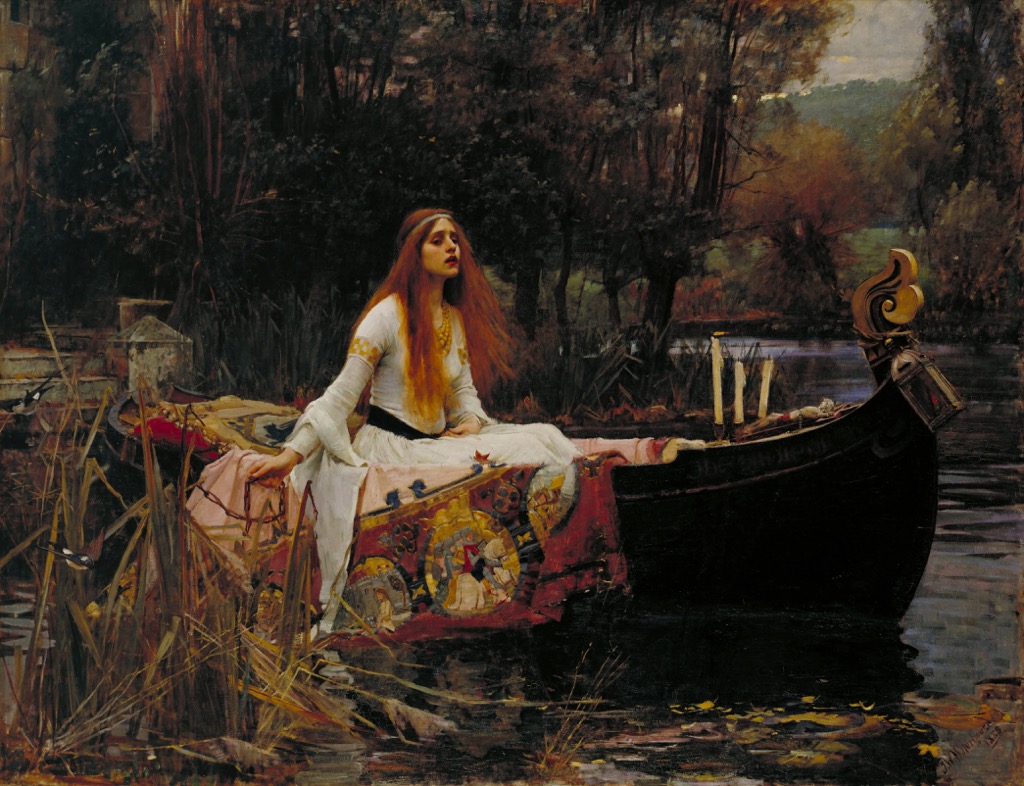
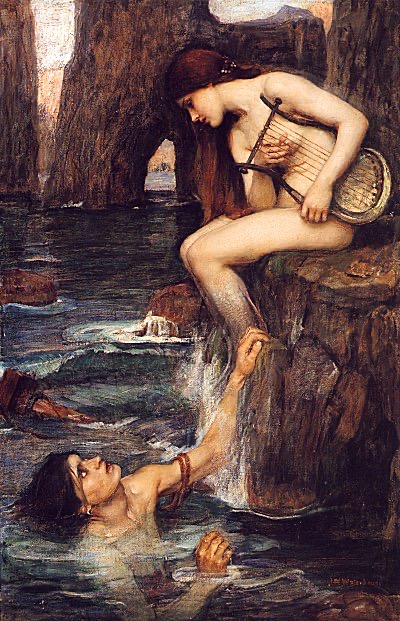
The term can nevertheless be vague. Waterhouse's imagination was supported by exact decisions: bird-bodied Sirens rather than modern mermaids; the diagonal fall of Eulalia's body; a mirror that returns Circe's gaze to Ulysses; the Lady of Shalott's chain and dying candles. Critics who praised fantasy were responding to constructed pictorial intelligence, not to an escape from observation.
His drawing and colour were equally central. The later Britannica notice joined imaginative power to a “very personal style,” able draughtsmanship and fine colour. [3] That combination helps explain why Waterhouse remained inside the Academy establishment while developing subjects that could be strange, sexually charged or emotionally unresolved.
French influence and The Lady of Shalott
Modern audiences often call Waterhouse a Pre-Raphaelite without qualification. Contemporary reactions to The Lady of Shalott of 1888 reveal why the label is incomplete. Reviewers noticed qualities they associated with French painting: freer handling, natural atmosphere and a less enamelled surface than the earliest Pre-Raphaelite ideal. [8]
The subject was insistently British. Tennyson's poem, Arthurian setting and history within Pre-Raphaelite illustration connected the canvas with a national literary tradition. Its technique, however, did not reproduce the Brotherhood's original demand for intense and relatively even focus. Reeds, water, distant bank and autumn foliage create atmosphere through changing degrees of definition.
Critics therefore confronted a hybrid: a French-inflected method applied to a modern British classic. That tension later became central to the retrospective title “The Modern Pre-Raphaelite.” It was visible to viewers in 1888 before later scholarship made it a curatorial thesis. [8] [9]
The critical category “French” should not be treated as a precise recipe. Reviewers could use it for loose touch, tonal naturalism, plein-air appearance or the broader challenge of foreign art to British finish. Their remarks show perceived difference; they do not prove that Waterhouse adopted one named French painter's complete method.
The painting's later national status also alters how those early comments sound. Sir Henry Tate presented it to the national collection in 1894. [10] What could first appear technically foreign became one of the most familiar images of British Victorian art. Reception converted a disputed mixture into an emblem.
Ulysses and the Sirens: criticism and technical testimony
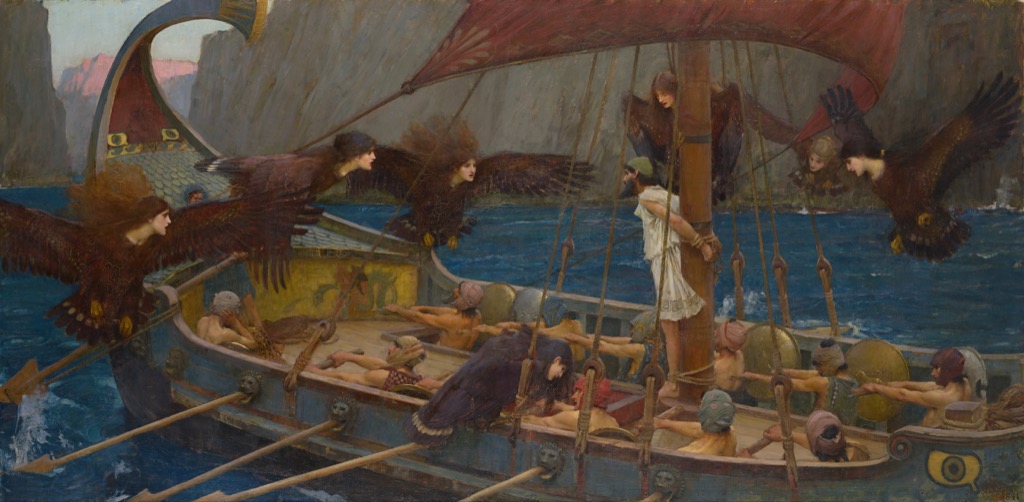
The 1891 purchase of Ulysses and the Sirens by the National Gallery of Victoria generated one of the richest surviving bodies of contemporary response. The scene shows Ulysses tied to the mast while bird-bodied Sirens descend upon his ship. Viewers accustomed to beautiful mermaid-like temptresses could find these attackers ugly or textually contentious. [2]
The dispute involved more than taste. Because a civic gallery used public funds, critics debated whether the acquisition represented sound judgment. Questions about Homer's wording, ancient visual precedents, modern ugliness and museum responsibility converged around the painting. Waterhouse's fantasy became a public argument.
Hubert von Herkomer defended the work as imaginative art and offered rare technical testimony. He described Waterhouse's method as direct, explaining that parts were painted in a comparatively complete way. Yet he also said a passage might be repainted many times. [2] The two points belong together. Directness did not mean effortless execution or a whole canvas dashed off in one session. It meant repeated complete restatement rather than a uniform slow accumulation.
Herkomer's account is especially valuable because it comes from a fellow artist close to the painting's creation. It supports what viewers can see in Waterhouse's controlled focal passages and freer surrounding marks. It also guards against a modern misuse of “alla prima.” Freshness of surface may be the outcome of persistent revision.
Herkomer linked the method with French influence. [2] That observation connects the Melbourne controversy with reviews of The Lady of Shalott. In both cases critics recognised that Waterhouse's literary subjects did not entail an antiquated technique. His challenge was to make complex narrative appear immediate without losing the authority expected of a major exhibition painting.
The critical record also shows that source fidelity was unstable. Waterhouse's Sirens have ancient pictorial precedent, including bird-bodied forms, but no single image can illustrate every feature of Homer's episode. A Victorian complaint that the attackers violated expectation tells us what that viewer thought a Siren should look like. It does not by itself settle the classical question.
Circe: beauty, colour and repulsion
Waterhouse turned from Ulysses to Circe in Circe Offering the Cup to Ulysses of 1891 and Circe Invidiosa of 1892. These images made a female magician monumental. Their reception exposes the pressure that critics placed on beauty: was visual attraction an artistic virtue, a moral danger or a disguise for violence?
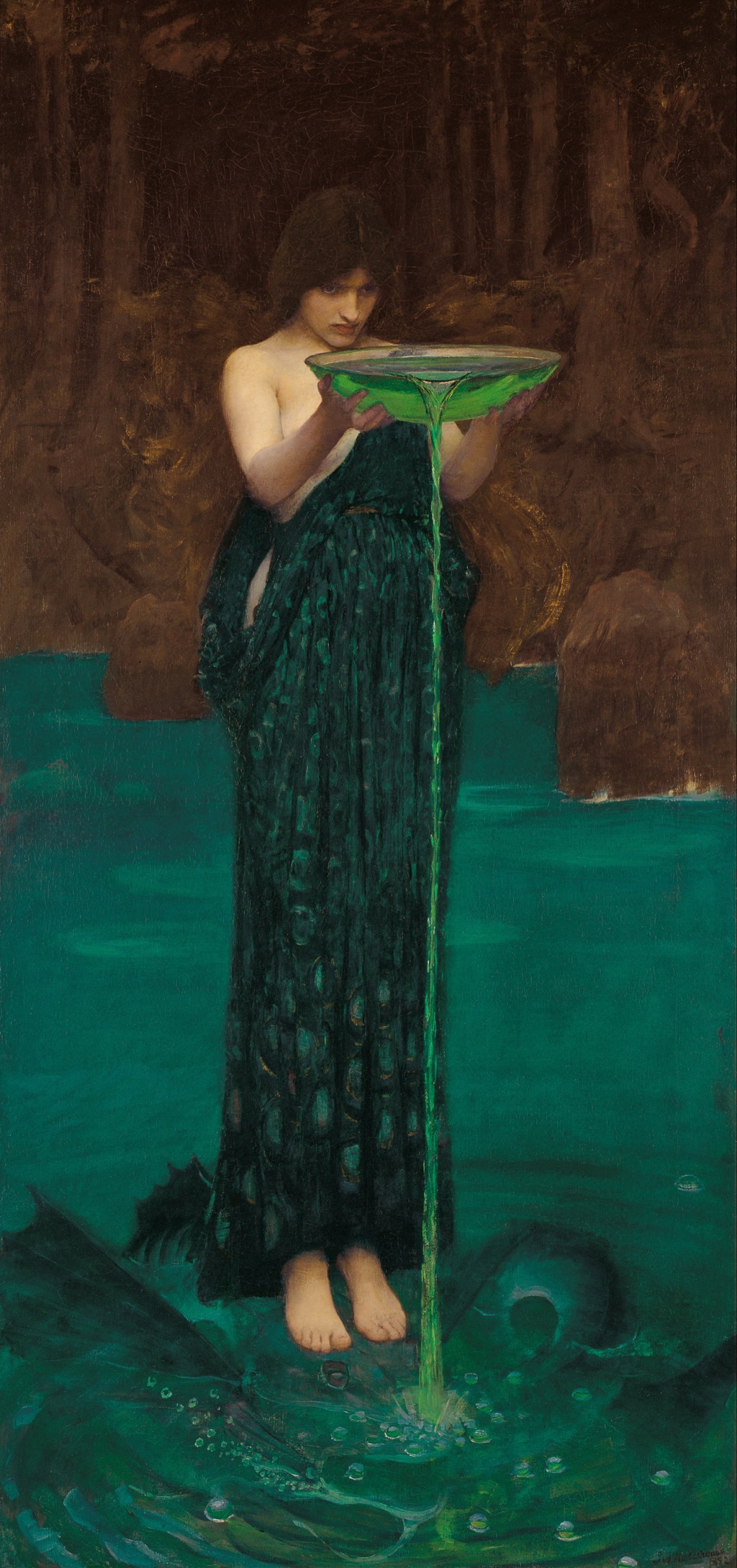
Adelaide's record of Circe Invidiosa preserves reviews saying that the painting repelled rather than attracted an average visitor and predicting that it would never become generally popular. [11] Those brief judgments are revealing even without treating them as a consensus. The vertical format, green-blue poison, dark sea creature and Circe's pale concentration did not read as comfortable decoration.
Other period description found the colour strange and beautiful and compared its mixture of tendencies with Burne-Jones and French art. [11] Attraction and repulsion were not opposites distributed neatly between supporters and detractors. The same unnatural colour could appear powerful because it was unsettling.
The controversy makes modern admiration more historically specific. Today Circe Invidiosa is frequently reproduced for its turquoise intensity and commanding heroine. The early complaints demonstrate that these qualities once challenged ideas about suitable public art. Reception did not merely discover an unchanged beauty; it altered the terms through which the danger became desirable.
Waterhouse himself did not leave a cited statement explaining whether Circe should be admired, feared or pitied. Ovid supplies the destructive action; the painting supplies bodily poise and visual command. Critics and later viewers complete the moral relation differently. Responsible interpretation keeps that openness instead of inventing an authoritative artist quotation.
Rose Sketchley's psychological Waterhouse
Rose E. D. Sketchley's 1909 Art Annual survey is one of the most important lifetime accounts of Waterhouse. It looked back across an established career while the painter was still producing major works. [6] The publication's scale and illustrations alone show that Waterhouse commanded sustained critical attention before his death.
Sketchley recognised a pattern among women drawn from Psyche, Pandora, Lamia, Shakespeare, Tennyson and other sources: their significance lay not simply in costume or prettiness but in inward pressure. Her account connected legendary figures through suffering, emotional suspension and lives turned towards an unseen crisis. [6] [12]
This emphasis remains useful because reproductions can flatten Waterhouse into a gallery of similar faces. Sketchley instead attended to states: listening, waiting, hesitating, remembering and enduring. A Thisbe pressed to a wall, Psyche approaching a forbidden threshold and the Lady of Shalott loosening a chain are not interchangeable beauties. Each body registers a different relation between knowledge and action.
Sketchley's interpretation also belongs to its Edwardian moment. Her language about womanhood and emotion should not be converted into Waterhouse's personal psychology. It demonstrates that a contemporary female critic found interior drama central to the pictures. It does not prove that every heroine expresses a hidden episode in the artist's marriage or private desires.
Her essay is especially valuable when read beside hostile museum reviews. Together they show the range of possible period responses. Some viewers asked whether Circe was attractive; Sketchley asked how mythic figures externalised states of mind. “Victorian opinion” was not singular.
Baldry on Waterhouse's late modernity
A. L. Baldry returned to Waterhouse in 1911 with “Some Recent Work by Mr. J. W. Waterhouse, R.A.” in The Studio. [7] The article discussed flower-women, literary subjects and late landscapes at a time when Waterhouse could easily have been described as a survivor of an earlier taste.
Baldry instead argued for Waterhouse's individuality and intellectual relation to modern art. [7] The point did not depend on modern dress or urban subject matter. A medievalising woman smelling a rose could be modern through handling, ambiguity and the transformation of literary inheritance into private sensory experience.
The article is also an important object record. Its illustrations document paintings that were privately held or imperfectly known elsewhere. The 1909 Gather Ye Rosebuds While Ye May, for example, was reproduced in monochrome although it had not been publicly exhibited during the painter's life. [13] Baldry's image confirms composition while reminding modern readers how much period criticism experienced colour paintings through grayscale.
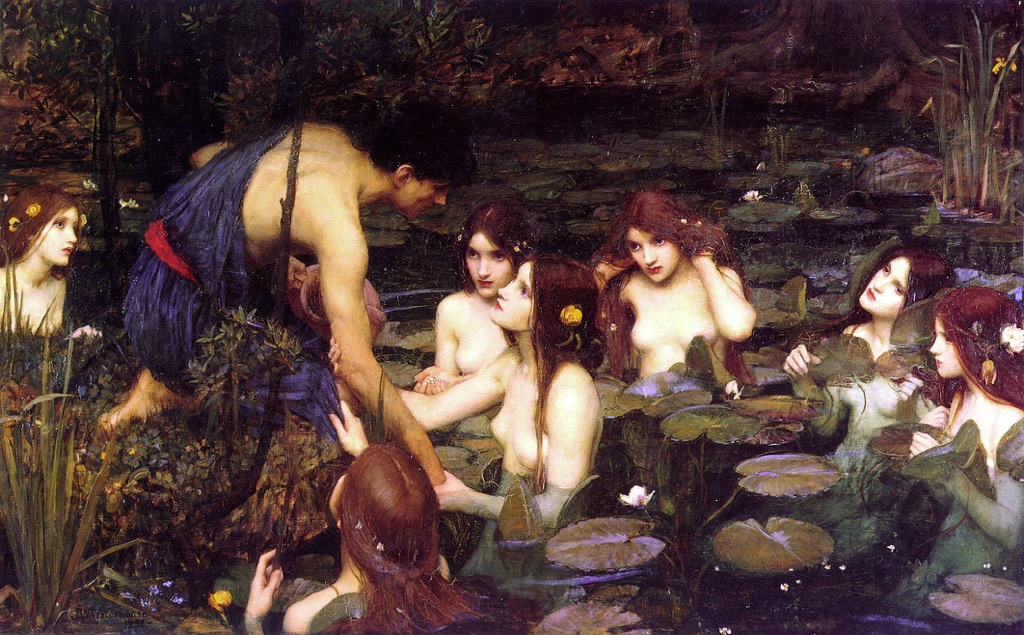
His caption for a head study connected it with Phyllis, correcting a later association with Hylas and the Nymphs. [14] This apparently small point illustrates critical method. A lifetime publication with a specific caption may carry more evidential weight than later recognition based only on a repeated face.
Baldry's praise should not be taken as neutral fact. He was an advocate interpreting recent work. Its value lies in the reasons he gave and in the historical possibility his account preserves: Waterhouse could appear modern to a critic in 1911 precisely while painting Arcadia, flowers and myth.
The 1911 Britannica: standing and error
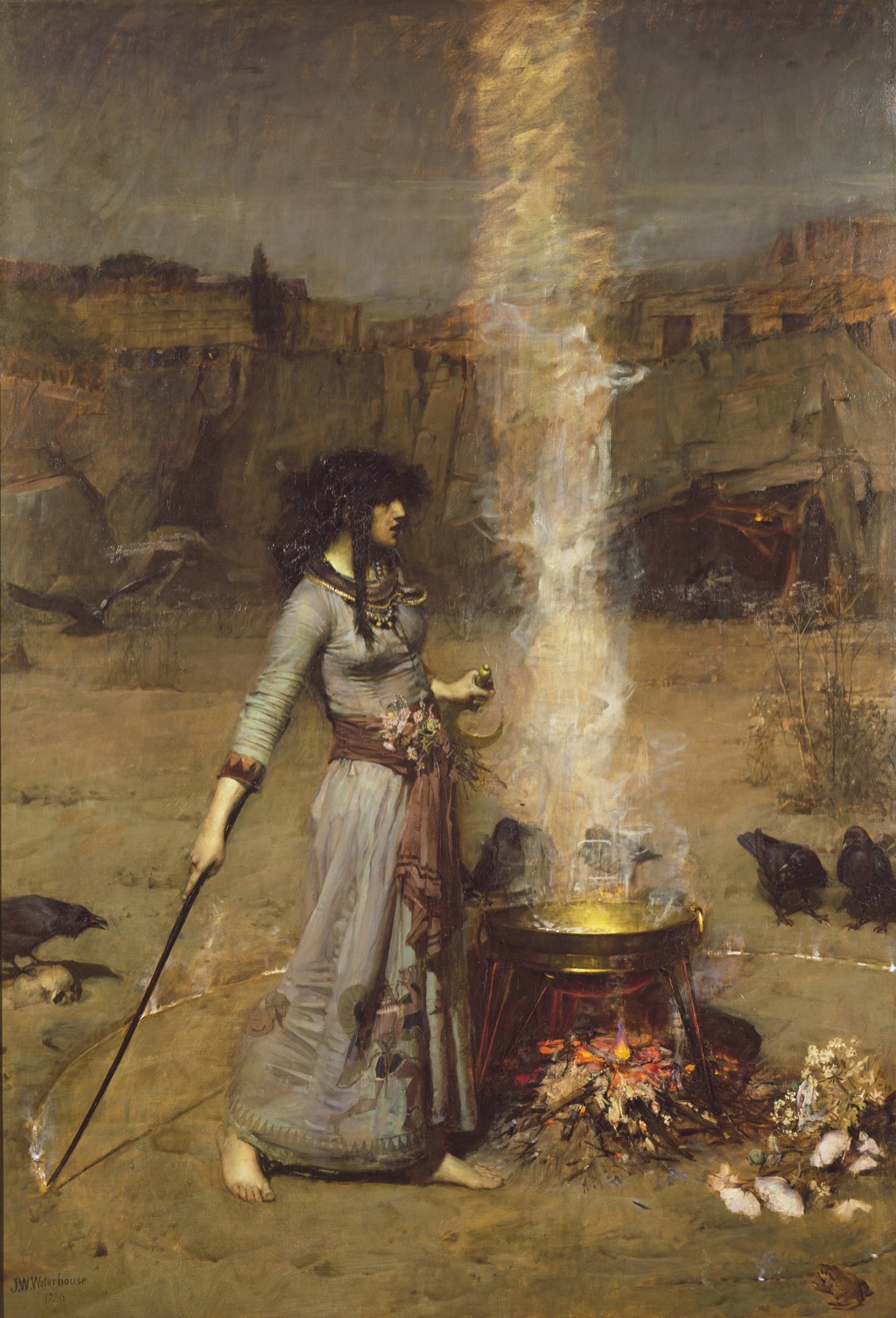
The short Encyclopædia Britannica notice of 1911 offers a compact contemporary verdict. It described Waterhouse as a figure painter with imaginative power and a personal style, praised his drawing and colour, and placed him among the leading artists of the British school. [3] It also named four paintings then in the National Gallery of British Art: Consulting the Oracle, Saint Eulalia, The Lady of Shalott and The Magic Circle.
The entry demonstrates establishment recognition. Waterhouse was not presented as a marginal Pre-Raphaelite imitator but as a prominent living British painter. Its emphasis on classical fantasy shows how his public identity could differ from today's focus on The Lady of Shalott and Hylas and the Nymphs.
At the same time, it misdated his birth to 1847. [3] Modern institutional research gives January 1849. [1] The error is not a reason to dismiss the entry. It is a reason to use it properly: authoritative evidence of contemporary valuation, weaker evidence for a biographical detail corrected by better records.
This combination of praise and error is an ideal lesson in quotation. A prestigious source can be highly informative and still require verification. Authority belongs to claims, not to publications in the abstract.
A quotation guide for Waterhouse
A reliable quotation guide keeps several categories distinct:
- Documented words by Waterhouse. These require a letter, inscription or reliably recorded statement.
- Contemporary testimony about his practice. Herkomer's account of direct repainting belongs here.
- Contemporary critical judgment. Sketchley, Baldry, newspaper reviewers and Britannica interpreted and evaluated his art.
- Literary source. Words by Homer, Ovid, Shakespeare, Tennyson or Keats belong to the writer, even when Waterhouse chose them as a title.
- Modern scholarly interpretation. A curator or historian may identify a model, influence or theme from new evidence.
- Visual analysis. A claim about composition or colour can be made by the present writer if framed as observation rather than recovered intention.
The title “I am half sick of shadows,” said the Lady of Shalott is Tennyson's line, not Waterhouse's personal confession. Gather Ye Rosebuds While Ye May comes from Robert Herrick. The Soul of the Rose appears in Tennyson and also has a wider medieval literary history. Attributing title words to Waterhouse simply because he painted them erases the literary partnership central to his art.
Untraceable inspirational sayings should be excluded even if widely repeated. A sentence does not become authentic through repetition beneath a portrait. The minimum requirement is a source that allows a reader to find the words in context.
Paraphrase is often more accurate than quotation. Herkomer's technical account can be explained in clear modern language while a short phrase establishes its period character. Long decorative quotations may obscure the distinction between evidence and rhetoric.
Related Pages
- Biography: Place Waterhouse's sparse documented voice within the wider life and career.
- Exhibitions and International Reception: Follow the public settings in which contemporary criticism appeared.
- Literary and Mythological Sources: Separate literary source language from Waterhouse's own documented words.
Frequently Asked Questions
No extensive autobiography, diary or manifesto is established in the sources used here. Individual letters survive, but his public first-person record is sparse. [1] [4]
They repeatedly noticed imagination, colour, drawing, personal style, psychological atmosphere and the combination of literary subjects with a comparatively modern, sometimes French-associated technique. [2] [3] [6] [7]
No. Ulysses and the Sirens provoked debate over its frightening bird-women and source fidelity, while Adelaide reviewers found Circe Invidiosa repellent or unlikely to become popular. [2] [11]
Hubert von Herkomer's 1892 discussion of Ulysses and the Sirens describes a direct method in which a passage could be completely repainted many times. [2]
She was an art writer whose illustrated 1909 Art Annual offered a major lifetime survey of Waterhouse and interpreted the inward, often suffering states of his literary women. [6] [12]
No documented self-description used here establishes that label. Critics and scholars relate him to the movement's literary and visual afterlife while also emphasising Academy training, classicism and French-influenced handling. [8] [9]
Only if they lead to a verifiable primary or reliable scholarly source. Waterhouse's sparse personal record makes unsourced aphorisms particularly suspect.
Discussion
Contemporary criticism restores risk to Waterhouse. His paintings were not received only as nostalgic beauty. Reviewers argued about modern technique, hostile supernatural women, literary fidelity and the obligations of public museums. The qualities now loved—the turquoise poison of Circe Invidiosa, the attacking Sirens, the loose atmospheric riverbank of The Lady of Shalott—could be the very qualities that made the pictures contentious.
The critical record also reveals how early the modern Waterhouse was visible. French influence was noticed in his lifetime. Sketchley recognised psychological continuity across different legends. Baldry found individuality in the late Arcadian work. Britannica gave him a leading place in the British school. Later reassessment did not invent these questions; it recovered and reorganised them.
Reader Insights
Which visible detail most changes the way you read this page?
Which source or comparison helps the work feel less familiar and more specific?
What question would you bring back to the painting after reading?
Join the Conversation
Share your reading of this page below.
References
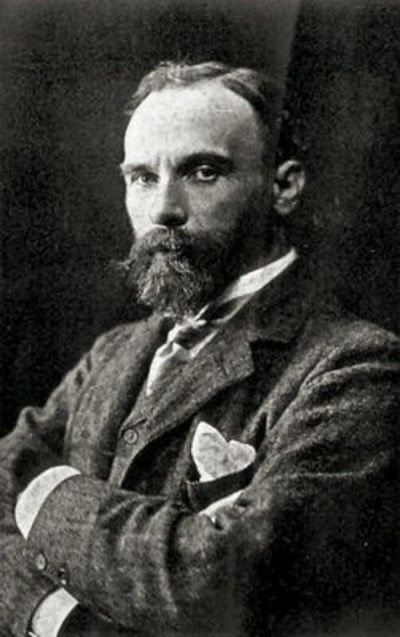
- Main image: H. S. Mendelssohn, John William Waterhouse, c. 1886, public-domain photograph via Wikimedia Commons.
- National Portrait Gallery, “John William Waterhouse (1849–1917), Figure Painter,” biography and bibliography. View source
- Michelle Bonollo / National Gallery of Victoria, “J. W. Waterhouse's Ulysses and the Sirens: breaking tradition and revealing fears,” including contemporary criticism and Hubert von Herkomer's account. View source
- Encyclopædia Britannica, “Waterhouse, John William,” 11th edition, 1911, contemporary notice transcribed by Wikisource. View source
- Yale Center for British Art, “John William Waterhouse letter to Harry Quilter,” archival collection record, MSS 84. View source
- A. L. Baldry, “J. W. Waterhouse and His Work,” The Studio, vol. 4, 1895, bibliographically cited in the 1911 Britannica notice and Waterhouse scholarship. View source
- R. E. D. Sketchley, The Life and Work of Mr. J. W. Waterhouse, R.A., Art Annual: The Christmas Number of The Art Journal, London, 1909; bibliography recorded by the Art Gallery of New South Wales. View source
- A. L. Baldry, “Some Recent Work by Mr. J. W. Waterhouse, R.A.,” The Studio, vol. 53, 1911, pp. 174–185, Heidelberg University Library digitisation. View source
- Khan Academy, “Waterhouse, The Lady of Shalott,” discussion of Pre-Raphaelite inheritance, French-inflected handling and contemporary response. View source
- Royal Academy of Arts / Victorian Web, “J. W. Waterhouse: The Modern Pre-Raphaelite,” retrospective account and scholarly framing. View source
- Tate, “The Lady of Shalott,” collection and provenance record. View source
- Art Gallery of South Australia, “Circe Invidiosa,” object record and accessible account of contemporary Adelaide reviews. View source
- Christie's, “John William Waterhouse, R.A., Thisbe,” catalogue essay discussing Sketchley's 1909 interpretation. View source
- Sotheby's, “Gather Ye Rosebuds While Ye May,” catalogue essay documenting the 1909 painting's reproduction by Baldry. View source
- Christie's, “A Study for Phyllis in Phyllis and Demophoon,” catalogue essay documenting Baldry's 1911 identification. View source