 Buy Art Prints Now
from Amazon
* As an Amazon Associate I earn from qualifying purchases.
Image reference [image]
 by Tom Gurney
Tom Gurney BSc (Hons) is an art history expert with over 20 years experience
Published on August 14, 2026 / Updated on August 14, 2026
Email: tomgurney1@gmail.com / Phone: +44 7429 011000
John William Waterhouse Influences, Reputation and Legacy: Introduction
John William Waterhouse belongs to several histories at once. He trained within the Royal Academy, began with classical and historical subjects, inherited the literary ambitions of Pre-Raphaelitism, absorbed aspects of French naturalism, and developed an increasingly Symbolist art of inward states. Calling him simply “a Pre-Raphaelite” identifies a real connection but conceals the mixture that made his work distinctive.
His reputation is equally layered. Waterhouse was professionally successful and internationally exhibited during his lifetime. He then sat uneasily within modernist accounts of progress, remaining popular with viewers while receiving comparatively little sustained scholarship. Exhibitions in 1978–79 and 2008–10 helped reverse that imbalance. Today his images circulate through museums, books, digital culture and debates about gender and display. His legacy lies not only in a recognisable style but in the continuing power of narrative painting to generate desire, uncertainty and argument. [1] [2] [3]
At a Glance
- TrainingRoyal Academy Schools, initially as a sculpture student [1]
- Early artistic contextBritish classical and history painting associated with Leighton, Alma-Tadema and Poynter [2] [4]
- Pre-Raphaelite inheritanceLiterary subjects, close natural detail, intense colour and the visual traditions of Tennyson, Shakespeare and Keats
- Important difference from the original BrotherhoodLater birth, Academy establishment, convincing spatial depth and freer paint
- French and naturalist influenceRecognised by contemporary critics and linked with colleagues including William Logsdail and Frank Bramley [2] [5]
- Symbolist affinityMyth, dream, enchantment and psychological suspension, without secure evidence that Waterhouse joined a Symbolist group
- Lifetime reputationRoyal Academician, internationally awarded and represented in public collections [1]
- Scholarly revivalSheffield and Wolverhampton survey, 1978–79; international retrospective, 2008–10 [3] [6]
- Popular legacyExceptional reproduction and digital circulation, especially of The Lady of Shalott, Hylas and the Nymphs and the Circe paintings [7]
- Current debateBeauty, agency, erotic looking, museum interpretation and the boundaries of “Pre-Raphaelite” art [8]
Contents
- Introduction
- Why one label is insufficient
- Royal Academy training and classical foundations
- Pre-Raphaelite literary and visual inheritance
- French naturalism and the Primrose Hill network
- Symbolism, myth and the supernatural
- Waterhouse's distinctive synthesis
- Lifetime reputation and early afterlife
- Revival through exhibitions and scholarship
- Popular culture, museums and public debate
Why one label is insufficient
Waterhouse is routinely introduced as a Pre-Raphaelite painter. The description is understandable: he painted Tennyson's Lady of Shalott, Shakespeare's Ophelia and Keats's Lamia; he gave close attention to flowers and textiles; his women recall types developed by Dante Gabriel Rossetti and Edward Burne-Jones. Yet Waterhouse was born in 1849, after the Brotherhood was formed in 1848, and did not belong to its original circle. [1] [2]
“Pre-Raphaelite” therefore describes inheritance and afterlife rather than membership. It can be productive if it prompts comparison. It becomes misleading when used as a complete biography, a fixed technique or proof of personal contact with artists from an earlier generation.
Waterhouse also belongs to academic classicism. His early emperors, priests and Roman interiors emerged from a culture of ambitious history painting. He belongs to naturalism through landscape, light and broad handling. His magicians, dreams and metamorphoses have Symbolist affinities. His late flower-women overlap with Aesthetic interests in beauty and mood beyond explicit narrative.
These categories should not be imagined as stages that replace one another neatly. Classical myth persists into the late work. Pre-Raphaelite poetry enters after an Academy career is established. Freer technique coexists with careful drawing. A single painting can be classical in subject, Pre-Raphaelite in literary atmosphere, naturalist in landscape and Symbolist in emotional effect.
The retrospective title “The Modern Pre-Raphaelite” captures this contradiction. [2] [3] “Pre-Raphaelite” signals continuity; “modern” insists that Waterhouse translated rather than copied. His importance lies in the translation.
Royal Academy training and classical foundations
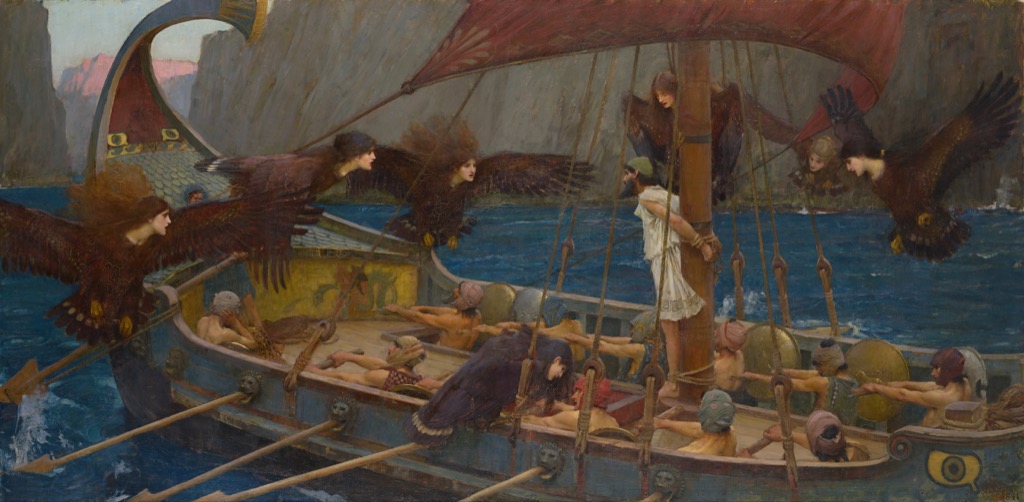
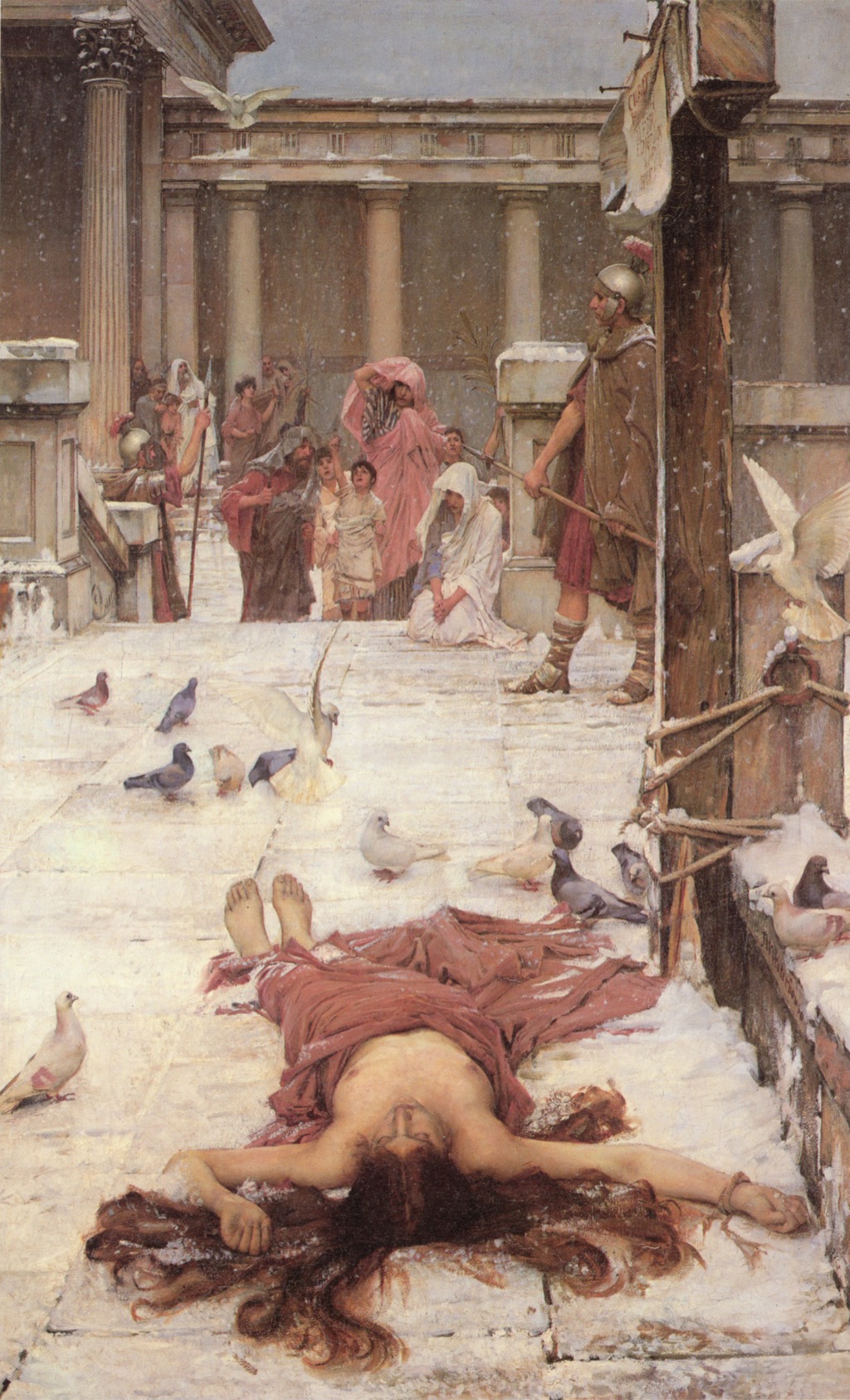
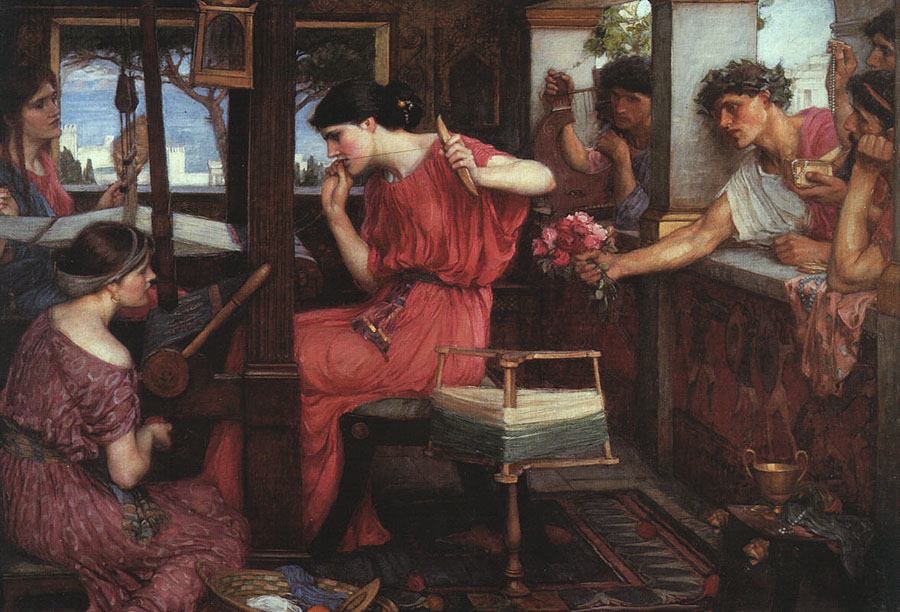
Waterhouse entered the Royal Academy Schools as a sculpture student—recorded as 1871 by the National Portrait Gallery, with other Academy summaries distinguishing probationary study beginning in 1870. [1] [2] Sculpture matters to his paintings. Bodies carry narrative through weight, turn and balance: Eulalia's fall, Ulysses' twist against the mast, Circe's vertical command and Penelope's defensive turn.
The Academy provided life drawing, institutional tradition and a public exhibition system. It also placed Waterhouse within a British classical culture represented by Frederic Leighton, Edward Poynter and Lawrence Alma-Tadema. Comparisons with these artists help identify a shared appetite for antiquity, beautiful surfaces and ambitious figure composition. [4]
Waterhouse was not merely an imitator of Alma-Tadema's archaeological interiors. His early classical scenes often loosen historical specificity in order to concentrate on mood. The Favourites of the Emperor Honorius uses late Roman decline as an image of absorbed irresponsibility. Diogenes stages confrontation between philosophical withdrawal and curious society. Consulting the Oracle invents a hybrid ritual atmosphere rather than reconstructing one documented ancient ceremony.
Leighton's influence was institutional as well as stylistic. As President of the Royal Academy and an adviser on overseas purchases, Leighton belonged to the professional network through which Waterhouse rose and through which paintings reached collections such as Adelaide. [5] Poynter and Hubert von Herkomer likewise participated in judgments about his work.
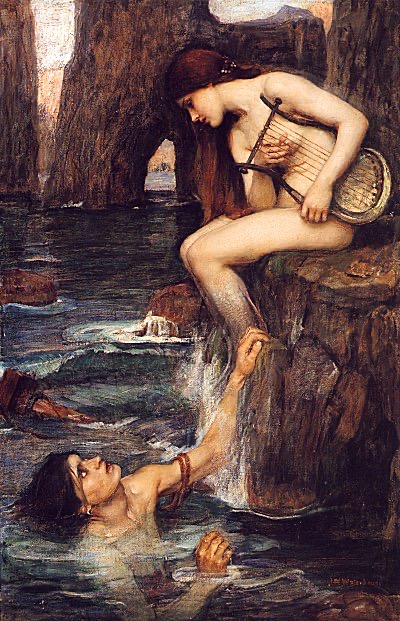
The classical foundation remained active after Waterhouse turned to English poetry. Homer, Ovid and Apuleius supplied Sirens, Circe, Echo, Narcissus, Lamia, Psyche, Pandora, Daphne, Phyllis and other figures. Antiquity was not a youthful phase abandoned for Arthurian legend. It was a permanent imaginative archive.
Pre-Raphaelite literary and visual inheritance
The original Brotherhood challenged academic convention through intense observation, saturated colour and subjects drawn from religion, medieval literature and modern life. By the time Waterhouse matured, Pre-Raphaelitism had diversified. Rossetti and Burne-Jones had developed aesthetic and dreamlike modes far from the precise early manifesto.
Waterhouse inherited above all a belief that literature could generate major modern painting. Tennyson gave him the Lady of Shalott, Mariana, Saint Cecilia and the Lady Clare. Shakespeare supplied Ophelia, Miranda and Juliet. Keats supplied Isabella, Lamia and La Belle Dame sans Merci. These were not antiquarian illustrations. Victorian poetry and canonical drama provided ways to think about isolation, desire, gender, art and fatal knowledge.
Specific visual comparisons matter. Millais's Ophelia established a powerful relation between Shakespearean death and botanically charged water landscape. Waterhouse did not copy its floating body; he returned repeatedly to the moments before drowning, giving Ophelia upright agency, listening tension or anxious self-adornment. The influence is a field of possibilities, not a transferred composition.
Rossetti's half-length women, abundant hair and compressed spaces offer another comparison, especially for Waterhouse's late flower subjects. Yet Waterhouse often turns his figures away from direct confrontation. The Soul of the Rose closes the woman's eyes and places her sensory attention on the flower rather than the viewer. The inherited beauty type becomes an inward action.
Burne-Jones provides affinities in elongated bodies, dream states and legendary time. Contemporary viewers compared aspects of Waterhouse's work with his. [5] The differences are again substantial: Waterhouse's bodies frequently have more weight, his environments more atmospheric depth and his narrative moment more sharply legible.
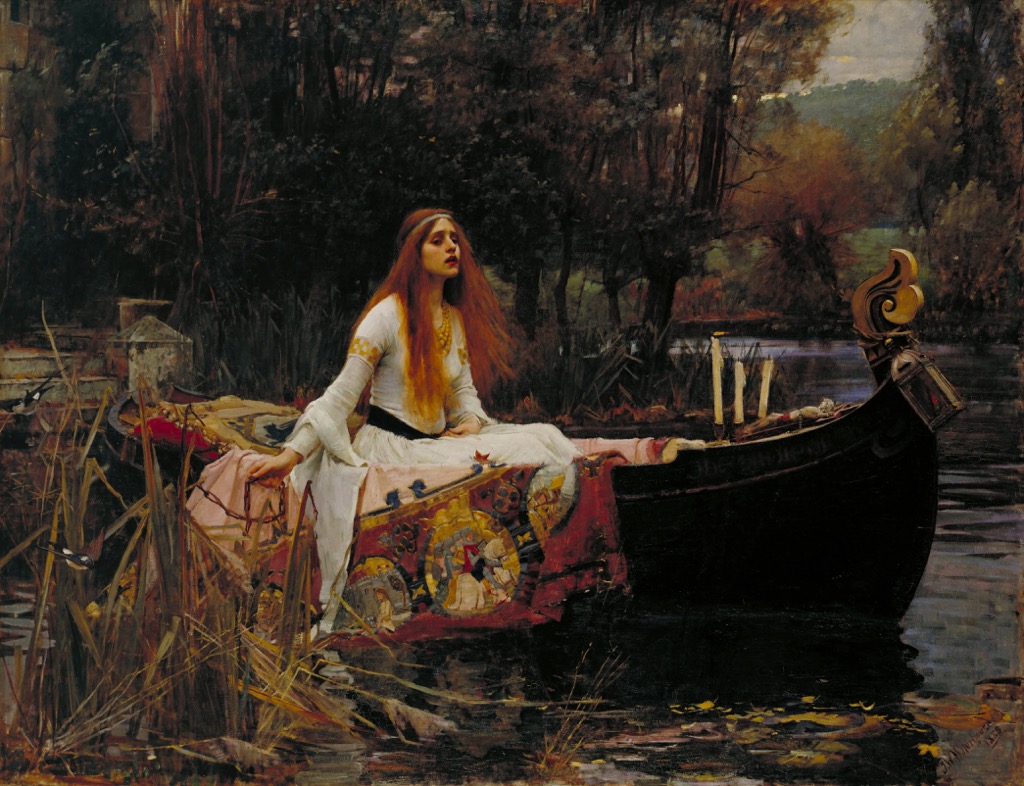
The 1888 Lady of Shalott is a key synthesis. Its Tennysonian subject belongs to Pre-Raphaelite tradition, but critics noticed French qualities in the handling. [9] Waterhouse renewed a native literary subject through a technique associated with newer European painting. He did not recover an untouched past; he made inheritance visibly contemporary.
French naturalism and the Primrose Hill network
Waterhouse's paint distinguishes him from the original Brotherhood's ideal of intense, even focus. He could finish a face or hand tightly while allowing reeds, foliage, drapery or shadow to broaden and dissolve. Atmospheric space often emerges through changing edge and touch rather than line alone.
Hubert von Herkomer's 1892 account of Ulysses and the Sirens linked Waterhouse's direct method with French influence. [5] He described passages painted comparatively completely and repainted in full when necessary. Directness therefore involved persistent restatement, not casual speed.
The Royal Academy retrospective account connected Waterhouse's development with the artistic community at Primrose Hill Studios, especially William Logsdail and Frank Bramley. [2] Logsdail had studied in Antwerp and became known for detailed modern urban scenes. Bramley was associated with the Newlyn School, whose artists absorbed naturalist and plein-air approaches. Neighbourship allowed artistic ideas to move through daily contact rather than formal allegiance.
National Portrait Gallery research gives the community unusual specificity. Waterhouse and Logsdail modelled for one another in relation to The Bank and Royal Exchange, and Logsdail later recalled the sociability of the studios. [10] Influence here need not mean one painter copying another. It can mean shared discussion, mutual observation and exposure to different ways of handling modern life.
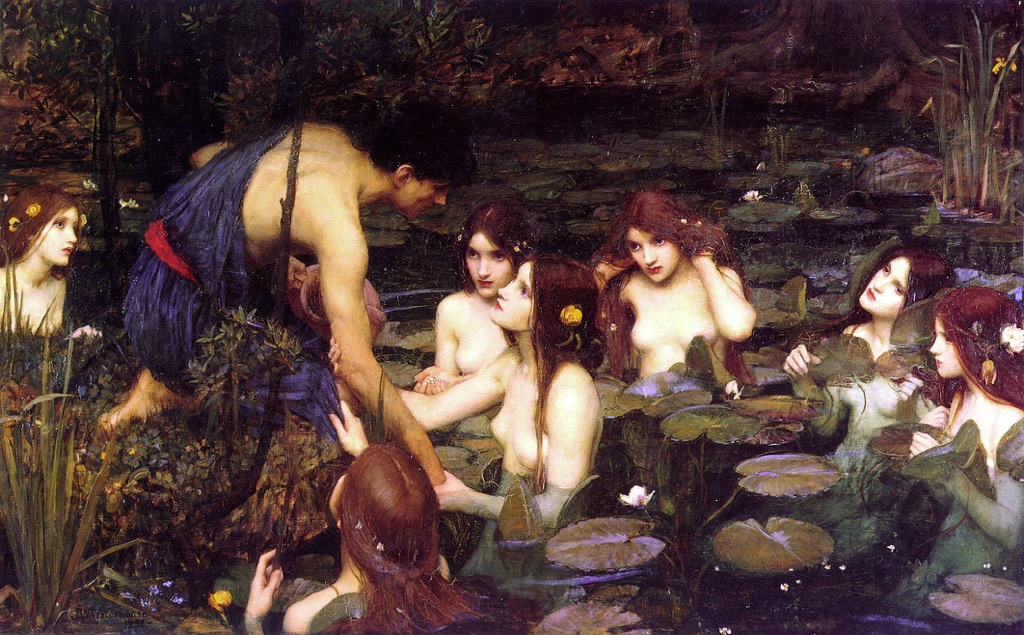
Waterhouse's landscapes bear the result. The riverbank in The Lady of Shalott, the wind in Boreas and Windflowers, the dark pool in Hylas and the Nymphs and the late Arcadian gardens feel encountered rather than diagrammed. Naturalism grounds the impossible event.
French influence should not be used as a catch-all explanation. Waterhouse's sources were multiple, and the exact path from a named French artist to a specific passage requires evidence. What can be said securely is that contemporaries perceived modern French qualities and that his network included painters engaged with continental training and naturalism. [2] [5] [9]
Symbolism, myth and the supernatural
Waterhouse's paintings often behave like Symbolist art even when they illustrate a recognisable story. They concentrate on subjective states, dreamlike spaces, dangerous beauty and the threshold between material and supernatural worlds. Mirrors, water, flowers, doors, vessels and musical instruments become structures through which desire and knowledge operate.
The connection should be framed as affinity rather than membership. No source used here establishes Waterhouse as a formal participant in a continental Symbolist group. He worked through the Royal Academy and public narrative painting. Yet his mature images shared the period's fascination with suggestion, occultism, fatal women and the instability of visible reality. [2] [11]
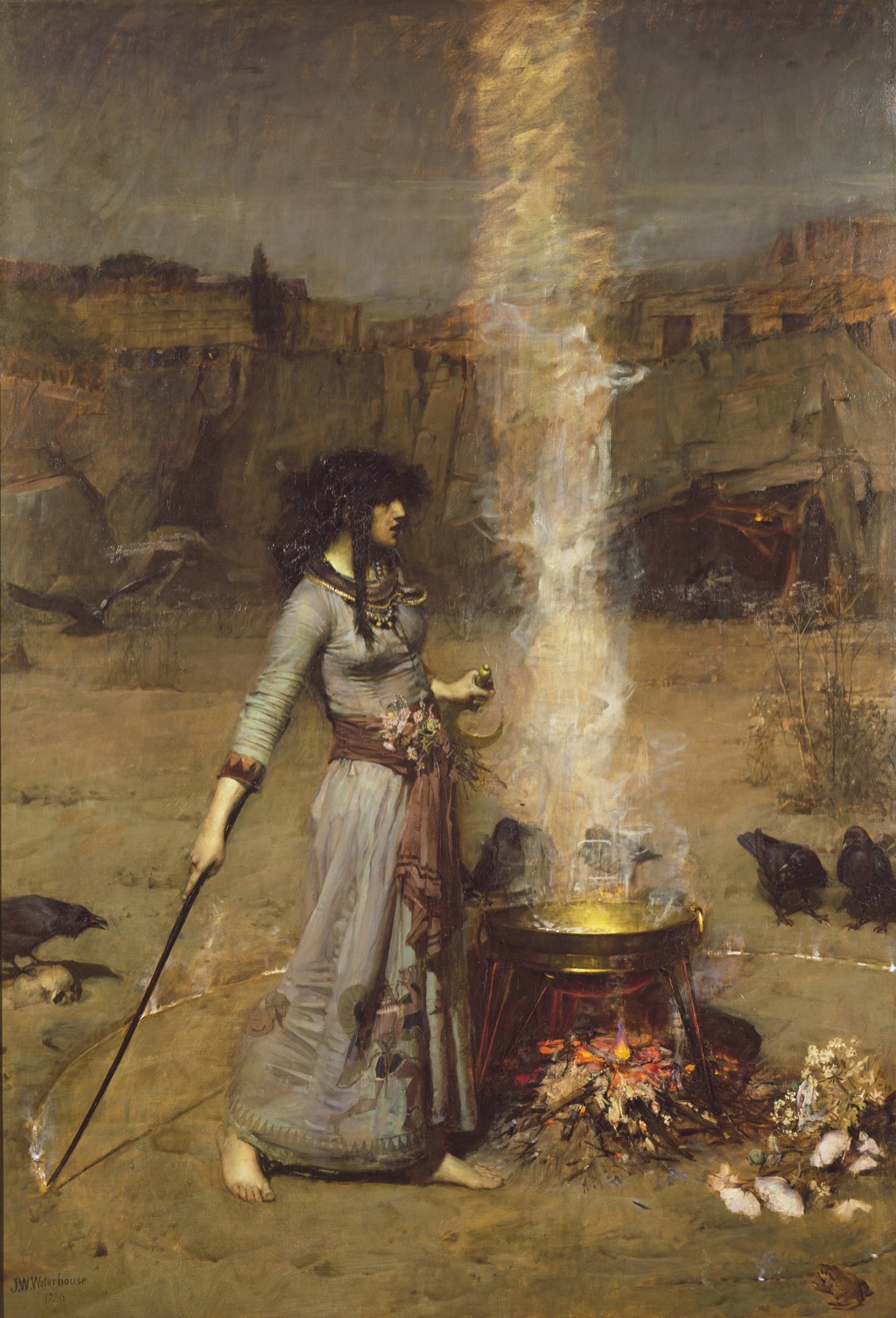
Myth gave him distance from contemporary dress while allowing contemporary anxieties to surface. Circe can embody female agency, destructive jealousy, artistic creation or male fear without reducing to one allegory. Hylas's nymphs make desire collective and uncanny. Psyche's doors and boxes turn curiosity into an encounter with forbidden knowledge.
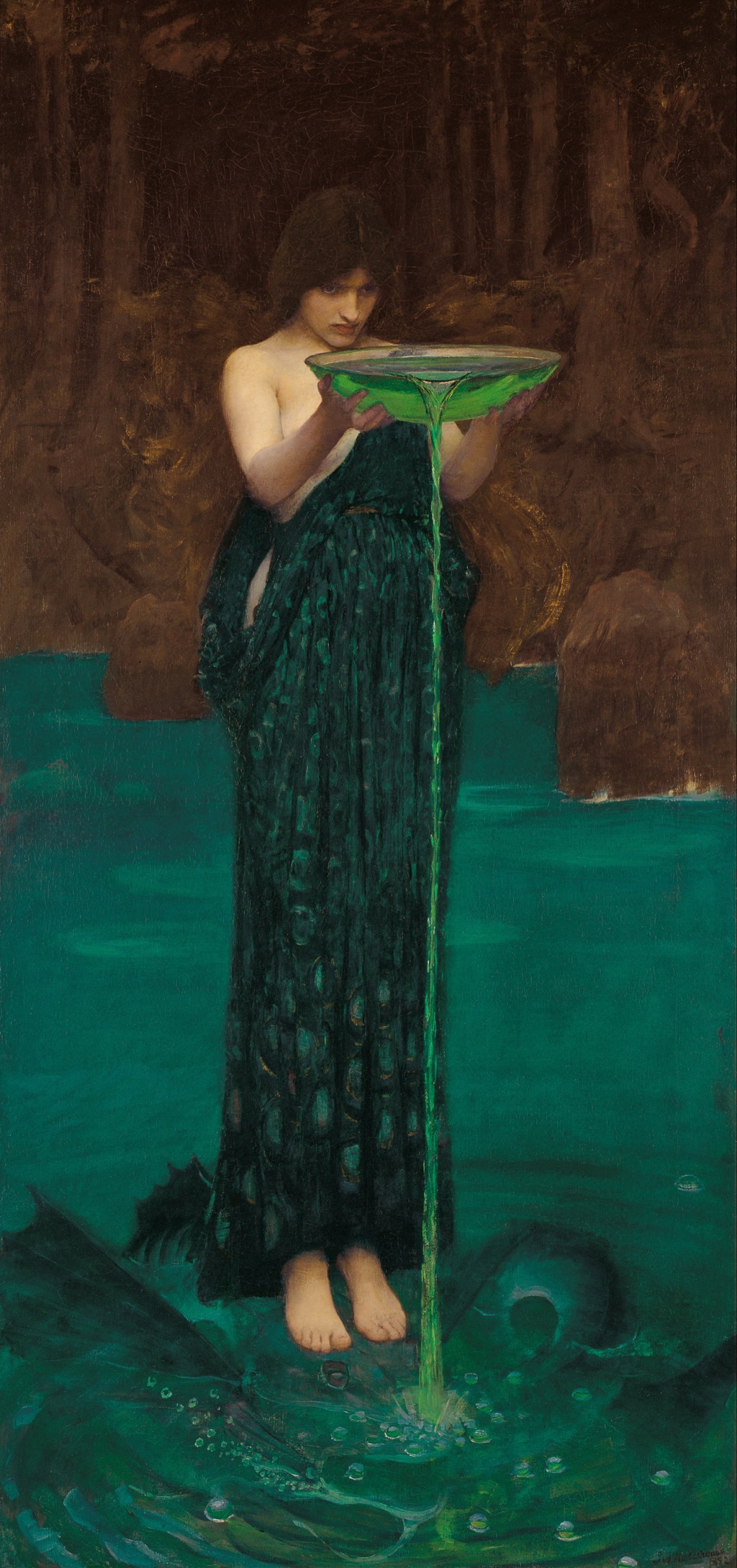
Water itself becomes a symbolic medium. It reflects, conceals, transports and transforms. The Lady of Shalott travels towards death; Hylas is drawn below the pool; Narcissus mistakes reflection for an attainable body; Circe pours poison into the sea; the Danaïdes repeat futile labour. These meanings arise from different texts, not from a single private code, but repetition gives the oeuvre structural continuity.
Flowers similarly move between observation and symbol. Ophelia's plants carry Shakespearean associations. Phyllis becomes an almond tree in later myth. Roses connect beauty with time, scent, love and enclosure. The flower remains materially painted even when it gathers meanings.
Symbolist comparison helps explain why Waterhouse's best-known works resist simple illustration. He usually omits complete narrative resolution. The viewer encounters a charged sign at the moment before it becomes consequence.
Waterhouse's distinctive synthesis
Influence is easiest to list and hardest to explain. Waterhouse's achievement was not the sum of Leighton plus Rossetti plus French naturalism. It was a working synthesis organised around the readable threshold.
From academic training he took bodily clarity and exhibition scale. From classicism he took an enormous store of narratives and forms. From Pre-Raphaelitism he took literary seriousness, plant detail and the capacity of beauty to carry moral tension. From naturalism he took atmosphere, variable finish and environments that make myth feel physically present. From Symbolist culture he shared an interest in suggestion, dream and dangerous inwardness.
He then chose moments that keep agency undecided. The Lady has loosened the boat but not reached Camelot. Hylas leans but has not vanished. Circe's liquid falls while its victim remains outside the frame. Psyche opens a door or box before consequence is complete. Daphne transforms while pursuit is still active.
Composition turns this suspension into a bodily experience. Hands touch chains, cups, flowers and thresholds. Gazes meet, miss or return through mirrors. Water and foliage surround figures without simply illustrating setting. The viewer is brought close enough to anticipate what comes next but denied the closure of the event itself.
This pattern also distinguishes Waterhouse from weaker followers. A red-haired woman in medieval dress is not sufficient. The quality of the work depends on how story, pose, space, handling and withheld consequence reinforce one another.
His synthesis changed over time. Early history paintings often distribute action among groups and architecture. Middle-period masterpieces intensify confrontation and supernatural danger. Late works reduce explicit narrative, allowing flowers, wind and sensory absorption to carry meaning. The underlying interest in thresholds persists.
Lifetime reputation and early afterlife
Waterhouse's institutional success was substantial. He exhibited at the Royal Academy from 1874 to 1917 with only two gaps, became an Associate in 1885 and a full Academician in 1895, and taught in the Academy Schools. [1] [2] Mariamne received international exposure and awards, while public museums in Britain and Australia acquired major paintings during his life. [1] [5]
The 1911 Encyclopædia Britannica praised his imagination, drawing, colour and personal style and ranked him highly within the British school. [12] That contemporary judgment does not settle present valuation, but it disproves the idea that Waterhouse was ignored by his own profession.
His posthumous reputation did not collapse into total obscurity. Tate, Manchester, Melbourne, Adelaide and other museums kept major works accessible. Reproductions sustained a broad audience. Yet dominant modernist histories privileged innovation understood through avant-garde rupture, abstraction or explicit engagement with modern urban life. Waterhouse's literary narratives, Academy status and idealised figures sat awkwardly within that account. [7]
The First World War also interrupted plans for an immediate memorial retrospective, according to later review scholarship. [13] The timing mattered: Waterhouse died during profound cultural change, and the Edwardian world of his final pictures rapidly came to seem remote.
His ambiguous movement identity compounded the problem. He was too late for the original Brotherhood, too painterly for its earliest technique, too literary for some naturalist histories, and insufficiently radical for modernist ones. Popular affection and scholarly attention became unusually separated. [7]
That separation should not be romanticised as proof that “the public was right and experts were wrong.” It reflects changing questions and institutions. Victorian art itself had to be re-evaluated before Waterhouse's mixture could appear historically interesting rather than merely belated.
Revival through exhibitions and scholarship
The 1978–79 exhibition organised by Sheffield City Art Galleries and shown in Sheffield and Wolverhampton provided the first substantial posthumous survey. [6] Its catalogue by Anne L. Goodchild, with Anthony Hobson, helped establish chronology, biography and a group of works for renewed comparison.
Anthony Hobson's 1980 study and later Peter Trippi's monograph extended that foundation. Object research corrected attributions, traced patrons and assembled studies. Model scholarship challenged anonymity in specific cases while also revealing the limits of the record.
The international retrospective of 2008–10 represented a larger reassessment. Organised by the Groninger Museum, Royal Academy and Montreal Museum of Fine Arts, it combined paintings with drawings, sketchbooks, photographs and literary material. [2] [3] The exhibition asked how Waterhouse related to archaeology, classicism, French painting, occultism, gender and the New Woman.
Its catalogue, edited by Elizabeth Prettejohn, Peter Trippi, Robert Upstone and Patty Wageman, won the Historians of British Art Prize. [3] Reviews welcomed the attention while testing its account of Waterhouse's modernity. [7] [13] This is what a successful retrospective should produce: not unanimous praise but better-informed argument.
The new scholarship reframed familiar works. The Lady of Shalott could be read as a meeting of British literary tradition and French naturalism. Early classicism could be treated as ambitious history painting rather than immature prelude. Late flower pictures could be analysed as Edwardian modernity rather than automatic decline into prettiness.
Reassessment also widened the evidence. Unfinished surfaces and preparatory studies made process visible. Patronage and international exhibitions placed the work within institutions. Gender analysis asked how repeated female agency and danger addressed contemporary viewers. Waterhouse became less mysterious by becoming more complex.
Popular culture, museums and public debate
Waterhouse's pictures circulate exceptionally well. The Lady of Shalott has long been a strong seller in postcard reproduction. [7] Its boat, pale heroine and autumn river remain legible when reduced. The Soul of the Rose offers intimate sensory absorption. Circe Invidiosa provides commanding colour. Hylas and the Nymphs combines repeating beauty with an instantly grasped threat.
Reproduction creates access but changes the art. Scale, surface and peripheral handling disappear. A large history painting becomes a decorative rectangle; a privately held work may be known from one colour balance; a detail of a face may circulate without the dangerous story around it.
Digital culture intensifies selection. Images are tagged as dark academia, fantasy, mythology or Pre-Raphaelite beauty. These categories can introduce new viewers to Victorian art. They can also strip titles, dates and literary context. Responsible legacy writing connects recognition back to object and source.
Museums actively shape reception. Manchester Art Gallery's 2018 temporary removal of Hylas and the Nymphs formed part of Sonia Boyce's participatory project Six Acts. [8] The intervention prompted debate about gender, beauty, censorship and curatorial authority. It was temporary, not a permanent ban, and the surrounding public response became part of the artwork and the painting's modern history.
The episode shows that legacy is not passive admiration. A museum can ask who is invited to look, whose desire is normalised, how naked bodies are labelled and whether a nineteenth-century fantasy should be contextualised differently. Viewers can challenge both the original image and the curatorial challenge.
Such debate need not end in a verdict that Waterhouse is either empowering or misogynistic. His paintings often give women commanding presence while making their beauty available to a predominantly male exhibition gaze. Hylas is vulnerable, but the nymphs are repeated as alluring bodies. Circe acts, yet her agency is imagined through the period's fascination with the dangerous woman. The tensions are part of the legacy.
What Waterhouse's legacy means
Influence on later artists requires evidence. A contemporary fantasy illustration with a red-haired sorceress may resemble Waterhouse, but resemblance alone does not prove direct study. His images have certainly entered a broad visual archive of mythic femininity, yet claims about a named artist, film, game or fashion campaign should be sourced individually.
Legacy is easier to establish through circulation and institutions. Paintings remain in major collections; the 2008–10 retrospective travelled internationally; catalogue scholarship continues to be cited; images reproduce widely; Hylas and the Nymphs became the centre of a contemporary artwork and public debate. [2] [3] [7] [8]
Waterhouse also demonstrates the survival of narrative painting. His pictures remain accessible because they offer a readable crisis, but they endure because they do not resolve it. Literary knowledge deepens the scene without exhausting visual ambiguity.
His example further challenges a simple opposition between academic and modern art. Academy membership did not prevent technical experiment, foreign influence or troubling subject matter. Modernity could operate inside inherited narrative and institutional form.
Finally, his reputation warns against equating popularity with simplicity. Mass reproduction can flatten the work, but widespread attraction can coexist with complex scholarship. The task is not to rescue Waterhouse from his admirers; it is to give admiration a more accurate history.
Related Pages
- Biography: Connect Waterhouse's legacy to his training, career and late Victorian context.
- Technique and Style: Compare reputation with the handling, finish and visual inheritance of the paintings.
- Exhibitions and International Reception: Place Waterhouse's modern reputation beside exhibition history and institutional reception.
Frequently Asked Questions
No. He was born after its formation and did not belong to the original group. He is best understood as an inheritor and transformer of Pre-Raphaelite subjects and visual ideas. [1] [2]
His work belongs in dialogue with classical painters such as Leighton, Alma-Tadema and Poynter; Pre-Raphaelites and successors including Millais, Rossetti and Burne-Jones; and French-influenced naturalism encountered through contemporary art and colleagues such as Logsdail and Bramley. [2] [4] [5]
His interest in dream, myth, fatal attraction and suggestive objects has strong Symbolist affinities, but the sources used here do not establish formal membership of a Symbolist group. [2] [11]
His Academy standing, literary narratives and idealised figures fit poorly within influential modernist histories. Popular reproduction remained strong while sustained academic attention lagged. [7] [13]
The 1978–79 Sheffield and Wolverhampton survey was a major institutional step. Later monographs and the international 2008–10 retrospective greatly expanded reassessment. [3] [6]
It assembled paintings, studies and literary material across three international venues and framed Waterhouse through classicism, naturalism, Pre-Raphaelitism, gender and modernity. [2] [3]
His imagery participates in a widely circulating visual language of myth and enchantment, but direct influence on any named later artist or production should be established with specific evidence rather than resemblance alone.
Its temporary removal was one act in Sonia Boyce's Six Acts, designed to provoke discussion about representation and museum decision-making. It was returned to display. [8]
Discussion
Waterhouse's artistic identity is strongest when no single influence is asked to explain it. Academy training gave his figures weight; classicism gave stories; Pre-Raphaelitism gave a literary and visual inheritance; naturalism gave atmosphere and mobile paint; Symbolist culture gave an intensified relation between beauty and unseen danger. His work made those elements cooperate at the moment before consequence.
His reputation followed a similarly mixed path. He was neither an unknown visionary nor a permanently secure canonical master. He enjoyed lifetime success, retained a popular audience, lost ground within some scholarly narratives and returned through exhibitions that asked new questions of familiar images.
Reader Insights
Which visible detail most changes the way you read this page?
Which source or comparison helps the work feel less familiar and more specific?
What question would you bring back to the painting after reading?
Join the Conversation
Share your reading of this page below.
References
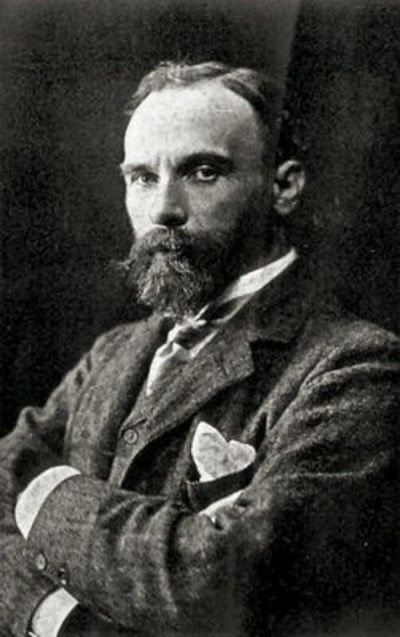
- Main image: H. S. Mendelssohn, John William Waterhouse, c. 1886, public-domain photograph via Wikimedia Commons.
- National Portrait Gallery, “John William Waterhouse (1849–1917), Figure Painter,” biography, Academy career and international record. View source
- Royal Academy of Arts / Victorian Web, “J. W. Waterhouse: The Modern Pre-Raphaelite,” retrospective account discussing training, classicism, French influence, gender and exhibition material. View source
- University of Bristol, “J. W. Waterhouse 1849–1917: The Modern Pre-Raphaelite,” catalogue, tour and prize record. View source
- Tate, “John William Waterhouse,” artist summary placing the early work within classical painting and the later work in relation to Pre-Raphaelitism. View source
- Michelle Bonollo / National Gallery of Victoria, “J. W. Waterhouse's Ulysses and the Sirens: breaking tradition and revealing fears,” contemporary reception, Herkomer testimony and French influence. View source
- Yale Center for British Art, John William Waterhouse, R.A., 1849–1917, catalogue record for the 1978–79 Sheffield and Wolverhampton exhibition. View source
- Pamela Fletcher, review of J. W. Waterhouse: The Modern Pre-Raphaelite, CAA Reviews, 2010, discussing popular reception and scholarly reappraisal. View source
- Manchester Art Gallery, “Sonia Boyce,” interpretive text for Six Acts and the temporary removal of Hylas and the Nymphs. View source
- Khan Academy, “Waterhouse, The Lady of Shalott,” comparison of Pre-Raphaelite subject and French-associated handling. View source
- National Portrait Gallery, “John William Waterhouse, by William Logsdail, circa 1887,” extended entry on reciprocal modelling and Primrose Hill Studios. View source
- Andrew Stephenson, “Waterhouse and the Occult,” Pre-Raphaelite Society Review, reproduced by Victorian Web, on occult and Symbolist contexts. View source
- Encyclopædia Britannica, “Waterhouse, John William,” 11th edition, 1911, contemporary reputation. View source
- Journal of Victorian Culture, “Between Innovation and Nostalgia: Rethinking the Paintings of J. W. Waterhouse,” review of the 2008–10 retrospective and catalogue. View source