 by Tom Gurney
Tom Gurney BSc (Hons) is an art history expert with over 20 years experience
Published on August 14, 2026 / Updated on August 14, 2026
Email: tomgurney1@gmail.com / Phone: +44 7429 011000
The Favourites of the Emperor Honorius: Introduction
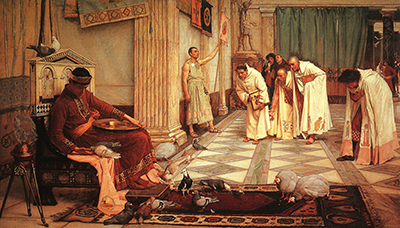
An emperor sits inside a luxurious palace, feeding birds. Across the room, councillors wait for his attention. John William Waterhouse makes no battle visible in The Favourites of the Emperor Honorius, yet the painting is about rule at a moment of crisis. Grain scattered on a carpet, a lowered gaze and a barrier of pigeons become the signs of power turned inward.
Painted around 1883, the picture helped establish Waterhouse's early reputation for subjects from the ancient Roman world. It is sumptuous, humorous and severe. Honorius appears richly enthroned but psychologically unavailable; the ministers have access to his room but not to his mind. The empire's political emergency is expressed as an interruption that never succeeds.
At a Glance
- ArtistJohn William Waterhouse (1849–1917)
- TitleThe Favourites of the Emperor Honorius
- Datec. 1883; the canvas is signed but not dated [1]
- MediumOil on canvas
- Dimensions119.3 × 205 cm
- CollectionArt Gallery of South Australia, Adelaide
- Accession number0.52
- Place madeHolland Road, London [1]
- First exhibitedRoyal Academy, London, 1883, no. 462 [2]
- AcquisitionPurchased with a South Australian Government Grant in 1883 [1]
- Collection significanceThe Art Gallery of South Australia records it as the first Waterhouse painting acquired by a public institution anywhere in the world [3]
- Historical subjectHonorius, western Roman emperor from 393 to 423, shown absorbed in pet birds while state advisers wait [4]
- Possible literary associationProcopius's later story that Honorius confused news of Rome's fall with news about a favourite bird named Roma [5]
Contents
- Introduction
- Government Postponed for the Sake of Birds
- Honorius and the Troubled Western Empire
- Procopius and the Bird Named Roma
- Honorius Enclosed Within His Favourites
- The Waiting Councillors
- Carpet, Curtain and the Division of the Room
- Pigeons as Pets, Court and Barrier
- Roman Luxury and Victorian History Painting
- From the Royal Academy to Adelaide
Government Postponed for the Sake of Birds
Waterhouse builds the scene around a mismatch of importance. Honorius is the most powerful person present, but his attention is directed towards the smallest and least politically consequential creatures in the room. The men who presumably carry news or seek a decision remain standing at a distance.
The painting does not need to show the contents of their message. Their collective posture establishes urgency, or at least expectation. They have entered the imperial presence and stopped. Honorius has neither dismissed them nor begun to listen.
Feeding birds is not inherently contemptible. It may suggest gentleness, routine or private affection. The criticism arises from context. An emperor performs a quiet leisure activity while representatives of public business wait. Care is lavished within a chosen circle and withheld from the political world beyond it.
The title sharpens the contrast. “Favourites” can refer simply to beloved pets, but at court it also means people who receive privileged access and influence. Waterhouse uses the word to expose the structure of Honorius's attention. The birds enjoy the intimacy that his human advisers cannot obtain.
No explicit catastrophe enters the room. That omission makes the image more flexible than an illustration of one historical message. The councillors might report military danger, administrative business or the ordinary demands of empire. Any of them would be subordinated to grain and pigeons.
The emperor's failure is therefore temporal. He does not visibly issue a disastrous command; he delays the moment in which command could occur. Government becomes waiting.
Waterhouse also lets comedy operate without turning the work into caricature. The birds are real enough to be engaging, the interior magnificent enough to be admired, and Honorius dignified enough to remain an emperor. Satire emerges from arrangement, not from a grotesque face.
That restraint gives the painting its sting. A foolish ruler need not look ridiculous. He can occupy a beautiful throne, wear the correct robe and still place his attention where it does the least public good.
Honorius and the Troubled Western Empire
Flavius Honorius was born in 384, the younger son of Theodosius I. He was made Augustus in 393 and ruled the western part of the Roman Empire after his father's death in 395, initially under the dominant influence of the general Stilicho. [4] [6]
Honorius was a child when imperial rank was given to him. Waterhouse does not present a ten-year-old at accession, however. The figure is a young adult ruler in a generalised court scene. The image condenses a reputation rather than documenting one dated audience.
His reign was marked by usurpations, incursions into imperial territory, conflict with Alaric and the Visigoths, and the weakening of western Roman control. The court moved to the more defensible city of Ravenna. In 410, Alaric's forces sacked Rome, an event with immense symbolic effect even though Rome was no longer the normal seat of the western emperor. [4] [6]
Modern history does not explain the whole collapse of western Roman power through one emperor's personality. Military finance, civil wars, court politics, contested loyalties, regional fragmentation and long-term structural pressures all matter. Waterhouse's painting offers a moral image of inattentive rule, not a complete political analysis.
Honorius's reign was also conducted through powerful generals, officials and competing court groups. Stilicho directed government until Honorius ordered his execution in 408; later Constantius became the major military figure and briefly co-emperor. [4] [6] The waiting men in the painting can evoke this dependence without representing identified portraits.
The historical Honorius has frequently been judged weak or ineffectual, and ancient sources helped construct that reputation. Such sources were not neutral. Court history, later imperial politics and moral storytelling shaped the image inherited by nineteenth-century readers.
Waterhouse needed that reputation more than a specific constitutional event. His Honorius is a ruler whose private absorption stands for failure to grasp the scale of public responsibility.
The painting's history is therefore double. It refers to a fifth-century emperor through stories and judgements transmitted across centuries, and it reveals how a nineteenth-century artist imagined political decline through the language of domestic attention.
Procopius and the Bird Named Roma
The most famous story about Honorius and poultry appears in Procopius's Wars, written in the sixth century, more than a century after the sack of Rome. Procopius says that a eunuch, apparently responsible for the birds, told the emperor in Ravenna that “Rome” had perished. Honorius first thought the message concerned a favourite fowl named Roma and expressed relief when he learned that only the city had fallen. [5]
The tale is perfectly shaped satire. One word names both capital and pet; the emperor's emotional priorities are exposed through misunderstanding; relief at the bird's safety replaces horror at the city's fate.
Its very perfection is reason for caution. Procopius introduces it as something “they say,” and modern scholarship treats it as anecdote rather than secure eyewitness history. A recent classical study argues that the story may transform circumstances around an earlier siege and court message, demonstrating how much interpretation still surrounds it. [7]
Waterhouse's painting is often linked to the anecdote, and the association is compelling. Honorius feeds birds while men wait with possible news. Yet the painted birds look like pigeons or doves rather than the large cockerel described by Procopius. No messenger visibly announces Rome's fall, and the title does not name Roma.
It is therefore best to call the story a possible or likely literary association, not to assert that Waterhouse illustrates Procopius line by line. The painting generalises the emperor's misplaced devotion.
That generalisation may be more effective. A literal illustration would require a messenger speaking and Honorius reacting. Waterhouse shows a habitual condition: the birds have already formed a court within the court, and the councillors already know they must wait.
The anecdote also explains why the subject can be funny and appalling at once. Concern for an animal becomes politically grotesque only because the city and its inhabitants have disappeared from the emperor's emotional scale.
Modern viewers should resist using the tale as proof that Rome “fell because Honorius loved chickens.” Waterhouse paints the ethics of attention. History remains more complicated than the emblem he creates.
Honorius Enclosed Within His Favourites
The emperor sits towards the left or centre-left, his body contained by throne, curtain, carpet and birds. Rich red or crimson clothing gives him visual prominence, but his downward gaze closes communication.
His hand distributes grain. This small repeated gesture controls the birds and rewards their nearness. It is a miniature economy of patronage: the ruler gives, the favourites gather, and access produces benefit.
The throne confirms official power even while the action empties it of urgency. Honorius does not need to stand or defend his position. Everyone else must accommodate his inattention.
His posture is neither dramatically slumped nor violently mad. Waterhouse's criticism is subtler. The emperor appears comfortable, concentrated and self-contained. He is good at the wrong task.
Youth complicates the image. The face may retain softness or detachment associated with a sheltered ruler raised inside court. The birds can look like the continuance of a childhood absorption into adult sovereignty.
The closed gaze creates a barrier stronger than architecture. Councillors are visible in the same room, yet they do not enter his field of attention. The political community has become visually peripheral to its centre.
Honorius is not entirely alone. An attendant near him may belong to the private mechanism of the court, reinforcing the difference between those who manage the emperor's chosen activity and those who bring external demands.
Waterhouse makes the ruler both dominant and diminished. He commands the largest chromatic field and most elaborate seat, but the narrative reduces him to a man feeding birds. Visible rank and moral scale move in opposite directions.
The Waiting Councillors
At the right, a group of men stands behind the zone occupied by the pigeons. Their pale robes and upright postures distinguish them from the darker, richer enclosure around the emperor.
They carry the picture's unsatisfied demand. Without their presence, Honorius would simply be engaged in private recreation. With them, every second of attention to the birds becomes a political choice.
Their bodies are compressed into a narrow area. This gives the impression of delegation: several offices or concerns have arrived together, only to encounter one shared obstacle.
Waterhouse does not provide readable documents or individual attributes sufficient to identify them as specific historical ministers. Calling one Stilicho or another a named senator would be invention. They function as councillors, petitioners or bearers of state business.
Their restraint is telling. No one strides across the birds or grabs the emperor's attention. Court hierarchy remains operative even when it prevents effective speech. The ruler's dignity protects his disengagement.
One figure may incline or look towards Honorius more urgently than the others, but the group largely waits. The image is about access to power and the etiquette that can make access useless.
The councillors' paler colouring keeps them visible without allowing them to dominate. They resemble a world outside the emperor's enclosed richness—public obligation rendered almost colourless by comparison with private pleasure.
Their silence also invites projection. Because viewers do not know the message, they tend to supply the greatest crisis associated with Honorius: invasion or the sack of Rome. Waterhouse gains historical gravity without depicting disaster itself.
Carpet, Curtain and the Division of the Room
The richly patterned carpet does more than display Waterhouse's skill with surfaces. It defines the emperor's territory. Honorius, grain and birds occupy it; councillors halt at or beyond its edge.
Patterns can flatten space, but here the carpet also measures distance. Its motifs lead the eye across a horizontal field while the scattered birds interrupt regularity. The luxurious order of court becomes a playground for imperial preference.
A heavy curtain encloses Honorius from behind. Its dark or warm mass creates a private chamber inside the wider palace. The councillors appear closer to architectural openness or a lighter wall, strengthening the division between withdrawn ruler and waiting state.
Curtain and carpet work like theatrical devices. The emperor occupies the principal stage but refuses the expected drama. The men at the side resemble actors held before an entrance that cannot begin.
The horizontal canvas gives this separation room to breathe. At 205 centimetres wide, it lets Waterhouse create two social zones within one continuous interior. [1] The gulf is not large in metres, but it is immense in authority.
Roman objects and architectural details make the setting persuasive without establishing a precisely reconstructed palace at Ravenna. Waterhouse's “Rome” is the imaginative antiquity of Victorian history painting, formed through study, museum culture and comparison with contemporary painters of classical life.
The interior has no obvious window onto the empire. This enclosure is part of the meaning. Territory, armies and cities have been reduced to whatever message the councillors cannot deliver.
Surface richness may initially seduce the viewer into enjoying the court as Honorius enjoys his pets. Only slowly does the painting reveal that beauty itself participates in the delay.
Pigeons as Pets, Court and Barrier
The birds are active across the carpet, pecking or approaching the grain. They introduce movement low in the composition while the human figures remain almost fixed.
They can be called pigeons or doves by appearance; the exact species is less important than their collective role. They are tame enough to gather around the emperor and numerous enough to separate him from his ministers.
As “favourites,” they parody a royal court. They cluster close to patronage, receive gifts and occupy privileged ground. Their natural behaviour becomes an image of political intimacy stripped of counsel.
The birds are not morally at fault. They respond to food. Satire falls upon the ruler who has made them the recipients of attention required elsewhere.
It is tempting to assign each bird a fixed symbol—peace, soul, foolishness or empire—but the painting does not need a symbolic dictionary. Their secure functions are visual and narrative: pets, recipients of grain and a living barrier.
Their low position affects scale. Honorius looks down, following their world. The councillors look across or towards him, seeking an upward recognition that never comes. Gaze establishes two incompatible directions of government.
If Procopius's poultry anecdote is remembered, the birds acquire an additional irony. They stand for the private Roma that can matter more than public Rome. Yet Waterhouse multiplies them, turning one named favourite into a whole system of absorption.
The painting's tenderness towards the birds keeps its politics complex. Private affection is not condemned in itself. The question is whether a ruler can distinguish the time for care from the time for responsibility.
Roman Luxury and Victorian History Painting
Waterhouse's early career was strongly shaped by large subjects from the ancient world. The Favourites of the Emperor Honorius allowed him to combine historical narrative, architectural setting, textiles, costume, animals and psychological contrast.
The picture is often compared with Lawrence Alma-Tadema's scenes of Roman life. The comparison is reasonable at the level of material antiquity and polished interiors, but Waterhouse's scene is less an anecdote of social custom than a political character study.
Victorian viewers could read decline in personal terms. Histories of Rome often turned late imperial complexity into lessons about weak rulers, luxury and lost civic virtue. Honorius offered a ready negative example. [6]
The painting can also speak to nineteenth-century anxieties about government at a distance. It was made in London and purchased for a young public collection in South Australia, within the global structures of the British Empire. No source cited here proves that Waterhouse intended a direct analogy between Roman and British imperial rule, so such a reading should remain a question rather than a claim.
The work's moral structure is broad enough to exceed both empires. Institutions often fail not because information is absent but because attention cannot cross hierarchy. Waterhouse makes that failure immediately visible.
His archaeological detail lends authority to an invented scene. Viewers may feel that they are seeing “what happened,” even though the arrangement is a nineteenth-century synthesis. The more convincing the room, the more important it is to distinguish historical record from artistic judgement.
No cited technical examination identifies pigments or hidden changes. The official record supports oil on canvas and notes that the signature is present but the painting itself is not dated. [1] The conventional date c. 1883 is secured by its Academy exhibition and acquisition that year.
The visible achievement lies in orchestration. Waterhouse manages many decorative elements without losing the simple opposition between downward-looking emperor and waiting men.
From the Royal Academy to Adelaide
The painting was exhibited at the Royal Academy in 1883 as no. 462. [2] Contemporary attention helped mark Waterhouse as an artist of growing promise; a review the following year referred back to the Honorius picture when judging Consulting the Oracle a technical advance. [8]
The Art Gallery of South Australia records the work as made at Holland Road, London, signed at lower left and undated. Its government-grant credit line is dated 1883. [1]
The acquisition was remarkably early. AGSA's institutional history describes it as the first Waterhouse painting to enter a public collection anywhere. [3] This gives the canvas significance beyond its subject: Adelaide recognised and collected Waterhouse before the British national collection received his work through Sir Henry Tate's 1894 gift.
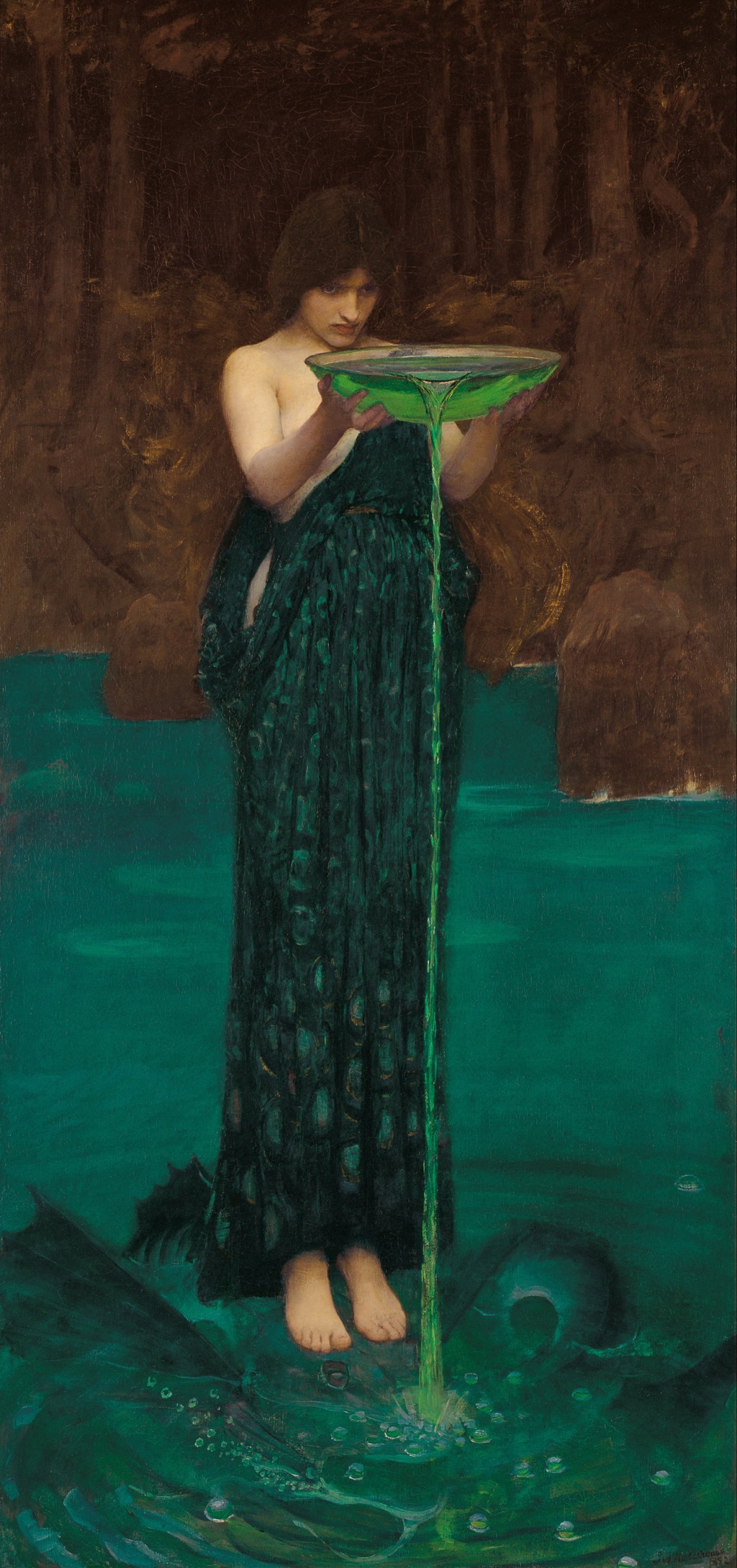
The same gallery later acquired Circe Invidiosa (1892), creating an instructive pairing. Honorius is enclosed, passive and inattentive; Circe stands active and concentrated as she pours poison into the sea. Both use saturated colour and ancient subject matter, but power is performed in opposite ways.
Public ownership in Adelaide also changes the painting's cultural geography. A work made for the London exhibition world became part of an Australian collection almost immediately, rather than travelling there only after Waterhouse's reputation was established.
The official date remains “c.1883” because the signature contains no year. [1] This precision is preferable to pretending the canvas itself supplies a date it does not. Exhibition and purchase establish that it existed by 1883.
Its condition and display history require the gallery's current records rather than assumption. The stable facts are ownership, dimensions, medium, signature and acquisition.
More than a century later, the work remains one of AGSA's most recognisable British paintings. Its wit makes entry easy; its account of inaccessible power makes return rewarding.
Attention as a Political Resource
The painting becomes especially revealing when attention is treated as something a ruler distributes. Honorius possesses only one gaze and one immediate field of action. He gives both to the birds.
Political systems are larger than individual concentration, but monarchic imagery often locates decision in the sovereign body. Councillors wait because access to that body—its ear, hand or spoken command—remains necessary. Waterhouse makes a whole state appear to stop at the edge of the carpet.
The emperor's grain resembles favour in material form. It falls selectively where he looks. The birds closest to him receive it, turning proximity into reward. This miniature economy mirrors the logic of a court in which offices, money and influence can follow personal access.
The title's plural deepens the point. Honorius does not suffer one momentary distraction. He has a community of favourites that receives the time and care withheld from government. Inattention has been organised.
The councillors' inability to interrupt shows how hierarchy can protect dysfunction. Their obedience appears proper in form and disastrous in effect. A less ceremonial room might permit someone to speak plainly.
Waterhouse does not make the ministers heroic. They may participate in the same court system, and history gives no reason to imagine every adviser around Honorius as wise or disinterested. Their painted role is to reveal that even official counsel cannot cross the emperor's private boundary.
The image also distinguishes visibility from accountability. Honorius is fully visible, centrally placed and richly marked as ruler. Nothing about the trappings of power guarantees responsiveness.
This political reading can travel beyond personal monarchy. Modern institutions also direct attention through access, routine and preferred information. The work's continuing relevance lies in the simple proposition that what power chooses to notice can matter as much as what power formally controls.
The pigeons are effective because their claim is innocent. They do not deceive the emperor or demand an empire. He has chosen a scale of responsibility on which feeding them feels complete. Waterhouse's satire asks how private virtue can coexist with public failure.
Three Early Experiments in Power
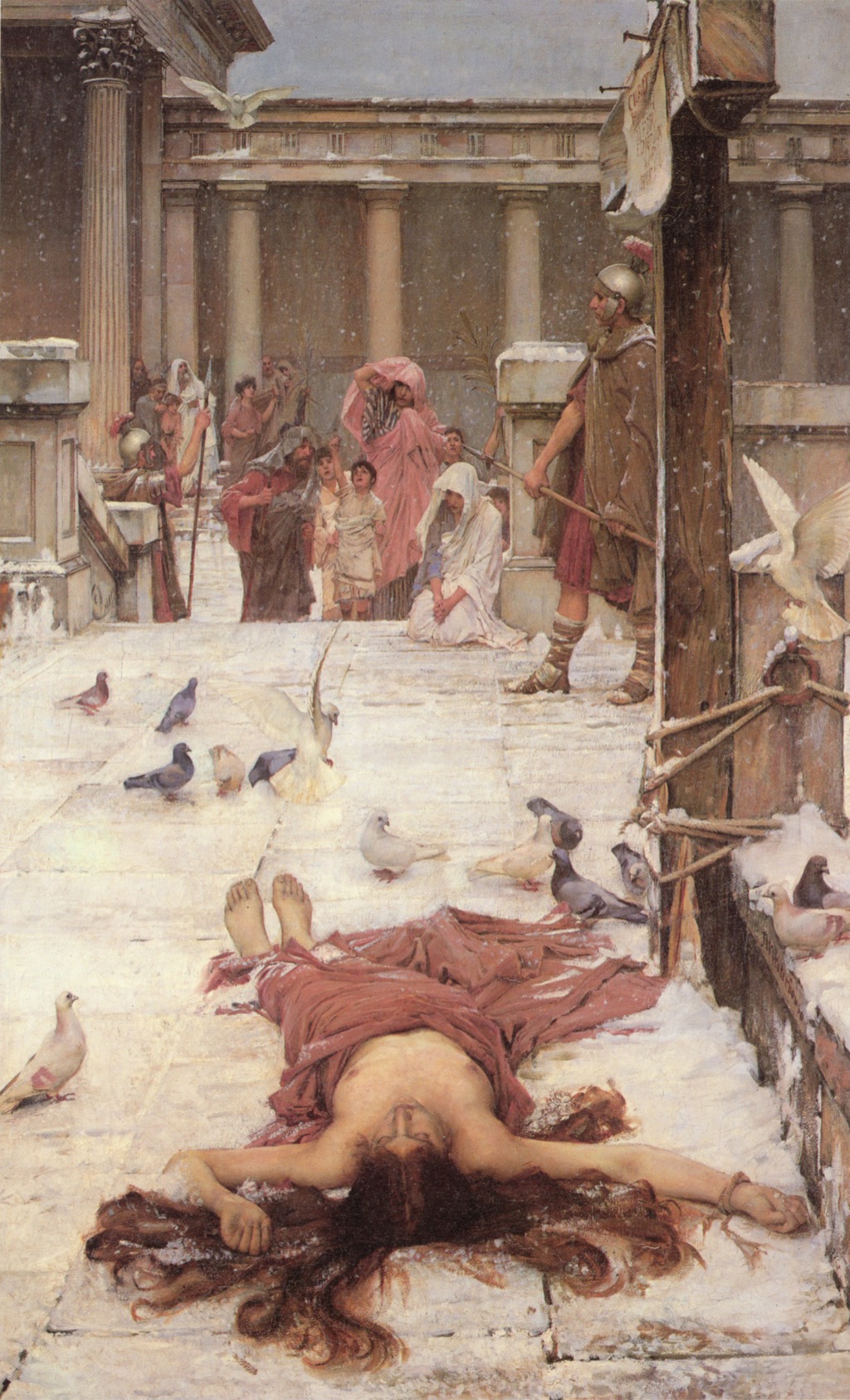
The Favourites of the Emperor Honorius, Consulting the Oracle and Saint Eulalia form a remarkable sequence from 1883 to 1885. All three use the ancient world, large canvases and carefully staged figures, but each imagines authority differently.
Honorius possesses institutional power and fails to exercise attention. In Consulting the Oracle, authority belongs to an object and a ritual that gathers attention intensely. In Saint Eulalia, Roman power has exercised lethal force, only to lose control over the martyr's meaning.
The sequence moves from enclosed court, to enclosed ritual chamber, to exposed public forum. Architecture remains important, but the relation between people and space changes. Honorius withdraws inside luxury; the women lean inward for knowledge; Eulalia lies abandoned while snow transforms the city around her.
Birds link the first and third works in very different registers. Honorius's pigeons keep his gaze down and inward. Eulalia's dove rises, carrying the soul beyond imperial reach. One group of birds marks confinement within preference; one small bird marks release.
The comparison should not be turned into a documented trilogy. Waterhouse did not exhibit the works under a shared title or leave a statement that they form one programme. Their chronological and visual proximity nevertheless clarifies his development.
Across the three pictures, he learned to reduce narrative into a decisive relation: ruler and petitioners, priestess and head, martyr and city. Later mythological works would build similar intensity around cup, mirror, boat, flower or song.
The Honorius painting remains the most overtly political of the group because its central failure concerns government. Yet it is also the most domestically comic. Waterhouse discovered that an empire could be represented by a carpet, a handful of grain and men who cannot make themselves heard.
How to Look at The Favourites of the Emperor Honorius
Start with Honorius's gaze. Follow it downward to grain and birds, then compare it with the direction of the councillors' eyes. The painting's politics is contained in those incompatible lines.
Notice where the carpet begins and ends. It functions like a border around preference. Ask whether the birds protect Honorius or imprison him.
Look at the ministers as a group rather than searching for portraits. Their inability to act is more important than individual identity.
Then enjoy the luxury of the room and consider the discomfort of that enjoyment. Waterhouse makes misgovernment visually splendid. The court's beauty helps explain how withdrawal can sustain itself.
Remember the Procopius story, but do not force every detail into it. The absence of a speaking messenger and the presence of pigeons rather than one cockerel make the painting an expansion of the anecdote, if it is an illustration at all.
Finally, imagine the sound. Wings and pecking may be the only activity in a chamber full of men waiting to speak. Political silence is filled by the ruler's private world.
Related Pages
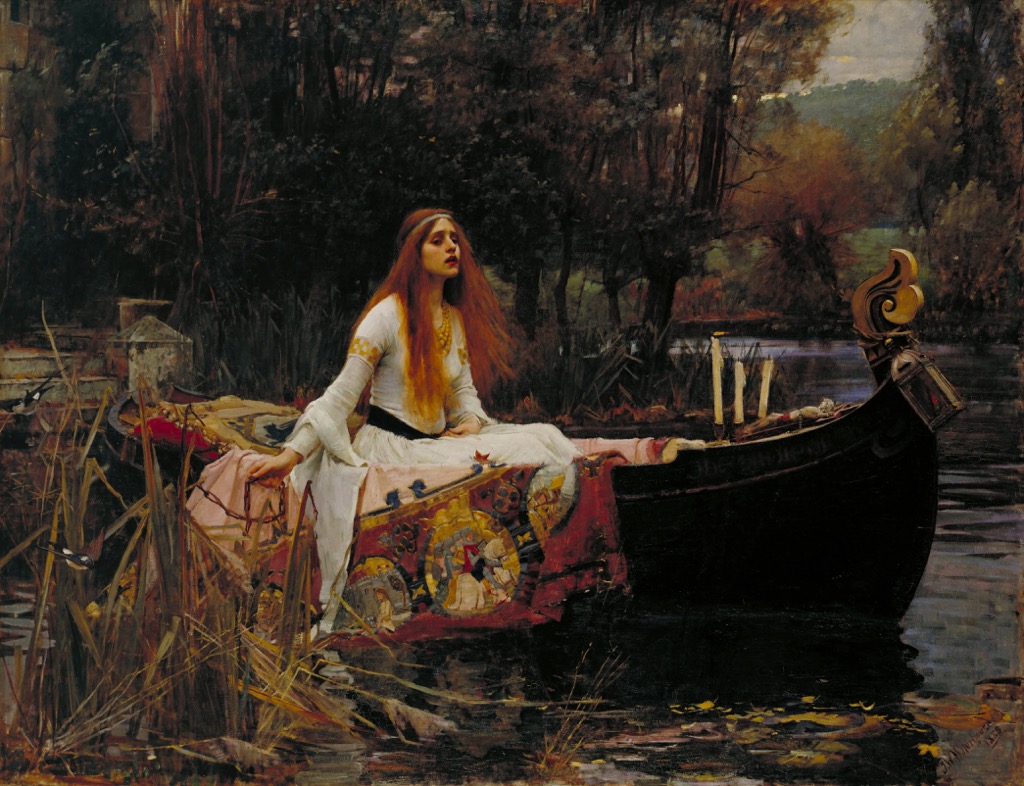
- The Lady of Shalott: Compare Waterhouse's best-known literary composition.
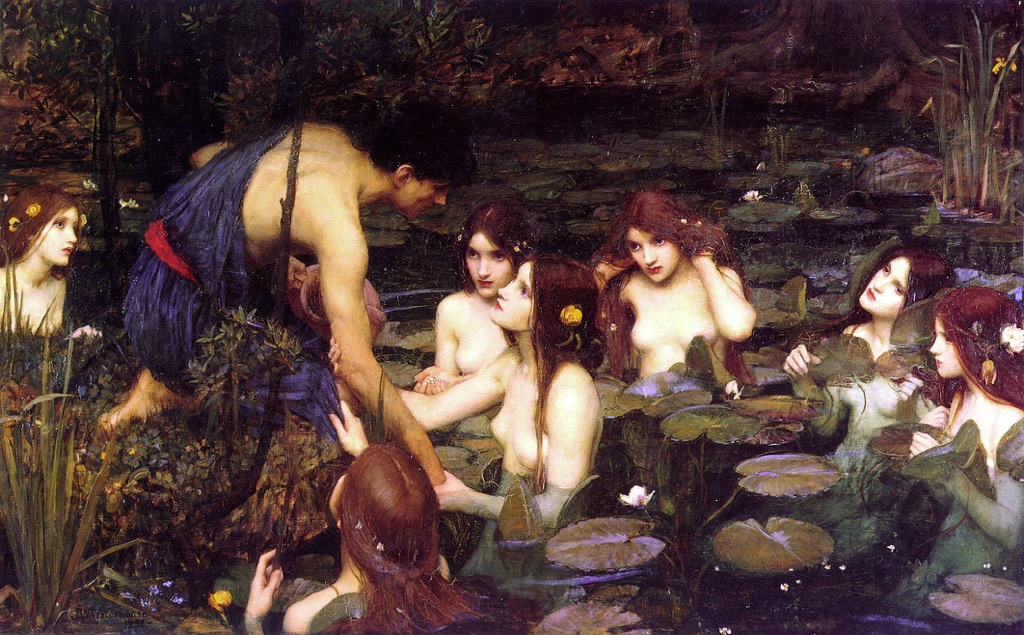
- Hylas and the Nymphs: Compare another major mythological scene.
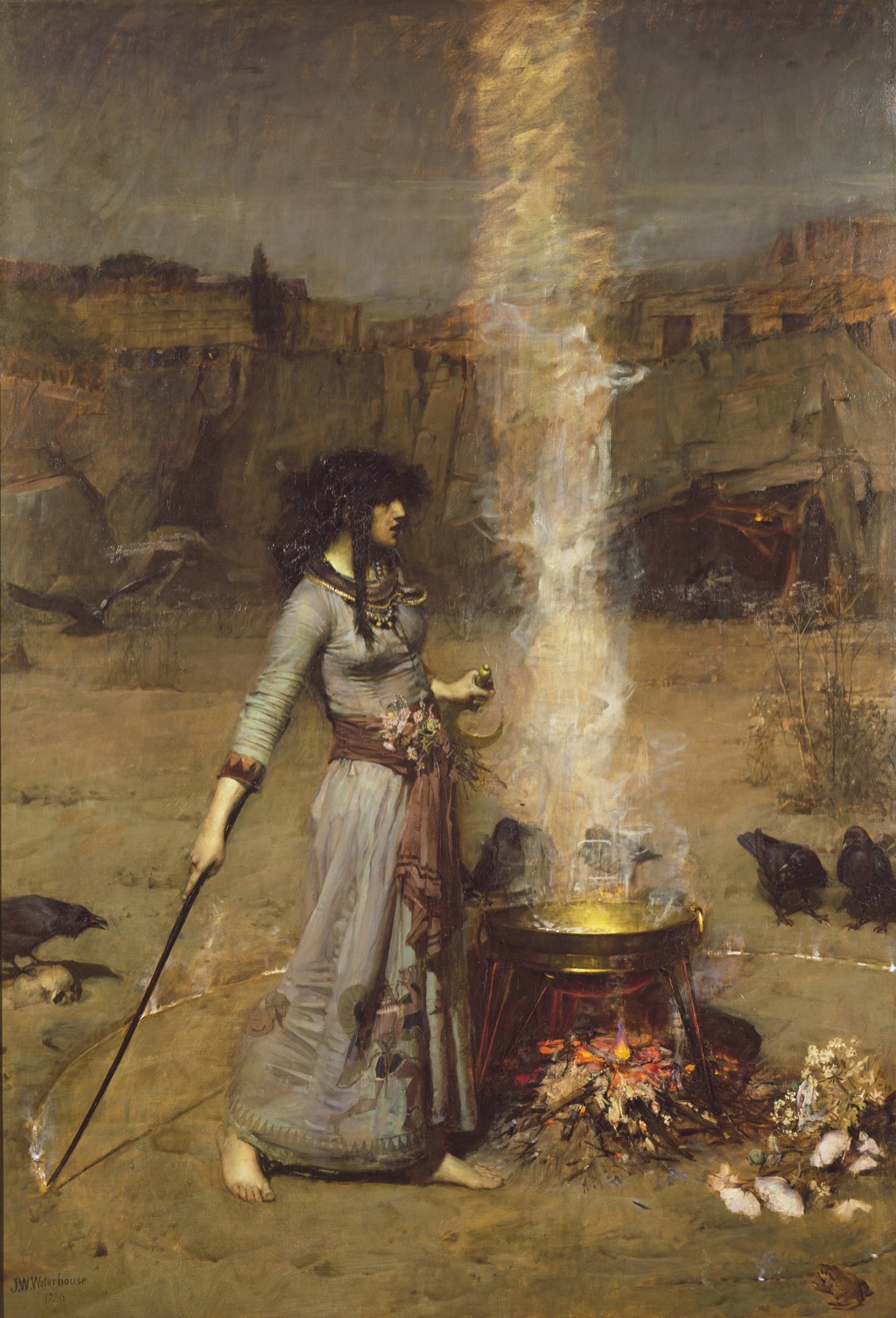
- The Magic Circle: Compare Waterhouse's treatment of ritual and symbolism.
Frequently Asked Questions
In the painting, the favourites are the tame birds gathered around Honorius for food. The title also invites comparison with court favourites—those granted privileged access to a ruler.
Waterhouse does not identify their message. Viewers often associate it with imperial crisis or the sack of Rome, but the lack of specification lets the scene represent habitual inattention.
It may allude to Procopius's later anecdote that Honorius mistook news of Rome's fall for the death of a favourite bird called Roma. The story is not secure eyewitness history, and Waterhouse's scene differs from it in important details. [5] [7]
AGSA dates it c. 1883. It was exhibited and acquired in 1883, but the painted signature itself is not dated. [1] [2]
The canvas measures 119.3 × 205 cm. [1]
It belongs to the Art Gallery of South Australia in Adelaide, accession number 0.52. [1]
AGSA states that its 1883 purchase was the first acquisition of a Waterhouse painting by a public institution anywhere in the world. [3]
Discussion
Waterhouse makes bad government look like concentration rather than chaos. Honorius is not distracted in the ordinary sense; he is deeply attentive to the birds. The problem is that his attention cannot expand to include the people and responsibilities attached to his throne.
That distinction keeps the picture contemporary. Power may fail while ceremonies, rooms and advisers remain in place. Information can reach the ruler's presence without reaching the ruler. The birds are charming, and that charm matters: private worlds become politically dangerous not because they are always ugly, but because they can be more immediately rewarding than difficult public obligation.
Reader Insights
Which visible detail most changes the way you read this page?
Which source or comparison helps the work feel less familiar and more specific?
What question would you bring back to the painting after reading?
Join the Conversation
Share your reading of this page below.
References
- Art Gallery of South Australia. “The Favourites of the Emperor Honorius,” collection record, accession 0.52. View source
- Algernon Graves. The Royal Academy of Arts: A Complete Dictionary of Contributors and Their Work from Its Foundation in 1769 to 1904, Waterhouse entry for 1883, no. 462. View source
- Art Gallery of South Australia. “Timeline,” institutional history noting the acquisition of Waterhouse's painting as a world first for a public collection. View source
- British Museum. “Honorius,” biographical authority record and historical summary. View source
- Procopius of Caesarea. Wars, Book III (Vandalic War I), 2.25–26, the anecdote of Honorius, Rome and the imperial poultry. View source
- Raymond Davis. “Honorius, Roman emperor, b. 384 CE,” Oxford Classical Dictionary. View source
- Vojtěch Hladký. “410: Honorius, his rooster, and the eunuch (Procop. Vand. 1.2.25–26),” Graeco-Latina Brunensia 25, no. 1 (2020). View source
- Henry Blackburn, ed. English Art in 1884, contemporary review of Consulting the Oracle referring back to the 1883 Honorius picture. View source