 by Tom Gurney
Tom Gurney BSc (Hons) is an art history expert with over 20 years experience
Published on August 14, 2026 / Updated on August 14, 2026
Email: tomgurney1@gmail.com / Phone: +44 7429 011000
Diogenes: Introduction
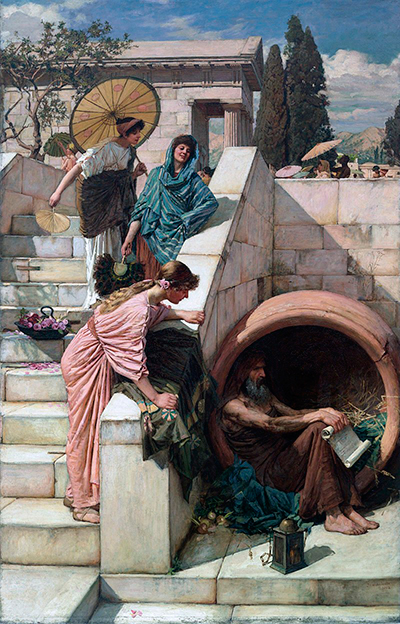
Three fashionably dressed women pause on marble steps to inspect a man who has rejected almost everything their world values. He sits in a huge earthenware jar with a scroll, a rough bed and few possessions. They occupy the architecture; he occupies the argument.
John William Waterhouse's Diogenes of 1882 turns the Cynic philosopher's radical simplicity into a monumental encounter between wealth and self-sufficiency. The painting belongs to the Art Gallery of New South Wales, which purchased it in 1886, and at more than two metres high it is among Waterhouse's imposing early classical subjects. [1]
At a Glance
- ArtistJohn William Waterhouse (1849–1917)
- TitleDiogenes [1]
- Date1882 [1]
- MediumOil on canvas [1]
- Dimensions208.3 × 134.6 cm on the stretcher; framed, 249 × 177.4 × 17 cm [1]
- SignatureSigned and dated at lower right in brown paint, “J W Waterhouse 1882” [1]
- CollectionArt Gallery of New South Wales, Sydney [1]
- AcquisitionPurchased in 1886 [1]
- Accession number720 [1]
- First exhibitedRoyal Academy, London, 1882, no. 1515 [1]
- SubjectDiogenes of Sinope, the fourth-century BCE Cynic philosopher, living in a large ceramic jar or pithos [2] [3]
- Essential correctionThe ancient dwelling and Waterhouse's vessel are not a wooden barrel
Contents
- Introduction
- The Philosopher at the Bottom of the Steps
- Diogenes between History and Anecdote
- Cynicism, Nature and Unnecessary Possessions
- The Pithos Rather than the Barrel
- Three Visitors and a Contest of Attention
- Scale, Sunlight and Classical Architecture
- Waterhouse's Early Classical Career
- Acquisition and Exhibition History
The Philosopher at the Bottom of the Steps
Waterhouse places Diogenes low in the tall canvas. A terracotta storage jar occupies the foreground, tipped so that its opening becomes a rough room. The philosopher sits within it, partly sheltered and partly exposed.
Above him, three women descend or lean from broad marble steps. Their height does not establish moral superiority. It makes the difference between social position and philosophical independence visible.
The visitors bring the apparatus of cultivated comfort. Draped clothing, jewellery, a fan and a parasol or sunshade belong to a life organised around status, climate, appearance and service. Diogenes possesses scarcely more than the covering on his body, straw, a scroll and the vessel itself.
The contrast could have become a simple caricature of wise poverty and foolish luxury. Waterhouse avoids that by making both sides attractive and alert. The women are curious rather than monstrous, and Diogenes is absorbed rather than theatrically contemptuous.
He does not perform one of his famous insults. No ruler stands before him, and no inscription supplies a punchline. His refusal is spatial: he turns away from the social group and remains within the austere environment he has chosen.
The jar's round mouth frames him like a second picture inside the first. Marble architecture offers an expansive public setting, but Diogenes makes a complete domain from one discarded or utilitarian object.
Books or written rolls complicate the theme of poverty. Diogenes rejects possessions, not thought. Yet the ancient tradition represents his philosophy above all as a way of living, performed through the body and everyday choices rather than secured in a surviving body of texts. [3] [4]
Waterhouse therefore paints a philosophical practice, not a lecture. The visitors see how Diogenes lives before they hear anything he might say.
Diogenes between History and Anecdote
Diogenes of Sinope lived in the fourth century BCE and became the exemplary figure of ancient Cynicism. Exact dates differ, but he is usually placed around 404–323 BCE. [4]
His historical biography is unusually entangled with story. Diogenes Laertius compiled sayings and episodes centuries after the philosopher's lifetime, drawing upon earlier traditions that no longer survive complete. [2]
Even the reason Diogenes left Sinope is uncertain. Accounts connect him or his father with defaced or adulterated coinage. Later interpretation turned “defacing the currency” into a metaphor for challenging the values that society treats as legal tender. [4]
The most famous episodes are compact demonstrations. Diogenes lights a lamp in daylight and says that he is looking for a human being. He throws away his cup after seeing a child drink from cupped hands. When Alexander the Great offers him a favour, he tells the king to move out of his sunlight. [2]
These stories work because a material situation and a verbal reversal expose convention. A lamp reveals moral darkness; a child makes a cup excessive; the world's conqueror becomes an obstruction to a poor man's sun.
Their perfection should also encourage caution. The anecdotes convey what later readers believed Diogenes represented, but they are not documentary transcripts. The Internet Encyclopedia of Philosophy emphasises how hard it is to separate events from the philosophical legend built around him. [4]
Waterhouse does not illustrate one securely identifiable anecdote. There is no daylight lamp in use, child drinking, Alexander or Plato. The three women are not named in the principal ancient account cited here.
Instead, the painting invents an encounter consistent with the tradition. Affluent spectators are drawn towards someone who has made their advantages irrelevant.
This freedom is typical of nineteenth-century classical painting. Ancient stories supply character, setting and recognisable attributes; the painter designs the exact social moment needed for a new visual argument.
Cynicism, Nature and Unnecessary Possessions
Modern “cynicism” usually means distrust of motives or disbelief in sincerity. Ancient Cynicism was a demanding ethical practice, and the modern everyday meaning captures only part of its abrasiveness.
The Cynics placed nature against convention. Diogenes argued through example that human beings burden an already manageable life with status, luxury, shame and artificial needs. [3]
His poverty was therefore not merely misfortune represented as virtue after the fact. In the philosophical portrait, it is training. By learning to withstand heat, cold, hunger and exposure, the Cynic tries to make happiness less dependent upon unstable external goods. [3] [4]
Diogenes Laertius summarises the opposition through a group of claims: courage can answer fortune, nature can oppose convention and reason can oppose passion. [2] The force lies in independence. If wealth, reputation and comfort do not determine the good life, rulers and crowds lose some of their power.
The child-and-cup anecdote gives the programme miniature form. Diogenes already owns little, yet a child demonstrates that even his drinking cup can be discarded. [2] [3]
Waterhouse builds his canvas around the same economy. The women possess multiple objects whose functions viewers can recognise immediately. Diogenes's great jar appears to be the one extravagant form in his zone, but it is not a luxury object: it combines shelter, seat and boundary.
His scroll raises a productive tension. Cynic tradition often values lived training over abstract theory, while Waterhouse gives the philosopher something written to hold or study. The object may signal thought, learning or simply the conventional way Victorian art identified an ancient thinker.
It should not be treated as proof of a specific Diogenian text. The IEP notes that whether Diogenes wrote works is disputed and that any such writings have been lost. [4]
The painting's contrast is thus broader than rich versus poor. The women belong to a world in which objects support presentation and social distinction. Diogenes tests whether an object is needed at all.
The Pithos Rather than the Barrel
Popular retellings say that Diogenes lived in a barrel. Ancient Greece did not possess the familiar wooden, metal-hooped barrel implied by that English word in this context.
The dwelling was described as a pithos: a very large ceramic storage vessel used for commodities such as grain, oil or wine. Modern scholarly summaries accordingly call it a wine jar, tub or pithos. [3] [4]
Waterhouse paints an enormous terracotta container, not timber staves. Its reddish-brown surface, rounded belly and thick circular opening make the material distinction clear.
The error is understandable because older English translations of Diogenes Laertius often use “tub.” Later popular imagery turned that into the more familiar barrel. But the correction matters to the painting: the earthen jar belongs visually to the ancient Mediterranean world and echoes the ceramic vessels placed elsewhere in the composition.
According to Diogenes Laertius, the philosopher took up residence in the vessel at the Metroön after someone was slow to find him a cottage. Another anecdote says that when a boy broke his tub, the Athenians punished the boy and supplied a replacement. [2]
These stories make the vessel both an emblem of renunciation and a point of social contact. Diogenes rejects conventional housing, yet the city knows where he lives, gathers around him and even replaces the object when it is destroyed.
Waterhouse captures the same ambiguity. The jar gives privacy without closing Diogenes away. Its open mouth exposes him to the steps, the women and the viewer.
The philosopher is outside respectable domestic space but not outside the city. Classical buildings, gardens and passers-by surround his experiment.
Calling the object a pithos also changes scale. This is not a man squeezed into a comic beer barrel. It is a body accommodated by a storage vessel large enough to become improvised architecture.
Three Visitors and a Contest of Attention
The women are Waterhouse's principal narrative invention. No cited ancient story records this exact trio confronting Diogenes.
Their curiosity matters more than fixed identities. One leans forward, reducing the distance between step and jar. Another looks from beneath or beside a parasol; the third carries a fan. Their varied poses turn a passing glance into sustained inspection.
The visitors may appear amused, intrigued, sceptical or condescending. The painting does not give enough evidence to secure one emotion for all three.
Nor should they automatically be called courtesans. Elaborate dress can indicate wealth and fashion without establishing occupation. Assigning a sexual identity from appearance would turn visual inference into unsupported biography.
The group's femininity creates a contrast with the male philosopher, but the work need not be reduced to an opposition between woman and wisdom. Waterhouse frequently used women as the leading spectators and actors in classical scenes. Here they allow differences of colour, fabric and movement to surround Diogenes's austere body.
The decisive relation is attention. The women look at the person who rejects public approval. Diogenes's independence becomes socially magnetic; renunciation creates a spectacle.
This produces a paradox the Cynic tradition repeatedly faces. To demonstrate indifference to reputation, Diogenes performs in marketplaces and before powerful observers. His rejection of an audience depends upon being seen.
Waterhouse makes the women agents of that visibility. They do not corrupt his solitude so much as reveal that it was never complete.
Viewers join them. We approach Diogenes through the same mixture of fascination and distance, examining the possessions of a man whose philosophy challenges the need to possess the painting's beautiful world.
Scale, Sunlight and Classical Architecture
The canvas is vertical and monumental. At 208.3 cm high, it exceeds the height of many viewers; its frame reaches almost 2.5 metres. [1]
That scale makes the steps physically persuasive. They rise behind Diogenes, lifting the women into a zone of white stone, patterned textiles and bright air.
The composition is structured by a long descent from cypress trees and architecture at the top, through the visitors, to the jar and philosopher below. Social curiosity travels downward while philosophical refusal turns inward.
Sunlight is especially appropriate to Diogenes. In the Alexander anecdote, access to the sun is the one good imperial power can only obstruct. [2] Waterhouse does not directly stage that meeting, but the warm outdoor setting lets light remain a form of wealth available without ownership.
The parasol makes the difference visible. One visitor carries an object designed to moderate the sun; Diogenes accepts exposure as part of his stripped life.
Marble and terracotta supply another contrast. The architecture represents labour, expense and civic order. The jar is humble, portable in principle and repurposed. Yet Waterhouse gives the earthen vessel enough scale and pictorial weight to compete with the entire staircase.
Books, pottery, plants and patterned surfaces enrich the setting. They should not all be decoded as individual symbols. Their collective function is to establish a cultivated classical world against which Diogenes's reduction of needs can be measured.
Perspective contributes to the same argument. The steps offer a conventional route through the city, directing respectable bodies in orderly ascent and descent. The jar interrupts that route at an angle, turning a storage object into a rival centre of habitation. Diogenes has not climbed the social staircase; he has made its base sufficient.
The scale of the terracotta form also prevents austerity from becoming visually negligible. Renunciation may reduce possessions, but Waterhouse refuses to reduce the philosopher's presence. The largest single object in the foreground belongs to the person who owns almost nothing.
The painter's imagined antiquity is not an archaeological reconstruction of a documented Athenian site. The Metroön associated with the pithos tradition is not identified through exact architecture here. [2] [4]
Waterhouse makes philosophy spatially legible. High and low, open and enclosed, marble and clay, ornament and poverty do the work that an ancient anecdote performs through dialogue.
Waterhouse's Early Classical Career
Waterhouse exhibited Diogenes at the Royal Academy in 1882 as catalogue no. 1515. [1] He was thirty-three and had shown his first accepted Academy painting, Sleep and His Half-Brother Death, eight years earlier.
The picture belongs to his early concentration on classical, Roman and late-antique subjects. Before the Tennysonian and Shakespearean paintings that later defined his reputation, Waterhouse developed ambitious figure compositions through imagined Mediterranean interiors and historical settings.
The work is sometimes grouped with Victorian “Olympian” painting: large, technically accomplished treatments of ancient life associated with artists such as Frederic Leighton, Lawrence Alma-Tadema and Edward Poynter. The label can clarify context, but it should not erase differences of paint handling, subject and tone.
Diogenes gives Waterhouse a way to stage antiquity while questioning its splendour. Marble, fabric and ornament are beautifully painted, yet the canvas's moral centre belongs to the figure who needs none of them.
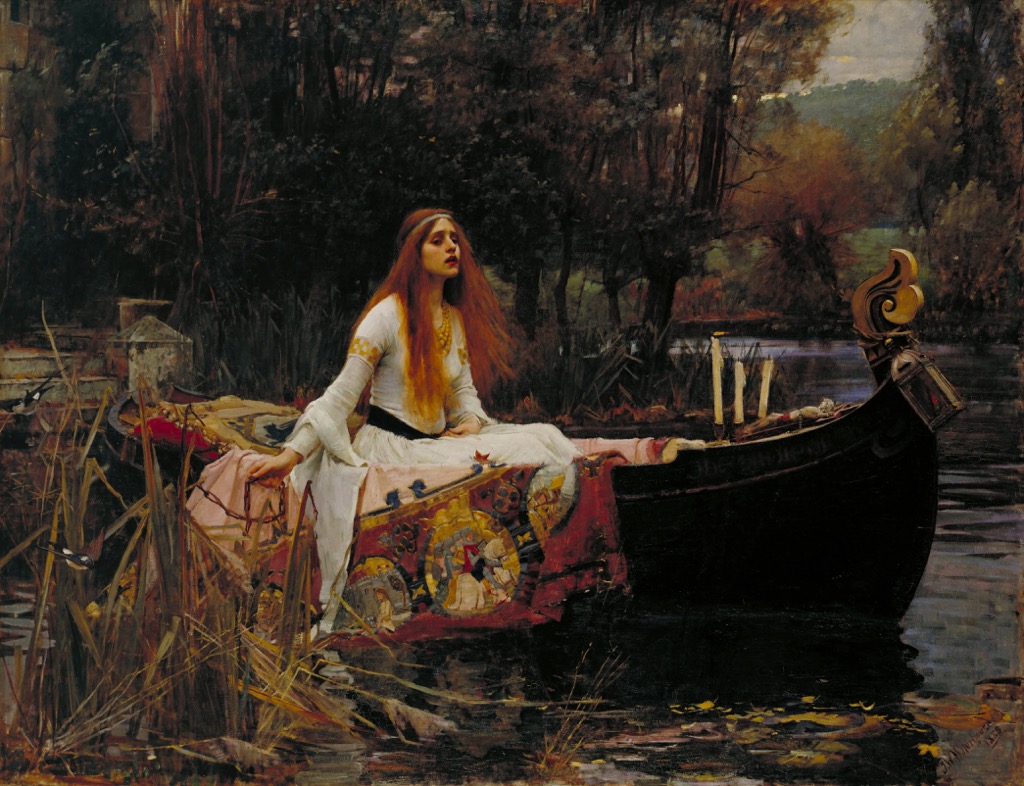
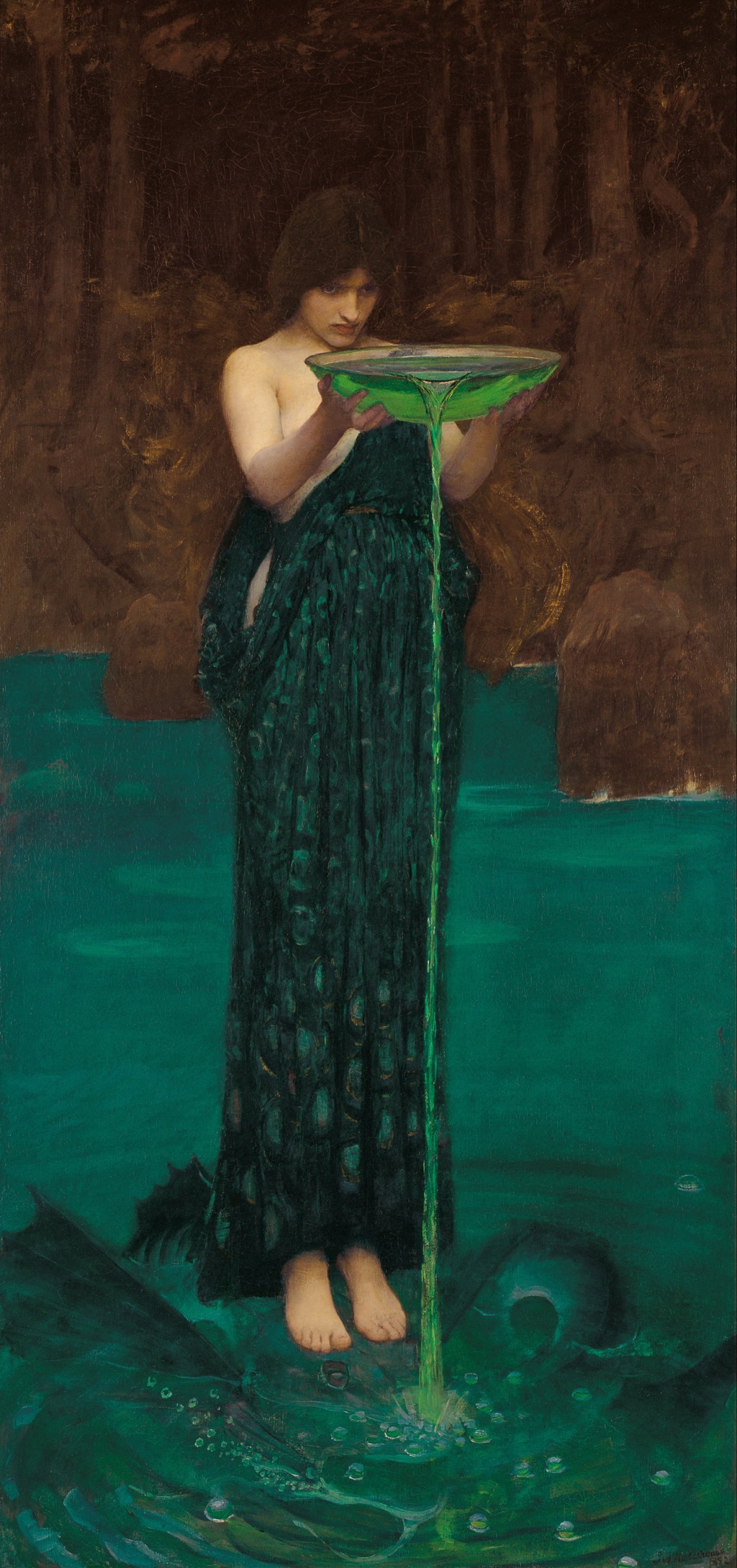
The painting also anticipates a recurring Waterhouse structure: one absorbed central figure set against observers, tempters or an encroaching group. Later women such as Penelope, the Lady of Shalott and Circe occupy very different stories, but attention and enclosure continue to organise the drama.
Here the leading solitary figure is male, elderly and deliberately unbeautiful by comparison with the visitors. That difference is useful in a career too often summarised only through idealised young women.
Diogenes shows that Waterhouse's interest in psychological boundaries and visual approach was established well before his mature Pre-Raphaelite literary subjects.
Acquisition and Exhibition History
The Art Gallery of New South Wales records R. J. Jeffray as owner before April 1886. The painting was sold through Gemmell, Tucket and Co. at Devoirgilla in Toorak, Melbourne, passed to Henry Wallis and was purchased by the gallery from Wallis in 1886. [1]
The rapid move from a London Royal Academy exhibit to an Australian public collection demonstrates the international circulation of British Victorian painting. Sydney did not receive the work as a late rediscovery; it entered the collection four years after completion.
The gallery's bibliography records contemporary Australian newspaper coverage in 1886 and early illustrated catalogues. These references show that the painting became part of the institution's public identity rather than remaining an obscure import. [1]
Later exhibitions include Victorian Olympians in Australia in 1975, Victorian Dreamers in Japan in 1989, Pre-Raphaelites and Olympians in Sydney in 2001 and the major J. W. Waterhouse: The Modern Pre-Raphaelite retrospective in Groningen and London in 2008–09. [1]
The sequence is significant. A work created before Waterhouse's decisive turn to later Pre-Raphaelite themes could still be incorporated into a retrospective framed by that modern label. It helps explain the classical training and visual ambition from which his later art developed.
The collection page currently assigns Diogenes to Naala Nura, the gallery's Grand Courts. [1] Displays can change, so visitors should confirm current location before travelling.
Its long public residence also protects a crucial aspect of the painting: scale. Digital images can make the jar look like a decorative prop. In the gallery, the philosopher, vessel and staircase confront the viewer as near-life-size architecture.
Related Pages
- The Lady of Shalott: Compare Waterhouse's best-known literary composition.
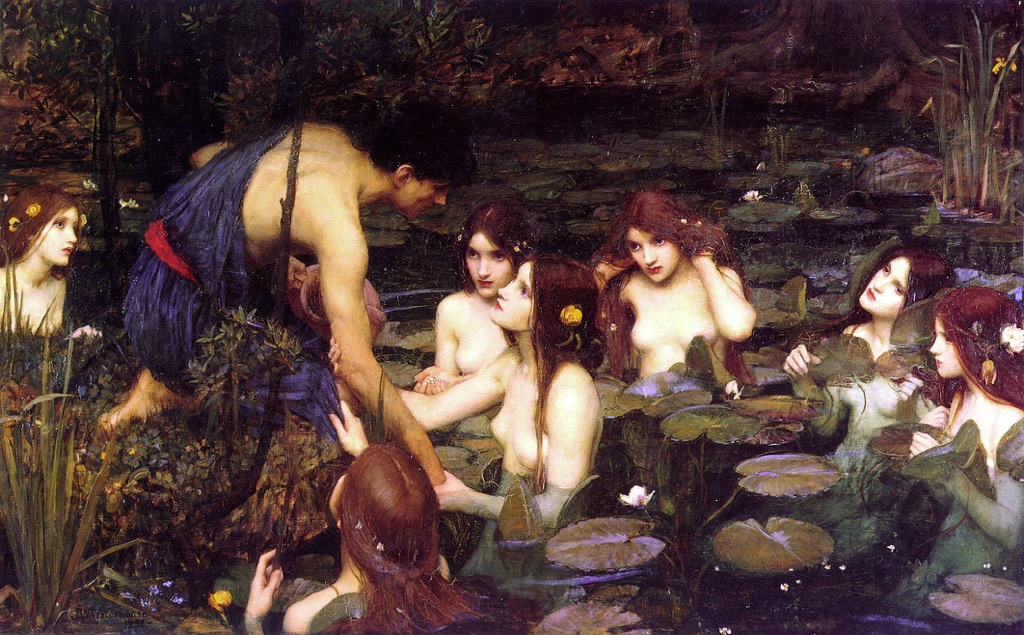
- Hylas and the Nymphs: Compare another major mythological scene.
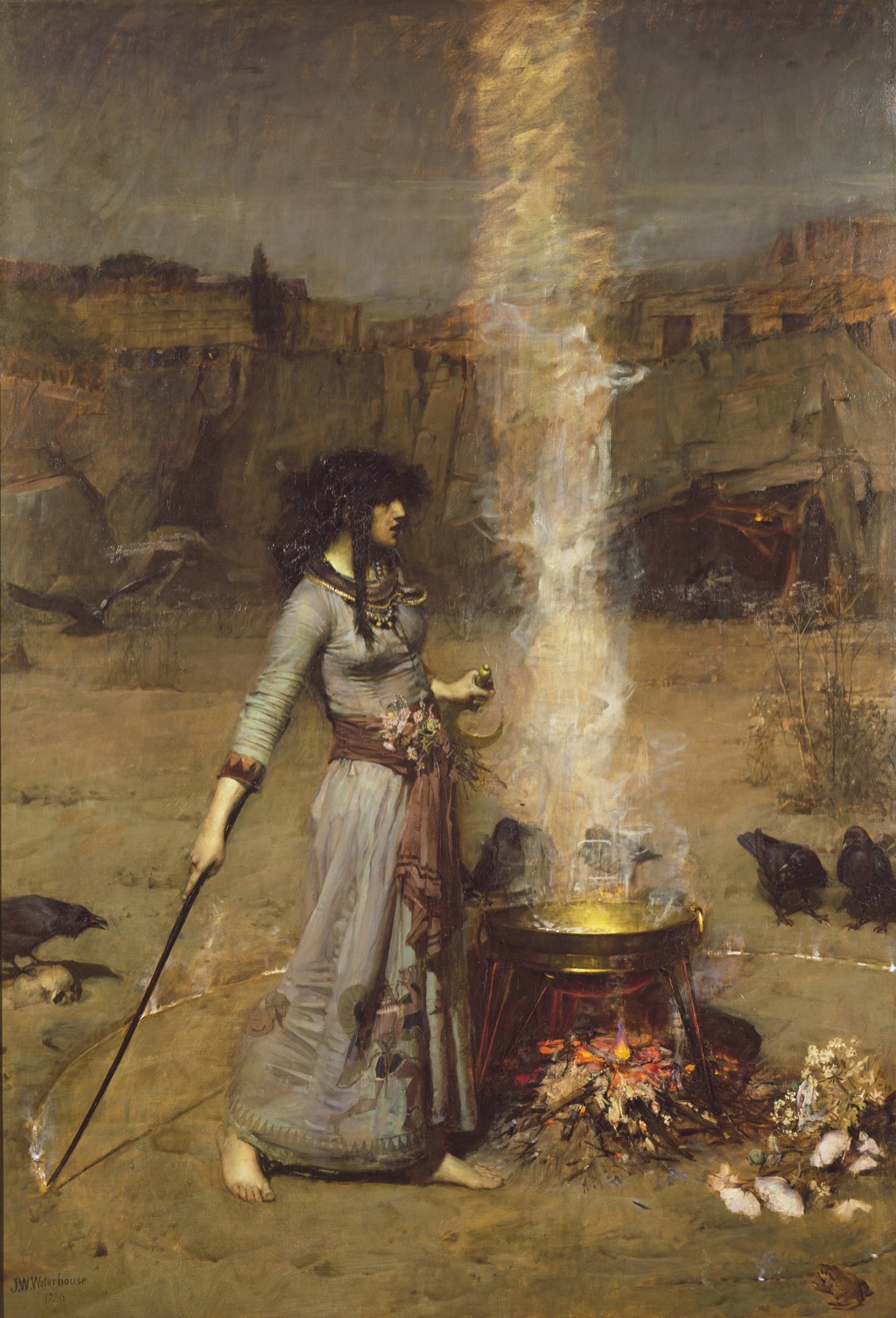
- The Magic Circle: Compare Waterhouse's treatment of ritual and symbolism.
Frequently Asked Questions
Diogenes of Sinope was a fourth-century BCE Cynic philosopher remembered for practising radical simplicity, challenging convention and teaching through memorable actions and sayings. [2] [3] [4]
Ancient and scholarly sources describe a large ceramic storage jar or pithos, sometimes translated as a tub. The familiar wooden barrel is an anachronistic popular image. [2] [3] [4]
He appears to hold or read a scroll. It identifies intellectual activity but should not be assigned to one surviving work, since any writings by Diogenes are lost and even their existence is disputed. [4]
Waterhouse does not securely identify them. They function as affluent, curious visitors and should not be given names or occupations without evidence.
No. The famous meeting in which Diogenes asks Alexander to move out of his sunlight is relevant to the philosopher's legend, but Waterhouse paints a different encounter. [2]
It helps characterise the visitors' fashionable comfort and creates a visual contrast with Diogenes's acceptance of exposure. No surviving artist statement cited here fixes a symbolic meaning.
The canvas measures 208.3 × 134.6 cm on its stretcher; the frame is 249 cm high. [1]
It belongs to the Art Gallery of New South Wales in Sydney, accession number 720. [1]
The gallery purchased it from Henry Wallis in 1886, four years after Waterhouse painted and exhibited it. [1]
Discussion
1. Does placing Diogenes below the women diminish him or give his jar greater visual weight? 2. How does the painting distinguish poverty imposed by circumstance from simplicity chosen as practice? 3. Why might a philosopher who rejects reputation attract such intense attention? 4. What changes when the dwelling is understood as a ceramic pithos rather than a wooden barrel? 5. Do the women appear amused, curious, respectful or uncertain—and what visual evidence supports the reading? 6. How does sunlight function as a good that cannot be owned? 7. Is the scroll consistent with Cynic emphasis on lived practice, or does it introduce a productive contradiction? 8. How does Waterhouse use a beautiful classical setting to present a philosophy suspicious of luxury?
Reader Insights
Which visible detail most changes the way you read this page?
Which source or comparison helps the work feel less familiar and more specific?
What question would you bring back to the painting after reading?
Join the Conversation
Share your reading of this page below.
References
- Art Gallery of New South Wales, “Diogenes, 1882 by John William Waterhouse,” collection record, accession 720, accessed 6 August 2026, View source.
- Diogenes Laertius, Lives of Eminent Philosophers, Book 6, chapter 2, translated by R. D. Hicks, Perseus Digital Library, Tufts University, accessed 6 August 2026, View source.
- Richard Parry, “Ancient Ethical Theory,” section 5, “Cynics,” Stanford Encyclopedia of Philosophy, revised 16 June 2020, accessed 6 August 2026, View source.
- Julie Piering, “Diogenes of Sinope (c. 404–323 B.C.E.),” Internet Encyclopedia of Philosophy, accessed 6 August 2026, View source.