 Buy Art Prints Now
from Amazon
* As an Amazon Associate I earn from qualifying purchases.
Image reference [image]
 by Tom Gurney
Tom Gurney BSc (Hons) is an art history expert with over 20 years experience
Published on August 14, 2026 / Updated on August 14, 2026
Email: tomgurney1@gmail.com / Phone: +44 7429 011000
A Tale from the Decameron: Introduction
Ten young Florentines have left a city devastated by plague and made a temporary society around conversation. In John William Waterhouse's A Tale from the Decameron, danger is not visible. What fills the canvas is the cultural answer Boccaccio's characters devise against it: a garden, an audience and the disciplined pleasure of taking turns to tell stories.
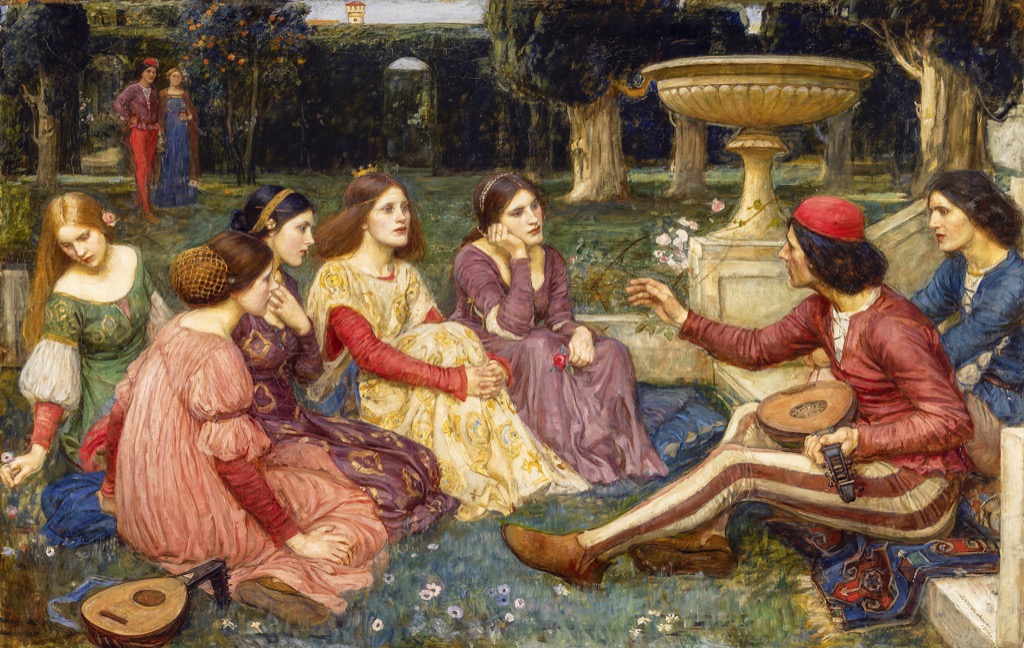
Painted in 1916, the large horizontal work depicts the frame narrative of Giovanni Boccaccio's Decameron rather than securely illustrating one of its hundred individual tales. A seated young man addresses a semicircle of women while another man listens nearby. Their concentrated exchange makes narration itself the subject. [1] [2]
At a Glance
- ArtistJohn William Waterhouse (1849–1917)
- TitleA Tale from the Decameron, also catalogued as The Decameron [1] [2]
- Date1916 [1] [2]
- MediumOil on canvas [1] [2]
- DimensionsApproximately 101 × 159 cm [1] [2]
- CollectionLady Lever Art Gallery, National Museums Liverpool [1] [2]
- Accession numberLL 3133 [2]
- ExhibitedRoyal Academy, London, 1916 [3]
- Literary sourceGiovanni Boccaccio's Decameron, especially its frame narrative [4]
- SubjectMembers of the brigata—seven women and three men who have left plague-stricken Florence—gathered for storytelling in a country garden [4]
- Essential distinctionThe painting presents the storytelling company, not a securely identifiable scene from one particular novella
Contents
- Introduction
- A Garden Made into an Audience
- The Plague and Boccaccio's Frame Narrative
- Who Speaks and Who Listens
- Music, Costume and Cultivated Nature
- Storytelling as Order and Freedom
- A Late Waterhouse Composition
- Companion to The Enchanted Garden
A Garden Made into an Audience
Waterhouse arranges the group across a wide, shallow space. At the left, a young man sits on a raised stone edge with a lute beside or across him. His torso turns towards the company and his hand opens in a gesture that can be read as speech. The instrument identifies a cultured recreation, but his active hand and the listeners' attention suggest that he is telling rather than merely performing music.
Women occupy most of the canvas. They sit or recline upon the grass in richly coloured gowns, forming an arc that both encloses the speaker and opens towards the viewer. Their bodies overlap without becoming a uniform crowd. One bends forward; another looks across the circle; a figure near the centre turns with quiet concentration. Listening acquires varied physical forms.
A second young man lies or sits at the right edge, partly separated from the principal female group. The literary frame tells us that the company consists of seven women and three men, though every member need not be individually visible or securely nameable in this particular arrangement. [4]
The semicircle is crucial. It gives the scene social coherence without the formality of a lecture hall. No table, throne or architectural barrier fixes hierarchy. Authority belongs provisionally to the person whose turn it is to speak.
The garden creates privacy, but it is not empty background. Trees, flowering plants, grass and distant architecture establish a protected world in which the company can regulate its own time. The arrangement feels leisurely because bodies rest on the ground, yet the common focus prevents leisure from dissolving into distraction.
Waterhouse does not paint the horror that prompted the retreat. No corpse, funeral procession or abandoned street intrudes. Knowledge of the Decameron supplies the absent city. That absence is ethically important: the picture shows not denial alone, but a fragile practice of mental survival conducted beyond the plague's immediate reach.
The company has made a room outdoors. Their circle provides walls; attention provides the shared roof.
The Plague and Boccaccio's Frame Narrative
Boccaccio begins the Decameron with an extended account of the pestilence that struck Florence in 1348. He describes sickness, fear, disrupted burial, abandoned obligations and the collapse of familiar social bonds. The severity of that opening prevents the later gardens from being understood as innocent timeless idylls. [4]
Seven young women meet in the church of Santa Maria Novella. Pampinea, the eldest, proposes leaving the diseased city for a country estate. Three young men join them, along with servants. The ten principal narrators are commonly called the brigata, the company. [4]
Outside Florence they organise daily life. A ruler is chosen for each day, a theme may be set, and each member tells a story in turn. Over ten storytelling days, the structure produces one hundred tales. Music, dancing, meals, rest and walks in gardens frame the narration. [4]
This arrangement matters because the stories themselves range widely. They include erotic adventures, mercantile calculation, cruel reversals, verbal tricks, anticlerical satire, fidelity and astonishing generosity. A Tale from the Decameron cannot be reduced to a visual summary of that variety. Waterhouse instead paints the mechanism that contains it.
The title's indefinite article—“A Tale”—can encourage viewers to search for a specific plot being narrated. The painting supplies no decisive attribute that identifies one novella. No tragic lover, comic trick or supernatural event materialises in the garden. The safer reading is that a tale is being spoken within the frame company.
That makes the listener as important as the speaker. Boccaccio's stories exist because the company agrees to hear one another. Sequence, rules and attention turn private invention into social experience.
The plague remains outside the painted boundary, but it explains the need for this order. The group has not found a cure. It has created a limited interval in which conversation, pleasure and judgement can continue.
A modern audience may see an image of distancing because the narrators leave an epidemic city. The comparison became especially prominent when the painting appeared on a 2020 public-health journal cover. [5] Yet the historical work should not be made into a prediction of modern terminology. Boccaccio's retreat and a contemporary infection-control policy belong to different medical and social worlds.
What endures is the recognition that people under collective threat use stories to preserve community and interpret behaviour.
Who Speaks and Who Listens
The seated man at the left is generally treated as the current storyteller. His open hand gives speech visual form. Fingers and wrist extend the narrative into the listeners' space, while the lute supplies an alternative mode of performance that may precede or follow the tale.
It is not possible to identify him securely as Panfilo, Filostrato or Dioneo from appearance alone. Boccaccio names the three men and assigns them distinct turns, but Waterhouse provides no legible inscription or exclusive attribute. The same caution applies to the women: a particular pose cannot prove Pampinea, Fiammetta, Filomena, Emilia, Lauretta, Neifile or Elissa.
The refusal to individualise by name is not a weakness. It allows Waterhouse to treat the company as a system of changing roles. The person who listens now may speak next; today's ruler will yield the crown to another. Authority circulates.
Several women look towards the man, but their attention is not mechanically identical. One seems absorbed; another rests more languidly; neighbouring figures may exchange a glance. The range protects listening from becoming passive obedience.
The speaker is not elevated high above them. His stone seat raises him only enough to clarify gesture and profile. The lute's diagonal leads from his body towards the group, bridging the gap without allowing him to dominate the whole width.
Gender balance in the source is striking: seven women organise the initial departure and outnumber the men. Boccaccio also addresses the book to women troubled by love, though the work's sexual and social politics remain complex. [4] Waterhouse's canvas gives women most of the visual field and makes their reception of the story the measure of its success.
At the same time, the painting turns the women into beautiful figures available to a gallery viewer's gaze. Their dresses, hair and varied profiles contribute to the work's appeal. The scene therefore both honours female participation in storytelling and belongs to Waterhouse's established practice of arranging idealised women as aesthetic subjects.
The listener at the right offers a useful counterweight. His more horizontal pose prevents the men's role from being reduced to performance alone. One man speaks; another receives. Gender does not map perfectly onto speech and silence.
The group is close enough for conversation but spacious enough for each figure to keep an individual silhouette. Waterhouse makes social harmony from intervals rather than from physical fusion.
Music, Costume and Cultivated Nature
The lute is the scene's clearest object of performance. Boccaccio's daily conclusions and garden episodes include songs, dances and musical recreation, so the instrument belongs naturally to the frame world. [4] It does not prove that the man is singing at this exact instant. His hand and the group's still attention support narration as the primary action.
Costume places the company in an imagined late-medieval or early Renaissance past without claiming documentary reconstruction of Florentine dress in 1348. Long gowns, patterned textiles, coloured sleeves and flowing hair make a poetic historical world. Waterhouse's purpose is atmospheric and compositional rather than archaeological.
The dresses distribute colour through the group. Reds, blues, creams and violets prevent the reclining bodies from merging with the grass. Repeated folds carry the eye from one listener to the next, almost as sentences pass from speaker to audience.
The garden is cultivated enough to indicate retreat on an estate, yet informal enough to permit sitting on the ground. This middle condition is important. The company has left the city, not civilisation. They bring forms of courtesy, governance and art into a natural setting.
Flowers and foliage are sensuous but not associated with one secure symbolic programme. They can evoke renewal, pleasure and the temporary abundance of the retreat. Their most demonstrable function is to create the “fresh meadows” and ordered gardens repeatedly described around Boccaccio's storytelling sessions. [4]
Stone architecture at the edge or distance situates the scene within a designed property. It also provides horizontal and vertical controls against the organic spread of leaves and drapery. Nature and art are not opponents here; both support the company.
The painting's surface is broader and less minutely hard than a viewer might expect from the label “Pre-Raphaelite.” Waterhouse was never a member of the original Brotherhood, founded before his career began. By 1916 he had developed a late handling in which passages cohere at viewing distance while retaining mobile brushwork up close.
The picture is still rich in material cues, but detail serves attention rather than becoming an inventory. Lute, fabrics, flowers and stone all direct the same question: how can a temporary place be made fit for stories?
Storytelling as Order and Freedom
The Decameron company escapes a city where ordinary rules have broken down, then deliberately invents new ones. Each day has leadership, timing and often a topic. The constraint produces variety rather than suppressing it. [4]
Waterhouse makes that structure visible through composition. The arc of listeners is orderly, but postures remain free. The speaker holds attention without a pulpit. The scene balances governance and pleasure.
Storytelling also creates a protected way to debate dangerous subjects. Characters inside the tales deceive spouses, outwit authorities, expose hypocrisy, cross class boundaries and suffer the volatility of fortune. Members of the company can laugh, judge or disagree at one remove.
Nothing in the painting tells us what moral conclusion the present audience reaches. Their concentration matters more than a prescribed verdict. Waterhouse captures narrative before it has hardened into lesson.
The image can look escapist because the plague is excluded. Escape is indeed part of the frame: the young people leave Florence to protect themselves and seek a more agreeable life. But the stories continually reintroduce conflict, appetite, death and contingency through speech. The garden does not seal reality out; it changes the form in which reality can be considered.
Waterhouse's choice of a storyteller addressing peers also reflects painting's own relation to narrative. The canvas cannot unfold one hundred tales in sequence. It shows the instant of transmission and asks the viewer to supply duration.
The open gesture is analogous to the picture's invitation. We stand outside the arc yet close enough to become an additional audience. Because the actual words are inaudible, our attention turns to the conditions that make hearing possible.
Silence in a painting is therefore not the absence of story. It is the medium through which Waterhouse makes us imagine voices.
A Late Waterhouse Composition
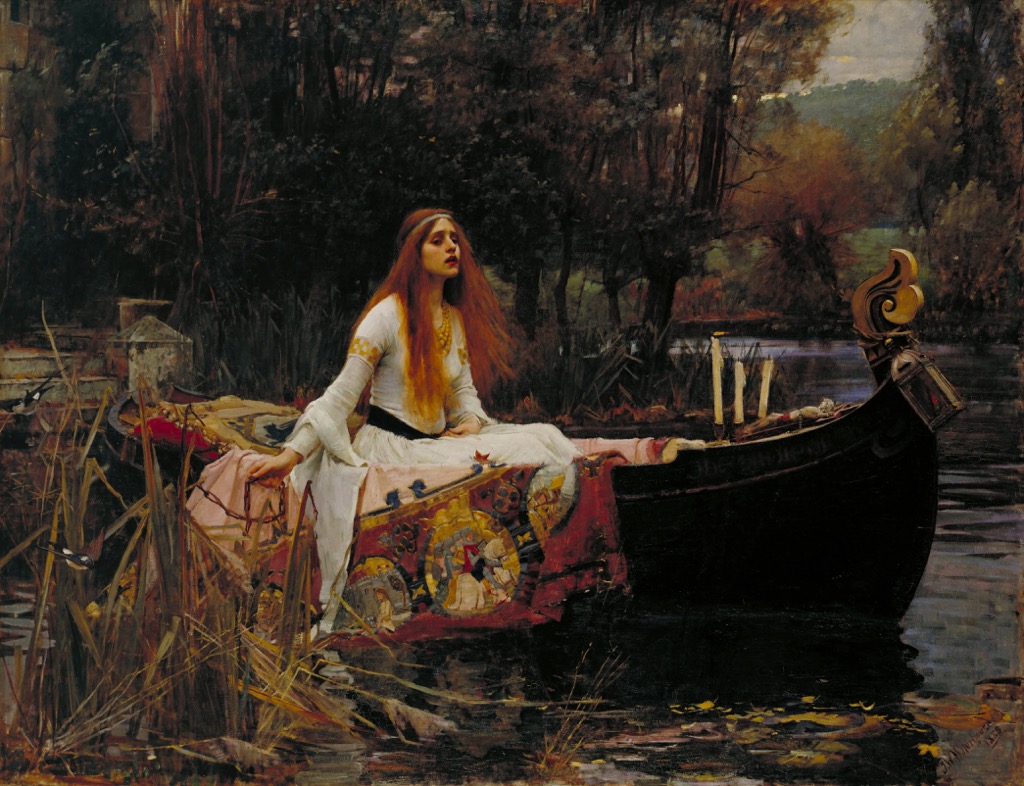
Waterhouse exhibited A Tale from the Decameron at the Royal Academy in 1916 with Miranda – The Tempest and “I Am Half-Sick of Shadows,” Said the Lady of Shalott. [3] The group demonstrates the breadth of his late literary practice.
Miranda places a single figure against storm and supposed shipwreck. The Lady of Shalott sits at a loom in an interior structured by reflections. A Tale from the Decameron opens horizontally into sociability. One exhibition could therefore contain exterior drama, enclosed psychological tension and communal narration.
The date also places the painting during the First World War. A peaceful medieval garden shown in London in 1916 inevitably met a society under wartime pressure. It may have offered contrast, consolation or apparent distance. Without a statement from Waterhouse, however, the work should not be assigned a precise anti-war or escapist programme.
Its source had long attracted British artists and readers. Boccaccio's tales fed later literature, including Chaucer and Keats, and Waterhouse had already painted Isabella and the Pot of Basil, a subject that reaches him through Keats's retelling of Boccaccio. The 1916 canvas returns directly to the Italian book's frame.
The large width lets Waterhouse move beyond the solitary heroine for which he is most famous. Women remain prominent, but emotional meaning now arises between people: the speaker's offer, the listeners' reception and the group's voluntary attention.
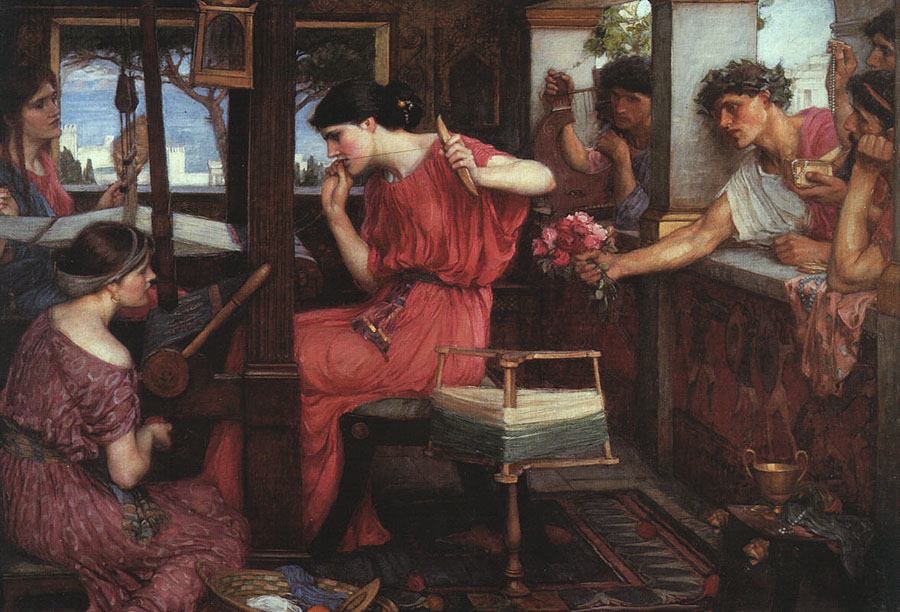
This does not abandon his interest in suspended time. It generalises it. The whole company waits within a tale whose content we cannot hear, and the painted instant becomes as charged with duration as Penelope's loom or the Lady of Shalott's mirror.
The work belongs late in his life but is not a retreat into a simpler formula. Coordinating numerous bodies, instruments, landscape and architecture across nearly 1.6 metres required a complex design.
Companion to The Enchanted Garden
Waterhouse's final major project, The Enchanted Garden, also comes from the Decameron. It illustrates Day 10, Story 5, in which Dianora asks Ansaldo for a garden flowering in January like May. He achieves the marvel through a magician, forcing a moral crisis that ends in acts of generosity. [6]
The two paintings now hang in the Lady Lever Art Gallery. Christie's explicitly notes their proximity and describes A Tale from the Decameron as another large Waterhouse of Florentines in a verdant garden. [6]
Their relationship can be expressed as frame and embedded tale. The 1916 work shows a company capable of telling one hundred stories. The unfinished 1916–17 canvas enters one of those stories and makes a spoken condition materially visible.
Gardens function differently in each. Here, cultivation supports order, conversation and refuge. In The Enchanted Garden, unnatural abundance proves that an apparently impossible promise has been fulfilled. One garden shelters narrative; the other is produced by narrative.
The emotional centres also diverge. The Decameron company shares attention and appears at ease. Dianora stands troubled amid companions who enjoy the flowers. Social harmony in the first painting becomes unequal knowledge in the second.
Together the canvases complicate the idea that Waterhouse's late work withdrew into private reverie. They are concerned with communities, agreements and the consequences of words. Even the most magical garden is structured by what people have said to one another.
The companion status does not prove that Waterhouse planned a formally commissioned pair. Their common scale, source, date and eventual collection make comparison productive, but documented “pendant” intention should not be asserted without evidence.
What can be said is that William Hesketh Lever brought them together and that public display preserves an unusually coherent view of Waterhouse's last literary direction.
Related Pages
- Paintings: Return to the protected Waterhouse paintings hub.
- Literary and Mythological Sources: Read the literary frame for Waterhouse's Decameron subjects.
- Technique and Style: Connect the Decameron garden composition with Waterhouse's mature colour, texture and figure handling.
Frequently Asked Questions
A young man appears to tell a story to a group of women and another male companion in a country garden. They represent Boccaccio's company of ten narrators who leave plague-stricken Florence. [4]
The painting does not provide enough evidence to identify one specific novella. It is best understood as a depiction of the Decameron's frame narrative and the act of storytelling.
They leave to escape the devastating plague of 1348 and establish a temporary, ordered life in the countryside. [4]
Seven women and three men tell one story each on ten storytelling days, producing the collection's one hundred tales. [4]
The lute is associated with him and with the company's musical recreations. His open hand and the listeners' concentration suggest speech at the represented moment, but a silent painting cannot prove whether narration and music are being combined.
He was not a member of the original Pre-Raphaelite Brotherhood. His later literary subjects, colour and medievalising settings led him to be associated with the broader Pre-Raphaelite tradition.
It was one of Waterhouse's three works at the Royal Academy in 1916. [3]
It was painted more than a century earlier. A public-health journal used it in 2020 because Boccaccio's narrators respond to plague by withdrawing to the countryside, but the historical circumstances and medical knowledge are different. [5]
Discussion
1. How does Waterhouse turn listening into an active subject? 2. What is gained by leaving plague-stricken Florence outside the picture? 3. Does the garden represent escape, resilience or a mixture of both? 4. How does the semicircle distribute authority between speaker and audience? 5. Why might Waterhouse have chosen the frame narrative instead of one dramatic tale? 6. How do music, dress and cultivated nature create a temporary social order? 7. Compare this garden with The Enchanted Garden. How do words shape each space? 8. What risks arise when a medieval plague retreat is read directly through modern pandemic experience?
Reader Insights
Which visible detail most changes the way you read this page?
Which source or comparison helps the work feel less familiar and more specific?
What question would you bring back to the painting after reading?
Join the Conversation
Share your reading of this page below.
References
- Main image: John William Waterhouse, A Tale from the Decameron, 1916, public-domain faithful reproduction via Wikimedia Commons.
- National Museums Liverpool, “The Decameron,” Lady Lever Art Gallery collection record, View source.
- Wikimedia Commons, “John William Waterhouse: A Tale from the Decameron,” object metadata citing National Museums Liverpool, including dimensions, collection and accession LL 3133, View source.
- Sotheby's, “John William Waterhouse, Miranda—The Tempest,” catalogue note recording Waterhouse's three Royal Academy exhibits of 1916, View source.
- Giovanni Boccaccio, The Decameron, translated by John Payne, Project Gutenberg, including the introduction, the brigata and the garden storytelling sessions, View source.
- Terence Chorba, “About the Cover: Social Distancing and Artful Pandemic Survival,” Emerging Infectious Diseases, vol. 26, no. 11, November 2020, Centers for Disease Control and Prevention, View source.
- Christie's, “John William Waterhouse, R.A., Head Study for ‘The Enchanted Garden’, 1916,” catalogue essay prepared with assistance from Peter Trippi, View source.