 Buy Art Prints Now
from Amazon
* As an Amazon Associate I earn from qualifying purchases.
Image reference [image]
 by Tom Gurney
Tom Gurney BSc (Hons) is an art history expert with over 20 years experience
Published on August 14, 2026 / Updated on August 14, 2026
Email: tomgurney1@gmail.com / Phone: +44 7429 011000
Ophelia: Introduction
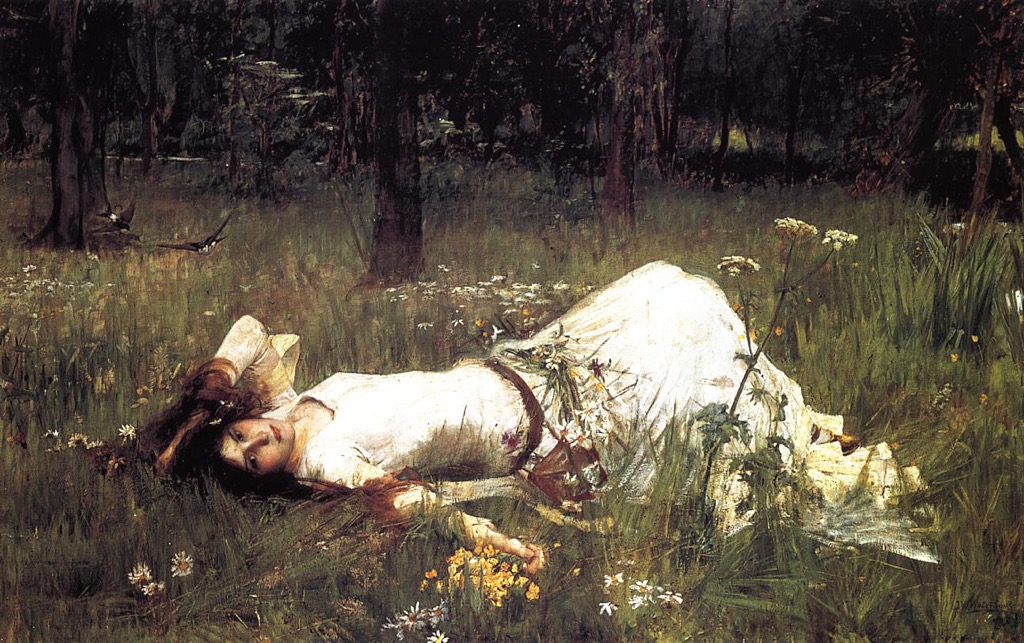
Ophelia lies almost flat among meadow flowers while a stream winds through the willow trunks behind her. Daisies crown her loosened hair; buttercups and other wild plants gather in her dress. The water that will define her death is present, but she has not yet entered it.
John William Waterhouse's 1889 Ophelia is the earliest of his three completed major treatments of Shakespeare's heroine. Its wide, ground-level composition differs sharply from the seated riverbank figure of 1894 and the upright, distressed Ophelia of 1910. Exhibited at the Royal Academy, it asks viewers to encounter madness before drowning rather than beauty already afloat. [1] [2]
At a Glance
- ArtistJohn William Waterhouse (1849–1917)
- TitleOphelia
- Date1889 [2] [3]
- MediumOil on canvas [3]
- DimensionsApproximately 98 × 158 cm, also recorded as 38.5 × 62 inches [3] [4]
- FormatHorizontal
- First exhibitedRoyal Academy, London, 1889 [2] [5]
- Current collectionRecorded in modern Waterhouse literature as the Andrew Lloyd Webber Collection; public access is not assured [3]
- Literary sourceWilliam Shakespeare, Hamlet, especially Act 4, scenes 5 and 7 [1]
- SubjectOphelia lying among gathered flowers in a meadow beside the brook in which she will later drown [2] [4]
- SequenceFirst of Waterhouse's three completed major Ophelia paintings, followed by versions in 1894 and 1910 [2]
- Essential correctionThis was a Royal Academy exhibit of 1889, not Waterhouse's Royal Academy Diploma Work; the Diploma Work he eventually deposited was A Mermaid [5]
Contents
- Introduction
- A Figure Lying Close to the Earth
- Ophelia's Path through Hamlet
- Flowers before the Drowning
- Stream, Willows and Swallows
- Naturalism and the Problem of “Realism”
- Three Ophelias and Three Bodily Positions
- Exhibition, Reception and Object History
A Figure Lying Close to the Earth
Waterhouse spreads Ophelia's body across a low meadow rather than raising her into a portrait pose. The horizontal canvas makes her nearly parallel to the earth and to the stream behind. [3] [4]
Her pale dress forms an irregular band among green grass and scattered flowers. The figure is visible, but nature does not open into a clear stage around her. Plants touch clothing and hair; the meadow begins to absorb the human outline before the river does.
Ophelia is not peacefully asleep. Her face, partly shadowed by rich brown hair, turns with an expression difficult to stabilise. Open or unsettled eyes interrupt any purely decorative reading of the reclining body.
One hand holds buttercups, according to the contemporary Academy Notes description preserved in a later research guide. Further flowers collect in the folds of her dress, and daisies form a coronet in her hair. [4]
The pose can suggest exhaustion after gathering, withdrawal from the court or a body already rehearsing death. Waterhouse refuses the upright social position appropriate to Polonius's daughter. Ophelia has moved outside and down.
No other figure approaches her. Hamlet, Gertrude, Claudius, Laertes and the court remain absent, though their actions have produced the crisis.
This isolation shifts attention from plot exchange to embodied aftermath. Ophelia has received commands from father and brother, rejection from Hamlet and the shock of Polonius's killing. The painting shows what those pressures look like after language has fragmented.
The stream remains secondary at first glance. Its relative distance is important: Ophelia is endangered by more than proximity to water. The psychological and narrative conditions of her death already occupy the meadow.
Ophelia's Path through Hamlet
Ophelia is the daughter of Polonius, sister of Laertes and a young woman courted by Hamlet. Her position in Elsinore is defined by relationships that repeatedly instruct her how to understand her own experience. [1]
Laertes warns her against trusting Hamlet's love. Polonius orders her to refuse private contact and later uses her in the plan to observe Hamlet. Hamlet's words to her move between remembered intimacy, rejection, misogyny and performance. [1]
After Hamlet kills Polonius behind the arras, Ophelia reappears in Act 4 speaking and singing in broken sequences. Her songs touch death, burial, abandoned love and sexual betrayal. She distributes flowers and herbs while the court tries to interpret her. [1]
The flowers do not reduce her speech to nonsense. They let Ophelia communicate through a language of objects when direct political speech is unavailable or unsafe.
Waterhouse's 1889 painting belongs around this final phase but does not reproduce the indoor distribution scene. He moves Ophelia from court to the river meadow and combines gathered flowers with the approach to drowning.
Gertrude later describes the death to Laertes. A willow grows beside the brook; Ophelia climbs or reaches to hang “fantastic garlands” on a bough; it breaks, dropping her and the flowers into the water. [1]
For a time, her clothes spread and keep her afloat while she sings. Then the saturated garments pull her down. Shakespeare does not stage the event before the audience. We receive it through Gertrude's shaped, image-rich report. [1]
Waterhouse similarly stands between event and report. He does not claim documentary access to a fictional death. He selects a possible interval from the elements Shakespeare supplies: meadow, garlands, willow, stream and a woman whose relation to danger the observers have failed to understand.
The painting should not be described as Ophelia dying of a broken heart. Hamlet's rejection matters, but so do paternal control, surveillance, bereavement, political violence and the collapse of her place within the court.
Flowers before the Drowning
Flowers connect Ophelia's two final appearances. In Act 4, scene 5, she names rosemary, pansies, fennel, columbines, rue, daisies and violets. Gertrude's later description adds crowflowers, nettles, daisies and long purples to the garlands made beside the brook. [1]
Waterhouse does not paint a botanical inventory of every named plant. The contemporary description of the 1889 picture identifies buttercups in one hand, daisies in the hair and wildflowers gathered in the dress. [4]
Buttercups are not a conspicuous item in Shakespeare's spoken list. Their presence demonstrates that Waterhouse constructs a convincing English meadow rather than treating the play as a closed set of iconographic instructions.
The daisy has a firmer textual basis, appearing in both the distribution scene and Gertrude's account. [1] Yet assigning one fixed Victorian flower-dictionary meaning to every bloom would flatten the play's instability.
Ophelia's herbs and flowers can direct remembrance, thought, flattery, repentance, faithlessness or innocence depending upon plant, addressee and interpretation. Some violets have withered after Polonius's death; rue can be shared and worn differently. [1]
Waterhouse moves this mobile language into the landscape. Flowers no longer pass from hand to courtier. They surround and touch the person who gathered them.
The coronet of daisies resembles a fragile form of rank. Ophelia receives no crown at court; the meadow supplies one that will not protect her.
Her dress functions like a basket, holding the accumulated plants. This anticipates Gertrude's description of flowers entering the water beside her, but it does not prove that Waterhouse depicts the exact second before the branch breaks.
Flowers are therefore evidence of activity as well as symbols. Ophelia has walked, chosen, pulled, carried and arranged. Even within breakdown, she is not merely an inert beautiful victim.
Stream, Willows and Swallows
The stream winds through the background between willow trunks. Its placement lets the viewer see the fatal site without making Ophelia gaze directly into it. [4]
Willow belongs to Gertrude's account and to a longer visual language of forsaken love. In this painting it is also physical structure: narrow trunks interrupt the view and filter distance.
The Academy Notes description mentions swallows flying low over the water. [4] Small and easily lost in reproduction, they add weather, season and movement to an otherwise suspended scene.
Low-flying birds can suggest moisture in the air, but the painting should not be turned into a forecast. Their principal visible function is to animate the band of space above the stream and confirm that ordinary natural life continues.
The contrast is painful. Birds cross the scene, water flows and plants grow while Ophelia lies unable to return to courtly order.
Unlike Millais's famous 1851–52 Ophelia, Waterhouse does not put the heroine into the river. He paints the meadow before immersion and denies viewers the extraordinary visual contradiction of a singing face afloat in dark water. [2]
The stream is nevertheless narrative gravity. Once noticed, it changes the flowers from pastoral abundance into preparations for the garlands described by Gertrude.
Waterhouse's low viewpoint helps the vegetation occupy much of the horizontal field. There is little sky and no distant prospect offering escape. Ophelia's world has narrowed to grass, willow, water and air just above the surface.
The landscape does not attack her. Its indifference is more disturbing. The environment provides materials for beauty and the mechanism of death without revealing intention.
Naturalism and the Problem of “Realism”
Modern scholarship associates the 1889 Ophelia with the naturalist painting Waterhouse was exploring around this date and with the influence of French artists such as Jules Bastien-Lepage. [6]
The connection appears in the low horizon, close observation of ordinary vegetation, muted outdoor light and a figure whose pose avoids formal historical-painting grandeur.
Calling the picture realistic requires qualification. Ophelia is fictional, and the composition fuses moments from a play into an imagined meadow. Realism here concerns visual treatment and bodily immediacy, not documentary subject matter.
Contemporary debate recognised that tension. A modern review of the 2008–10 Waterhouse retrospective notes critical attention to the painting's realism and records that it failed to sell in 1889. [6]
The failure to find a buyer should not be converted automatically into rejection by every critic. Market result, exhibition notice and later reputation are different forms of reception.
The prostrate body may have unsettled viewers because it resists easy prettiness. Ophelia is close enough to the ground to look socially disordered, physically depleted and psychologically inaccessible.
That inaccessibility separates sympathy from possession. Viewers can recognise distress without receiving a composed face that explains it. Hair, grass and flowers interrupt the visual clarity through which feminine sorrow was often made attractive.
The painting's naturalism is therefore emotional as well as environmental. Ophelia does not occupy the meadow like a model arranged on an outdoor couch. Her body seems to have reached the ground through fatigue or collapse, even though the precise preceding action is invented.
Waterhouse still composes carefully. Pale dress prevents the figure from vanishing, the stream supplies a distant narrative axis and repeated small flowers carry the eye across the field. Apparent disorder is structured rather than accidental.
The balance lets the work remain legible at exhibition distance while preserving discomfort when the face, hands and crushed vegetation are examined closely.
Beauty remains present, but it no longer guarantees emotional composure.
Waterhouse's later 1894 treatment restores a more recognisable elegiac beauty: Ophelia sits on a branch above water, arranging flowers in her hair. Christie's describes the 1889 canvas as painfully realistic by contrast. [2]
That comparison captures a change in tone without establishing a single linear development. The earlier work's broad horizontal meadow and the later painting's vertical decorative enclosure pursue different problems.
The 1889 painting is consequently important to Waterhouse's career beyond its subject. It stands near a point of reinvention between his large classical histories and the literary, late Pre-Raphaelite works for which he became best known. [6]
Three Ophelias and Three Bodily Positions
Waterhouse completed major Ophelia paintings in 1889, 1894 and 1910. [2]
The 1889 figure lies in a meadow with the brook behind. The horizontal body suggests collapse, exposure and proximity to earth. [3] [4]
The 1894 Ophelia sits on a slanting willow bough over the water, placing flowers in her hair. Her pale embroidered dress, jewellery and lilies create an elegiac, richly coloured image of the interval immediately before the fall. [2]
The 1910 figure stands or steadies herself against an old willow beside the stream, clutching flowers while two distant women cross a bridge. Her upright body appears more dramatically distressed and more directly confronted by the viewer. [2] [3]
The sequence is not a storyboard of three consecutive seconds. Each painting reimagines Ophelia, uses a different model or pose and selects a separate relation among body, flowers and water.
Nevertheless, bodily orientation offers a powerful comparison: lying, sitting, standing. Waterhouse does not move steadily towards death through those positions. He tests how vulnerability appears when a woman is absorbed by landscape, balanced above water or arrested in approach.
The 1889 format is the widest. Its meadow distributes attention laterally and makes Ophelia one extended form among plants.
The 1894 and 1910 canvases are vertical. Both bring the figure closer to portraiture, but the earlier creates poetic suspension while the later intensifies encounter.
Keeping dates attached to description is essential. Online images and measurements are often mislabelled, especially between the two vertical compositions. The 119 × 71 cm measurement belongs to the 1894 version; the retrospective literature gives 101.5 × 63.5 cm for 1910. [2] [3]
Exhibition, Reception and Object History
Waterhouse exhibited the first Ophelia at the Royal Academy in 1889. [2] [4] He had been elected an Associate of the Royal Academy in 1885 but would not become a full Academician until 1895. [5]
The painting was therefore not his Academy Diploma Work. After election as a full RA, he temporarily offered the 1894 Ophelia while completing A Mermaid, which became the finished Diploma Work in 1901. [2] [5]
This correction matters because several popular pages conflate Academy exhibition with graduation. British Academicians did deposit Diploma Works, but exhibiting at the Summer Exhibition was not the same process.
Christie's wrote in an earlier catalogue that the 1889 canvas was lost and known through an old photograph. [2] Later Waterhouse literature records it in the collection of Lord Andrew Lloyd Webber with dimensions of about 98 × 158 cm. [3]
The apparent change is not necessarily contradiction: works can re-emerge after a catalogue is written. It does mean that current location statements should be dated and attributed rather than presented as timeless fact.
The Andrew Lloyd Webber Collection is private. Collection association does not guarantee display, loan or public access.
The old photographic record remains important because it shaped scholarship during the period when the painting's whereabouts were uncertain. It also means reproductions may vary greatly in quality and colour.
Object information is less centralised than for a museum painting with an official online record. Dimensions should therefore be presented as approximate and provenance should not be invented to fill gaps.
What is secure is substantial: a horizontal oil of about 98 × 158 cm, exhibited at the Royal Academy in 1889, showing Ophelia lying with flowers beside the distant brook. [2] [3] [4]
A close-looking sequence can begin with the face rather than the flowers. Ophelia's hair partly obscures it, denying the clean access expected from portraiture. The viewer must look through disorder before interpreting expression.
Next follow the line of the body across the field. Pale dress, gathered plants and bent limbs do not create one smooth reclining silhouette. The figure repeatedly disappears into and re-emerges from vegetation.
Only then move to the stream. Its distance demonstrates how narrative knowledge reorganises vision: a narrow background feature becomes the place towards which every flower and willow points.
Finally locate the swallows and other small signs of moving life. Their scale tests reproduction quality and reminds viewers that the painting's emotional stillness is not shared by the landscape. [4]
This order prevents the work from becoming an illustrated flower list. Body, earth, water and air form successive zones, and Ophelia's crisis belongs to the relation among them.
It also clarifies why the wide format matters. A vertical crop might give Ophelia greater portrait prominence, but it would weaken the slow lateral movement from her prostrate body through meadow to brook. Waterhouse makes fatal approach spatial before it is sequential.
Related Pages
- Paintings: Return to the protected Waterhouse paintings hub.
- Literary and Mythological Sources: Place Ophelia beside Waterhouse's literary subjects and Shakespearean source material.
- Exhibitions and International Reception: Follow the exhibition and reception frame around Waterhouse's major works.
Frequently Asked Questions
Ophelia lies among wildflowers in a meadow. Daisies crown her hair, buttercups are in her hand and the stream in which she will drown is visible through willow trunks behind. [4]
No. The painting shows her on land before the drowning. Her unsettled face and flowers connect the scene to her madness and final journey to the brook.
No. Shakespeare presents Ophelia's flower distribution at court and has Gertrude later narrate the drowning. Waterhouse invents an outdoor interval from those elements. [1]
The contemporary description identifies buttercups, daisies and gathered wildflowers. The play names a wider range of flowers and herbs, but not every one must be present in the canvas. [1] [4]
The 1889 Ophelia lies in a meadow. The 1894 Ophelia sits on a willow bough above the water and arranges flowers in her hair. [2]
The 1910 Ophelia is upright beside a willow, clutching garlands, with two women visible on a distant bridge. [2]
No. It was a Royal Academy Summer Exhibition picture. A Mermaid became his completed Diploma Work after his election as a full Academician. [5]
Modern Waterhouse literature records it in the Andrew Lloyd Webber Collection, but it is privately owned and not assured public display. [3]
Discussion
1. How does lying close to the earth change Ophelia's relation to the landscape? 2. Does the distant stream dominate the scene once the viewer knows the story? 3. What do flowers allow Ophelia to communicate that courtly speech does not? 4. How does Waterhouse combine naturalistic treatment with a fictional, condensed moment? 5. Why might the 1889 image have seemed more difficult to purchase than the later versions? 6. Compare lying, sitting and standing across Waterhouse's three Ophelias. Which position conveys the greatest distress? 7. How should Gertrude's poetic report affect interpretations of an event no character sees on stage? 8. What is lost when the painting is known chiefly through old photographs and reproductions?
Reader Insights
Which visible detail most changes the way you read this page?
Which source or comparison helps the work feel less familiar and more specific?
What question would you bring back to the painting after reading?
Join the Conversation
Share your reading of this page below.
References
- Main image: John William Waterhouse, Ophelia, 1889, Collection of Andrew Lloyd Webber, public-domain faithful reproduction via Wikimedia Commons.
- William Shakespeare, Hamlet, especially Act 4, scenes 5 and 7, Folger Shakespeare Library, accessed 6 August 2026, View source.
- Christie's, “John William Waterhouse, R.A., Ophelia,” catalogue record and essay for the 1894 version, comparing the 1889 and 1910 paintings, View source.
- Akiko Kawasaki, “J. W. Waterhouse's Ophelia,” Bulletin of Tokyo Kasei University Museum (2016), p. 51, dimensions and collection data drawn from Peter Trippi and the 2008–10 retrospective catalogue, View source.
- “Ophelia (1889, 1894, 1910) by John William Waterhouse,” William Shakespeare's Hamlet: A Research Guide, reproducing the 1889 Academy Notes description, accessed 6 August 2026, View source.
- National Portrait Gallery, London, “John William Waterhouse: Biography,” Royal Academy training and election chronology, accessed 6 August 2026, View source.
- Elizabeth C. Mansfield, review of J. W. Waterhouse: The Modern Pre-Raphaelite, CAA Reviews, 22 September 2009, View source.