 Buy Art Prints Now
from Amazon
* As an Amazon Associate I earn from qualifying purchases.
Image reference [image]
 by Tom Gurney
Tom Gurney BSc (Hons) is an art history expert with over 20 years experience
Published on August 14, 2026 / Updated on August 14, 2026
Email: tomgurney1@gmail.com / Phone: +44 7429 011000
The Lady of Shalott Looking at Lancelot: Introduction
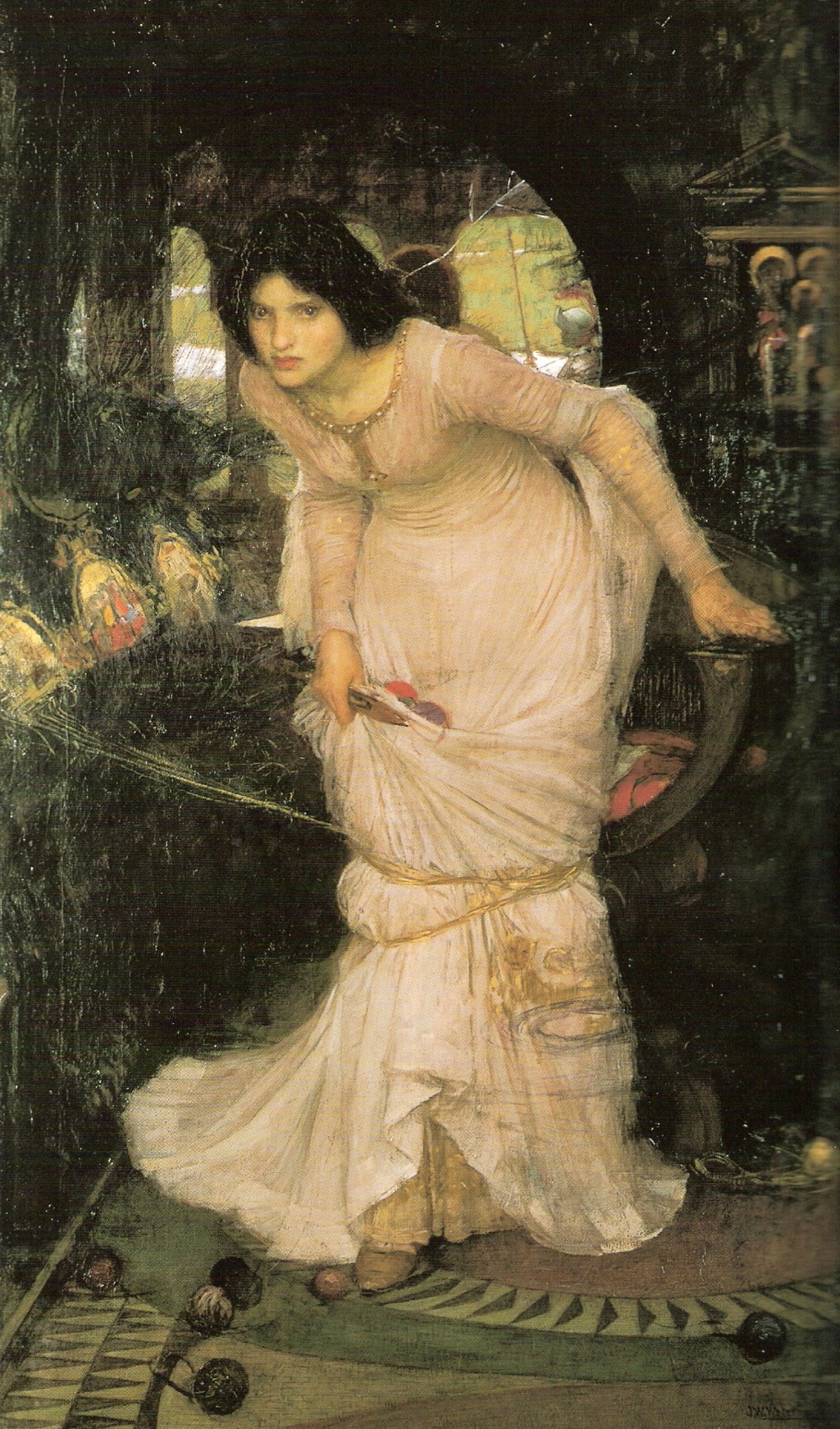
The Lady of Shalott has turned from reflection to direct sight. Threads fly loose from the loom and wind around her body; the mirror behind begins to fail; the sunlit world beyond the window has become more compelling than the work that kept her safe.
John William Waterhouse's 1894 Lady of Shalott isolates the instant at which Tennyson's heroine looks directly at Sir Lancelot and activates the curse. Now in Leeds Art Gallery, it is the central work in Waterhouse's three major Shalott paintings: later in the story than the loom scene painted in 1915, but earlier than the fatal river journey painted in 1888. [1] [2]
At a Glance
- ArtistJohn William Waterhouse (1849–1917)
- TitleThe Lady of Shalott, widely known as The Lady of Shalott Looking at Lancelot [1]
- Date1894 [1]
- MediumOil on canvas [1]
- Dimensions142.2 × 86.3 cm [1]
- CollectionLeeds Art Gallery, Leeds Museums and Galleries [1]
- AcquisitionPurchased in 1895 [3]
- Accession numberLEEAG.PA.1895.0004 [3]
- Literary sourceAlfred Tennyson, “The Lady of Shalott,” Part III [2]
- SubjectThe Lady abandons the mirror's reflection and looks through the window at Lancelot, whereupon the mirror cracks and the curse begins [2]
- SequenceThe middle narrative moment among Waterhouse's three major treatments: 1915 loom scene, 1894 forbidden look, 1888 river journey
- Essential warningThe painting does not show the first time the Lady sees Lancelot in the mirror; it shows her turning to look at him directly [2]
Contents
- Introduction
- The Instant the Rule Is Broken
- What Tennyson's Poem Actually Says
- Lancelot in Reflection and Direct Sight
- Loom, Threads and a Body Caught by Its Work
- Mirror, Window and Competing Kinds of Image
- The Three Waterhouse Shalott Paintings in Order
- Preparatory Evidence and the Leeds Acquisition
The Instant the Rule Is Broken
Waterhouse chooses an action that a still image is unusually well equipped to hold: a turn not yet completed.
The Lady's body remains close to the loom, but head, shoulders and attention move towards the window. Threads stretch and loosen around her. The chamber that organised her previous life is visibly coming apart before she has left it.
Nothing violent enters from outside. Lancelot rides past, sunlight fills the opening and the world continues. Catastrophe arises because the Lady changes how she looks.
The distinction is crucial. She has been permitted to see shadows in a mirror. Direct vision crosses the unknown condition of the curse. Waterhouse makes a movement of the eyes and body carry the weight normally assigned to a weapon or supernatural apparition.
Her expression can be read as desire, astonishment, fear or recognition. It should not be fixed too quickly. At the selected instant she may not yet understand every consequence, though the disturbed loom and cracking mirror tell the viewer that consequence has already begun.
The threads provide movement. They travel across the lower half of the canvas, link loom to dress and make the curse appear to seize the very labour through which she has endured confinement.
The Lady is neither quietly seated nor fully escaping. Her unstable pose belongs between obedience and departure. That interval prevents the picture from becoming a simple illustration of punishment: the forbidden act is also a first assertion of direct experience.
Her movement also reverses the normal direction of looking at a portrait. Rather than presenting herself to be seen, she turns away from the viewer towards something we can know only indirectly. The painting makes her attention more important than our access to her face.
Waterhouse places viewers in a privileged position. We can see the room, the Lady, the loom, the mirror and the world she wants. She must choose between partial views.
The painting's drama therefore depends less on Lancelot's identity than on the end of mediation. A reflected life is no longer enough.
What Tennyson's Poem Actually Says
Tennyson's Lady lives on an island in the river flowing towards Camelot. No one sees her directly; reapers hear her singing and call her a fairy. [2]
An unexplained curse forbids her to look down towards Camelot. She does not know what the curse will do. She sits at a loom and weaves a “magic web” from the scenes that pass in a mirror before her. [2]
The mirror provides a moving world of indirect experience: villagers, market girls, funerals, young lovers, knights and other travellers appear as shadows. The Lady turns these appearances into textile.
Part II ends with her complaint that she is half sick of shadows. The line does not follow Lancelot's arrival; it follows the reflected passage of two young lovers. Waterhouse's 1915 painting takes its title from that earlier stage. [2]
Lancelot appears in Part III. His armour and bridle shine, bells ring and his song carries beside the river. He flashes into the mirror “like to some branch of stars.” [2]
The Lady leaves the web and loom, crosses the room and looks down towards Camelot. Tennyson then gives the consequences in rapid sequence: the web flies out and floats, the mirror cracks from side to side and the Lady declares that the curse has come. [2]
Waterhouse condenses those lines into one vertical composition. The loom remains present; threads have begun to fly; mirror and window compete; the Lady's turn joins cause to effect.
The poem does not explain why Lancelot, rather than an earlier sight, makes her break the rule. His brightness, sound and embodied movement intensify the attraction, but the Lady's prior dissatisfaction has prepared the act.
The direct look is therefore not a random failure of self-control. It is the point at which long isolation and a particular appearance meet.
Lancelot in Reflection and Direct Sight
Lancelot first enters the Lady's experience as a reflected image. The mirror remains active at the very moment she rejects its authority. [2]
Waterhouse must show two relations to one absent or distant man. The mirror communicates the mediated sight on which the Lady's life has depended; the window offers physical direction towards the rider himself.
Lancelot is not the principal body in the painting. He is reduced by distance, framing or reflection while the Lady occupies nearly the full height of the canvas. His narrative effect exceeds his pictorial size.
This imbalance protects the painting from becoming a portrait of a famous knight. The subject is the Lady's decision, not Lancelot's self-conscious seduction.
Tennyson's Lancelot does not know that she watches or that his passing has activated a curse. He sings as he rides. The catastrophe is asymmetrical: one person supplies the sight that transforms another person's life without recognising the encounter. [2]
Waterhouse preserves that asymmetry. No exchanged gaze establishes mutual romance. The Lady looks outward; Lancelot remains part of the moving world.
The title commonly used today—Looking at Lancelot—can imply a stable act of contemplation. The canvas is more unstable. She is looking and being pulled away from the apparatus that made looking safe.
The threads may suggest that the image of Lancelot enters the web even as weaving becomes impossible. Art and life do not simply exchange places. They tangle.
The knight's splendour is real within the poem, but it is also optical and acoustic display: gem, shield, plume, bridle bells and song. The Lady leaves a world of shadows in response to one of its brightest appearances.
Waterhouse therefore allows a troubling question. Does direct sight give her reality, or does it expose her to another magnificent image?
Loom, Threads and a Body Caught by Its Work
The loom is the Lady's instrument, occupation and restraint. It gives form to the passing world while fixing her inside the tower.
Waterhouse does not present it as neutral furniture. Uprights divide space, worked textile occupies the foreground and loose threads cross the Lady's dress and legs.
Those threads visualise Tennyson's statement that the web flies out and floats. A poem can narrate sudden release; a painting must choose the shape of release. Waterhouse makes it look like both escape and entanglement.
The Lady has produced the web through sustained skill. When it moves against her, creation becomes consequence. The work no longer remains obedient to the worker.
Threads around the body can be read as the curse taking material form, but no surviving artist statement cited here assigns that exact symbolism. They are first a pictorial translation of Tennyson's flying web. [2]
Their visual effect nevertheless exceeds literal illustration. Fine lines make invisible forces legible: attraction towards Lancelot, recoil from the loom and the remaining bonds of the tower.
The vertical format gives the Lady's body room to rise. Unlike Waterhouse's wide 1888 boat scene, the 1894 canvas compresses tower, loom and window around one standing or half-risen figure. [1]
Clothing contributes to the conflict. Pale fabric catches the shifting threads and connects the heroine's body to the textile environment. Her hair and drapery appear less controlled than the carefully woven surface.
There is no clean path from loom to window. She must move through the structure of her former life. Freedom begins as disorder.
The scene can also be understood as an image of artistic crisis. The Lady has known the world through representation and converted representation into art. When she insists on direct experience, the system that sustains her work breaks.
That reading need not turn the Lady into a simple allegory of the artist. Tennyson's narrative remains primary, but the web, mirror and act of seeing make questions of art impossible to exclude.
Mirror, Window and Competing Kinds of Image
The mirror is not merely a magical surveillance device. It determines the form of the Lady's knowledge.
Everything it shows is displaced. People pass outside, light reaches them directly and events continue beyond the tower; she receives flattened moving appearances inside the room.
The window promises directness but also narrows sight. It frames a fragment of the external world, and the Lady cannot yet know what life beyond the image will demand.
Waterhouse sets these devices against one another. Mirror and opening offer separate versions of Lancelot while the loom turns the reflected version into a third image.
The room is therefore an image-making circuit: world to mirror, mirror to eye, eye and hand to tapestry. The forbidden glance breaks that circuit at its first mediation.
When the mirror cracks, it does more than announce supernatural punishment. The whole system by which the Lady has inhabited the world becomes unusable.
The crack is often treated as instantaneous proof of doom. It also confirms that her former life cannot be resumed. Even if she turned back immediately, the mirror and web have changed.
Waterhouse gives the mirror physical presence rather than leaving the curse entirely invisible. A hard reflective surface fails while flexible threads escape. Rigidity breaks; softness tangles.
The painting itself introduces another mediation. Viewers never encounter the Lady or Lancelot directly; we see Waterhouse's image of Tennyson's verbal images. The work can criticise the insufficiency of shadows while depending upon representation for its existence.
That paradox keeps the subject alive beyond its plot. Art cannot give the direct life the Lady seeks, but it can make the desire for that life visible.
The Three Waterhouse Shalott Paintings in Order
Waterhouse's three major Shalott canvases were not painted in narrative order.
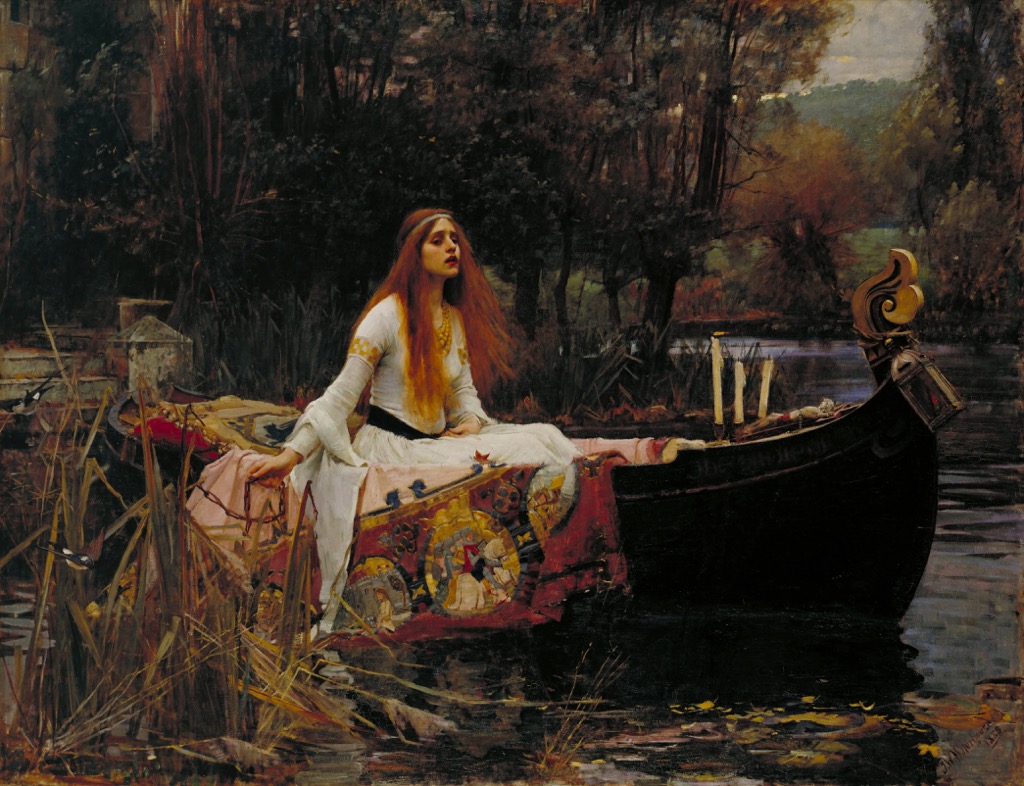
The 1888 Lady of Shalott in Tate shows Part IV. The Lady has left the tower, inscribed her name on a boat and begun the river journey towards Camelot that ends in death. [2] [4]
The Leeds painting followed in 1894 but returns to Part III. It shows the decisive look, flying web and cracking mirror. [1] [2]
The 1915 “I Am Half-Sick of Shadows,” Said the Lady of Shalott in the Art Gallery of Ontario moves back again to Part II. The Lady sits at the loom before Lancelot appears, already dissatisfied with reflected existence. [2] [5]
Read by painted date, the sequence moves backwards towards motivation: consequence in 1888, transgression in 1894 and prior discontent in 1915.
Read by Tennyson's narrative, the order is 1915, 1894, 1888. The Lady first weaves and tires of shadows, then looks at Lancelot, then travels towards Camelot.
This distinction prevents a common mistake. The 1915 line is not the Lady's reaction to seeing Lancelot. It occurs earlier, after two reflected lovers pass. [2]
Each canvas also uses a different spatial form. The 1915 room is sustained enclosure; the 1894 room is breaking apart; the 1888 landscape opens around a boat whose route is fatal.
The heroine's relation to textile changes accordingly. In 1915 she makes the web; in 1894 it flies and binds; in 1888 finished tapestry spills across the boat, carrying the tower's imagery into the external world.
Waterhouse did not paint a literal illustrated series designed for one installation. The works have separate dates, collections and exhibition histories. Yet together they form an exceptional meditation on one poem across nearly three decades.
The Leeds canvas is the hinge because it joins cause to consequence. Without it, dissatisfaction and death remain separated; with it, a bodily turn connects them.
Looking across the trio also changes the meaning of enclosure. In 1915, the room can still support a life, however diminished; furniture, mirror and loom form a working order. In 1894, those same categories become unstable as reflection breaks and textile escapes. In 1888, the tower is absent, but the boat and tapestry carry its signs into the landscape.
The Lady's gaze changes with the spaces. The loom scene directs attention through the mirror, the Leeds scene pulls it violently towards the window and the boat scene turns it along the river towards a destination outside the frame. Waterhouse repeatedly makes looking into a form of travel before the body can follow.
This is why the paintings remain separate rather than interchangeable illustrations. Each gives a different material answer to the poem's central problem: how a person confined to images tries to enter the world those images promise.
Preparatory Evidence and the Leeds Acquisition
A preparatory oil sketch for the 1894 composition survived outside public view for much of the twentieth century. A later account describes its recognition from an old photograph and its connection to the finished Leeds picture. [6]
The sketch matters because it confirms Waterhouse's process of testing the figure and crisis before finalising the large canvas. It should not be confused with the finished painting or treated as a second full version.
Preparatory evidence can show changes of pose and arrangement, but it cannot by itself provide a private statement of symbolism. The finished work remains the authority for what Waterhouse finally presented.
Leeds acquired the painting in 1895, the year after its completion, and records it under accession LEEAG.PA.1895.0004. [3] Its early purchase placed an important late Pre-Raphaelite literary picture in a civic collection rather than leaving it dependent on later rediscovery.
The canvas measures 142.2 × 86.3 cm, large enough for the Lady to approach human scale while the narrow format intensifies the tower's vertical enclosure. [1]
Leeds Museums and Galleries identifies the work among the notable Victorian and Pre-Raphaelite romantic pictures in its holdings. [7] That institutional description is useful context, though Waterhouse was not a member of the original Pre-Raphaelite Brotherhood.
His 1894 painting belongs to the movement's later legacy: literary subject, brilliant surface, medievalising setting, emotional pressure and symbolic objects, combined with Waterhouse's Royal Academy training and looser handling.
Public ownership also enables comparison with the 1888 Tate and 1915 Toronto paintings through reliable collection records. The three canvases do not need to be physically reunited for their distinct moments and dimensions to remain clear.
The Leeds work deserves to be identified by moment as well as title. “The Lady of Shalott” alone can refer to several Waterhouse images; “Looking at Lancelot” names the crisis this one alone sustains.
Related Pages
- The Lady of Shalott: Compare the forbidden look with Waterhouse's 1888 Tate boat painting.
- I Am Half-Sick of Shadows: Read the later Toronto loom scene that precedes this moment in Tennyson's narrative.
- Study for The Lady of Shalott: Set the Leeds painting beside the Falmouth study linked to the same Shalott sequence.
- Literary and Mythological Sources: Follow Tennyson's poem and the literary frame behind Waterhouse's Shalott sequence.
Frequently Asked Questions
It shows the Lady turning from the loom and looking directly at Lancelot. The web flies loose, the mirror cracks and the curse begins. [2]
No. In Tennyson's poem she first sees him flash into the mirror. She then leaves the loom and looks directly towards Camelot. [2]
They translate the poem's flying web into a physical design. They can also suggest that the work sustaining her confinement becomes part of the crisis.
The crack announces that the Lady has broken the condition of the curse by looking directly outward. Its exact supernatural mechanism remains unexplained in the poem. [2]
No. The boat painting dates from 1888 and shows the later journey towards Camelot. The Leeds canvas dates from 1894 and shows the earlier forbidden look. [1] [4]
No. That 1915 painting shows the Lady at the loom before Lancelot's arrival. Its title comes from Part II of the poem. [2] [5]
By story: 1915 loom scene, 1894 look at Lancelot, 1888 boat journey. By date painted: 1888, 1894, 1915.
The gallery purchased it in 1895. [3]
Discussion
1. Is the Lady's direct look best understood as desire, rebellion, error or all three? 2. How do the loose threads make a moment of vision physically dramatic? 3. Does the window truly offer direct reality, or another framed image? 4. What changes when Lancelot is understood as unaware of the Lady's response? 5. How does the painting turn artistic labour into both refuge and restraint? 6. Compare the mirror's crack with the web's flexibility. How do hard and soft materials register crisis differently? 7. Why did Waterhouse return backwards through the poem across his three major paintings? 8. Which of the three Shalott moments gives the Lady the greatest agency?
Reader Insights
Which visible detail most changes the way you read this page?
Which source or comparison helps the work feel less familiar and more specific?
What question would you bring back to the painting after reading?
Join the Conversation
Share your reading of this page below.
References
- Main image: John William Waterhouse, The Lady of Shalott Looking at Lancelot, 1894, Leeds Art Gallery, public-domain faithful reproduction via Wikimedia Commons.
- Art UK and Leeds Museums and Galleries, “The Lady of Shalott,” collection record, accessed 6 August 2026, View source.
- Alfred Tennyson, “The Lady of Shalott” (1842), complete primary text, Poetry Foundation, accessed 6 August 2026, View source.
- Wikimedia Commons, “File: The Lady of Shalott Looking at Lancelot.jpg,” object data reproducing Leeds Art Gallery's accession number and credit line, accessed 6 August 2026, View source.
- Tate, “The Lady of Shalott, 1888, John William Waterhouse,” collection record, object N01543, accessed 6 August 2026, View source.
- Art Gallery of Ontario, “‘I am half-sick of shadows,’ said The Lady of Shalott,” 1915, collection record, object 82002, accessed 6 August 2026, View source.
- Maev Kennedy, “Fisherman Finds Lost Sketch for Lady of Shalott,” The Guardian, 26 May 2003, View source.
- Leeds Museums and Galleries, “Collections Development Policy,” Victorian art collection overview, accessed 6 August 2026, View source.