 by Tom Gurney
Tom Gurney BSc (Hons) is an art history expert with over 20 years experience
Published on June 19, 2020 / Updated on November 5, 2026
Email: tomgurney1@gmail.com / Phone: +44 7429 011000
Juan Gris Sculptures
Juan Gris usually makes us think of paintings: a guitar divided into intersecting planes, a tabletop assembled from fragments, or a Harlequin whose costume becomes a pattern of angles. Sculpture offers a different encounter with those ideas. An edge becomes something we could walk around; a dark shape can be an opening rather than a painted shadow. His relatively small sculptural production deserves attention because it exposes the relationship between an image and a constructed object with unusual clarity.
It also requires careful distinctions. The painted plaster Harlequin of 1917 in Philadelphia, the painted metal figures catalogued in Paris and Madrid, and a bronze offered under Gris’s name at Heritage in 2006 are separate objects. Their materials and documentary histories cannot be exchanged simply because they share a theatrical subject. This overview follows those differences, keeping the bronze’s auction attribution distinct from the museum records. [1] [2] [3] [4]
At a Glance
- Documented plasterHarlequin, Philadelphia, 1917
- Painted metalDistinct figures catalogued in Paris and Madrid
- BronzeSeparate Heritage auction attribution; casting history qualified
Contents
Harlequin as a recurring subject
Harlequin came from the Italian commedia dell’arte, a theatrical tradition in which recognisable characters could appear in changing situations. The Metropolitan Museum’s account of Gris’s Harlequin with a Guitar, painted in 1917, identifies the patterned costume and the character’s reputation for unpredictable behaviour. It also notes Gris’s repeated treatment of the subject across paintings made between 1917 and 1925. [5]
That recurrence makes a sculpted Harlequin more than an isolated curiosity. The figure supplies a recognisable framework within which Gris can reconsider the relationship between a person, a costume and an instrument. Recognition depends on a few features, while the arrangement of those features can change radically.
A musician offers particularly useful shapes: the curved body of a guitar, the long direction of its neck, the spread of a hat and the vertical axis of a standing body. In a painting those elements can overlap on one surface. Sculpture makes the relationship physically consequential, because each projecting shape needs support and each opening allows actual space to enter the work.
The painted plaster in Philadelphia
The Philadelphia Museum of Art dates its Harlequin to 1917. Its collection commentary describes a standing figure built from curved and angular forms, supported by a projecting wedge-shaped slab. Colour was applied after the plaster dried. The museum also records that Gris encountered practical problems and completed the sculpture with help from Jacques Lipchitz in the autumn of that year. [1]
Those details describe a particular object and a practical collaboration. Lipchitz’s assistance should not be erased in order to create a story of solitary invention; equally, assistance does not turn the museum’s attribution to Gris into an attribution to Lipchitz. The sculpture belongs to a conversation between painting and the work of building a stable figure.
Plaster also changes the relationship between form and finish. Applied colour can distinguish a surface without changing its physical depth, while a protruding volume remains present whichever colour covers it. The painted object therefore asks us to consider two kinds of construction together: the material body and the arrangement made visible on its skin.
Why the metal figures matter
The Centre Pompidou catalogues another Arlequin, dated approximately 1923, in painted sheet metal. Its inventory number is AM 1984-534, and the museum records its arrival through the Louise and Michel Leiris donation of 1984. This is a different material and a different collection history from the Philadelphia plaster. [2]
Sheet metal suggests another way of making volume. Instead of treating a figure as a mass to be carved or modelled, the maker can construct it through surfaces, edges and the relationships between adjoining planes. A surface has thickness, but its visual presence may depend more on its outline than on bulk. Space around it becomes part of the composition.
That distinction helps connect sculpture with Gris’s pictorial language without reducing either medium to an illustration of the other. A flat shape in a painting can suggest several things at once. A metal plane can likewise alternate between being a fragment of costume, a structural support and an abstract shape, depending on how the viewer approaches it.
A separate Arlequín in Madrid
The Reina Sofía’s Arlequín is catalogued as a sculpture of cut and painted metal, dated 1923 and measuring thirty centimetres in height. The record gives registration number DO01944 and identifies a temporary deposit from Colección ICO in 2013. These particulars distinguish it from the Pompidou object, even though the titles, dates and materials are closely related. [3]
For the viewer, the comparison raises a useful question: when do related figures become versions, and when should they be understood as separate solutions to the same problem? Similarity is a starting point for looking, rather than permission to combine two catalogue entries. Collection numbers preserve that separation when an abbreviated caption might obscure it.
These metal figures also explain why a simple assertion that Gris made only one sculpture is inadequate as an overview. The Philadelphia commentary uses that wording for its plaster, but the Paris and Madrid records document further objects classified as sculpture. It is more useful to describe the works individually than to force them into a single total. [1] [2] [3]
The bronze and its auction history
Heritage Auctions offered a bronze Harlequin as a work by Juan Gris in November 2006, auction 638, lot 24082. Its catalogue dated the work approximately 1917–18 and described it as a unique casting, with a signature and number beneath the base. These are the auction house’s statements about the object it sold; they do not independently establish when the bronze was cast. [4]
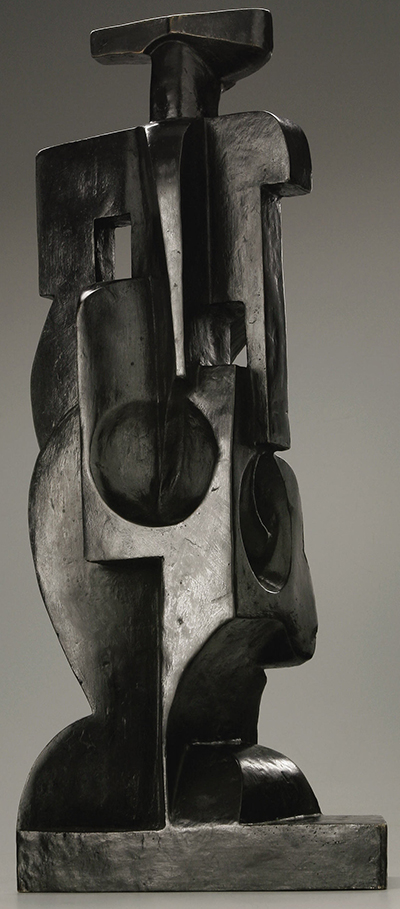
The existing reproduction on this page shows a dark standing figure with a broad hat and a guitar-like curved form. Without a secure photograph-to-lot binding, that reproduction should not acquire the auction lot’s dimensions, inscription or provenance by assumption. The bronze is discussed here as a distinct attribution and casting question, rather than silently presented as the Philadelphia plaster in another material.
This caution does not prevent close looking. The long central edge, offset shoulders and curved openings create a sequence of interruptions in the upright figure. Highlights pick out projecting planes while deep shadows obscure others. A single photograph fixes those relationships at one viewpoint; the physical object would disclose changing alignments as a viewer moved around it.
Looking between painting and sculpture
A productive way to approach Gris’s sculpture is to look first for support, then for recognition. Ask how the figure stands, where its weight seems concentrated, and which shapes connect the upper and lower parts. Only afterwards identify a hat, a hand or an instrument. This order makes the structure visible before familiar names settle the image too quickly.
Then compare the actual material with the effect of its surface. Painted plaster combines colour with modelled mass. Painted metal brings thin planes into three-dimensional relationships. The dark bronze reproduction makes reflections and openings especially prominent. These differences matter even when the figures share a title.
Gris’s sculptures reward this patient movement between things seen and things constructed. They extend questions present in his paintings while making balance, thickness and surrounding space unavoidable. Their interest lies in those particular encounters, supported by the distinct histories of the objects that survive, rather than in a dramatic claim about an undisputed number of masterpieces.
Works discussed on this page
Selected works discussed in the article. Different objects retain separate records; source links are in References.
| Name | Date | Medium |
|---|---|---|
| Harlequin — Philadelphia | 1917 | Painted plaster |
| Arlequin — Paris | Approximately 1923 | Painted sheet metal |
| Arlequín — Madrid | 1923 | Cut and painted metal |
| Harlequin — Heritage auction attribution | Catalogued circa 1917–18; casting date unestablished | Bronze |
Frequently Asked Questions
Yes. Museum records document a 1917 painted plaster Harlequin and later painted metal figures. These should be distinguished from the separately catalogued bronze auction attribution.
No. The Philadelphia work is painted plaster. The bronze discussed in the auction record is a separate object, and this page does not transfer one object’s particulars to the other.
Discussion
Consider how the documented words and objects change your understanding of the artist.
Reader Insights
Which source most changes the way you look at the works?
Which distinction between objects or speakers is most useful?
What would you like to compare next?
Join the Conversation
Share a detail, comparison or question about Juan Gris Sculptures below.
References
- Philadelphia Museum of Art. Juan Gris, Harlequin, 1917, object 53920. Collection commentary on construction, colour and Lipchitz’s assistance; accessed 5 November 2026. View source.
- Centre Pompidou. Juan Gris, Arlequin, approximately 1923, AM 1984-534. Material, collection history and object record; accessed 5 November 2026. View source.
- Museo Nacional Centro de Arte Reina Sofía. Juan Gris, Arlequín, 1923, DO01944. Cut and painted metal; Colección ICO deposit. Collection record; accessed 5 November 2026. View source.
- Heritage Auctions. Juan Gris, Harlequin, circa 1917–18, auction 638, lot 24082, 9 November 2006. Auction attribution and catalogue statements, not an independently established casting history or a demonstrated match to the inherited photograph. View source.
- Metropolitan Museum of Art. Juan Gris, Harlequin with a Guitar, 1917, 2008.468. Collection commentary on the theatrical subject; accessed 5 November 2026. View source.