


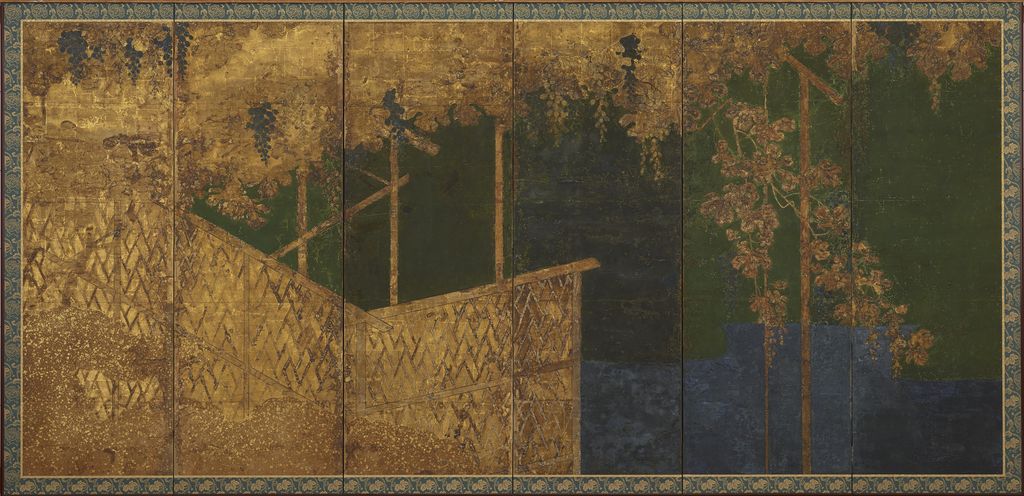
Kanō Eitoku, Fruiting Grapevines on a Bamboo Trellis, six-panel screen. National Museum of Asian Art, F1904.353. Smithsonian, CC0.
 by Tom Gurney
Tom Gurney BSc (Hons) is an art history expert with over 20 years experience
Published on September 25, 2026 / Updated on September 25, 2026
Email: tomgurney1@gmail.com / Phone: +44 7429 011000
A biography made from commissions and losses
Kanō Eitoku (狩野永徳, 1543–1590) lived during a rapid change in who could command paintings and where they were seen. The Kano family had supplied professional painters to the Ashikaga shoguns; its artists later served the leading military figures of the late sixteenth century. Eitoku's name is attached to a transition from the comparatively intimate screen, fan and temple programme to immense painted castle and palace interiors. The largest of those commissions have not survived. A biography must therefore work with dated documents, surviving objects, institutional accounts and the family workshop's later history rather than pretending that the artist left a complete visual diary. [1] [2]
At a glance
- ArtistKanō Eitoku (狩野永徳)
- Life1543–1590
- FamilyGrandson of Motonobu; son of Shōei
- Major patronsAshikaga world, Nobunaga and Hideyoshi
- Key issueMany architectural commissions have not survived
The years 1543 and 1590 are consistently given in the checked museum records. His grandfather was Kanō Motonobu, whose generation enlarged the school's clientele and developed a studio capable of delivering many kinds of painting. His father, Kanō Shōei, was also a painter. Kyoto National Museum's account of the school stresses that its success depended on both artistic training and an organised body of makers. This context helps explain Eitoku's later position: the large interiors for which he became famous could not plausibly have been completed by a lone painter moving from panel to panel without assistants, suppliers and family colleagues. Nor does participation in a group programme prove that Eitoku painted every surviving mark. [3] [1]
Contents
- A biography made from commissions and losses
- Kyoto screens and a disputed patron
- A father and son at Jukō-in
- The Azuchi commission and its vanished interior
- After Nobunaga: another patron, more vanished rooms
- The last year and the court commission dispute
- A chronology of objects and commissions
- A workshop that outlived its leader
- Books on Japanese Art
The University of Tsukuba's art-history chronology reports an early appearance before the shogun Ashikaga Yoshiteru in 1552, accompanied by Motonobu, and points to the diary Gon Tsugu kyōki. The original diary entry has not been checked for this manuscript, so the incident is best understood as a reported early documentary anchor, not a scene whose gestures or dialogue we can reconstruct. It does show the sort of courtly and military connections into which the boy was trained. Motonobu died in 1559. By the following decade, the family's younger painter had become visible through works on a far larger public stage. [4] [3]
Kyoto screens and a disputed patron
The Uesugi version of Scenes in and Around Kyoto is a central work of Eitoku's early career. Kyoto National Museum dates the pair to 1565 and describes a remarkable 2,485 figures. The screens move through the capital at a scale that can register a building, a procession and ordinary street activity within one painted world. The Uesugi Museum identifies Eitoku as the artist and preserves the traditional account of the screens reaching Uesugi Kenshin as a gift from Oda Nobunaga in 1574. The current ownership history matters, but a gift nine years after Kyoto's stated work date does not, by itself, explain who first ordered the picture. [5] [6]
Several Japanese scholars have argued that the shogun Ashikaga Yoshiteru was the original patron. Shimokawa Masahiro proposes a commission around late 1563 or 1564 in the context of Yoshiteru's effort to draw Kenshin toward Kyoto and strengthen his political position. Tokyo National Museum has described this as a research position with considerable support. Kyoto National Museum's more recent exhibition dossier calls Yoshiteru the presumed commissioner, not a person established by a surviving contract. Shimokawa himself warns that an earlier date remains possible and that Yoshiteru's role is an inference. The most defensible life story thus says the screens may have originated in the Ashikaga political world and were later presented by Nobunaga; it does not collapse both events into “Nobunaga ordered them in 1574.” [7] [8] [5]
This question changes how one reads Eitoku's beginnings. A commission from Yoshiteru would place a sophisticated pictorial and political project before the painter's work for Nobunaga's castle. It would also link his training within an Ashikaga-serving family to his own large Kyoto panorama. But the picture contains buildings, seasons and figures whose identification is itself debated. Kyoto's dossier, for example, describes a visitor approaching a shogunal residence as Kenshin according to one interpretation. That does not permit a confident sentence saying the figure is a portrait of Kenshin or that a specific meeting depicted on the screen took place. [5] [7]
A father and son at Jukō-in
Around the mid-1560s, Eitoku and Shōei worked on paintings for Jukō-in, a subtemple of Daitoku-ji in Kyoto. The surviving programme matters because it places the younger painter inside both a family collaboration and a Zen temple setting, rather than only in the later castles of warlords. Kyoto National Museum opened its 2007 Eitoku exhibition with the Jukō-in ink-painted sliding doors. The reviewer, Nakabe Yoshitaka, found a direct, energetic response to the viewer in them and then described a gallery of fan paintings that showed continuity with the older Kano tradition. An exhibition sequence is a curator's interpretation, not a dated diary, but it makes clear that Eitoku's career cannot be told as a simple leap from childhood apprenticeship to gold-ground splendour. [9] [4]
The precise division of hands between father, son and other studio members needs care. A temple room could commission an ensemble, and an ensemble could outlast the artist while being remounted or moved. The University of Tsukuba chronology dates father-and-son Jukō-in work to 1566; Osaka City Museum's 2025 exhibition list credits four Birds and Flowers door panels to Eitoku. Those records establish an important object and a plausible chronological anchor. They do not establish that every remaining panel from the original building is an autograph by the younger painter. The distinction matters most on an illustrated page, where an attractive detail can otherwise acquire a misleading single-artist caption. [4] [10]
A Kyoto National Museum loans list identifies the Jukō-in National Treasure as a 38-panel room-painting ensemble; an eight-panel selection from its Birds and Flowers and Four Accomplishments subjects was scheduled for display in a later exhibition. Those figures describe the registered ensemble and a display selection, not 38 paintings newly verified as the individual work of Eitoku. The difference is useful when reconstructing his early career. A few panels may be discussed closely as attributed objects; the whole temple interior also shows the scale of work possible within a family workshop. The 2007 curatorial account starts with Jukō-in ink paintings, while the registered subjects include birds, flowers and cultivated accomplishments. That range places the young painter in an established Kano repertoire before the famous castle commissions. [26] [9]
The Azuchi commission and its vanished interior
In 1576, building began at Nobunaga's Azuchi Castle. The National Institutes for Cultural Heritage says the Kano family group led by Eitoku worked on its painted interior. This was not a commission for one framed picture: the paintings would have occupied architectural surfaces within a political residence. The project helps explain why Eitoku's name became associated with large-scale arrangements of figures, animals and nature. It also shows the practical importance of the studio. Kyoto National Museum reports that Eitoku left his younger brother Sōshū in charge of the Kano headquarters in Kyoto while he worked at Azuchi. Delegation was part of the painter's professional life, not merely an invisible footnote to his style. [11] [12]
The castle's physical ambition helps explain the size of the opportunity, while also setting a limit on reconstruction. In a checked chapter of Japan's Castles, Oleg Benesch and Ran Zwigenberg give 1579 for completion of Azuchi's great keep and discuss contemporary reports of unusually rich colour and gilding. Their subject is the building and its later historical interpretation, rather than a catalogue of paintings securely identified as Eitoku's hand. A brightly coloured exterior described by a visitor cannot tell us the composition of a vanished interior door. The useful connection is more specific: Nobunaga's residence brought political display, architecture and a Kano workshop into one project, and its loss forces us to distinguish written description from surviving art. [27] [11]
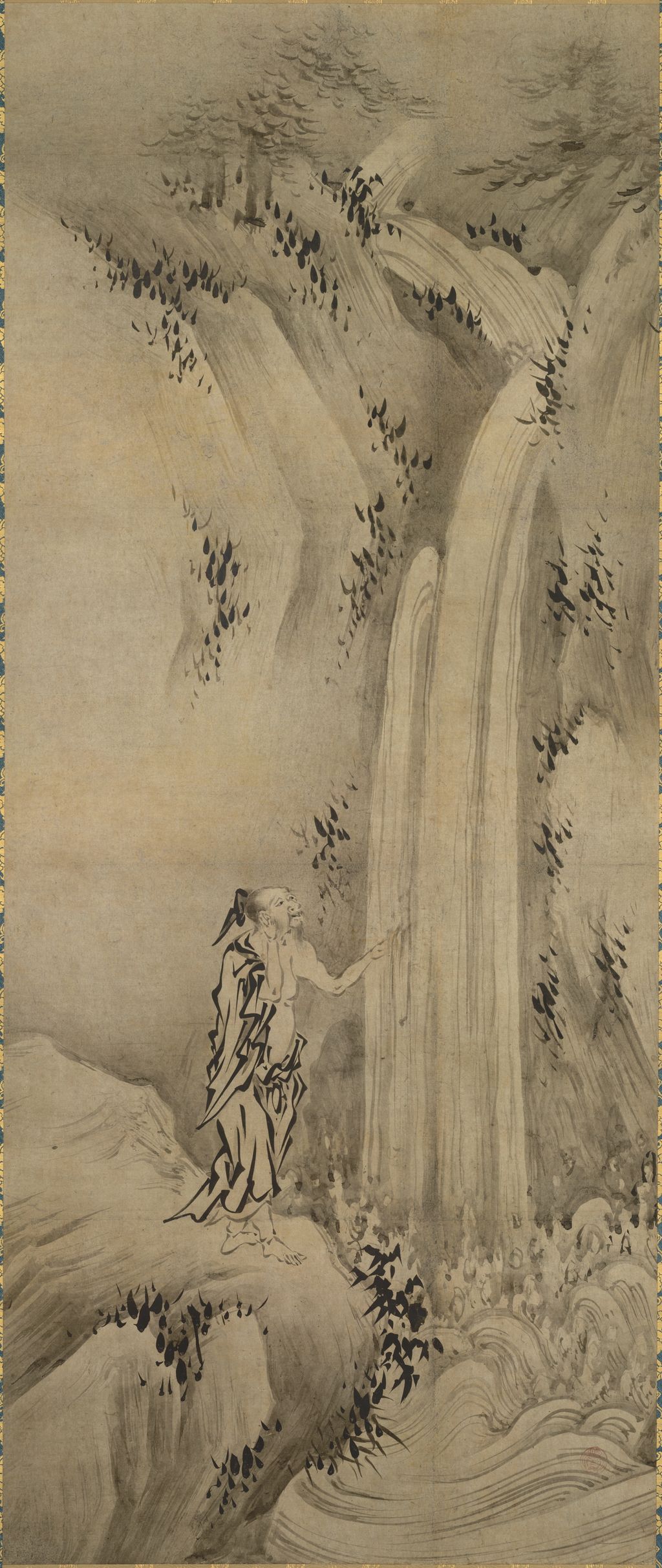
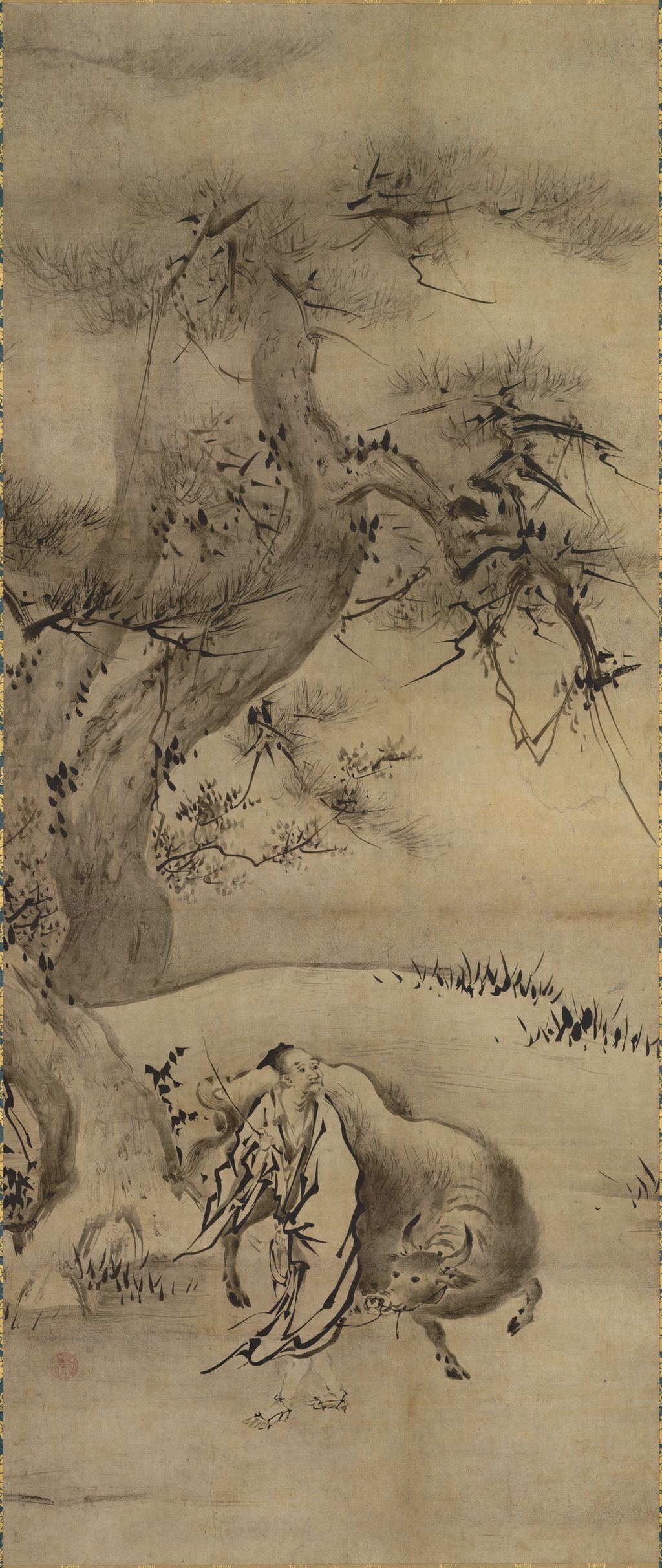
Azuchi's painted spaces were lost when the castle burned in 1582. One fragment of their history survives in description: the Shinchō kōki names a Xuyou and Chaofu subject in the castle. Tokyo National Museum owns a surviving Eitoku painting of the same Chinese recluses, now two hanging scrolls. The National Institutes' account explicitly says the Azuchi picture was lost. The museum painting is therefore a useful comparison for subject and brushwork, not the actual castle panel. The surviving work itself has changed form: Eitoku's great-grandson Tsunenobu copied it in 1694 when it was still a pair of two-panel screens, and it became the present scrolls later. A biographical account of “Eitoku's hanging scrolls at Azuchi” would merge two different histories into a false one. [11] [13]
After Nobunaga: another patron, more vanished rooms
Nobunaga's death in 1582 did not end the Kano workshop's demand. Eitoku was engaged by Toyotomi Hideyoshi, whose own castle and palace projects required extensive interior decoration. Kyoto National Museum lists Azuchi, Jurakudai and Osaka among the major settings in its current retrospective material. Most of the original paintings have disappeared along with the buildings or later interventions. This makes the surviving screens valuable, but also places a limit on their evidence. Chinese Lions might have served an imposing architectural or portable setting, according to Tokyo National Museum, yet one cannot place the surviving Eitoku screen in a named room of Osaka Castle without a provenance argument. [5] [14]
Hideyoshi's support also shaped the workshop through people. Kyoto National Museum says Sanraku, born outside the Kano family, entered Eitoku's training at Hideyoshi's recommendation. A painter attached to a major patron could thus become part of a family-run studio and later lead a related line. It is tempting to imagine the master accepting a pupil on a particular day or assigning him a specific motif, but no checked source gives such a scene. What can be documented is the relationship among patron, teacher and later successor. [12]
The Met/Yale catalogue The Tale of Genji: A Japanese Classic Illuminated gives the patronage story a wider subject range. Kyoko Kinoshita's chapter reports seventeenth-century records of a pair of Genji screens accompanying the 1574 gift to Kenshin. Their present location is unknown. The same chapter discusses surviving Genji paintings attributed to Eitoku and his studio that may once have formed part of the Hachijō prince's residence. “Attributed” and “may” are essential here: the surviving doors are not automatically the missing gift screens, and their suggested residence is not an indisputable room inventory. The catalogue follows a traditional account in which Eitoku made the Kyoto panorama for Nobunaga; the Japanese Yoshiteru-commission research noted above shows why this earlier patronage should remain open. [15] [7]
That Genji material also expands the image of a painter supposedly limited to warlike force. The Tale of Genji was a classical court narrative long associated with other painters, especially the Tosa tradition. A Kano studio asked to make Genji for a military gift or an elite residence had to handle that literary language at the dimensions of screens and walls. Kinoshita reads Eitoku's participation as evidence that the leading painter of the day crossed subject boundaries to meet prestigious patronage. It is a biographical fact about his professional reach as much as a matter of style. [15]
The last year and the court commission dispute
By 1590, another ambitious painter, Hasegawa Tōhaku, had become a serious challenger to Kano dominance. Kyoto National Museum describes the two as major figures whose work met in the same late-Momoyama field. A dispute over paintings for an imperial residence is associated with a diary kept by the courtier Kajuji Harutoyo. Academic discussions report that the Kano group sought to prevent Tōhaku from receiving a portion of the commission. That is evidence of competition between working studios for a prestigious job; it does not give direct access to Eitoku's emotions, prove every later tale of an enduring personal feud, or show Tōhaku becoming sole master of court painting after Eitoku died. [16] [17] [18]
A chronology of objects and commissions
The dates mark different kinds of evidence: a museum date for a surviving object, a reported temple programme, the start and loss of a building, and the painter’s death. They do not place Eitoku at each site on an exact day. [5] [4] [11] [19]
Kyoto screens
1565 · museum date for the Uesugi pairJukō-in work
1566 · reported father-and-son programmeAzuchi begins
1576 · building and studio commissionAzuchi lost
1582 · castle fire; paintings did not surviveLast year
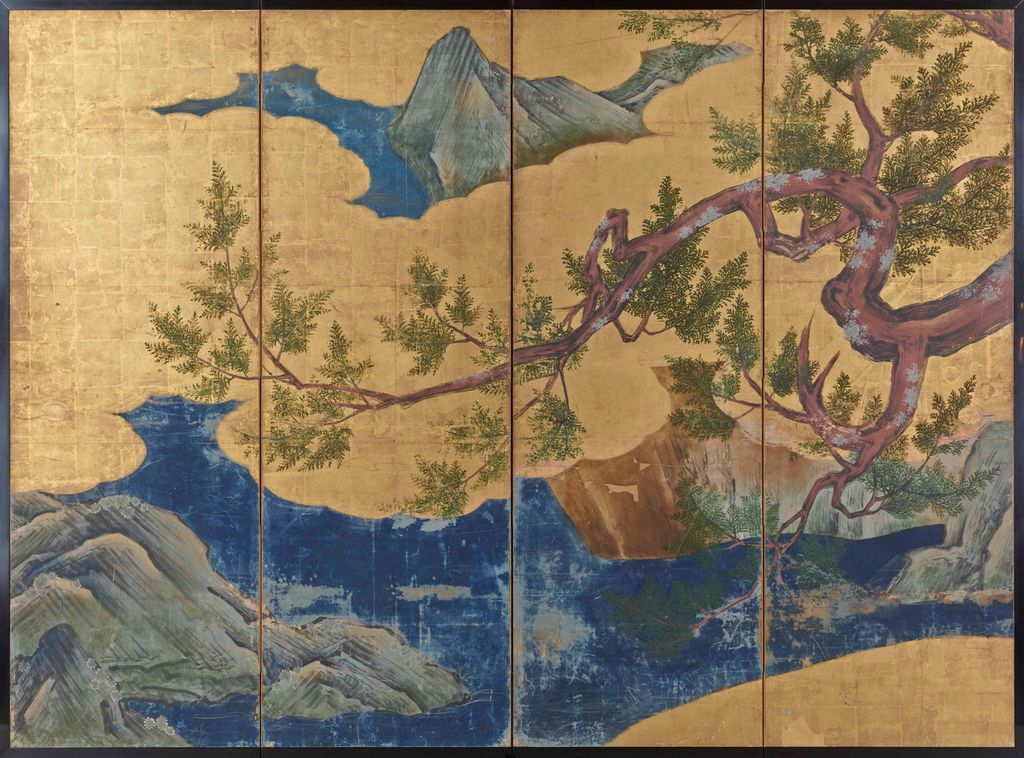
1590 · Cypress Trees; Eitoku diesEitoku's late Cypress Trees is directly credited to him by Tokyo National Museum and was likely made for the Hachijō palace. Traces of door pulls show an original life as sliding doors; the restored object is now two four-panel screens. Conservation also found a mica paulownia pattern on the back that matched paper associated with the residence. This is material evidence for the proposed setting, though it does not map each former door to a particular room. The building was completed in December 1590, while Eitoku died in September. The artwork can have been prepared for the residence even if its maker did not see the completed palace. [19] [20]
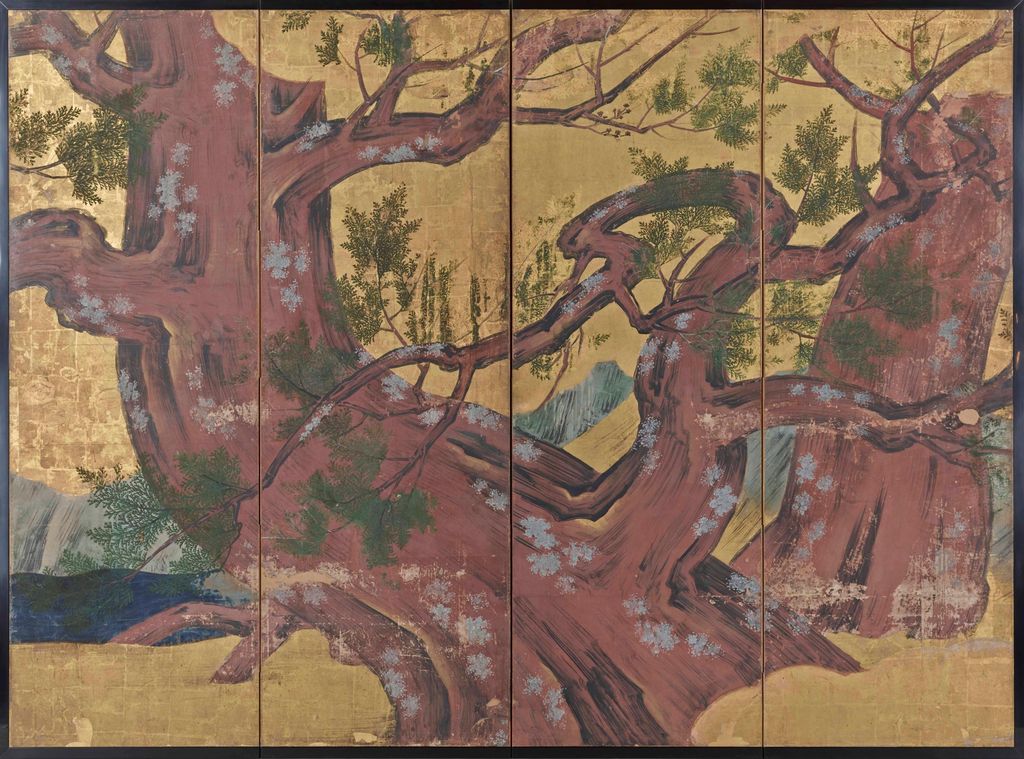
The circumstances of Eitoku's death are frequently told as an overwork story. Some accounts join an illness to a ceiling painting at Tōfuku-ji, but published accounts disagree about when he became ill. Kinoshita's museum chapter says Sanraku completed the dragon-ceiling project after his teacher died; it does not establish that work as Eitoku's cause of death. The surviving evidence supports a heavily commissioned workshop and a successor finishing a project, but not a dramatic final collapse at the scaffold. [15] [21]
A workshop that outlived its leader
Kyoto National Museum identifies the eldest son Mitsunobu as the immediate leader after Eitoku's death. Mitsunobu continued large projects while developing a more delicate approach that the museum connects to yamato-e. Sōshū had already served as a trusted deputy; the second son Takanobu later supported the group and trained painters important to its Edo future. Sanraku maintained a strong Kyoto line. These roles were not interchangeable, and a later screen made by any one of them should be named for its own artist. The family's response to Eitoku's death explains both the endurance of the Kano name and the risk of assigning its whole output to one celebrated ancestor. [12] [22]
The transition crossed several political changes. Mitsunobu, the eldest son, had to keep a successful practice under the Toyotomi while adapting the older large manner to subjects and patrons who wanted greater elegance. Kyoto National Museum singles out his Tale of Genji work as part of that response. Sōshū was not an inexperienced substitute suddenly promoted in 1590; he had already managed the Kyoto workshop during Azuchi. Sanraku's connection to Hideyoshi and his later Kyoto base made another branch possible. Takanobu's work for the court and his role in training a younger generation show why workshop continuity was not dependent on one heir alone. Those careers are the reason the phrase “the Kano school after Eitoku” covers several different artistic and institutional answers to his death. [12]
The later Tokugawa age was not a straightforward copy of his favourite compositions. Kyoto's successor exhibition describes a movement from Eitoku's bold scale toward different forms of splendour and then toward the more restrained taste of Tokugawa rulers. One of Eitoku's brothers, Naganobu, entered the new shogunate's service, while Sanraku remained associated with Kyoto. A still later painter, Tan'yū, belonged to Takanobu's line and became central to the Edo Kano organisation. This branching family history belongs in a biography because Eitoku's historical reputation was preserved and changed by people who continued to work under the Kano name. It also warns against a family tree drawn as though all later artists simply descended through one unbroken father-to-son mastership. [12]
Mitsunobu's Birds and Flowers of the Four Seasons makes that succession visible as an attribution problem. Kyoto National Museum records a “Shūshin” seal, a mark also used by Eitoku, on this pair of screens. Its curators nevertheless assign the work to Mitsunobu on stylistic grounds and describe it as a characteristic example of his late-Momoyama gold-ground painting. A biography that ends in 1590 would miss why this matters. A famous father's mark, a family visual language and a son's own manner can coexist on an object; none alone licenses a simple autograph claim. The record also gives the pair a precise museum identity, A甲2017. It can therefore be compared with Eitoku's directly catalogued screens without silently extending his career after death or turning the son's work into an anonymous workshop leftover. [28]
The later life of the objects gives the biography one final complication. Tsunenobu, a great-grandson, copied Xuyou and Chaofu in 1694 and later added a companion to the Chinese Lions screen. The surviving objects therefore carry the decisions of descendants as well as Eitoku's own work. Other paintings have had their attributions revised by museums. The Metropolitan Museum of Art now describes some once-famous “Eitoku” works as Kano-school or later-family paintings. Such changes are not a loss of the artist's importance; they show the evidence being sharpened. His securely credited Cypress Trees, scrolls and screens, together with documented lost commissions, already suffice to explain why his name remains central to the story of late-sixteenth-century Japanese painting. [13] [23] [24]
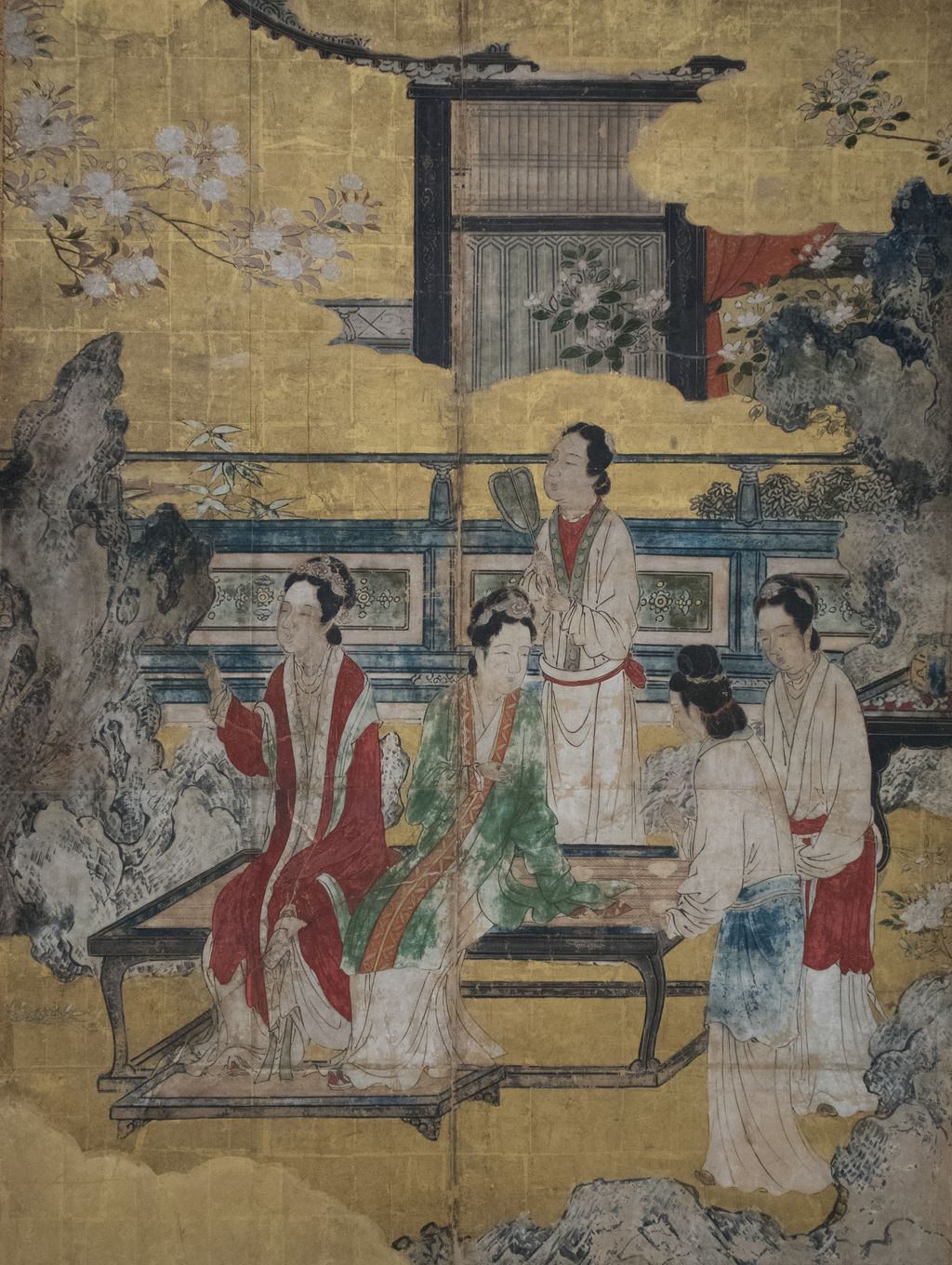
The Met's Chinese Women in a Palace Garden shows the point in one object. Its present record begins “Formerly attributed to Kanō Eitoku,” then argues that the meticulous draperies and rocks suit a Kano painter who may have worked close to Mitsunobu. The two surviving panels were themselves remounted from a larger screen as a hanging scroll. The qualification is essential: this work illustrates changing attribution, rather than adding another masterpiece to Eitoku's secure catalogue. [25]
Frequently Asked Questions
He grew up within the Kano family of painters: Shōei was his father and Motonobu his grandfather. Kyoto National Museum credits his early formation to that family environment. The surviving account does not reduce learning to one private lesson or identify every senior studio member who instructed him. [3]
No. The National Institutes describes a Kano family group led by Eitoku working on Azuchi's decoration. Kyoto National Museum says his brother Sōshū oversaw the Kyoto headquarters during the commission. The castle interior was lost; individual assignments should not be invented for every vanished wall. [11] [12]
Tokyo National Museum calls it a work of his final phase and links it to a residence completed in 1590. That is strong evidence for a late work, not proof that no other project was under way or completed later in his lifetime. [19]
No. Mitsunobu, Takanobu, Sōshū, Sanraku and later artists continued the workshop and adapted its work to new patrons. The succession is a major part of Eitoku's legacy, though it should not make their paintings into autographs by him. [12]
Discussion
Compare the surviving paintings with the dated evidence for Eitoku’s life and workshop.
Reader Insights
Which evidence concerns the 1574 gift of the Uesugi screens, and which concerns their earlier commission?
What can a written Azuchi description establish when its painted walls no longer survive?
Which later painter is named as a son, brother or disciple, and why does the relationship matter?
Join the Conversation
Share a documented example or reliable source below, keeping observation separate from inference.
References
- The Metropolitan Museum of Art, “The Kano School of Painting”.
- Kyoto National Museum, curatorial review of the 2007 Eitoku exhibition.
- Kyoto National Museum, press dossier for The Great Kano School, pp. 3–4, issued before the planned 2027 exhibition.
- University of Tsukuba art-history chronology, Eitoku; reported diary and 1566 work not checked against original text.
- Kyoto National Museum, The Great Kano School press dossier, p. 4, Uesugi screen date, 2,485 figures, proposed patron.
- Yonezawa City Uesugi Museum, Uesugi Scenes in and Around Kyoto.
- Shimokawa Masahiro, “『上杉本洛中洛外図屏風』の注文時期とその動機に関するノート”, 駒沢女子大学研究紀要 22 (2015), 69–84; full paper checked.
- Tokyo National Museum, note comparing Kyoto screens.
- Kyoto National Museum, Jukō-in and the 2007 exhibition.
- Osaka City Museum of Fine Arts, 2025 exhibition work list, Jukō-in Birds and Flowers panels.
- National Institutes for Cultural Heritage, Xuyou and Chaofu object essay, textual research only, not a production-image licence.
- Kyoto National Museum, Eitoku's Legacy exhibition.
- ColBase, Xuyou and Chaofu, A-10598, source for production files.
- Tokyo National Museum, exhibition description of Chinese Lions.
- Kyoko Kinoshita, “Evolving Iconographies,” in The Tale of Genji: A Japanese Classic Illuminated (Metropolitan Museum of Art/Yale University Press, 2019), p. 63; checked in complete publication.
- Kyoto National Museum, “Eitoku and Tōhaku” exhibition.
- Kyoei College academic article on Tōhaku's art, citing the Harutoyo-kō ki diary; diary original still to check.
- National Diet Library name authority, Kajuji Harutoyo.
- Tokyo National Museum, Cypress Trees, A-1069.
- Tokyo National Research Institute for Cultural Properties, Cypress Trees restoration.
- JapanKnowledge, Sanraku encyclopaedia excerpt, reports a date for Eitoku illness that should not be flattened with other accounts.
- The Metropolitan Museum of Art, Amusements at Kitano Shrine, studio of Takanobu, family/workshop context.
- Museum of the Imperial Collections, Chinese Lions, exact screen attributions.
- The Metropolitan Museum of Art, Appreciation of Painting, Kano-school painting in an Eitoku-related manner, not credited to his hand.
- The Metropolitan Museum of Art, Chinese Women in a Palace Garden, 29.100.495g,h, current “formerly attributed” label and object history; Met object API provides public-domain image and separate attribution-prefix field.
- Kyoto National Museum, loans list for Jukō-in room paintings, registered 38-panel National Treasure ensemble and an eight-panel exhibition selection.
- Oleg Benesch and Ran Zwigenberg, “Castles and the Transition to the Imperial State,” in Japan's Castles: Citadels of Modernity in War and Peace (Cambridge University Press, 2019), chapter 1, pp. 17–60; the open chapter's Azuchi passage was checked for architectural context, not object attribution.
- Kyoto National Museum, Mitsunobu's Birds and Flowers of the Four Seasons, A甲2017, catalogue discussion of the “Shūshin” seal and stylistic attribution.